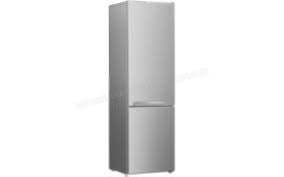
USER MANUAL RCNA305K20S BEKO
Frost Free Refrigerator-Freezer type I
Frost Free Refrigerator-Freezer type I
Freezer-refrigerator type I
In order to ensure a normal operation of your refrigerating appliance, which uses a completely environmentally friendly refrigerant the R600a (flammable only under certain conditions) you must observe the following rules:
- Do not hinder the free circulation of the air around the appliance.
- Do not use mechanical devices in order to accelerate the defrosting, others than the ones recommended by the manufacturer.
- Do not destroy the refrigerating circuit.
- Do not use electric appliances inside the food keeping compartment, other than those that might have been recommended by the manufacturer.
In order to ensure a normal operation of your refrigerator, which uses the cooling agent R600a, absolutely harmless for the environment (it ignites only under certain conditions), you must
observe the following rules:
Do not create obstacles for the free circulation of air around the refrigerator. Do not use mechanical devices or instruments for accelerating the defrosting of the refrigerator, except those recommended by the manufacturer. Do not allow damage to the cooling circuit. Do not install inside the refrigerating compartment, where products are stored, any electric devices, except those recommended by the manufacturer.
ATTENTION
In order to ensure a normal operation of your refrigerator, which uses the cooling agent R600a, completely harmless for the environment (it ignites only under certain conditions), you must follow the following rules.
Do not create obstacles for the free circulation of air around the refrigerator. Do not use any mechanical devices or instruments for accelerating the defrosting of the refrigerator, except those recommended by the manufacturer. Do not allow damage to the cooling circuit. Do not install inside the refrigerating compartment, where products are stored, any electric devices, except those recommended by the manufacturer.
ATTENTION!
Electrical requirements /2
Transportation instructions /2
Installation instructions /2
Getting to know your appliance /3
Suggested arrangement of food in the appliance /3
Temperature control and adjustment /4
Before operating /4
Storing frozen food /4
Freezing fresh food /4
Making ice cubes /4
Defrosting /5
Replacing the interior light bulb /5
Cleaning and care /5
Repositioning the door /6
Do's and don'ts /6
Energy Consumption /7
Information concerning the noises /8
Troubleshooting /8

Before first use! /9
Connecting to the power supply /10
Instructions for transportation /10
Instructions for installation /10
Short description of the device /11
Recommendations for placing products in the
refrigerator /11
Temperature control and regulation /11
Switching off /12
Storage of frozen products /12
Warranty for our products /12
Connecting the cubes /12
Dispensing /13
Replacing the interior lighting bulb /13
Cleaning /13
Limits of use /14
Tests and their results /14
Information about working conditions /15
Energy consumption /16
Troubleshooting /16

Contents
Safety first /18
Electrical requirements /19
Recommended way to place products
Refrigerators /20
Figures that take place in this instruction manual are schematic and may not correspond exactly with your product. If the subject parts are not included in the product you have purchased, then it is valid for other models.
The illustrations in this instruction manual are schematic and may not correspond exactly with your model. If some parts are not included in the kit of the model you have purchased, they are intended for other models.
The illustrations in this instruction manual are schematic and may not correspond to your model. Some components that are not included in the composition of the product you have purchased are used in other models.
Congratulations on your choice of a BEKO Quality Appliance, designed to give you many years of service.
Safety first!
Do not connect your appliance to the electricity supply until all packing and transit protectors have been removed.
- Leave to stand for at least 4 hours before switching on, to allow compressor oil to settle, if transported horizontally.
- If you are discarding an old appliance with a lock or latch fitted to the door, ensure that it is left in a safe condition to prevent the entrapment of children.
- This appliance must only be used for its intended purpose.
- Do not dispose of the appliance on a fire. Your appliance contains non CFC substances in the insulation which are flammable. We suggest you contact your local authority for information on disposal and available facilities.
- We do not recommend use of this appliance in an unheated, cold room. (e.g. garage, conservatory, annex, shed, out-house etc.)
To obtain the best possible performance and trouble free operation from your appliance it is very important to read these instructions carefully. Failure to observe these instructions may invalidate your right to free service during the guarantee period.
Please keep these instructions in a safe place for easy reference.
Original Spare parts will be provided for 10 years, following the product purchasing date.
This appliance is not intended for use by persons with reduced physical, sensory or mental capabilities, or lack of experience and knowledge, unless they have been given supervision or instruction concerning use of the appliance by a person responsible for their safety.
Children should be supervised to ensure that they do not play with the appliance.
Electrical requirements
Before inserting the plug into the wall socket, make sure that the voltage and the frequency shown on the rating plate inside the appliance correspond to your electricity supply.
We recommend that this appliance is connected to the mains supply via a suitably switched and fused socket in a readily accessible position.
Warning! This appliance must be earthed.
Repairs to electrical equipment should only be performed by a qualified technician. Incorrect repairs carried out by an unqualified person carry risks that may have critical consequences for the user of the appliance.
ATTENTION!
This appliance operates with R600a, which is an environmentally friendly but flammable gas. During transportation and fixing of the product, care must be taken not to damage the cooling system. If the cooling system is damaged and there is a gas leakage from the system, keep the product away from open flame sources and ventilate the room for a while.
WARNING - Do not use mechanical devices or other means to accelerate the defrosting process, other than those recommended by the manufacturer.
WARNING - Do not damage the refrigerant circuit.
WARNING - Do not use electrical appliances inside the food storage compartments of the appliance, unless they are of the type recommended by the manufacturer.
WARNING - If the supply cord is damaged, it must be replaced by the manufacturer, its service agent or similarly qualified persons in order to avoid a hazard.
Transportation instructions
- The appliance should be transported only in an upright position. The packing as supplied must be intact during transportation.
- If during transport the appliance has been positioned horizontally, it must not be operated for at least 4 hours, to allow the system to settle.
- Failure to comply with the above instructions could result in damage to the appliance, for which the manufacturer will not be held liable.
- The appliance must be protected against rain, moisture and other atmospheric influences.
Important!
- Care must be taken while cleaning/carrying the appliance not to touch the bottom of the condenser metal wires at the back of the appliance, as this could cause injury to fingers and hands.
- Do not attempt to sit or stand on top of your appliance as it is not designed for such use. You could injure yourself or damage the appliance.
- Make sure that the mains cable is not caught under the appliance during and after moving, as this could damage the cable.
- Do not allow children to play with the appliance or tamper with the controls.
Installation instructions
- Do not keep your appliance in a room where the temperature is likely to fall below -15 degrees C (5 degrees F) at night and/or especially in winter.
- Do not place the appliance near cookers or radiators or in direct sunlight, as this will cause extra strain on the appliance's functions. If installed next to a source of heat or freezer, maintain the following minimum side clearances:
From Cookers 30 mm
From Radiators 300 mm
From Freezers 25 mm
- Make sure that sufficient room is provided around the appliance to ensure free air circulation (Item 2).
- Put the back airing lid to the back of your refrigerator to set the distance between the refrigerator and the wall (Item 3).
- The appliance should be positioned on a smooth surface. The two front feet can be adjusted as required. To ensure that your appliance is standing upright, adjust the two front feet by turning clockwise or anti-clockwise until firm contact is secured with the floor. Correct adjustment of feet prevents excessive vibration and noise (Item 4).
- Refer to the "Cleaning and Care" section to prepare your appliance for use.
Getting to know your appliance (Item 1)
1 - Setting knob and interior light 2 - Fresh Food fan 3 - Adjustable Cabinet shelves 4 - Crisper cover 5 - Crisper 6 - Compartment for quickly freezing 7 - Ice tray support & ice tray 8 - Compartments for frozen foods keeping 9 - Adjustable foot 10 - Shelf for jars 11 - Shelf for bottles 12 - Freezer fan
The fans have the purpose to provide the circulation of the air in the compartment. They are connected in parallel with the motor-compressor. When the motor-compressor is off, the fans will also be off.
Suggested arrangement of food in the appliance
Guidelines for obtaining optimum storage and hygiene:
- The fridge compartment is for the short-term storage of fresh food and drinks.
- The freezer compartment is rated and suitable for the freezing and storage of pre-frozen food.
The recommendation for **** storage as stated on the food packaging should be observed at all times.
- Dairy products should be stored in the special compartment provided in the door liner.
- Cooked dishes should be stored in airtight containers.
- Fresh wrapped produce can be kept on the shelf. Fresh fruit and vegetables should be cleaned and stored in the crispers.
- Bottles can be kept in the door section.
- To store raw meat, wrap in polythene bags and place on the lowest shelf. Do not allow to come into contact with cooked food, to avoid contamination. For safety, only store raw meat for two to three days.
- For maximum efficiency, the removable shelves should not be covered with paper or other materials to allow free circulation of cool air.
- Do not keep vegetable oil on door shelves. Keep the food packed, wrapped or covered. Allow hot food and beverages to cool before refrigerating. Leftover canned food should not be stored in the can.
- Fizzy drinks should not be frozen and products such as flavoured water ices should not be consumed too cold.
- Some fruit and vegetables suffer damage if kept at temperatures near 0°C. Therefore wrap pineapples, melons, cucumbers, tomatoes and similar produce in polythene bags.
- High-proof alcohol must be stored upright in tightly closed containers. Never store products that contain an inflammable propellant gas (e.g. cream dispensers, spray cans, etc.) or explosive substances. These are an explosion hazard.
- To take out the baskets from the freezer compartment please proceed as in item 11.
Temperature control and adjustment
Operating temperatures are controlled by the setting knob (Item 5) located on the ceiling of fridge compartment. Settings may be made from min, 1 ... 4, 4 being the coldest position.
When the appliance is switched on for the first time, the setting knob should be adjusted so that after 24 hours, the average fridge temperature is no higher than +5°C (+41°F). We recommend you set the knob on 1 position between the min and 4 setting and monitor to obtain the desired temperature i.e. towards max you will obtain a colder fridge temperature and vice versa. Some sections of the fridge may be cooler or warmer (such as the salad crisper and the top part of the cabinet) which is quite normal.
We recommend that you check the temperature with an accurate thermometer to ensure that the storage compartments are kept to the desired temperature.
Remember you must take your reading very quickly since the thermometer temperature will rise very rapidly after you remove it from the freezer.
Please remember each time the door is opened cold air escapes and the internal temperature rises. Therefore never leave the door open and ensure it is closed immediately after food is put in or removed.
Before operating
Final Check
Before you start using the appliance, check that:
- The feet have been adjusted for perfect levelling.
- The interior is dry and air can circulate freely at the rear.
- The interior is clean as recommended under "Cleaning and care."
- The plug has been inserted into the wall socket and the electricity is switched on. When the door is open, the interior light will come on.
And note that:
- You will hear a noise as the compressor starts up. The liquid and gases sealed within the refrigeration system may also make some noise, whether the compressor is running or not. This is quite normal.
- Slight undulation of the top of the cabinet is quite normal due to the manufacturing process used; it is not a defect.
- We recommend setting the knob midway and monitoring the temperature to ensure the appliance maintains desired storage temperatures (See section Temperature Control and Adjustment).
- Do not load the appliance immediately it is switched on. Wait until the correct storage temperature has been reached. We recommend checking the temperature with an accurate thermometer (see Temperature Control and Adjustment).
Storing frozen food
Your freezer is suitable for the long-term storage of commercially frozen foods and also can be used to freeze and store fresh food.
If there is a power failure, do not open the door. Frozen food should not be affected if the failure lasts for less than 16 hrs. If the failure is longer, then the food should be checked and either eaten immediately or cooked and then re-frozen.
Freezing fresh food
Please observe the following instructions to obtain the best results.
Do not freeze too large a quantity at any one time. The quality of the food is best preserved when it is frozen right through to the core as quickly as possible.
Do not exceed the freezing capacity of your appliance in 24 hours.
Placing warm food into the freezer compartment causes the refrigeration machine to operate continuously until the food is frozen solid. This can temporarily lead to excessive cooling of the refrigeration compartment.
When freezing fresh food, to reach the best freezing capacity, put the setting knob to maximum position 24 hours before placing it. After freezing, the knob can be set to the initial position. Small quantities of food up to 1/2 kg (1 lb) can be frozen without adjusting the temperature control knob.
Take special care not to mix already frozen food and fresh food.
Making ice cubes
Fill the ice-cube tray 3/4 full with water and place it in the freezer. Loosen frozen trays with a spoon handle or a similar implement; never use sharp-edged objects such as knives or forks.
Defrosting
A) Fridge compartment
The fridge compartment defrosts automatically. The defrost water runs to the drain tube via a collection container at the back of the appliance. Check that the tube is permanently placed with its end in the collecting tray on the compressor to prevent the water spilling on the electric installation or on the floor (Item 6).
B) Freezer compartment
The NO FROST type defrost is completely automatic. No intervention from your side is required. The water is collected on the compressor tray. Due to the heat of the compressor, the water is evaporated.
Do not use pointed or sharp-edged objects, such as knives or forks, to remove the frost.
Never use hairdryers, electrical heaters or other such electrical appliances for defrosting. Sponge out the defrost water collected in the bottom of the freezer compartment. After defrosting, dry the interior thoroughly (Item 7 & 8). Insert the plug into the wall socket and switch on the electricity supply.
Warnings!
The fans inside the freezer and fresh food compartments circulate cold air. Never insert any object through the guard. Do not allow children to play with the fresh food and freezer fan.
Never store products that contain inflammable propellant gas (eg dispensers, spray cans etc.) or explosive substances.
- Don't cover the shelves with any protective materials, which may obstruct air circulation.
- Do not allow children to play with the appliance or tamper with the controls.
Do not obstruct the fan guards to ensure that you obtain the best possible performance from your appliance. (Item 9 and Item 10)
Warning!
Your appliance is fitted with a circulating fan which is essential for the performance of the refrigerator. Please ensure the fans are not blocked (stopped) or impaired by food or packaging. Blocking (stopping) or impairing the fan can result in an increase of the internal freezer temperature (Thawing).
Replacing the interior light bulb
To change the Bulb/LED used for illumination of your refrigerator, call your
Authorised Service.
The lamp(s) used in this appliance is not suitable for household room illumination. The intended purpose of this lamp is to assist the user to place foodstuffs in the refrigerator/freezer in a safe and comfortable way.
The lamps used in this appliance have to withstand extreme physical conditions such as temperatures below -20°C.
Cleaning and care
- We recommend that you switch off the appliance at the socket outlet and pull out the mains plug before cleaning.
- Never use any sharp instruments or abrasive substances, soap, household cleaner, detergent or wax polish for cleaning.
- Use lukewarm water to clean the cabinet of the appliance and wipe it dry.
- Use a damp cloth wrung out in a solution of one teaspoon of bicarbonate of soda to one pint of water to clean the interior and wipe it dry.
- Make sure that no water enters the temperature control box.
- If the appliance is not going to be used for a long period of time, switch it off, remove all food, clean it and leave the door ajar.
- We recommend that you polish the metal parts of the product (i.e. door exterior, cabinet sides) with a silicone wax (car polish) to protect the high quality paint finish.
- Any dust that gathers on the condenser, which is located at the back of the appliance, should be removed once a year with a vacuum cleaner.
- Check door seals regularly to ensure they are clean and free from food particles.
- Never:
- Clean the appliance with unsuitable material; eg petroleum based products.
- Subject it to high temperatures in any way,
- Scour, rub etc., with abrasive material.
- Removal of dairy cover and door tray :
- To remove the dairy cover, first lift the cover up by about an inch and pull it off from the side where there is an opening on the cover.
- To remove a door tray, remove all the contents and then simply push the door tray upwards from the base.
- Make sure that the special plastic container at the back of the appliance which collects defrost water is clean at all times. If you want to remove the tray to clean it, follow the instructions below:
- Switch off at the socket outlet and pull out the mains plug.
- Gently uncrimp the stud on the compressor, using a pair of pliers, so that the tray can be removed.
- Lift it up.
- Clean and wipe it dry.
- Reassemble, reversing the sequence and operations.
- To remove a drawer, pull it as far as possible, tilt it upwards and then pull it out completely.
Repositioning the door.
Proceed in numerical order (Item 12).
Do's and don'ts.
Do- Clean your appliance regularly. Do- Keep raw meat and poultry below cooked food and dairy products. Do- Take off any unusable leaves on vegetables and wipe off any soil. Do- Leave lettuce, cabbage, parsley and cauliflower on the stem. Do- Wrap cheese firstly in greaseproof paper and then in a polythene bag, excluding as much air as possible. For best results, take out of the fridge compartment an hour before eating. Do- Wrap raw meat and poultry loosely in polythene or aluminium foil. This prevents drying. Do- Wrap fish and offal in polythene bags. Do- Wrap food with a strong odour or which may dry out, in polythene bags, or aluminium foil or place in airtight container. Do- Wrap bread well to keep it fresh. Do- Chill white wines, beer, lager and mineral water before serving. Do- Check contents of the freezer every so often. Do- Keep food for as short a time as possible and adhere to "Best Before" and "Use by" etc. dates. Do- Store commercially frozen food in accordance with the instructions given on the packets. Do- Always choose high quality fresh food and be sure it is thoroughly clean before you freeze it. Do- Prepare fresh food for freezing in small portions to ensure rapid freezing. Do- Wrap all food in aluminium foil or freezer quality polythene bags and make sure any air is excluded. Do- Wrap frozen food immediately after purchasing and put it in to the freezer as soon as possible.
Don't store bananas in your fridge compartment. Don't store melon in your fridge. It can be chilled for short periods as long as it is wrapped to prevent it flavoring other food. Don't cover the shelves with any protective materials which may obstruct air circulation. Don't store poisonous or any dangerous substances in your appliance. It has been designed for the storage of edible foodstuffs only. Don't consume food which has been refrigerated for an excessive length of time. Don't store cooked and fresh food together in the same container. They should be packaged and stored separately. Don't let defrosting food or food juices drip onto food. Don't leave the door open for long periods, as this will make the appliance more costly to run and cause excessive ice formation. Don't use sharp edged objects such as knives or forks to remove the ice. Don't put hot food into the appliance. Let it cool down first. Don't put liquid-filled bottles or sealed cans containing carbonated liquids into the freezer, as they may burst. Don't exceed the maximum freezing loads when freezing fresh food. Don't give children ice-cream and water ices direct from the freezer. The low temperature may cause 'freeze burns' on lips. Don't freeze fizzy drinks. Don't try to keep frozen food which has thawed; it should be eaten within 24 hours or cooked and refrozen. Don't remove items from the freezer with wet hands.
Energy Consumption
Maximum frozen food storage volume is achieved without using the middle and upper drawer provided in the freezer compartment. Energy consumption of your appliance is declared while the freezer compartment is fully loaded without using the middle and upper drawer.
Practical advice concerning the reduction of the electricity consumption.
- Make sure that the appliance is located in well-ventilated areas, far from any source of heat (cooker, radiator etc.). At the same time, the location of the appliance must be done in such a way that it prevents it to be under the direct incidence of the sunbeams.
- Make sure that the food purchased in refrigerated/frozen condition is placed into the appliance as soon as possible, especially during summertime. It is recommended to use thermal insulated bags to transport the food home.
- We recommend the thawing of the packets taken out from the freezer compartment be done in the refrigerator compartment. For this purpose, the packet which is going to be thawed will be placed in a vessel so that the water resulting from the thawing does not leak in the refrigerator compartment. We recommend you to start the thawing at least 24 hours before the use of the frozen food.
- We recommend reducing the number of door openings to the minimum.
- Do not keep the door of the appliance open more than necessary and make sure that after each opening the door is well closed.
- The operation noise can increase during the operation.
- In order to keep the temperatures at the adjusted temperatures, the compressor of the appliance starts periodically. The noise produced by the compressor becomes stronger when it starts and a click can be heard when it stops.
- The performance and operation features of the appliance can change according to the modifications of the temperature of the ambient environment. They must be considered as normal.
- Noises like liquids flowing or as being sprayed
- These noises are caused by the flow of the refrigerant in the circuit of the appliance and comply with the operation principle of the appliance.
- Noise similar to wind blowing.
- It is generated by the fan (fans) with which your appliance is endowed. These fans help to the efficient cooling of the appliance. This noise is normal, not a defect.
- Other vibrations and noises.
- The level of noise and vibrations can be caused by the type and the aspect of the floor on which the appliance is placed. Make sure that the floor does not have significant level distortions or if it can yield to the weight of the appliance (it is flexible).
- Another source of noise and vibrations is represented by the objects placed on the appliance. These objects must be removed from the appliance
- The bottles and the vessels placed in the refrigerator touching each other. In such cases move the bottles and the vessels so that there is a small distance between them.
Troubleshooting
If the appliance does not operate when switched on, check;
- That the plug is inserted properly in the socket and that the power supply is on. (To check the power supply to the socket, plug in another appliance)
- Whether the fuse has blown/circuit breaker has tripped/main distribution switch has been turned off.
- That the temperature control has been set correctly.
- That the new plug is wired correctly, if you have changed the fitted, moulded plug.
If the appliance is still not operating at all after above checks, contact the dealer from whom you purchased the unit.
Please ensure that above checks have been done, as a charge will be made if no fault is found.

The symbol on the product or on packaging indicates that this product may not be treated as household waste. Instead it shall be handed over to the applicable collection point for the recycling of electrical and electronic equipment. By ensuring this product is disposed of correctly, you will help prevent potential negative consequences for the environment and human health, which could otherwise be caused by inappropriate waste handling of this product. For more detailed information about recycling of this product, please contact your local city office, your household waste disposal service or the shop where you purchased the product.
Thank you for choosing a high-quality BEKO product, designed to serve you for many years.
Safety first!
Do not connect the appliance to the electricity supply without removing the packaging and protective transport fasteners.
Also pay attention to the following:
- You may hear a sound, because the compressor may operate. The gas and refrigerant, hermetically sealed in the cooling system, may also create a sound, regardless of whether the compressor is running or not. This is normal.
- Slight unevenness of the surface of the door, caused by the manufacturing process, is normal; it is not a defect.
- We recommend setting the knob to the middle position and monitoring the temperature to ensure the required storage temperature (see section "Temperature control and adjustment").
- Do not load the refrigerator immediately after switching it on. Wait until the required storage temperature is reached. We recommend checking the temperature with a thermometer (see section "Temperature control and adjustment").
Storage of frozen products
The freezer compartment is intended for long-term storage of products placed in the frozen state, as well as for freezing and storing fresh products.
If the power supply is disconnected, do not open the door. Disconnecting the power supply for 16 hours or less will not affect frozen products. If the disconnection lasts longer, the products should be checked and, if necessary, consumed or refrozen.
Freezing of fresh products
For best results, follow the instructions below. Do not freeze too many products at once. The quality of products is best if they are frozen quickly. Do not exceed the maximum freezing capacity of the freezer.
Placing warm products in the freezer causes the cooling unit to operate continuously until they are completely frozen. This may lead to temporary overcooling of the cooling compartment. When freezing products to achieve maximum freezing capacity, set the thermostat knob to the maximum position "24 h" before placing the products in the compartment. After freezing is complete, the knob can be returned to the original position. Products in small quantities (up to 0.5 kg) can be frozen without adjusting the thermostat knob. Pay special attention to the fact that already frozen and fresh products cannot be mixed.
Freezing of ice cubes
Fill the ice cube tray with water up to 3/4 and place it in the freezer. Remove the frozen cubes using the tray handle or similar tools; never use sharp objects such as knives or screwdrivers.
Defrosting
A) Refrigerator compartment
The refrigerator compartment defrosts automatically. The water flows through a drain tube to the collection container at the back of the appliance.
Make sure that the end of the tube is always directed to the collection container on the compressor, to prevent water from dripping onto electrical equipment or the floor (item 6).
B) Freezer compartment
Defrosting of the No Frost type is completely automatic. It does not require any intervention from your side. Water collects in the tray on the compressor. Thanks to the heat from the compressor, the water evaporates.
Do not use sharp objects to remove frost or ice.
Never use heaters, electric heaters or other electrical appliances for defrosting.
Wipe the frost and ice that has accumulated on the lower part of the freezer compartment. After defrosting, carefully dry the inside (items 7 and 8). Insert the plug into the socket and switch on the appliance.
Warning!
Ventilators in the freezer and in the refrigerator for storing dairy products ensure air circulation. Never insert objects into the appliance. Do not allow children to play with the ventilators in the freezer and in the refrigerator for storing dairy products. Never store containers in the refrigerator that emit flammable gas (for example, aerosols, aerosol cans, etc.), as they may explode.
Do not block the appliance with any materials that could obstruct air circulation.
Do not allow children to play with the appliance or touch the control elements.
Do not block the ventilator grille to ensure optimal product storage performance. (pos. 9 and pos. 10)
Warning!
The appliance is equipped with a fan for air circulation, which is necessary for its normal operation. Make sure that the fan is not blocked (clogged) with products or packaging.
Remove the protective film
from the door (item 12).
Do not do the following:
Tips for regulating the temperature in the refrigerator. Tips: store meat and poultry in prepared dishes. Tips: discard wilted leafy vegetables and wipe off dirt. Tips: pour out sauces, cabbage, and cauliflower on stems. Tips: wrap food in cling film and then in a plastic bag to prevent air access. It is best to remove products from the refrigerator an hour before consumption. Tips: wrap meat and poultry tightly in foil or aluminum foil. This prevents them from drying out. Tips: store fruits and vegetables in plastic bags. Tips: wrap products with a strong smell or those that may dry out in plastic bags, aluminum foil, or place in airtight containers. Tips: it is better to wrap bread so that it stays fresh. Tips: before use, cool cooked dishes, beer, lager beer, and mineral water. Tips: from time to time, check the contents of the freezer compartment. Tips: store products for a shorter time and follow the "best before" dates and "use by" terms indicated on the labels. Tips: store products that are sold frozen according to the instructions on the packaging. Tips: to choose high-quality fresh products, check them before freezing. Tips: divide fresh products into small portions to ensure quick freezing. Tips: wrap all products in aluminum foil or plastic bags for freezing and make sure they are airtight. Tips: immediately wrap products that have been purchased frozen and as soon as possible place them in the freezer compartment.
Do not store bananas in the refrigerator.
Do not store eggs in the refrigerator. You can cool them for a short time in a closed container so that they do not impart odor to other products.
Do not use sodium chloride with any materials that may damage the appliance.
Do not store poisons or any hazardous substances in the refrigerator. It is intended for storing fresh food products.
Do not use the refrigerator if it has been stored in a cold place for a long time.
Do not store cooked and fresh food together in the same container. They should be covered and stored separately.
Do not allow drips from defrosting products or their juice to fall on other products.
Do not leave the door open for a long time, as this will cause inefficient operation of the refrigerator and lead to excessive ice formation.
Do not use sharp objects such as knives or forks to remove ice cubes.
Do not place hot products in the refrigerator. First, let them cool down.
Do not place in the freezer compartment bottles that are not tightly sealed or cans with carbonated drinks, as they may burst.
Do not exceed the maximum load capacity of the freezer when freezing fresh products.
Do not give children ice cream and water directly from the refrigerator. The low temperature may cause frostbite on the lips.
Do not freeze carbonated drinks.
Do not attempt to refreeze thawed frozen products. They should be consumed within 24 hours or cooked immediately.
Do not touch products from the freezer compartment with wet hands.
- The refrigerator's noise level may vary.
To set the temperature at the desired level, the compressor periodically switches on. When the compressor is running, a slight clicking sound may be heard.
- The operating characteristics of the device may change depending on changes in the ambient temperature. This is normal.
- Noise, similar to wind noise.
- Such noises are caused by fans installed in the refrigerator (one or several), which are necessary to increase the efficiency of cooling. These are normal noises that are not a sign of malfunction.
- Other vibrations and noises.
- The level of noise and vibration depends on the type and quality of the floor on which the appliance is installed. The floor must be sufficiently level and support the weight of the appliance.
The source of noise can also be objects that are on the appliance. Such objects should be removed from the appliance.
- Noise can also occur when the shelves or dishes placed on them vibrate. In such cases, it is enough to slightly move the shelves or dishes.
Energy saving
To make the most of the freezer compartment space for storing products, it is recommended to remove the central and upper drawers from it. The data on energy consumption of the refrigerator are given for conditions when the central and upper drawers are removed and the freezer compartment is fully loaded.
Practical recommendations for reducing energy consumption
- Household electrical appliances should be installed in well-ventilated places, away from heat sources such as kitchen stoves, radiators, etc. Also, avoid places where direct sunlight falls.
- Place frozen products in the cold or freezer compartment immediately after purchase, especially in summer. For transporting products from the store to home, it is recommended to use a thermal bag. 3. Products taken out of the freezer should be placed in the refrigerator to thaw. To avoid contamination of the refrigerator, frozen products should be placed in a container where water can drain during thawing. It is recommended to thaw products gradually, for example, a day before use.
- It is recommended to keep the doors closed as much as possible.
- Do not leave the doors open longer than necessary and make sure they are fully closed.
Troubleshooting
If the refrigerator does not work when switched on, check the following:
- Check that the plug is correctly inserted into the socket and that it is working (for verification, plug another appliance into the same socket). - Check that the circuit breaker or fuse has not tripped/blown the main switch. - Check that the temperature regulator is set correctly. - Check that the new plug, if you replaced the molded plug, is correctly wired. If after the above checks the refrigerator still does not work, contact the service center where you purchased the appliance. We recommend that you have the above checks carried out, as if no faults are found, you will have to pay for the service call.
The symbol on the product or its packaging indicates that this appliance cannot be treated as household waste. Instead, it should be taken to the appropriate collection point for recycling electrical and electronic equipment. By ensuring proper disposal of this appliance, you will help prevent potential negative consequences for the environment and human health, which could otherwise be caused by inappropriate waste handling. For more detailed information about recycling this product, please contact your local municipal office, your household waste disposal service, or the shop where you purchased the appliance.
Manufacturer: 'S.C. Arctic S.A.', Gaesti, str.13 Decembrie N210, Romania
Official representative in Ukraine: LLC "Beko Ukraine", address: 01021, Kyiv, Klovsky Uzviz, 5. Tel/Fax: 0-800-500-4-3-2
Service life: 10 years
Please also pay attention to the following:
- When the compressor switches off, a hissing sound may be heard. The liquid and gases inside the cooling system may also create noise, regardless of whether the compressor is running. This is quite normal.
- Some unevenness on the top surface of the cabinet is not a defect - it is a feature of the manufacturing process.
- We recommend setting the thermostat knob to the middle position and monitoring that the refrigerator maintains the required storage temperature parameters (see section "Temperature Control and Adjustment").
- Do not load the products immediately after switching on the appliance. Wait until the required storage temperature is reached. For checking the temperature, it is recommended to use a precise thermometer (see section "Temperature control and adjustment").
Storage of frozen products
The freezer compartment is intended for long-term storage of products frozen under industrial conditions, as well as for freezing and storing fresh products.
In case of power supply interruptions, do not open the door. Frozen products should not spoil if the electricity is absent for less than 16 hours. If the power outage lasts longer, the products must be checked and either used immediately or cooked and then refrozen.
Freezing fresh products
To achieve the best results, follow the instructions below. Do not freeze large quantities of products at the same time. The quality of products is best preserved if they freeze completely in the shortest possible time.
Do not exceed the daily freezing capacity of the appliance.