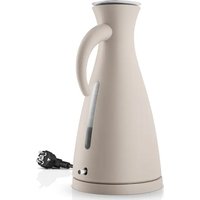
Electric kettle 1.5 l - Other kitchen appliances Eva Solo - Free user manual and instructions
Find the device manual for free Electric kettle 1.5 l Eva Solo in PDF.


User questions about Electric kettle 1.5 l Eva Solo
0 question about this device. Answer the ones you know or ask your own.
Ask a new question about this device
Download the instructions for your Other kitchen appliances in PDF format for free! Find your manual Electric kettle 1.5 l - Eva Solo and take your electronic device back in hand. On this page are published all the documents necessary for the use of your device. Electric kettle 1.5 l by Eva Solo.
USER MANUAL Electric kettle 1.5 l Eva Solo
Instructions for Use
Brugsvejledning
Bruksanvisning
Bruksanvisning
Käyttöohje
Gebruikshandleiding
Gebrauchsanweiung
Mode d'emploi
natural_image
White ceramic kettle with handle and black handle, no visible text or symbols on the device itselfElectric kettle 1.5 l
Read the instructions carefully before using the electric kettle for the first time, and retain for later use.
IMPORTANT
- Before plugging in the electric kettle, it is important to check that the voltage in the socket corresponds to the voltage stated on the bottom of the kettle (220-240 V). The kettle is only to be used with the stand provided (e).
- This electric kettle is designed for ordinary domestic use only.
- Only use the kettle to boil/heat water.
- Only use the electric kettle on a dry, flat and firm surface.
- Never allow the cord to hang down from the worktop when the kettle is being used. Use the manual cord winder in the power base to reduce the length of the cord.
- This appliance can be used by children aged from 8 years and above if they have been given supervision or instruction concerning use of the appliance in a safe way and if they understand the hazards involved. Cleaning and user maintenance shall not be made by children unless they are older than 8 and supervised. Keep the appliance and its cord out of reach of children aged less than 8 years.
- Always remove the plug from the socket after use.
- Caution: During and after use, do not touch the electric kettle's metal surfaces as they become hot and can cause burns and scalding. Always hold the kettle by its handle. Always keep the kettle upright so that it does not spill boiling water. Do not touch the base, the kettle or the cord with wet hands.
-
The base, the kettle and the cord must never be allowed to come into contact with hot surfaces, for example cooker hobs.
-
Do not fill the electric kettle with water when it is sitting on the power base.
- Never switch on the electric kettle when it is empty.
- If the electric kettle is accidentally switched on when empty, the thermal cut-off automatically disconnects the power. If this happens, allow the kettle to cool for 10 minutes before filling with water.
- Caution: If the kettle is overfilled, boiling water may be ejected. Do not fill above the max. indicator, otherwise the water can boil over and cause scalding.
- Avoid contact with the steam as it can cause scalding.
- Do not open or unscrew the lid when the water is boiling.
- Check the base, the kettle and the power cord regularly for any damage/defects.
- If the electric kettle appears to be defective in any way, return it to the shop where it was purchased to be repaired. Incorrect or unqualified repairs may cause accidents and/or injury.
- If the supply cord is damaged, it must be replaced by the manufacturer, its service agent or similarly qualified persons in order to avoid a hazard.
- If the electric kettle is not working properly, try descaling it (see section on descaling).
- The instructions for cordless kettles shall state that the kettle is only to be used with the stand provided.
- This appliance is intended to be used in household and similar applications such as:
– staff kitchen areas in shops, offices and other working environments; - farm houses;
-
by clients in hotels, motels and other residential type environments;
– bed and breakfast type environments. -
This appliance can be used by persons with reduced physical, sensory or mental capabilities or lack of experience and knowledge if they have been given supervision or instruction concerning use of the appliance in a safe way and understand the hazards involved.
- Children shall not play with the appliance.
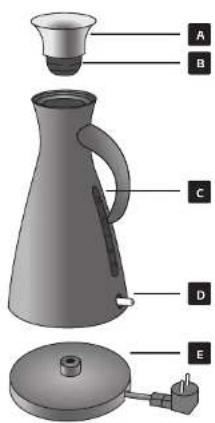
text_image
Diagram of a kettle with labeled parts including a conical flask, handle, and electrical plugDescription
Before using the electric kettle for the first time, fill it up twice with water to the max. level and bring to the boil. Empty the kettle after boiling each time.
natural_image
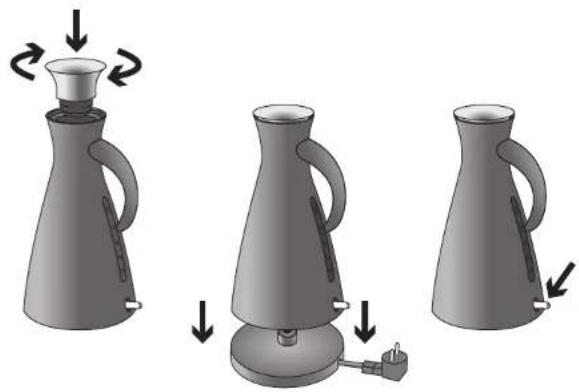
Three-step illustration of a kettle being placed on top, showing step-by-step folding and adjustment (no text or symbols)Using the electric kettle
- Place the power base and the kettle on a firm surface, and lift the kettle from the base.
- Fill the electric kettle with water through the lid. Check the max. indicator on the external water level indicator below the handle.
- Place the electric kettle on the dry power base and plug in.
- Press the On/Off switch (d) and the LED comes on (avoid opening or unscrewing the lid while the electric kettle is switched on).
- Once the water starts to boil, the kettle switches off automatically. The kettle can be switched off at any time by pressing the On/Off switch (d).
- Remove the plug from the socket when the kettle is not in use. Always pull the plug rather than the cord.
Automatic thermal cut-off
The kettle switches off automatically
- once the water has boiled
- if there is no water in the kettle (for example if the kettle is accidentally switched on).
If the lid is not in place, the automatic thermal cut-off function is delayed.
Cleaning
- Always remove the plug from the socket and allow the electric kettle to cool down before cleaning.
- Never clean the kettle under running water or immersed in water. None of the kettle parts are dishwasher-safe. Use a damp cloth to clean the outside of the kettle. Use washing-up liquid sparingly. Do not use steel wool or abrasive cleaning agents. Do not use solvents such as alcohol, benzine or benzene.
- Afterwards, always wipe the kettle with a dry, soft cloth or kitchen roll.
- The removable lid with the filter can be cleaned using a soft brush, not a metal brush.
Descaling
To prolong the life of the electric kettle, descale it regularly. The kettle should be emptied completely after use. This reduces the build-up of limescale.
- Boil 0.8 litres of water in the kettle.
- Important: Switch off the kettle and add 0.4 litres of household vinegar (4-5% acid). Do not boil the water and vinegar solution as it may boil over and cause scalding.
- Leave the solution in the kettle for a couple of hours.
-
Empty the electric kettle and rinse thoroughly with clean water. Fill the kettle with clean water and boil.
-
Empty the kettle and rinse again with clean water.
- Repeat the procedure if the kettle still contains limescale.
- Other descaling agents intended for descaling kettles may be used, but it is important to follow the instructions carefully.
- The limescale filter can be left to soak in diluted vinegar to remove any limescale deposits.
- Rinse the kettle thoroughly after descaling.
- Do not use sharp implements when descaling/cleaning the kettle.
Disposal
This appliance is labelled in accordance with the European Waste Electrical and Electronic Equipment Directive (WEEE) 2012/19/EC. The legislation requires that electric and electronic products are collected and that parts of the products are recycled. Electric and electronic goods carrying the WEEE label must be taken to a municipal recycling centre.
Electrical and electronic equipment (EEE) contains materials, components and substances which may be hazardous to human health and the environment if the WEEE waste is not disposed of correctly.
Electrical and electronic products carry the crossed-out wheelie bin label below. The crossed-out wheelie bin symbolises that waste electrical and electronic equipment must not be disposed of in the household waste stream, but must be collected separately. For this purpose, municipalities have established collection
schemes where waste electrical and electronic equipment may be taken free of charge by citizens to household waste recycling centres or approved authorised treatment facilities (AATFs) – or collected directly from households. For more information, contact your local authority's environment and planning department.
Users of electrical and electronic equipment must not dispose of waste electrical and electronic equipment with their normal household refuse. They must use the local authority collection schemes to reduce the impact on the environment from the disposal of waste electrical and electronic equipment.

Technical data
Voltage: 220-240 V \~ 50/60 Hz
Wattage: 2000-2400 W
Capacity: 1.5 l
Certification: GS, CE
Complaints
Right of complaint in accordance with applicable legislation. No right of complaint in the case of damage caused by insufficient descaling, using the kettle in any way other than for its intended use, incorrect handling, normal wear, inadequate or incorrect maintenance or incorrect repairs as well as tampering with the kettle by unauthorised persons.
Remember to retain the receipt/invoice as it must be produced in the event of a complaint. Contact the shop where the product was purchased.
Eva Solo A/S
Errors and omissions excepted.
eva solo
Electric kettle 1.5 l
Item no.
502920, 502921
220-240V - 50-60Hz
2000-2400 W
Eve Solo A/S
Masice Tekkenby 18-20


text_image
Diagram of a kettle with labeled parts including a conical flask, handle, base, and electrical plug.Beskrivelse
A) Låg
B) Filter
C) Vandstandsmåler
D) On/Off-knap/LED-lys
E) Strømbase
Maksimal kapacitet: 1,5 liter vand
natural_image
Three-step illustration of a kettle being heated by a lamp, showing the process from top to bottom (no text or symbols)Kom godt i gang
text_image
Diagram of a kettle with labeled parts including a handle, spout, and power plugBeskrivning
A) Lock
B) Filter
C) Vattennivåmätare
D) Strömbrytare/lysdiodlampa
E) Strömbasplatta
Maximal kapacitet:
1,5 liter vatten
natural_image
Three-step illustration of a kettle being placed on top, showing step-by-step folding and adjustment (no text or symbols)Att komma igång
text_image
Diagram of a kettle with labeled parts including a conical flask, handle, base, and power plug.Beskrivelse
A) Lokk
B) Filter
C) Vannivåmåler
D) On/Off-knapp/LED-lys
E) Strømbase
Maksimal kapasitet: 1,5 liter vann
natural_image
Three-step illustration of a kettle being placed on top, showing step-by-step folding and adjustment (no text or symbols)Kom godt i gang
natural_image
Three-step illustration of a kettle being heated by a power outlet, showing step-by-step cooling and heating (no text or symbols)Helppokäyttöinen
natural_image
Three-step illustration of a kettle being heated by a power outlet, showing step-by-step cooling and heating (no text or symbols)Ga goed van start
natural_image
Three-step diagram showing a kettle being opened, with arrows indicating process flow (no text or symbols)text_image
Diagram of a kettle with labeled parts including a conical flask, bulb, and power plugDescription
natural_image
Three-step illustration of a kettle being heated by a power outlet, showing step-by-step cooling and heating (no text or symbols)Pour bien commencer
Certifications : GS, CE.
Réclamation
text_image
Diagram of a kettle with labeled parts including a conical flask, bulb, and plugDescripción
natural_image
Three-step illustration of a kettle being heated by a power outlet, showing the process from top to bottom (no text or symbols)Uso del hervidor
text_image
Diagram of a kettle with labeled parts A through E, showing internal structure and base components.Opis
natural_image
Three-step illustration of a kettle being opened, showing step-by-step folding and mounting (no text or symbols)natural_image
Three-step illustration of a kettle being heated by a power outlet, showing step-by-step cooling and heating (no text or symbols)natural_image
Three-step illustration of a kettle being placed on top, showing step-by-step folding and adjustment (no text or symbols)text_image
Diagram of a kettle with labeled parts including a conical flask, bulb, and electrical plugОписание
natural_image
Three-step illustration of a kettle being heated by a power outlet, showing step-by-step cooling and heating (no text or symbols)text_image
Diagram of a kettle with labeled parts including a conical flask, handle, base, and electrical plug.Opis
A) Pokrov
B) Filter
C) Oznaka za višino vode
D) Stikalo za vklop in izklop/LED
E) Podstavek za napajanje
Največja dovoljena količina vode: 1,5 litra
natural_image
Three-step illustration of a kettle being heated by a power plug, showing the process from top to bottom (no text or symbols)text_image
Diagram of a kettle with labeled parts including a conical flask, handle, base, and electrical plug.Popis
A) Víko
B) Filtr