
PM600 - Polisher SCHEPPACH - Free user manual and instructions
Find the device manual for free PM600 SCHEPPACH in PDF.


| Brand | Scheppach |
| Model | PM600 |
| Product Type | Polisher |
| Power Consumption | 600 W |
| Mains Voltage | 230 V~ / 50 Hz |
| Speed | 1200 - 5000 min⁻¹ |
| Polishing Pad Diameter | 125 mm |
| Connection Thread | M14 |
| Weight | 2.1 kg |
| Protection Class | II |
| Sound Pressure Level (LpA) | 80 dB(A) |
| Sound Power Level (LWA) | 91 dB(A) |
| Vibration Emission Value (ah) | 6.09 m/s² |
| Main Functions | Polishing, buffing, waxing of vehicle paints |
| Speed Adjustment | Electronic, by dial (from 1200 to 5000 rpm) |
| Spindle Lock | Yes, for accessory change |
| Additional Handle | Yes, screwable left or right |
| Power Supply | Mains, with power cable |
| Maintenance and Cleaning | Clean with soft brush or vacuum; lubricate moving parts; do not use chemicals |
| Safety | Automatic shut-off in case of overload; protection against unintentional starts; wear PPE (goggles, hearing protection) |
| Wear Parts | Brushes, polishing attachments, polishing pads |
| Intended Use | Polishing of paints on cars, boats, caravans; not for commercial use |
| Delivery Contents | Polisher, additional handle, polishing pad, polishing bonnet, instruction manual |
Frequently Asked Questions - PM600 SCHEPPACH
User questions about PM600 SCHEPPACH
0 question about this device. Answer the ones you know or ask your own.
Ask a new question about this device
Download the instructions for your Polisher in PDF format for free! Find your manual PM600 - SCHEPPACH and take your electronic device back in hand. On this page are published all the documents necessary for the use of your device. PM600 by SCHEPPACH.
USER MANUAL PM600 SCHEPPACH
natural_image
Exterior view of a Schappach electric power tool with mesh base (no text or symbols on the tool itself)PM600
| DE | Polier- und SchleifmaschineOriginalbetriebsanleitung | 3-9 |
| GB | Polishing and sanding machineTranslation of Original Operating Manual | 10-16 |
| FR | Aff uteuse et machine a polirTraduction de la notice originale | 17-24 |
| CZ | Leštička a bruskaPřeklad originálního návodu k obsluze | 25-31 |
Günzburger Straße 69
D-89335 Ichenhausen
VEREHRTER KUNDE,
Explanation of the symbols on the equipment
 | GB | Warning! Danger to life, risk of injury or damage to the tool are possible by ignoring!. |
 | GB | Caution - Read the operating instructions to reduce the risk of inquiry |
 | GB | Wear safety goggles! |
 | GB | Wear ear-muffs! |
 | GB | Protection class II |
Introduction
Günzburger Straße 69
D-89335 Ichenhausen
DEAR CUSTOMER,
We hope your new tool brings you much enjoyment and success.
NOTE:
According to the applicable product liability laws, the manufacturer of the device does not assume liability for damages to the product or damages caused by the product that occurs due to:
- Improper handling,
• Non-compliance of the operating instructions, - Repairs by third parties, not by authorized service technicians,
- Installation and replacement of non-original spare parts,
- Application other than specified,
- A breakdown of the electrical system that occurs due to the non-compliance of the electric regulations and VDE regulations 0100, DIN 57113 / VDE0113.
WE RECOMMEND:
Read through the complete text in the operating instructions before installing and commissioning the device.
The operating instructions are intended to help the user to become familiar with the machine and take advantage of its application possibilities in accordance with the recommendations.
The operating instructions contain important information on how to operate the machine safely, professionally and economically, how to avoid danger, costly repairs, reduce downtimes and how to increase reliability and service life of the machine.
In addition to the safety regulations in the operating instructions, you have to meet the applicable regulations that apply for the operation of the machine in your country.
Keep the operating instructions package with the machine at all times and store it in a plastic cover to protect it from dirt and moisture. Read the instruction manual each time before operating the machine and carefully follow its information. The machine can only be operated by persons who were instructed concerning the operation of the machine and who are informed about the associated dangers. The minimum age requirement must be complied with.
In addition to the safety requirements in these operating instructions and your country's applicable regulations, you should observe the generally recognized technical rules concerning the operation of woodworking machines.
Layout (Fig. 1)
- Spindle lock button
- Variable speed dial
- Lock-on button
- ON/OFF switch
- Polishing bonnet
- Rubber disc
- Additional handle
Unpacking
- Open the packaging and remove the device carefully.
- Remove the packaging material as well as the packaging and transport bracing (if available).
- Check that the delivery is complete.
- Check the device and accessory parts for transport damage.
- If possible, store the packaging until the warranty period has expired.
ATTENTION
The device and packaging materials are not toys! Children must not be allowed to play with plastic bags, film and small parts! There is a risk of swallowing and suffocation!
Intended use
This appliance is intended exclusively for the waxing and buffing / polishing of paint finishes applied to vehicles, boats and caravans / campervans. Use the appliance only as described and only for the areas of application specified. Any other use of, and modification to, the appliance is deemed to be improper usage and may result in serious physical injury. The manufacturer declines to accept responsibility for damage(s) arising out of usage contrary to the instructions specified below. The appliance is not intended for commercial use.
General Power Tool Safety Warnings
⚠ WARNING!
Read all safety warnings and all instructions. Failure to follow the warnings and instructions may result in electric shock, fire and/or serious injury.
Save all warnings and instructions for future reference.
The term „power tool“ in the warnings refers to your mains-operated (corded) power tool or battery operated (cordless) power tool.
1. Work area safety
a) Keep work area clean and well lit. Cluttered or dark areas invite accidents.
b) Do not operate power tools in explosive atmospheres, such as in the presence of flammable liquids, gases or dust. Power tools create sparks which may ignite the dust or fumes.
c) Keep children and bystanders away while operating a power tool. Distractions can cause you to lose control.
2. Electrical safety
a) Power tool plugs must match the outlet. Never modify the plug in any way. Do not use any adapter plugs with earthed (grounded) power tools. Unmodified plugs and matching outlets will reduce risk of electric shock.
b) Avoid body contact with earthed or grounded surfaces, such as pipes, radiators, ranges and refrigerators. There is an increased risk of electric shock if your body is earthed or grounded.
c) Do not expose power tools to rain or wet conditions. Water entering a power tool will increase the risk of electric shock.
d) Do not abuse the cord. Never use the cord for carrying, pulling or unplugging the power tool. Keep cord away from heat, oil, sharp edges or moving parts. Damaged or entangled cords crease the risk of electric shock.
e) When operating a power tool outdoors, only use an extension cable suitable for outdoor use. Use of a cord suitable for outdoor use reduces the risk of electric shock.
f) If operating a power tool in a damp location is unavoidable, use a residual current device (RCD) protected supply. Use of an RCD reduces the risk of electric shock.
3. Personal safety
a) Stay alert, watch what you are doing and use common sense when operating a power tool. Do not use a power tool while you are tired or under the influence of drugs, alcohol or medication. A moment of inattention while operating power tools may result in serious personal injury.
b) Use personal protective equipment. Always wear eye protection. Protective equipment such as dust mask, non-skid safety shoes, hard hat, or hearing protection used for appropriate conditions will reduce personal injuries.
c) Prevent unintentional starting. Ensure the switch is in the off-position before connecting to power source and/or battery pack, picking up or carrying the tool. Carrying power tools with your finger on the switch or energising power tools that have the switch on invites accidents.
d) Remove any adjusting key or wrench before turning the power tool on. A wrench or a key left attached to a rotating part of the power tool may result in personal injury.
e) Do not overreach. Keep proper footing and balance at all times. This enables better control of the power tool in unexpected situations.
f) Dress properly. Do not wear loose clothing or jewellery. Keep your hair, clothing and gloves away from moving parts. Loose clothes, jewellery or long hair can be caught in moving parts.
g) If devices are provided for the connection of dust extraction and collection facilities, ensure these are connected and properly used. Use of dust collection can reduce dust-related hazards.
4. Power tool use and care
a) Do not force the power tool. Use the correct power tool for your application. The correct power tool will do the job better and safer at the rate for which it was designed.
b) Do not use the power tool if the switch does not turn it on and off. Any power tool that cannot be controlled with the switch is dangerous and must be repaired.
c) Disconnect the plug from the power source and/or the battery pack from the power tool before making any adjustments, changing accessories, or storing power tools. Such preventive safety measures reduce the risk of starting the power tool accidentally.
d) Store idle power tools out of the reach of children and do not allow persons unfamiliar with the power tool or these instructions to operate the power tool. Power tools are dangerous in the hands of untrained users.
e) Maintain power tools. Check for misalignment or binding of moving parts, breakage of parts and any other condition that may affect the power tools operation. If damaged, have the power tool repaired before use. Many accidents are caused by poorly maintained power tools.
f) Keep cutting tools sharp and clean. Properly maintained cutting tools with sharp cutting edges are less likely to bind and are easier to control.
g) Use the power tool, accessories and tool bits, etc. in accordance with these instructions, taking into account the working conditions and the work to be performed. Use of the power tool for operations different from those intended could result in a hazardous situation.
5. Service
a) Have your power tool serviced by a qualified repair person using only identical replacement parts. This will ensure that the safety of the power tool is maintained.
b) Always arrange for the replacement of the plug or the power cord to be carried out by the manufacturer of the appliance or by his approved customer services. This will ensure that the safety of the power tool is maintained.
Safety instructions for all applications Safety instructions for polishing
a) This power tool is to be used as a grinder and abrasive cutting appliance. Please follow all safety instructions, instructions, diagrams and data that you receive with the appliance. If you do not observe the following instructions, this can lead to an electrical shock, fire and/or serious injuries.
b) This power tool is not suitable for sandpaper sanding, working with a steel brush or burnishing. Using the power tool for applications for which it is not designed can lead to hazards and injuries.
c) Do not use any accessories that have not been specifically provided or recommended by the manufacturer for this power tool. Just because you can attach the accessories to your power tool does not guarantee they are safe to use.
d) The maximum speed of the accessory tool used must be at least as high as the maximum speed specified for the power tool. Accessories that rotate faster than the permissible rate can break and throw pieces into the air.
e) The external diameter and thickness of the accessory tool used must comply with the dimensions of the power tool. Incorrectly dimensioned accessory tools cannot be sufficiently shielded or controlled.
f) Attachment tools with a thread insert must match the thread of the grinding spindle exactly. For attachment tools that are mounted using a flange, the diameter of the hole on the attachment tool must correspond to the width of the fitment on the flange. Accessory tools that do not exactly fit on the grinding spindle rotate unevenly, vibrate severely and can lead to a loss of control.
g) Never use damaged accessory tools. Check accessory tools such as grinding discs before each use for chips or cracks, grinding plates for cracks, wearing or excessive wear and tear and wire brushes for loose or broken wires. If the power tool or the accessory tool in use is dropped, check to see if it is damaged or use an undamaged accessory tool. When you have checked and inserted the accessory tool, ensure that you and any other persons in the vicinity remain outside of the level of the rotating accessory tool and allow the tool to rotate at maximum speed for one minute. Damaged accessories usually break during the test period.
h) Wear personal protective equipment. Depending on the application, ensure that you use full face protection, eye protection or goggles. Use a dust mask, hearing protection, protective gloves or special apron that protect you from grindings and material particles as required. Protected your eyes from flying debris that may be created during certain applications. Dust or filter masks must be used to filter any dust created by the application. If you are exposed to loud noise for any length of time, you may suffer hearing loss.
i) Ensure that other people remain at a safe distance to your workspace. Anyone who enters the workspace must wear personal protective equipment. Fragments of the workpiece or broken accessory tools can fly off and cause injury – even outside the immediate working area.
j) Hold the power tool only by the insulated handles when you are carrying out work in which the accessory tool may come into contact with concealed power cables or the tool's own power cord. Contact with a live cable can also make metal parts of the appliance live and could result in an electric shock.
k) Keep the power cord away from any rotating accessories. If you lose control of the appliance, the cord may get caught or cut and your hand or arm could get caught in the rotating accessory tool.
1) Never put the power tool down until the accessory tool being used has come to a complete standstill. The rotating accessory tool can come into contact with the surface and cause you to lose control of the power tool.
m) Do not leave the power tool running whilst carrying it. Accidental contact between your clothing and the rotating accessory tool could lead to physical injury.
n) Clean the ventilation slits of your power tool regularly. The engine fan draws dust into the housing and a strong accumulation of metal dust can cause electrical hazards.
o) Never use the power tool in the vicinity of inflammable materials. Sparks can ignite these materials.
p) Do not use any accessory tools which require liquid coolant. The use of water or other liquid coolants may lead to electric shock.
Kickback and corresponding safety instructions Kickback is a sudden reaction caused when a rotating accessory tool, e.g. grinding disc, grinding plate, wire brush, etc., catches or jams. Catching or jamming leads to an abrupt stop of the rotating accessory tool. If this happens, an uncontrolled power tool turns rapidly against the direction of rotation of the accessory tool caught in the blockage.
If, for example, a grinding disc catches or jams in a workpiece, the edge of the grinding disc projecting into the workpiece can get caught and break off the grinding disc or cause a kickback. The grinding disc can then fly in the direction of the operator or away from him, depending on the direction of rotation of the disc at the blockage. This can also break grinding discs.
A kickback is caused by incorrect use or misuse of the power tool. This can be avoided by taking proper precautions as described below.
a) Hold the power tool firmly in both hands and position your body and arms so they can absorb the force of a kickback. Always use the additional handle, if available, so that you have the maximum possible control over the kickback force or reaction forces at full speed. By taking adequate precautions, the operator can stay in control of the kickback and reaction torques.
b) Never hold your hand close to a rotating accessory tool. The accessory tool could hit your hand in the event of a kickback.
c) Avoid having any part of your body in the region in which the power tool is likely to move in event of a kickback. The kickback will force the power tool in the opposite direction to the direction of rotation of the grinding disc at the blockage.
d) Take special care when working near corners, sharp edges, etc. Avoid allowing the accessory tool to bounce back from the workpiece or jam. The rotating accessory tool is more likely to jam in corners or sharp edges or if it rebounds off them. This can cause a loss of control or kickback.
e) Do not use chains or toothed saw blades. Such accessories often cause a kickback or loss of control over the power tool.
Safety Warnings Specific for Polishing Operations:
- Do not allow any loose portion of the polishing bonnet or its attachment strings to spin freely. Tuck away or trim any loose attachment strings.
Loose and spinning attachment strings can entangle your fingers or snag on the workpiece.
Residual risks
Even if you use this electric power tool in accordance with instructions, certain residual risks cannot be rules out. The following hazards may arise in connection with the equipment's construction and layout:
- Damage to hearing if no suitable ear protection is used.
- Health damage caused by hand-arm vibrations if the equipment is used over a prolonged period or is not properly guided and maintained.
Technical Data
| Voltage | 230 V~ / 50 Hz |
| Power rating | 600 W |
| Speed n | 1200 - 5000 min ^-1 |
| Polishing / sanding disk diameter | 125 mm |
| Connection thread | M14 |
| Protection class | II |
| Weight | 2,1 kg |
Noise and vibration values
The total noise values determined in accordance with EN 60745.
| sound pressure level L_pA | 80 d(A) |
| uncertainty K_pA | 3 dB |
| sound power level L_WA | 91 dB(A) |
| uncertainty K_WA | 3 dB |
Wear hearing protection.
The effects of noise can cause a loss of hearing. Total vibration values (vector sum - three directions) determined in accordance with EN 60745.
Vibration emission value ah = 6,09 m/s ^2
K uncertainty = 1,5 m/s ^4
The specified vibration value was established in accordance with a standardized testing method. It may change according to how the electric equipment is used and may exceed the specified value in exceptional circumstances.
The specified vibration value can be used to compare the equipment with other electric power tools.
The specified vibration value can be used for initial assessment of a harmful effect.
Before starting the equipment
Before you connect the equipment to the mains supply make sure that the data on the rating plate are identical to the mains data.
Warning! Always pull the power plug before making adjustments to the equipment.
Fitting the additional handle (fig. 2)
- The polishing machine must not be operated without additional handle (3).
- The additional handle can be secured in any of 2 positions (A, B).
| Tool side Suitable for | |
| Left (position A / as shown) | Right-handed users |
| Right (position B) Left-handed | users |
Attaching/Removing the rubber disc (fig. 1)
Warning! Turn the machine off. Pull out the power plug!
- Press the spindle lock button (1).
- Use your hand to screw the rubber disc (6) from or onto the spindle.
Notice!
Only ever press the spindle lock when the motor and grinding spindle are at a standstill! You must keep the spindle lock pressed while you change the wheel!
Attaching/Removing the polishing bonnet (fig. 1)
Warning! Turn the machine off. Pull out the power plug!
- The polishing bonnet (5) can be attached to the rubber disc (6) via a hook and loop fastener.
- To remove it, simply pull the polishing bonnet (5) from the rubber disc (6).
Operation
Switching on/off (fig. 1)
To turn the machine on, press the ON/OFF switch (4). To turn the machine off, simply release the ON/OFF switch.
Continuous operation: Press the ON/OFF switch (4) followed by the lock-on button (3).
To turn it off, briefly press the ON/OFF switch (4).
Setting the speed (fig. 1)
Set the desired speed using the variable speed dial (2).
Using the polishing bonnet (fig.1)
The polishing bonnet (5) supplied is suitable for polishing scratch-resistant varnishes and for processing polishing pastes.
Regardless of the machine's scope of delivery, it is possible to also use other polishing bonnets. In this regard, pay attention to the nominal diameter.
Electrical connection
The electrical motor installed is connected and ready for operation. The connection complies with the applicable VDE and DIN provisions.
The customer's mains connection as well as the extension cable used must also comply with these regulations.
Important information
In the event of an overloading the motor will switch itself off. After a cool-down period (time varies) the motor can be switched back on again.
Damaged electrical connection cable
The insulation on electrical connection cables is often damaged.
This may have the following causes:
- Passage points, where connection cables are passed through windows or doors.
- Kinks where the connection cable has been improperly fastened or routed.
- Places where the connection cables have been cut due to being driven over.
- Insulation damage due to being ripped out of the wall outlet.
- Cracks due to the insulation ageing.
Such damaged electrical connection cables must not be used and are life-threatening due to the insulation damage.
Check the electrical connection cables for damage regularly. Make sure that the connection cable does not hang on the power network during the inspection. Electrical connection cables must comply with the applicable VDE and DIN provisions. Only use connection cables with the marking „H05VV-F“.
The printing of the type designation on the connection cable is mandatory.
AC motor
- The mains voltage must be 230 V\~
- Extension cables up to 25 m long must have a cross-section of 1.5 mm ^2 .
Connections and repairs of electrical equipment may only be carried out by an electrician.
Please provide the following information in the event of any enquiries:
• Type of current for the motor
• Machine data - type plate
• Machine data - type plate
Cleaning and Servicing
Pull the mains plug before any adjustments, maintenance or repair.
△ Have any work on the device that is not described in this instruction guide performed by a professional. Only use original parts. Allow the device to cool off before any maintenance or cleaning is undertaken. There is a risk of burning!
Always check the device before using it for obvious defects such as loose, worn or damaged parts, correct the positioning of screws or other parts. Exchange the damaged parts.
Cleaning
Do not use any cleaning agents or solvents. Chemical substances can etch the plastic parts of the device. Never clean the device under running water.
• Thoroughly clean the device after every use.
- Clean the ventilation openings and the surface of the device with a soft brush or cloth.
- Remove chips, dust and dirt with a vacuum cleaner if necessary.
- Lubricate moving parts regularly.
Service information
Please note that the following parts of this product are subject to normal or natural wear and that the following parts are therefore also required for use as consumables.
Wear parts*: Carbon brushes; polishing bonnets, rubber discs
* Not necessarily included in the scope of delivery!
Storage
Store the device and its accessories in a dark, dry and frost-proof place that is inaccessible to children.
The optimum storage temperature is between 5 and 30°C.
Store the electrical tool in its original packaging.
Cover the electrical tool in order to protect it from dust and moisture.
Store the operating manual with the electrical tool.
Disposal and recycling
The equipment is supplied in packaging to prevent it from being damaged in transit. The raw materials in this packaging can be reused or recycled. Never place batteries in your household refuse, in fire or in water. Batteries should be collected, recycled or disposed of by environment-friendly means. The equipment and its accessories are made of various types of material, such as metal and plastic. Defective components must be disposed of as special waste. Ask your dealer or your local council.
Old devices must not be disposed of with household waste!
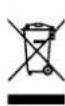
This symbol indicates that this product must not be disposed of together with domestic waste in compliance with the Directive (2012/19/EU) pertaining to waste electrical and electronic equipment (WEEE). This product must be disposed of at a designated collection point. This can occur, for example, by handing it in at an authorised collecting point for the recycling of waste electrical and electronic equipment. Improper handling of waste equipment may have negative consequences for the environment and human health due to potentially hazardous substances that are often contained in electrical and electronic equipment. By properly disposing of this product, you are also contributing to the effective use of natural resources. You can obtain information on collection points for waste equipment from your municipal administration, public waste disposal authority, an authorised body for the disposal of waste electrical and electronic equipment or your waste disposal company.
Günzburger Straße 69
D-89335 Ichenhausen
CHER CLIENT,
Activation/désactivation (fig. 1)
Günzburger Straße 69
D-89335 Ichenhausen
VÁŽENÝ ZÁKAZNÍKU,
Günzburger Straße 69
D-89335 Ichenhausen
VÁŽENÝ ZÁKAZNÍK,
Günzburger Straße 69
D-89335 Ichenhausen
TISZTELT VÁSÁRLÓ!
Günzburger Straße 69
D-89335 Ichenhausen
DROGI KLIENCIE,
CE - Declaration of Conformity
POLISHING AND SANDING MACHINE - PM600
AFFUTEUSE ET MACHINE A POLIR - PM600 5903901901
Noise: measured L_WA = xx dB(A) ; guaranteed L_WA = xx dB(A) P = 0.55 KW; L/∅ = cm
Notified Body:
Notified Body No.:
X 2006/42/EC
Annex IV
Notified Body:
Notified Body No.:
Certificate No.:
2010/26/EC
Emission. No:
Standard references:
EN 60745-1; EN 60745-2-3; EN 55014-1; EN 55014-2; EN 61000-3-2; EN 61000-3-3
This declaration of conformity is issued under the sole responsibility of the manufacturer.
The object of the declaration described above fulfils the regulations of the directive 2011/65/EU of the European Parliament and Council from 8th June 2011, on the restriction of the use of certain hazardous substances in electrical and electronic equipment.
Subject to change without notice
Documents registar: Georg Kohler
Günzburger Str. 69, D-89335 Ichenhausen
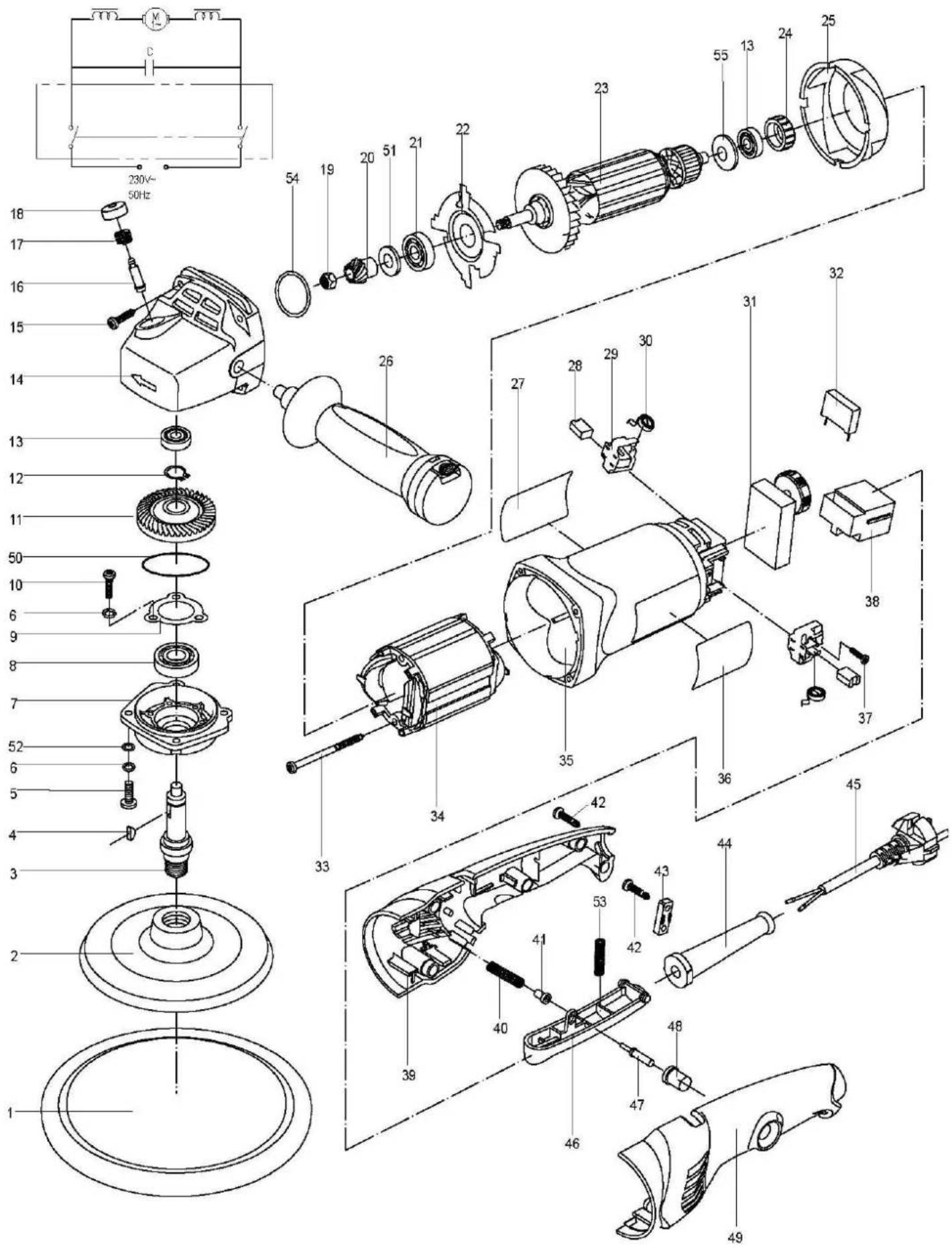
Garantiebedingungen
- PM600
- VEREHRTER KUNDE,
- Introduction
- DEAR CUSTOMER,
- NOTE:
- WE RECOMMEND:
- Layout (Fig. 1)
- Unpacking
- ATTENTION
- Intended use
- General Power Tool Safety Warnings
- ⚠ WARNING!
- Save all warnings and instructions for future reference.
- Work area safety
- Electrical safety
- Personal safety
- Power tool use and care
- Service
- Safety instructions for all applications Safety instructions for polishing
- Residual risks
- Noise and vibration values
- Wear hearing protection.
- Before starting the equipment
- Fitting the additional handle (fig. 2)
- Attaching/Removing the rubber disc (fig. 1)
- Notice!
- Attaching/Removing the polishing bonnet (fig. 1)
- Operation
- Switching on/off (fig. 1)
- Setting the speed (fig. 1)
- Using the polishing bonnet (fig.1)
- Electrical connection
- Important information
- Damaged electrical connection cable
- AC motor
- Cleaning and Servicing
- Cleaning
- Service information
- Storage
- Disposal and recycling
- Old devices must not be disposed of with household waste!
- CHER CLIENT,
- Activation/désactivation (fig. 1)
- VÁŽENÝ ZÁKAZNÍKU,
- VÁŽENÝ ZÁKAZNÍK,
- TISZTELT VÁSÁRLÓ!
- DROGI KLIENCIE,
- CE - Declaration of Conformity
- Standard references:
- Garantiebedingungen
Brand : SCHEPPACH
Model : PM600
Category : Polisher