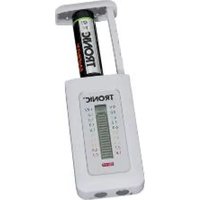
HG01717 - Battery tester TRONIC - Free user manual and instructions
Find the device manual for free HG01717 TRONIC in PDF.


| Product type | Battery tester |
| Brand | Tronic |
| Model | HG01717 |
| Measurement ranges | 0.7 - 1.5 V (D, C, AA, AAA batteries) and 1.8 - 9 V (9V battery) |
| Testable battery types | 1.5 V (D, C, AA, AAA) and 9 V |
| Power supply | 1 AAA 1.5 V battery |
| Display | Analog scale with needle (1.5 V and 9 V scales) |
| Zero reset function | Reset button on the back (use a paperclip) |
| Contact arm | Telescopic for D, C, AA, AAA batteries |
| Contacts for 9V battery | Dedicated test contacts |
| Intended use | Checking the remaining voltage of 1.5 V and 9 V batteries and rechargeable batteries, indoor household use |
| Cleaning | Soft dry cloth, without liquid or cleaning product |
| Safety | Do not expose to moisture, extreme temperatures, direct sunlight, vibrations or shocks |
| Recycling | Compliant with WEEE and 2006/66/EC directives; do not dispose of with household waste |
| Warranty | Excludes damage due to incorrect handling or unauthorized repairs |
Frequently Asked Questions - HG01717 TRONIC
User questions about HG01717 TRONIC
0 question about this device. Answer the ones you know or ask your own.
Ask a new question about this device
Download the instructions for your Battery tester in PDF format for free! Find your manual HG01717 - TRONIC and take your electronic device back in hand. On this page are published all the documents necessary for the use of your device. HG01717 by TRONIC.
USER MANUAL HG01717 TRONIC
BATTERY TESTER
GB IE NI
BATTERY TESTER
Operation and safety notes
DK
BATTERITESTER
GB/IE/NI Operation and safety notes Page 5
Description of parts ...... Page 6
Technical data...... Page 6
Safety Information...... Page 7
Safety Instructions for Batteries...... Page 8
Before use Page 8
Insert / change battery...... Page 8
Operating instructions...... Page 9
Measuring D, C, AA and AAA battery.... Page 9
Measuring 9 V battery...... Page 9
Troubleshooting Page 9
Cleaning and maintenance...... Page 9
Disposal Page 10
BATTERY TESTER
Introduction
We congratulate you on the purchase of your new product. You have chosen a high quality product. The instructions for use are part of the product. They contain important information concerning safety, use and disposal. Before using the product, please familiarise yourself with all of the safety information and instructions for use. Only use the unit as described and for the specified applications. If you pass the product on to anyone else, please ensure that you also pass on all the documentation with it.
● Proper use
This device is intended for checking the residual voltage of disposable and rechargeable batteries with a voltage of 1.5 and 9 volts. The product is intended for indoor use only. The product is not intended for commercial use.
● Description of parts
1 extendable contact arm (battery types: D, C, AA, AAA)
2 reset button
3 battery compartment cover
4 1.5 V scale
5 voltage display
6 9 V scale
7 test contacts (9 V battery)
- Technical data
Measurement range: 0.7 - 1.5 V (direct current) (battery types: D, C, AA, AAA)
1.8 - 9 V
--- (direct current) (9 V battery)
Power supply: 1 × 1.5 V
--- (direct current) AAA battery
■ DANGER TO LIFE AND ACCIDENT HAZARD FOR TODDLERS AND
SMALL CHILDREN! Never allow children to play unsupervised with the packaging material. There is a danger of suffocation from the packaging material. Children
frequently underestimate the dangers. Children should be kept away from the product at all times. This product is not a toy.
This appliance can be used by children aged from 8 years and above and persons with reduced physical, sensory or mental capabilities or lack of experience and knowledge if they have been given supervision or instruction concerning use of the appliance in a safe way and understand the hazards involved. Children shall not play with the appliance. Cleaning and user maintenance shall not be made by children without supervision.
Children must never be allowed to play with the device.
- Do not use the device if it is damaged. Damaged devices represent a danger of death from electric shock!
Do not expose the device to
- extreme temperatures,
- strong vibrations,
- heavy mechanical loads,
- direct sunlight,
- moisture.
Otherwise there is a danger that the device will be damaged.
Please note that the guarantee does not cover damage caused by incorrect handling, non-compliance with the operating instructions or interference with the device by unauthorised individuals.
■ Under no circumstances should you take the device apart. Improper repairs may place the user in considerable danger. Repairs should only be carried out by specialist personnel.
Please keep the product clean.
Do not allow the product to be subjected to extreme heat or cold.
Do not allow the product to be subjected to extreme temperature fluctuations. Failure to observe this advice could lead to condensation forming. Wait until the product has reached temperature of the room before you use it.
Before inspection, please read the manufacturer's instructions for the respective battery.

Safety Instructions for Batteries
WARNING! DANGER TO LIFE! Batteries can be swallowed, which may represent a danger to life. If a battery has been swallowed, medical help is required immediately.
■ Remove the battery from the device when it has not been used for a longer period of time.
CAUTION! DANGER OF EXPLOSION! Non-rechargeable batteries must never be recharged!
- When inserting the battery, ensure the correct polarity! This is shown in the battery compartments.
If necessary, clean the battery and device contacts before inserting the battery.
■ Remove a spent battery immediately from the device. This can increased danger of leaks!
Batteries must not be disposed of in the normal domestic waste!
■ Every consumer is legally obliged to dispose of batteries in the proper manner!
- Keep batteries away from children; do not throw them in the fire, short-circuit them or take them apart.
If the above instructions are not complied with, the battery may discharge themselves beyond their end voltage. There is then a danger of leaking. If the battery have leaked inside your device, you should remove them immediately in order to prevent damage to the device!
- Avoid contact with the skin, eyes and mucous membranes. Any parts of the body coming into contact with battery acid should be rinsed off with copious amounts of water and / or a doctor contacted if necessary!
Before use
- Insert / change battery
☐ Remove the cover of the battery compartment 3 by pulling it off in the direction of the arrow (see illustration).
☐ Insert a micro battery (AAA 1.5 V).
Note: Please observe the correct polarity. This is indicated in the battery compartment.
☐ Then close the battery compartment again.
- Operating instructions
● Measuring D, C, AA and AAA battery
Place a battery of the type D, C, AA or AAA in the battery tester (see fig. A).
Note: In doing so, please observe the correct polarity. This is shown on the battery tester.
Note: Please ensure for proper contact between the battery and the battery tester.
☐ Secure the battery by means of the extendable contact arm 1 (see fig. A).
☐ Read the voltage of the connected battery using the voltage display 5 and the 1.5 V scale 4.
● Measuring 9 V battery
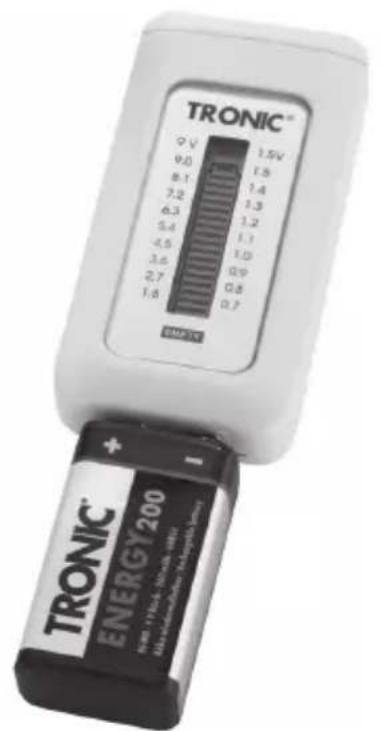
☐ Position the 9 V battery on the test contacts 7 (see fig. B).
Note: In doing so, please observe the correct polarity. This is shown on the test contacts 7.
Note: Please ensure for proper contact between the battery and the test contacts 7.
☐ Read the voltage of the connected battery using the voltage display 5 and the 9 V scale 6.
- Troubleshooting
● = Fault
C = Cause
O = Solution
● Battery tester does not react.
Electrostatic discharge can affect the function of the battery tester.
Press the reset button 2 on the back of the battery tester. For this purpose a paper clip or a similar object can be used.
The battery to be tested has been inserted incorrectly.
Insert the battery to be tested according to the correct polarity.
● The resulting measurement is unlikely.
The battery has not been inserted properly.
Remove the battery and wait for a few seconds, or press the reset button 2. Reinsert the battery.
● Cleaning and maintenance
☐ The device should only be cleaned on the outside with a soft dry cloth.
□ Under no circumstances should you use liquids or detergents, as these will damage the device.
- Disposal

The packaging is made entirely of recyclable materials, which you may dispose of at local recycling facilities.
Contact your local refuse disposal authority for more details of how to dispose of your worn-out product.
To help protect the environment, please dispose of the product properly when it has reached the end of its useful life and not in the household waste. Information on collection points and their opening hours can be obtained from your local authority.
Faulty or used batteries must be recycled in accordance with Directive 2006 / 66 / EC and its amendments. Return the battery and / or the device through the appropriate collection facilities.
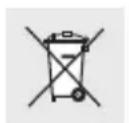
Environmental damage through incorrect disposal of the batteries!
Batteries may not be disposed of with the usual domestic waste. They may contain toxic heavy metals and are subject to hazardous waste treatment rules and regulations. The chemical symbols for heavy metals are as follows: Cd = cadmium, Hg = mercury, Pb = lead. That is why you should dispose of used batteries at a local collection point.
CE
Indledning.... Side 12

- BATTERY TESTER
- BATTERITESTER
- INTRODUCTION
- ● PROPER USE
- ● DESCRIPTION OF PARTS
- TECHNICAL DATA
- DANGER TO LIFE AND ACCIDENT HAZARD FOR TODDLERS AND
- SAFETY INSTRUCTIONS FOR BATTERIES
- WARNING! DANGER TO LIFE! BATTERIES CAN BE SWALLOWED, WHICH MAY REPRESENT A DANGER TO LIFE. IF A BATTERY HAS BEEN SWALLOWED, MEDICAL HELP IS REQUIRED IMMEDIATELY
- BEFORE USE
- INSERT / CHANGE BATTERY
- OPERATING INSTRUCTIONS
- ● MEASURING D, C, AA AND AAA BATTERY
- ● MEASURING 9 V BATTERY
- TROUBLESHOOTING
- ● CLEANING AND MAINTENANCE
- DISPOSAL
- ENVIRONMENTAL DAMAGE THROUGH INCORRECT DISPOSAL OF THE BATTERIES
- CE
Brand : TRONIC
Model : HG01717
Category : Battery tester