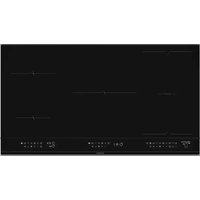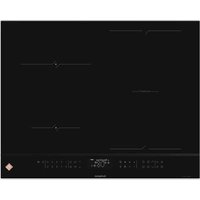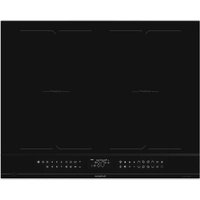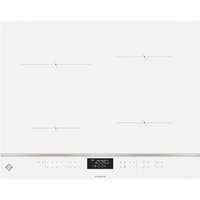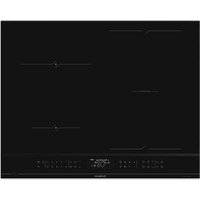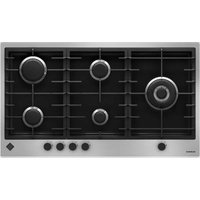
DPE4929XF - Cooker DE DIETRICH - Free user manual and instructions
Find the device manual for free DPE4929XF DE DIETRICH in PDF.


User questions about DPE4929XF DE DIETRICH
0 question about this device. Answer the ones you know or ask your own.
Ask a new question about this device
Download the instructions for your Cooker in PDF format for free! Find your manual DPE4929XF - DE DIETRICH and take your electronic device back in hand. On this page are published all the documents necessary for the use of your device. DPE4929XF by DE DIETRICH.
USER MANUAL DPE4929XF DE DIETRICH
text_image
Technical diagram showing a mechanical assembly with labeled component 'C' and a pencil inserted into a base.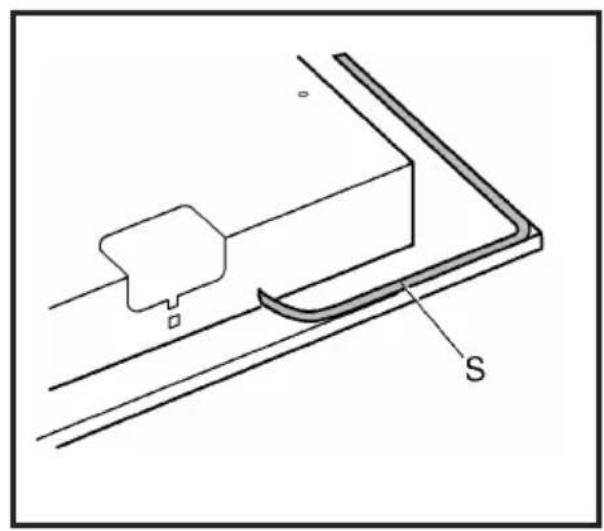
natural_image
Technical line drawing of a mechanical component with labeled part 'S' (no text or symbols beyond label)1.1.4 1.1.5
• 1
text_image
N L1.2.
1.2.1
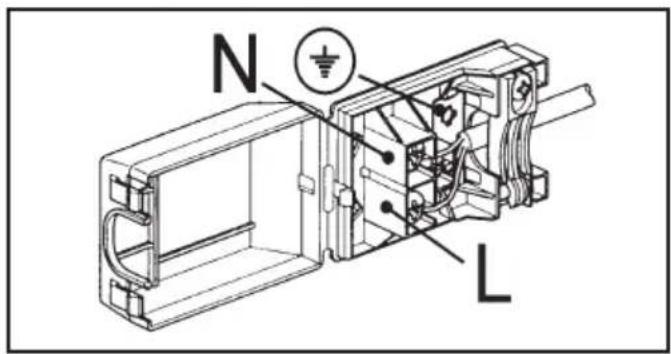
| Câble L marronCable L brown | PHASEPHASE |
| câble N bleuCable L blue | NEUTRENEUTRAL |
| câble ↓ vert-jaunecâble ↓ green-yellow | TERREEARTH |
text_image
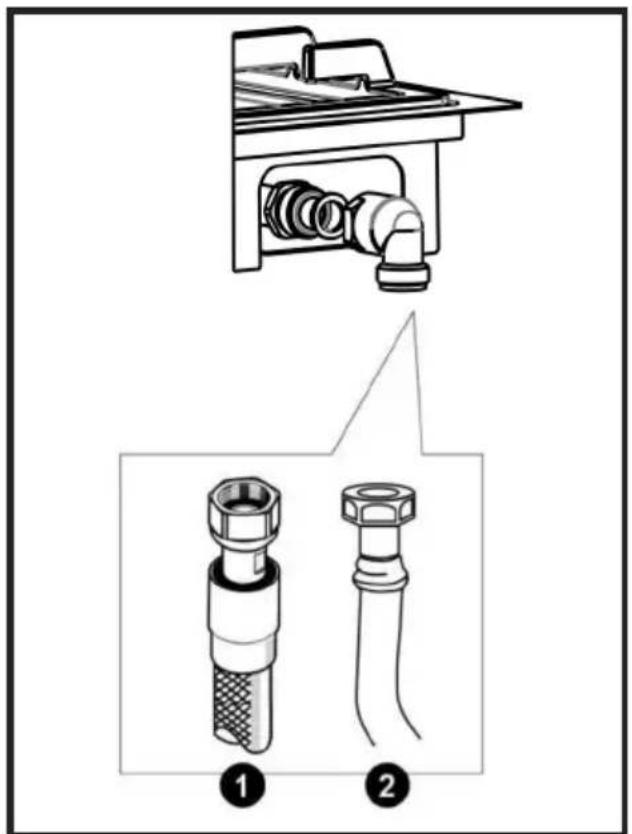
Technical diagram showing a mechanical assembly with labeled parts, including a component with threaded connectors and two separate views labeled 1 and 2.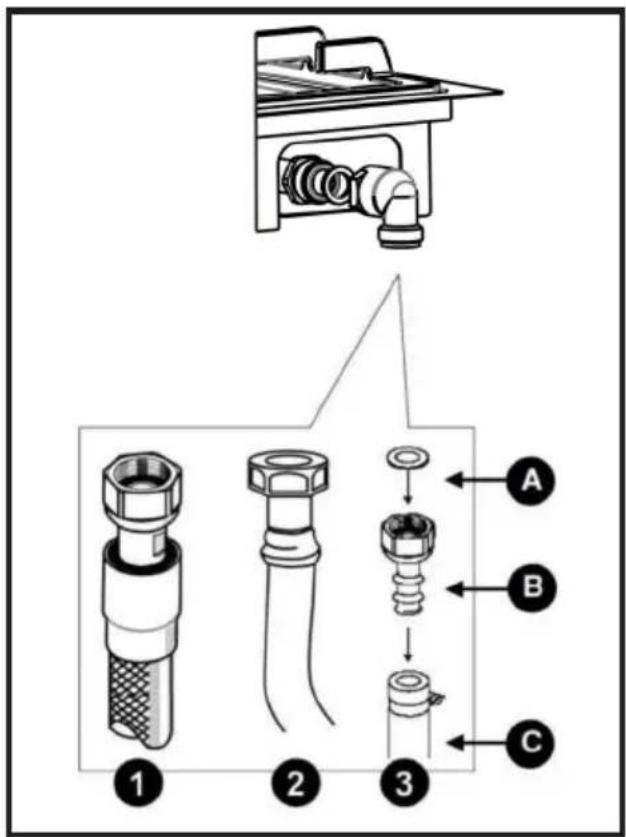
text_image
Technical diagram showing exploded view of a mechanical assembly with labeled parts A, B, and C1.3.
1.3.1 1.3.2
• 1
text_image
L U1.4.1
text_image
U ext int ext L C V1.4.2
text_image
A B C1.4.3
text_image
F1.4.4
| BRULEURS/ BURNER | GAZ/ GAS | PRESSION DE SERVICE/ NORMAL PRESSURE mbar g/h | DEBIT/ NORMAL RATE | DIAMÈTRE INJECTEUR/ INJECTOR DIAMETER 1/100 mm | DIAMÈTRE BY PASS ROBINET/ TAPE BY PASS DIAMETER 1/100 mm | DEBITS CALORIFIQUES (kW)/ NOMINAL HEAT INPUT (kW) | (EE brûleur à gaz/ gas burner) | |||
| N° | DESIGNATION/ DESCRIPTIONS | L/h | Max. Min. (%) * | |||||||
| 1 | RAPIDE/ RAPID | G30 28 | -30 218 - 87 | 42 3,0 0,95 | 58.6 | |||||
| G31 37 | 214 - 82 42 | 3,0 0,95 | ||||||||
| G20 20 | - 286 | 128 | Reg. 3,0 0,95 | |||||||
| G25.3 | 25 | - | 326 | 132 | Reg. | 3,0 | 0,95 | |||
| 2 | SEMI-RAPIDE/ SEMI-RAPID | G30 28 | -30 127 - 67 | 31 | 1,75 | 0,6 | 57.8 | |||
| G31 37 | 125 - 64 31 | 1,75 0,6 | ||||||||
| G20 20 | - 167 | 103 | Reg. 1,75 0,6 | |||||||
| G25.3 | 25 | - | 190 | 106 | Reg. | 1,75 | 0,6 | |||
| 3 | AUXILIAIRE/ AUXILIARY | G30 28 | -30 73 - 50 | 27 1,0 0,45 | N.A. | |||||
| G31 37 | 71 | - | 48 27 1,0 | 0,45 | ||||||
| G20 | 20 | - | 95 | 78 | Reg. | 1,0 | 0,45 | |||
| G25.3 | 25 | - | 109 | 79 | Reg. | 1,0 | 0,45 | |||
| 4 | DOUBLE COURONNE/ DOUBLE RING | G30 28 | -30 291 - 45 | (int)-69(ext) | 60 4,0 | 2,3 | 55 | |||
| G31 37 | 286 - 42(int) | -63(ext) | 60 4,0 | 2,3 | ||||||
| G20 | 20 | - | 381 | 68(int)-101(ext) | Reg. | 4,0 | 2,3 | |||
| G25.3 | 25 | - | 435 | 71(int)-100(ext) | Reg. | 4,0 | 2,3 | |||
1.5.
Short title or reference to the measurement and calculation methods used to establish compliance with the above requirements.
The performance of each individual burner is calculated according to standard EN 30-2-1 (2015)
The total efficiency of the hob is calculated according to the EU Regulation 66/2014 Par. 2.2
The efficiency is calculated only for the burners with a nominal capacity exceeding 1,16 KW (EN 30-2-1 (2015)).
Information which is relevant to the customer to minimize the energy consumption during usage:
Energy Saving Tips: use pots having flat base, Use pots with proper size, use pots with lid, minimize the amount of liquid or fat, when liquid starts boiling reduce the setting.
• 2
text_image
Maximum / maximum Fermé / Closed Minimum / Minimum2.1.
2.1.1
natural_image
Two identical line drawings of a cooking pot with a crossed-out pan, placed on a stove (no text or symbols)2.1.2
natural_image
Four identical line drawings of a cooking pot with a crossed-out black X symbol, no text or labels present.2.1.3
• 3
text_image
Diagram showing a toothbrush and screwdriver on a mechanical component with labeled point A3.1.
3.1.1
natural_image
Technical line drawing of a mechanical component with a pulley and circular base (no text or symbols)3.1.2
• 3
text_image
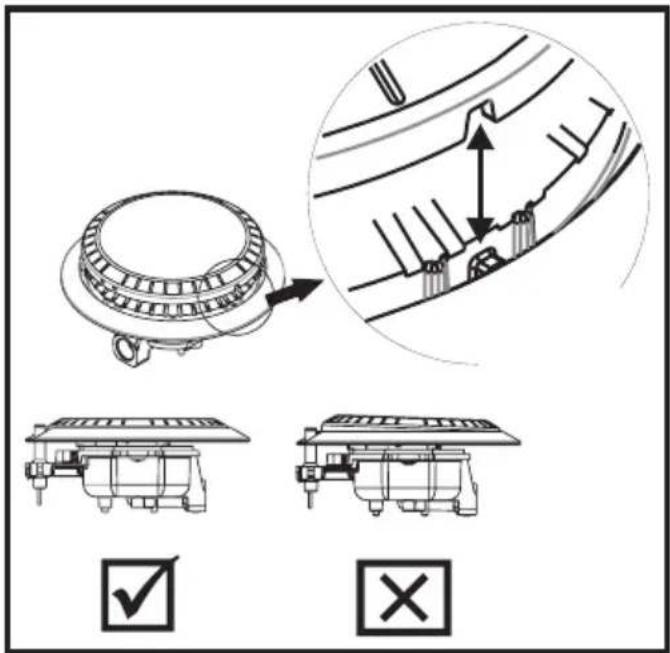
Technical diagram showing mechanical assembly with check and cross icons, including a magnified detail view of a component.■ After cleaning the burner, make sure that the lid is placed in the housing.
■ The 2 reference cuts must be entered on the 2 references made on the flame retardant (see the arrows drawn in the burner and lid).
■ The burner cap must be positioned steadily and flat..
• 5
natural_image
Symbol of a trash bin crossed with a diagonal line, representing waste sorting or disposal (no text or labels)• 6
text_image
De Dietrich DPE7620XF SERVICE: DPE7620XF1 CAT: II 2H3- ΣOn 546 g/h 7,5 kW 230 V ~ 50 Hz 0.6 W TZ604VNQL50XN0D42 SERIAL N.172100001 MADE IN ITALY MODEL: SH604WCAA Made by N.C. 1187 CE 1312-17 1312CS6225Service:
Serial:

text_image
FR CHÈRE CLIENTE,CHÈRE CLIENTE, CHER CLIENT
natural_image
Technical line drawing of a mechanical component with symmetrical arms and central hub (no text or symbols)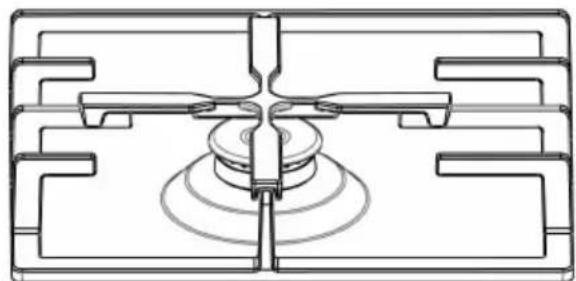
natural_image
Technical line drawing of a mechanical component with symmetrical arms and central hub (no text or symbols)• 3 ENTRETIEN
3.1 ENTRETIEN DE VOTRE APPAREIL
text_image
Technical diagram showing mechanical assembly steps with check and cross icons indicating inspection or failure conditions.natural_image
Symbol of a trash bin crossed with no text or numbers, representing waste sorting or disposal (no text present)RELATIONS CONSOMMATEURS FRANCE
You have just acquired a De Dietrich product. This choice reveals your demand as much as your taste for the French art of living.
Heirs to over 300 years of expertise, De Dietrich creations embody the fusion of design, authenticity, and technology serving culinary art.
Our appliances are made with noble materials and offer impeccable quality finishing.
We are certain that this high-quality craftsmanship will allow cooking enthusiasts to express all their talents.
The De Dietrich Consumer Service is at your disposal to answer all your questions and suggestions to always better meet your requirements.
We are honored to be your new kitchen partner and thank you for your trust
www.de-dietrich.com
De Dietrich
CRÉATEUR D'ÉMOTIONS DEPUIS 1684
TABLE OF CONTENTS
EN
SAFETY INSTRUCTIONS 3
0/ IDENTIFICATION 7
1/ INSTALLATION
- Fitting 7
- Electric connection 8
- Gas connection 8
- Changing of gas supply 9
• Gas properties 10
2/ USE
- Lighting the gas burners 11
- Cookware suitable for the gas burners 12
3/ ENTRETIEN
- Maintaining your appliance
– Igniters and injectors ...... 13 - Pan holders and gas burners 13
- Enamel or stainless steel 13
4/ PROBLEMS & SOLUTIONS 14
5/ ENVIRONMENT 15
6/ AFTER-SALES SERVICE 16
- IMPORTANT SAFETY INSTRUCTIONS – READ CAREFULLY AND RETAIN FOR FUTURE USE.
This guide can be downloaded from the brand web site.
- WARNING: this appliance may be used by children aged 8 years and older, and by persons with impaired physical sensorial or mental capacities, or without experience or knowledge, if they are supervised or have received prior instructions on how to use the appliance safely and have understood the risks involved.
- Children must not be allowed to play with the appliance.
- Cleaning and maintenance operations must not be carried out by children without supervision.
- Children must be supervised to ensure that they do not play with the appliance.
- It must be possible to disconnect the appliance from the power supply, either using a plug or by fitting a switch on the fixed wiring system in accordance with installation rules.
- The electrical plug must remain accessible after installation.
- The appliance is not designed to be switched on using an external timer or a separate remote control system.
- WARNING: leaving a hob unattended when cooking with fat or oil can be dangerous and could cause a fire.
SAFETY INSTRUCTIONS
- Never try to extinguish a fire with water but switch off the appliance, then cover the flame with a lid or a fire blanket.
- WARNING : fire risk: do not store any items on the cooking surfaces.
- Prior to installation, ensure that the local distribution conditions (type of gas and gas pressure) and the appliance's settings are compatible.
- The settings for this appliance are stated on the label inside the wallet or on the information plate.
- This appliance is not connected to a system for evacuating combustion products. It must be installed and connected in compliance with current regulations. Particular attention should be given to applicable ventilation requirements.
- The use of a gas hob produces both heat and humidity in a room. Ensure that the kitchen is well ventilated: keep mechanical ventilators open.
- Prolonged, intensive use of the hob may require additional ventilation, by opening a window, for example, or ventilating the room more efficiently by increasing the setting on mechanical ventilation, where installed.
- WARNING : Use only hob guards designed by the manufacturer of the cooking appliance or indicated by the manufacturer of the appliance in the instructions for use as suitable or hob guards incorporated in the appliance. The use of inappropriate guards can cause accidents.
SAFETY INSTRUCTIONS
- This hob has been designed for use by private persons in their homes.
- This hob complies with standard EN 30-1-1 and is a Class 3. This appliance must be installed and used only in a well-ventilated area. Read this guide carefully before installing and using your appliance.
- WARNING: You should never leave cooking unattended. The cooking process is to be continuously monitored.
• These hobs are designed exclusively for cooking drinks and foodstuffs and do not contain any asbestos-based component parts.
- Never leave any FLAMMABLE products in the cupboard beneath your hob (aerosols or other pressurized cans, papers, recipe books, etc.).
- If you have a drawer underneath the hob, we recommend avoiding placing objects in it that are temperature sensitive (plastics, paper, aerosols, etc.).
- Disconnect your hob from both electrical and gas supplies before carrying out any maintenance operations.
- When connecting electrical appliances to a nearby socket, ensure that the power supply cable is not in contact with hot areas.
- Do not use steam cleaning appliances.
- If the power cable is damaged, it should be replaced by the manufacturer, its after-sales service department or by a similarly qualified person in order to avoid danger. The cable is of type Y.
SAFETY INSTRUCTIONS
- Do not use cookware that overhangs the edge of the hob.
- For safety reasons, after use, do not forget to close the mair gas valve for mains gas lines or the valve on the top of you butane/propane gas cylinder.
- The conformity CE mark is applied to all these hobs.
- This appliance should be installed by a qualified technician / installer.
- WARNING: If the surface is cracked, disconnect the unit from the power supply to avoid the risk of electric shock.
- If a knob is difficult to turn, DO NOT FORCE and call your installer immediately
- Never use aluminium foil for cooking. Never place products wrapped in aluminium foil or in aluminium trays on your hob. The aluminium will melt and permanently damage your appliance.
- The appliance to be built into a kitchen unit or a worktop. This device belongs to class 3 and has been designed for home use only. The appliance is manufactured to be embedded in heat-resistant furniture. The walls of the furniture must withstand a temperature of 125^ , in accordance with European standards.

Declaration of conformity:
It declares that our products comply with current European directives, orders and regulations, and the requirements stated in the reference standards.
• 0 IDENTIFICATION
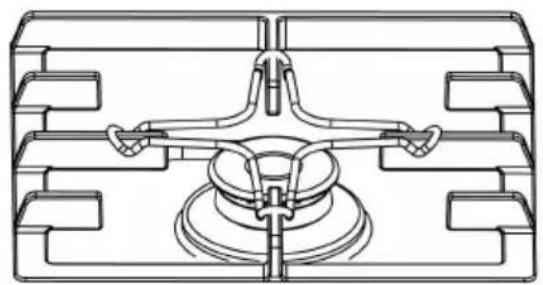
Identify your type of hob by comparing (0.1.1) and (0.1.2) and (0.1.3) .
the number and layout of the burners
on your appliance with the illustrations
• 1 INSTALLATION
Make a note of the references of your appliance on the "After-Sales Service and Customer Relations" page so that you can readily find them in future (6.1.1). This page also explains where to find them on your appliance.
1·1 - FITTING :
This worktop must be at least 3 cm thick and heatresistant or else coated with a heat resistant material.
If a horizontal partition is installed under the hob, it must be positioned 15 cm below the worktop. (1.1.2).
If the hob is going to be installed on the top of an oven, precautions must be taken to guarantee an installation in accordance with current accident prevention standards.
Under no circumstances keep any sprays or pressurised containers in any compartment below the hob (see "Safety guidelines" chapter).
Follow the guidelines in the sketch. (1.1.1).
- Remove the "pan supports", burner caps and burner heads, noting their original positions.
- Turn the hob upside down and place it carefully over the top of the base unit, so as not to damage the knobs or igniters.
- To ensure a good seal between the body of the hob and the worktop, stick the foam seal 🧿 around the edge
of the body, before installing the hob (1.1.5).
- Place the hob over the opening in the base unit, taking care to center the hob.
- Fit the burner heads, caps and pan supports.
- Connect your hob to the gas (see "Gas connection" section) and to the electricity (see "Electrical connection" section).
- If you wish, you can secure the hob in position, using the four fixing clam and screws supplied supplied (1.1.3/1.1.4) fixing them to the four corners of the housing. It is essential that you use the holes provided for the purpose, as per the drawing.
Stop screwing when the clamp starts to bend.
Do not use a power screwdriver.
- Installation room: This appliance is not equipped with a device for the evacuation of combustion products, so it is necessary to evacuate the fumes outwards using a hood or an electric fan inserted to walk every time the device is used. The room in which the appliance is installed must have a natural inflow of air for the regular combustion of the gas and for the ventilation of the room.
• 1 INSTALLATION
1·2 - ELECTRICAL CONNECTION:
Your hob is supplied with a H05RR-F-T90 3-core (phase, neutral + earth) mains cable, section 0,75 mm ^2 ) and must be connected to a 220-240 V\~single phase mains supply via a phase, neutral +earth socket meeting standard IEC 60083 or an omnipolar. The plug must be accessible after the hob is installed.
| Cross section of the cable to be used | |
| 220-240 V~ - 50/60HZ gas | |
| Cable H05RR-F - T90 | 3 conductors, One of which is an earth |
| Cross section of conductors in mm2 | 0,75 |
| Fuse 1,5 A | |

The protective conductor (green/ yellow) is connected to the earth terminal ⏚ on the hob and must also beconnectedtotheinstallation'searth terminal ⏚(1.2.1).
If the supply cable is damaged, it must be replaced by a cable or special set available from the manufacturer or its after-sales department.

So that you can find the references for your appliance without difficulty in the future, we recommend that you make a note of them on page (6.1.1) "After-sales service and customer relations" (that page also tells you where to find them on your appliance).
1·3 - GAS CONNECTION:
If the hob is to be installed above an oven or if other nearby heating appliances could heat and damage the gas hose, then it is essential that a rigid pipe is installed instead.
If a flexible hose is used (as is the case of butane gas) then it must not be installed in a place where it may be in contact with a moving part of the kitchen unit or a location likely to get cluttered.

No flexible hoses with a limited service life may be longer than 2 metres and must be accessible for inspection along their entire length. They must be replaced before their expiry date (printed on the hose). Whatever means of connection is chosen, make sure that it is gastight when installed, using soapy-water. In France, you must use a hose or pipe stamped NF Gaz.
The gas connection must comply with the regulations in force in the country where it is installed.
• Mains natural gas (1.3.1).
For your safety, you must choose only one of the following two connections:
o Connection via a rigid copper pipe with mechanical screw connectors ( 12 " gas standard).
- Connect directly on to the elbow on the appliance.
• 1 INSTALLATION
1 Connection via a flexible metal hose (stainless steel) with screw connectors (meeting standard NF D 36-121); the life of such hoses is not limited.
2 Connection with a flexible reinforced rubber hose with mechanical screw connectors (meeting standard NF D 36-103) with a 10-year life.
When connecting the gas to your hob, if you have to change the direction of the elbow fitted into the appliance:
- Change the seal.
- Tighten the nut on the elbow ensuring that you do not exceed a tightening torque of 17 N.m.
- Gas supplied from a cylinder or tank (butane/propane gas) (1.3.2). For your safety, you must choose only one of the following three connections:
1 Connection via a rigid copper pipe with mechanical screw connectors ( 12 " gas standard). Connect directly to the elbow on the appliance.
2 Connection with a flexible metal hose (stainless steel) with screw connectors (to standard NF D 36-125); the life of such hoses is not limited).
3 Connection with a reinforced flexible rubber hose with mechanical screw connectors (meeting standard NF D 36-112) with a 10-year life.)
In an existing installation, a flexible hose fitted C with jubilee clips (meeting standard XP D 36-110) whose service life is limited to 5 years may be used). In this case an end connector must be used with a sealing washer A fitted between the end connector B and the elbow on the hob.
You can purchase the end connector and the sealing washer from your after-sales department.
Tighten the end connector to a torque not exceeding 25 N.m.
1•4 - CHANGING THE TYPE OF GAS:
Your appliance is supplied ready for use with natural gas.
The injectors required for adapting it to butane/propane can be found in the plastic bag containing this guide.
Whenever you change the gas type, you must follow these steps in turn:
- Change the gas connection,
- Change the injectors,
- Adjust the retarder on the taps.
1) To change the gas connection :
- refer to the "Gas connection" paragraph.
2) Change the injectors, proceeding as follows:
- Remove all the supports, burner caps and heads.
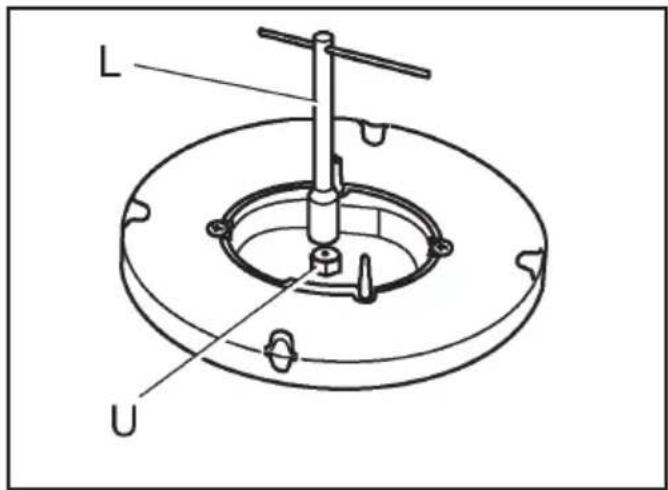
- completely insert the "straight pipe" key
L key on the injector U. (1.4.1)
• 1 INSTALLATION
By means of a straight spanner L nscrew the nozzle U and substitute it with the corresponding one.
- Replace them with injectors for the gas to be used, as shown in the gas characteristics table (1.5);
- Thoroughly engage the key on the injector.
- Strongly block the injectors.
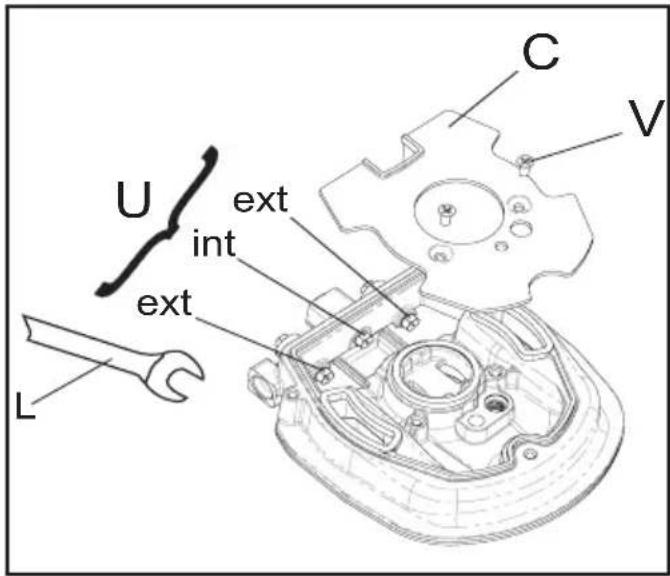
Double crown burner: (1.4.2)
- Unscrew the screws (V) and remove the cover (C);
- Unscrew the injector with a English wrench (L)
- Fit the corresponding gas injectors (U) instead, in accordance with the marking of the injectors and the gas characteristics table.
- Block the injectors vigorously.
- Fit the cover (C) and tighten the screws (V).
Do not go beyond this limit; you could to damage the product.
- Re-fit the burner heads, caps and pan supports.
Every time you change the type of gas used, tick the appropriate box on the label in the wallet. Refer to the "corresponding gas connection" paragraph
3) Set the retarders on the taps:
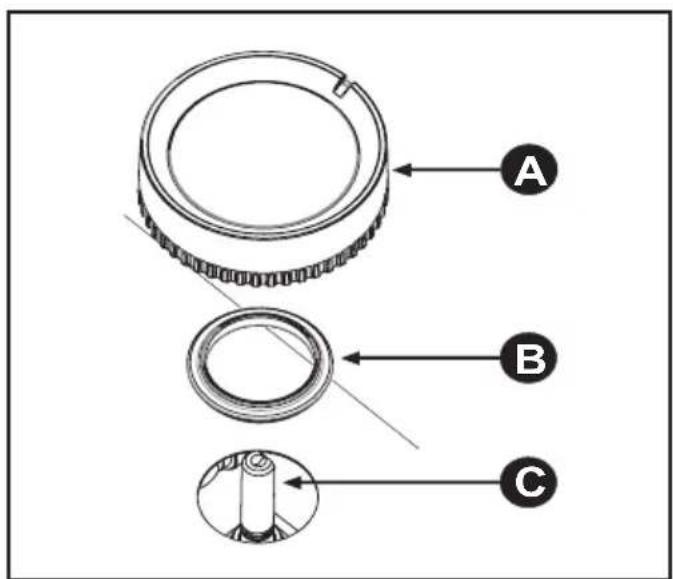
- Adjust each tap in turn ©
- Remove the knobs A, and sealing washers B by pulling them upwards.
— Changing from natural gas to butane/propane:
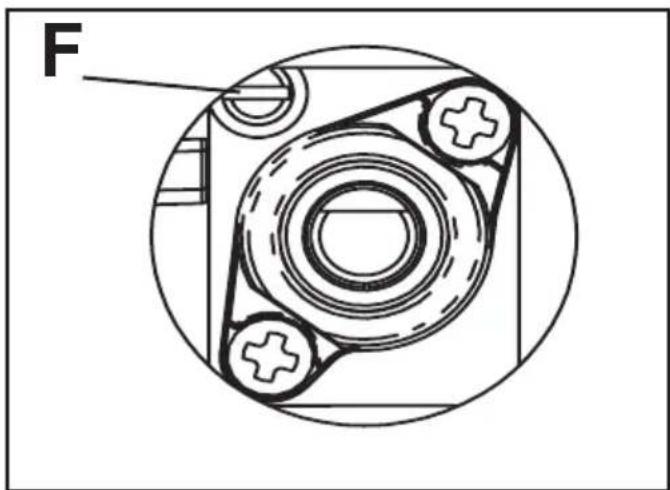
- Insert a flat-tipped screwdriver C into the hole in the control panel and turn the by-pass screw F (1.4.5), and, for correct minimum setting, turn the screw clockwise.
As regards G30 gas burners, the by-pass screw must be tightened completely.
The setting of the minimum must always be correct and the flame must always remain on even if the position is changed from maximum to minimum.
— Changing from butane/propane to natural gas:
- Loosen the adjusting screws in the brass retarders (yellow) (1.4.5), using a small, flat screwdriver, by 2 turns anticlockwise (1.4.5.2).
- Refit the knob,
- Light the burner in the maximum position and then move to the low position.
- Remove the knob again, then turn the adjusting screw clockwise as far as the lowest possible position before the flame goes out.
- Re-fit the sealing washer and the knob.
- Move the knob from maximum to minimum a few times: the flame should not go out; if it does, loosen the adjustment screw so that the flame stays alight during these movements.
1•5 - GAS PROPERTIES :
The table (1.5) shows the installation of the injectors on your appliance depending on the gas used. Each number is marked on the injector.
• 2 USE
2.1 SWITCHING ON THE GAS BURNERS
Each burner is controlled by a tap fitted with a safety system which, if the flame accidentally goes out (spills, draughts, etc.) the gas inlet is quickly and automatically switched off and gas is prevented from escaping.
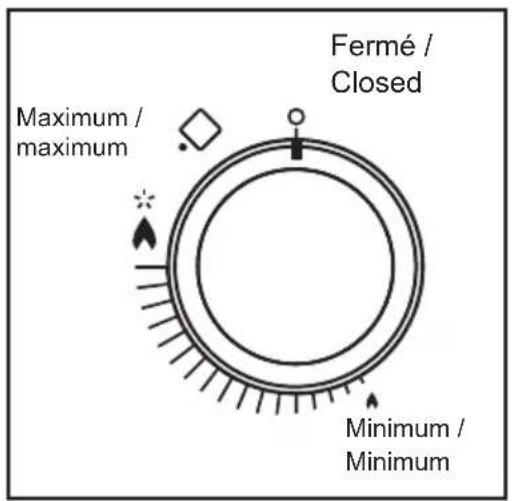
Each burner is supplied from a tap, which is opened by pressing and turning the knob anti-clockwise.
The “0” point corresponds to the tap being off.
- Choose the desired burner by using the symbols located near the knobs (e.g.: right rear burner ◇).
2.1.1
- To light a burner:
- Press the knob and turn fully anti-clockwise to the maximum position
- Holding the knob pressed will cause a series of sparks until the gas lights
- Adjust the setting by turning to between the symbol ⚙ and symbol ⚠.

If the flame goes out, light it n normally, following the lighting uctions.
The burner flames are smaller near the grid supports to protect the enameled grid.
The noise made by some burners is the result of their high power and burning gas; this in no way adversely affects cooking quality.
If the flow is interrupted, place a match close to the previously lit burne.

Hold the knob pushed in fully for a seconds after the flame appears, so o trigger the safety system.
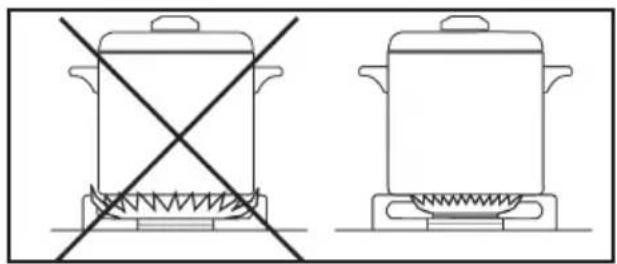
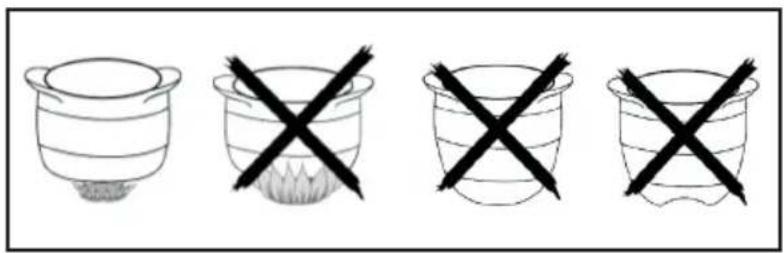
- Adjust the ring of flames so that it does not overflow the edge of the pan (2.1.2 / 2.1.3).
- Do not use a pan with a concave or convex bottom (2.1.2 / 2.1.3).
- Do not use pans that partly cover the knobs.
- Do not leave the gas on under an empty pan.

Keep all natural air-vents inroom open or have a mechanicaltilation system installed (achanically ventilated hood).
Prolonged, intensive use of the hob may require extra ventilation, for example, by opening a window, for example, or more efficient ventilation by increasing the level of mechanical ventilation, where fitted (a minimum air input of 2 m3 per hr per kW of gas power is required).
Example : table 60 cm - 4 gas burners. total power :
$$ \begin{array}{l} 3, 0 + 1, 7 5 + 1, 7 5 + 1, 0 = 7, 5 \mathrm{kW} \ \begin{array}{l} 7, 5 \mathrm{kW} \times 2 = 1 5 \mathrm{m3} \text { per hr minimum } \ \text { flow. } \end{array} \ \end{array} $$
- 2 USE
2·2 - PANS DIAMETER ACCORDING TO GAS BURNERS:
| Pan diameter Burner Use | |
| 22 to 24 cm Doulbe crown Frying - Boiling | |
| 20 to 22 cm Rapid Searing foods | |
| 16 to 18 cm Semi-rapid Sauces, re-heating | |
| 10 to 14 cm Auxiliary Simmering |
With the hob (in stainless steel or cast iron depending on the model) is supplied a trivet to adapt to the Auxiliary burner grid.
natural_image
Technical line drawing of a mechanical component with symmetrical arms and central hub (no text or symbols)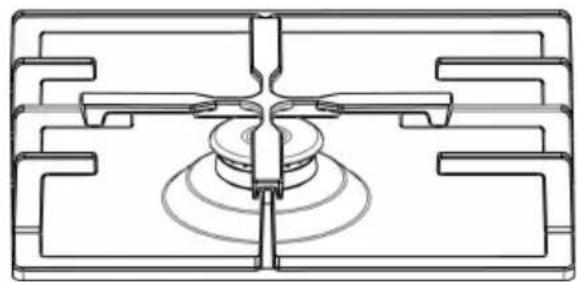
natural_image
Technical line drawing of a mechanical component with symmetrical cross-shaped features and central circular feature (no text or symbols)• 3 DAILY CARE OF YOUR APPLIANCE
3.1 - MAINTAINING YOUR APPLIANCE
Igniters and injectors:
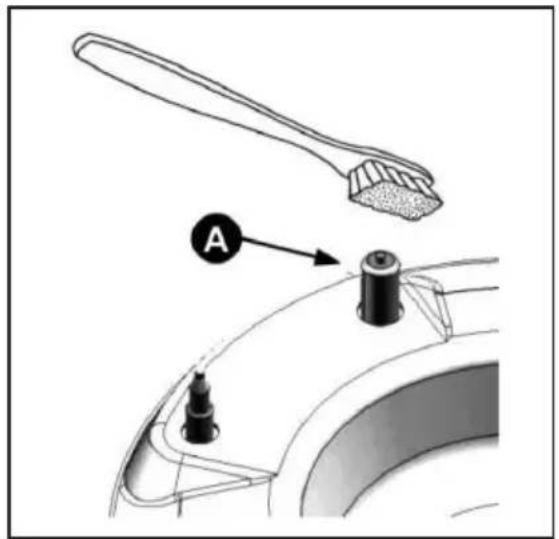
If the igniters become dirty A clean them with a small, stiff (non-metallic) brush (3.1.1).
The gas injectors are located in the centre of each burner in the well shape.
Ensure that you do not block them during cleaning, which could impair your hob's performances.
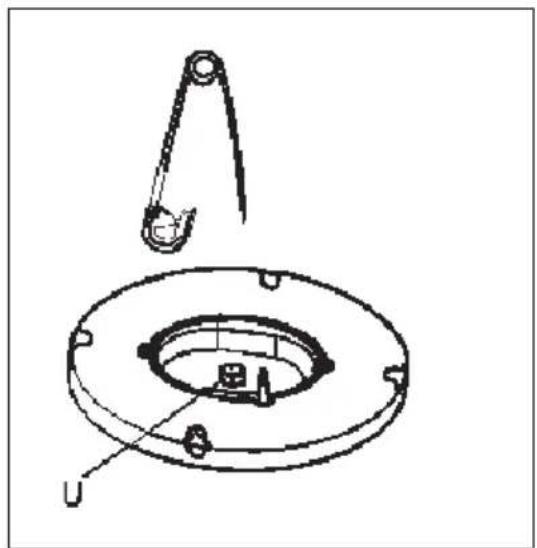
If you do block them, use a safety pin to unblock the injector. (3.1.2)
Pan holders and gas burners:
For persistent stains, use a non-abrasive cream, and then rinse with clean water. Carefully wipe each part of the burner before using your hob again.
Enamel part:
the enamelled part should be cleaned with a sponge and soapy water or with a mild detergent.
Do not use abrasive or corrosive products.
Stainless steel :
To clean the hob's stainless steel, use a sponge and soapy water or a commercially available stainless steel cleaner.
Do not allow acid liquids such as lemon juice, vinegar, etc. to remain on the enamelc.

Your hob will be easier to maintain if done prior to use. Turn off all electrical and gas controls.

Preferably clean hob components by hand rather than in the dishwasher:
• do not use scourers to clean your hob.
- Do not use steam cleaners.
text_image
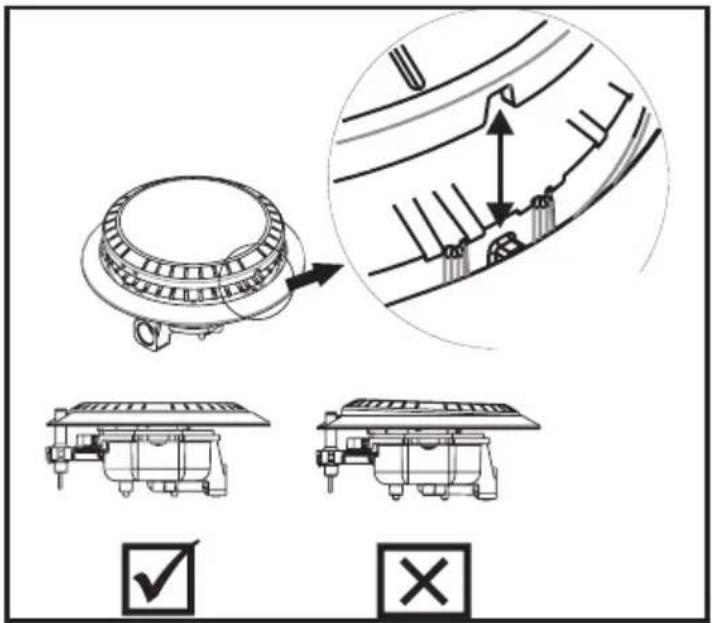
Technical diagram showing mechanical assembly steps with check and cross icons for inspection and validation.• After cleaning the burner, make sure that the lid is placed in the housing.
- The 2 reference cuts must be entered on the 2 references made on the flame retardant.
- The burner cap must be positioned steadily and flat.
• 4 PROBLEMS & SOLUTIONS
4.1 LIGHTING BURNERS.
There are no sparks when I push down on the knobs:
- Check that your hob is electrically connected.
- Check that the igniters are clean.
- Check that burners are clean and properly assembled.
- If the hob is fixed to the worktop, make sure that the fixing clamps have not been twisted.
- Check that the sealing washers under the knobs have not come out of their locations.
4.2 WHEN I PRESS A KNOB, THERE ARE SPARKS ON ALL BURNERS AT ONCE
This is normal. The lighting system is centralised and all the burners spark at the same time.
4.3 THERE ARE SPARKS BUT THE BURNERS DO NOT LIGHT.
- Check that the gas inlet is open.
- If you use gas tanks or cylinders check that they are not empty.
- If you have just installed your hob or changed a gas cylinder, keep the knob fully pressed for a few seconds to allow gas to arrive at the burners.
- Check that the injector is not blocked and, if it is, unblock it with a safety pin
- Make sure the cover is properly positioned (3.1.2).
4.3 WHEN LIGHTING, FLAMES IGNITE BUT GO OUT WHEN THE KNOB IS RELEASED
- Press the knobs as far as they will go and maintain the pressure for several seconds after flames appear.
- Check that the burner components are correctly positioned.
- Check that the sealing washers under the knobs have not come out of their locations.
- Avoid strong draughts in the room.
- Light the burner before placing a pan on it.
4.5 IN THE LOW POSITION, THE BURNER GOES OUT OR FLAMES REMAIN TOO HIGH.
- Avoid strong draughts in the room.
- Check that the injectors fitted are the right ones for the gas being used (see the identification on the injectors in the "Changing gas type" section).
- Reminder: Remember that gas hobs are delivered set up for use with mains gas (natural gas).
- Check that the retarder screws are properly adjusted (see "Changing gas type" paragraph).
4.6 THE FLAMES HAVE AN IRREGULAR APPEARANCE.
- Check that the burners and injectors underneath them, burner assemblies, are clean, etc....
4.5 KNOBS BECOME HOT DURING COOKING.
- Use smaller pans on the burners close to the knobs. Put large pans on the larger burners, further away from the knobs
- Place the pan in the centre of the burner. It should not sit over the knobs.
• 5 ENVIRONMENT
CARING FOR THE ENVIRONMENT
This appliance's packing materials are recyclable.
Recycle them and help to protect the environment by disposing of them in the council receptacles provided for this purpose.
natural_image
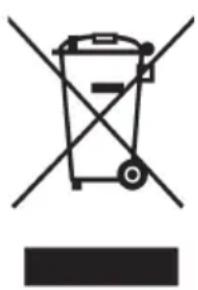
Symbol of a waste bin with no text or labels, crossed by two diagonal lines and a solid black rectangle below (no text or symbols present)Your appliance also contains various recyclable materials.
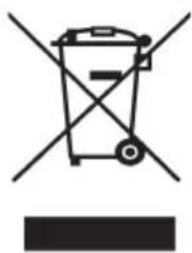
It is therefore marked with this logo to indicate that, in European Union countries
used appliances must not be mixed with other waste. Appliance recycling organised by your manufacturer will thus be carried out in optimum conditions, in accordance with European directive 2002/96/EC on waste electrical and electronic equipment. Consult your local authority or your retailer to find the drop-off points for used appliances nearest to your home. We thank you for your help in protecting the environment.

PERSONAL NOTE

PERSONAL NOTE
• 6 AFTER-SALES SERVICE
6.1 - SERVICE CALLS
Any maintenance on your equipment should be undertaken by:
- either your dealer,
- or another qualified mechanic who is an authorized agent for the brand appliances.
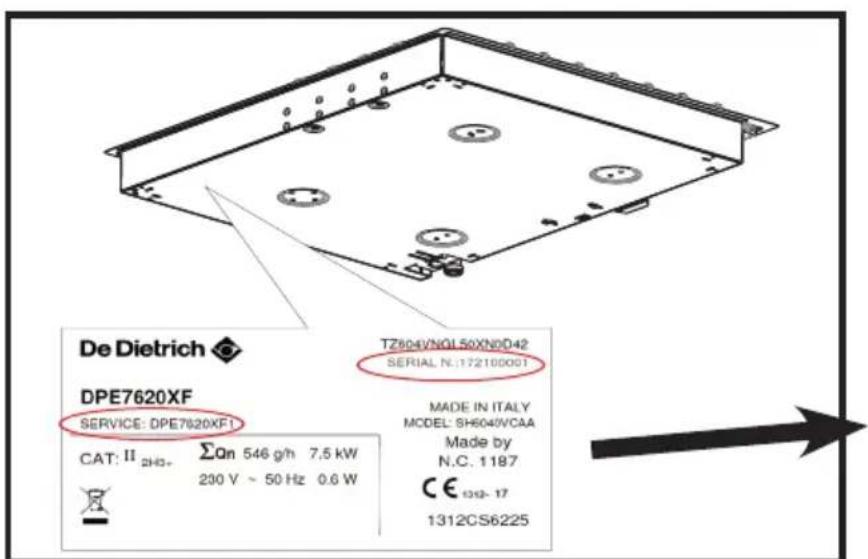
When making an appointment, state the full reference of your equipment (model, type and serial number).
This information appears on the manufacturer's nameplate attached to your equipment (6.1.1).
Find full information about the brand at :
www.de-dietrich.com
De Dietrich