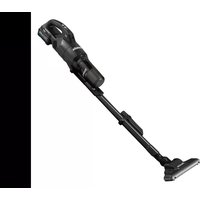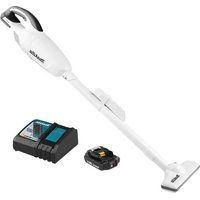
XLC02 - Vacuum Cleaner MAKITA - Free user manual and instructions
Find the device manual for free XLC02 MAKITA in PDF.


User questions about XLC02 MAKITA
0 question about this device. Answer the ones you know or ask your own.
Ask a new question about this device
Download the instructions for your Vacuum Cleaner in PDF format for free! Find your manual XLC02 - MAKITA and take your electronic device back in hand. On this page are published all the documents necessary for the use of your device. XLC02 by MAKITA.
USER MANUAL XLC02 MAKITA
MANUEL D'INSTRUCTION
natural_image
Line drawing of a single vacuum cleaner (no text or symbols present)010053
ENGLISH (Original instructions)
SPECIFICATIONS
| Model | XLC02 | |
| Capacity | 650 | |
| Continuous use (With battery BL1830) Approx. 20 m/n | ||
| Overall length 999 mm (39-5/16") | ||
| Net weight 1.2 kg (2.7 lbs) 1.5 kg (3.2 lbs) | ||
| Rated voltage D.C. 18 V | ||
| Standard battery cartridges BL1815 / BL1815N | / BL1820 BL1830 / BL1840 / BL1850 | |
- Due to our continuing program of research and development, the specifications herein are subject to change without notice.
- Specifications and battery cartridge may differ from country to country.
- Weight, with battery cartridge, according to EPTA-Procedure 01/2003
USA012-1
IMPORTANT
SAFETY INSTRUCTIONS
When using an electrical appliance, basic precautions should always be followed, including the following:
READ ALL INSTRUCTIONS BEFORE USING THIS APPLIANCE.
WARNING
- To reduce the risk of fire, electric shock or injury:
- Do not leave appliance when battery fitted. Remove battery from appliance when not in use and before servicing.
-
Do not expose to rain. Store indoors.
-
Do not allow to be used as a toy. Close attention is necessary when used by or near children.
- Use only as described in this manual. Use only manufacturer's recommended attachments.
- Do not use with damaged battery. If appliance is not working as it should, has been dropped, damaged, left outdoors, or dropped into water, return it to a service center.
- Do not handle appliance with wet hands.
- Do not put any object into openings. Do not use with any opening blocked; keep free of dust, lint, hair, and anything that may reduce air flow.
- Keep hair, loose clothing, fingers, and all parts of body away from openings and moving parts.
- Turn off all controls before removing the battery cartridge.
- Use extra care when cleaning on stairs.
- Do not use to pick up flammable or combustible liquids, such as gasoline, or use in areas where they may be present.
- Use only the charger supplied by the manufacturer to recharge.
-
Do not pick up anything that is burning or smoking, such as cigarettes, matches, or hot ashes.
-
Do not use without filters in place.
- Do not charge the battery outdoors.
SAVE THESE INSTRUCTIONS.
This appliance is intended for household use.
USB062-2
- Do not bring close to stoves or other heat sources.
- Do not block the intake hole or vent holes.
SAVE THESE INSTRUCTIONS.
ENC007-7
ADDITIONAL SAFETY RULES
- Read this instruction manual and the charger instruction manual carefully before use.
-
Do not pick up the following materials:
-
Hot materials such as lit cigarettes or spark/metal dust generated by grinding/cutting metal
- Flammable materials such as gasoline, thinner, benzine, kerosene or paint
- Explosive materials like nitroglycerin
- Ignitable materials such as Aluminum, zinc, magnesium, titanium, phosphorus or celluloid
- Wet dirt, water, oil or the like
- Hard pieces with sharp edges, such as wood chips, metals, stones, glasses, nails, pins or razors
- Powder to clot such as cement or tonor
- Conductive dust such as metal or carbon
-
Fine particle like concrete dust Such action may cause fire, injury and/or property damage.
-
Stop operation immediately if you notice anything abnormal.
-
If you drop or strike the cleaner, check it carefully for cracks or damage before operation.
IMPORTANT SAFETY INSTRUCTIONS
FOR BATTERY CARTRIDGE
- Before using battery cartridge, read all instructions and cautionary markings on (1) battery charger, (2) battery, and (3) product using battery.
- Do not disassemble battery cartridge.
- If operating time has become excessively shorter, stop operating immediately. It may result in a risk of overheating, possible burns and even an explosion.
- If electrolyte gets into your eyes, rinse them out with clear water and seek medical attention right away. It may result in loss of your eyesight.
- Do not short the battery cartridge:
(1) Do not touch the terminals with any conductive material.
(2) Avoid storing battery cartridge in a container with other metal objects such as nails, coins, etc.
(3) Do not expose battery cartridge to water or rain.
A battery short can cause a large current flow, overheating, possible burns and even a breakdown.
- Do not store the tool and battery cartridge in locations where the temperature may reach or exceed 50^ C ( 122^ F).
- Do not incinerate the battery cartridge even if it is severely damaged or is completely worn out. The battery cartridge can explode in a fire.
- Be careful not to drop or strike battery.
- Do not use a damaged battery.
SAVE THESE INSTRUCTIONS.
Tips for maintaining maximum battery life
- Charge the battery cartridge before completely discharged.
Always stop tool operation and charge the battery cartridge when you notice less tool power. - Never recharge a fully charged battery cartridge.
Overcharging shortens the battery service life. - Charge the battery cartridge with room temperature at 10^ C - 40^ C ( 50^ F - 104^ F). Let a hot battery cartridge cool down before charging it.
- Charge the battery cartridge once in every six months if you do not use it for a long period of time.
FUNCTIONAL DESCRIPTION
CAUTION:
- Always be sure that the tool is switched off and the battery cartridge is removed before adjusting or checking function on the tool.
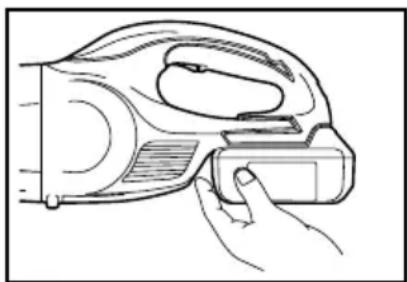
- Take care not to trap finger(s) between cleaner and battery as shown in diagram when loading battery.Trapping finger(s) may cause injury.
natural_image
Line drawing of a hand holding a handheld device with a handle (no text or symbols)010055
Installing or removing battery cartridge
text_image
Technical diagram of a device's internal components with numbered parts labeled 1, 2, and 3.012130
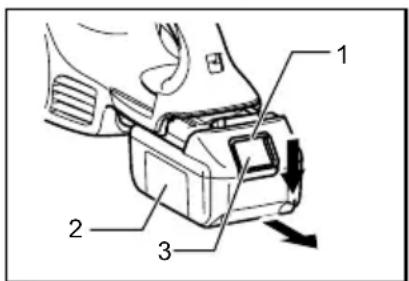
- Red indicator
- Battery cartridge
-
Button
-
Always switch off the tool before installing or removing of the battery cartridge.
- To remove the battery cartridge, slide it from the tool while sliding the button on the front of the cartridge.
- To install the battery cartridge, align the tongue on the battery cartridge with the groove in the housing and slip it into place. Always insert it all the way until it locks in place with a little click. If you can see the red indicator on the upper side of the button, it is not locked
completely. Install it fully until the red indicator cannot be seen. If not, it may accidentally fall out of the tool, causing injury to you or someone around you.
- Do not use force when installing the battery cartridge. If the cartridge does not slide in easily, it is not being inserted correctly.
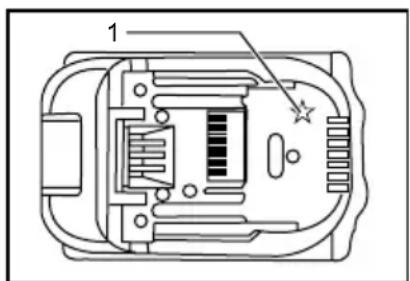
Battery protection system (Lithium-ion battery with star marking)
text_image
1- Star marking
012128
Lithium-ion batteries with a star marking are equipped with a protection system. This system automatically cuts off power to the tool to extend battery life.
The tool will automatically stop during operation if the tool and/or battery are placed under one of the following conditions:
. Overloaded:
The tool is operated in a manner that causes it to draw an abnormally high current.
In this situation, release the trigger switch on the tool and stop the application that caused the tool to become overloaded. Then pull the trigger switch again to restart.
If the tool does not start, the battery is overheated. In this situation, let the battery cool before pulling the trigger switch again.
- Low battery voltage:
The remaining battery capacity is too low and the tool will not operate. In this situation, remove and recharge the battery.
Switch action
text_image
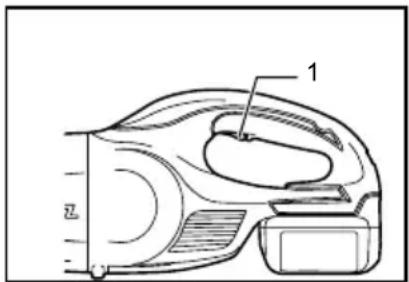
Technical diagram of a mechanical component with labeled parts and dimension line- Switch trigger
009986
⚠️CAUTION:
- Before inserting the battery cartridge into the tool, always check to see that the switch trigger actuates properly and returns to the "OFF" position when released.
To start the tool, simply pull the switch trigger. Release the switch trigger to stop.
ASSEMBLY
CAUTION:
- Always be sure that the tool is switched off and the battery cartridge is removed before carrying out any work on the tool.
Disposing of Dust
CAUTION:
· Empty the cleaner before it becomes too full, or the suction force weakens.
- Be sure to empty out the dust inside the cleaner itself. Failure to do so may cause the filter to be clogged or the motor to be damaged.
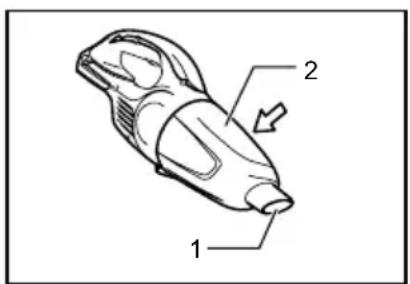
text_image
1 2- Suction inlet
- Capsule
009992
In order to drop dust sticking on the filter in the capsule, tap the capsule 4 or 5 times with your hand.
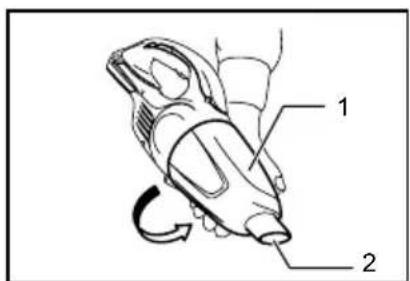
text_image
Diagram of a handheld device with labeled parts 1 and 2, showing internal structure and motion arrow.- Capsule
- Suction inlet
009993
Now point suction inlet downwards, turn capsule in direction of arrow in diagram, and disconnect capsule slowly and straight.
NOTE:
- Dust may spill out when capsule is opened, so be sure to set a garbage bag beneath capsule.
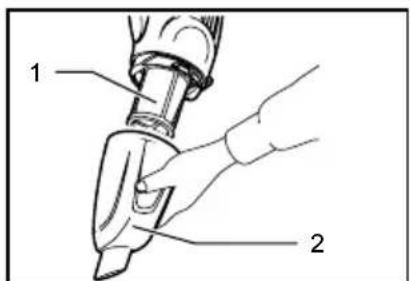
text_image
1 2-
Prefilter
-
Capsule
009994
Remove accumulated dust from inside of capsule and off of prefilter.
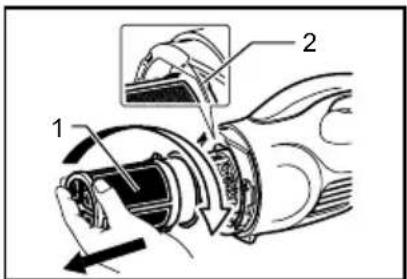
text_image
Technical diagram of a mechanical assembly with labeled parts 1 and 2, showing directional arrows and components.-
Prefilter
-
Securing lip
009995
Twist prefilter in direction of arrow to unfasten securing lip from cleaner unit and then pull off prefilter.
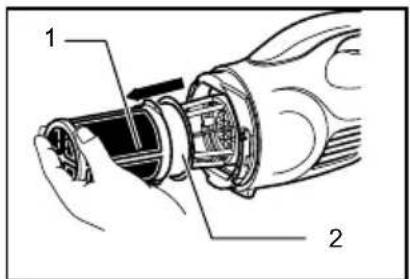
text_image
1 2-
Prefilter
-
Filter
009996
Clean out fine dust from prefilter. Next, remove filter, and lightly tap to dislodge dust.
Reassembly
natural_image
Technical line drawing of a mechanical component with an arrow indicating direction (no text or symbols)- Filter
009997
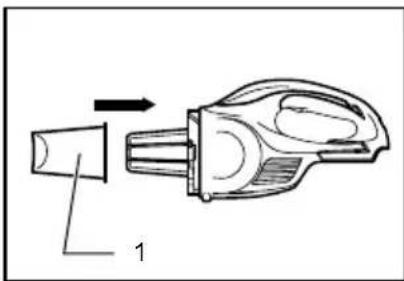
Put on filter until it is fully in position on the cleaner unit.
NOTE:
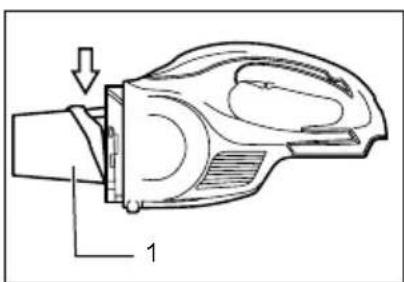
- Make sure filter is put on straight without being peeled back. If filter is put on incorrectly as shown in diagram, dust will get into motor housing, and cause motor failure.
natural_image
Technical line drawing of a mechanical component with labeled parts (no text or symbols present)- Filter
010005
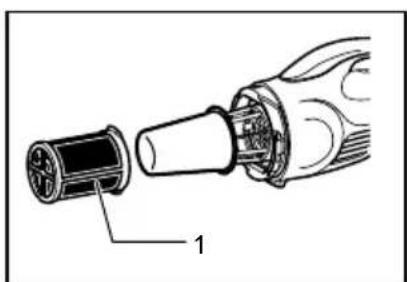
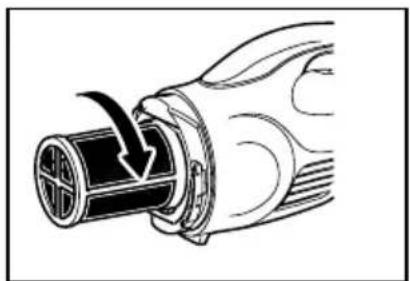
Connect prefilter. At this time, make sure to twist prefilter so that securing lip is firmly locked into cleaner unit.
natural_image
Cross-sectional diagram of a plug with internal components, labeled with number 1 (no text or symbols beyond label)- Prefilter
009999
natural_image
Diagram of a mechanical component with an arrow indicating rotation or force direction (no text or symbols)010000
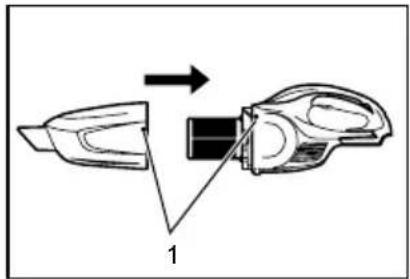
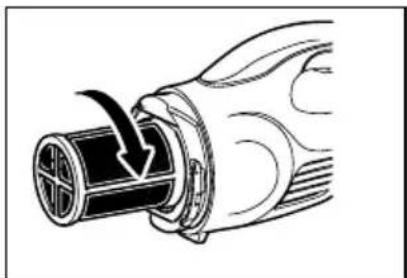
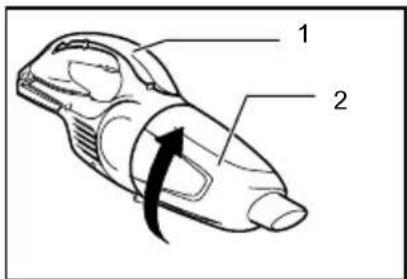
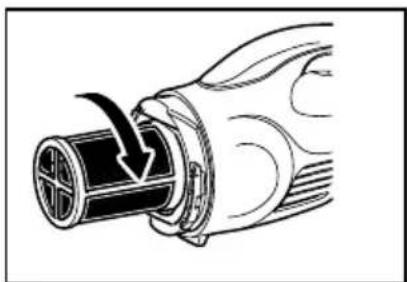
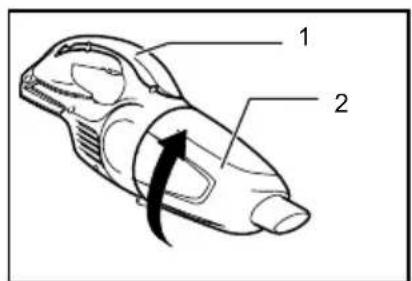
Connect capsule. Align O symbol on capsule with O symbol on handle and then firmly twist capsule in direction of arrow until it is secured.
natural_image
Diagram of a device being inserted into a housing, showing internal components and an arrow indicating direction (no text or symbols)010001
1. Mark

text_image
Technical diagram of a handheld device with labeled parts 1 and 2, showing internal structure and motion arrow.010002
1. Handle
2. Capsule
NOTE:
· Always remove dust ahead of time, as suction power will be reduced if there is too much dust in cleaner.
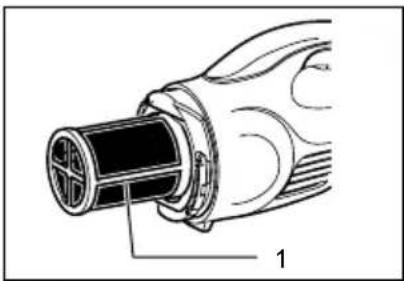
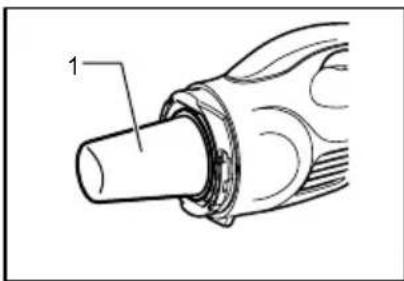
• Always be sure to check that both filter and prefilter are loaded correctly prior to using cleaner. If they are not loaded correctly, dust will get into the motor housing, and cause motor failure. If the following examples occur, filter and prefilter are not loaded correctly. Reload them correctly to rectify problem.
Problem Examples
Example 1: Only prefilter has been loaded (no filter)
natural_image
Technical line drawing of a mechanical component with no visible text or symbols- Prefilter
010003
Example 2: Only filter has been loaded (no prefilter)
natural_image
Technical line drawing of a mechanical component with labeled part 1 (no text or symbols beyond label)- Filter
010004
Example 3: Filter has been loaded in a peeled back state
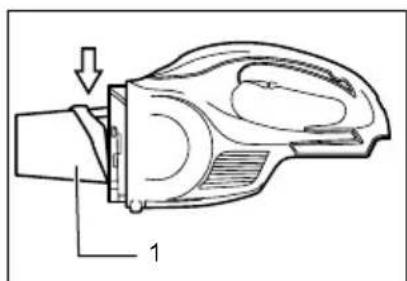
natural_image
Technical line drawing of a mechanical component with labeled parts (no text or symbols present)- Filter
010005
Example 4: Prefilter's securing lip is not firmly locked into groove of cleaner housing
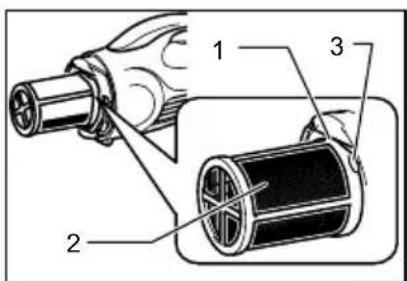
text_image
Technical diagram of a mechanical device with labeled parts 1, 2, and 3- Groove of cleaner housing
- Prefilter
- Securing lip
010006
OPERATION
⚠️CAUTION:
- To connect attachments, such as nozzle, twist-insert attachment in direction of arrow to ensure secure connection during use. To disconnect attachment, twist-extract also in direction of arrow.
If attachment is twisted in the opposite direction, when being connected or disconnected, capsule may become loose.
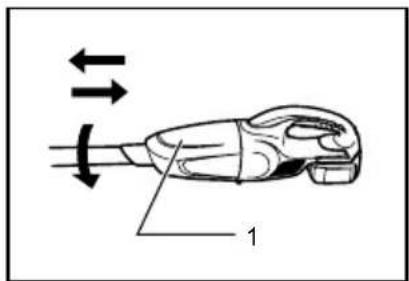
text_image
Diagram of a mechanical component with directional arrows and labeled parts 1 and 2- Capsule
009987
Cleaning (Suction)
Nozzle
Attach the nozzle to clean off tables, desks, furniture, etc. Nozzle slips on easily.
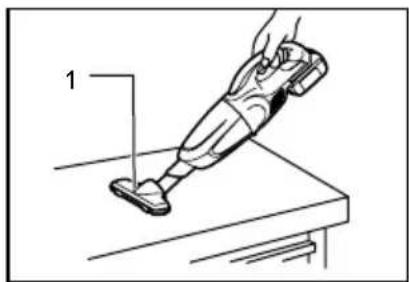
natural_image
Line drawing of a hand using a vacuum cleaner on a workbench (no text or symbols)- Nozzle
010056
Nozzle + Extension wand (Straight pipe)
The extension wand fits in between the nozzle and the cleaner itself. This arrangement is convenient for cleaning a floor while standing erect.
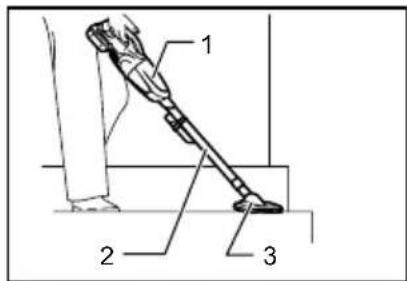
text_image
1 2 3010058
- Cleaner body
- Extension wand
- Nozzle
Corner nozzle
Fit on the corner nozzle for cleaning corners and crevices of a car or furniture.
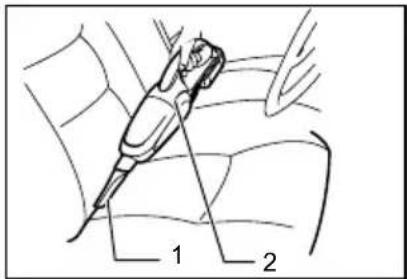
text_image
Diagram showing a car interior with labeled parts 1 and 2, likely indicating parts of the vehicle's seat or steering wheel.010059
- Corner nozzle
- Cleaner body
Corner nozzle + Extension wand (Straight pipe)
In tight quarters where the cleaner itself cannot squeeze in, or in high places hard to reach, use this arrangement.
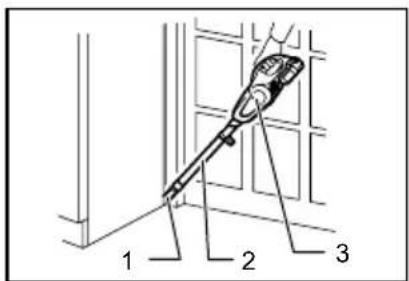
text_image
1 2 3010060
- Corner nozzle
- Extension wand
- Cleaner body
Cleaning without nozzle
You can pick up powder and dust without nozzle.
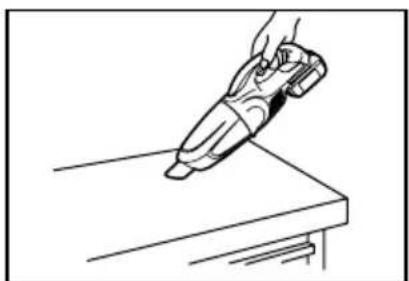
natural_image
Line drawing of a hand holding a pen above a flat surface (no text or symbols)010057
MAINTENANCE
⚠️CAUTION:
· Always be sure that the tool is switched off before attempting to perform inspection or maintenance.
Cleaning
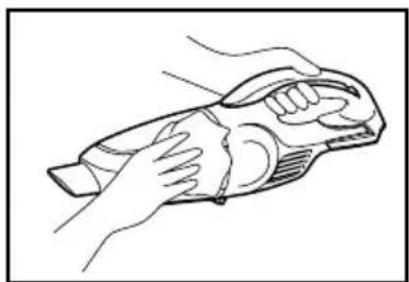
natural_image
Line drawing of a hand holding a handheld device (no text or symbols)010008
From time to time wipe off the outside (cleaner body) of the cleaner using a cloth dampened in soapy water.
Clean out also the suction opening, dust bag/dust pack mounting area and the dust stopper.
⚠️ CAUTION:
- Never use gasoline, benzine, thinner, alcohol or the like. Discoloration, deformation or cracks may result.
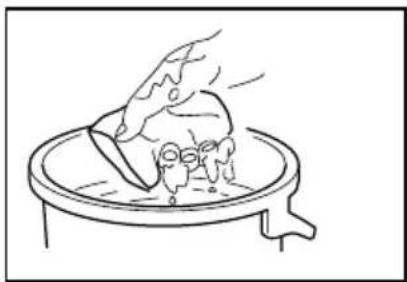
natural_image
Simple line drawing of a hand pressing down on a circular object with a handle (no text or symbols)010009
Wash the filter in soapy water when it is clogged with dust and the cleaner power becomes small. Dry it out thoroughly before use. An insufficiently dried filter may cause poor suction and shorten the service life of the motor.
Do not blow dust stlicking on the cleaner by air duster. It brings dust into the housing and causes failure.
Things to Check Before Asking for Repairs
| Symptom Area to be investigated Fixing method | ||
| Weak suction power | •Is filter clogged?Is battery exhausted? | • Empty dust from capsule.Is capsule full of dust?• Dust down or wash filter.Recharge battery. |
| Not working | • Is battery exhausted? | • Recharge battery. |
010051
NOTE:
- Do not attempt to repair cleaner by yourself.
To maintain product SAFETY and RELIABILITY, repairs, any other maintenance or adjustment should be performed by Makita Authorized or Factory Service Centers, always using Makita replacement parts.
OPTIONAL ACCESSORIES
⚠️CAUTION:
• These accessories or attachments are recommended for use with your Makita tool specified in this manual. The use of any other accessories or attachments might present a risk of injury to persons. Only use accessory or attachment for its stated purpose.
If you need any assistance for more details regarding these accessories, ask your local Makita Service Center.
- Extension wand (Straight pipe)
- Nozzle
- Nozzle for carpet
. Shelf brush
· Corner nozzle
. Round brush - Flexible hose
- Filter
. Prefilter - Various type of Makita genuine batteries and chargers
NOTE:
- Some items in the list may be included in the tool package as standard accessories. They may differ from country to country.
MAKITA LIMITED ONE YEAR WARRANTY
Warranty Policy
Every Makita tool is thoroughly inspected and tested before leaving the factory. It is warranted to be free of defects from workmanship and materials for the period of ONE YEAR from the date of original purchase. Should any trouble develop during this one year period, return the COMPLETE tool, freight prepaid, to one of Makita's Factory or Authorized Service Centers. If inspection shows the trouble is caused by defective workmanship or material, Makita will repair (or at our option, replace) without charge.
This Warranty does not apply where:
• repairs have been made or attempted by others:
• repairs are required because of normal wear and tear:
• the tool has been abused, misused or improperly maintained:
• alterations have been made to the tool.
IN NO EVENT SHALL MAKITA BE LIABLE FOR ANY INDIRECT, INCIDENTAL OR CONSEQUENTIAL DAMAGES FROM THE SALE OR USE OF THE PRODUCT. THIS DISCLAIMER APPLIES BOTH DURING AND AFTER THE TERM OF THIS WARRANTY.
MAKITA DISCLAIMS LIABILITY FOR ANY IMPLIED WARRANTIES, INCLUDING IMPLIED WARRANTIES OF "MERCHANTABILITY" AND "FITNESS FOR A SPECIFIC PURPOSE," AFTER THE ONE YEAR TERM OF THIS WARRANTY.
This Warranty gives you specific legal rights, and you may also have other rights which vary from state to state. Some states do not allow the exclusion or limitation of incidental or consequential damages, so the above limitation or exclusion may not apply to you. Some states do not allow limitation on how long an implied warranty lasts, so the above limitation may not apply to you.
EN0006-1
natural_image
Line drawing of a hand holding a handheld device (no text or symbols)010055
text_image
Technical diagram of a device's internal components with numbered parts labeled 1, 2, and 3.012130
natural_image
Technical diagram of a device internal structure with labeled components (no text or symbols)- Étoile
012128
text_image
Technical diagram of a mechanical component with labeled parts and dimension line- Gâchette
009986
ATTENTION:
text_image
Technical diagram of a mechanical device with labeled parts 1 and 2, showing internal components and motion indicators.text_image
Technical diagram of a mechanical assembly with labeled parts 1 and 2, showing directional arrows and components.text_image
Technical diagram of a mechanical device with labeled component '1' and directional arrow indicating motion or assembly.- Filtre
009997
natural_image
Technical line drawing of a mechanical component with an arrow indicating direction (no text or symbols present)- Filtre
010005
natural_image
Diagram of a mechanical component with a cylindrical shaft and flanged end, labeled with number 1 (no text or symbols present)- Préfiltre
009999
natural_image
Diagram of a plug being inserted into a housing, showing fluid flow direction (no text or symbols)010000
natural_image
Diagram of a device being cut with an arrow indicating direction, no text or symbols present- Symbole
010001
text_image
Technical diagram of a device with labeled parts 1 and 2, showing internal structure and motion direction.natural_image
Technical line drawing of a mechanical component with no visible text or symbols- Préfiltre
010003
natural_image
Technical line drawing of a mechanical component with labeled part '1' (no text or symbols beyond label)- Filtre
010004
natural_image
Technical line drawing of a mechanical component with labeled parts (no text or symbols present)- Filtre
010005
text_image
Technical diagram of a mechanical device with labeled parts 1, 2, and 3010006
text_image
Diagram of a mechanical device with directional arrows and labeled component '1'009987
- Bac à poussière
natural_image
Line drawing of a hand using a vacuum cleaner to lift a surface, with no text or symbols present.- Buse
010056
text_image
Diagram of a car interior showing a lever mechanism with labeled parts 1 and 2010059
natural_image
Line drawing of a hand holding a pen above a surface, no text or symbols present010057
ENTRETIEN
ATTENTION:
natural_image
Line drawing of hands holding a handheld device (no text or symbols)010008
natural_image
Simple line drawing of a hand using a tool to clean or wash food on a plate (no text or symbols)010009
natural_image
Line drawing of a hand holding a handheld device (no text or symbols)010055
text_image
Diagram of a car interior showing labeled parts 1, 2, and 3 with directional arrows indicating movement or flow.text_image
Diagram of a robotic hand with labeled parts 1 and 2, showing mechanical components and motion direction.text_image
Technical diagram of a mechanical assembly with labeled parts 1 and 2, showing directional arrows and components.natural_image
Technical line drawing of a mechanical device with an arrow indicating direction (no text or symbols)- Filtro
009997
natural_image
Technical line drawing of a mechanical component with an arrow indicating direction (no text or symbols present)- Filtro
010005
natural_image
Diagram of a plug assembly showing internal components and a labeled part (no text or symbols present)- Prefiltrar
009999
natural_image
Diagram of a plug with a black connector and flame-like blades, showing internal structure (no text or symbols)010000
natural_image
Diagram of a device with an arrow indicating direction, showing two components (no text or symbols present)- Marca
010001
text_image
Technical diagram of a handheld device with labeled parts 1 and 2, showing internal structure and motion arrow.- Mango
- Cápsula
010002
NOTA:
natural_image
Technical line drawing of a mechanical component with no visible text or symbols- Prefiltrar
010003
natural_image
Technical line drawing of a mechanical component with no visible text or symbols- Filtro
010004
natural_image
Technical line drawing of a mechanical component with an arrow indicating direction (no text or symbols present)- Filtro
010005
text_image
Technical diagram of a mechanical device with labeled parts 1, 2, and 3text_image
Diagram of a mechanical device with directional arrows and labeled component '1'- Cápsula
009987
Aspirado (succión)
Boquilla
natural_image
Line drawing of a hand using a vacuum cleaner to lift a surface, with no text or symbols present.- Boquilla
010056
Boquilla + Vara de extensión (tubo recto)
natural_image
Line drawing of a hand holding a pen above a flat surface (no text or symbols)010057
MANTENIMIENTO
PRECAUCIÓN:
natural_image
Line drawing of hands holding a handheld device (no text or symbols)010008
natural_image
Line drawing of a hand using a tool to clean or store items on a stove (no text or symbols)010009
Some dust created by power sanding, sawing, grinding, drilling, and other construction activities contains chemicals known to the State of California to cause cancer, birth defects or other reproductive harm. Some examples of these chemicals are:
- lead from lead-based paints,
• crystalline silica from bricks and cement and other masonry products, and
• arsenic and chromium from chemically-treated lumber.
Your risk from these exposures varies, depending on how often you do this type of work. To reduce your exposure to these chemicals: work in a well ventilated area, and work with approved safety equipment, such as those dust masks that are specially designed to filter out microscopic particles.