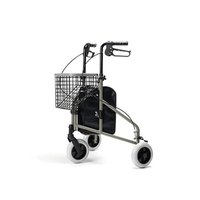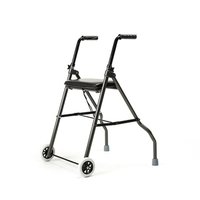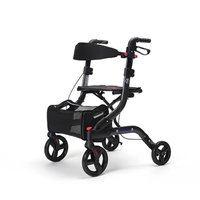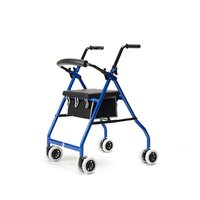
276 - Medical walker Vermeiren - Free user manual and instructions
Find the device manual for free 276 Vermeiren in PDF.


User questions about 276 Vermeiren
0 question about this device. Answer the ones you know or ask your own.
Ask a new question about this device
Download the instructions for your Medical walker in PDF format for free! Find your manual 276 - Vermeiren and take your electronic device back in hand. On this page are published all the documents necessary for the use of your device. 276 by Vermeiren.
USER MANUAL 276 Vermeiren
natural_image
Modern mobility bicycle with black seat, silver frame, and shopping basket (no text or symbols visible)Contents
EN
Preface 4
1. Your product 5
2. Before use 6
2.1. Intended use and indications 6
2.2. Safety instructions and applicable risks 7
2.3. Symbols on the rollator 8
2.4. Upon delivery 9
2.5. Shipping and storage 9
3. Assembly/Disassembly and adjustments 10
3.1. Assembly 10
3.2. Height adjustments 10
3.3. Adjusting the brakes 12
4. Using your rollator 12
4.1. Brake system 12
4.2. Folding/Unfolding 13
4.3. Sitting down, standing up and walking 14
5. Maintenance 15
5.1. Cleaning 15
5.2. Disinfection 15
5.3. Inspection / Service / Repairs 15
5.4. Reuse 16
5.5. Disposal at end of life 16
6. Technical specifications 17
Preface
Congratulations! You are now owner of a Vermeiren rollator!
Thank you for your trust in the products of Vermeiren. To support you on the use of this rollator and its operating options, this manual is offered. Please read it carefully; it will help you to get familiar with the operation, capabilities and limitations of your rollator.
If you still have questions after reading this manual, do not hesitate to contact your specialist dealer. He/she will be glad to help you.
Important note
To ensure your safety, and to prolong the lifetime of your product, please take good care of it and have it checked and serviced on a regular basis.
This manual reflects the latest product developments. Vermeiren has the right to implement changes to this type of product without any obligation to adapt or replace similar products previously delivered.
Pictures of the product are used to clarify the instructions. Details of the depicted product may deviate from your product.
Information available
On our website http://www.vermeiren.com/ you will always find the most recent version of the following information. Please consult this website regularly for possible updates.
Visually impaired people can download the electronic version of this manual and have it read out by means of a text-to-speech software application.
 | User manualFor user and specialist dealer |
 | Service manual for rollatorsFor specialist dealer |
1. Your product
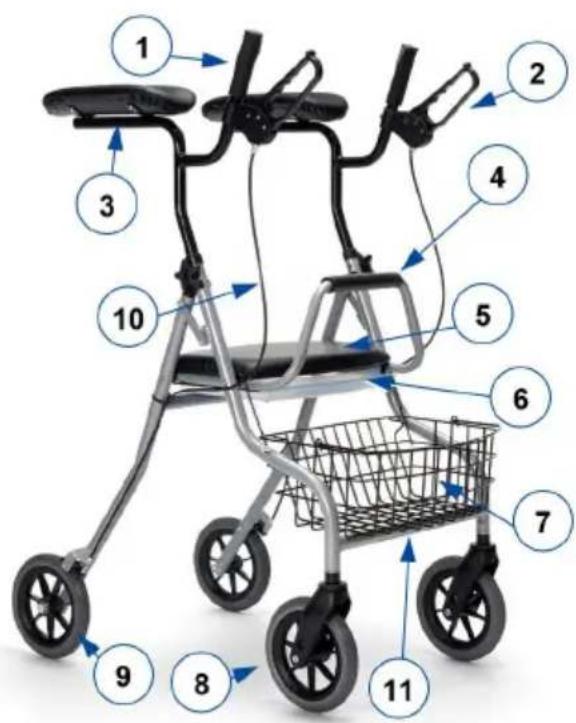
text_image
Diagram of a 11-wheeled car with numbered parts and directional arrows indicating components.- Handgrips
- Brake lever
- Underarm support
- Backrest
- Seat
- Plastic tray
- Basket
- Front wheels
- Rear wheels
- Brake cable
- Identification plate
2. Before use
2.1. Intended use and indications
• This product is a medical device.
- Indications and contraindications: The rollator is meant as support of the leg function during walking and daily activities. With the underarm supports, it is specifically suited for users suffering from mobility impairments involving reduced movement/balance but with sufficiently preserved walking ability and coordination, when the use of the standard rollator is not possible due to impaired hand function and the use of other walking aids is insufficient. Do not use the rollator if you have other physical limitations that may cause unsafe use of your rollator, like a weak arm, balance disorders, impaired vision, limb loss, ...
- The rollator is designed and produced solely to be used as walking aid for one person with a maximum weight of 120 kg.
- The rollator will compensate the lack of adequate support by the legs by leaning on, or moving with, the rollator with usage of the upper limbs or chest. The rollator will provide better stability, support and safety during walking.
- The rollator can be used indoors and outdoors.
- It is not intended for transport of goods and/or more people than the user. It is also not intended to be used as a transport aid while sitting down.
- It should only be used on surfaces where all four wheels are touching the ground. Do not use the rollator on rocky, bumpy or sandy terrain, or places with a steep inclination. The rollator may become unstable. Look for flat, stable areas, and bevelled kerbs to walk with your rollator.
- The warranty on this product is based on normal use and maintenance as described in this manual. Damage to your product caused by improper use or lack of maintenance will cause the warranty to lapse.
- Please check all technical details and limits of your rollator in §6..
2.2. Safety instructions and applicable risks
CAUTION
Risk of injuries
- Please read and follow the instructions in this manual. Otherwise you may get injured, or your product may get damaged.
Keep the following general warnings in mind during use:
- Check that no stones or other objects block the wheels of the rollator.
- Make sure that both brake levers are in parking mode before you use the rollator as aid to stand up. When you are standing comfortable and stable, you can unlock the parking brakes.
- While walking, keep both hands on the handgrips.
- Be aware that some parts of your rollator may get very hot or cold due to ambient temperature, solar radiation, heating devices, etc. Be careful when touching.
• Before every use, check that the height adjustments are firmly secured, see §3.2.. - Do not hold the handgrips with wet hands. If you do so, you can lose your grip and lose your balance.
- Do not proceed with your rollator into traffic. Always stay on the pavement.
- Take note of the instructions for care and service. The manufacturer is not liable for damage caused by improper servicing / care.
Any serious incident [MDR (EU) 2017/745 §2 (65)] that has occurred in relation to the device should be reported to the manufacturer and the competent authority of the Member State in which the user and/or patient is established.
Be aware that your rollator may interfere with some types of anti-theft systems, depending on the settings used. This may cause the shop's alarm to go off.
2.3. Symbols on the rollator
 | Maximum weight of the user in kg |
 | Type designation |
 | Catalogue number |
 | Serial number |
 | Medical device |
 | Manufacturer |
 | Date of manufacture |
 | Declaration of conformity |
 | Attention: important information |
 | It is advised to read the manual |
2.4. Upon delivery
Unpack your product and verify if the delivery is complete. The following items should be included:
- Base frame with seat, 4 wheels, backrest;
- Handgrips with brakes
- Basket
- Plastic tray
- Manual
Verify your product for transport damage. If you find any damages after delivery, contact the transporter.
2.5. Shipping and storage
The shipping and storage of the rollator should happen according to the technical specifications in §6.. Make sure that the rollator is stored dry.
Provide sufficient covering or packaging to protect the rollator from rust and foreign bodies (e.g. salt water, sea air, sand, dust).
Make sure no objects are stored on or against the rollator to prevent damage.
3. Assembly/Disassembly and adjustments
3.1. Assembly
- Slide the handgrips in the front frame.
- Adjust the handgrips to the desired height (see §3.2.).
CAUTION
Risk of falling or tipping over
- Do not overload the basket.
The maximum carrying weight of the shopping basket can be found in §6..
The plastic tray can be inserted from the front below the seat. If you want to use the tray, it can be placed on top of the basket.
The shopping basket is mounted to the frame below the seat with 2 hooks. The bottom of the basket rests on the front transversal tube (between the front wheels).
3.2. Height adjustments
CAUTION
Risk of falling or tipping over
- Firmly fix the handgrips before using the rollator.
- Do not exceed the minimum or maximum adjustment as indicated on the handgrips. Your rollator will not be stable anymore.
CAUTION
Risk of damage
- Don't pull the handgrips too high to prevent damage to the brake cable.
3.2.1. Handgrip height
The rollator can be altered in height by adjusting the handgrips:
- Put your rollator in parking mode, see §4.1..
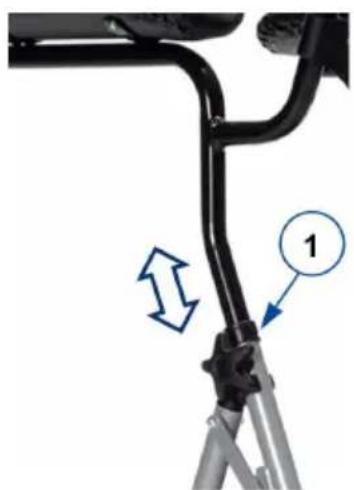
- Loosen and remove the star button (1).
- Remove the bolt from the tube.
- Adjust the handle to the desired height (7 positions, steps of 25 mm).
- Place the bolt back in the hole of the tube.
-
Place the star button (1) on the bolt. Retighten firmly by hand.
-
Repeat for the second handgrip. Make sure that both handgrips are well secured, and that they are set to the same height.
text_image
Diagram showing a bicycle track with labeled components and directional arrows indicating motion or movement.EN
3.3. Adjusting the brakes
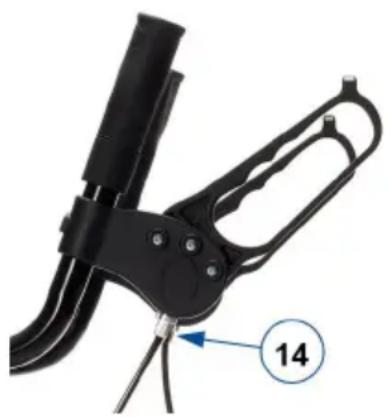
The force of the brakes can be adjusted by loosening/tightening the screw (14) on the back of the brake lever.
natural_image
Close-up of a black mechanical tool with a numbered label '14' pointing to a component (no readable text or symbols beyond the number)4. Using your rollator
4.1. Brake system
CAUTION
Risk of falling
- Check the working of the brakes to ensure your safety. The condition of the brakes is influenced by wear, oil and other contamination of the rear wheels and braking mechanism.
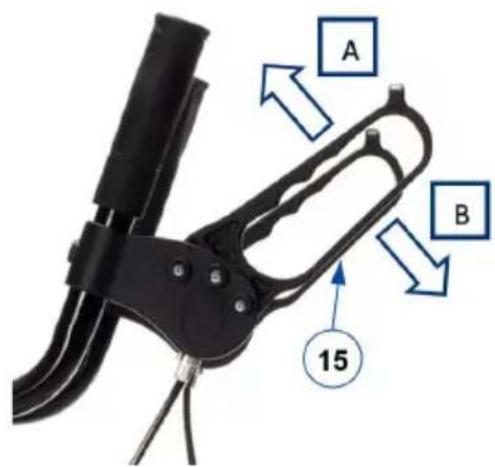
The rollator is equipped with brakes, operated by two brake levers (15). The brake levers operate in two modes: running brakes and parking brakes.
CAUTION
Risk of damage
- Do not push the rollator too hard while using the running brakes. This may cause damage to the tyres or brakes.
To use the running brakes, pull both brake levers (15) simultaneously upwards [A] in a squeezing motion. To stop braking, release the brake levers.
To use the parking brakes, push both brake levers (15) downwards in locked position [B]. Always use both parking brakes simultaneously. To end the parking mode, pull both brake levers simultaneously upwards.
text_image
A B 154.2. Folding/Unfolding
CAUTION
Risk of entrapment
- Keep fingers, buckles, jewellery and clothes away from the folding mechanism.
CAUTION
Risk of falling
- Check that the rollator is completely open and that the frame is locked.
text_image
Diagram of a two-step car stroller with labeled parts and directional arrows indicating motion or change.EN
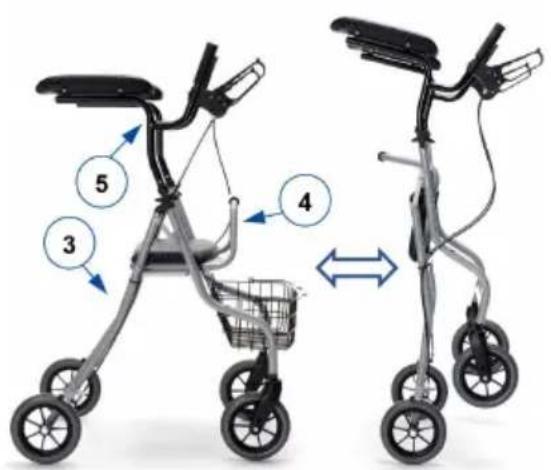
4.2.1. Unfolding the rollator
- Push both brake levers down to parking position, see §4.1..
- Pull the rear frame tubes (3) backwards to open the frame. Push down on the backrest (4) to make sure that the frame is fully opened.
- Place the shopping basket and plastic tray.
- Adjust the rollator to the desired height (see §3.2.).
4.2.2. Folding the rollator
- Stand behind the rollator.
- Remove the shopping basket and plastic tray.
- Close the frame completely by pushing front and rear frame tubes together.
4.3. Sitting down, standing up and walking
CAUTION
Risk of falling
- Make sure that both brake levers are in parking position before sitting down, see §4.1.. Keep the brake levers in this position until you start walking again. Keep your feet between the rear wheels.
-
Do not propel the rollator while seated.
-
Push both brake levers down to parking position.
- While leaning on the handgrips, turn around and sit down on the seat.
- To stand up again, lean on the handgrips and turn around.
- Pull both brake levers up and use the running brakes.
- Release the brake levers and step forward with the rollator close to your body.
5. Maintenance
EN
i Regular care ensures that your rollator is preserved in a perfectly functional condition. For the maintenance manual, refer to the Vermeiren website: www.vermeiren.com.
5.1. Cleaning
Use a soft, damp cloth and lukewarm water with a mild household soap to clean the rollator. Avoid soaking. Do not use abrasive cleaning agents to clean.
5.2. Disinfection
CAUTION
Risk of damage
• Disinfections may only be undertaken by trained persons. Consult your specialist dealer.
Use a soft, damp cloth and lukewarm water with a mild household disinfectant to clean the rollator.
5.3. Inspection / Service / Repairs
The expected service life of your rollator is 5 years. The lifespan of the rollator is influenced by its use, storage, maintenance, service and cleaning.
Before you resume use of the rollator, it should be inspected on the following points:
- Completeness.
- Folding mechanism: functioning well.
- Bolts and nuts: tightly fastened.
- Brakes: functioning well.
-
Wheels (stability, tracking, fixing screws).
-
In case of regular contact with wires, hair or other residues, the wheels may get blocked. Check regularly that the wheels rotate freely and that they are in good condition.
• Frame (deformation, stability, connections). - Handgrips (safe locking of height adjustment system, good support of handgrips).
Your rollator is constructed of aluminium and plastic components. We recommend to have your product inspected at least once a year, but the service frequency depends on the frequency and intensity of use. Consult your specialist dealer to make an agreement on service frequency.
Repairs and replacements may only be undertaken by trained persons, and only genuine replacement parts of Vermeiren should be used.
Do not hesitate to use the services offered by your specialist dealer. He/she will be glad to assist you regarding any service and repairs.
5.4. Reuse
Before each reuse, have the rollator disinfected, inspected and serviced according to the instructions in §5.2. and §5.3.
5.5. Disposal at end of life
At end of life, you need to dispose your rollator according to the local environmental legislation. The best way to do so, is to disassemble the rollator to facilitate the transport of recyclable parts.
6. Technical specifications
EN
The technical details below are only valid for this rollator, at standard settings and optimal ambient conditions. Take these details into account during use.
| Brand Vermeiren | |
| Product group Rollator | |
| Type 276 | |
| Description Dimensions | |
| Maximum user weight 120 kg | |
| Maximum basket load 5 kg | |
| Overall length 750 mm | |
| Folded length 440 mm | |
| Overall width 630 mm | |
| Folded width 630 mm | |
| Overall height 1100 - 1230 mm | |
| Folded height 1100 - 1230 mm | |
| Handgrip height | 1100 - 1230 mm |
| Recommended body height | 1650 - 1900 mm |
| Distance between handgrips | 445 mm |
| Seat height | 570 mm |
| Seat width | 440 mm |
| Seat depth | 210 mm |
| Total mass- without basket | 11 kg9,5 kg |
| Wheel diameter | 200 mm |
| Brakes | Running & parking brakes |
| Turning width 900 mm | |
| Storage and use temperature | +5°C - +41°C |
| Storage and use humidity | 30% - 70% |
| We reserve the right to introduce technical changes. Measurement tolerance +- 15 mm / 1,5 kg / 1,5° | |
Table des matières
Préface
19
1. Votre produit 20
text_image
Diagram of a children's mobility scooter with numbered parts for identification and usage.natural_image
Mechanical linkage diagram showing a black cable with directional arrows and a numbered label (1), no readable text or symbols beyond the number.natural_image
Close-up of a black mechanical clamp or bracket with a blue arrow pointing to a numbered label '14' (no text or symbols on the clamp itself)text_image
Diagram of a two-step car stroller with labeled parts and directional arrows indicating motion or change.text_image
Diagram of a children's mobility device with numbered parts for identification and labeling.text_image
Diagram showing a mechanical linkage or cable assembly with labeled component '1' and directional arrows indicating motion.3.3. De remmen afstellen
natural_image
Close-up of a black mechanical clamp or bracket with a numbered label '14' pointing to a specific part (no text or symbols on the clamp itself)text_image
Diagram of a two-step car stroller with labeled parts and directional arrows indicating motion or change.text_image
Diagram of a child's mobility device with numbered parts for identification and tracking.natural_image
Mechanical linkage diagram showing a black cable with directional arrows and a numbered label (1), no readable text or symbols beyond the number.natural_image
Close-up of a black mechanical clamp or bracket with a numbered label (14) pointing to a specific part, no readable text or symbols present.text_image
Diagram of a child's mobility device with numbered parts for identification and labeling.text_image
Diagram showing a mechanical linkage with labeled component '1' and directional arrows indicating motion or force.natural_image
Close-up of a black mechanical clamp or tool with a numbered label '14' pointing to a specific part (no readable text or symbols beyond the label)text_image
Diagram showing a stroller with labeled parts and directional arrows indicating motion or change.text_image
Diagram of a child's mobility device with numbered parts for identification and tracking.natural_image
Mechanical linkage diagram showing a lever with directional arrows and a numbered label (1), no readable text or symbols present.natural_image
Close-up of a black mechanical clamp or bracket with a numbered label '14' pointing to a specific part (no text or symbols on the clamp itself)text_image
Diagram of a two-step car stroller with labeled parts and directional arrows indicating motion or change.text_image
Diagram of a child's mobility device with numbered parts for identification and labeling.text_image
Diagram showing a bicycle track with labeled component '1' and directional arrows indicating motion or movement.3.3. Seřízení brzd
natural_image
Close-up of a black mechanical clamp or tool with a numbered label '14' pointing to a specific part (no readable text or symbols beyond the number)4. Použití chodítka
CS
4.1. Brzdový systém
POZOR
Nebezpečí pádu
text_image
Diagram of a two-step car stroller with labeled parts and directional arrows indicating motion or change.Service registration form
This product (name): ....
was inspected (I), serviced (S), repaired (R) or disinfected (D):
| By (stamp):Kind of work: I / S / R / DDate: | By (stamp):Kind of work: I / S / R / DDate: | By (stamp):Kind of work: I / S / R / DDate: |
| By (stamp):Kind of work: I / S / R / DDate: | By (stamp):Kind of work: I / S / R / DDate: | By (stamp):Kind of work: I / S / R / DDate: |
| By (stamp):Kind of work: I / S / R / DDate: | By (stamp):Kind of work: I / S / R / DDate: | By (stamp):Kind of world: I / S / R / DDate: |
| By (stamp):Kind of work: I / S / R / DDate: | By (stamp):Kind of work: I / S / R / DDate: | By (stamp):Kind of work: I / S / R / DDate: |
| By (stamp):Kind of work: I / S / R / DDate: | By (stamp):Kind of work: I / S /R / DDate: | By (stamp):Kind of work: I / S / R / DDate: |
| By (stamp):Kind of work: I / S / R / DDate: | By (stamp):Kind of work: I / S / R / DDate: | By (stamp):Kind of work: I / S / R / DDate: |

VERMEIREN GROUP
Vermeirenplein 1/15
2920 Kalmthout
Belgium
www.vermeiren.com
Version: D, 2025-01
Basic UDI-DI: 54151741206062765U
All rights reserved, including translation.