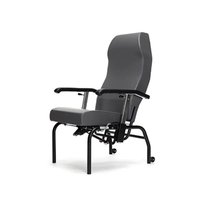
Languedoc - Wheelchair Vermeiren - Free user manual and instructions
Find the device manual for free Languedoc Vermeiren in PDF.


| Product Type | Reclining chair (wheelchair) |
| Brand | Vermeiren |
| Model | Languedoc |
| Intended Use | Indoor use, on flat and level floors, for elderly people, in rehabilitation or patients suffering from paralysis |
| Maximum Weight Capacity | 130 kg |
| Dimensions (without wheels) | Total width: 860 mm; Seat depth: 480 mm; Seat width: 500 mm; Front seat height: 500 mm; Total height: 1200 mm; Dismantled height: 490 mm |
| Dimensions (with wheels) | Total width: 685 mm; Front seat height: 520 mm; Total height: 1205 mm |
| Total weight (without wheels) | Approximately 22.4 kg |
| Total weight (with wheels) | Approximately 23.75 kg |
| Backrest angle | 13° to 45° |
| Angle between seat and leg rest | 0° to 90° |
| Armrest adjustment | Height adjustable in 19 mm increments, travel of 114 mm, low position for lateral transfer |
| Wheels and brakes | Optional wheels with parking brakes (model with wheels) |
| Materials and upholstery | Flame retardant fabric (EN 1021-1/2) |
| Expected service life | 5 years (under normal use and maintenance) |
| Operating and storage temperature | +5°C to +40°C |
| Operating and storage humidity | 30% to 70% |
| Maintenance | Clean with damp cloth and mild soap; inspect before each use |
| Certifications | Compliant with EN 1021-1, EN 1021-2 (flame resistance) |
| Accessories and spare parts | Use only accessories and parts approved by Vermeiren |
| Repairability | Repairs and replacements by trained personnel, original Vermeiren parts |
Frequently Asked Questions - Languedoc Vermeiren
User questions about Languedoc Vermeiren
0 question about this device. Answer the ones you know or ask your own.
Ask a new question about this device
Download the instructions for your Wheelchair in PDF format for free! Find your manual Languedoc - Vermeiren and take your electronic device back in hand. On this page are published all the documents necessary for the use of your device. Languedoc by Vermeiren.
USER MANUAL Languedoc Vermeiren
MANUEL D'UTILISATION
GEBRUIKSAANWIJZING
GEBRAUCHSANWEISUNG
natural_image
Blue medical rehabilitation chair with adjustable armrest and black legs (no text or symbols visible)EN
Instructions for specialist dealer
This instruction manual is part and parcel of the product and must accompany every product sold.
Version: B, 2022-10
FR
All rights reserved, including translation.
This page is intentionally left blank
Contents
Contents....1
Preface....2
1 This product....3
2 Before use ....4
2.1 Intended use 4
2.2 General safety instructions....4
2.3 Symbols on the chair....4
2.4 Assembly/Disassembly 5
2.5 Transport and storage 5
3 Using this chair....6
3.1 Transfer into and out of the chair 6
3.2 Comfort adjustments....6
3.3 Running wheels / Parking brakes (only with wheels) 8
4 Maintenance....9
4.1 Points of maintenance....9
4.2 Instructions for maintenance 9
4.3 Expected lifespan....9
4.4 Reuse....9
4.5 End of use....10
5 Technical specifications....11
Preface
Thank you for your trust in the products of Vermeiren. To support you on the use of this comfort chair and its operating options, this manual is offered. Please read it carefully; it will help you to get familiar with the operation, capabilities and limitations of your chair.
If you still have questions after reading this manual, do not hesitate to contact your specialist dealer. He/she will be glad to help you.
Important note
To ensure your safety and to prolong the lifetime of your product, please take good care of it and have it checked and serviced on a regular basis.
This manual reflects the latest product developments. Vermeiren has the right to implement changes to this type of product without being imposed to any obligation to adapt or replace similar products previously delivered.
Pictures are used to clarify the instructions in this manual. Details of the depicted product may deviate from your product.
Information available
On our website http://www.vermeiren.com/ you will always find the most recent version of the information in this manual. Please consult this website regularly for possible updates.
Visually impaired people can download the electronic version of this manual and have it read out by means of a text-to-speech software application.

This instruction manual
For user and specialist dealer

Service manual
For specialist dealer

EC declaration of conformity
1 This product
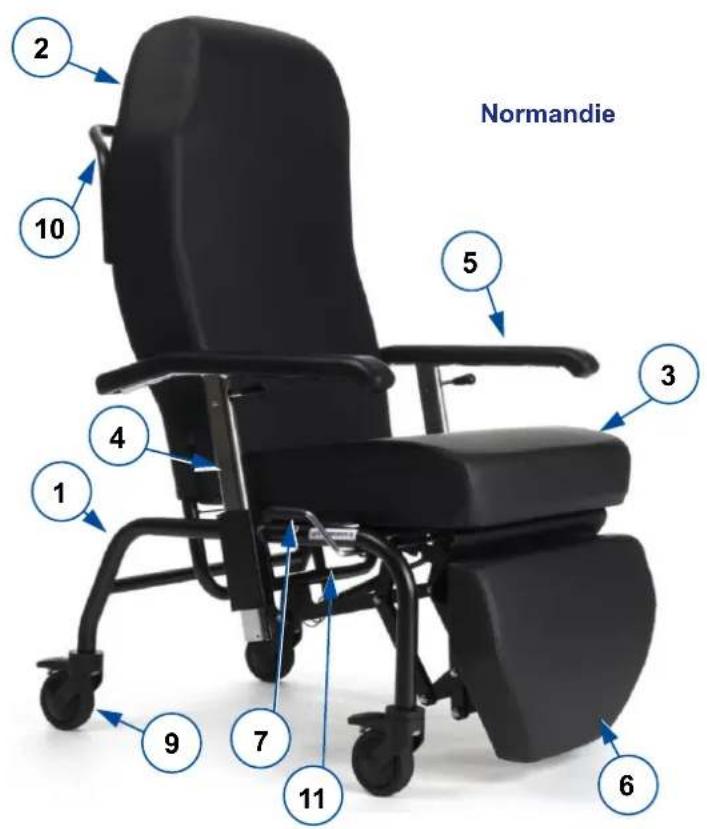
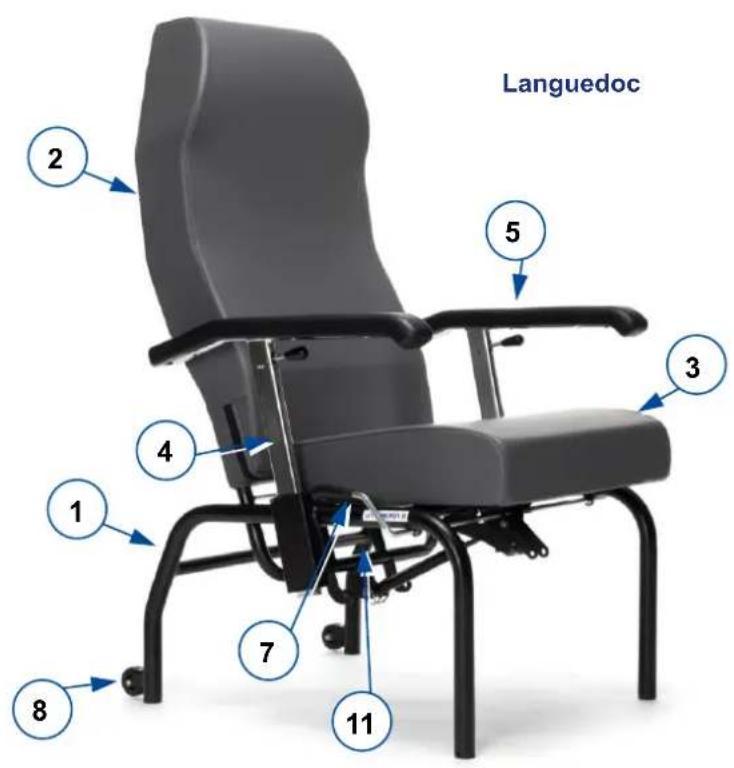
- Base frame
- Adjustable backrest
- Removable seat
- Height adjustable armrests
- Arm pads
- Leg rest
- Inclination lever (Normandie 2F: 2 levers)
- Transport wheels
- Wheels (optional)
- Push bar (optional)
- Identification plate
2 Before use
2.1 Intended use
In this paragraph a brief description of the intended use of your comfort chair is given. Additionally, relevant warnings are added to the instructions in the other paragraphs. In this way we would like to make you aware of the possible misuse that may appear.
- The comfort chair is intended to be used by the elderly, during revalidation, or by patients suffering from paralysis.
- This comfort chair is suitable for indoor use only, on flat, level grounds.
- This chair is designed and produced solely as seat and resting place for one (1) person with a maximum weight of 130kg. It is not designed for transport of goods or objects, nor for any other use as previously described.
- If applicable, only use accessories and spare parts approved by Vermeiren.
- Please read all technical details and limits of your chair in §5.
- The warranty on this product is based on normal use and maintenance as described in this manual. Damage to your product caused by improper use or lack of maintenance will cause the warranty to lapse.
2.2 General safety instructions

CAUTION
Risk of injuries and/or damage
Keep the following general warnings in mind during use:
- Be aware that some parts of this chair may get very hot or cold due to ambient temperature, solar radiation, heating devices. Be careful when touching. Use protective clothing if the weather is cold.
- Be careful when using possible causes of fire such as cigarettes since they may set the seat and back covers alight.
- Do not modify this shell chair in any way.
2.3 Symbols on the chair
The symbols in following list are applicable for your chair. Symbols can be found in the relevant ISO standard (ISO 7000, ISO 7001 and IEC 417).

Maximum weight of user in kg
Indoor use only
Type designation
The comfort chair complies to the requirements set up in:
EN 1021-1, EN1021-2: Resistance to ignition of upholstered parts
2.4 Assembly/Disassembly
Upon delivery of the comfort chair, the seat and backrest have to be installed before use. The seat and backrest can also be removed for easy transport.
2.4.1 Backrest
- Place the backrest tubes over the frame tubes.
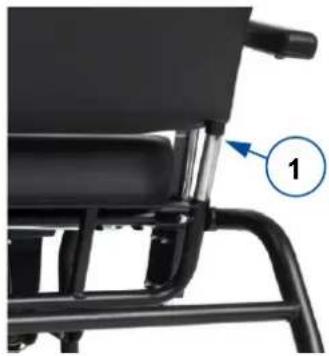
- Press the spring button (1) to slide the backrest down.
- Push the backrest all the way down until it is secured into place.
To remove the backrest, press the spring button beneath the upholstery and pull the backrest upwards until it detaches from the frame.
natural_image
Close-up of a black wheelchair chair with a blue circle highlighting the number 1 (no text or symbols on the chair itself)2.4.2 Seat
- Place the hooks on the rear side of the seat over the frame tube close to the backrest.
- Push down on the front side of the seat to fix it into place. You will hear a click.
To remove the seat, pull of the front of the seat until it detaches from the frame.
2.5 Transport and storage
CAUTION
Risk of injuries and damage
- Pay attention when passing with the chair through narrow passages.
- Make sure the passage is clear from objects, obstacles and persons.
2.5.1 Moving aside
- Check that the brakes of the comfort chair are engaged (only with wheels, see §3.3).
- Transfer the patient out the chair.
- Disengage the brakes (only with wheels).
- Place the backrest into the upright position.
-
Transport the chair to the desired place on a horizontal underground.
a) With wheels: Move the comfort chair by using its wheels and roll it to its destination.
b) Without wheels: Ask help to lift the chair with two persons. Firmly grasp the frame with both hands and lift it from the floor. Do not use leg rest(s), armrests, wheels or seat to grasp the chair. -
Engage the brakes (only with wheels).
2.5.2 Storage
CAUTION
Risk of damage
Make sure that your comfort chair is stored dry to prevent mould from growing and the upholstery from being damaged, see also technical details in §5.
3 Using this chair

WARNING
Risk of injuries
- First read previous chapters and inform yourself about the intended use. Do NOT use your chair unless you have read and fully understood all instructions.
- In case of doubts or questions, do not hesitate to contact your local specialist dealer, your care provider or technical adviser to help you on this.

CAUTION
Risk of injuries and/or damage
- Make sure that your fingers, clothes, belts, buckles or jewellery won't get caught by moving parts, during assembly, use or adjustment.
3.1 Transfer into and out of the chair

CAUTION
Risk of injuries or damage
- In case you cannot perform the transfer in a safe manner, ask someone to assist you.
- Check that the brakes of the comfort chair are engaged (only with wheels, see §3.3).
- Place the comfort chair in its most upright sitting position.
- Transfer to/out of the chair. Place the arm pad at the same height as the seat cushion for a sideways transfer (see paragraph 3.2.3).
3.1.1 Correct position in the chair
Sit down on the seat with the lower back against the backrest.
3.2 Comfort adjustments

CAUTION
Risk of injuries or damage
- Always apply the brakes before adjustments (only with wheels, see §3.3).
3.2.1 Backrest inclination Normandie/Languedoc

CAUTION
Risk of injuries or damage
- Be sure that the comfort chair does not tip over backwards when it is placed in its most backwards position.
- Make sure that no objects or individuals are in the adjusting area (see entrapment zones).
The angle of the backrest and the leg rest can be adjusted by means of a gas spring.
Entrapment zones are indicated in the figure below by (1).
To incline the comfort chair:
- Engage the brakes (only with wheels, see §3.3).
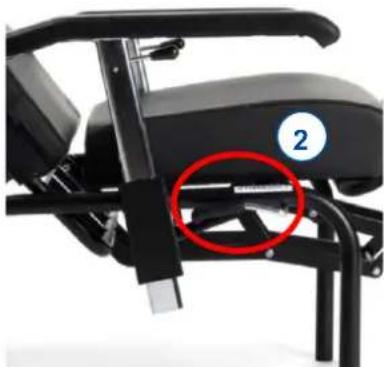
- To incline the backrest, pull the lever (2) and push against the backrest until you reach the desired position. Let go of the lever to block the backrest into position. For Normandie, the backrest and leg rest incline simultaneously. (Backrest inclination: 13^ - 45^ ; leg rest inclination: 0^ - 90^ )
- To reduce the backrest and leg rest inclination, pull the lever (2) and let the backrest and leg rest return to the desired position. Let go of the lever to block the backrest and leg rest into position.
natural_image
Close-up of a black bicycle seat with a red circle highlighting the seat number 2 (no text or symbols on the chair itself)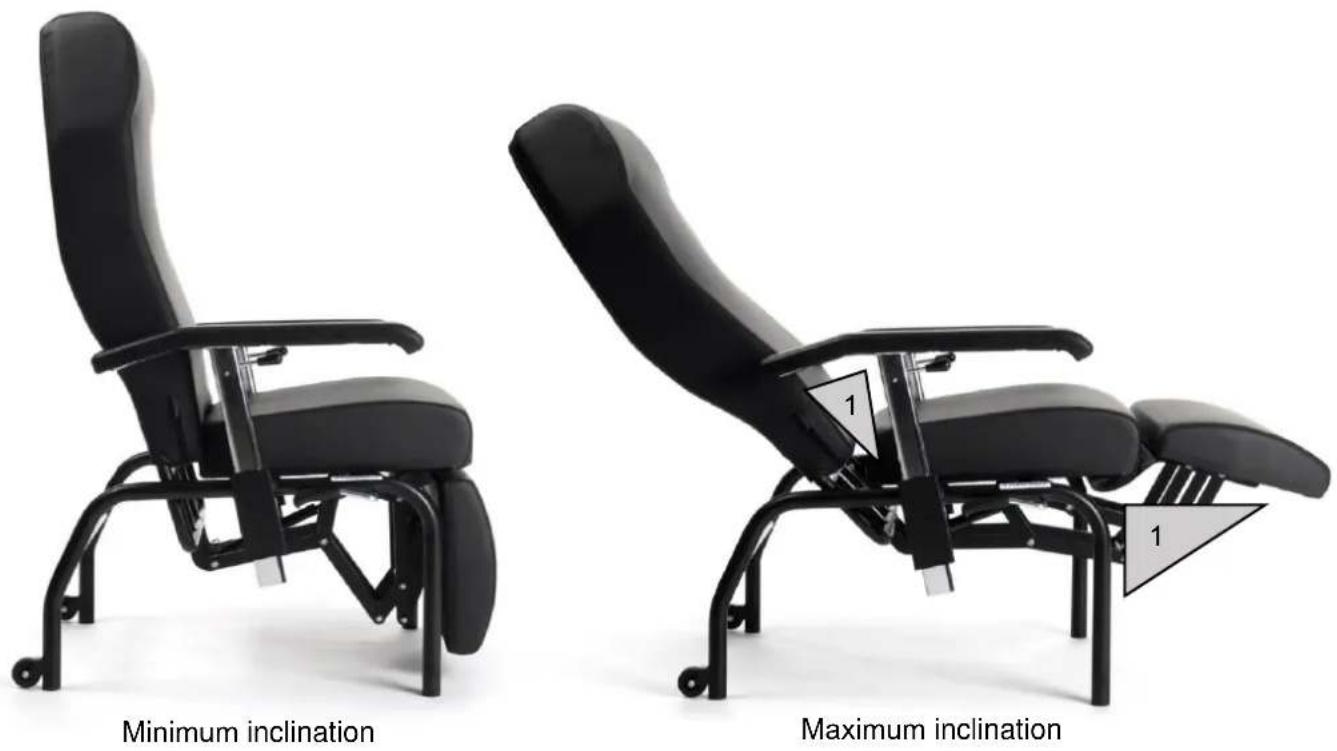
3.2.2 Backrest and leg rest inclination Normandie 2F

CAUTION
Risk of injuries or damage
- Be sure that the comfort chair does not tip over backwards when it is placed in its most backwards position.
- Make sure that no objects or individuals are in the adjusting area (see entrapment zones).
The angle of the backrest and the leg rest can be adjusted separately by means of a gas spring.
Entrapment zones are indicated in the figure above by (1).
To incline the comfort chair:
- Engage the brakes (only with wheels, see §3.3).
-
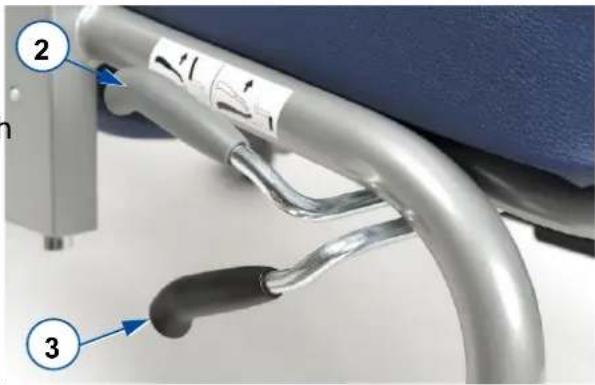
To incline the backrest, pull the upper lever (2) and push against the backrest until you reach the desired position. Let go of the lever to block the backrest into position. (Backrest inclination: 13^ - 45^ ; leg rest inclination: 0^ - 90^ )
-
To incline the leg rest, pull the lower lever (3) and place the leg rest in the desired position.
-
To reduce the backrest and/or leg rest inclination, pull the lever (2 or 3) and let the
backrest and leg rest return to the desired position. Let go of the lever to block the backrest and leg rest into position.
3.2.3 Adjusting the armrests
The armrests can be adjusted in height and can be lowered to the height of the seat frame for the sideways transfer of the patient.
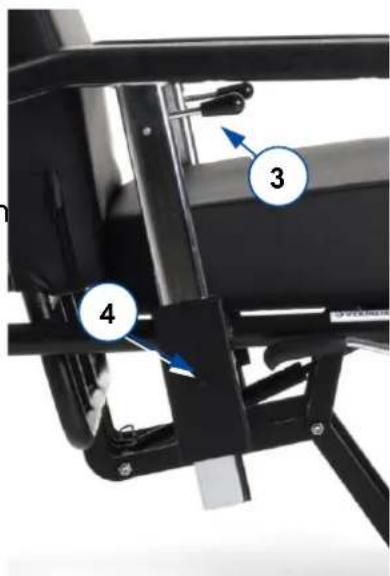
- Pull the lever of the armrests (3) upwards (in the direction of the arm pad).
- The locking spring will be released and the armrest can be moved within the armrest socket (4) into the desired position (range 114 mm, steps of 19 mm).

Risk of injuries
- If the locking spring is guided outside the armrest socket (4), the armrest is not locked. Use this position only for the sideways transfer of the patient.
For sideways transfer of the patient:
Pull the lever (3) and guide the armrest down to the lowest possible position.
Now the arm pad comes at the same height of the seat cushion.
3.3 Running wheels / Parking brakes (only with wheels)

Risk of injuries or damage
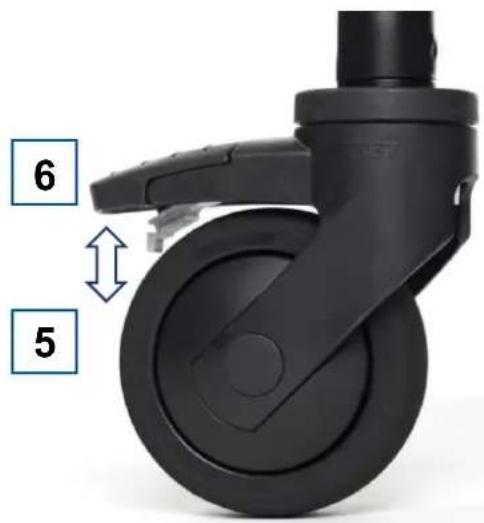
- Lock all four wheels in place to put the comfort chair in a parking position.
- Make sure that the comfort chair is on a flat horizontal surface before releasing the brakes. Never release all the brakes simultaneously.
natural_image
Close-up of a black bicycle steering wheel with labeled parts (6 and 5), no text or symbols on the wheel itself.⑤ Engaging the parking brakes
With your foot, press the brake plate of the wheels downwards until it locks into place. The wheels cannot roll.
⑥ Disengaging the parking brakes
With your foot, press the brake plate of the wheels in the direction of the frame. The wheels have now been released and can both roll and swivel.
4 Maintenance
i Regular care ensures that your comfort chair is preserved in a perfectly functional condition. For the maintenance manual, refer to the Vermeiren website: www.vermeiren.com.
4.1 Points of maintenance

CAUTION
Risk of injuries and damage
Repairs and replacements may only be undertaken by trained persons and only genuine replacement parts of Vermeiren should be used.
i The last page of this manual contains a registration form for the specialist dealer to record each service.
The service frequency depends on the frequency and intensity of use. Contact your dealer to agree to a common timetable for inspection/maintenance/repair.
Before each use
Inspect the following points:
- All parts: Present and undamaged or unworn.
• All parts: Clean, see § 4.2.1. - Wheels, backrest, seat: Well secured.
• Working of gas springs, brakes, armrests. - Wheels/tyres; keep them free of wires, hair, sand, fibres and other contamination (oil, mud).
- Condition of frame parts: No deformation, instability, weakness or loose connections
- Upholstery, seat cushion, calf-rest cushion: No excessive wear (like dented spots, damage or tears).
Contact your specialist dealer for possible repairs or part replacements.
4.2 Instructions for maintenance
4.2.1 Cleaning
CAUTION
Risk of damage
Never use a steam cleaner to clean the chair.
Wipe all rigid parts of the chair frame with a damp cloth (not drenched). If necessary, use a mild soap, suitable for varnishes and synthetics.
The upholstery can be cleaned with lukewarm water and a mild soap. Do not use abrasive cleaning agents, sponge, or hard brush to clean.
4.2.2 Disinfection
CAUTION
Risk of damage
Disinfections may only be undertaken by trained persons. Consult your specialist dealer.
4.3 Expected lifespan
The average lifespan of your comfort chair is 5 years. Depending on the frequency of use and maintenance, the lifespan of your comfort chair will increase or decrease.
4.4 Reuse
Before each reuse, have the comfort chair disinfected, inspected and serviced according to the instructions in §4.1 and §4.2.
4.5 End of use
At end of life, you need to dispose your chair according to the local environmental legislation. The best way to do so, is to disassemble the chair to facilitate the transport of recyclable parts.
5 Technical specifications
The technical details below are only valid for this chair, at standard settings and optimal ambient conditions. Take these details into account during use. The values are no longer applicable if your chair has been modified, damaged, or is severely worn.
| MakeType | VermeirenComfort chair |
| Model | Normandie |
| Maximum occupant mass | 130 kg |
| Description | Dimensions | |
| Without wheels | With wheels | |
| Overall length | 860 mm | |
| Overall width | 685 mm | |
| Total mass | Approx. 27,8 kg | Approx. 29,15 kg |
| Mass of heaviest part | 19,45 kg | 19,2 kg |
| Masses of parts that can be removed or dismantled | Seat: 2,85 kgBackrest: 5,45 kg | Seat: 2,85 kgBackrest: 7,1 kg |
| Seat plane angle | 8° | |
| Effective seat depth | 480 mm | |
| Effective seat width | 500 mm | |
| Seat surface height at front edge | 500 mm | 520 mm |
| Backrest angle | 13° - 45° | |
| Backrest height | 750 mm | |
| Armrests height | 0 mm (only for sideways transfer)150 mm - 210 mm | |
| Overall height | 1200 mm | 1205 mm |
| Dismantled height | 490 mm | |
| Thickness seat cushions | 100 mm | |
| Angle between seat and leg rest | 0° - 90° | |
| Storage and use temperature | + 5 °C - + 40°C | |
| Storage and use humidity | 30% - 70% | |
| We reserve the right to introduce technical changes. Measurement tolerance ± 15 mm / 1,5 kg / 1,5° | ||
Table 1: Technical specifications Normandie
| Make | Vermeiren |
| Type | Comfort chair |
| Model | Languedoc |
| Maximum occupant mass | 130 kg |
| Description | Dimensions | |
| Without wheels | With wheels | |
| Overall length | 860 mm | |
| Overall width | 685 mm | |
| Total mass | Approx. 22,4 kg | Approx. 23,75 kg |
| Mass of heaviest part | 14,1 kg | 13,8 kg |
| Masses of parts that can be removed or dismantled | Seat: 2,85 kgBackrest: 5,45 kg | Seat: 2,85 kgBackrest: 7,1 kg |
| Seat plane angle | 8° | |
| Effective seat depth | 480 mm | |
| Effective seat width | 500 mm | |
| Seat surface height at front edge | 500 mm | 520 mm |
| Backrest angle | 13° - 45° | |
| Backrest height | 750 mm | |
| Armrests height | 0 mm (only for sideways transfer)150 mm - 210 mm | |
| Overall height | 1200 mm | 1205 mm |
| Dismantled height | 490 mm | |
| Thickness seat cushions | 100 mm | |
| Storage and use temperature | + 5 °C - + 40°C | |
| Storage and use humidity | 30% - 70% | |
| We reserve the right to introduce technical changes. Measurement tolerance ± 15 mm / 1,5 kg / 1,5° | ||
Table 2: Technical specifications Languedoc
| Make | Vermeiren |
| Type | Comfort chair |
| Model | Normandie 2F |
| Maximum occupant mass | 130 kg |
| Description | Dimensions | |
| Without wheels | With wheels | |
| Overall length | 860 mm | |
| Overall width | 685 mm | |
| Total mass | Approx. 30,4 kg | Approx. 32,1 kg |
| Mass of heaviest part | 21,6 kg | 22,9 kg |
| Masses of parts that can be removed or dismantled | Seat: 2,85 kgBackrest: 5,45 kg | Seat: 2,85 kgBackrest: 7,1 kg |
| Seat plane angle | 8° | |
| Effective seat depth | 480 mm | |
| Effective seat width | 500 mm | |
| Seat surface height at front edge | 500 mm | 520 mm |
| Backrest angle | 13° - 45° | |
| Backrest height | 750 mm | |
| Armrests height | 0 mm (only for sideways transfer)150 mm - 210 mm | |
| Overall height | 1200 mm | 1205 mm |
| Dismantled height | 490 mm | |
| Thickness seat cushions | 100 mm | |
| Angle between seat and leg rest | 0° - 90° | |
| Storage and use temperature | + 5 °C - + 40°C | |
| Storage and use humidity | 30% - 70% | |
| We reserve the right to introduce technical changes. Measurement tolerance ± 15 mm / 1,5 kg / 1,5° | ||
Table 2: Technical specifications Normandie 2F
Table des matières
natural_image
Close-up of a black wheelchair seat with a blue circle highlighting the number 1 (no text or symbols on the chair itself)2.4.2 Siège
natural_image
Close-up of a black bicycle seat with labeled components and a red circle highlighting a specific area (no text or symbols present)natural_image
Two black ergonomic chair models with adjustable armrests, shown from different angles (no text or symbols visible)natural_image
Close-up of a black plastic car steering wheel with labeled parts (6 and 5), no text or symbols on the wheel itself.natural_image
Close-up of a black wheelchair seat with a blue circle highlighting the number 1 (no text or symbols on the chair itself)2.4.2 Zit
natural_image
Close-up of a black bicycle seat with a red circle highlighting the seat number 2 (no text or symbols on the chair itself)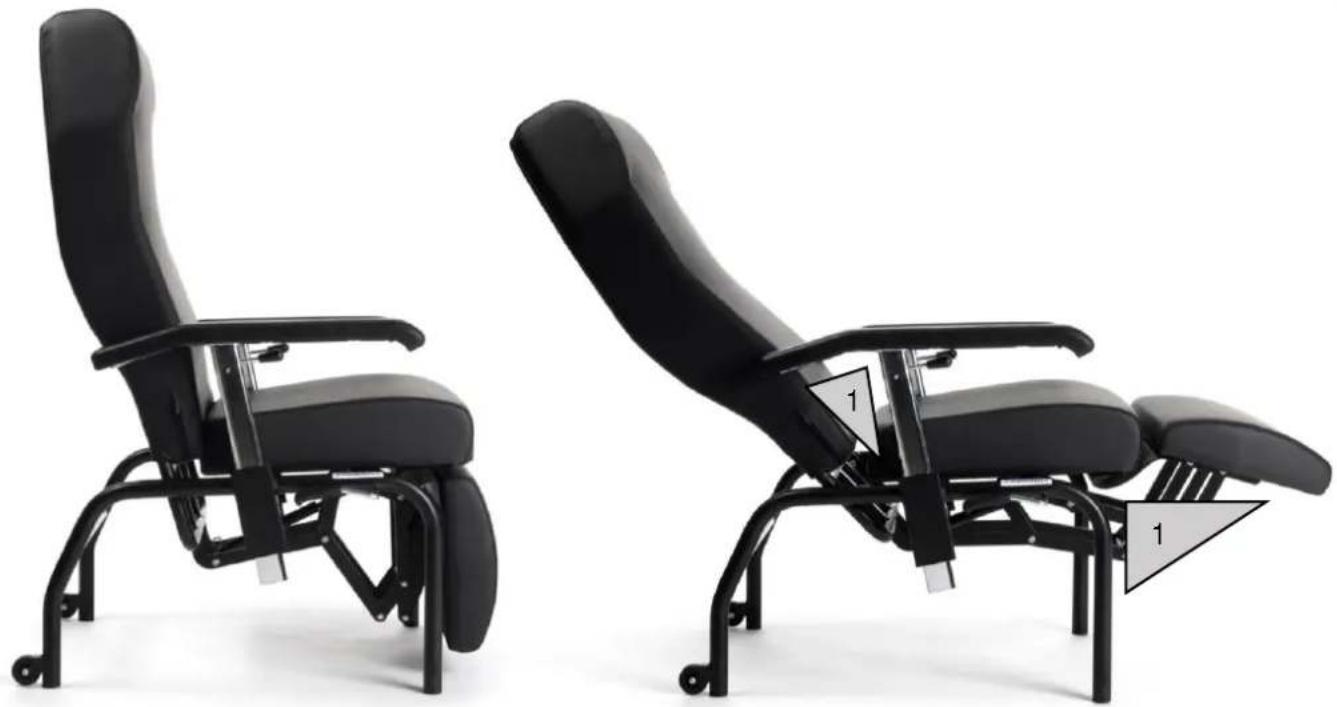
natural_image
Two black ergonomic chair models with adjustable armrests, shown from different angles (no text or symbols visible)Minimale inclinatie
Maximale inclinatie
natural_image
Close-up of a black car steering wheel with labeled parts (6 and 5), no text or symbols on the wheel itself.
natural_image
Close-up of a black wheelchair chair with a blue arrow pointing to the number 1 on the side (no text or symbols on the chair itself)2.4.2 Sitz
natural_image
Close-up of a black bicycle seat with a numbered label (2) and a red circle highlighting a mechanical component, no readable text or symbols beyond the number.
natural_image
Close-up of a black plastic car steering wheel with labeled parts (6 and 5), no text or symbols on the wheel itself.
natural_image
Close-up of a black wheelchair seat with a numbered label pointing to the seat area (no text or symbols on the chair itself)2.4.2 Sedile
natural_image
Close-up of a black exercise chair seat with labeled components and a red circle highlighting a specific area (no text or symbols present)natural_image
Close-up of a black three-wheeled vehicle with labeled parts (6 and 5), no visible text or symbols on the wheel or background.
natural_image
Close-up of a black wheelchair seat with a numbered label pointing to the seat (no text or symbols on the chair itself)
2.4.2 Asiento
natural_image
Close-up of a black ergonomic chair seat with a red circle highlighting the seat number 2 (no text or symbols on the chair body)natural_image
Two black ergonomic chair models with adjustable armrests, shown from different angles (no text or symbols visible)natural_image
Close-up of a black bicycle control wheel with labeled parts (6 and 5), no text or symbols on the wheel itself.
natural_image
Close-up of a black wheelchair seat with a numbered label pointing to the side (no text or symbols on the chair itself)
2.4.2 Siedzisko
natural_image
Close-up of a black bicycle seat with a numbered label (2) and a red circle highlighting the seat area, no text or symbols present.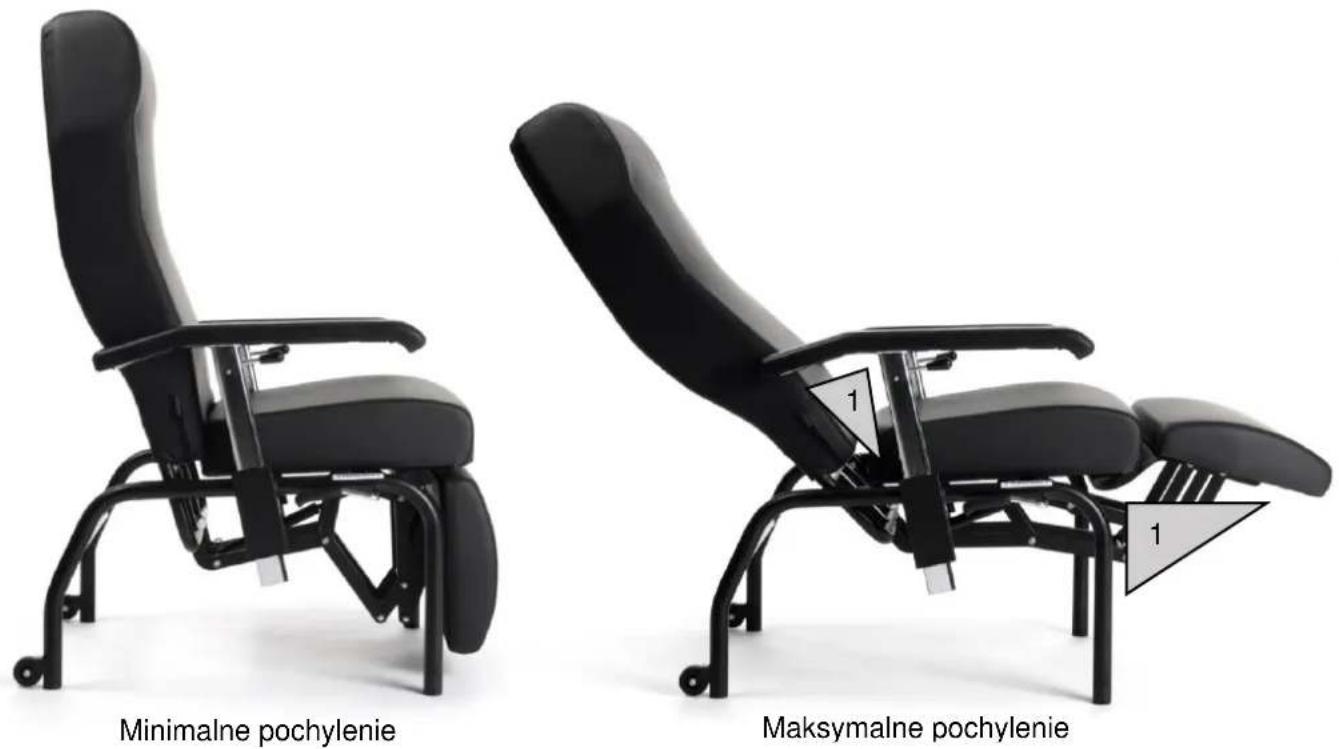

3.2.2 Nachylenie oparcia i podnóżka Normandie 2F

UWAGA
natural_image
Close-up of a black plastic car steering wheel with labeled parts (6 and 5), no text or symbols on the wheel itself.
natural_image
Close-up of a black wheelchair seat with a numbered label pointing to the seat (no text or symbols on the chair itself)
2.4.2 Sedadlo
natural_image
Close-up of a black bicycle seat with a red circle highlighting the number 2 on the side (no text or symbols beyond the number)natural_image
Close-up of a black three-wheeled car with labeled parts (6 and 5), no text or symbols on the object itself.
Service registration form
This product (name): ....
was inspected (I), serviced (S), repaired (R) or disinfected (D):
| By (stamp):Kind of work: I / S / R / DDate: | By (stamp):Kind of work: I / S / R / DDate: | By (stamp):Kind of work: I / S / R / DDate: |
| By (stamp):Kind of work: I / S / R / DDate: | By (stamp):Kind of work: I / S / R / DDate: | By (stamp):Kind of work: I / S / R / DDate: |
| By (stamp):Kind of work: I / S / R / DDate: | By (stamp):Kind of work: I / S / R / DDate: | By (stamp):Kind of world: I / S / R / DDate: |
| By (stamp):Kind of work: I / S / R / DDate: | By (stamp):Kind of work: I / S / R / DDate: | By (stamp):Kind of work: I / S / R / DDate: |
| By (stamp):Kind of work: I / S / R / DDate: | By (stamp):Kind of work: I / S /R / DDate: | By (stamp):Kind of work: I / S / R / DDate: |
| By (stamp):Kind of work: I / S / R / DDate: | By (stamp):Kind of work: I / S / R / DDate: | By (stamp):Kind of work: I / S / R / DDate: |

Vermeiren GROUP
Vermeirenplein 1 / 15
2920 Kalmthout
BE
website: www.vermeiren.com
- EN
- Instructions for specialist dealer
- FR
- Contents
- Contents....1
- Preface....2
- This product....3
- Before use ....4
- Using this chair....6
- Maintenance....9
- Technical specifications....11
- Preface
- Important note
- Information available
- This product
- Before use
- Intended use
- General safety instructions
- Symbols on the chair
- Assembly/Disassembly
- Backrest
- Seat
- Transport and storage
- Moving aside
- Storage
- Using this chair
- Transfer into and out of the chair
- Correct position in the chair
- Comfort adjustments
- Backrest inclination Normandie/Languedoc
- Backrest and leg rest inclination Normandie 2F
- CAUTION
- Adjusting the armrests
- Risk of injuries
- Running wheels / Parking brakes (only with wheels)
- Risk of injuries or damage
- ⑤ Engaging the parking brakes
- ⑥ Disengaging the parking brakes
- Maintenance
- Points of maintenance
- Before each use
- Instructions for maintenance
- Cleaning
- Disinfection
- Expected lifespan
- Reuse
- End of use
- Technical specifications
- Table des matières
- Siège
- Zit
- Sitz
- Sedile
- Asiento
- Siedzisko
- Nachylenie oparcia i podnóżka Normandie 2F
- UWAGA
- Sedadlo
- Service registration form
Brand : Vermeiren
Model : Languedoc
Category : Wheelchair