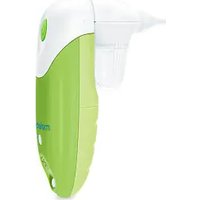
Nose clean - Electric nasal aspirator Mebby - Free user manual and instructions
Find the device manual for free Nose clean Mebby in PDF.


User questions about Nose clean Mebby
0 question about this device. Answer the ones you know or ask your own.
Ask a new question about this device
Download the instructions for your Electric nasal aspirator in PDF format for free! Find your manual Nose clean - Mebby and take your electronic device back in hand. On this page are published all the documents necessary for the use of your device. Nose clean by Mebby.
USER MANUAL Nose clean Mebby
SPÉCIFICATIONS DU PRODUIT
FR
INSTALLATION DES PILES
HPOΦOPIE ΠPINTH XPHSE
O avappoqnnpac mntnc Mebby eivai ia ouokeun xpnoiun yia tnv anouakpuvon EKKpioeewv kai piviknc evvac aio naiidia (aio 0 ecw 12 etwv)-ia oikiakn xpon.
- PPOsOxH! Mny npaymuToOnoiEiTa aAlambdaEc Otn ouokEun, xwpi Tnv adEia Tou kataoKeuaoTn.
- Mny ekTeTe Tn ouokevn oe uynlc thepuokpaoicc, oeuyna einie- 8a uypaiaac n oe aean nlaikn aktivoBoia.
- Mny apnveTc TOn ouokeu n va neoi
- AvtikataoTnoTe Tc mataapiec otav n 1oxuc n o nyoc tou avappoynTnpa eivai aoEvnc kata tn xpnon.
- Uviotatai n apaipoeon twv mntapiwv ano tn ouokeu n ev o avappo- qntnpac ev npoketai va xpnoiomointheta iia eya lo xpovikó diateta.
- H iEon nou eapuocetai otn ouokcun evai yia diakekoumuevn xponon. Kpntote natnevo to nnktpo Ekkivnonc yia va evepyonoioeTe tv avTia avappoqnonc kai va aopaieote tic evvec kai tic pivikec ekkpioeic. Tia va otapatnoete tny avappoqnon, anwca apnoote to nnktpo EKKIVNONC.
- O pivikoc avappoqnnpac evdeltaivutai anokkietika yia tov kathetaiou / aioaekpvon twv pivikwv ekkpioewv. Mny xpnoiopoioite tn oukeun yia aalccdelta apopetikecx npoeic. nepiTTwoan aupoioliaac, akoloueite tic oumboulcs Tou iaipou oc.
- Kata t n xphon Tou avappoqnnpa, To naidi dev npenei va kpataei Tnv avanvoTou, va KLeivEi TO oToMa n va kataniivei Ta oAia Tou etou wote n pieon Kevouva mnu pokaoleoi duwpopia ota autia.
- Eav to naidi dev aioavtheta ka kata tv avappoqnon, anevpyo- poinote aepoa tn ouokun kal aneuvvthe tse evav yiatpo
- Mny piézete tn ouokueun unepoalika kata tnv tonoetnon tnC ot
EL
pivikn koiotnta.
- H ouokcun npoopicietai mvo yia oikiakn xpon. Aneuovvte e evav yiatpo oe nepiintwn pivikwv npoBnmuatwv. KaapioTe tov avappoqntnpa niv ano kaee xpon.
- H ouokéun πoopicietai yia xpnon ano nleupac evnlaika / yovea o onoioc mnpei va diaaosei kai va katavonoei tic odnyiec npiv tn xpnon. KpatnoTe Tn ouokeun paikia ano paiidia.
-
Mny xpoiooie to pivko avappoqnnpa otic akolouthetac peiTTwoeic:
-
aɪoʊpəyia tɪŋc μʊtɪnc ᷋ avoɪxτές πληγές
-Evtovec nIyEc oTo KepaI, to npOswno n tv laIuO
-Δiatapaxεc tou aiμatoc n tnc πηεnc tou aiμatoc -
Piv Tn xpon Tnc ouokeunc, diaaote npooektiKa Tc odnyiec xpon. Mia eopalmev n xpon Tnc ouokeunc mOpel va npokaloei:
-
Tpaúμata
-
Pivikouc ερεθισμούς / αιμoppayia
-Aioppayia tou o
-EvoXnOeic kai nOvo -
KpatnoTe to akpofoio oIikovnc paKpia aNo PaIdia kai kaToikidia Zwa.KivduvoC katanoonc.
- To akpofoio o i npokaloei aAepyikc avTidpaoeic,

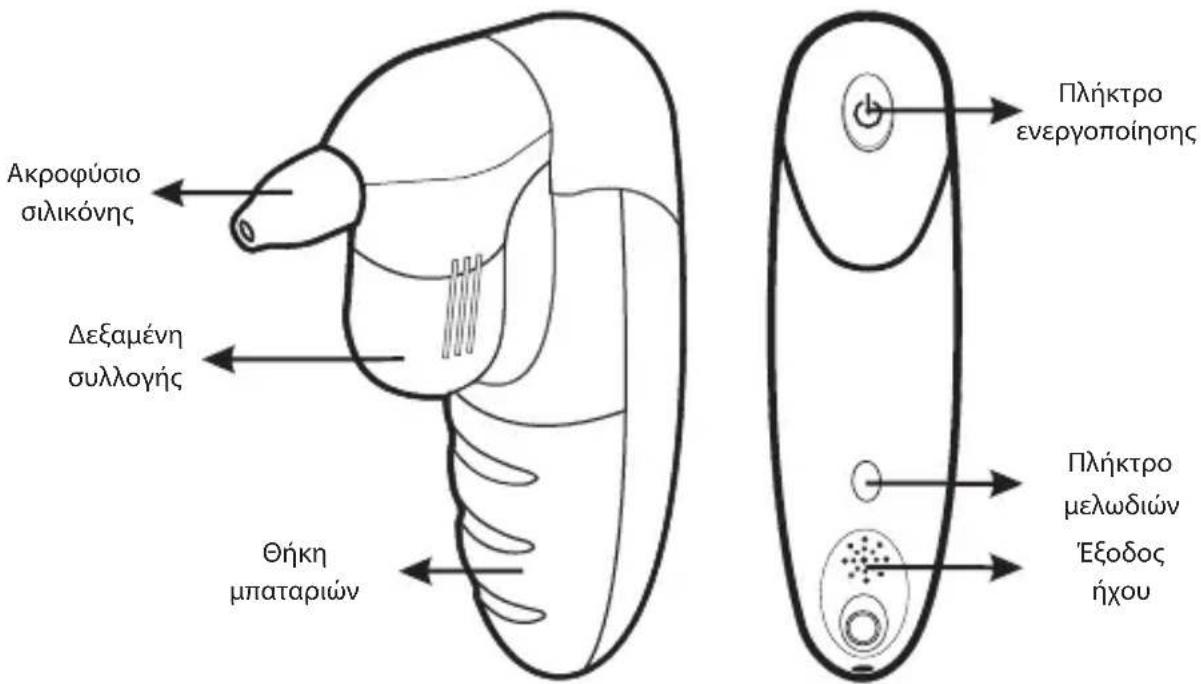
ПОДIАГРАФЕС TOY ПОДIONTOS
EL
ERKATAASTAH MNTAPION
Avikataoan natapiow:
- ApaipéoTe anaλa To kαλuμα tnc ΘnKnc μntapaiwv
- Apaipoe TPOOeKtikac Tc naiec mnatapiec kai anoppiTc Tc ouwva e Touc 1oxuovTEc kavovioouc
- TOnoTheTnote n avtikataoTnote TIC 2 aAkkaikec μnatapiεc AA 1,5 V -βλ. ΘnKn μntapaiw-tnpωvTac tic noAikóTnTec Touc -βλ. oxTeiKec evδeEic
- Xpnoiunoieite navta kaivoupyiec mnatapiec
- Enavatoo oetnoe to kalumu ta nC thknc natapiw.
i Aetoupyia matapia
- KpatnoTe TIC matapiec maakpi aio naia n npyeC 0epuotntac
- uviotatai n apaipoeon twv mntapiwv eav n ouokevun dev npoketai va xnpoiuointhe i yia eyaXpovikadiaotnata.
- Oi natapiEc ev Eivai oikiaKa anoppipuata.AnpoiTc xpnoiOIOINUEVCnata pntaepc otka tALnla onueia ouLoync.
- Mny xnooionoieite enavaapoptioevc unatapiic.
OΔHΓIEΣ XPHΣΕΩΣ
aaiiall bai i daii wall
.
1
1.
abla jc laai 1y e bll
1.1
12.11 g jlg 11
1 1 1 1 1 1 1 1 1 1 1 1 1 1 1 1 1 1 1 1 1 1 1 1 1 1 1 1 1 1 1 1 1 1 1 1 1 1 1 1 1 1 1
AR
.
S OBC = S BOC + S_ CBA
y

J 1

2.
1.
Bolal jll Jl 150s k s b 111 gall
Jl aln l 111 111 111 111 111 111 111 111 111 111 111 111 111 111 111 111 111 1
- 4,5 ,
1
g 1
- jlll lbiill
sall j
a
A
- jzj
0
acwllj
AR

1 1
1
d
j 1 j05 %V.
JzjI (1)
. 1
0g 0000000000000000000000000000000000000000
a 1
Ji jilgwl 2. yjlll lalbiy all aclil
laii jj 1j j
jglal aaiil 1ydiol piai
jlll aalbi lblall gaoell lalil

:aaal jglal gslai
$$ \begin{array}{l} \left. \right.\left. \right.\left. \right.\left. \right.\left. \right.\left. \right.\left. \right.\left. \right.\left.\left.\left.\left.\left.\left.\left.\left.\left.\left.\left.\left.\left.\left.\left.\left.\left.\left.\left.\left.\left.\left.\left.\left.\left.\left.\right.\right.\right.\right.\right.\right.\right.\right.\right.\right.\right.\right.\right.\right.\right.\right.\right.\right.\right.\right.\right.\right.\right.\right.\right.\right\rangle_ {0} ^ {1 0} - 4 5 0 0 0 0 0 0 0 0 0 0 0 0 0 0 0 0 0 0 0 0 0 0 0 0 0 0 0 0 0 0 0 0 0 0 0 0 0 0 0 0 0 0 0 0 0 0 0 0 0 0 2 _ {1} ^ {1} = \frac {1}{2} \ (\text {d i s k}) \% 10 \text {山} \text {山} \text {山} \text {山} \text {山} \text {山} \text {山} \text {山} \text {山} \text {山} \text {山} \text {山} \text {山} \text {山} \text {山} \text {山} \text {山} \text {山} \text {山} \text {山} \text {山 9 0} \sim \text {山} \ \end{array} $$
$$ (1 7 -) \text {a} _ {\text {四}} \text {a} _ {\text {四}} \text {a} _ {\text {四}} \text {a} _ {\text {四}} \text {a} _ {\text {四}} \text {a} _ {\text {四}} \text {a} _ {\text {四}} \text {a} _ {\text {四}} \text {a} _ {\text {四}} \text {a} _ {\text {四}} $$
$$ (\text {i d} \leqslant 1) \% \lambda = \sum_ {j} \sum_ {i} \sum_ {j} \sum_ {i} \sum_ {j} \sum_ {i} \sum_ {j} \sum_ {i} \sum_ {j} \sum_ {i} \sum_ {j} \sum_ {i} \sum_ {j} \sum_ {i} \sum_ {j} \sum_ {i} \sum_ {j} \sum_ {i} \sum_ {\mathrm {的}} $$
$$ \therefore \text {i n} \quad \text {i n} \quad \text {i n} \quad \text {i n} \quad \text {i n} \quad \text {i n} \quad \text {i n} \quad \text {i n} \quad \text {i n} \quad \text {i n} \quad \text {i n} \quad \text {i n} \quad \text {i n} \quad \text {1 0 0} $$
$$ \therefore \text {A A} \text {A A} \text {A A} \text {A A} \text {A A} \text {A A} \text {A A} \text {A A} $$
$$ (\varepsilon \text {如} | x, \text {如} x \times \text {上} b) \neq 1 5 \lambda 4 9, 9 x \times 9 7, 0: p a $$
$$ (\text {山} \text {山} \text {山} \text {山}) \rho \geq 1 4 7: \infty $$
jg 2
$$ (\varepsilon \text {如}) \cup {j, j, j, j, j, j, j, j, j, j, j, j, j, j, j, j, j, j, j, j, j, j, j, j, j, j, j, j, j, j, j, j, j, j, j, j, j, j, j, j, j, j, j, j, j, j, j, j, j, j, j, $$
$$ \left(\varsigma \text {j i} \cup \cup \cup \cup\right) _ {\rho} \leq 1 4 7: \cup \cup $$
#
- Music Function:12 Chord Melodies
- High Power: Put aspiration tip at the entrance of the nostril, then you may use this device to remove nasal secretions activating as you like with the push button.
- Safe: The soft aspiration tip is for comfortable design to prevent the possibility of injuring when using this device.
- Simple & Compact Design: This device is compact, easy to hold and operate. Its is also safe and comfortable for baby use.
- Washable suction head: Tips, collection cup & head part can be taken off from the device and rinsed with clean water.
- Noiseless: Easy to use while the baby is sleeping.
- Battery: This device needs to use two 1.5V AA batteries; it is convenient to change the batteries anytime, anywhere.
IMPORTANT INFORMATION BEFORE USE
The device is designed for using intermittent suction to remove nasal secretion and mucus in Children (age 0~12 years old) in the home environment.
- WARNING - Do not modify this equipment without authorization of the manufacturer.
- Do not expose the device to extreme temperature, very high humidity level, or direct sunlight.
- Avoid extreme stress, shock or accidental dropping.
- Please replace all the batteries when the power or/and the sound of the pump get weak during using the device.
- It is recommended to remove the batteries if the device will not be used for a period of time.
- The application of pressure by the device is intermittent. You shall keep pressing the power button to start the device to generate vacuum for removing nasal secretion and mucus. If you want to stop the suction, just need to release the power button to turn off the device.
- The Nasal Aspirator is for cleaning/removing the nasal secretion only. Do not use this device other than for the intended purposes. Any further medical action should follow the advice of doctors.
- During the use of the device, the baby should not hold their breath, close his mouth or swallow his saliva to avoid vacuum pressure causing eardrum imbalance.
- If the baby does not feel well when using the device, stop and consult
EN
a doctor immediately.
- Do not apply excessive force when placing the aspiration tip at the base of the nasal cavity.
- This device is for home use only. Please consult a doctor in case of nasal conditions. Clear the aspirator tip prior to each use.
- The Intended Operators for this device shall be parents or adults who can follow the instructions and notices in this manual to operate the device. The device is not allowed to be used by children themselves. Keep the nasal aspirator away from the children.
- DO NOT use the Nasal Aspirator when patients have the following contraindications:
- Nasal bleeding or any open wounds inside
- Acute head, facial, or neck injury
Coagulopathy or bleeding disorder - Before using the device, please read this manual carefully. Wrong use of the device may cause the following hazards/complications:
- Mechanical trauma
- Nasal irritation/bleeding
Mucosal hemorrhage - Discomfort and pain
- Please keep the replaceable tip where children and pets cannot access to avoid risk of them been swallowed.
- The tip may cause potential allergic reactions.
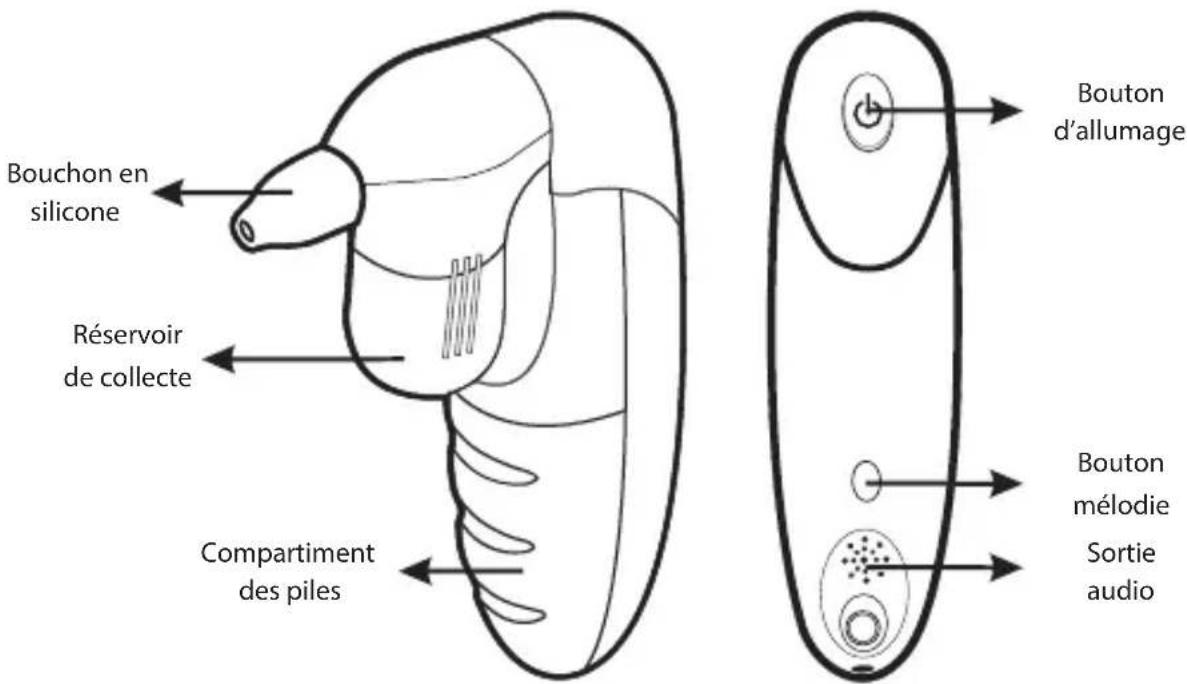
PRODUCT IDENTIFICATION
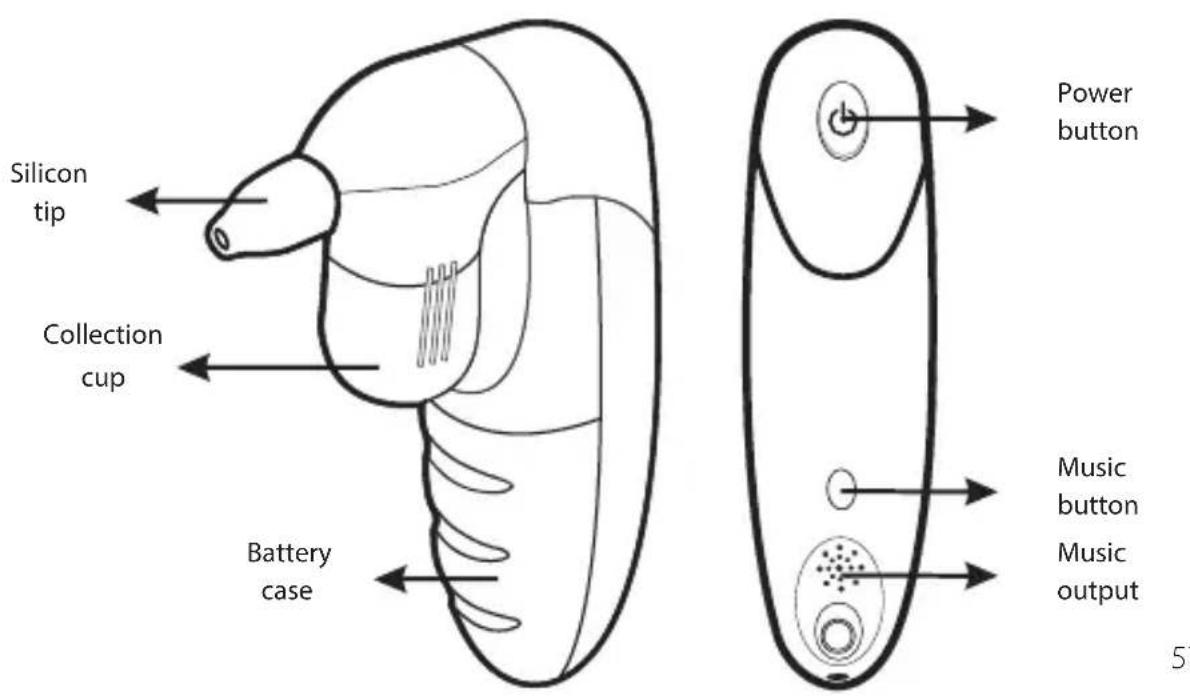
EN
BATTERIES INSTALLATION
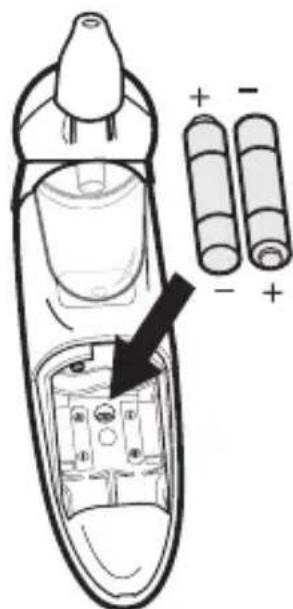
Replacing the Battery:
- Gently slide the battery cover back.
- Carefully remove the old batteries and properly discard.
- Insert or replace 2 × 1.5 ~V AA alkaline batteries into the battery compartment, ensuring to match the indicated polarity symbols.
- Always use new batteries
- Replace the battery cover.
i
Battery-operated
- Please properly dispose of the batteries away from small children and heat.
- It is recommended to remove the batteries if the unit will not be used for an extended period of time.
- For long durations of non-operation, please remove all batteries from the device.
- Dispose of used batteries in accordance with the applicable legal regulations. Never dispose of batteries in the normal household waste.
INSTRUCTION FOR USE
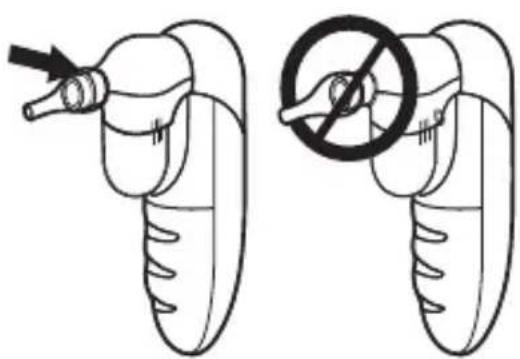
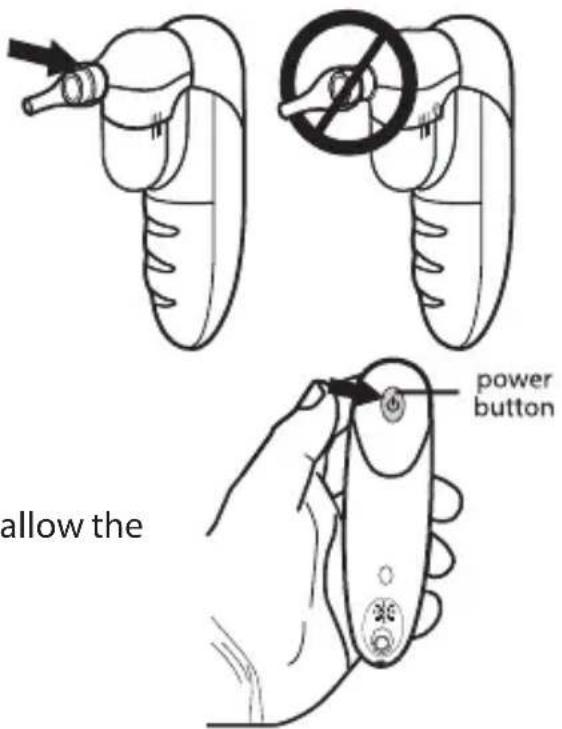
- Be sure to place the tip securely on the aspirator. Make sure tip slips over the entire circumference of the rib before using.
-
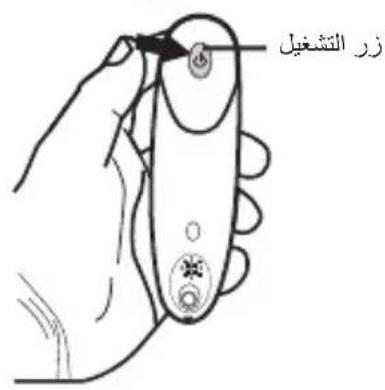
Press and hold the power button to allow the suction to clear the mucus.
-
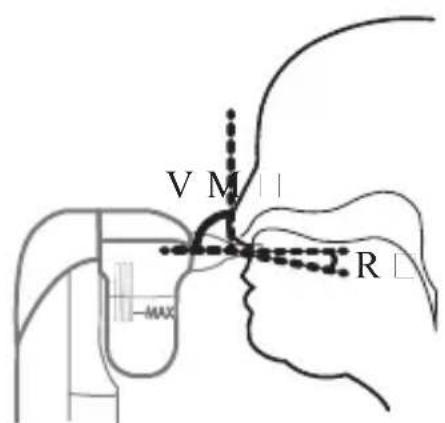
Hold the baby upright and place the tip at the entrance of the babies nostril. Be careful not to place the tip inside the nostril (about 10mm depth) or press against the inside wall of the nostril. Be sure to keep the tip of the aspirator at a 90^ angle. Do not point it up into the nostril. Allow the suction to clear the mucus. Repeat with other nostril and as needed.
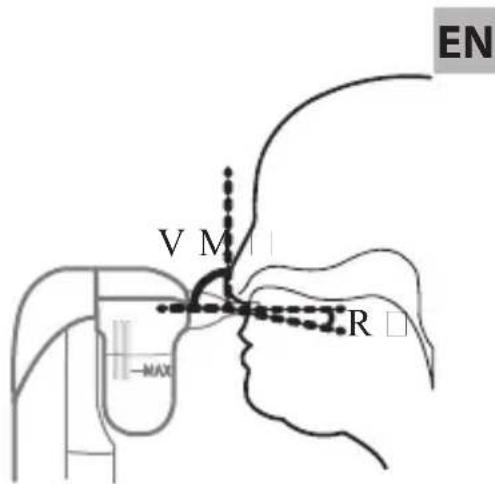
The mucus may not immediately appear in the collection cup. After each use it is recommended to give a quick clean of the tip having first removed it from the unit.
-
Release Power button to stop suction.
-
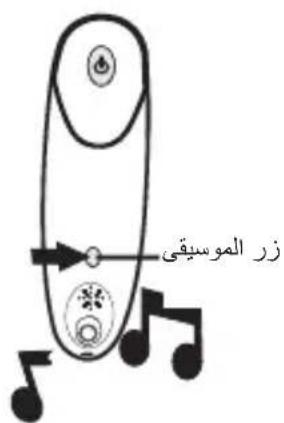
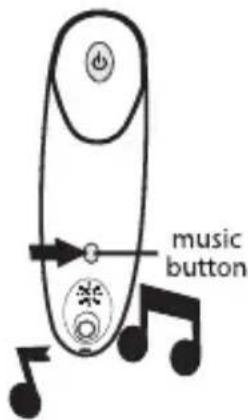
If you want to play the songs to comfort your baby, just push the music button to start and press it repeatedly to select the desired melody. Music: Instead of hearing disturbing sounds when using the device, our device provides the unique design of the melodious ring choice of these 12 worldwide children's ballads. With the beautiful songs, the baby will feel more comfortably treated with the device.
-
After using the device, press the "Music" button for 1~2 seconds to turn off the melody.
CLEANING AND DISINFECTING
-
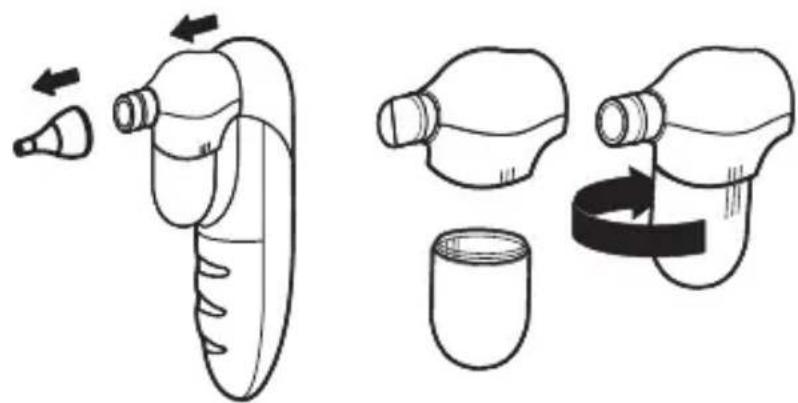
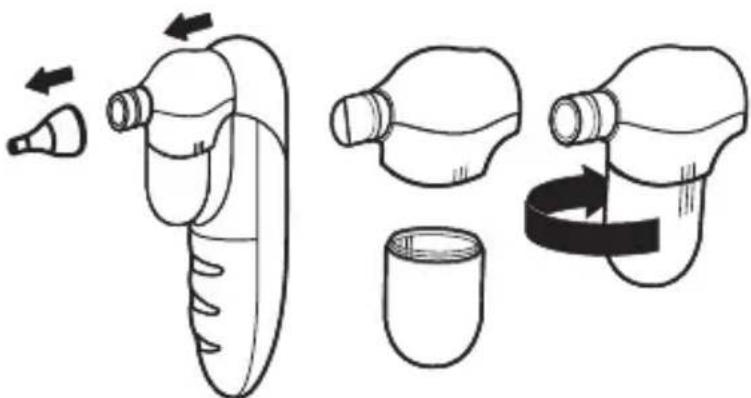
Separate the tip and the head module from the base of the aspirator by gently pulling it apart.
-
Unscrew collection cup by turning it clockwise.
EN
Cleaning process of collection cup and aspiration tip:
Washing the collection cup and aspiration tip with mild soap in water for 3 minutes. Then rinse these parts with running hot tap water for 3 minutes and air dry.
For home use device disinfection, 70% Ethanol or Isopropyl alcohol (available in the pharmacy) can be used. You can clean the collection cup, head module after using several times. Please prepare a pair of gloves and a clean cloth or cotton bud that can be moist-
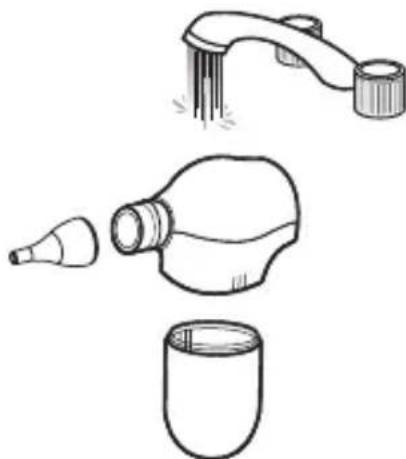
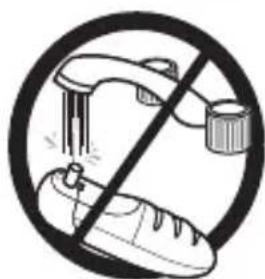
ned with 70% alcohol. To clean the entire device, please use a soft cloth slightly moistened with a mild soapy solution. Under no circumstances may liquid enter the device. Do not use the device again until it is completely dry.
NOTE: DO NOT use solvents to clean the unit.
The head module can only be rinsed with water, it may be rinsed with hot water but must not be cleaned with any soap or chemical cleaners. Soap and cleaners may damage the vent which prevents mucus from being sucked into the device. It is recommended that all pieces be allowed to dry completely before reassembly.
DO NOT wash this device with water or any kind of liquids. It is strongly recommended to wipe the device with soft cloth and keep the device clean.

TROUBLESHOOTING
| PROBLEM POSSIBLE CAUSE SOLUTION | ||
| The suction is weak or there is no suction at all | Batteries are low or improperly installed. | Check or replace batteries. |
| The grey rubber ring located where the collection cup screws in is missing. | Make sure there is a grey rubber ring where the collection cup screws in. | |
| The collection cup is not properly screwed in. | Make sure the three guides on each side of the collection cup line up with the guides on the suction portion of the aspirator. | |
TECHNICAL SPECIFICATIONS
Effective Vacuum Pressure: ≥ 300mmHg (39.99 kPa)
Sound Pressure Level: ≤ 75 dB
Motor: 3V/DC
Operating environment: 16^ 35^ (60.8^ 95^) with relative
humidity up to 85% (non condensing).
Storage/Transportation environment :-25°C~+55°C (-13°F)
+131^) with relative humidity up to 85% (non condensing).
Aspiration Tip: soft silicon
Batteries: 2 1.5V alkaline AA Size
Dimensions: 93,5 × 39,9 × 148mm (LxWxH)
Weight: 132g (without batteries)
SYMBOLS EXPLANATION
| i | Follow instructions for use Lot number | OT | |
| Disposal information: Should you wish to dispose of the article, do so in accordance with current regulations. Details are available from your local authority | Keep dry | ||
| Power Button | IP 22 | IP 22: Protection level against solid foreign objects & falling water.) | |
| Type of protection of applied partagainst electric shock, body foating | EC REP | European Authorized Representative | |
| Temperature limits | CE | The CE marking with the Registration Number of the Notified Body. This denotes the compliance of European Medical Device Directive 93/42/EEC | |
| Manufacturer | RoHS | This product fulfilling the requirements of the RoHS Directive 2011/65/EU. | |
| SN | Series number |
Guidance and manufacturer's declaration of electromagnetic emissions
| The Mebbby NOSE CLEAN Nasal Aspirator is intended for use in the electromagnetic environment specified below. The customer or the user of the Mebbby NOSE CLEAN Nasal Aspirator should assure that it is used in such an environment. | |||
| Emissions test Compliance Electromagnetic environment guidance | |||
| RF emissions CISPR 11 | Group 1 The Mebby NOSE CLEAN Nasal Aspirator uses RF energy only for its internal function. Therefore, its RF emissions are very low and are not likely to cause any interference in nearby electronic equipment. | ||
| RF emissions CISPR 11 | Class B The Mebby NOSE CLEAN Nasal Aspirator is suitable for use in all establishments, including domestic establishments and those directly co nected to the public low-voltage power supply network that supplies buildings used for domestic purposes. | ||
| Harmonic emissions IEC 61000-3-2 | Not applicable | ||
| Voltage fluctuations/ flicker emissions IEC 61000-3-3 | Not applicable | ||
EMCTABLES
Guidance and manufacturer's declaration of electromagnetic immunity
| The Mebbby NOSE CLEAN Nasal Aspirator is intended for use in the electromagnetic environment specified below. The customer or the user of the Mebbby NOSE CLEAN Nasal Aspirator should assure that it is used in such an environment. | |||
| Immunity test | IEC 60601 test level | Compliance level | Electromagnetic environment-guidance |
| Electrostatic discharge (ESD) | ±8kV contact | ±8kV contact | Floors should be wood, concrete or ceramic tile. |
| IEC 61000-4-2 | ±15kV contact | ±15kV contact | If floors are covered with synthetic material, the relative humidity should be at least 30%. |
| Power frequency (50/60 Hz) magnetic field | 30 A/m 30 A/m | Power frequen- | cy magnetic fields should be at levels characteristic of a typical location in a typical commercial or hospital environment. |
| IEC 61000-4-8 | |||
EN
EMCTABLES
Guidance and manufacturer's declaration electromagnetic immunity
| The Mebbby NOSE CLEAN Nasal Aspirator is intended for use in the electromagnetic environment specified below. The customer or the user of the Mebbby NOSE CLEAN Nasal Aspirator should assure that it is used in such an environment. | |||
| Immunity test | IEC 60601 test level | Compliance level | Electromagnetic environmentguidance |
| Radiated RF IEC 61000-4-3 | 10 V/m 80 MHz to 2,5 GHz | 10 V/m Portable and mobile RF communications equipment should be used no closer to any part of the Mebbby NOSE CLEAN Nasal Aspirator, including cables, than the recommended separation distance calculated from the equation applicable to the frequency of the transmitter.Recommended separation distance: d=1.2 √P d=2 √P d=1.2 √P 80MHz to 800MHz d=2.3 √P 80MHz to 2.7GHz where P is the maximum output power rating of the transmitter in watts (W) according to the transmitter manufacturer and d is the recommended separation distance in metres (m). Field strengths from fixed RF transmitters, as determined by an electromagnetic site survey, should be less than the compliance level in each frequency range.Interference may occur in the vicinity of equipment marked with the following symbol: | |
| NOTE 1 At 80 MHz and 800 MHz, the higher frequency range applies.NOTE 2 These guidelines may not apply in all situations. Electromagnetic propagation is affected by absorption and reflection from structures, objects and people. | |||
| a. Field strengths from fixed transmitters, such as base stations for radio (cellular/cordless) telephones and land mobile radios, amateur radio, AM and FM radio broadcast and TV broadcast cannot be predicted theoretically with accuracy. To assess the electromagnetic environment due to fixed RF transmitters, an electromagnetic site survey should be considered. If the measured field strength in the location in which the Mebbby NOSE CLEAN Nasal Aspirator is used exceeds the applicable RF compliance level above, the Mebbby NOSE CLEAN Nasal Aspirator should be | |||
observed to verify normal operation. If abnormal performance is observed, additional measures may be necessary, such as reorienting or relocating the Mebby NOSE CLEAN Nasal Aspirator. b. Over the frequency range 150kHz to 80MHz , field strengths should be less than 3V / m .
EMCTABLES
Recommended separation distances between portable and mobile RF communications equipment and the Mebbby NOSE CLEAN Nasal Aspirator
| The Mebbby NOSE CLEAN Nasal Aspirator is intended to use in anelectromagnetic environment in which radiated RF disturbances are controlled. The customer or the user of the NS1 Nasal Aspirator can help prevent electromagnetic interference by maintaining a minimum distance between portable and mobile RF communications equipment (transmitters) and the Mebbby NOSE CLEAN Nasal Aspirator as recommended below, according to the maximum output power of the communications equipment. | ||||
| Rated maximum output power of transmitter W | Separation distance according to frequency of transmitter fMHz | |||
| 150 kHz to 80 MHz d=1.2 √P | d=2 √P 80 | MHz to 800 MHz d=1.2 √P | 800 MHz to 2.5 GHz d=2.3 √P | |
| 0.01 0.12 0.2 0.1 | 2 0.23 | |||
| 0.1 0.38 0.63 0.1 | 9 0.73 | |||
| 1 1.2 2 1.2 2.3 | ||||
| 10 3.8 6.32 3.8 7 | .3 | |||
| 100 | 12 | 20 | 12 | 23 |
| For transmitters rated at a maximum output power not listed above, the recommended separation distance d in metres (m) can be estimated using the equation applicable to the frequency of the transmitter, where P is the maximum output power rating of the transmitter in watts (W) according to the transmitter manufacturer. NOTE 1 At 80 MHz and 800 MHz, the separation distance for the higher frequency range applies. NOTE 2 These guidelines may not apply in all situations. Electromagnetic propagation is affected by absorption and reflection from structures, objects and people. | ||||


AVITA Corporation:
9F, No.78, Sec.1, Kwang-Fu Rd.
San-Chung District
24158 New Taipei City - Taiwan
EC REP
EC- Representative:
Medical Device Safety Service GmbH
Schiffgraben 41, 30175 Hannover, Germany
Distributed by:
Medel International Srl - Via Villapizzone 26
20156 Milano, Italy
Tel.: +39 0283451194
C∈0598