C20 - Pump Generac - Free user manual and instructions
Find the device manual for free C20 Generac in PDF.


| Product Type | Chemical Pump |
| Brand | Generac |
| Model | C20 |
| Primary Use | Pumping agricultural chemicals, seawater, and compatible liquids |
| Body Material | Nylon 66 (PA66 +30% GF) |
| Seal Material | Buna N Rubber |
| Engine Type | 4-stroke, gasoline engine |
| Fuel | Unleaded gasoline, min. octane 87 (91 RON), ethanol max 10% |
| Engine Oil | Grade SJ or higher, viscosity according to climate (SAE 30, 5W-30, 10W-30) |
| Starting | Recoil starter |
| Max suction height | 26 feet (8 m) |
| Priming | Manual with orange priming plug |
| Hose connection | Semi-rigid flexible hoses, clamps |
| Main functions | Pumping non-flammable liquids, compatible with agricultural chemicals |
| Regular maintenance | Drain after each use, rinse with clean water, change oil every 100 hours |
| Safety | Outdoor use only, avoid carbon monoxide, wear PPE |
| Spare parts | Contact an authorized Generac dealer |
| Warranty | Warranty according to conditions, not covered in case of misuse or lack of draining |
Frequently Asked Questions - C20 Generac
User questions about C20 Generac
0 question about this device. Answer the ones you know or ask your own.
Ask a new question about this device
Download the instructions for your Pump in PDF format for free! Find your manual C20 - Generac and take your electronic device back in hand. On this page are published all the documents necessary for the use of your device. C20 by Generac.
USER MANUAL C20 Generac
Section 1 Introduction and Safety 1
Introduction 1
Safety Rules 1
Safety Symbols and Meanings ..... 1
Chemical Hazards 2
Exhaust Hazards 2
Fire Hazards 3
Fuel Hazards 3
Before Starting Equipment 3
When Operating Equipment 3
When Transporting or Repairing Equipment 4
When Storing Fuel or Equipment with
Fuel In Tank 4
Section 2 General Information and
Setup 5
Know Your Chemical Pump 5
Product Specifications .... 5
Emissions 5
Remove Contents from Carton ..... 5
Add Engine Oil 5
Add Fuel 6
Assembly 6
Connect the Hoses 6
Priming the Pump 7
Section 3 Operation ....8
Operation and Use Questions ....8
Pump Output 8
High Altitude Operation 9
Transporting / Tipping ......9
Before Starting Engine 9
Starting the Engine 9
Preventing Water Hammer .....10
Chemical Pump Shut Down .....10
After Each Use 10
Section 4 Maintenance and
Troubleshooting 11
Maintenance Recommendations ...11
Maintenance Schedule 11
Preventive Maintenance ....11
Engine Maintenance ....11
Storage 13
Troubleshooting 14
Notes 16
Section 1 Introduction and Safety
Introduction

WARNING
Consult Manual. Read and understand manual completely before using product. Failure to completely understand manual and product could result in death or serious injury. (000100a)
Thank you for purchasing a Generac Power Systems Inc. product. This unit has been designed to provide high performance, efficient operation, and years of use when maintained properly.
Read this manual thoroughly and understand all of the instructions, cautions, and warnings before using this equipment. If any section of the manual is not understood, contact your nearest Independent Authorized Service Dealer (IASD) or contact Generac Customer Service at 1-888-GENERAC (1-888-436-3722), or www.generac.com with any questions or concerns.
The owner is responsible for proper maintenance and safe use of the equipment. Before operating, servicing or storing this chemical pump:
• Study all warnings in this manual the product carefully.
- Become familiar with this manual and the unit before use.
• Refer to the Assembly section of the manual for instructions on final assembly procedures. Follow the instructions completely.
Save these instructions for future reference. ALWAYS supply this manual to any individual that will use this machine.
The information in this manual is accurate based on products produced at the time of publication. The manufacturer reserves the right to make technical updates, corrections, and product revisions at any time without notice.
Safety Rules
The manufacturer cannot anticipate every possible circumstance that might involve a hazard. The warnings in this manual, and on tags and decals affixed to the equipment are, therefore, not all inclusive. If using a procedure, work method or operating technique that the manufacturer does not specifically recommend, verify that it is safe for others. Also make sure the procedure, work method or operating technique utilized does not render the equipment unsafe.
Throughout this publication, and on tags and decals affixed to the chemical pump, DANGER, WARNING, CAUTION and NOTE blocks are used to alert personnel to special instructions about a particular operation that may be hazardous if performed incorrectly or carelessly. Observe them carefully. Their definitions are as follows:
DANGER
Indicates a hazardous situation which, if not avoided, will result in death or serious injury.
(000001)
WARNING
Indicates a hazardous situation which, if not avoided, could result in death or serious injury.
(000002)
CAUTION
Indicates a hazardous situation which, if not avoided, could result in minor or moderate injury.
(000003)
NOTE: Notes contain additional information important to a procedure and will be found within the regular text of this manual.
These safety warnings cannot eliminate the hazards that they indicate. Common sense and strict compliance with the special instructions while performing the action or service are essential to preventing accidents.
Safety Symbols and Meanings

DANGER
Asphyxiation. Running engines produce carbon monoxide, a colorless, odorless, poisonous gas. Carbon monoxide, if not avoided, will result in death or serious injury. (000103)

DANGER
Electrocution. Water contact with a power source, if not avoided, will result in death or serious injury.
(000104)

DANGER
Explosion and Fire. Fuel and vapors are extremely flammable and explosive. Add fuel in a well ventilated area. Keep fire and spark away. Failure to do so will result in death or serious injury. (000105)

DANGER
Risk of fire. Allow fuel spills to completely dry before starting engine. Failure to do so will result in death or serious injury. (000174)

WARNING
Risk of Fire. Hot surfaces could ignite combustibles, resulting in fire. Fire could result in death or serious injury.
(000110)

WARNING
Hearing Loss. Hearing protection is recommended when using this machine. Failure to wear hearing protection could result in permanent hearing loss. (000107)

WARNING
Hot Surfaces. When operating machine, do not touch hot surfaces. Keep machine away from combustibles during use. Hot surfaces could result in severe burns or fire. (000108)

WARNING
Risk of Fire. Verify machine has properly cooled before installing cover and storing machine. Hot surfaces could result in fire. (000109)

WARNING
Moving Parts. Keep clothing, hair, and appendages away from moving parts. Failure to do so could result in death or serious injury. (000111)

!WARNING
Risk of Falling. Use of machine creates wet areas and trip hazards. Be aware of work area conditions. A fall could result in death or serious injury. (000112)

WARNING
Risk of Falling. Do not use this machine or any components on elevated surfaces. Doing so can result in a fall, serious injury, or death. (000114)

WARNING
Consult Manual. Read and understand manual completely before using product. Failure to completely understand manual and product could result in death or serious injury.(000100a)

WARNING
Moving Parts. Do not wear jewelry when starting or operating this product. Wearing jewelry while starting or operating this product could result in death or serious injury. (000115)

WARNING
Vision Loss. Eye protection is required to avoid spray from spark plug hole when cranking engine. Failure to do so could result in vision loss. (000181)

WARNING
Recoil Hazard. Recoil could retract unexpectedly. Kickback could result in death or serious injury. (000183)
Chemical Hazards

WARNING
Bodily injury and / or property damage. Chemicals can cause bodily injury and / or property damage. Wear personal protective equipment and avoid spills. (000126a)

WARNING
Vision Loss. Eye goggles are required to be worn when using this machine. Failure to wear eye goggles could result in permanent vision loss. (000101)
WARNING
Personal Injury. Do not pump volatile, corrosive, flammable materials, or drinking water. Doing so could result in death or serious injury and pump damage. (000395)
- Consult chemical manufacturer if you are unsure of chemical compatibility with this pump constructed from Nylon 66 polymer and Buna N rubber seals.
- Handle and dispose of chemicals as directed by the chemical manufacturer.
Exhaust Hazards

DANGER
Asphyxiation. Running engines produce carbon monoxide, a colorless, odorless, poisonous gas. Carbon monoxide, if not avoided, will result in death or serious injury. (000103)

DANGER
Asphyxiation. The exhaust system must be properly maintained. Do not alter or modify the exhaust system as to render it unsafe or make it noncompliant with local codes and/or standards. Failure to do so will result in death or serious injury. (000179b)

!WARNING
Asphyxiation. Always use a battery operated carbon monoxide alarm indoors and installed according to the manufacturer's instructions. Failure to do so could result in death or serious injury. (000178a)
• The pump MUST be operated outdoors.
- If operating the pump in a trench or pit, do not enter the area while the engine is running. Carbon monoxide will accumulate in enclosed areas.
- Use a respirator or mask whenever there is a chance that harmful gas or vapors might be inhaled.
- Adequate, unobstructed flow of cooling and ventilating air is critical to correct pump operation. Do not alter the installation or permit even partial blockage of ventilation provisions, as this can seriously affect safe operation of the water pump.
Fire Hazards

DANGER
Explosion and Fire. Fuel and vapors are extremely flammable and explosive. Add fuel in a well ventilated area. Keep fire and spark away. Failure to do so will result in death or serious injury. (000105)

DANGER
Explosion and Fire. Do not overfill fuel tank. Overfilling may cause fuel to leak and ignite or explode, resulting in death or serious injury.
(000204)
- Wipe up any fuel or oil spills immediately. Verify that no combustible materials are left on or near the chemical pump.
- Reflective exhaust heat may damage the fuel tank, causing fire. Keep at least five (5) feet (152 cm) of clearance on all sides of the pump for adequate cooling, maintenance, and servicing.
- It is a violation of California Public Resource Code, Section 4442, to use or operate the engine on any forest-covered, brush-covered, or grass-covered land unless the exhaust system is equipped with a spark arrestor, as defined in Section 4442, maintained in effective working order. Other states or federal jurisdictions may have similar laws. Contact the original equipment manufacturer, retailer, or dealer to obtain a spark arrestor designed for the exhaust system installed on this engine.
Fuel Hazards

DANGER
Explosion and Fire. Fuel and vapors are extremely flammable and explosive. Add fuel in a well ventilated area. Keep fire and spark away. Failure to do so will result in death or serious injury. (000105)

WARNING
Explosion and fire risk. Do not smoke near unit. Keep fire and spark away. Failure to do so could result in death, serious injury, or property or equipment damage. (000282)

WARNING
Explosion and Fire. Do not smoke while refueling unit. Failure to do so could result in death, serious injury, or property or equipment damage. (000284a)
- Turn pump OFF and let cool at least two (2) minutes before removing fuel cap. Loosen cap slowly to relieve pressure in tank.
Before Starting Equipment
- There is no oil in the engine. The engine crankcase must be filled before starting the engine for the first time. See Add Engine Oil.
- Verify spark plug, muffler, fuel cap, and air cleaner are in place.
- DO NOT crank engine with spark plug removed.
- Keep your hands and body clear from the discharge of the pump.
- Make sure all connections are tight.
- Secure the pump. Loads from the hoses may cause it to tip over.
- Secure the discharge hose to avoid whipping.
When Operating Equipment

DANGER
Electrocution. Water contact with a power source, if not avoided, will result in death or serious injury.
(000104)
WARNING
Equipment and property damage. Do not operate unit on uneven surfaces, or areas of excessive moisture, dirt, dust or corrosive vapors. Doing so could result in death, serious injury, property and equipment damage. (000250)
WARNING
Personal injury. Keep out of reach of children.
Failure to do so could result in death or serious injury.
(000128a)
WARNING
Personal injury and equipment damage. Do not use equipment as a step. Doing so could result in fall, equipment damage, unsafe equipment operation, and could result in death or serious injury.
(000397)
- DO NOT tip engine or equipment at angle which causes fuel to spill.
- DO NOT pump flammable liquids, such as fuel, or fuel oils.
- Secure the pump. Loads from the hoses may cause it to tip over.
- Do not submerge the pump.
- DO NOT stop the engine by moving the choke lever to the CHOKE position.
• Always run pump with liquid. Running a dry pump will destroy the pump seal. - Run pump with open valves to avoid overheating and pump failure.
- Run pump at full throttle to prevent engine overheating.
- Do not add pressurized liquid from another source to the inlet as this may cause pump failure.
- Always use flexible non-collapsible hose. Hard piping causes pump connection stress and pump failure.
When Transporting or Repairing Equipment
WARNING
Risk of injury. Do not operate or service this machine if not fully alert. Fatigue can impair the ability to service this equipment and could result in death or serious injury. (000215)
- Transport/repair with fuel tank EMPTY.
- Disconnect spark plug wire.
- For safety reasons, it is recommended that the maintenance of this equipment be performed by an IASD. Inspect the generator regularly, and contact the nearest IASD for parts needing repair or replacement.
- Replacement parts must be of the same type, and installed in the same position as the original parts.
When Storing Fuel or Equipment with Fuel In Tank

DANGER
Explosion and Fire. Fuel and vapors are extremely flammable and explosive. Store fuel in a well ventilated area. Keep fire and spark away. Failure to do so will result in death or serious injury.
(000143)
Section 2 General Information and Setup
Know Your Chemical Pump

WARNING
Consult Manual. Read and understand manual completely before using product. Failure to completely understand manual and product could result in death or serious injury. (000100a)
Read this manual thoroughly before assembling and operating this equipment. Save this manual for future and immediate reference. Replacement owner's manuals are available at www.generac.com.
This pump is designed to pump agriculture chemicals, sea water, and other liquids deemed safe by consulting chemical material compatibility guides or the chemical manufacturer. Do not use for pumping the following:
- Drinking water
- Kerosene
- Fuel, oil, or solvents
- Flammable liquid
Product Specifications
Refer to the Product Specification Sheet for detailed information on product features and specifications.
This pump is constructed from Nylon 66 (PA66+30%GF) with rubber seals made of Buna N. This pump is recommended for pumping agriculture chemicals. Refer to chemical manufacturer material compatibility lists for chemicals other than those used for agriculture.
Emissions
The United States Environmental Protection Agency (US EPA) (and California Air Resources Board (CARB), for engines/equipment certified to California standards) requires that this engine/equipment complies with exhaust and evaporative emissions standards. Locate the emissions compliance decal on the engine to determine applicable standards. For emissions warranty information, please reference the included emissions warranty. It is important to follow the maintenance specifications in the manual to ensure that the engine complies with the applicable emissions standards for the duration of the product's life.
Remove Contents from Carton
- Remove the loose parts, kits, and inserts included with chemical pump.
- Open carton completely by cutting each corner from top to bottom.
-
Remove and verify carton contents prior to assembly. Carton contents should contain the following:
-
Main Unit
- Loose Parts:
-Oil
- Funnel
- Owner's Manual
– Owner's Registration Card
– Product Specifications Sheet
- Wheel Kit (if equipped)
- Hose Kit (if equipped)
- If any items are missing from carton, please call Generac Customer Service at 1-888-436-3722. When calling for assistance, have the model and serial number from the data tag available.
- Record model, serial number, and date of purchase on front cover of this manual.
- Fill out and send in registration card.
Add Engine Oil
CAUTION
Engine damage. Verify proper type and quantity of engine oil prior to starting engine. Failure to do so could result in engine damage.
(000135)
There is no oil in the engine. The crankcase must be filled before starting the engine for the first time.
- Place pump on a level surface.
- Verify oil fill area is clean.
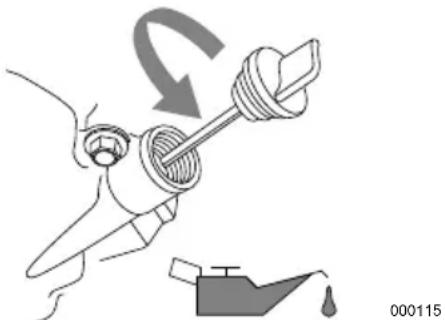
- See Figure 2-1. Remove oil fill cap and wipe dipstick clean.
natural_image
Illustration of a hand holding a tool with a valve, showing mechanical components and a water droplet (no text or symbols)Figure 2-1. Remove Dipstick
- See Figure 2-2. Add recommended engine oil to the bottom of the oil fill hole (A).
Only high-quality detergent oils classified for service SJ or higher are recommended. DO NOT use special additives.
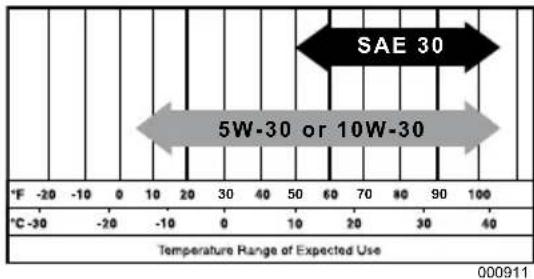
See Figure 2-2. Climate determines proper engine oil viscosity.
line
| Temperature Range of Expected Use | Value | | -------------------------------- | ----- | | -30°F | -30 | | -20°F | -20 | | -10°F | -10 | | 0°F | 0 | | 10°F | 10 | | 20°F | 20 | | 30°F | 30 | | 40°F | 40 | | 50°F | 50 | | 60°F | 60 | | 70°F | 70 | | 80°F | 80 | | 90°F | 90 | | 100°F | 100 |Figure 2-2. Recommended Oil
- Thread dipstick into oil filler neck. Oil level is checked with dipstick fully installed.
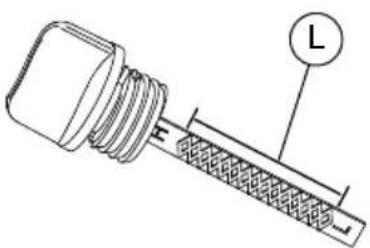
- See Figure 2-3. Remove dipstick and verify oil level is within safe operating range above the lower limit (L).
000116
Figure 2-3. Safe Oil Operating Range
- Install oil fill cap/dipstick and hand-tighten.
Add Fuel

DANGER
Explosion and Fire. Fuel and vapors are extremely flammable and explosive. Add fuel in a well ventilated area. Keep fire and spark away. Failure to do so will result in death or serious injury. (000105)

DANGER
Explosion and Fire. Do not overfill fuel tank. Overfilling may cause fuel to leak and ignite or explode, resulting in death or serious injury. (000204)
Fuel requirements are as follows:
- Clean, fresh, unleaded gasoline.
• Minimum rating of 87 octane/87 AKI (91 RON). - Up to 10% ethanol (gasohol) is acceptable.
• DO NOT use E85.
• DO NOT use a gas oil mix. -
DO NOT modify engine to run on alternate fuels.
• Stabilize fuel prior to storage. -
Verify equipment is OFF and cooled for a minimum of two minutes prior to fueling.
-
Place equipment on level ground in a well ventilated area.
-
Clean area around fuel cap and remove cap slowly.
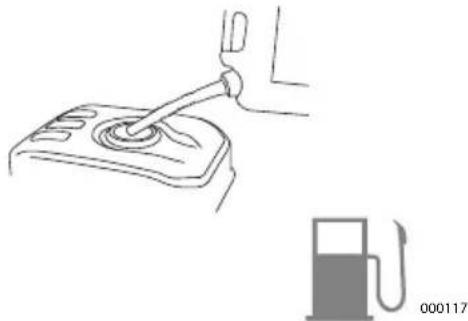
natural_image
Line drawing of a hand using a tool to lift a valve into a pump (no text or symbols)Figure 2-4. Add Recommended Fuel
- Slowly add recommended fuel. Do not overfill.
- Install fuel cap.

DANGER
Risk of fire. Allow fuel spills to completely dry before starting engine. Failure to do so will result in death or serious injury. (000174)
IMPORTANT: It is important to prevent gum deposits from forming in fuel system parts such as the carburetor, fuel hose or tank during storage. Alcohol-blended fuels (called gasohol, ethanol or methanol) can attract moisture, which leads to separation and formation of acids during storage. Acidic gas can damage the fuel system of an engine while in storage. To avoid engine problems, the fuel system should be emptied before storage of 30 days or longer. See Storage. Never use engine or carburetor cleaner products in the fuel tank as permanent damage may occur.
Assembly

!WARNING
Consult Manual. Read and understand manual completely before using product. Failure to completely understand manual and product could result in death or serious injury. (000100a)
Connect the Hoses
CAUTION
Equipment damage. Use only hoses and couplings designed for this pump. Incorrect hoses and couplings can cause performance issues and permanent equipment damage. (000197)
NOTE: Appearance of pump may vary. Discharge ports face 90° from inlet on certain models.
NOTE: Hose kit may be sold separately.
- Place pump in desired operating location.
-
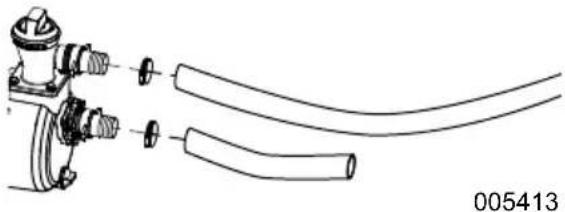
Attach the flexible discharge hose to the flange (top) by sliding the hose over the barb and securing with a hose clamp.
-
See Figure 2-5. Attach the suction hose to the flange (bottom) by sliding the hose over the barb and securing with a hose clamp.
NOTE: Hose attachment styles may vary. Use only flexible hoses. Hard piping may damage pump due to cantilever loads.
natural_image
Technical line drawing of a mechanical assembly with hoses and connectors (no text or symbols)Figure 2-5. Typical Hose Attachment
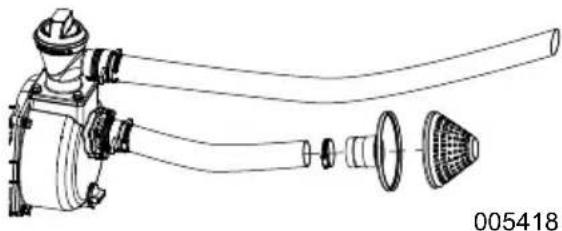
NOTE: Strainer sold separately.
- See Figure 2-6. Suspend and use a strainer on end of suction line if there is any mud, sand, or particles that may cause pump damage.
natural_image
Technical line drawing of a mechanical device with hoses and connectors (no text or symbols)Figure 2-6. Typical Strainer Attachment
CAUTION
Equipment damage. Use recommended strainer to prevent debris from entering the pump. Failure to do so could result in equipment damage.
(000241)
Priming the Pump
CAUTION
Equipment damage. Before starting engine, verify pump is primed with liquid and suction strainer is submerged. Failure to do so will cause pump damage and void the warranty. (000398)
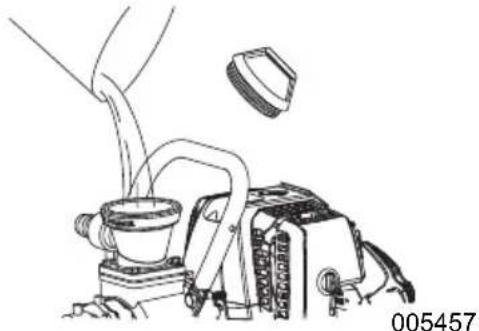
Remove the orange priming cap from the pump and carefully fill the pump chamber completely with liquid. Tighten the cap. DO NOT over tighten.
natural_image
Line drawing of a mechanical device with a bucket and lever assembly (no text or symbols)Figure 2-7. Chemical Priming Plug
Section 3 Operation
Operation and Use Questions
If you have any problems operating your chemical pump, please call Generac customer service at 1-888-GENERAC (888-436-3722).
Placing Chemical Pump for Use

DANGER
Asphyxiation. Running engines produce carbon monoxide, a colorless, odorless, poisonous gas. Carbon monoxide, if not avoided, will result in death or serious injury. (000103)

WARNING
Risk of Fire. Hot surfaces could ignite combustibles, resulting in fire. Fire could result in death or serious injury. (000110)

WARNING
Hot Surfaces. When operating machine, do not touch hot surfaces. Keep machine away from combustibles during use. Hot surfaces could result in severe burns or fire. (000108)
It is a violation of California Public Resource Code, Section 4442, to use or operate the engine on any forest-covered, brush-covered, or grass-covered land unless the exhaust system is equipped with a spark arrestor, as defined in Section 4442, maintained in effective working order. Other states or federal jurisdictions may have similar laws. Place the pump on a level surface free from any obstructions or potential hazards. The pump should be placed close to the material level to ensure maximum performance.
- Only operate pump outdoors in a well ventilated area. Never operate pump indoors, or in a confined space. Be aware of building openings and ventilation systems where exhaust may enter during use.
• See Figure 3-1. Keep at least five (5) ft (152 cm) of clearance on all sides of pump including overhead. - Verify pump is placed on level ground to avoid tipping during operation.
- Submerge strainer.
NOTE: Suspend and use a strainer on end of suction line if there is any mud, sand, or particles that may cause pump damage.
- Place discharge hose in appropriate location to pump chemicals. Make sure hose is securely attached to discharge. Verify that the hose opening is unobstructed.
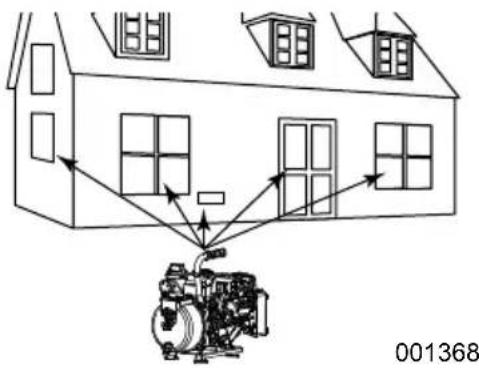
001368
Figure 3-1. Minimum of Five Feet Clearance
CAUTION
Equipment damage. The hose can be damaged if it comes in contact with the hot engine muffler. Keep hose away from muffler during operation. (000124)
Pump Output
See Figure 3-2. Pump output will be affected by the type, length, and size of the suction and discharge hoses. Suction head is the distance (A) from the intake to the suction port. The pumping height, total head, is the distance (B) from the intake to the point of discharge. Minimizing the suction hose length and distance (A) allows for more effective pump priming and use.
NOTE: Total suction head should not exceed 26 ft (8 m).
NOTE: NEVER shut off flow while engine is running, as overheating of liquid or cavitation may result in damaging the pump.
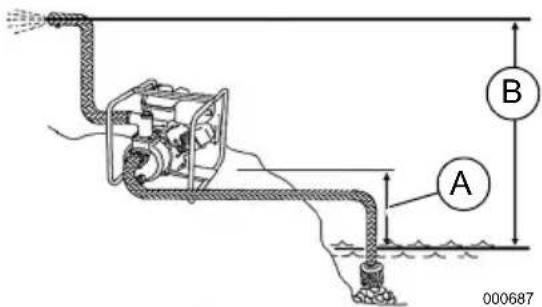
Figure 3-2. Pump Output
High Altitude Operation
This equipment produces maximum suction lift at elevations below 1000 ft (305 m). For every increase of 1000 ft (305 m) above sea level:
- the engine will lose about 3 % of its power - total head will be reduced by about 10 in (25 cm).
Lower atmospheric pressure results in slower engine speeds and reduced flow through the pump.
Transporting / Tipping
Do not operate, store or transport the equipment at an angle greater than 15 degrees.
Before Starting Engine
- Verify engine oil level is correct.
- Verify fresh fuel level is correct.
- Verify all fittings, gaskets, and couplers are properly secured.
- Verify hoses are properly connected.
- Verify equipment is secure on level ground, with proper clearance and is in a well ventilated area.
NOTE: Pumping substances with solids larger than the maximum stated particle size can damage the pump and void the warranty. Maximum particle size is listed on the product specifications sheet. Ensure that correct strainer is attached to the suction hose to prevent pumping larger solids.
Starting the Engine
CAUTION
Equipment damage. Before starting engine, verify pump is primed with liquid and suction strainer is submerged. Failure to do so will cause pump damage and void the warranty. (000398)
- Remove priming cap and fill the pump. Replace priming cap.
- See Figure 3-3. Move fuel valve lever (A) to ON position.
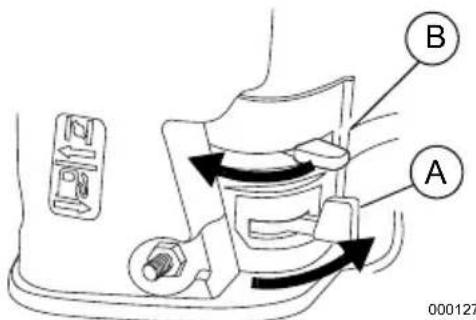
Figure 3-3.Starting the Engine
- Move choke lever (B) to CLOSED position.
NOTE: For warm engine, leave choke lever in OPEN position.
- See Figure 3-5. Move throttle lever (C) about 1/3 away from the MIN position.
- See Figure 3-4. Turn engine switch (D) ON.
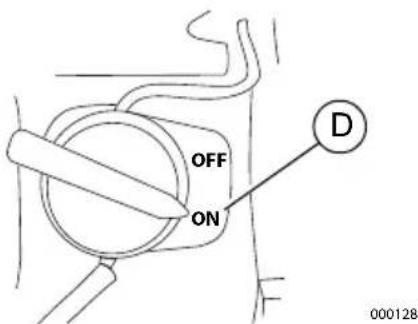
Figure 3-4. Engine Switch
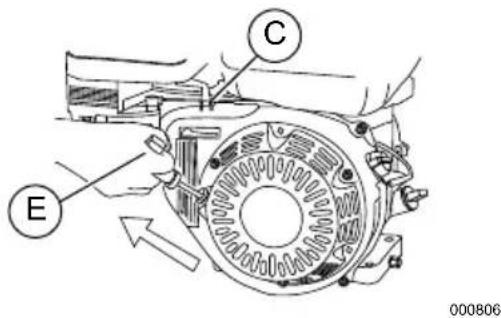
Figure 3-5. Engine Recoil

!WARNING
Recoil Hazard. Recoil could retract unexpectedly. Kickback could result in death or serious injury. (000183)
- Grasp recoil handle (E) and pull slowly until you feel some resistance. Then pull rapidly to start engine. Return recoil handle slowly. DO NOT let recoil snap back against recoil housing.
- When engine starts, slowly move choke lever to OPEN position as engine warms. If engine falters, move choke lever to CLOSE position, then to OPEN position.
If engine fails to start after six pulls, move choke lever to "OPEN" position, and repeat step 6. - When the engine is running smoothly, adjust the throttle lever to set the desired engine speed.

WARNING
Risk of Fire. Hot surfaces could ignite combustibles, resulting in fire. Fire could result in death or serious injury.
(000110)

WARNING
Hot Surfaces. When operating machine, do not touch hot surfaces. Keep machine away from combustibles during use. Hot surfaces could result in severe burns or fire.
(000108)
Preventing Water Hammer
Water hammer occurs when the discharge flow is suddenly blocked or stopped. Pressurized chemicals trapped inside the pump can quickly boil and crack or damage the pump housing. To prevent water hammer:
- Do not close the discharge valve while the pump is operating.
- Do not allow vehicles to drive over the discharge hose.
- Do not abruptly compress the discharge hose.
- Do not shut off flow while the engine is running.
Chemical Pump Shut Down
- Move throttle lever from fast to slow.
- Turn engine switch OFF.
- Move fuel valve lever to OFF position.
- Allow the engine to cool thoroughly.
After Each Use
See Figure 3-6. After cooling, remove the priming plug (A) and drain plug (B) from the pump housing and allow it to drain thoroughly.
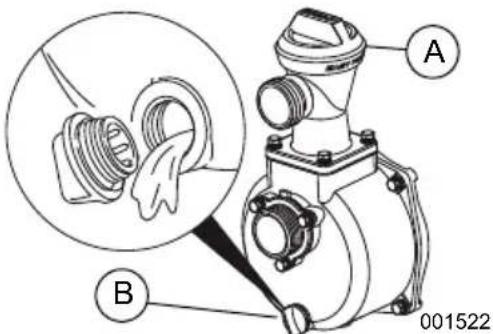
Figure 3-6. Typical Drain Pump Housing
NOTE: Dispose of the chemical as recommended by the chemical manufacturer and in accordance with all applicable state and federal laws.
Rinse out pump with clean water and dispose of as recommended by the chemical manufacturer.
NOTE: DO NOT allow chemical to remain in pump after use. Leaving chemicals inside the pump may degrade the materials of the pump. Trapped chemicals can freeze and crack the pump housing. Pump damage caused by not draining pump is not covered by warranty.
NOTE:
Follow these procedures after every use:
- Drain pump housing.
- Disconnect hoses.
- Wipe pump with a clean, dry cloth to remove excess water and dirt.
- Store equipment in a clean, dry area.
NOTE: If storing for more than 30 days, see Storage.
Section 4 Maintenance and Troubleshooting
Maintenance Recommendations
Regular maintenance will improve performance and extend pump life. See an IASD for service.
Chemical pump warranty does not cover items subjected to operator abuse or negligence. To receive full warranty value, operator must maintain chemical pump as instructed in this manual, including proper storage as detailed in Storage.
NOTE: Call 1-888-GENERAC (888-436-3722) with questions about component replacement.
Maintenance Schedule
Follow maintenance schedule intervals, whichever occurs first according to use.
NOTE: Adverse conditions will require more frequent service.
NOTE: All required service and adjustments should be performed each season as detailed in the following chart.
| Before Each Use |
| Check engine oil level |
| Check air cleaner |
| Check and tighten fasteners |
| After Each Use |
| Drain chemical from pump |
| Every 3 Months or 50 Hours |
| Clean air cleaner* |
| Every 6 Months or 100 Hours |
| Change oil ‡ |
| Clean sediment cup |
| Check and adjust spark plug |
| Clean fuel tank and fuel filter ** |
| Clean spark arrestor (if equipped) |
| Every Year or 300 Hours |
| Replace air cleaner element (paper) |
| Replace spark plug |
| Check and adjust idle speed ** |
| Check and adjust valve clearance ** |
| Every Two Years |
Check condition of fuel lines and replace if necessary
* Service more often in dusty or dirty conditions.
** Contact an IASD.
‡ Change oil after the first 20 hours of operation, and every 100 hours thereafter.
Preventive Maintenance
Dirt or debris can cause improper operation and equipment damage. Clean pump daily or before each use. Keep area around and behind muffler free from combustible debris.
- Use a damp cloth to wipe exterior surfaces clean.
- Use a soft bristle brush to loosen caked on dirt, oil, etc.
- Use a vacuum to pick up loose dirt a debris.
- Low pressure air (not to exceed 25 psi [172 kPa]) may be used to blow away dirt.
Engine Maintenance
WARNING
Accidental start-up. Disconnect spark plug wires when working on unit. Failure to do so could result in death or serious injury.
(000141)
Inspect Engine Oil Level

WARNING
Risk of burns. Allow engine to cool before draining oil or coolant. Failure to do so could result in death or serious injury.
(000139)
Inspect engine oil level prior to each use, or every 8 hours of operation.
Add recommended engine oil as necessary. See Add Engine Oil..
NOTE: If equipped with an "Oil Alert System" the system will automatically stop the engine before the oil level falls below a safe limit.
Change Engine Oil
WARNING
Accidental start-up. Disconnect spark plug wires when working on unit. Failure to do so could result in death or serious injury.
(000141)
When using chemical pump under extreme, dirty, dusty conditions, or in extremely hot weather, change oil more frequently.
NOTE: Properly dispose of used oil in accordance with all local laws and regulations.
Change oil while engine is still warm from running, as follows:
- Disconnect the spark plug wire from the spark plug and place the wire where it cannot contact spark plug.
- Place a suitable collection container beneath the engine.
- See Figure 4-1. Remove oil fill cap (A).
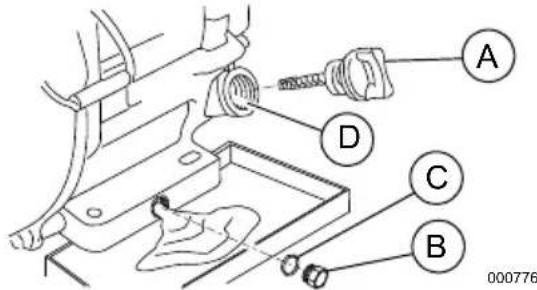
Figure 4-1. Changing Engine Oil
- Remove the oil drain plug (B) and discard the washer (C). Drain oil completely.
- Place a new washer on the oil drain plug. Install oil drain plug and tighten securely.
- Add recommended engine oil as necessary. See Add Engine Oil.
- Install oil fill cap, and finger tighten.
- Wipe up any spilled oil.
- Properly dispose of oil in accordance with all applicable regulations.
Service Air Cleaner
Engine will not run properly and may be damaged if run with a dirty air cleaner. Service air cleaner more frequently in dirty or dusty conditions.
To service air cleaner:
- Remove air cleaner cover.
- Remove filter element(s).
- Inspect filter element(s) and replace if damaged. To order replacements, contact Generac Customer Service at 1-888-GENERAC (888-436-3722) for the name of your nearest IASD.
- Clean foam filter element in warm soapy water. Rinse, and allow to dry thoroughly. Dip in clean engine oil and squeeze out excess oil.
- Tap paper filter element several times on hard surface to remove dirt. Compressed air (not exceeding 30 psi (207 kPa) can also be used to blow through filter element from the inside.
- Use a clean, damp cloth to wipe dirt from inside air cleaner cover.
- Put cleaned or new filter element(s) in place. Verify gasket is in place (if equipped).
- Install air cleaner cover. Tighten air cleaner screws or fasteners securely.
Service Spark Plug
To service spark plug:
- See Figure 4-2. Clean area around spark plug (A).
- Remove and inspect spark plug.
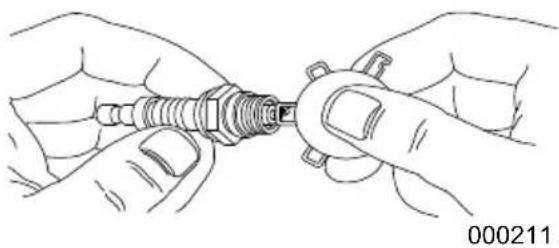
- See Figure 4-2 and Figure 4-3. Inspect electrode gap (B) with wire feeler gauge and replace spark plug if gap is not within 0.028 - 0.031 in (0.70 - 0.80 mm).
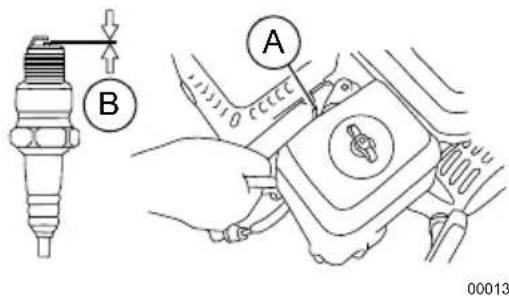
Figure 4-2. Service Spark Plug
natural_image
Line drawing of hands holding a screwdriver (no text or symbols present)Figure 4-3. Spark Plug Gap
NOTE: Replace spark plug if electrodes are pitted, burned or porcelain is cracked. Use ONLY recommended replacement plug. See product specification sheet.
4. Install spark plug finger tight, and tighten an additional 3/8 to 1/2 turn using spark plug wrench. DO NOT OVERTIGHTEN.
Inspect Muffler and Spark Arrestor (if equipped)
NOTE: It is a violation of California Public Resource Code, Section 4442, to use or operate the engine on any forest-covered, brush-covered, or grass-covered land unless the exhaust system is equipped with a spark arrestor, as defined in Section 4442, maintained in effective working order. Other states or federal jurisdictions may have similar laws.
Contact original equipment manufacturer, retailer, or dealer to obtain a spark arrestor designed for exhaust system installed on this engine.
NOTE: Use ONLY original equipment replacement parts.
Inspect muffler for cracks, corrosion, or other damage. Remove spark arrestor, if equipped, inspect for damage or carbon blockage. Replace parts as required.
Storage

DANGER
Explosion and Fire. Fuel and vapors are extremely flammable and explosive. Store fuel in a well ventilated area. Keep fire and spark away. Failure to do so will result in death or serious injury.
(000143)

WARNING
Risk of Fire. Verify machine has properly cooled before installing cover and storing machine. Hot surfaces could result in fire.
(000109)
Refer to the following list to prepare equipment for storage.
- DO NOT place a storage cover on a hot chemical pump. Allow equipment to cool to room temperature before storage.
- DO NOT store fuel from one season to another unless properly treated.
- Replace fuel container if rust is present. Rust in fuel will cause fuel system problems.
- Cover equipment with a suitable protective, moisture resistant cover.
- Store equipment in a clean and dry area.
• Always store chemical pump and fuel away from heat and ignition sources.
Prepare Fuel System for Storage
Fuel stored over 30 days can go bad and damage fuel system components. Keep fuel fresh, use fuel stabilizer.
If fuel stabilizer is added to fuel system, prepare and run engine according to Starting the Engine Run engine for 10-15 minutes to circulate stabilizer throughout fuel system. Adequately prepared fuel can be stored up to 24 months.
CAUTION
Equipment damage. Always run engine with water in the pump priming chamber. Failure to do so could result in equipment damage.
(000243)
NOTE: If fuel has not been treated with fuel stabilizer, it must be drained into an approved container. Run engine until it stops from lack of fuel. Use of fuel stabilizer in fuel storage container is recommended to keep fuel fresh.
- Change engine oil.
- Remove spark plug.
- Pour a tablespoon (5-10cc) of clean engine oil or spray a suitable fogging agent into cylinder.

WARNING
Vision Loss. Eye protection is required to avoid spray from spark plug hole when cranking engine. Failure to do so could result in vision loss.
(000181)
-
Pull starter recoil several times to distribute oil in cylinder.
-
Install spark plug.
- Pull recoil slowly until resistance is felt. This will close valves so moisture cannot enter engine cylinder. Gently release recoil.
Change Oil
Change engine oil before storage. See Change Engine Oil.
Prepare Chemical Pump for Storage
Protect equipment from freezing temperatures. Failure to do so will permanently damage pump and render equipment inoperable. Freeze damage is not covered under warranty.
Protect equipment from freezing temperatures as follows:
- Shut engine off by turning engine start switch to OFF.
- Disconnect hoses.
- Let engine cool.
-
Remove chemical drain plug and drain trapped chemical.
-
Rinse out pump with clean water and dispose of as recommended by the chemical manufacturer.
-
Turn fuel valve to OFF.
-
Winterize engine per manufacturer specifications.
Store equipment in a clean and dry area.
NOTE: Dispose of the chemical as recommended by the chemical manufacturer.
Troubleshooting
| PROBLEM | CAUSE CORRECTION | |
| Engine will not start, or starts and runs rough. | 1. Engine ON/OFF switch in OFF position.2. Dirty air filter3. Out of fuel.4. Stale fuel.5. Fuel switch in OFF position (if equipped).6. Low oil level (units with low oil shutdown system).7. Spark plug wire not connected to plug.8. Bad spark plug.9. Choke position incorrect.10. Water in fuel.11. Excessively rich fuel mixture.12. Impeller obstructed.13. Dirty fuel filter. | 1. Place Engine ON/OFF switch in ON position.2. Clean or replace air filter.3. Fill fuel tank.4. Replace with fresh fuel.5. Place fuel switch in ON position.6. Fill oil to proper level.7. Connect wire to spark plug.8. Replace spark plug.9. Adjust choke position.10. Drain fuel tank; replace with fresh fuel.11. Contact IASD.12. Clean impeller.13. Replace fuel filter. |
| Pump not operating. | 1. Air leak in suction hose.2. Suction and/or discharge hoses blocked.3. End of suction hose not submerged.4. Total head exceeds pump capacity. | 1. Check suction hose and connections for leaks. Tighten or repair.2. Check hoses and strainer. Clear obstructions.3. Increase suction hose length or move pump closer to supply.4. Reduce total head or choose a different pump for the task. |
| Weak discharge flow. | 1. Air leakage (intake) at suction side.2. Reduced engine power output.3. Damaged mechanical seal.4. Suction lift too high.5. Suction hose too long, or hose diameter too small.6. Leaking discharge hose or connection.7. Damaged mechanical seal.*8. Impeller obstructed.9. Worn impeller.**10. Engine throttle in SLOW position.11. Inlet hose joint not tight. | 1. Check suction hose and connections for leaks. Tighten or repair.2. Contact IASD.3. Replace mechanical seal.4. Lower suction lift.5. Shorten suction hose, or increase hose diameter.6. Check discharge hose and connection for leaks. Tighten or repair.7. Replace mechanical seal.8. Clean impeller.9. Replace impeller.10. Increase throttle position.11. Tighten inlet hose joint. |
| Pump does not prime, or priming takes a long time. | 1. Air leakage (intake) at suction side.2. Insufficient priming chemical inside pump casing.3. Drain plug is loose.4. Engine malfunction.5. Damaged mechanical seal.6. Incorrectly sized suction hose.7. Suction hose is too long.8. Excessive suction lift. ***9. Inlet hose joint not tight. | 1. Check suction hose and connections for leaks. Tighten or repair.2. Add priming chemical.3. Tighten drain plug.4. Contact IASD.5. Replace mechanical seal.6. Use correct suction hose.7. Move pump closer to supply.8. Correct suction head.9. Tighten inlet hose joint. |
| Pump loses prime. | 1. Chemical level drops below the end of the suction line. | 1. Increase length of suction line or move the pump closer to the supply source. |
| Pump shuts down during operation. | 1. No fuel.2. Low oil sensor shuts down unit. | 1. Allow engine to cool for 2 minutes, then fill fuel tank.2. Make sure unit is on flat surface. Check oil level and add more if necessary. |
| Oil leakage at muffler or air cleaner. | 1. Engine failure.2. Engine overfilled with oil. | 1. Repair or replace.2. Correct oil level. |
| Chemical leakage between engine and pump. | 1. Damaged mechanical seal.* 1. Replace mechanical seal.* | |
* Mechanical seal damage may be caused by normal wear, overheating, or pumping incompatible fluids or running pump without liquid.
** Excessive impeller wear is primarily due to cavitation. Causes include restricted suction and excessive suction lift.
*** Total suction head should not exceed 26 ft (8 m).
Notes
Part No. 10000014547 Rev. B 10/17/2018
©2018 Generac Power Systems, Inc.
All rights reserved
Specifications are subject to change without notice.
No reproduction allowed in any form without prior
written consent from Generac Power Systems, Inc.
GENERAC
Generac Power Systems, Inc.
S45 W29290 Hwy. 59
Waukesha, WI 53189
1-888-GENERAC (1-888-436-3722)
www.generac.com
natural_image
Diagram of a mechanical device with a rotating arrow and base, no text or symbols presentImagen 2-1. Sacar la varilla
000116
natural_image
Line drawing of a hand using a lever to lift a mechanical component (no text or symbols)
000117
natural_image
Technical line drawing of a mechanical assembly with hoses and connectors (no text or symbols)natural_image
Technical line drawing of a mechanical pump assembly with internal components (no text or symbols)natural_image
Technical line drawing of a mechanical device with pipes and a container, no visible text or symbolsImagen 3-3. Arranque del motor
000806
natural_image
Illustration of hands connecting a screw to a pin (no text or symbols)©2018 Generac Power Systems, Inc.
natural_image
Diagram of a mechanical device with a rotating arrow and a water drop symbol (no text or labels)natural_image
Line drawing of a hand using a lever to lift a valve on a control panel, with a fuel pump nearby (no text or symbols)natural_image
Technical line drawing of a mechanical assembly with two curved pipes and fittings (no text or symbols)Figure 2-5. Raccord de tuyau type
natural_image
Technical line drawing of a mechanical device with hoses and connectors (no text or symbols)Figure 2-6. Raccord de crépine type
ATTENTION
natural_image
Line drawing of a mechanical device with a handle and component, no text or symbols present000806
©2018 Generac Power Systems, Inc.
- Section 1 Introduction and Safety 1
- Section 2 General Information and
- Setup 5
- Section 3 Operation ....8
- Section 4 Maintenance and
- Troubleshooting 11
- Section 1 Introduction and Safety
- Introduction
- WARNING
- Safety Rules
- DANGER
- CAUTION
- Safety Symbols and Meanings
- !WARNING
- Chemical Hazards
- Exhaust Hazards
- Fire Hazards
- Fuel Hazards
- Before Starting Equipment
- When Operating Equipment
- When Transporting or Repairing Equipment
- When Storing Fuel or Equipment with Fuel In Tank
- Section 2 General Information and Setup
- Know Your Chemical Pump
- Product Specifications
- Emissions
- Remove Contents from Carton
- Add Engine Oil
- Add Fuel
- Assembly
- Connect the Hoses
- Priming the Pump
- Section 3 Operation
- Operation and Use Questions
- Placing Chemical Pump for Use
- Pump Output
- High Altitude Operation
- Transporting / Tipping
- Before Starting Engine
- Starting the Engine
- Preventing Water Hammer
- Chemical Pump Shut Down
- After Each Use
- NOTE:
- Section 4 Maintenance and Troubleshooting
- Maintenance Recommendations
- Maintenance Schedule
- Preventive Maintenance
- Engine Maintenance
- Inspect Engine Oil Level
- Change Engine Oil
- Service Air Cleaner
- Service Spark Plug
- Inspect Muffler and Spark Arrestor (if equipped)
- Storage
- Prepare Fuel System for Storage
- Change Oil
- Prepare Chemical Pump for Storage
- Notes
- ATTENTION
Brand : Generac
Model : C20
Category : Pump