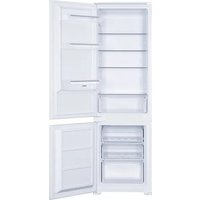
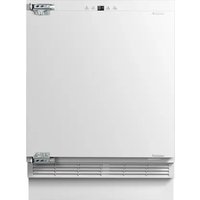
EFC-1711-I - Refrigerator EDESA - Free user manual and instructions
Find the device manual for free EFC-1711-I EDESA in PDF.


| Brand | EDESA |
| Model | EFC-1711-I |
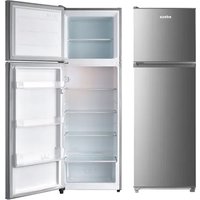
| Product type | Combined refrigerator with freezer compartment |
| Installation type | Built-in |
| Power supply | 220-240 V, 50 Hz |
| Refrigerant | R600a (flammable gas) |
| Main functions | Smart mode, Super mode, Door opening alarm, Cold zone |
| Interior lighting | LED, energy efficiency class G |
| Freezer defrosting | Manual, to be done at least once a year |
| Recommended cleaning | Soft cloth with warm water, white vinegar or baking soda |
| Safety | Mandatory grounding, do not use multi-sockets, keep away from flames |
| Repairability | LED lamp replaceable by after-sales service, parts available on request |
| Door opening direction | Reversible (inversion possible) |
| Number of doors | 2 (refrigerator and freezer) |
| Included accessories | Built-in kit (guides, slides, screws, seals) |
| Door open alarm | Triggers after 90 seconds |
| Super mode | Activates the lowest temperature for 54 hours |
| Smart mode | Automatically regulates temperature according to ambient temperature |
| Cold zone | Temperature below or equal to +4°C, indicated by a symbol |
| Number of manual pages | 125 pages |
Frequently Asked Questions - EFC-1711-I EDESA
User questions about EFC-1711-I EDESA
0 question about this device. Answer the ones you know or ask your own.
Ask a new question about this device
Download the instructions for your Refrigerator in PDF format for free! Find your manual EFC-1711-I - EDESA and take your electronic device back in hand. On this page are published all the documents necessary for the use of your device. EFC-1711-I by EDESA.
USER MANUAL EFC-1711-I EDESA
natural_image
White refrigerator with a curved line of sound waves above it, symbolizing energy or sound (no text or symbols present)ES Manual de instrucciones
EN Instruction manual
PT Manual de instruções
DE Bedienungsanleitung
FR Manuel d'instructions
natural_image
Simple line drawing of a table with a pointer and rotation arrow, no text or symbols presentnatural_image
Technical line drawing of a mechanical clamp or bracket assembly with a screwdriver (no text or symbols)natural_image
Technical line drawing of a mechanical component with a magnified inset showing internal components (no text or symbols)natural_image
Diagram showing two mechanical components with an arrow indicating direction (no text or symbols)natural_image
Technical line drawing of a mechanical clamp or bracket assembly (no text or symbols)natural_image
Technical line drawing of four mechanical bracket components with mounting holes and fasteners, shown in sequence (no text or symbols)natural_image
Simple line drawing of a mechanical setup with a rotating component and a vertical rod (no text or symbols)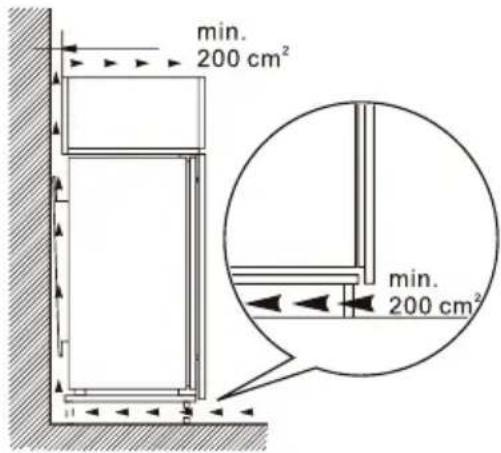
INSTALACIÓN
natural_image
Isometric diagram of a cabinet or enclosure with directional arrows indicating movement (no text or symbols)natural_image
Technical line drawing of a mechanical assembly with no visible text or symbolsnatural_image
Simple line drawing of a mechanical frame with a hanging hook and rotational arrow (no text or symbols)natural_image
Diagram showing a curved pipe or duct with an arrow indicating direction, alongside a magnified inset (no text or symbols)natural_image
Technical line drawing of a mechanical assembly with no visible text or symbols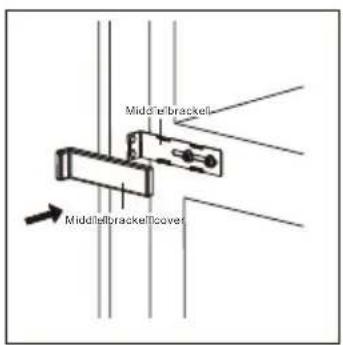
INSTALACIÓN
Posicionamiento
natural_image
Line drawing of a hand using a tool to install or install a shelf (no text or symbols)natural_image
Diagram showing two upward-pointing arrows inside a container-like structure (no text or symbols)In the interest of your safety and to ensure the correct use, before installing and first using the appliance, read this user manual carefully, including its hints and warnings. To avoid unnecessary mistakes and accidents, it is important to ensure that all people using the appliance are thoroughly familiar with its operation and safety features. Save these instructions and make sure that they remain with the appliance if it is moved or sold, so that everyone using it through its life will be properly informed on appliance use and safety.
For the safety of life and property keep the precautions of these user's instructions as the manufacturer is not responsible for damages caused by omission.
Children and vulnerable people safety
- This appliance can be used by children aged from 8 years and above and persons with reduced physical, sensory or mental capabilities or lack of experience and knowledge if they have been given super vision or instruction concerning use of the appliance in a safe way and understand the hazards involved.
- Children aged from 3 to 8 years are allowed to load and unload this appliance.
- Children should be supervised to ensure that they do not play with the appliance.
- Cleaning and user maintenance shall not be made by children unless they are aged from 8 years and above and supervised.
- Keep all packaging well away from children. There is risk of suffocation.
- If you are discarding the appliance pull the plug out of the socket, cut the connection cable (as close to the appliance as you can) and remove the door to prevent playing children to suffer electric shock or to close themselves into it.
- If this appliance featuring magnetic door seals is to replace an older appliance having a spring lock (latch) on the door or lid, be sure to make that spring lack unusable before you discard the old appliance. This will prevent it from becoming a death trap for a child.
General safety
WARNING! Keep ventilation openings, in the appliance enclosure or in the built-in structure, clear of obstruction.
WARNING! Do not use mechanical devices or other means to accelerate the defrosting process, other than those recommended by the manufacturer.
⚠ WARNING! Do not damage the refrigerant circuit.
WARNING! Do not use other electrical appliances (such as ice cream makers) inside of refrigerating appliances, unless they are approved for this purpose by the manufacture.
⚠ WARNING! Do not touch the light bulb if it has been on for a long period of time because it could be very hot. ^1)
⚠ WARNING! When positioning the appliance, ensure the supply cord is not trapped or damaged.
WARNING! Do not locate multiple portable socket-outlets or portable power suppliers at the rear of the appliance.
- Do not store explosive substances such as aerosol cans with a flammable propellant in this appliance.
- The refrigerant isobutane (R-600a) is contained within the refrigerant circuit of the appliance, a natural gas with a high level of environmental compatibility, which is nevertheless flammable.
- During transportation and installation of the appliance, be certain that none of the components of the refrigerant circuit become damaged.
- avoid open flames and sources of ignition
- thoroughly ventilate the room in which the appliance is situated
- It is dangerous to alter the specifications or modify this product in any way. Any damage to the cord may cause a short circuit, fire and/or electric shock.
-
This appliance is intended to be used in household and similar applications such as
-
staff kitchen areas in shops, offices and other working environments;
- farm houses and by clients in hotels, motels and other residential type environments;
- bed and breakfast type environments;
- catering and similar non-retail applications.
⚠ WARNING! Any electrical components (plug, power cord, compressor and etc.) must be replaced by a certified service agent or qualified service personnel.
⚠ WARNING! The light bulb supplied with this appliance is a “special use lamp bulb” usable only with the appliance supplied. This “special use lamp” is not usable for domestic lighting. ^1)
- Power cord must not be lengthened.
- Make sure that the or damaged by the power plug is not squashed back of the appliance. A squashed or damaged power plug may overheat and cause a fire.
- Make sure that you can come to the mains plug of the appliance.
- Do not pull the mains cable.
- If the power plug socket is loose, do not insert the power plug. There is a risk of electric shock or fire.
- You must not operate the appliance without the lamp.
- This appliance is heavy. Care should be taken when moving it.
- Do not remove nor touch items from the freezer compartment if you hands are damp/wet, as this could cause skin abrasions or frost/freezer burns.
- Avoid prolonged exposure of the appliance to direct sunlight.
Daily use
- Do not put hot on the plastic parts in the appliance.
-
Do not place food products directly against the rear wall.
-
Frozen food must not be re-frozen once it has been thawed out. ^1)
- Store pre-packed frozen food in accordance with the frozen food manufacture's instructions. ^1)
- Appliance’s manufactures storage recommendations should be strictly adhered to. Refer to relevant instructions.
- Do not place carbonated of fizzy drinks in the freezer compartment as it creates pressure on the container, which may cause it to explode, resulting in damage to the appliance. ^1)
- Ice lollies can cause frost burns if consumed straight from the appliance. ^1)
- To avoid contamination of food, please respect the following instructions
- Opening the door for long periods can cause a significant increase of the temperature in the compartments of the appliance.
- Clean regularly surfaces that can come in contact with food and accessible drainage systems.
- Clean water tanks if they have not been used for 48h; flush the water system connected to a water supply if water has not been drawn for 5 days.
- Store raw meat and fish in suitable containers in the refrigerator, so that it is not in contact with or drip onto other food.
-
Two-star frozen-food compartments (if they are presented in the appliance) are suitable for storing pre-frozen food, storing or making ice-cream and making ice cubes.
-
One-, two- and three-star compartments (if they are presented in the appliance) are not suitable for the freezing of fresh food.
- If the appliance is left empty for long periods, switch off, defrost, clean, dry and leave the door open to prevent mount developing within the appliance.
Care and cleaning
- Before maintenance, switch off the appliance and disconnect the mains plug from the mains socket.
- Do not clean the appliance with metal objects.
- Do not use sharp objects to remove frost from the appliance. Use a plastic scraper. ^1)
- Regularly examine the drain in the refrigerator for defrosted water. If necessary, clean the drain.
If the drain is blocked, water will collect in te bottom of the appliance. ^2)
Installation
Important! For electrical connection carefully follow the instructions given in specific paragraphs.
- Unpack the appliance and check if there are damages on it. Do not connect the appliance if it is damaged. Report possible damages immediately to the place you bought it. In that case retain packing.
- It is advisable to wait at least four hours before connecting the appliance to allow the oil to flow back in the compressor.
- Adequate air circulation should be around the appliance, lacking this leads to overheating. To achieve sufficient ventilation follow the instructions relevant to installation.
- Wherever possible the spacers of the product should be against a wall to avoid touching or catching warm parts (compressor, con-denser) to prevent possible burn.
- The appliance must not be located close to radiators or cookers.
- Make sure that the mains plug is accessible after the installation of the appliance.
Service
- Any electrical work required to do the servicing of the appliance should be carried out by a qualified electrician or competent person.
- This product must be serviced by an authorized Service Center, and only genuine spare parts must be used.
Energy saving
- Don't put hot food in the appliance;
- Don’t pack food close together as this prevents air circulating;
-
Make sure food don't touch the back of the compartment(s);
-
If electricity goes off, don't open the door(s);
- Don't open the door(s) frequently;
- Don't keep the door(s) open for too long time;
- Don't set the thermostat on exceeding cold temperatures;
- All accessories, such as drawers, shelves balconies, should be kept there for lower energy consumption.
Environment Protection
This appliance does not contain gasses which could damage the ozone layer, in either its refrigerant circuit or insulation. materials. The appliance shall not be discarded together with the urban refuse and rubbish. The insulation foam contains flammable gases: the appliance shall be disposed according to the appliance regulations to obtain from your local authorities. Avoid damaging the cooling unit, especially the heat exchanger.
The materials used on this appliance marked by the symbol 🌐 are recyclable.
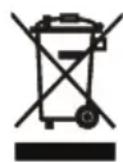
The symbol on the product or on its packaging indicates that this product may not be treated as household waste. Instead it should be taken to the appropriate collection point for the recycling of electrical and electronic equipment. By ensuring this product is disposed of correctly, you will help prevent potential negative consequences for the environment and human health,
which could otherwise be caused by inappropriate waste handling of this product. For more detailed information about recycling of this product, please contact your local council, your household waste disposal service or the shop where you purchased the product.
Packaging materials
The materials with the symbol are recyclable. Dispose the packaging in a suitable collection containers to recycle it.
Disposal of the appliance
- Disconnect the mains plug from the mains socket.
- Cut off the mains cable and discard it.
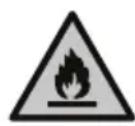
⚠ WARNING! During using, service and disposal the appliance, please pay attention to symbol similar as left side, which is located on rear of appliance (rear panel or compressor) and with yellow or orange color.
It's risk of fire warning symbol. There are flammable materials in refrigerant pipes and compressor.
Please be far away fire source during using, service and disposal.
Position different food in different compartments according to below table
| Refrigerator compartments Type of food | |
| Door or balconies of fridge compartment | ·Foods with natural preservatives, such as jams, juices, drinks, condiments.·Do not store perishable foods. |
| Crisper drawer (salad drawer) | ·Fruits, herbs and vegetables should be placed separately in the crisper bin.·Do not store bananas, onions, potatoes, garlic in the refrigerator. |
| Fridge shelf – middle | ·Dairy products, eggs |
| Fridge shelf – top | ·Foods that do not need cooking, such as ready-to-eat foods, deli meats, leftovers. |
| Freezer drawer(s)/shelf | ·Foods for long-term storage.·Bottom drawer/shelf for raw meat, poultry, fish.·Middle drawer/shelf for frozen vegetables, chips.·Top drawer/shelf for ice cream, frozen fruit, frozen baked goods. |
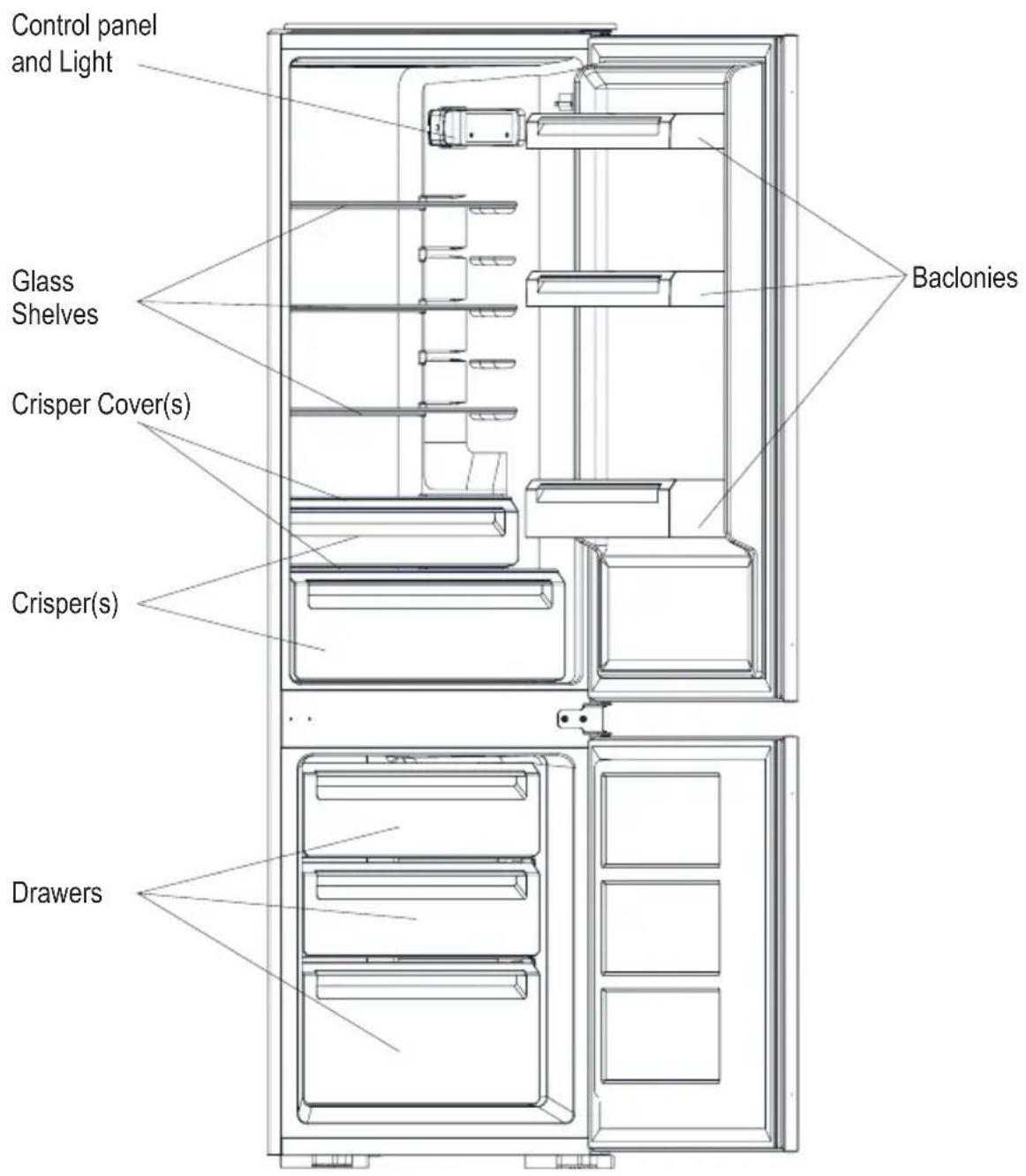
Note: Above picture is for reference only. Real appliance probably is different.
Tool required: Philips screwdriver, Flat bladed screwdriver, Hexagonal spanner.
- Ensure the unit is unplugged and empty.
- To take the door off, it is necessary to tilt the unit backwards. You should rest the unit on something solid so that it will not slip during the door reversing process.
- All parts removed must be saved to do the reinstallation of the door.
- Do not lay the unit flat as this may damage the coolant system.
-
It's better that 2 people handle the unit during assembly.
-
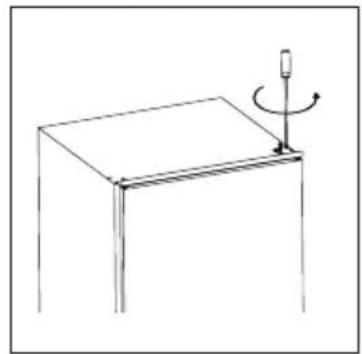
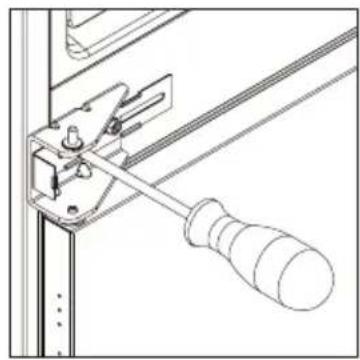
Unscrew the top hinge. Then lift the upper door and place it on a padded surface to avoid scratching.
-
Unscrew middle hinge and then lift bottom door and place it on a padded surface to avoid scratching.
-
Remove bottom hinge pin from right to left.
-
Move middle bracket from left to right. Than re-fit bottom door.
natural_image
Simple line drawing of a table with a pointer and curved arrow indicating rotation (no text or symbols)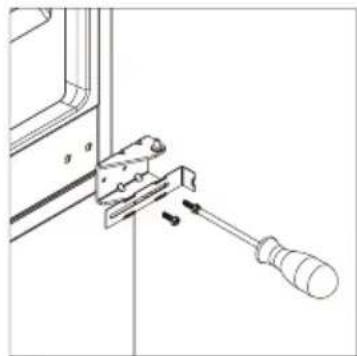
natural_image
Technical line drawing of a mechanical clamp or bracket assembly with a screwdriver (no text or symbols)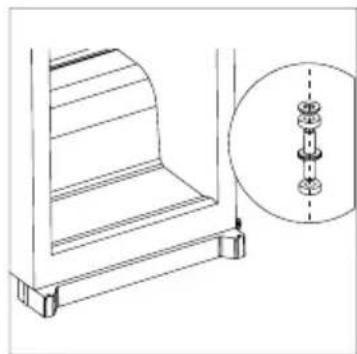
natural_image
Technical line drawing of a mechanical bracket with an inset showing a close-up of a bolt assembly (no text or symbols)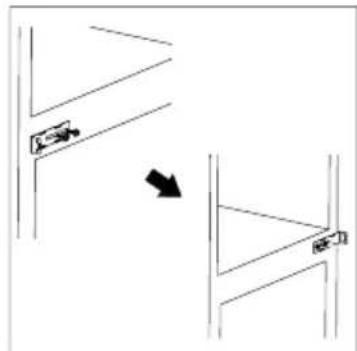
natural_image
Diagram showing two mechanical components with an arrow indicating direction (no text or symbols)Reverse Door
- Re-fit middle hinge to left side. Ensure bottom door is aligned horizontally and vertically, so that the seals are closed on all sides before finally tightening the middle hinge.
natural_image
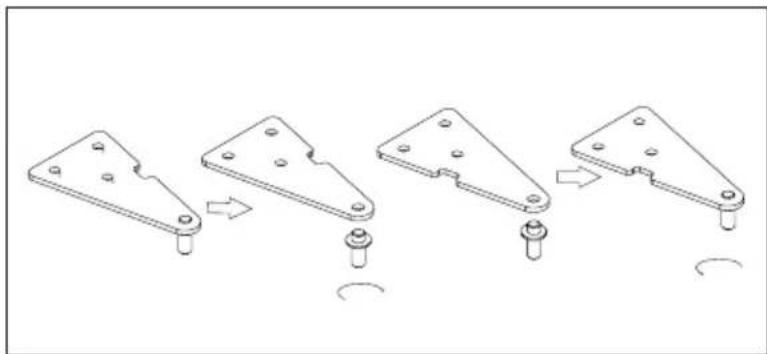
Technical line drawing of a mechanical clamp or bracket assembly (no text or symbols)- Unscrew top hinge pin from the hinge. Then turn the hinge over and screw hinge pin.
natural_image
Technical line drawing of four mechanical bracket assemblies with mounting holes and fasteners, shown in sequence (no text or symbols)- Re-fit upper door and then upper hinge on left side. Ensure upper door is aligned horizontally and vertically, so that the seals are closed on all sides before finally tightening the upper hinge. If necessary, a spanner to tighten the hinge.
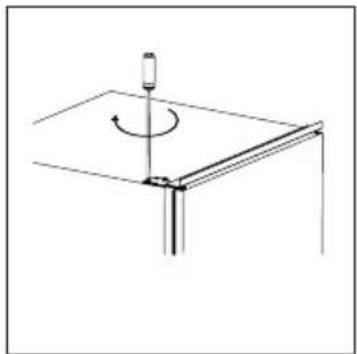
natural_image
Simple line drawing of a mechanical setup with a rotating component and base (no text or symbols)Kits for installation
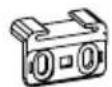
Guide x 4

Guide Cover x 4
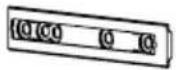
Slider x 4
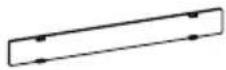
Slider Cover x 4

Short Screw x 27 Long Screw x 2

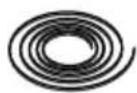
Rubber Seal x 1
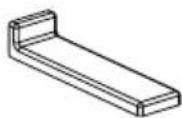
Middle Bracket Cover x 2
Install the appliance
- Ensure the size of cabinet and ventilation are enough.
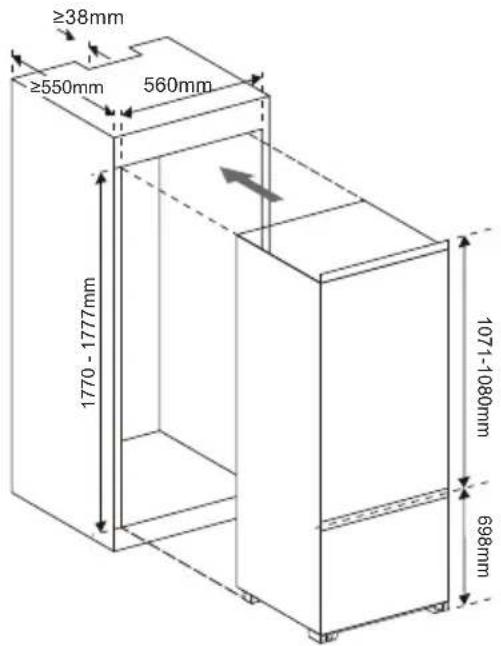
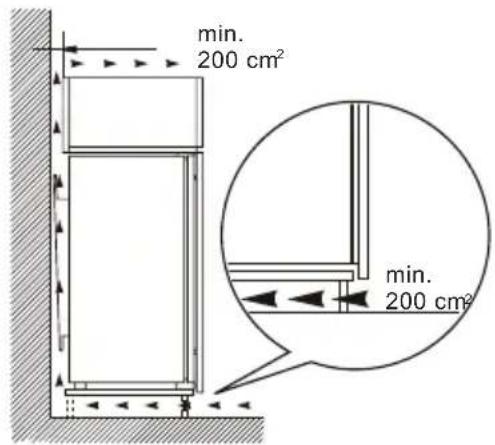
Installation
- Slowly and carefully push the appliance into the cabinet. Ensure the opening side is as close to the cabinet wall as possible.
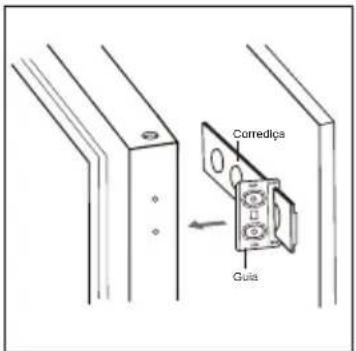
- Screw a guide to holes in the side of appliance door by short screw. Insert the slider into the guide, then fully open and close appliance door and wooden door to check whether wooden door can close totally and smoothly.
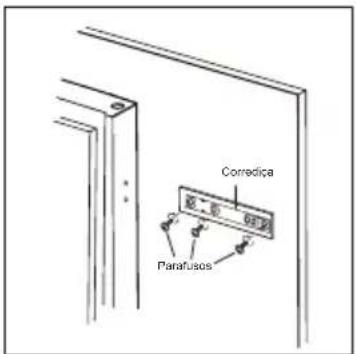
- Open appliance door and wooden door together and mark the position of slider when the slider can function well at all angle during door closes or opens. Take slider out of guide and fix slider with wooden door by two short screws. Then fix slider cover onto the slider.
- Unscrew the guide from appliance door.
- Repeat step 2 to 5 to fix other three sliders and covers.
- Fit four guides with sliders and fix them with short screws. Then fix guide covers with guides.
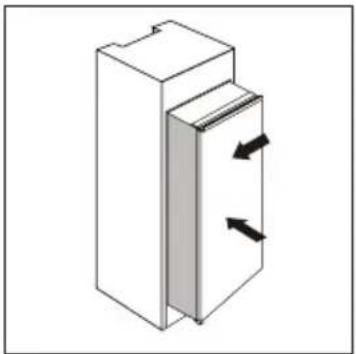
natural_image
Isometric diagram of a cabinet or enclosure with directional arrows indicating movement (no text or symbols)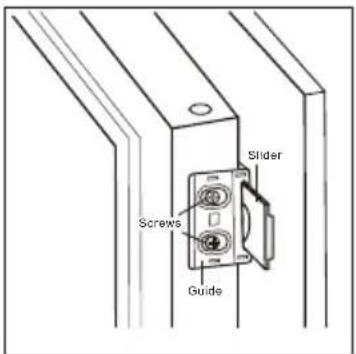
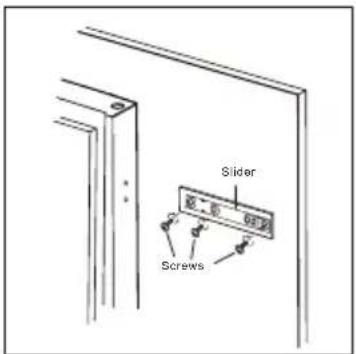
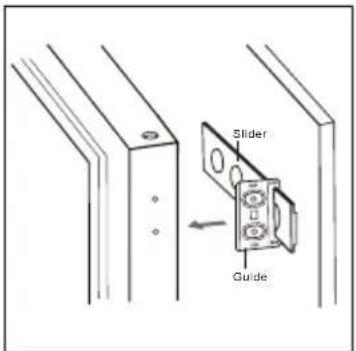
Installation
-
Double check the door can close and open smoothly and appliance is sealed well. If not, slightly adjust the unit. Then fix bottom bracket with wooden cabinet by 2 long screws.
-
Fix top bracket with wooden cabinet by short screws.
-
Attached rubber seal to the gap between unit and wooden cabinet at door open side.
-
Screw two middle brackets with wooden cabinet by short screws. Then fit middle bracket covers with brackets at two sides.
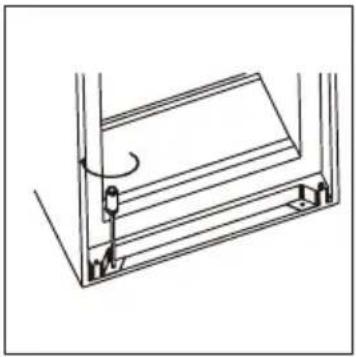
natural_image
Technical line drawing of a structural frame with no visible text or symbols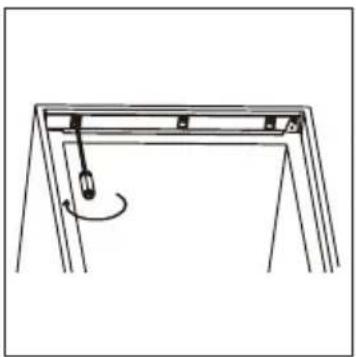
natural_image
Simple line drawing of a mechanical frame with a hanging hook and rotational motion arrow (no text or symbols)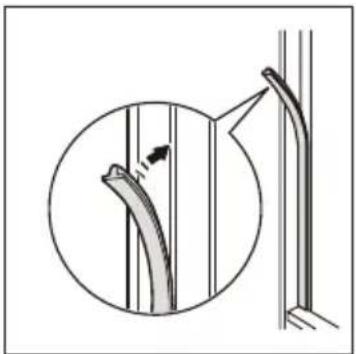
natural_image
Diagram showing a curved pipe or duct with an inset magnified view of the main structure (no text or symbols)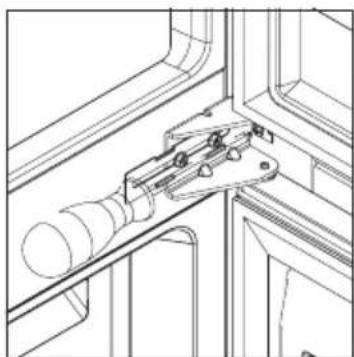
natural_image
Technical line drawing of a mechanical clamp or bracket assembly (no text or symbols)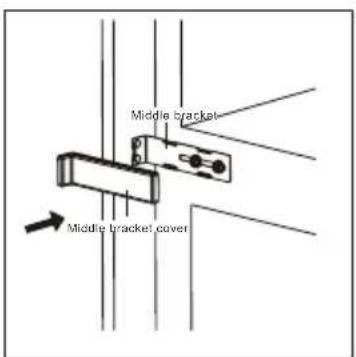
Positioning
Install this appliance at a location where the ambient temperature corresponds to the climate class indicated on the rating plate of the appliance:
| Climate class | Ambient temperature |
| SN +10°C to +32°C | |
| N +16°C to +32°C | |
| ST +16°C to +38°C | |
| T +16°C to +43°C |
Location
The appliance should be installed well away from sources of heat such as radiators, boilers, direct sunlight etc.

Warning! It must be possible to disconnect the appliance from the mains power supply; the plug must therefore be easily accessible after installation.
Electrical connection
Before plugging in, ensure that the voltage and frequency shown on the rating plate correspond to your domestic power supply. The appliance must be earthed. The power supply cable plug is provided with a contact for this purpose. If the domestic power supply socket is not earthed, connect the appliance to a separate earth in compliance with current regulations, consulting a qualified electrician.
The manufacturer declines all responsibility if the above safety precautions are not observed.
This appliance complies with the E.E.C. Directives.
First use
Cleaning the interior
Before using the appliance for the first time, wash the interior and all internal accessories with lukewarm water and some neutral soap so as to remove the typical smell of a brand new product, then dry thoroughly.
Important! Do not use detergents or abrasive powders, as these will damage the finish.
Control Panel
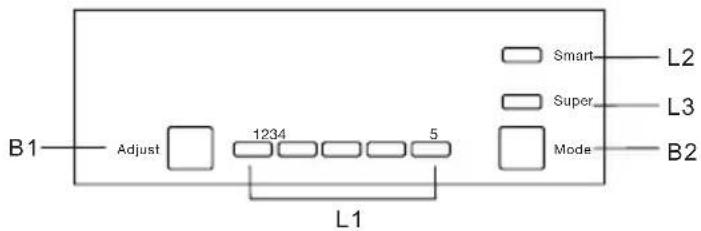
Buttons
B1- Press to adjust setting of fridge compartment in cycle of 1, 2, 3, 4, to 5.
B2- Press to select mode from Smart, Super and user's setting.
Lights
L1 - show the setting of fridge compartment.
L2 - light on once Smart mode is selected.
L3 - light on once Super mode is selected.
Operation
Temperature Setting
-
Press Mode button (B2) to select user's setting.
-
Press Adjust button (B1) to adjust the setting of fridge. Lower setting means lower temperature. The temperature of freezer is automatically controlled at around -18°C.
Smart Mode
Press Mode button (B2) to select Smart mode.
The appliance will runs automatically according to ambient temperature around the appliance.
Super Mode
Press Mode button (B2) to select Super mode.
The appliance will runs to make freezer compartment coldest. After 54 hours, the original temperature set will be automatically restored.
Turn off the appliance
Press and hold Adjust button (B1) for 5 seconds, the appliance will turn off. Press 5 seconds again to turn on the appliance.
Door open alarm
The alarm will sound when door is left open for 90 seconds and it will not stop until the door is closed.
Freezing fresh food
- The freezer compartment is suitable for freezing fresh food and storing frozen and deep-frozen food for a long time.
- Place the fresh food to be frozen in the freezer compartment.
- The maximum amount of food that can be frozen in 24 hours is specified on the rating plate.
- The freezing process lasts 24 hours: during this period do not add other food to be frozen.
Storing frozen food
When first starting-up or after a period out of use, before putting the product in the compartment let the appliance run at least 2 hours on the higher settings.
Important! In the event of accidental defrosting, for example the power has been off for longer than the value shown in the technical characteristics chart under "rising time", the defrosted food must be consumed quickly or cooked immediately and then re-frozen (after cooked).
Thawing
Deep-frozen or frozen food, prior to be used, can be thawed in the fridge compartment or at room temperature, depending on the time available for this operation.
Small pieces may even be cooked still frozen, directly from the freezer. In this case, cooking will take longer.
Ice-cube
This appliance may be equipped with one or more ice-cube to produce ice.
Accessories
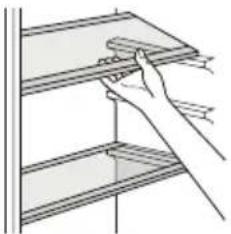
Movable shelves
The walls of the refrigerator are equipped with a series of runners so that the shelves can be positioned as desired.
natural_image
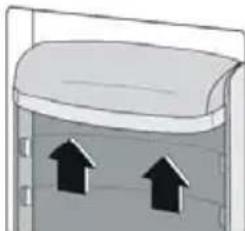
Line drawing of a hand holding a shelf with a rectangular object on top (no text or symbols)Positioning the door balconies
To permit storage of food packages of various sizes, the door balconies can be removed. To make these adjustments proceed as follows: gradually pull the balcony in the direction of the arrows until it comes free.
natural_image
Simple line drawing of a container with two upward arrows inside (no text or symbols)Helpful hints and tips
To help you make the most of the freezing process, here are some important hints:
- the maximum quantity of food which can be frozen in 24 hrs. is shown on the rating plate;
• the freezing process takes 24 hours. No further food to be frozen should be added during this period; - only freeze top quality, fresh and thoroughly cleaned, foodstuffs;
- prepare food in small portions to enable it to be rapidly and completely frozen and to make it possible subsequently to thaw only the quantity required;
- wrap up the food in aluminium foil or polythene and make sure that the packages are airtight;
- do not allow fresh, unfrozen food to touch food which is already frozen, thus avoiding a rise in temperature of the latter;
- lean foods store better and longer than fatty ones; salt reduces the storage life of food;
- water ices, if consumed immediately after removal from the freezer compartment, can possibly cause the skin to be freeze burnt;
- it is advisable to show the freezing in date on each individual pack to enable you removal from the freezer compartment, can possibly cause the skin to be freeze burnt;
- it is advisable to show the freezing in date on each individual pack to enable you to keep tab of the storage time.
Hints for storage of frozen food
To obtain the best performance from this appliance, you should:
• make sure that the commercially frozen foodstuffs were adequately stored by the retailer;
- be sure that frozen foodstuffs are transferred from the food store to the freezer in the shortest possible time;
• not open the door frequently or leave it open longer than absolutely necessary.
- once defrosted, food deteriorates rapidly and cannot be re-frozen;
- do not exceed the storage period indicated by the food manufacture.
Hints for fresh food refrigeration
To obtain the best performance:
- Do not store warm food or evaporating liquids in the refrigerator
- Do cover or wrap the food, particularly if it has a strong flavour
• Make (all types): wrap in polythene bags and place on the glass shelves above the vegetable drawer.
- For safety, store in this way only one or two days at the most.
• Cooked foods, cold dishes, etc...: these should be covered and may be placed on any shelf.
- Fruit and vegetables: these should be thoroughly cleaned and placed in the special drawer(s) provided.
- butter and cheese: these should be placed in special airtight containers or wrapped in aluminum foil or
polythene bags to exclude as much air as possible.
- Milk bottle: these should have a cap and should be stored in the balconies on the door.
- Bananas, potatoes, onions and garlic, if not packed, must not be kept in the fridge.
Cleaning
For hygienic reasons the appliance interior, including interior accessories, should be cleaned regularly.

Caution! The appliance may not be connected to the mains during cleaning. Danger of electrical shock! Before cleaning switch the appliance off and remove the plug from the mains, or switch off or turn out the circuit breaker or fuse. Never clean the appliance with a steam cleaner. Moisture could accumulate in electrical components, danger of electrical shock! Hot vapors can lead to the damage of plastic parts. The appliance must be dry before it is placed back into service.
Important! Ethereal oils and organic solvents can attack plastic parts, e.g. lemon juice or the juice form orange peel, butyric acid, cleanser that contain acetic acid.
- Do not allow such substances to come into contact the appliance parts.
- Do not use any abrasive cleaners
- Remove the food from the freezer. Store them in a cool place, well covered.
- Switch the appliance off and remove the plug from the mains, or switch off or turn out the circuit breaker of fuse.
- Clean the appliance and the interior accessories with a cloth and lukewarm water. After cleaning wipe with fresh water and rub dry.
• After everything is dry place appliance back into service.
Clean drain hole
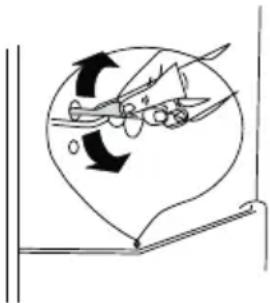
To avoid defrost water overflowing into the fridge, periodically clean the drain hole at back of fridge compartment. Use a cleaner to clean the hole as showed in right picture.
natural_image
Diagram showing a sewing machine needle with scissors and fabric, no text or symbols presentReplace the lamp
The internal light is a LED type. To replace the lamp, please contact qualified technician.
Defrosting of the freezer
The freezer compartment, however, will become progressively covered with frost. This should be removed. Never use sharp metal tools to scrape off frost from the evaporator as you could damage it.
However, when the ice becomes very thick on the inner liner, complete defrosting should be carried out as fellows:
• pull out the plug from the socket;
- remove all stored food, wrap it in several layers of newspaper and put it in a cool place;
- keep the door open, and placing a basin underneath of the appliance to collect the defrost water;
- when defrosting is completed, dry the interior thoroughly
- replace the plug in the power socket to run the appliance again.
Troubleshooting

Caution! Before troubleshooting, disconnect the power supply. Only a qualified electrician of competent person must do the troubleshooting that is not in this manual.
Important! There are some sounds during normal use (compressor, refrigerant circulation).
| Problem | Possible cause | Solution |
| Appliance does not work | Appliance is turned off. | Press “Adjust” button for 5 seconds to turn on the appliance. |
| Mains plug is not plugged in or is loose | Insert mains plug. | |
| Fuse has blown or is defective | Check fuse, replace if necessary. | |
| Socket is defective | Mains malfunctions are to be corrected by an electrician. | |
| The food is too warm. | Temperature is not properly adjusted. | Please look in the initial Temperature Setting section. |
| Door was open for an extended period. | Open the door only as long as necessary. | |
| A large quantity of warm food was placed in the appliance within the last 24 hours. | Turn the temperature regulation to a colder setting temporarily. | |
| The appliance is near a heat source. | Please look in the installation location section. | |
| Appliance cools too much | Temperature is set too cold. | Turn the temperature regulation knob to a warmer setting temporarily. |
| Unusual noises | Appliance is not level. | Adjust the wood cabinet if it's not level. |
| The appliance is touching the wall or other objects. | Move the appliance slightly. | |
| A component, e.g. a pipe, on the rear of the appliance is touching another part of the appliance or the wall. | If necessary, carefully bend the component out of the way. | |
| Water on the floor | Water drain hole is blocked. | See the Cleaning section. |
If the malfunction shows again, contact the Service Center.
Manual Leaflet Manual Leaflet
This list provides all Eco-design requirements (following the (EU)2019/2019 Eco-design and (EU)2019/2016 Energy labelling), if the requirement is applicable to your product.
The refrigerating appliance is not intended to be used as a built-in appliance, unless specifically shown as such into its instruction manual.
The drawers, baskets and shelves should be kept in their current position unless otherwise specified in this document.
Doors and lids of the refrigeration appliance should be removed before disposal in the landfill, to avoid children or animals getting trapped inside.
Recommended setting:
Refrigerator compartment: +4°C
Freezer compartment: -18°C
FAST FREEZE
The use of this function is recommended when placing a very high quantity of food to be frozen in the freezer compartment. 24 hours before freezing fresh food, press the Fast Freeze button to activate the Fast Freeze function. When activated, the Fast Freeze indicator turns on. After 24 hours place the food to be frozen in the freezing zone of freezer compartment. The function is automatically disabled after 72 hours, or can be manually disabled by pressing Fast Freeze button.
FAST COOL
Using Fast Cool function it is possible to increase the cooling capacity in the refrigerator compartment. The use of this function is recommended when placing a very high quantity of food in the refrigerator compartment. Press the Fast Cool button to activate Fast Cool function. When activated, the Fast Cool indicator turns on. The function is automatically disabled after 6 hours, or can be manually disabled by pressing Fast Cool button again.
How to store foodstuffs:
To avoid food waste, please refer to the recommended setting and storage times :
Fridge compartment: Different food, especially vegetable and fruit, have different storage temperature. The storage time is 1 to 3 days (temp setting: middle)
Freezer compartment: 1 week (temp setting: Min) and 1 month (temp setting: Max)
To optimize freezing speed and get more storage space, the freezer compartment can be used without the freezer drawers.
The quantity of fresh food that can be frozen in a specific time period is indicated on the rating plate. Load limits are determined by baskets,
flaps, drawers, shelves etc. Make sure that these components can still close easily after loading.
To avoid food waste, please refer to the recommended setting and storage times found in the user manual.
The model information can be retrieved using the QR-Code reported in the energy label.
The label also includes the model identifier that can be used to consult the portal of the registry at
https://eprel.ec.europa.eu
This product contains a light source of energy efficiency class G (if present).
According to the directive Waste of Electrical and Electronic Equipment (WEEE), the waste WEEE must be collected and treated separately. If in the future you need to dispose of this product DO NOT put it with household waste, send it to the WEEE collection points if they exist.
| Brand Edesa | |
| Model EFC-1711-I /D | |
| Energy Class E | |
| Certification CE CB GS EMC/ERP | |
| Yearly Energy Consumption 216kWh/year | |
| Net Volume Refrigerator 179L | |
| Net Volume Freezer 70L | |
| No. of Stars 4 | |
| Defrosting System Defrost | |
| Autonomy for Black Out 10h | |
| Freezing Capacity 3.2kg/24h | |
| Climatic Class N,ST | |
| Noise Level 39dB | |
| Overall Dimensions | 540x540x1780mm |
| Rated Voltage | 220-240V |
| Rated Current | 0.75A |
natural_image
Simple line drawing of a table with a pointer and curved arrow indicating rotation (no text or symbols)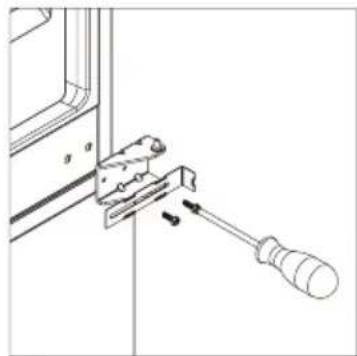
natural_image
Technical line drawing of a mechanical clamp or bracket assembly with a screwdriver (no text or symbols)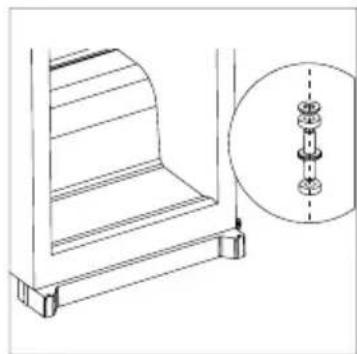
natural_image
Technical line drawing of a mechanical bracket with an inset showing a close-up of a bolt assembly (no text or symbols)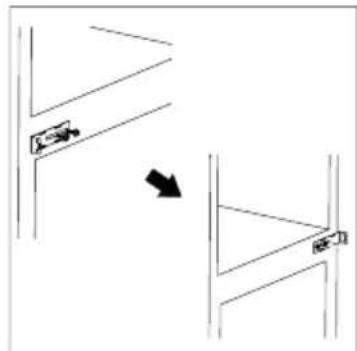
natural_image
Diagram showing two mechanical linkage configurations with an arrow indicating rotation (no text or symbols)Inverter a porta
natural_image
Technical line drawing of a mechanical clamp or bracket assembly (no text or symbols)natural_image
Technical line drawing of four mechanical bracket components with mounting holes and fasteners, shown in sequence (no text or symbols)natural_image
Simple line drawing of a mechanical setup with a rotating component and base (no text or symbols)natural_image
Isometric diagram of a cabinet or enclosure with directional arrows indicating movement (no text or symbols)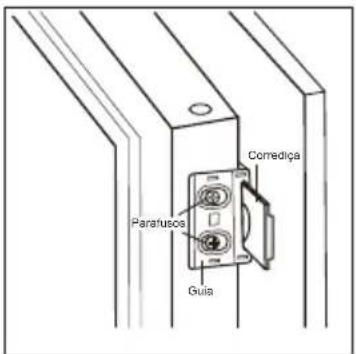
Instalação
natural_image
Technical line drawing of a window frame structure with no text or symbols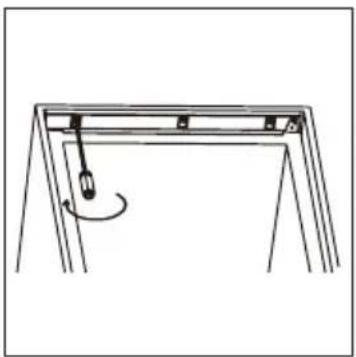
natural_image
Simple line drawing of a mechanical frame with a hanging hook and rotational motion arrow (no text or symbols)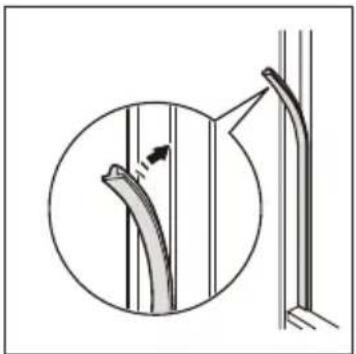
natural_image
Diagram showing a curved pipe or duct with an inset magnified view of the main structure (no text or symbols)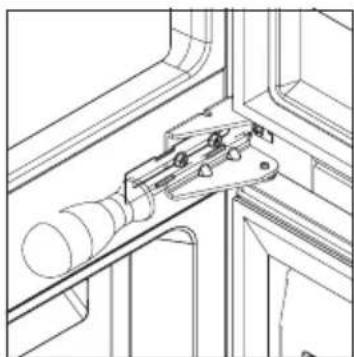
natural_image
Technical line drawing of a mechanical clamp or bracket assembly (no text or symbols)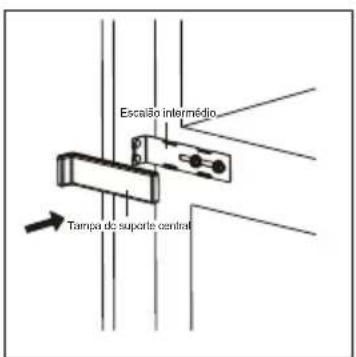
Posicionamento
Instale este aparelho num local onde a temperatura ambiente corresponda à classe climática indicada na placa de características do aparelho:
| Classe climática | Temperatura ambiente |
| SN +10 °C a +32 °C | |
| N +16 °C a +32 °C | |
| ST +16 °C a +38 °C | |
| T +16 °C a +43 °C |
Localização
natural_image
Line drawing of a hand holding a shelf with a rectangular object on top (no text or symbols)natural_image
Simple diagram of a container with two upward arrows inside, no text or symbols presentnatural_image
Diagram showing a circular object with arrows indicating rotation and cutting process, no text or symbols presentSubstitua a lâmpada
natural_image
Simple line drawing of a table with a pointer and curved arrow indicating rotation (no text or symbols)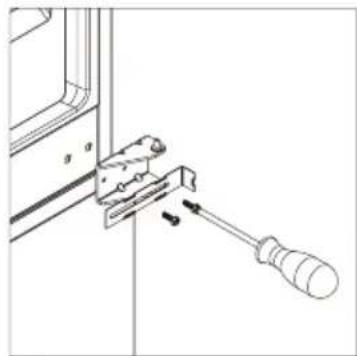
natural_image
Technical line drawing of a mechanical clamp or bracket assembly with a screwdriver (no text or symbols)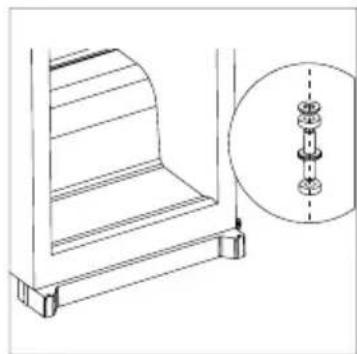
natural_image
Technical line drawing of a mechanical bracket with an inset showing a close-up of a bolt assembly (no text or symbols)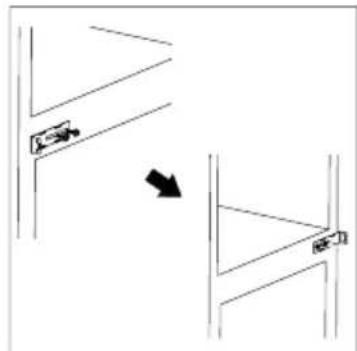
natural_image
Diagram showing two mechanical components with an arrow indicating direction (no text or symbols)natural_image
Technical line drawing of a mechanical clamp or bracket assembly (no text or symbols)natural_image
Technical line drawing of four mechanical bracket components with mounting holes and fasteners, shown in sequential steps (no text or symbols)natural_image
Simple line drawing of a mechanical setup with a rotating component and base (no text or symbols)natural_image
Isometric diagram of a cabinet or enclosure with directional arrows indicating movement (no text or symbols)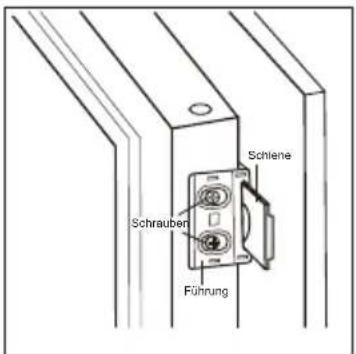
natural_image
Technical line drawing of a structural frame with no visible text or symbolsnatural_image
Simple line drawing of a mechanical frame with a hanging hook and rotational arrow (no text or symbols)natural_image
Diagram showing a curved pipe or duct with an inset magnified view of the main structure (no text or symbols)natural_image
Technical line drawing of a mechanical clamp or bracket assembly (no text or symbols)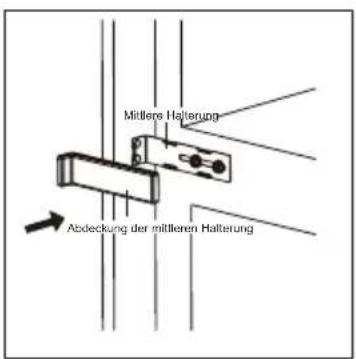
natural_image
Line drawing of a hand holding a shelf with a rectangular object on top (no text or symbols)natural_image
Simple diagram of a container with two upward arrows inside, no text or symbols presentnatural_image
Diagram showing a sewing machine needle cutting fabric, with no text or symbols present.natural_image
Simple line drawing of a table with a pointer and a curved arrow on top (no text or symbols)natural_image
Technical line drawing of a mechanical clamp or bracket assembly (no text or symbols)natural_image
Technical line drawing of a mechanical bracket with an inset showing two bolted components (no text or symbols)natural_image
Abstract geometric diagram with overlapping shapes and arrows, no text or symbols presentnatural_image
Technical line drawing of a mechanical clamp or bracket assembly (no text or symbols)natural_image
Sequence of five mechanical bracket components with mounting holes, shown in sequential steps (no text or symbols)natural_image
Simple line drawing of a rotating mechanical component with a central shaft and base (no text or symbols)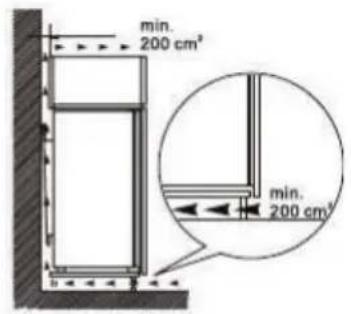
natural_image
Isometric line drawing of a rectangular box with a side panel and two arrows indicating direction (no text or symbols)natural_image
Simple line drawing of a door with an attached panel and directional arrows indicating motion (no text or symbols)natural_image
Pure technical line drawing of a mechanical assembly without any text, numbers, or symbolsnatural_image
Simple line drawing of a mechanical frame with a hanging hook and rotational arrow (no text or symbols)natural_image
Diagram showing a curved pipe or pipe with a magnified inset, no text or symbols presentnatural_image
Technical line drawing of a mechanical assembly with no visible text or symbolsnatural_image
Technical line drawing showing a hand pressing down on a shelf and a close-up of a mechanical component with upward arrows (no text or symbols)Conseils et astuces
natural_image
White refrigerator with a superimposed wavy line graphic, no text or symbols present
CNA group

- INSTALACIÓN
- Posicionamiento
- Children and vulnerable people safety
- General safety
- Daily use
- Care and cleaning
- Installation
- Service
- Energy saving
- Environment Protection
- Packaging materials
- Disposal of the appliance
- Reverse Door
- Kits for installation
- Install the appliance
- Positioning
- Location
- Electrical connection
- First use
- Cleaning the interior
- Control Panel
- Buttons
- Lights
- Operation
- Temperature Setting
- Smart Mode
- Super Mode
- Turn off the appliance
- Door open alarm
- Freezing fresh food
- Storing frozen food
- Thawing
- Ice-cube
- Accessories
- Movable shelves
- Positioning the door balconies
- Helpful hints and tips
- Hints for storage of frozen food
- Hints for fresh food refrigeration
- Cleaning
- Clean drain hole
- Replace the lamp
- Defrosting of the freezer
- Troubleshooting
- Manual Leaflet Manual Leaflet
- FAST FREEZE
- FAST COOL
- Inverter a porta
- Instalação
- Posicionamento
- Localização
- Substitua a lâmpada
- Conseils et astuces
- CNA group
Brand : EDESA
Model : EFC-1711-I
Category : Refrigerator