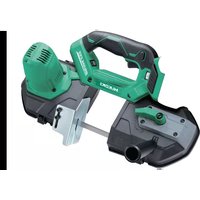
CB18DBL - Saw HiKOKI - Free user manual and instructions
Find the device manual for free CB18DBL HiKOKI in PDF.


| Product Type | Cordless Band Saw |
| Brand | HiKOKI |
| Model | CB18DBL |
| Rated Voltage | 18 V |
| Motor Type | Brushless DC Motor with Fan Cooling |
| Blade Dimensions | 900 x 12.5 x 0.5 mm (35-3/8 x 1/2 x 0.020 inches) |
| No-load Speed (Standard Mode) | 260 - 640 SFPM (80 - 195 m/min) |
| No-load Speed (AUTO Mode) | 395 SFPM (120 m/min) no load, 640 SFPM (195 m/min) under load |
| Max. Cutting Capacity (Round Pipe) | 83 mm (3-1/4 inches) |
| Max. Cutting Capacity (Square Pipe) | 80 x 80 mm (3-1/8 x 3-1/8 inches) |
| Overall Length | 413 mm (16-1/4 inches) |
| Weight (with BSL1850 Battery) | 3.5 kg (7.7 lb) |
| Power Supply | 18 V Li-ion Battery (BSL18, BSL14 series) not included |
| Recommended Charger | UC18YFSL (not included) |
| Main Functions | Soft start, overload and overheat protection, battery charge indicator, AUTO eco mode, LED light |
| Safety | Switch lock, side handle, blade pulley cover |
| Cut Materials | Mild steel, stainless steel, non-ferrous metals, plastics (except thermoplastics) |
| Maintenance and Cleaning | Clean vents, replace blade if dull, inspect pulley rubbers |
| Spare Parts and Repairability | Bimetal blades (18 TPI, 14 TPI), side handle, hex wrench; repair by authorized center |
| General Information | Estimated 2-year warranty; store in a dry place below 40°C |
Frequently Asked Questions - CB18DBL HiKOKI
User questions about CB18DBL HiKOKI
0 question about this device. Answer the ones you know or ask your own.
Ask a new question about this device
Download the instructions for your Saw in PDF format for free! Find your manual CB18DBL - HiKOKI and take your electronic device back in hand. On this page are published all the documents necessary for the use of your device. CB18DBL by HiKOKI.
USER MANUAL CB18DBL HiKOKI
natural_image
Technical line drawing of a mechanical clamp or fixture assembly (no text or symbols visible)SAFETY INSTRUCTIONS AND INSTRUCTION MANUAL
WARNING
IMPROPER OR UNSAFE use of this power tool can result in death or serious bodily injury! This manual contains important information about product safety. Please read and understand this manual BEFORE operating the power tool. Please keep this manual available for other users and owners before they use the power tool. This manual should be stored in safe place.
INSTRUCTIONS DE SECURITE ET MODE D'EMPLOI
AVERTISSEMENT
IMPORTANT SAFETY INSTRUCTIONS
Read all of the safety precautions, warnings and operating instructions in the Instruction Manual before operating or maintaining this power tool.
Most accidents that result from power tool operation and maintenance are caused by the failure to observe basic safety rules or precautions. An accident can often be avoided by recognizing a potentially hazardous situation before it occurs, and by observing appropriate safety procedures.
Basic safety precautions are outlined in the "SAFETY" section of this Instruction Manual and in the sections which contain the operation and maintenance instructions.
Hazards that must be avoided to prevent bodily injury or machine damage are identified by WARNINGS on the power tool and in this Instruction Manual.
NEVER use this power tool in a manner that has not been specifically recommended by metabo HPT.
MEANINGS OF SIGNAL WORDS
WARNING indicates a potentially hazardous situations which, if ignored, could result in death or serious injury.
CAUTION indicates a potentially hazardous situations which, if not avoided, may result in minor or moderate injury, or may cause machine damage.
NOTE emphasizes essential information.
SAFETY
GENERAL POWER TOOL SAFETY WARNINGS
WARNING
Read all safety warnings and all instructions.
Failure to follow the warnings and instructions may result in electric shock, fire and/or serious injury.
Save all warnings and instructions for future reference.
The term “power tool” in the warnings refers to your mains-operated (corded) power tool or battery-operated (cordless) power tool.
1) Work area safety
a) Keep work area clean and well lit. Cluttered or dark areas invite accidents
b) Do not operate power tools in explosive atmospheres, such as in the presence of fl ammable liquids, gases or dust. Power tools create sparks which may ignite the dust or fumes.
c) Keep children and bystanders away while operating a power tool. Distractions can cause you to lose control.
2) Electrical safety
a) Power tool plugs must match the outlet. Never modify the plug in any way. Do not use any adapter plugs with earthed (grounded) power tools. Unmodified plugs and matching outlets will reduce risk of electric shock.
b) Avoid body contact with earthed or grounded surfaces such as pipes, radiators, ranges and refrigerators. There is an increased risk of electric shock if your body is earthed or grounded.
c) Do not expose power tools to rain or wet conditions.
Water entering a power tool will increase the risk of electric shock.
d) Do not abuse the cord. Never use the cord for carrying, pulling or unplugging the power tool. Keep cord away from heat, oil, sharp edges or moving parts.
Damaged or entangled cords increase the risk of electric shock.
e) When operating a power tool outdoors, use an extension cord suitable for outdoor use.
Use of a cord suitable for outdoor use reduces the risk of electric shock.
f) If operating a power tool in a damp location is unavoidable, use a residual current device (RCD) protected supply.
Use of an RCD reduces the risk of electric shock.
3) Personal safety
a) Stay alert, watch what you are doing and use common sense when operating a power tool. Do not use a power tool while you are tired or under the influence of drugs, alcohol or medication.
A moment of inattention while operating power tools may result in serious personal injury.
b) Use personal protective equipment. Always wear eye protection.
Protective equipment such as dust mask, non-skid safety shoes, hard hat, or hearing protection used for appropriate conditions will reduce personal injuries.
c) Prevent unintentional starting. Ensure the switch is in the off -position before connecting to power source and/or battery pack, picking up or carrying the tool.
Carrying power tools with your finger on the switch or energising power tools that have the switch on invites accidents.
d) Remove any adjusting key or wrench before turning the power tool on.
A wrench or a key left attached to a rotating part of the power tool may result in personal injury.
e) Do not overreach. Keep proper footing and balance at all times.
This enables better control of the power tool in unexpected situations.
f) Dress properly. Do not wear loose clothing or jewellery. Keep your hair, clothing and gloves away from moving parts.
Loose clothes, jewellery or long hair can be caught in moving parts.
g) If devices are provided for the connection of dust extraction and collection facilities, ensure these are connected and properly used.
Use of dust collection can reduce dust-related hazards.
4) Power tool use and care
a) Do not force the power tool. Use the correct power tool for your application.
The correct power tool will do the job better and safer at the rate for which it was designed.
b) Do not use the power tool if the switch does not turn it on and off.
Any power tool that cannot be controlled with the switch is dangerous and must be repaired.
c) Disconnect the plug from the power source and/or the battery pack from the power tool before making any adjustments, changing accessories, or storing power tools.
Such preventive safety measures reduce the risk of starting the power tool accidentally.
d) Store idle power tools out of the reach of children and do not allow persons unfamiliar with the power tool or these instructions to operate the power tool.
Power tools are dangerous in the hands of untrained users.
e) Maintain power tools. Check for misalignment or binding of moving parts, breakage of parts and any other condition that may affect the power tool's operation.
If damaged, have the power tool repaired before use.
Many accidents are caused by poorly maintained power tools.
f) Keep cutting tools sharp and clean.
Properly maintained cutting tools with sharp cutting edges are less likely to bind and are easier to control.
g) Use the power tool, accessories and tool bits etc. in accordance with these instructions, taking into account the working conditions and the work to be performed.
Use of the power tool for operations different from those intended could result in a hazardous situation.
5) Battery tool use and care
a) Recharge only with the charger specified by the manufacturer.
A charger that is suitable for one type of battery pack may create a risk of fire when used with another battery pack.
b) Use power tools only with specifically designated battery packs.
Use of any other battery packs may create a risk of injury and fi re.
c) When battery pack is not in use, keep it away from other metal objects, like paper clips, coins, keys, nails, screws or other small metal objects, that can make a connection from one terminal to another.
Shorting the battery terminals together may cause burns or a fire.
d) Under abusive conditions, liquid may be ejected from the battery; avoid contact. If contact accidentally occurs, fl ush with water. If liquid contacts eyes, additionally seek medical help.
Liquid ejected from the battery may cause irritation or burns.
6) Service
a) Have your power tool serviced by a qualified repair person using only identical replacement parts.
This will ensure that the safety of the power tool is maintained.
-WARNING-
To reduce the risk of injury, user must read instruction manual.
SPECIFIC SAFETY RULES AND SYMBOLS
- Hold power tool by insulated gripping surfaces, when performing an operation where the cutting accessory may contact hidden wiring.
Cutting accessory contacting a "live" wire may make exposed metal parts of the power tool "live" and could give the operator an electric shock.
- Securely fasten the workpiece to be cut.
If the workpiece is not securely fastened, it may shift position and cause damage to the band saw blade and/or injury.
- ALWAYS wear ear protectors when using the tool for extended periods.
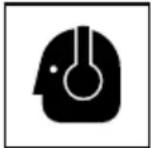
Prolonged exposure to high intensity noise can cause hearing loss.
-
NEVER touch the band saw blade with bare hands after operation.
-
Because the cordless band saw operates by battery power, be aware of the fact it can begin to operate at any time.
-
When working at elevated locations, clear the area of all other people and be aware of conditions below you.
-
NEVER touch rotating parts.
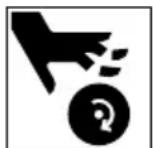
NEVER place your hands, fingers or other body parts near the tool's rotating parts.
- NEVER operate without all guards in place.
NEVER operate this tool without all guards or safety features in place and in proper working order. If maintenance or servicing requires the removal of a guard or safety feature, be sure to replace the guard or safety feature before resuming operation of the tool.
- Use right tool.
Don't force small tool or attachment to do the job of a heavy-duty tool.
Don't use tool for purpose not intended —for example— don't use band saw for cutting tree limbs or logs.
- NEVER use a power tool for applications other than those specified.
NEVER use a power tool for applications other than those specified in the Instruction Manual.
- Handle tool correctly.
Operate the tool according to the instructions provided herein. Do not drop or throw the tool. NEVER allow the tool to be operated by children, individuals unfamiliar with its operation or unauthorized personnel.
- Keep all screws, bolts and covers tightly in place.
Keep all screws, bolts, and plates tightly mounted.
Check their condition periodically.
- Do not use power tools if the plastic housing or handle is cracked.
Cracks in the tool's housing or handle can lead to electric shock. Such tools should not be used until repaired.
- Band saw blade and accessories must be securely mounted to the tool.
Prevent potential injuries to yourself or others. Band saw blade and accessories which have been mounted to the tool should be secure and tight.
- Keep motor air vent clean.
The tool's motor air vent must be kept clean so that air can freely flow at all times. Check for dust build-up frequently.
- NEVER use a tool which is defective or operating abnormally.
If the tool appears to be operating unusually, making strange noises, or otherwise appears defective, stop using it immediately and arrange for repairs by a metabo HPT authorized service center.
- NEVER leave tool running unattended. Turn power off.
Don't leave tool until it comes to a complete stop.
- Carefully handle power tools.
Should a power tool be dropped or struck against hard materials inadvertently, it may be deformed, cracked, or damaged.
- Do not wipe plastic parts with solvent.
Solvents such as gasoline, thinner benzine, carbon tetrachloride, and alcohol may damage and crack plastic parts. Do not wipe them with such solvents. Wipe plastic parts with a soft cloth lightly dampened with soapy water and dry thoroughly.
- ALWAYS wear eye protection that meets the requirement of the latest revision of ANSI Standard Z87.1.
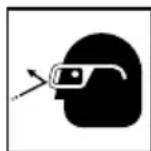
-
ALWAYS wear a mask or respirator to protect yourself from dust or potentially harmful particles generated during operation.
-
ALWAYS firmly grip the handle while operating.
-
ALWAYS be careful with buried object such as an underground wiring.
Touching these active wiring or electric cable with this tool, you may receive an electric shock.
Confirm if there are any buried object such as electric cable within the wall, floor or ceiling where you are going to operate here after.
- Defi nitions for symbols used on this tool V ....volts
==......direct current
SFPM.....surface feet
no ......no load speed
I......Switching ON
.....O...Switching OFF
......Tighten band saw blade
......Loosen band saw blade
Direction of band saw blade rotation
ADDITIONAL SAFETY WARNINGS
- Always hold the tool firmly with both hands on handle and side handle (Fig. 1). Do not touch the metal part.
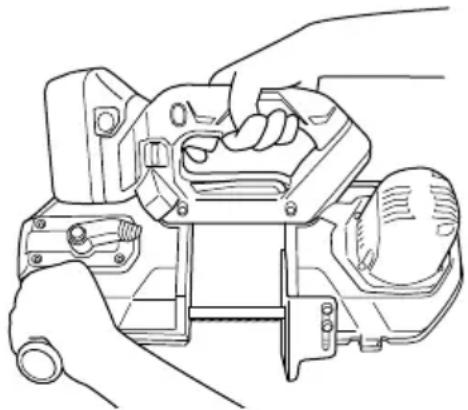
natural_image
Line drawing of a hand operating a mechanical device with no visible text or symbolsFig. 1
-
Make sure that the area to be cut is absolut of any hidden obstructions including electrical wiring, water, or gas pipes. Cutting into the aforementioned may result in electric shock or short circuit, gas leak or other hazards that can cause serious accidents or injuries.
-
Make sure to securely hold the tool during operation. Failure to do so can result in accidents or injuries.
-
Setting up and checking the work environment. Check if the work environment is suitable by following the precaution.
-
Dust particles such as silica or asbestos are hazardous to your health. When working with materials containing these components, take appropriate dust-proofing measures.
-
Working with metal can cause sparks. Make sure there are no fl ammable and combustible materials in the vicinity and that they are stored in a safe location.
-
Prior to operation, be sure the blade pulley cover is closed and fastened with screws.
Operating the tool with the blade pulley cover open may result in injury.
-
During operation, do not put your hands, face, or other body parts near the rotating band saw blade or other rotating parts. Doing so may result in injury.
-
If the main unit is accidentally dropped or suffers any impact, carefully inspect the band saw blade, the unit, etc. to be sure there are no damages, cracks, or deformations.
Injury may result if there are any damages, cracks, or deformations.
- During operation, if the unit is not running smoothly, or there are abnormal sounds or vibrations, promptly switch off the unit, discontinue use and contact a metabo HPT Authorized Service Center for inspection and/or repairs.
Continuing use under these conditions may result in injury.
-
When using this unit continuously, the unit may overheat, leading to damage in the motor and switch. Please leave it without using it for approximately 15 minutes.
-
Follow the instruction manual and make sure that the band saw blade and accessories are properly installed.
Improper installation may result in injury from parts coming loose.
- Securely fasten the workpiece to be cut.
If the workpiece is not securely fastened, it may shift position and cause damage to the band saw blade and/or injury.
- To avoid having the band saw blade clamped between the cut surfaces during or immediately after cutting, set up a support stand to bear the weight of the workpiece, placing it near the section to be cut.
If the band saw blade becomes clamped, it may result in injury.
- If the section to be cut off is large, set up another stable support stand to bear the weight of that section as well.
Not using such a support may result in injury.
- During operation, do not wear cloth work gloves or other similar hand protection that may get caught in the unit.
Getting caught in the rotating section of the tool may result in injury.
- Prior to operation, verify the safety of the surrounding area and run the blade briefly to make sure that there are no abnormalities in the vibrations of the unit or in the band saw blade.
If there are such abnormalities, unexpected movements may occur and cause injury.
- When working in a high location, ensure that there are no people below.
Dropping the workpiece or the cordless tool from a high location may result in an accident.
- Do not apply any sudden impact to the workpiece with the band saw blade.
Doing so may damage the band saw blade and/or result in injury.
- Use the product's own weight or press gently to cut a workpiece.
Applying unnecessary force while cutting can result in detachment of or damage to the band saw blade which may cause injury.
- Do not touch the band saw blade, the workpiece, or shavings with bare hands immediately after cutting, as they will be hot.
Doing so may result in burns.
- Remove any shavings adhering to the band saw blade or blade pulley rubbers as well as any shavings that accumulates inside the frame.
The shavings may cause the band saw blade to detach or slip, and result in injury.
- Make sure the blade pulley cover is properly attached before use.
If the band saw blade is damaged or comes loose, it may result in injury.
-
Verify that the blade pulley cover and the band saw blade are not in contact with each other.
-
If there is an abnormality with the blade pulley cover and the switch lock won't return to its original position, promptly discontinue use and contact a metabo HPT Authorized Service Center for repairs.
-
Use of a band saw blade other than one authorized by the manufacture or a band saw blade with any abnormalities may result in damage to the band saw blade and/or injury.
-
When switching the power on, verify that the band saw blade is not in contact with the workpiece to be cut or any surrounding objects.
Failure to do so may result in the main unit being dropped and/or injury.
-
In order to prevent accidents, when taking a break from operation or after operation, be sure to switch off the power and remove the battery from the cordless tool.
-
If the band saw blade locks up while cutting, promptly switch off the power and stop it from running.
Failure to do so may result in damage to the band saw blade.
-
The motor may stop in the event the tool is overloaded. In this should occur, release the tool's switch and eliminate the cause of the overload.
-
Do not leave the tool running unattended on the floor, table or other locations. Doing so may result in injury.
-
For cutting efficiency, switch the mode of the application tool according to task conditions and workpieces to be cut.
-
After use, be sure not to place the tool near chips or sawdust before it comes to a full stop as the tool may suck in those particles.
-
After use, if the unit will not be used for a long period, remove the band saw blade from the unit body and store the band saw blade.
If the band saw blade is left installed in the unit body for a long period, the lifespan of the band saw blade will become shorter.
IMPORTANT SAFETY INSTRUCTIONS FOR BATTERY CHARGER
WARNING
Death or serious bodily injury could result from improper or unsafe use of battery chargers. To avoid these risks, follow these basic safety instructions:
Battery and battery charger are not included with this product
READ ALL INSTRUCTIONS
-
This manual contains important safety and operating instructions for battery charger Model UC18YFSL.
-
Before using battery charger, read all instructions and cautionary markings on (1) battery charger, (2) battery, and (3) product using battery.
-
To reduce risk of injury, charge metabo HPT rechargeable battery type BSL18 and BSL14 series. Other type of batteries may burst causing personal injury and damage.
-
Use of an attachment not recommended or sold by the battery charger manufacturer may result in a risk of fire, electric shock, or injury to persons.
-
To reduce risk of damage to electric plug and cord, pull by plug when disconnecting battery charger.
-
Make sure cord is located so that it will not be stepped on, tripped over, or otherwise subjected to damage or stress.
-
An extension cord should not be used unless absolutely necessary. Use of improper extension cord could result in a risk of fire and electric shock. If extension cord must be used make sure:
a. That blades of extension cord are the same number, size, and shape as those of plug on battery charger:
b. That extension cord is properly wired and in good electrical condition; and
c. That wire size is large enough for AC ampere rating of battery charger as specified in Table 1.
Table 1 RECOMMENDED MINIMUM AWG SIZE FOR EXTENSION CORDS FOR BATTERY CHARGERS
| AC input rating Ampere* | AWG size of cord | ||||
| Equal to or greater than | but less than | Length of cord, feet (meter) | |||
| 25 (7.5) | 50 (15) | 100 (30) | 150 (45) | ||
| 0 | 2 | 18 | 18 | 18 | 16 |
| 2 | 3 | 18 | 18 | 16 | 14 |
| 3 | 4 | 18 | 18 | 16 | 14 |
* If the input rating of a battery charger is given in watts rather than in amperes, the corresponding ampere rating is to be determined by dividing the wattage rating by the voltage rating—for example:
$$ \frac {1 , 2 5 0 \text { watts }}{1 2 5 \text { volts }} = 1 0 \text { amperes } $$
- Do not operate battery charger with damaged cord or plug-replace them immediately.
- Do not operate battery charger if it has received a sharp blow, been dropped, or otherwise damaged in any way; take it to a qualified serviceman.
- Do not disassemble battery charger; take it to a qualified serviceman when service or repair is required. Incorrect reassembly may result in a risk of electric shock or fire.
- To reduce risk of electric shock, unplug charger from receptacle before attempting any maintenance or cleaning. Removing the battery will not reduce this risk.
IMPORTANT SAFETY INSTRUCTIONS FOR USE OF THE BATTERY AND BATTERY CHARGER
You must charge the battery before you can use the power tool. Before using the model UC18YFSL battery charger, be sure to read all instructions and cautionary statements on it, the battery and in this manual.
CAUTION
USE ONLY metabo HPT BATTERY TYPE BSL1850. OTHER TYPES OF BATTERIES MAY BURST AND CAUSE INJURY!
Follow these instructions to avoid the risk of injury:
WARNING
Improper use of the battery or battery charger can lead to serious injury. To avoid these injuries:
- NEVER disassemble the battery.
- NEVER incinerate the battery, even if it is damaged or is completely worn out. The battery can explode in a fire.
-
NEVER short-circuit the battery.
-
NEVER insert any objects into the battery charger's air vents. Electric shock or damage to the battery charger may result.
- NEVER charge outdoors. Keep the battery away from direct sunlight and use only where there is low humidity and good ventilation.
- NEVER charge when the temperature is below 32^ F ( 0^ C) or above 104^ F ( 40^ C).
Charging the battery at temperatures outside the range of 32^ F – 104^ F ( 0^ C – 40^ C) may prevent proper charging and reduce battery life.
- NEVER connect two battery chargers together.
- NEVER insert foreign objects into the hole for the battery or the battery charger.
-
NEVER use a booster transformer when charging.
-
NEVER use an engine generator or DC power to charge.
- NEVER store the battery or battery charger in places where the temperature may reach or exceed 104^ F ( 40^ C) such as inside metal box or car.
- NEVER expose the battery or battery charger to rain or wet conditions.
- ALWAYS operate charger on standard household electrical power (120 volts). Using the charger on any other voltage may overheat and damage the charger.
- ALWAYS wait at least 15 minutes between charges to avoid over rheating the charger.
- ALWAYS disconnect the power cord from its receptacle when the charger is not in use.
CAUTION ON LITHIUM-ION BATTERY
To extend the lifetime, the lithium-ion battery equips with the protection function to stop the output.
In the cases of 1 to 3 described below, when using this product, even if you are pulling the switch, the motor may stop. This is not the trouble but the result of protection function.
- When the battery power remaining runs out, the motor stops.
In such case, charge it up immediately.
-
If the tool is overloaded, the motor may stop. In this case, release the switch of tool and eliminate causes of overloading. After that, you can use it again.
-
If the battery is overheated under overload work, the battery power may stop.
In this case, stop using the battery and let the battery cool. After that, you can use it again.
Furthermore, please heed the following warning and caution.
WARNING
In order to prevent any battery leakage, heat generation, smoke emission, explosion and ignition beforehand, please be sure to heed the following precautions.
-
Make sure that swarf and dust do not collect on the battery.
○ During work make sure that swarf and dust do not fall on the battery.
○ Make sure that any swarf and dust falling on the power tool during work do not collect on the battery.
○ Do not store an unused battery in a location exposed to swarf and dust.
Before storing a battery, remove any swarf and dust that may adhere to it and do not store it together with metal parts (screws, nails, etc.). -
Do not pierce battery with a sharp object such as a nail, strike with a hammer, step on, throw or subject the battery to severe physical shock.
-
Do not use an apparently damaged or deformed battery.
-
Do not use the battery in reverse polarity.
-
Do not connect directly to an electrical outlets or car cigarette lighter sockets.
-
Do not use the battery for a purpose other than those specified.
-
If the battery charging fails to complete even when a specified recharging time has elapsed, immediately stop further recharging.
-
Do not put or subject the battery to high temperatures or high pressure such as into a microwave oven, dryer, or high pressure container.
-
Keep away from fire immediately when leakage or foul odor are detected.
-
Do not use in a location where strong static electricity generates.
-
If there is battery leakage, foul odor, heat generated, discolored or deformed, or in any way appears abnormal during use, recharging or storage, immediately remove it from the equipment or battery charger, and stop use.
-
Do not immerse the battery or allow any fluids to flow inside. Conductive liquid ingress, such as water, can cause damage resulting in fire or explosion. Store your battery in a cool, dry place, away from combustible and flammable items. Corrosive gas atmospheres must be avoided.
CAUTION
- If liquid leaking from the battery gets into your eyes, do not rub your eyes and wash them well with fresh clean water such as tap water and contact a doctor immediately.
If left untreated, the liquid may cause eye-problems.
- If liquid leaks onto your skin or clothes, wash well with clean water such as tap water immediately.
There is a possibility that this can cause skin irritation.
- If you find rust, foul odor, overheating, discolor, deformation, and/or other irregularities when using the battery for the first time, do not use and return it to your supplier or vendor.
WARNING
If an electrically conductive foreign object enters the terminals of the lithium ion battery, a short-circuit may occur resulting in the risk of fire. Please observe the following matters when storing the battery.
Do not place electrically conductive cuttings, nails, steel wire, copper wire or other wire in the storage case.
○ Either install the battery in the power tool or store by securely pressing into the battery cover until the ventilation holes are concealed to prevent short-circuits (See Fig. 1).
REGARDING LITHIUM-ION BATTERY TRANSPORTATION
When transporting a lithium-ion battery, please observe the following precautions.
WARNING
Notify the transporting company that a package contains a lithium-ion battery, inform the company of its power output and follow the instructions of the transportation company when arranging transport.
● Lithium-ion batteries that exceed a power output of 100Wh are considered to be in the freight classification of Dangerous Goods and will require special application procedures.
- For transportation abroad, you must comply with international law and the rules and regulations of the destination country.
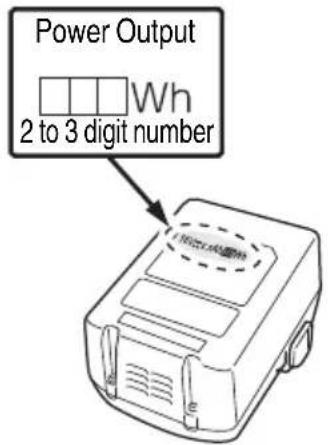
SAVE THESE INSTRUCTIONS AND MAKE THEM AVAILABLE TO OTHER USERS AND OWNERS OF THIS TOOL!
FUNCTIONAL DESCRIPTION
NOTE
The information contained in this Instruction Manual is designed to assist you in the safe operation and maintenance of the power tool.
NEVER operate, or attempt any maintenance on the tool unless you have first read and understood all safety instructions contained in this manual.
Some illustrations in this Instruction Manual may show details or attachments that differ from those on your own power tool.
NAME OF PARTS
Battery and battery charger are not included with this product.
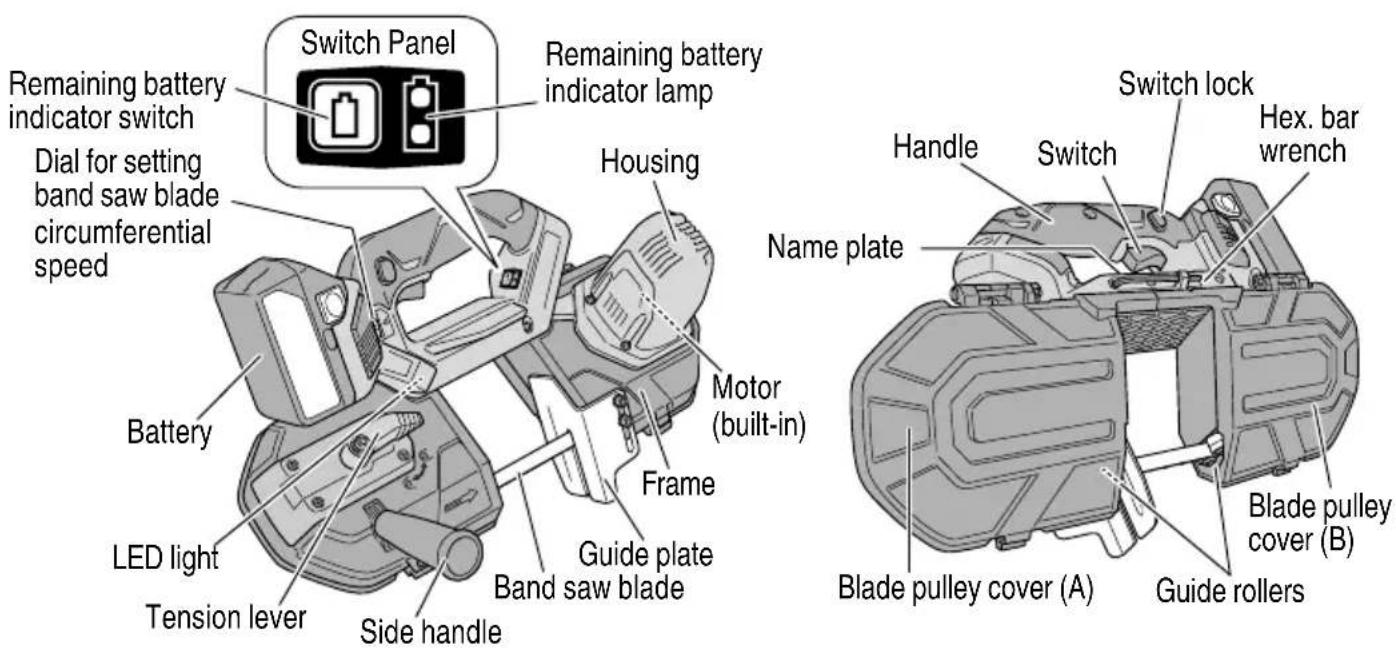
○ Battery (BSL1850)
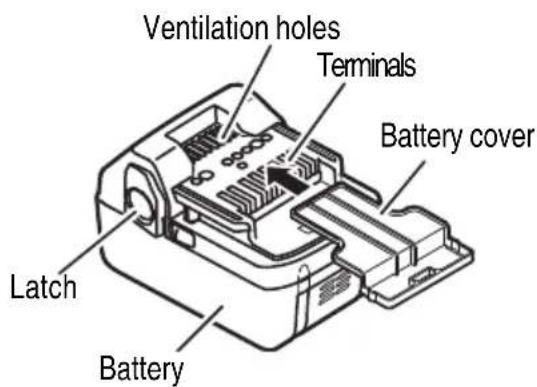
Fig. 2
2 Battery Charger (UC18YFSL)
Battery and battery charger are not included with this product.
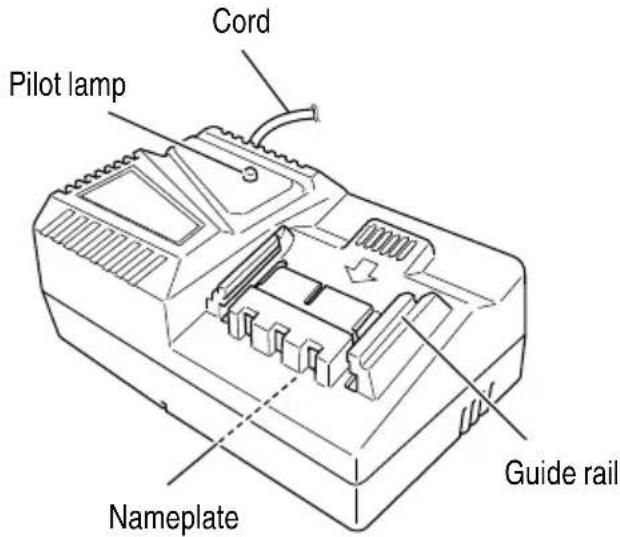
Fig. 3
SPECIFICATIONS
- Cordless Band Saw
| Model CB18DBL | ||
| Voltage 18 V | ||
| Type of motor Fan-cooled DC brushless motor | ||
| Band Saw Blade dimensions 35 – 3/8" × 1/2" × 0.020" (900 × 12.5 × 0.5 mm) | ||
| No-Load Band Saw blade speed | Standard Mode (1 – 5) 260 – 640 SFPM (80 – 195 m/min) | |
| Auto Mode (A) 395 SFPM (120 m/min) | ||
| Max. cutting capacity | Round pipe 3 – 1/4" (83 mm) | |
| Square pipe 3 – 1/8" × 3 – 1/8" (80 mm × 80 mm) | ||
| Overall length 16 – 1/4" (413 mm) | ||
| Weight (with BSL1850) 7.7 lbs. (3.5 kg) | ||
NOTE
Due to metabo HPT's continuing program of research and development, the specifications herein are subject to change without prior notice.
Electronic control
○ Soft-start
○ Overload protection
This protection feature cuts off the power to the motor in the event of overloading of motor or a conspicuous reduction in rotational speed during operation.
When the overload protection feature has been activated, the motor may stop.
In this case, release the tool switch and eliminate causes of overloading.
After that you can use it again.
○ Overheat protection
This protection feature cuts off the power to the motor and stops the power tool in the event of overheating of motor during operation.
When the overheat protection feature has been activated, the motor may stop.
In this case, release the tool switch and cool it down in a few minutes.
After that you can use it again.
ASSEMBLY AND OPERATION
APPLICATIONS
○ Cutting various types of soft steel materials including conduit pipes, stainless steel pipes, lining steel pipes and steel rods
○ Cutting nonferrous metal materials including power and communication cables and aluminum window frames
○ Cutting plastic (thermoplastic material cannot be cut as the band saw blade may become wedged in the material which is prone to melting when heated by cutting friction
REMOVAL AND INSTALLATION METHOD OF BATTERY
Battery and battery charger are not included with this product.
- Battery removal
Hold the handle tightly and push the battery latch to remove the battery (See Fig. 4).
CAUTION
Never short-circuit the battery.
- Battery installation
Insert the battery while observing its polarities (see Fig. 4).
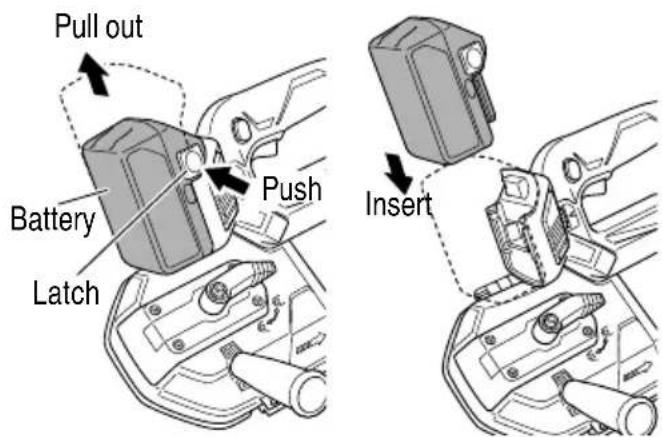
Fig. 4
CHARGING METHOD
Before using the power tool, charge the battery as follows. Battery and battery charger are not included with this product.
NOTE
Before plugging into the receptacle, make sure the following points.
○ The power source voltage is stated on the nameplate.
○ The cord is not damaged.
WARNING
Do not charge at voltage higher than indicated on the nameplate. If charged at voltage higher than indicated on the nameplate, the charger will burn up.
- Connect the charger's power cord to a receptacle.
When the power cord is connected, the charger's pilot lamp will blink in red. (At 1-second intervals)
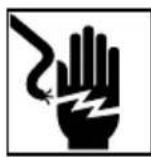
WARNING
Do not use the electrical cord if damaged. Have it repaired immediately.
- Insert the battery into the charger.
Firmly insert the battery into the charger as shown in Fig. 5.
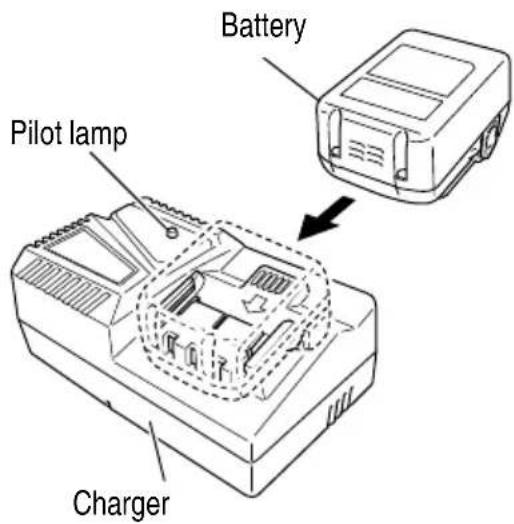
Fig. 5
- Charging
When the battery is connected to the battery charger, charging will commence and the pilot lamp will light in red. (See Table 2)
NOTE
If the pilot lamp flikers in red, pull out the plug from the receptacle and check if the battery is properly mounted.
When the battery is fully charged, the pilot lamp will blink in red slowly. (At 1-second intervals) (See Table 2)
(1) Pilot lamp indication
The indications of the pilot lamp will be as shown in Table 2, according to the condition of the charger or the rechargeable battery.
Table 2
| Indications of the pilot lamp | ||||
| Pilot lamp(red) | Beforecharging | Blinks | Lights for 0.5 seconds. Does not light for 0.5 seconds. (off for 0.5 seconds) | |
| Whilecharging | Lights | Lights continuously | ||
| Chargingcomplete | Blinks | Lights for 0.5 seconds. Does not light for 0.5 seconds. (off for 0.5 seconds) | ||
| Overheatstandby | Blinks | Lights for 1 second. Does not light for 0.5 seconds. (off for 0.5 seconds) | Battery overheated.Unable to charge.(Charging will commence when battery cools) | |
| Chargingimpossible | Flickers | Lights for 0.1 seconds. Does not light for 0.1 seconds. (off for 0.1 seconds) | Malfunction in the battery or the charger | |
(2) Regarding the temperature of the rechargeable battery.
The temperatures for rechargeable batteries are as shown in the Table 3, and batteries that have become hot should be cooled for a while before being recharged.
Table 3 Recharging ranges of batteries
| Rechargeable battery | Temperatures at which the battery can be recharged |
| BSL1850 | 32°F – 104°F(0°C – 40°C) |
(3) Regarding recharging time (At 68°F (20°C))
Table 4 Charging time (At 20°C)
| Battery\Charger | UC18YFSL |
| BSL1850 Approx. 75 | min. |
NOTE
The charging time may vary according to temperature and power source voltage.
- Disconnect battery charger from the receptacle.
CAUTION
Do not pull the plug out of the receptacle by pulling on the cord.
Make sure to grasp the plug when removing from receptacle to avoid damaging cord.
- Remove the battery from the battery charger.
Supporting the battery charger with hand, pull out the battery from the battery charger.
NOTE
After operation, pull out batteries from the charger first, and then keep the batteries properly.
CAUTION
- When the battery charger has been continuously used, the battery charger will be heated, thus constituting the cause of the failures. Once the charging has been completed, give 15 mir rest until the next charging.
- If the battery is charged while it is heated because it has been left for a long time in a location subject to direct sunlight or because the battery has just been used, the pilot lamp of the charger lights for 1 second, does not light for 0.5 seconds (off for 0.5 seconds). In such a case, fi rst let the battery cool, then start charging.
- When the pilot lamp fl ikers rapidly in red (at 0.2-second intervals), check for and take out any foreign objects in the charger's battery connector. If there are no foreign objects, it is probable that the battery or charger is malfunctioning. Take it to your authorized Service Center.
- Since the built-in micro computer takes about 3 seconds to confi rm that the battery being charged with charger is taken out, wait for a minimum of 3 seconds before reinserting it to continue charging. If the battery is reinserted within 3 seconds, the battery may not be properly charged.
- If the pilot lamp does not blink in red (every second) even though the charger cord is connected to the power, it indicates that the protection circuit of the charger may be activated.
Remove the cord or plug from the power and then connect it again after 30 seconds or so. If this does not cause the pilot lamp to blink in red (every second), please take the charger to the metabo HPT Authorized Service Center.
PRIOR TO OPERATION
- Preparing and checking the work environment
Make sure that the work site meets all the conditions laid forth in the precautions.
- Installing the side handle
Be sure to install the side handle and use both hands while operating. Failure to do so may result in injury. (See Fig. 6)
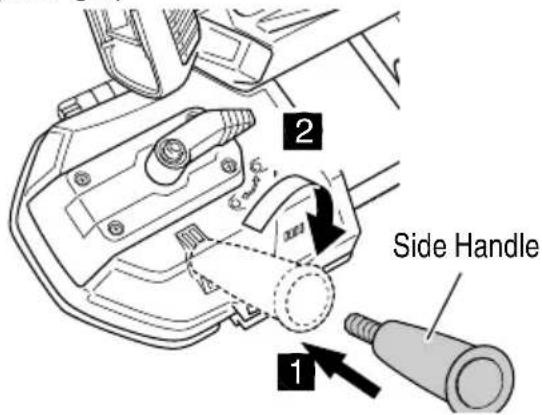
Fig. 6
- Checking the battery
Make sure that the battery is installed firmly. If it is at all loose it could come off and cause an accident.
- Hex. bar wrench storage
The included Hex. Bar wrench can be stored in the main unit. Store the tool to prevent losing it. (See Fig. 7)
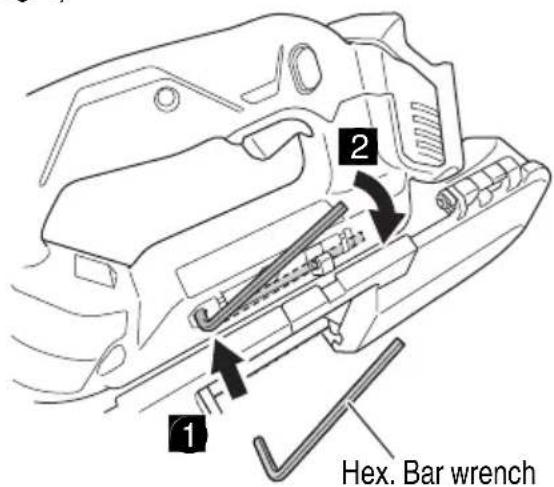
Fig. 7
- Guide plate protrusion adjustment
CAUTION
- Be sure to switch power OFF and disconnect the battery from the body when adjusting protrusion of guide plate.
In the ordinary operation, protrude the guide plate to the A side fully.
Loosen two Hex. socket bolts with the attached Hex. bar wrench, then slide the guide plate and secure it by tightening two Hex. socket bolts firmly.
When the guide plate strikes against the obstacles like a wall or the like at the finishing of a cut, slide it at the appropriate position. (See Fig. 8)
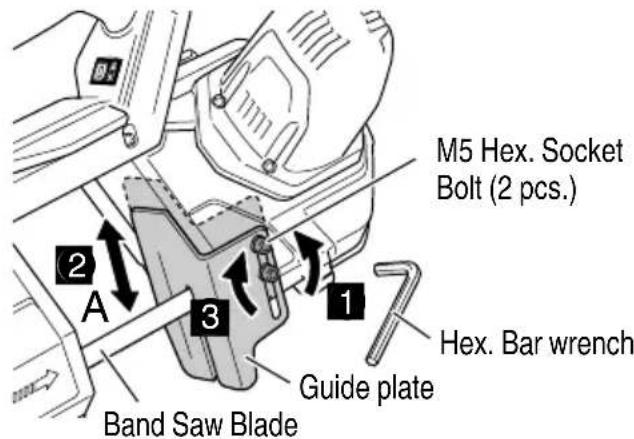
Fig. 8
- Switch operation (Fig. 9)
Drawing the switch while pressing the switch lock to either direction indicated by arrow will revolve the band saw blade while lighting up the LED light.
After the switch is activated and remains drawn, the band saw blade will continue revolving even if the Switch Lock is released.
In addition, the LED light will remain lit.
When you release the switch, the revolution of the band saw blade will stop and the LED light will automatically be extinguished in approximately 15 seconds.
CAUTION
Do not lock directly into the light from the LED lamp. Continuous and direct exposure to the light from the LED lamp can injure your eyes.
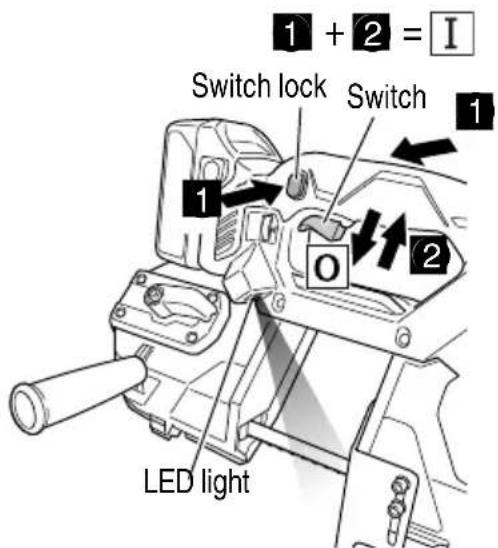
Fig. 9
NOTE
○ Using a soft cloth, wipe off any foreign matter that has adhered to the lens of the LED light, being careful not to scratch the lens.
Scratches on the LED light may reduce the brightness of the light.
When cleaning the lens of the LED light, do not wipe with gasoline, paint thinner, etc.
Doing so will damage the lens.
7. About remaining battery indicator
When pressing the remaining battery indicator switch, the remaining battery indicator lamp lights and the battery remaining power can be checked. (Fig. 10) When releasing your finger from the remaining battery indicator switch, the remaining battery indicator lamp goes off. The Table 5 shows the state of remaining battery indicator lamp and the battery remaining power.
Table 5
| State of lamp | Battery Remaining Power |
| The battery remaining power is enough. | |
| The battery remaining power is a half. | |
| The battery remaining power is nearly empty.Re-charge the battery soonest possible. |
As the remaining battery indicator shows somewhat differently depending on ambient temperature and battery characteristics, read it as a reference.
Remaining battery indicator switch
Remaining battery indicator lamp
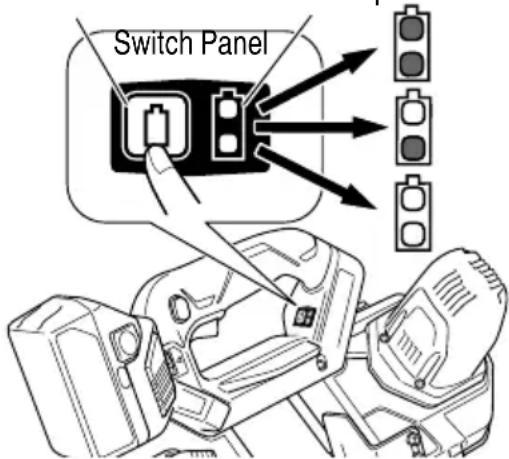
Fig. 10
NOTE
○ Do not give a strong shock to the switch panel or break it. It may lead to a trouble.
☐ To save the battery power consumption, the remaining battery indicator lamp lights while pressing the remaining battery indicator switch.
Unless the power is switched on after installing the battery to the unit, remaining battery indicator lamp will not light up when the remaining battery indicator switch is pressed.
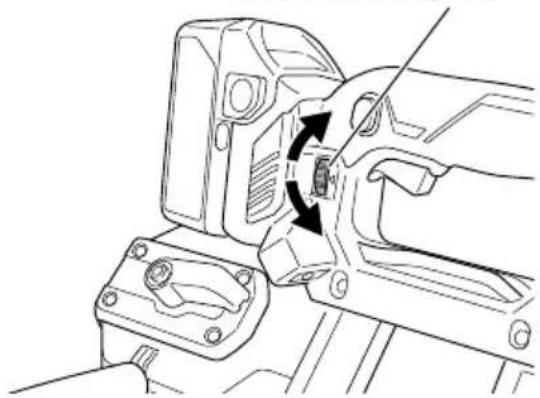
8. Adjusting operating speed (Fig. 11)

CAUTION
Use the band saw blade circumferential speed setting dial to select the circumferential speed best suited for the workpiece.
Using a band saw blade circumferential speed unsuited to cut a workpiece will not only negatively affect cutting precision, but can also cause damage to the band saw blade.
This unit is equipped with an electronic control circuit that allows the circumferential speed of the band saw blade to be freely adjusted.
Prior to operation, use the band saw blade circumferential speed setting dial to set a mode that suits the properties, thickness and task conditions of the workpiece being cut.
○ In Standard Mode, the circumferential speed or the band saw blade can be freely set from 1 to 5 on the dial.
On the dial, 1 is the lowest speed and 5 is the highest speed.
In Standard Mode, the circumferential speed that is set with the dial is maintained even when load changes.
○ In AUTO Mode ("A" on the dial), noise can be reduced and the duration of operation can be extended by lowing the circumferential speed when there is no load.
In AUTO Mode, if a load is applied during operation, the circumferential speed is automatically increased. (Equivalent of 5 on the dial)
Additionally, if the load becomes lighter after cutting is completed, the circumferential speed is automatically decreased, reducing power consumption when there is no load.
Dial for setting band saw blade circumferential speed
natural_image
Technical line drawing of a mechanical assembly with no visible text or symbolsFig. 11
Table 6 Operating Speed
| Mode Dial | Band saw blade circumferential speed (guideline) | Uses | |
| Standard Mode | 1 Low Speed 260 | SFPM (80 m/min) | Diffi cult-to-cut materials such as stainless steel and alloysSteel materials(Thick materials including cylindrical rods, l-beams, and steel pipe)(Thickness of 0.14" (3.5mm) or greater)Steel materials(Thin materials including steel pipe)(Thickness of under 0.14" (3.5mm)) |
| 2 358 SFPM (109 m/min) | |||
| 3 453 SFPM (138 m/min) | |||
| 4 545 SFPM (166 m/min) | |||
| 5 High Speed 640 SFPM (195 m/min) | |||
| AUTO Mode* A | 395 SFPM (120 m/min)(Without load) | Idle operation | |
| 640SFPM (195 m/min)(With load) | Cutting operation |
* Circumferential speeds may vary from those stated above depending on operating conditions.
9. Band saw blade selection
CAUTION
● Use a band saw blade appropriate to the workpiece.
Using a band saw blade unsuited to cut a workpiece will not only negatively affect cutting precision, but can also cause damage to the band saw blade.
- When selecting the number of teeth for a band saw blade, your standard choice should be a blade that exceeds the thickness of the workpiece by two or more teeth.
Select a band saw blade based on the thickness of the workpiece being cut, using Table 7 as a guideline.
Table 7 Band saw blade selection chart (use the band saw blade indicated with a √ symbol)
| Thickness (inch) | Band saw blade | |
| Material: Bi-Metal | ||
| 18 (teeth/inch) 14 (teeth/inch) | ||
| Under 1/8 | √ | |
| 1/8 – 1/4 | √ | √ |
| Over 1/4 | √ | |
10. Replacing the band saw blade
WARNING
- When replacing the band saw blade, be sure to switch off the power and remove the battery from the cordless tool.
● Use caution when changing or inspecting the band saw blade as it may sometimes spring out.
CAUTION
● Wear gloves when changing the band saw blade.
● The band saw blade is hot immediately after operation. Remove it only after it has cooled.
How to remove (Fig. 12)
Loosen the tension lever in the direction indicated in the figure.
Open the cover by pressing Blade pulley cover tabs (A) and (B).
Like the figure on the right, insert a screwdriver between the side of the band saw blade and the frame.
As you press the screwdriver against the side of the band saw blade, lean the screwdriver towards the revolving direction of the band saw blade. By slowly revolving the band saw blade, the blade will come loose from Blade pulley (A).
Remove the band saw blade.

flowchart
graph TD
    A["Tension lever"] --> B["Blade pulley cover (A)"]
    B --> C["Blade pulley cover (B)"]
    C --> D["Band saw blade"]
    D --> E["Tab"]
    style A fill:#f9f,stroke:#333
    style B fill:#ccf,stroke:#333
    style C fill:#cfc,stroke:#333
    style D fill:#fcc,stroke:#333
    style E fill:#cff,stroke:#333
Fig. 12
How to install (Fig. 13)
Being careful of the direction of revolution and the facing of the band saw blade (see figure), place the band saw blade in Guide roller (A) and (B), installing the band saw blade until it comes into contact with the Band saw blade back ball bearing support.
Holding the band saw blade in place so it doesn't come loose, seat the band saw blade in Blade pulley (B) and then (A), in this order.
At this point, make sure that the blade of the band saw blade is not protruding from the edges of Blade pulley (A) and that the band saw blade is not riding on the collar portion of Blade pulley (B).
Holding the band saw blade in place, turn the Tension lever in the direction for tightening and secure the band saw blade.
At this point, rotate Blade pulley (A) in the revolving direction with your hands and make sure the band saw blade does not come loose.
Close Blade Pulley Cover (A) and (B).
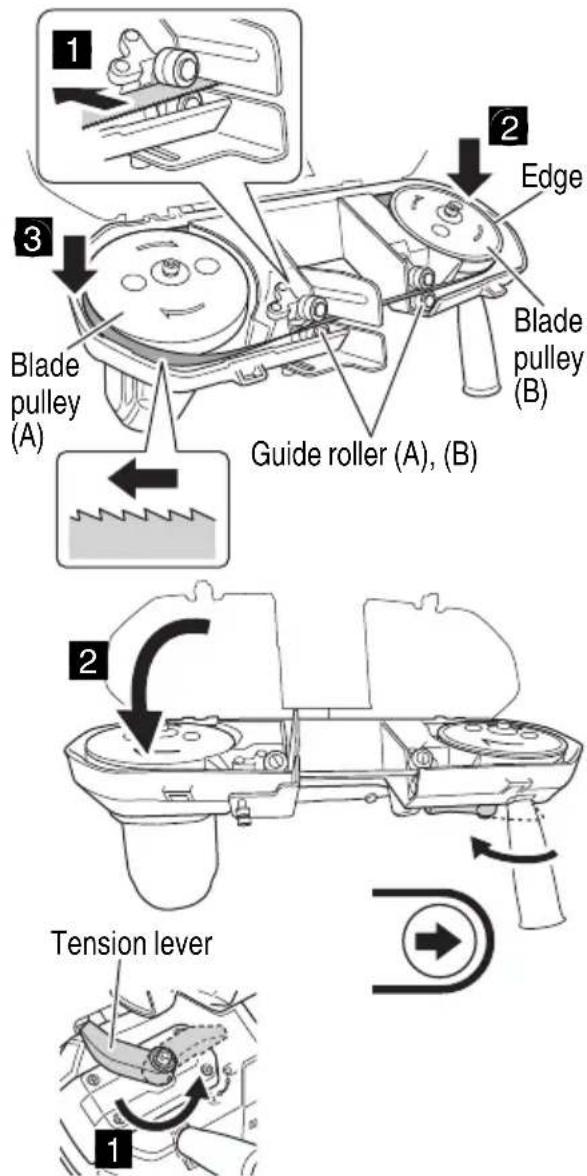
Fig. 13
NOTE
○ Minimize warm-up cutting with the band saw blade. Warm-up cutting shortens the lifespan of the band saw blade.
○ Verify that there are no nicks, cracks, or other abnormalities on the band saw blade before installing it.
○ Wipe off any oil or grime adhering to the band saw blade before installing it on the blade pulleys.
Additionally, wipe off any shavings or grime adhering to the blade pulley rubbers.
If a band saw blade that has oil or grime adhering to it is installed on the blade pulleys, the band saw blade may slip or come loose.
When installing the band saw blade, do not twist or bend its joint.
Doing so may damage the band saw blade.

CAUTION: on lithium-ion battery
To extend the lifetime, the lithium-ion battery equips with the protection function to stop the output. Therefore, if the tool is overloaded, the motor may stop. However, this is not the trouble but the result of protection function. In this case, release the switch of tool and eliminate the causes of overloading.

CAUTION
- When switching on the tool, make sure the band saw blade is not in contact with the workpiece. Failure to do so may result in injury.
- For cutting efficiency, switch the band saw blade speed according to operating conditions and workpiece to be cut.
- Do not apply any unnecessary pressure when operating the tool. Doing so may damage the band saw blade.
● After use, be sure not to place the tool near chips before it comes to a full stop as the tool may suck in those particles.
CUTTING OPERATION

WARNING
- Be absolutely sure to keep the switch turned off and the battery removed to prevent any accident.
● During operation, do not place your face or hands near the application tool of the unit.
○ Select a band saw blade (the band saw blade's teeth/inch) and a band saw blade operating speed that is suitable for properties and thickness of the workpiece to be cut.
When using a new band saw blade, be sure to set the band saw blade operating speed setting dial to "1" and perform 1–2 warm-up cuts with a light cutting load (while pulling slightly upward on the product) on an object with an outer diameter of 3/4" or less such as cylindrical rod (carbon steel).
Failure to perform warm-up cuts may result in nicks on the blade edge and decreased cutting precision.
☐ Do not cut thermoplastic material. It can melt from cutting friction heat which can result in the band saw blade becoming wedged in the material, causing the motor to lock up.
○ Do not cut hard materials such as hardened steel.
○ If there is a gap between the guide plate and the workpiece, the piece may erratically shift position and cause breakage to the band saw blade.
○ Do not apply excessive loads to the band saw blade.
When the workpiece is thin (0.08" thick or less), cut with the piece slightly raised up.
○ About continuous operation
This tool is equipped with a temperature protection circuit for safeguarding the motor as well as the electronic motor drive control components.
If the tool is operated continuously, the temperature of the unit may rise and activate the temperature protection circuit, automatically stopping operation. If this happens, allow the machine to sufficiently cool.
Once the temperature has decreased, the tool is ready to be used again.
In the event the storage battery is changed during continuous operation, allow the cordless tool to rest for about 15 minutes before resuming use.
If operation is resumed soon after the battery is changed, the temperatures of the motor, switch, etc. will become high and may result in malfunction or damage.
○ About holding the unit and applying force
Hold the tool securely with both hands.
When holding the unit, make sure the band saw blade is perpendicular to the workpiece.
Additionally, there is no need to push the unit with any excessive force.
Be aware that applying any excessive prying or pressing force to the tool may result in the unit's malfunction or damage.
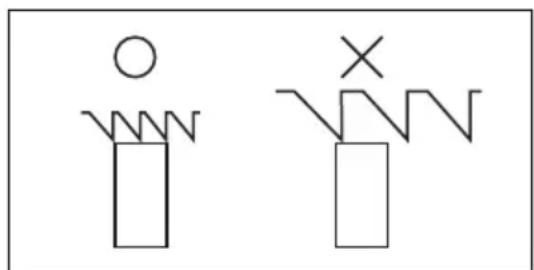
natural_image
Two simple line drawings of a person holding a box with 'WW' and a cross symbol, no text or labels present.For stable cut, always keep at least two teeth in the cut.
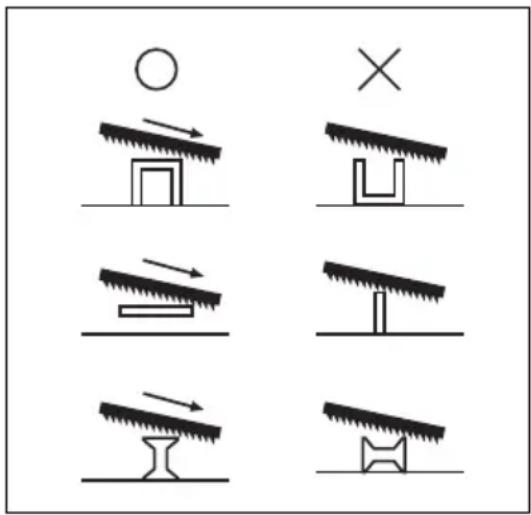
Select the proper cutting position for your workpiece by referring to the figure.
- Press the workpiece against the guide plate (Fig. 14) Press the workpiece against the guide plate in a position where there is no contact with the band saw blade.
- Press the switch and cut (Fig. 14)
When the revolutions are stable, avoid any sudden impact to the band saw and gently bring the band saw to the workpiece to cut.
When completing a cut, hold the tool firmly, so it will not fall against the workpiece.
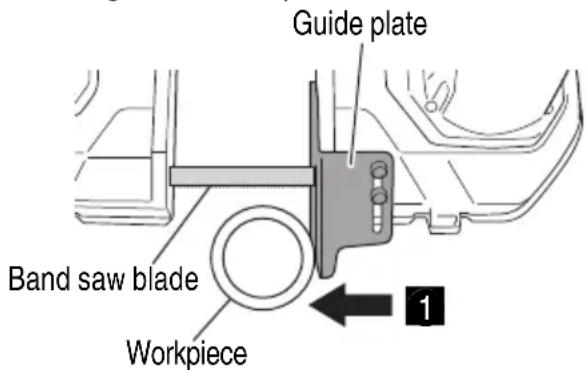
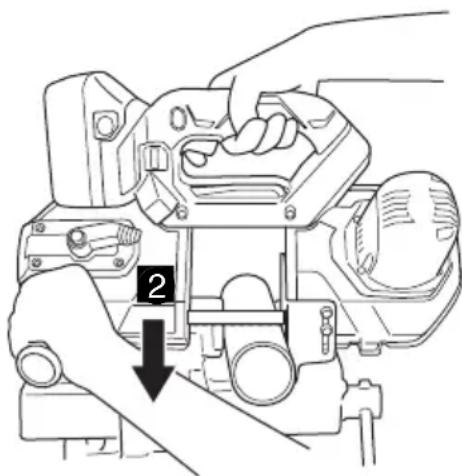
natural_image
Technical line drawing of a mechanical assembly with a hand operating a tool (no text or symbols present)Fig. 14
MAINTENANCE AND INSPECTION
WARNING: Be sure to tuned off the switch and pull out the battery. Be sure to wear gloves when handling the band saw blade.
1. Replacing the band saw blade (Fig. 12, 13)
If the band saw blade becomes dull, it can result in overburdening the motor and the various parts of the tool as well as decrease efficiency.
Do not delay in replacing the band saw blade.
2. Blade pulley rubbers inspection (Fig. 15)
The blade pulley rubbers are installed on the outer circumferences of the blade pulleys (2 places). (Fitted type)
When replacing the band saw blade, inspect the blade pulley rubbers for sagging or damage.
If there is sagging or damage, request a replacement from metabo HPT Authorized Service Center, as it may result in the band saw blade running unstable or coming loose.
NOTE
Periodically remove any shavings, etc. that has adhered to the blade pulley rubbers.
Failure to do so may result in slippage of the band saw blade and/or injury.
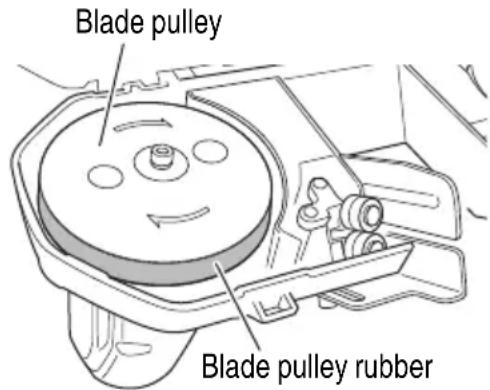
Fig. 15
3. Inspection of band saw blade back ball bearing supports (Fig. 16)
Periodically inspect the band saw blade back ball bearing supports inside the bearing holders for wear. If the band saw blade back ball bearing supports are worn, there will be excessive force on the band saw blade that could result in damage to the band saw blade.
If the band saw blade back ball bearing supports are worn, arrange for replacements from metabo HPT Authorized Service Center.
Band saw blade back ball bearing support
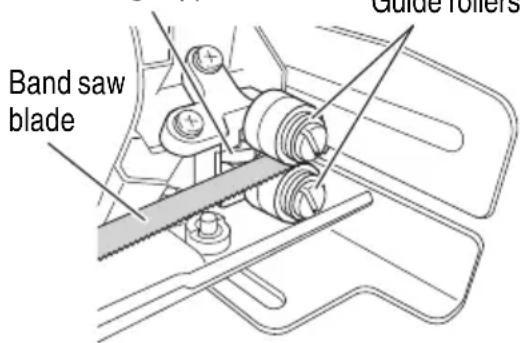
Fig. 16
4. Inspection of band saw blade guide rollers and adjustment of gaps (Fig. 17)
After continued use of the unit, the gaps between the band saw blade guide rollers may become wider.
If the gaps become wider, the band saw blade may till, resulting in reduced cutting precision.
Periodically inspect whether the gaps between the band saw blade guide rollers are appropriate (bearings are lightly touching the band saw blade), and make any adjustments if necessary.
Additionally, if the band saw blade guide rollers are damaged, arrange for replacements from metabo HPT Authorized Service Center.
① Open the blade pulley cover and remove the band saw blade.
(See Fig. 12 for band saw blade removal)
② Use a Phillips head screwdriver to loosen the screws and remove the bearing holders (A) and (B) from the unit.
③ Use a flathead screwdriver to loosen the bearing pins.
Place the band saw blade between the guide rollers and tighten the bearing pins, adjusting as necessary to make sure that the blade is lightly in contact with the supports.
④ Place bearing holders (A) and (B) back into the unit and install the band saw blade.
(See Fig.13 for band saw blade installation)
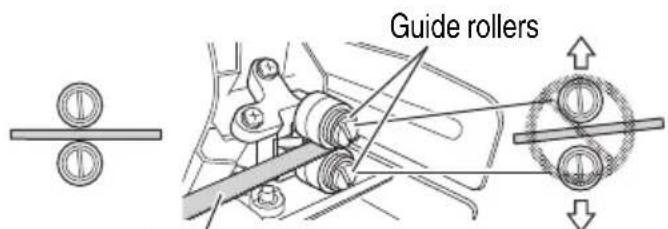
Band saw blade
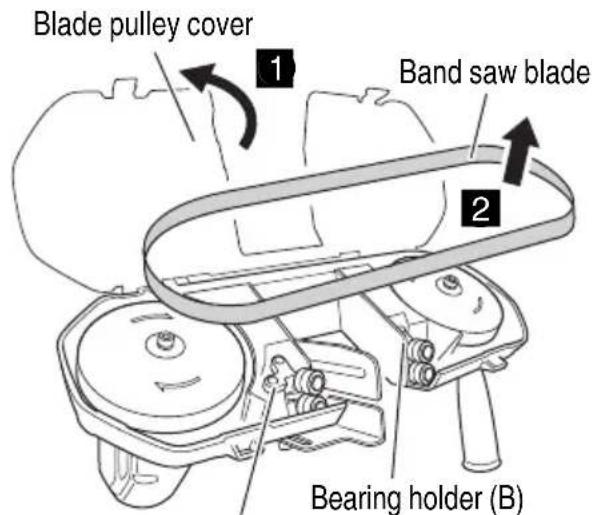
Bearing holder (A)
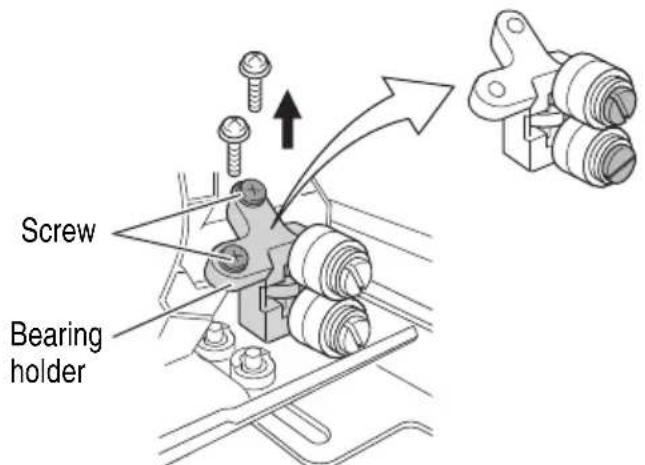
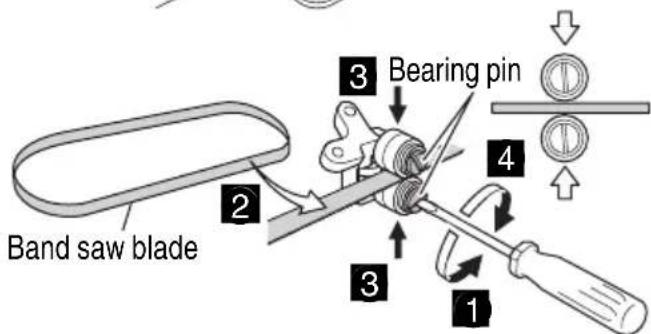
Fig. 17
5. Check the Screws
Loose screws are dangerous. Regularly inspect them and make sure they are tight.
CAUTION
Using this power tool with loosened, screws is extremely dangerous.
6. Maintenance of the motor
The motor unit winding is the very "heart" of the power tool.
Exercise due care to ensure the winding does not become damaged and/or wet with oil or water.
7. Check for Dust
Dust may be removed with a soft cloth or a cloth dampened with soapy water.
Do not use bleach, chlorine, gasoline or thinner, for they may damage the plastics.
8. Disposal of the exhausted battery
WARNING
Do not dispose of the exhausted battery. The battery must explode if it is incinerated. The product that you have purchased contains a rechargeable battery. The battery is recyclable. At the end of its useful life, under various state and local laws, it may be illegal to dispose of this battery into the municipal waste stream. Check with your local solid waste offi cials for details in your area for recycling options or proper disposal.
9. Storage
Storing in a place below 104^ F ( 40^ C) and out of the reach of children.
NOTE
Storing lithium-ion batteries
Make sure the lithium-ion batteries have been fully charged before storing them.
Prolonged storage (3 months or more) of batteries with a low charge may result in performance deterioration, significantly reducing battery usage time or rendering the batteries incapable of holding a charge.
However, significantly reduced battery usage time may be recovered by repeatedly charging and using the batteries two to five times.
If the battery usage time is extremely short despite repeated charging and use, consider the batteries dead and purchase new batteries.
10. Service and repairs
All quality power tools will eventually require servicing or replacement of parts because of wear from normal use. To assure that only authorized replacement parts will be used, all service and repairs must be performed by a metabo HPT AUTHORIZED SERVICE CENTER, ONLY.
CAUTION
In the operation and maintenance of power tools, the safety regulations and standards prescribed in each country must be observed.
Important notice on the batteries for the metabo HPT cordless power tools
Please always use one of our designated genuine batteries. We cannot guarantee the safety and performance of our cordless power tool when used with batteries other than these designated by us, or when the battery is disassembled and modified (such as disassembly and replacement of cells or other internal parts).
ACCESSORIES
WARNING
ALWAYS use Only authorized metabo HPT replacement parts and accessories. NEVER use replacement parts or accessories which are not intended for use with this tool. Contact metabo HPT if you are not sure whether it is safe to use a particular replacement part or accessory with your tool.
The use of any other attachment or accessory can be dangerous and could cause injury or mechanical damage.
NOTE
Accessories are subject to change without any obligation on the part of the metabo HPT.
STANDARD ACCESSORIES
| CB18DBL(NN) | ○ Band Saw Blade (Bi-Metal 18 TPI)......1○ Side Handle (Code No. 981828)......1○ Hex. Bar Wrench (Code No. 944458)......1Battery, battery charger, plastic case and battery cover are not contained. |
OPTIONAL ACCESSORIES (sold separately)
- Battery
- Battery Charger
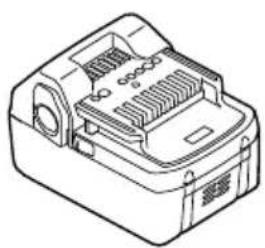
natural_image
Line drawing of a mechanical device with internal components (no text or symbols)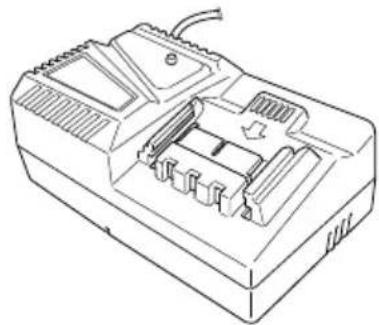
natural_image
Line drawing of a device casing with internal components and ventilation slots (no text or symbols)BSL1850 (Code No. 335791) UC18YFSL
- Band Saw Blade
| Bi-Metal | 18 TPI (3 pcs/pack) Code No. 338431 | |
| 14 TPI (3 pcs/pack) Code No. 338430 |
NOTE
Specifications are subject to change without any obligation on the part of the metabo HPT.
TROUBLE SHOOTING
Use the inspections in the table below if the tool does not operate normally. If this does not remedy the problem, consult your dealer or the metabo HPT Authorized Service Center.
| Symptom Possible | cause Remedy | |
| The unit does not run/is stopped | The battery capacity is depleted Charge the storage battery. | |
| The unit has stopped suddenly | The unit is overloaded Get rid of the cause of the large load. | |
| The storage battery is overheated | Allow the storage battery to cool sufficiently. | |
| The band saw blade has come loose | There is oil or grime adhering to the band saw blade or workpiece | Wipe off oil or grime that is adhering to the band saw blade or workpiece. |
| The band saw blade is not installed correctly | Install the band saw blade correctly.(See “Replacing the band saw blade”) | |
| The band saw blade is becoming bound in the workpiece | A band saw blade appropriate for the workpiece is not being used | Select the correct band saw blade.(See “Band saw blade selection”) |
| A band saw blade operating speed appropriate for the workpiece is not being used | Select the correct band saw blade operating speed.(See “Adjusting operating speed”) | |
| Cutting precision is poor | The band saw blade is worn away | Replace the band saw blade with a new one. |
| A band saw blade appropriate for the workpiece is not being used | Select the correct band saw blade.(See “Band saw blade selection”) | |
| A band saw blade operating speed appropriate for the workpiece is not being used | Select the correct band saw blade operating speed.(See “Adjusting operating speed”) | |
| The band saw blade is not installed correctly | Install the band saw blade correctly.(See “Replacing the band saw blade”) | |
| The gaps between the band saw blade ball bearing supports have become wide | Correctly adjust the gaps.(See “Inspection of band saw blade guide rollers and adjustment of gaps”) | |
| A band saw blade that is not authorized by the manufacturer is being used | Use a band saw blade that is authorized by the manufacturer. | |
| Sufficient warm-up cuts have not been performed | With the band saw blade operating speed setting dial set to “1”, perform 1 or 2 warm-up cuts with a light cutting load such as a cylindrical rod (carbon steel, etc.) with an outer diameter of 3/4" or less. | |
| Cutting takes a long time | The band saw blade is facing the wrong directionDirection of rotation 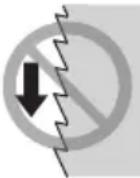 | Install the band saw blade correctly.(See “Replacing the band saw blade”)Direction of rotation 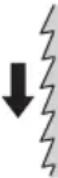 |
| A band saw blade appropriate for the workpiece is not being used | Select the correct band saw blade.(See “Band saw blade selection”) | |
| The band saw blade operating speed is not appropriate for the workpiece | Select the correct band saw blade operating speed.(See “Adjusting operating speed”) | |
| The band saw blade is worn away Replace the band saw blade. | ||
| The remaining battery supply is low Charge the storage battery. | ||
| There are large vibrations during cutting | The band saw blade edge is chipped Replace the band saw blade. | |
| A band saw blade appropriate for the workpiece is not being used | Select the correct band saw blade.(See “Band saw blade selection”) | |
| The band saw blade operating speed is not appropriate for the workpiece | Select the correct band saw blade operating speed.(See “Adjusting operating speed”) | |
| The blade edge frequently becomes chipped | The unit is being pressed too hard during cutting | Cut using the unit’s own weight or while pressing gently. |
| The band saw blade has impacted against the workpiece | Bring the band saw blade near the workpiece slowly and gently begin cutting. | |
| The workpiece has moved during cutting | Fasten the workpiece firmly with a vice, etc. | |
| A band saw blade appropriate for the workpiece is not being used | Select the correct band saw blade.(See “Band saw blade selection”) | |
| The band saw blade operating speed is not appropriate for the workpiece | Select the correct band saw blade operating speed.(See “Adjusting operating speed”) | |
CONSIGNES DE SÉCURITÉ IMPORTANTES
natural_image
Line drawing of a hand operating a mechanical device with no visible text or symbolsFig. 1
natural_image
Technical line drawing of a mechanical assembly with no visible text or symbolsFig. 11
natural_image
Technical line drawing of a mechanical device with a hand adjusting the component (no text or symbols present)Fig. 14
ENTRETIEN ET INSPECTION
natural_image
Line drawing of a mechanical device with internal components (no text or symbols)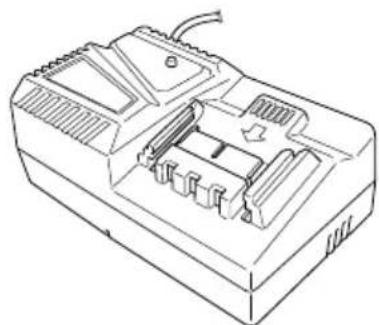
natural_image
Line drawing of a device casing with internal compartments and ventilation slots (no text or symbols)BSL1850 (N° de code 335791) UC18YFSL
natural_image
Line drawing of a hand operating a mechanical device with no visible text or symbolsFig. 1
natural_image
Mechanical assembly diagram showing a clamping mechanism with no visible text or symbolsnatural_image
Two simple line drawings of a container with circular and cross symbols, no text or labels present.natural_image
Line drawing of a mechanical device with internal components (no text or symbols)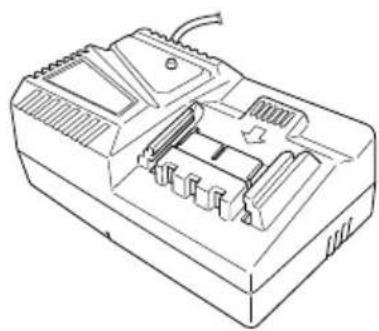
natural_image
Line drawing of a device casing with internal components and ventilation slots (no text or symbols)natural_image
Line drawing of a quill pen in an inkwell (no text or symbols)WARNING:
Some dust created by power sanding, sawing, grinding, drilling, and other construction activities contains chemicals known to the State of California to cause cancer, birth defects or other reproductive harm. Some examples of these chemicals are:
- Lead from lead-based paints,
- Crystalline silica from bricks and cement and other masonry products, and
- Arsenic and chromium from chemically-treated lumber.
Your risk from these exposures varies, depending on how often you do this type of work. To reduce your exposure to these chemicals: work in a well ventilated area, and work with approved safety equipment, such as those dust masks that are specially designed to filter out microscopic particles.
AVERTISSEMENT:
Please contact Koki Holdings America Ltd. at 1-800-59-TOOLS (toll free), or metabo HPT AUTHORIZED POWER TOOL SERVICE CENTER regarding COLLECTION.
Pour le RAMASSAGE, contacter Koki Holdings America Ltd. au 1-800-59-TOOLS (appel gratuit), ou UN SERVICE APRÈS-VENTE D'OUTILS ÉLECTRIQUE AGRÉÉ PAR metabo HPT.
Minato-ku, Tokyo 108-6020, Japan
Distributed by
Koki Holdings America Ltd.
1111 Broadway Ave,
Braselton, Georgia, 30517
Koki Holdings America Ltd. Canadian Branch
3405 American Drive, Units 9-10,
Mississauga, ON, L4V 1T6
811
Code No. C99713062 G
Printed in China
- SAFETY INSTRUCTIONS AND INSTRUCTION MANUAL
- WARNING
- INSTRUCTIONS DE SECURITE ET MODE D'EMPLOI
- AVERTISSEMENT
- IMPORTANT SAFETY INSTRUCTIONS
- MEANINGS OF SIGNAL WORDS
- SAFETY
- GENERAL POWER TOOL SAFETY WARNINGS
- -WARNING-
- SPECIFIC SAFETY RULES AND SYMBOLS
- ADDITIONAL SAFETY WARNINGS
- IMPORTANT SAFETY INSTRUCTIONS FOR BATTERY CHARGER
- READ ALL INSTRUCTIONS
- IMPORTANT SAFETY INSTRUCTIONS FOR USE OF THE BATTERY AND BATTERY CHARGER
- CAUTION
- USE ONLY metabo HPT BATTERY TYPE BSL1850. OTHER TYPES OF BATTERIES MAY BURST AND CAUSE INJURY!
- CAUTION ON LITHIUM-ION BATTERY
- REGARDING LITHIUM-ION BATTERY TRANSPORTATION
- SAVE THESE INSTRUCTIONS AND MAKE THEM AVAILABLE TO OTHER USERS AND OWNERS OF THIS TOOL!
- FUNCTIONAL DESCRIPTION
- NOTE
- NAME OF PARTS
- Battery Charger (UC18YFSL)
- SPECIFICATIONS
- Electronic control
- ASSEMBLY AND OPERATION
- APPLICATIONS
- REMOVAL AND INSTALLATION METHOD OF BATTERY
- CHARGING METHOD
- PRIOR TO OPERATION
- About remaining battery indicator
- Adjusting operating speed (Fig. 11)
- Band saw blade selection
- Replacing the band saw blade
- How to remove (Fig. 12)
- How to install (Fig. 13)
- CAUTION: on lithium-ion battery
- CUTTING OPERATION
- MAINTENANCE AND INSPECTION
- Replacing the band saw blade (Fig. 12, 13)
- Blade pulley rubbers inspection (Fig. 15)
- Inspection of band saw blade back ball bearing supports (Fig. 16)
- Inspection of band saw blade guide rollers and adjustment of gaps (Fig. 17)
- Check the Screws
- Maintenance of the motor
- Check for Dust
- Disposal of the exhausted battery
- Storage
- Service and repairs
- ACCESSORIES
- OPTIONAL ACCESSORIES (sold separately)
- TROUBLE SHOOTING
- CONSIGNES DE SÉCURITÉ IMPORTANTES
- ENTRETIEN ET INSPECTION
- WARNING:
- AVERTISSEMENT:
- Koki Holdings America Ltd.
- Koki Holdings America Ltd. Canadian Branch
Brand : HiKOKI
Model : CB18DBL
Category : Saw