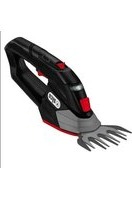
AGS 10 8 Li - Grass trimmer AYCE - Free user manual and instructions
Find the device manual for free AGS 10 8 Li AYCE in PDF.


User questions about AGS 10 8 Li AYCE
0 question about this device. Answer the ones you know or ask your own.
Ask a new question about this device
Download the instructions for your Grass trimmer in PDF format for free! Find your manual AGS 10 8 Li - AYCE and take your electronic device back in hand. On this page are published all the documents necessary for the use of your device. AGS 10 8 Li by AYCE.
USER MANUAL AGS 10 8 Li AYCE
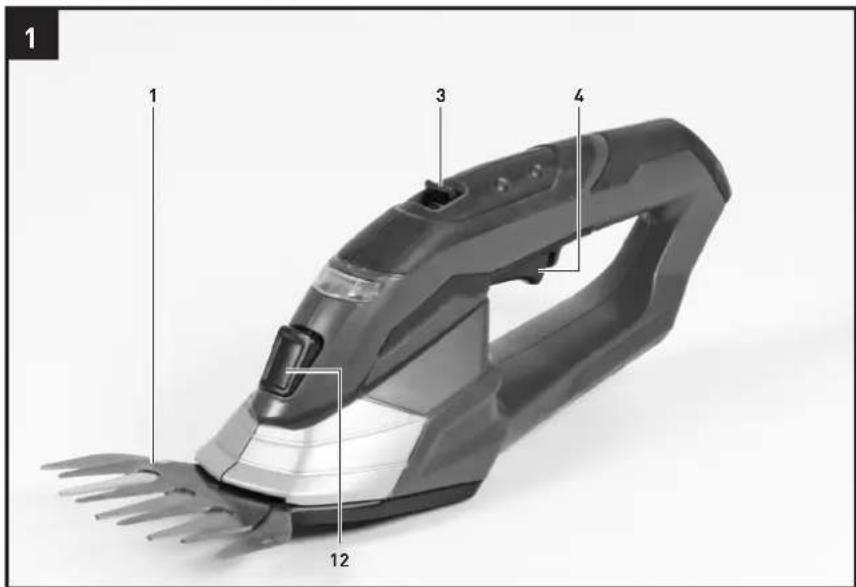
| 1 Grass cutter blade 10 Battery charger | ||
| 3 Safety lock-off 11 Shrub cutter blade | ||
| 4 ON button 12 Blade release mechanism | ||
| 9 Blade guard | ||
2. TECHNICAL DATA
| Cordless grass and shrub shears | |
| Speedn 0:1200 rpm | |
| Cutting width of the grass cutter:100 mm | |
| Cutting width of the shrub shears:190 mm | |
| Cutting thickness of the shrub shears:8 mm | |
| Running time max.:100 min | |
| Battery pack:Li-lon/10.8V d.c./1.3Ah | |
| Charging time:2 h | |
| Sound pressure level LpA:61 dB(A) | |
| Sound power level LWA:81 dB(A) | |
| Uncertainty K:6 dB(A) | |
| Vibration aHV:5,5m/s | 2 |
| Uncertainty K:1.5 m/s | 2 |
| Uncertainty K:3 dB(A) | |
| Sound pressure level at the operator's ear:77 dB(A) | |
| Weight:1.4kg | |
| Battery charger | |
| Mains voltage: 100-240 V ~ 50-60 Hz | |
| Rated voltage: 13 V d. c. | |
| Rated current: | 900 mA |

- The vibration emission level has been measured in accordance with a set of standardized criteria and can be used to compare one power tool with another.
- The specified emission level can also be used to make an initial assessment of the exposure to vibrations.
- The vibration emission level may vary from the level specified during actual use, depending on the way in which the power tool is used.
- Try to keep the impact from vibrations as low as possible. Exposure to vibrations can be reduced by wearing gloves when using the tool, for example, and by limiting the amount of operating time. This includes the full cycle of operation (e.g. times when the power tool is switched off and times when the tool is switched on but no working load is applied).
3. SAFETY REGULATIONS
Danger!
When using the equipment, a few safety precautions must be observed to avoid injuries and damage. Please read the complete operating instructions and safety regulations with due care. Keep this manual in a safe place, so that the information is available at all times. If you give the equipment to any other person, hand over these operating instructions and safety regulations as well. We cannot accept any liability for damage or accidents which arise due to a failure to follow these instructions and the safety instructions.
Danger!
Read all safety regulations and instructions.
Any errors made in following the safety regulations and instructions may result in an electric shock, fire and/or serious injury.
Keep all safety regulations and instructions in a safe place for future use.
EXPLANATION OF THE WARNING SIGNS ON THE MACHINE
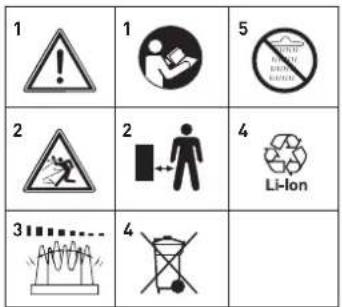

- Important! Read the operating instructions and follow the warnings and safety instructions
- Keep all other persons away from the danger zone.
- Caution! The cutter blades continue to run after the motor is switched off. Wait for the blades to come to a standstill. Risk of injury!
- Dispose of batteries correctly!
- Protect the tool from the damp and never expose it to rain.
- Guaranteed sound power level: 87 dB
General safety instructions for electric tools
CAUTION: Read all safety regulations and instructions. Any failures made in following the safety regulations and instructions may result in an electric shock, fire and/or serious injury.
Keep all safety regulations and instructions in a safe place for future use.
The term "electric tool" used in the safety instructions refers to electric tools operated from the mains power supply (with a power cable) and to battery operated electric tools (without a power cable).

1. Workplace safety
a) Keep your work area clean and well illuminated. Untidy or unfit work areas can result in accidents.
b) Do not operate the electric tool in an environment where there is a risk of explosions and where there are inflammable liquids, gases or dust. Electric tools produce sparks which could set the dust or vapours alight.
c) Keep the electric tool out of the reach of children and other persons. If there is a distraction, you may lose control of the appliance.
2. Electrical safety
a] The connector plug from this electric tool must fit into the socket. The plug should never be altered in any way. Never use adapter plugs together with earthed electric tools. Unaltered plugs and correct sockets reduce the risk of an electric shock.
b) Avoid bodily contact with earthed surfaces such as pipes, heating, ovens and fridges. The risk of electric shock is increased if your body is earthed.
c) Keep the tool out of the rain and away from moisture. The ingress of water into an electric tool increases the risk of an electric shock.
d) Do not use the cable to carry the electric tool, to hang it up or to pull it out of the socket. Keep the cable away from heat, oil, sharp edges and moving parts of the appliance. Damaged or entangled cables increase the risk of an electric shock.
e) If you are working outdoors with an electric tool, only use extension cables which are designed specifically for this purpose. Using specially designed outdoor extension cables, the risk of electric shock is reduced.
f) If operation of the electric tool in a damp environment can not be avoided, use a earth-leakage circuit-breaker. The earth-leakage circuit-breaker reduces the risk of an electric shock.
3. Safety of persons
a] Be careful, watch what you are doing and use an electric tool sensibly. Do not use the tool if you are tired or under the influence of drugs, alcohol or medication. A moment of inattention when using the electric tool can result in serious injuries.
b) Wear personal protection equipment and always wear safety goggles. Wea- ring personal protection (such as dust masks, non-slip safety shoes, safety helmet or ear protection, depending upon the type and use of the electric tool) reduces the risk of injury.
c) Make sure that the appliance cannot start up accidentally. Ensure that the electric tool is switched off before you connect it to the power supply and/or insert the battery, or pick up or carry the tool. If your finger is on the switch whilst carrying the electric tool or if you connect the appliance to the mains
when it is switched on, this can lead to accidents.
d] Remove keys and wrenches before switching on the electric tool. A tool or key which comes into contact with rotating parts of the appliance can lead to injuries.
e) Avoid abnormal working postures. Make sure you stand squarely and keep your balance at all times. In this way, you can control the electric tool better in unexpected circumstances.
f) Wear suitable work clothes. Do not wear loose clothing or jewellery. Keep hair, clothes and gloves away from moving parts. Loose clothing, jewellery or long hair can get trapped in moving parts.
g] If vacuuming devices and draining devices can be fitted, make sure that these are correctly attached and correctly used. The use of a dust extraction system can reduce the danger posed by dust.
4. Usage and treatment of the electric tool
a) Do not overload the appliance. Use the correct tool for your work. You will be able to work better and more safely within the given performance boundaries.
b] Do not use an electric tool with a defective switch. An electric tool that cannot be switched on or off is dangerous and must be repaired.
c] Pull the plug out of the socket and/or remove the battery before making any adjustments to the appliance, changing accessories or put the appliance down. This safety measure prevents starting the electric tool unintentionally.
d] Keep unused electric tools out of the reach of children. Do not allow people who are not familiar with the appliance or who have not read these instructions to use the appliance. Electric tools are dangerous if they are used by inexperienced people.
e) Clean your electric tool carefully. Check whether moving parts are functioning properly and not jamming, whether parts are broken or damaged enough that the functioning of this electric tool is affected. Have damaged parts repaired before using the appliance. Many accidents are caused by badly maintained electric tools.
f) Keep your cutting tools sharp and clean. Carefully maintained cutting tools with sharp cutting edges will jam less and are easier to control.
g] Make sure to use electric tools, accessories, attachments, etc. in accordance with these instructions. Take the conditions in your work area and the job in hand into account. Using electric tools for any purpose other than the one for which they are intended can lead to dangerous situations.

- Using and handling the cordless tool
a) Ensure that the tool is switched off before you insert the battery. Inserting a battery into an electric tool that is switched on can cause accidents.
b) Only charge the batteries in chargers that are recommended by the manufacturer. A charger that is designed for a certain type of battery may pose a fire risk if it is used with other types of battery.
c) Use only the correct batteries in the electric tools. The use of other batteries may result in injuries and a fire risk.
d) Keep unused batteries away from paper clips, coins, keys, nails, screws and other metallic objects that could cause a short circuit between the contacts. A short circuit between the battery contacts may cause burns or a fire.
e] In case of incorrect use, fluid may escape from the battery. Avoid contact with it. If you touch it by accident, rinse the affected area with water. If you get the fluid in your eyes, also seek medical advice. Leaking battery fluid can cause skin irritation or burns.
6. Service
a) Have your electric tool repaired only by trained personnel using only genuine spare parts. This will ensure that your electric tool remains safe to use.
Hold the equipment by the insulated handles when carrying out work during which the screw or the plug-in tool could strike concealed power cables. Contact with a live cable may also make the metal parts of the equipment live and cause an electric shock.
Make sure you keep all parts of your body away from the blades. Never attempt to remove the cuttings with the blades running or to hold material you wish to cut. Always switch off the equipment before attempting to remove any jammed cuttings. A single moment of carelessness when using the hedge trimmer can result in serious injuries.
Carry the hedge trimmer by its handle and make sure the blades have stopped. Always fit the protective cover when transporting the hedge trimmer or putting it into storage. Careful handling of the equipment reduces the likelihood of injury by the blades.
Additional safety instructions
We pay a great deal of attention to the design of every battery pack to ensure that we supply you with batteries which feature maximum power density, durability and safety. The battery cells have a wide range of safety devices. Each individual cell is initially formatted and its electrical characteristic curves are recorded.
These data are then used exclusively to be able to assemble the best possible battery packs. Despite all the safety precautions, caution must always be exercised when handling batteries. The following points must be obeyed at all times to ensure safe use.
Safe use can only be guaranteed if undamaged cells are used. Incorrect handling can cause cell damage.
Important: Analyses confirm that incorrect use and poor care are the main causes of the damage caused by high performance batteries.
Information about the battery
-
The battery pack supplied with your cordless tool is not charged. The battery pack has to be charged before you use the tool for the first time.
-
For optimum battery performance avoid low discharge cycles. Charge the battery pack frequently.
-
Store the battery pack in a cool place, ideally at 15^ and charged to at least 40% .
-
Lithium-ion batteries are subject to a natural ageing process. The battery pack must be replaced at the latest when its capacity falls to just 80% of its capacity when new. Weakened cells in an aged battery pack are no longer capable of meeting the high power requirements and therefore pose a safety risk.
-
Do not throw battery packs into an open fire. There is a risk of explosion!
-
Do not ignite the battery pack or expose it to fire.
7. Do not exhaustively discharge batteries.
Exhaustive discharge will damage the battery cells. The most common cause of exhaustive discharge is lengthy storage or non-use of partly discharged batteries. Stop working as soon as the performance of the battery falls noticeably or the electronic protection system triggers. Place the battery pack in storage only after it has been fully charged.
8. Protect batteries and the tool from overloads.
Overloads will quickly result in overheating and cell damage inside the battery housing without this overheating actually being apparent externally.
9. Avoid damage and shocks.
Replace batteries which have been dropped from a height of more than one meter or which have been exposed to violent shocks without delay, even if the housing of the battery pack appears to be undamaged. The battery cells inside the battery may have suffered serious damage. In this respect, please also read the waste disposal information.
- If the battery pack suffers overloading and overheating, the integrated protective cut-off will switch off the equipment for safety reasons. Important. Do not press the ON/OFF switch any more if the protective cut-off has actuated. This

may damage the battery pack.
- Use only original battery packs. The use of other batteries may result in injuries, explosion and a fire risk.
Information on chargers and the charging process
7. Do not over-charge batteries.
- Please check the data marked on the rating plate of the battery charger. Be sure to connect the battery charger to a power supply with the voltage marked on the rating plate. Never connect it to a different mains voltage.
- Protect the battery charger and its cable from damage and sharp edges. Have damaged cables repaired without delay by a qualified electrician.
- Keep the battery charger, batteries and the cordless tool out of children's reach.
- Do not use damaged battery chargers.
- Do not use the supplied battery charger to charge other cordless tools.
- In heavy use the battery pack will become warm. Allow the battery pack to cool to room temperature before commencing with the charging.
Do not exceed the maximum charging times. These charging times only apply to discharged batteries. Frequent insertion of a charged or partly charged battery pack will result in over-charging and cell damage. Do not leave batteries in the charger for days on end.
8. Never use or charge batteries if you suspect that the last time they were charged was more than 12 months previously. There is a high probability that the battery pack has already suffered dangerous damage (exhaustive discharge).
9. Charging batteries at a temperature below 10^ will cause chemical damage to the cell and may cause a fire.
10. Do not use batteries which have heated during the charging process, as the battery cells may have suffered dangerous damage.
11. Do not use batteries which have suffered curvature or deformation during the charging process or which show other non-typical symptoms (gassing, hissing, cracking,...)
12. Never fully discharge the battery pack (recommended depth of discharge max. 80% ) A complete discharge of the battery pack will lead to premature ageing of the battery cells.
13. Never charge the batteries unsupervised.
Protection from environmental influences
- Wear suitable work clothes. Wear safety goggles.
- Protect your cordless tool and the battery charger from moisture and rain. Moisture and rain can cause dangerous cell damage.
- Do not use the cordless tool or the battery charger near vapors and inflammable liquids.
- Use the battery charger and cordless tools only in dry conditions and an ambient temperature of 10 - 40^
- Do not keep the battery charger in places where the temperature is liable to reach over 40^ . In particular, do not leave the battery charger in a car that is parked in the sunshine.
- Protect batteries from overheating. Overloads, over-charging and exposure to direct sunlight will result in overheating and cell damage. Never charge or work with batteries which have been overheated – replace them immediately if possible.
- Storage of batteries, battery chargers and cordless tools. Store the charger and your cordless tool only in dry places with an ambient temperature of 10- 40^ . Store your lithium-ion battery pack in a cool, dry place at a temperature of 10 - 20^ . Protect them from humidity and direct sunlight. Only place fully charged batteries in storage (charged at least 40% ).
- Prevent the lithium-ion battery pack from freezing. Battery packs which were stored below 0^ for more than 60 minutes must be disposed of.
- When handling batteries, beware of electrostatic charge: Electrostatic discharges cause damage of the electronic protection system and the battery cells. Avoid electrostatic charging and never touch the battery poles.
Rechargeable batteries and cordless electric machines and tools contain materials that are potentially harmful to the environment. Never place any cordless electric machines or tools in your household refuse. If the equipment becomes defective or worn, take the equipment to the Jumbo sales point of your choice.
When shipping or disposing of batteries and cordless tools, always ensure that they are packed individually in plastic bags to prevent short circuits and fires.

Safety instructions for grass shears
- Before you begin your work, examine the material you want to cut. Remove any foreign bodies. Keep a continuous watch out for foreign bodies while you are working. If you come across any foreign bodies while cutting, turn off the device (release the ON button) and remove the items in question.
- Keep the device at a suitable distance from your body while working. Only switch on the device when all parts of the body are well out of the way.
- Make sure that no people or animals ever come within the working or swiveling range of the device.
- Only use the device in broad daylight or make sure that you provide adequate artificial light.
- Important! The cutting tools continue running on after the device has been switched off.
- When the device is not in use, make sure that it is stored in such a way that there is no risk of hands coming into contact with the cutting blades.
- If the cutting blades get jammed while cutting, turn off the device (release the ON button) and remove the object in question (thick branch, foreign body) with a suitable blunt aid. Never remove any such objects with your fingers as the pre-tensioned blade can cause serious injuries through cutting.
- Keep the air vents clean.
- Keep the charging cable away from the blades. Never use the device with the charging cable plugged in.
- We recommend that you use a socket with a residual current device with maximum 30mA tripping current for the charger.
- Never attempt to remove the cuttings with the motor running or to hold material you wish to cut. Always switch off the device before attempting to remove any jammed cuttings.
- Make sure you keep all parts of your body away from the blade. Never attempt to remove the cuttings with the blade running or to hold the material you wish to cut. Always switch off the equipment before attempting to remove any jammed cuttings. A single moment of carelessness when using the hedge trimmer can result in serious injuries.
- Carry the hedge trimmer by its handle with the blades at a standstill. Always fit the protective cover when transporting the hedge trimmer or putting it into storage. Careful handling of the equipment reduces the likelihood of injury by the blade.
- Hold the power tool by the insulated handles because the blade may strike concealed power cables. Contact between the blade and a live cable can make the metal parts of the equipment live and cause an electric shock.
- Hold the equipment correctly, for example with both hands if the equipment is fitted with two handles.
Do not lose this safety information.
This appliance is not intended for use by persons (including children) with reduced physical, sensory or mental capabilities, or lack of experience and knowledge, unless they have been given supervision or instruction concerning use of the appliance by a person responsible for their safety. Children should be supervised to ensure that they do not play with the appliance.
Familiarize yourself with the operator controls and proper operation of the machine. Local regulations may set minimum age requirements for the user. Always keep in mind that the operator or user of the equipment is responsible for accidents or risks involving other persons or their property. Never use the machine with safety devices which are damaged or fitted in the wrong position. Beware of injuries to your feet and hands by the cutting mechanism. Use only spare parts and accessories which are recommended by the manufacturer.
4. ITEMS SUPPLIED
Please check that the article is complete as specified in the scope of delivery. If parts are missing, please contact our service center or the sales outlet where you made your purchase at the latest within 5 working days after purchasing the product and upon presentation of a valid bill of purchase. Also, refer to the warranty table in the service information at the end of the operating instructions.
- Open the packaging and take out the equipment with care.
- Remove the packaging material and any packaging and/or transportation brac- ces (if available).
Check to see if all items are supplied. - Inspect the equipment and accessories for transport damage.
If possible, please keep the packaging until the end of the guarantee period.
Danger!
The equipment and packaging material are not toys. Do not let children play with plastic bags, foils or small parts. There is a danger of swallowing or suffocating!

5.PROPERUSE
The equipment is designed for cutting the edges of lawns and small areas of grass in private and hobby gardens.
Tools for private and hobby gardens are not suitable for use in public facilities, parks and sport centers, along roadways, on farms or in the forestry sector. For the tool to be used properly it is imperative to follow the instructions set out in the manufacturer's directions for use.
Warning! It is prohibited to use the tool to chop material for composting because of the potential danger to persons and property.
The machine is to be used only for its prescribed purpose. Any other use is deemed to be a case of misuse. The user / operator and not the manufacturer will be liable for any damage or injuries of any kind caused as a result of this.
Please note that our equipment has not been designed for use in commercial, trade or industrial applications. Our warranty will be voided if the machine is used in commercial, trade or industrial businesses or for equivalent purposes.
6. BEFORE STARTING THE EQUIPMENT
6.1 Charging the battery pack (Figure 2, 3)
-
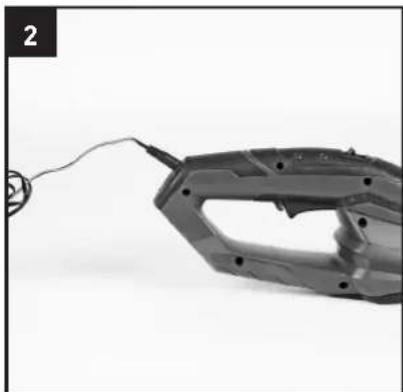
Connect the charger to the charging station (Figure 2).
-
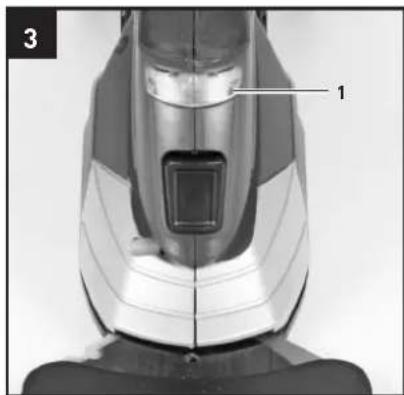
Check that your mains voltage is the same as that marked on the rating plate of the battery charger. Plug the battery charger in a socket-outlet. The red LED (Figure 3 / Item 1) comes on to indicate that charging voltage is available.
-
The battery pack is being charged. An empty battery pack requires a maximum charging period of 2 hours. The temperature of the battery pack may rise slightly during the charging operation. This is normal.
-
As soon as battery pack is fully charged, the red LED (Fig. 3/Item 1) extinguishes
If the rechargeable battery fails to charge, check whether there is voltage at the socket outlet.
If you still fail to charge the battery, please return the complete equipment together with the charger to the Jumbo sales point of your choice.
Timely recharging of the battery pack will help it serve you well for a long time. Recharging is always necessary when you notice a drop in the tool's performance.
Never allow the battery pack to become fully discharged. This will cause it to develop a defect.
Warning!
It is prohibited to remove or bridge any of the switching elements installed on the tool by the manufacturer (e.g. by securing a button to the handle) as this would prevent the tool from switching off automatically and result in high risk of injury. Under no circumstances are you to use the shrub cutter with the telescopic long handle fitted.

7.OPERATION
The area to be cut must first be cleared of stones and other solid objects. The safety lock-off (Fig. 1/Item 3) prevents the tool being started unintentionally. Activate the safety lock-off (Figure 1 / Item 3) by pushing it forward and pressing the ON/OFF switch (Figure 1 Item 4) at the same time. To switch off the tool, let go of the ON/OFF switch (Figure 1 / Item 4).
7.1 Cutting grass
Allow the grass cutter to glide above the ground. The best results are achieved when the lawn is dry. When you notice a drop in cutting performance, re-charge the tool immediately so that the battery does not become fully discharged.
7.2 Trimming hedges
The tool can be used to trim small hedges and shrubs.
Hold the tool slightly tilted in relation to the hedge you want to cut.
First cut the sides from the bottom up, then cut the top.
Watch out for foreign objects in or on the hedge which could damage the blades.
When is the best time to trim hedges?
- As a general rule, hedges which lose their leaves in the autumn should be trimmed in June and October.
Hedges which do not lose their leaves should be cut in April and August.
7.3 Changing the blades
Warning! Risk of injury!
To remove the blade, press the release mechanism (Fig. 1/Item 12) and take out the blade as shown in Fig. 4/Item 12.
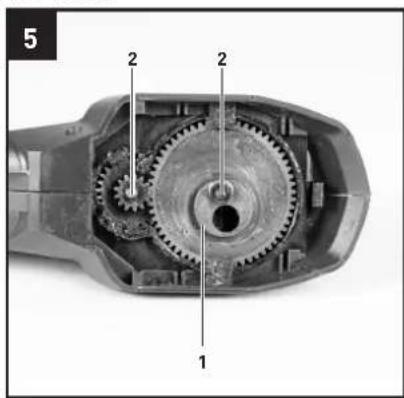
Once you have removed the blade you will be able to see the toothed wheels of the gear unit (Fig. 5). Make sure that no dirt gets into the gear unit when you change the blade. To assemble, proceed in the reverse order.
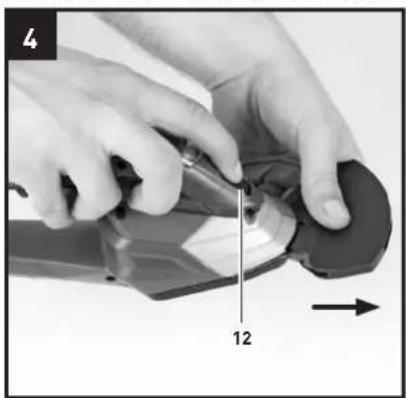
Caution! The blade will fall out when the release mechanism is pressed (Fig. 1/Item 12)!

When you fit the hedge cutter blade
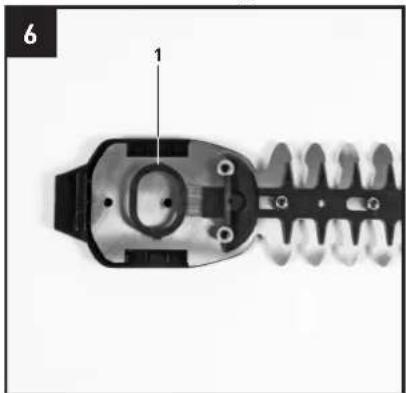
check the position of the pin for the eccentric connector (Fig. 5/Item 1). Take the hedge cutter blade and slide the eccentric mount (Fig. 6/Item 1) into position so that the pin for the eccentric connector and the eccentric mount fit together precisely when assembled. Slot the hedge cutter blade onto the guide pins (Fig. 5/Item 2).
When you fit the grass cutter blade
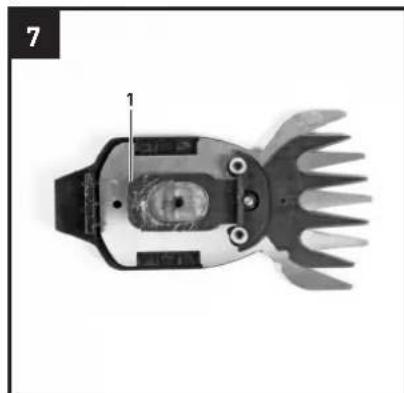
check the position of the pin for the eccentric connector (Fig. 5/Item 1) again. Shift the eccentric mount (Fig. 7/Item 1) on the grass cutter blade to the left or the right to find the position at which the pin for the eccentric connector (Fig. 5/Item 1) and the eccentric mount (Fig. 7/Item 1) match up.
8. CLEANING, MAINTENANCE AND ORDERING OF SPARE PARTS
8.1 Cleaning
- Keep all safety devices, air vents and the motor housing free of dirt and dust as far as possible. Wipe the equipment with a clean cloth or blow it with compressed air at low pressure.
We recommend that you clean the device immediately each time you have finished using it. - Clean the equipment regularly with a moist cloth and some soft soap. Do not use cleaning agents or solvents; these could attack the plastic parts of the equipment. Ensure that no water can seep into the device.
-
A few drops of oil (e.g. sewing machine oil) will improve the cutting performance of the blades, but never apply any grease to the blades.
-
To ensure constant exact cutting it is also important to remove grass remnants and dirt from between the upper and lower blade.
Caution!
Never clean the tool under running water - and particularly never with high pressure - because of the potential danger to persons and property. Keep your cordless grass cutter and hedge trimmer in a dry and frost-proof place. Choose a place that children are unable to enter.
8.2 Maintenance
-
To achieve good results you should keep the blades sharp at all times. In particular we recommend that you immediately level off any jags or ridges caused by stones or the like. The tool should be thoroughly cleaned both before and after use.
-
There are no parts inside the equipment which require additional maintenance.
9. DISPOSAL AND RECYCLING
The unit is supplied in packaging to prevent its being damaged in transit. This packaging is raw material and can therefore be reused or can be returned to the raw material system.
The unit and its accessories are made of various types of material, such as metal and plastic. Defective components must be disposed of as special waste. Ask your dealer or your local council.
The reprinting or reproduction by any other means, in whole or in part, of documentation and papers accompanying products is permitted only with the express consent of the iSC GmbH.
Subject to technical changes

WARRANTY CERTIFICATE
You have made an excellent choice with the purchase of this quality product. Our commitment to quality also includes our service.
Jumbo offers an excellent repair service, exclusively in Switzerland, for all ayce products.

Should you, contrary to expectations, experience defects due to material or manufacturing faults during private use within FIVE YEARS of the date of purchase we shall be liable for warranty in accordance with statutory warranty regulations, provided that:
- The device was not put to any use other than the intended.
- Was not overloaded.
- Was not used with the wrong accessories.
- Repairs where not carried out by any other than the authorized workshop.
The warranty certificate is only valid in connection with the receipt. Please keep both in a safe place. The warranty does not affect your statutory rights. The product is guaranteed for a period of FIVE YEARS beginning on the day of purchase. Keep your purchase receipt safe as proof of the date of purchase. The guarantee period can only be extended for the duration of any repair required. During the warranty period, defective devices can be returned at every Jumbo store. We will, at our discretion either repair or exchange the device in accordance with warranty legislation.
Please include the following when returning your product for repair:
- The receipt (proof of purchase)
- This warranty certificate with your name, address, contact details and a fault description completed overleaf.
If the original receipt is not enclosed the repair will be charged for in all cases. After the warranty has expired you can still return defective devices for repairs. Quotes as well as repairs after warranty period are to be paid for in all cases. This warranty does not affect your statutory rights.
Additional note service center:
Defect products can be returned to every Jumbo store during the warranty period. After the warranty period, the ayce products are accepted in any Jumbo store, so the product may be tested in accordance.
CH-Import & Distributed exclusively by:
Jumbo-Markt AG, 8305 Dietlikon www.jumbo.ch Tel. 044 805 61-11
WARRANTY CARD
| First name Last name | ||
| Street/No. Telephone | ||
| Postal Code | City Mobil | |
| Item-number Barcode (EAN) | ||
| Warranty (please mark with a cross!) Sales receipt | ipt number/Date (Please also attach a copy of the sales receipt!) | |
| Yes No | ||
| Purchased at Jumbo store | ||
Which error occurred (please specify)
(Pleases describe the problem or malfunction of your device as accurately as possible. This allows us to process your complaint more quickly and efficiently. An imprecise description with terms like "device is not working" or "broken device" can delay the process considerably.)


C
EC CONFORMITY DECLARATION/KONFORMITÄTSERKLÄRUNG DECLARATION DE CONFORMITE/DICIHIARAZIONE DI CONFOMITA
The undersigned hereby certifies that the units described below: Der Unterzeichner bestägt, dass die nachfolgenden beziehchenen Geräte: Nous, sousigné, en notre quaste d'importateur, déclarons que le produit Il sottoscritto certifiche che i dispositi viscriti di seguito :
And to the following standards:
CH-8305 Dietlikon, Switzerland
m = 311
m = 311 ;
G
MADE IN CHINA
Manufacturing Year 2016
86187

WWW.AYCE.CH