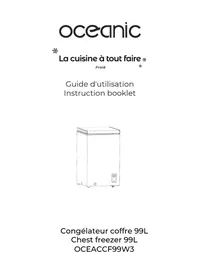
OCEACCF99W3 - Freezer CONTINENTAL EDISON - Free user manual and instructions
Find the device manual for free OCEACCF99W3 CONTINENTAL EDISON in PDF.


| Product Type | 99 L Chest Freezer |
| Brand | Continental Edison (model OCEACCF99W3) |
| Dimensions (W×D×H) | 54.5 × 47.8 × 83.5 cm |
| Net Weight | 20 kg |
| Power Supply | 220-240 V ~ 50 Hz |
| Climate Class | SN, N, ST, T (from 10 °C to 43 °C) |
| Freezing Capacity | Approx. 12 kg/24 h (check rating plate) |
| Thermostat Setting | 7 positions: 1 (refrigerator ~5 °C), 2-4 (-12 to -18 °C), 4-6 (-18 to -24 °C), 7 (< -24 °C) |
| Conversion Mode | Can operate as refrigerator (position 1) |
| Defrosting | Manual, recommended when frost > 5 mm; use a plastic scraper and a drip tray |
| Defrost Water Drainage | Water conduit on the lower face, rotate 180° |
| Supplied Accessories | Basket, defrost scraper, ice cube tray (built-in) |
| Refrigerant | R600a (isobutane) – flammable, low pollution |
| Energy Consumption | Energy class F (according to EU energy label) |
| Noise Level | Approx. 40 dB (estimate for this type of appliance) |
| Installation | Freestanding; min. 20 cm sides, 70 cm above |
| Cleaning | Soft cloth, warm water and mild detergent; avoid abrasives |
| Food Storage Duration | 1 to 12 months depending on food type |
| Availability of Spare Parts | Thermostat, sensors, board, handle, hinge, gasket (7 to 10 years) |
| Warranty | 24 months from date of purchase |
| After-Sales Service | Schneider Consumer Services (p.blanc@schneiderconsumer.com) |
Frequently Asked Questions - OCEACCF99W3 CONTINENTAL EDISON
User questions about OCEACCF99W3 CONTINENTAL EDISON
0 question about this device. Answer the ones you know or ask your own.
Ask a new question about this device
Download the instructions for your Freezer in PDF format for free! Find your manual OCEACCF99W3 - CONTINENTAL EDISON and take your electronic device back in hand. On this page are published all the documents necessary for the use of your device. OCEACCF99W3 by CONTINENTAL EDISON.
USER MANUAL OCEACCF99W3 CONTINENTAL EDISON
natural_image
Line drawing of a simple rectangular appliance with lid and side buttons (no text or symbols)- EN (translated from the original)
URL: https://eprel.ec.europa.eu/qr/1785328
III. AVANT LA PREMIERE UTILISATION
flowchart
graph LR
    A["Step ①: Tool with rotational arrow"] --> B["Step ②: Rotation of mechanical part"]
    B --> C["Step ③: Rotation of mechanical part"]
    C --> D["Step ④: Final assembly with rotation arrow"]
natural_image
Symbol of a trash bin crossed with a diagonal line and a horizontal bar below (no text or labels)IMPORTANT WARNINGS AND SAFETY ADVICE
We encourage you to read this user guide carefully and completely before installing and using your device.
It is important that this user guide is kept with the device for any new consultation. If this unit is to be transferred to another person, make sure that the user guide follows the unit so that the new user can be informed of the operation of the unit.
In this user guide, the following symbols are used:
 | Important information about your personal safety and how to avoid damage to the device |
 | General information and advice |
 | Environmental information |
 | Fire hazard |
 | Risk of electric shock |
Read this guide carefully before using the device to know exactly what to do and what not to do. Improper use of the device can be dangerous, especially for children.
- This device is intended for use in domestic applications.
- This device may be used by children 8 years of age or older and by persons with reduced physical, sensory or mental capacity or lack of experience or knowledge, if they are properly supervised if instructions for the safe use of the apparatus have been given to them and the risks involved have been apprehended. Children should not play with the device. Cleaning and user maintenance should not be performed by unattended children.
- Children should be supervised to ensure that they do not play with the appliance.
- WARNING: Keep the ventilation openings free in the enclosure of the appliance or in the installation structure. CAUTION: Do not use mechanical devices or other means to speed up the defrosting process other than those recommended by the manufacturer. CAUTION: Do not damage the refrigeration circuit.
-
WARNING: Do not use electrical appliances inside the food storage compartment unless they are of the type recommended by the manufacturer.
-
If the power cable is damaged, it must be replaced by the manufacturer, its after-sales service or similarly qualified persons in order to avoid a hazard.
-
Do not store explosive substances such as aerosols containing flammable propellants in this device.
-
Never allow children to operate or play with the appliance.
- Never clean parts of the device with flammable fluids. Fumes pose a fire hazard or may cause explosions.
- Do not store or use gasoline or other flammable gases or liquids in or near this appliance. Fumes can cause a fire or explosion.
-
Do not install this unit in a location with extreme weather conditions such as: insufficient ventilation, temperatures below 10 °C or above 38 °C.
-
This product complies with current European safety standards for electrical appliances. It has been subjected to extensive testing and meticulous testing to assess its safety and reliability.
-
Before connecting the device, check that the data on the type plate corresponds to that of your installation. The packaging materials are
recyclable, do not abandon them in the environment, bring them to a specialized center for recycling.
-
The electrical safety of this appliance is only ensured when it is connected to an electrical installation equipped with a grounding plug in good condition, according to the current standard. If in doubt, have a qualified technician inspect the system thoroughly.
-
The use of this device, like that of any electrical device, involves observing certain basic rules:
- Do not touch the device with wet or damp hands or feet;
- Do not pull on the power cable to disconnect the plug from the socket;
- Do not leave the unit exposed to atmospheric agents;
- Do not allow the device to be used by children without supervision;
- Do not unplug or plug the plug into the wall outlet with wet hands; before carrying out any cleaning or maintenance operation, disconnect the appliance from the power supply by disconnecting the plug or switching off the main switch of the installation; The outlet must remain accessible after installation of the appliance.
- In case of breakdown or malfunction, switch off the device and do not damage it.
12The power plug must always remain accessible after installation of the device.
-
This refrigerating appliance is not intended to be used as a built-in appliance.
-
Recommended storage times of frozen food in the freezer compartment.
These times vary depending on the type of food. The food that you freeze can be preserved from 1 months (minimum at -18°C).
| Food | Storage time |
| Bacon, casseroles, milk | 1 month |
| Bread, ice cream, sausages, pies, prepared shellfish, oily fish | 2 months |
| Non-oily fish, shellfish, pizza, scones and muffins | 3 months |
| Ham, cakes, biscuits, beef and lamb chops, poultry pieces | 4 months |
| Butter, vegetables (blanched), eggs whole and yolks, cooked crayfish, minced meat (raw), pork (raw) | 6 months |
| Fruit (dry or in syrup), egg whites, beef (raw), whole chicken, lamb (raw), fruit cakes | 12 months |
Never forget:
- When you freeze fresh foods with a ‘use by /best before/best by/’ date, you must freeze them before this date expires.
- Check that the food was not already frozen. Indeed, frozen food that has thawed completely must not be refrozen.
- Once defrosted, food should be consumed quickly.
WARNING: When positioning
the appliance, ensure the supply cord is not
trapped or damaged.
WARNING: Do not locate
multiple portable socket-outlets or portable power supplies at the rear of the appliance.
Refrigerant
Danger: risk of fire / flammable materials
Danger; risk of fire / flammable material
The refrigerant gas contained in the circuit of this unit is isobutane (R600a), a low-pollution but flammable gas. When transporting and installing the unit, take care not to damage any part of the refrigerant circuit.
Do not use sharp or sharp tools to defrost the unit.
Do not use any electrical devices inside the device. If the refrigeration system is damaged:
- Turn off the refrigerator.
- Do not use a flame near the unit.
- Avoid sparks - do not light electrical appliances or electric lamps.
- Ventilate the room immediately.
For installation, handling, cleaning and disposal of the device, refer to the following chapters of the user's guide.

Suitable for food contact

Information on the meaning of the conformity marking
The marking CE indicates that the product meets the main requirements of the European Directives: 2014/35/EU (Low Voltage), 2014/30/EU (Electromagnetic Compatibility), 2011/65/EU (Restriction of use of certain substances in equipment electronic)
SUMMARY
Important warnings and safety advice -1-
I. Description of the device -9-
II. Technical characteristics -10-
III. Before first use -11-
a. Transport and start-up -11-
b. Unpacking the device and disposing of -11-
the packaging elements
c. Cleaning the appliance -11-
IV. Installation -12-
V. Instructions to use -14-
VI. Cleaning and maintenance -17-
VII. Troubleshooting -19-
VIII.Disposal -20-
IX. Guarantee -21-
This user guide is available in the following languages:
- FR (original version)
- EN (translated from the original)
Any other translation would be a translation of the original version.
This user guide, any modifications or any new version, is available on our www.oceanic.eu
I. DESCRIPTION OF THE DEVICE
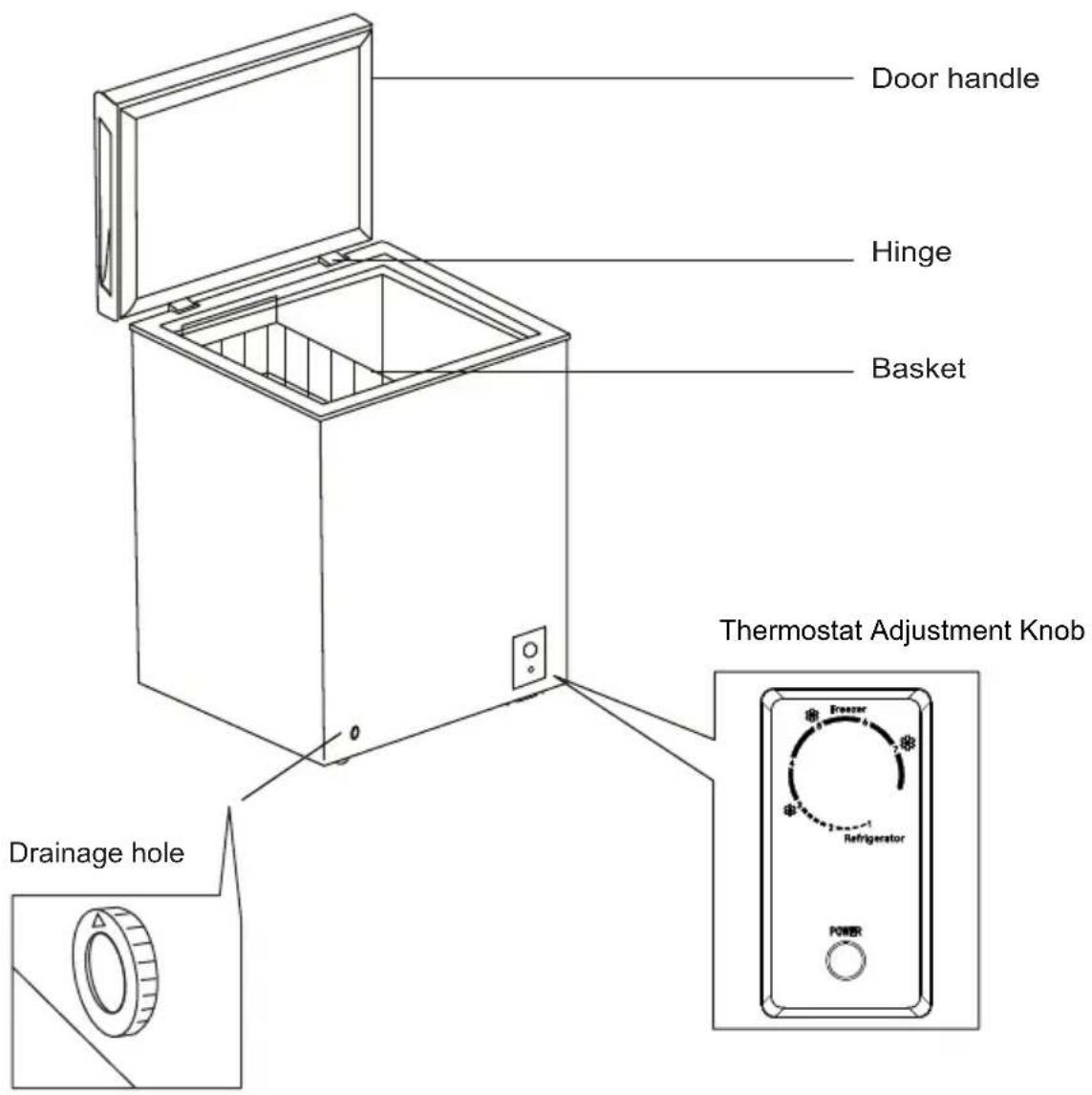
(The image above is provided for reference only. The actual configuration will depend on the physical product or the distributor's declaration.)
II. TECHNICAL CHARACTERISTICS
TECHNICAL DATA:
| Mark | OCEANIC |
| Reference | OCEACCF99W3 |
| Power supply | 220-240V~ |
| Electric power 50Hz | |
| Product Dimensions WxDxH 54.5 x | 47.8 x 83.5cm |
| Net weight | 20kg |
| Type of installation | Freestanding |
TECHNICAL SHEET RELATING TO THE REGULATION ON ENERGY LABELING: 2019/2016/EU
Product Information sheet according to EU Regulation No. 2019/2016 Energy labelling for Refrigerating appliance can be found be below URL or QR code indicated on Energy label
URL: https://eprel.ec.europa.eu/qr/1785328
When transporting this unit, take it by the base and gently tilt it up to 45^ . Do not lift the appliance by the door handle. Do not put the unit in a fully horizontal position or upside down. Push the refrigerator on the wheeled legs to move it.
Attention: After transporting the refrigerator, you must wait at least 8 hours before putting it into service.
b. UNPACKING THE APPLIANCE AND DISPOSING OF THE EMBALLAGIC ELEMENTS
- Remove all packing material around the appliance and the protective elements inside the appliance compartments.
- Carton board and sheets of paper are recyclable. They must be thrown in the collection bins provided for this purpose.
- Other packaging elements (adhesive, fasteners, etc.) must be disposed of with household waste.
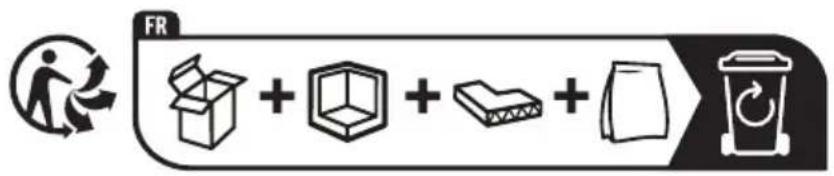
To know more: www.quefairedemesdechets.fr
c. CLEANING THE APPLIANCE:
Clean all parts of the refrigerator with water and a mild detergent solution. Rinse it thoroughly and dry it with a soft cloth.
Note: The electrical parts of the device can be cleaned only with a dry cloth.
IV. INSTALLATION
BEFORE OPERATION
Before using your new device, please read the following instructions carefully: they contain important information regarding safety, installation, operation and maintenance.
Keep this manual in a safe place; you may need it later.
Upon receipt, check that the device is not damaged. Damage due to transport must be notified to your supplier before using your freezer.
Remove the packaging. Clean the inside of the device with lukewarm water and a non-aggressive, fragrance-free product. Rinse with clean water and dry (see cleaning chapter). Use a soft cloth.
If the freezer has been stored in a cold environment (below +5°C), it will need an adaptation period of at least 1 hour before switching it on.
If the freezer has been transported on its side, leave it upright for 12 hours before switching it on.
Setting up
IMPORTANT: The installation of this unit requires the intervention of several people.
For reasons of safety and operation, the device must not be placed outdoors.
Place the device horizontally on a flat and stable floor, in a dry and well-ventilated room (max. 75% relative humidity).
Never place the appliance near heat sources such as stoves or radiators, and avoid placing it in direct sunlight or near any other heat sources.
AMBIENT TEMPERATURE
The climate class is indicated on the nameplate. It indicates in which ambient temperature range the freezer operates optimally. If the ambient temperature is below freezing, the freezer will not operate properly.
| Climatic class Permissible ambient temperature | |
| SN +10 °C to +32 °C | |
| N +16 °C to +32 °C | |
| ST +16 °C to +38 °C | |
| T +16 °C to +43 °C |
For refrigerating appliances with climate class:
—extended temperate (SN): ‘this refrigerating appliance is intended to be used at ambient temperatures ranging from 10 °C to 32 °C’;
—temperate (N): ‘this refrigerating appliance is intended to be used at ambient temperatures ranging from 16 °C to 32 °C’;
—subtropical (ST): ‘this refrigerating appliance is intended to be used at ambient temperatures ranging from 16 °C to 38 °C’;
—tropical (T): ‘this refrigerating appliance is intended to be used at ambient temperatures ranging from 16 °C to 43 °C’;
VENTILATION
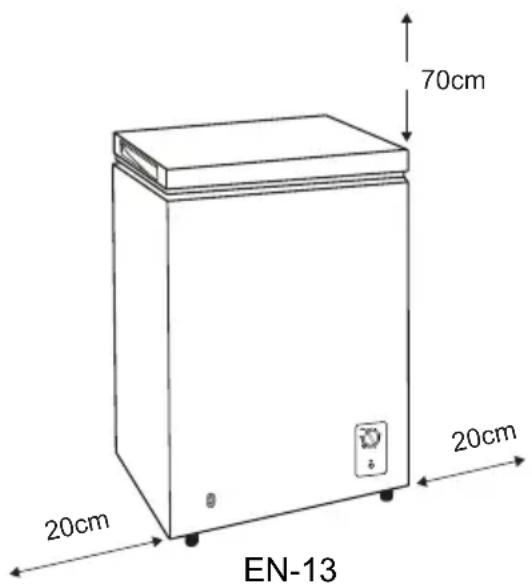
To allow adequate ventilation, a minimum spacing of 20 cm on each side and 70 cm below the device must be guaranteed.
V. INSTRUCTIONS TO USE
Temperature control
Note:
Long use may cause some degree of hinge wear, which will produce noise when opening / closing the hinge.
The door and will shorten the life of the hinge. It is recommended to apply grease to the hinge for maintenance. can effectively eliminate noise and extend the service life of the hinge.
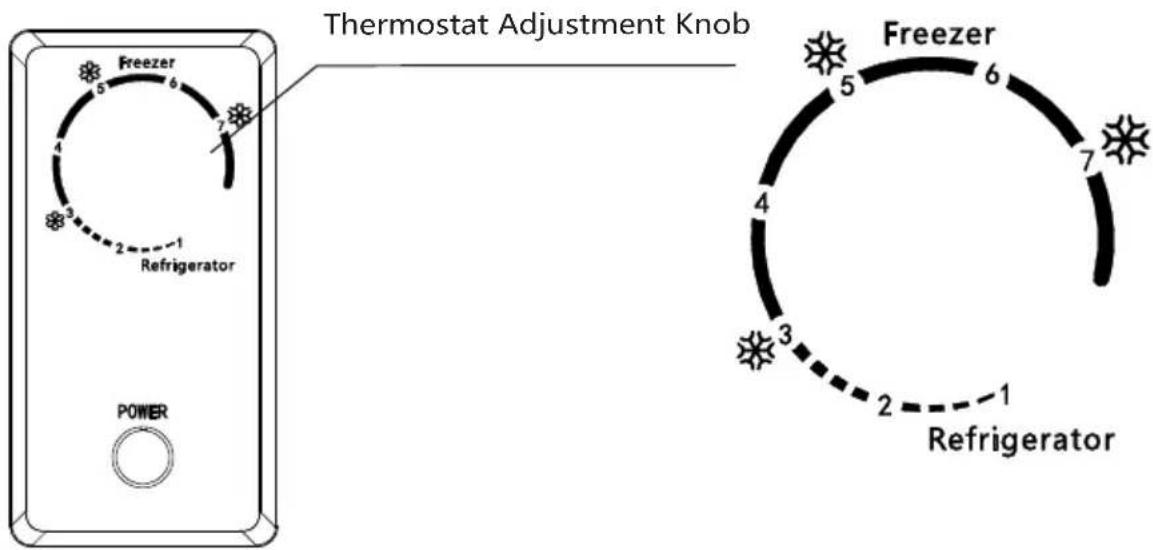
The inside temperature of freezer is regulated by thermostat adjustment knob.
The "1,2,3,4,5,6,7" marks on the button do not represent temperature values. The smaller the number, the higher the temperature as explained below:
1: Refrigerator mode: maintains the temperature at 5^ C
2 - 4: Freezer mode: maintains the temperature between -12^ C and -18^ C
4 - 6: Freezer mode: maintains the temperature between -18^ C and -24^ C
7: Freezer mode: maintains a temperature below -24^ C
There is a deviation of ±3^ for each temperature mode in different usage environments due to the mechanical control mode. Please make fine adjustment according to the actual use condition.
Deep freeze (below -24°C) : When you set the button to the freezing range, the compressor works continuously, the food can be quickly frozen.
Caution: Do not keep the knob at the Deep-freezing position after deep freezing.
Refrigeration mode conversion:
When switching from refrigerator mode to freezer mode, be sure to remove fresh food in time to avoid freezing damage. When switching from freezer mode or soft freeze mode to refrigerator mode, follow these steps: set the thermostat knob to the refrigerator range, remove all frozen foods, leave the cabinet empty for about 1 hour, then place it in foods for fresh storage.

Due to individual factors of the refrigerator, the actual temperature in the box may have a certain error from the set temperature, which is a normal phenomenon and does not affect the normal use of the product.
USAGE TIPS
Freezer
In order to preserve all their qualities, foodstuffs must be frozen at -18^ C as quickly as possible.
The freezing capacity of the appliance is indicated on the nameplate in kg/24 hours.
Use only good quality food products. Meat, poultry, fish, vegetables, fruit, dairy products and ready meals are ideal for freezing. Foods with a high concentration of water, such as salads, radishes, grapefruit, apples, cucumbers and pears, are not suitable for freezing.
Package products in airtight containers or freezer bags. Adapt the portion size to their use. Do not freeze a portion of vegetables or meat weighing more than 2.5 kg. Avoid making freezer bags and bags damp to prevent them from “sticking” together. Place the products so that they are in as little contact with each other as possible, in order to speed up their freezing. Evacuate the air contained in the packaging to prevent the surface of the products from drying out.
Do not forget to note the contents, quantity and date on each packaging. It is advisable to divide the different products into categories. That is to say, it is better to group vegetables with vegetables, meat with meat, etc.
For jar containers, leave at least 5 mm of space under the lid.
Defrosting
Frozen vegetables should not be thawed before use, but immersed directly in boiling water.
As for meat, it is preferable to take it out of the freezer the day before using it and place it in the refrigerator to defrost: this gives optimal hygiene and perfect preservation of the quality of the meat.
Noticed
Aerosols and cans containing a liquid in which carbon dioxide is dissolved must not be frozen due to the risk of explosion.
Using the ice cube tray:
Place the ice cube tray in the upper compartment of the freezer, provided for this purpose.
Tips for reducing energy consumption to a minimum
- Low ambient temperature results in lower energy consumption.
- Low temperature in the device results in higher energy consumption.
• Recommended temperature -18°C - Defrost the appliance when the formation of frost is greater than 5 mm.
- Do not open the lid more often than necessary.
- Regularly check the tightness of the cover and the gasket.
- Allow hot drinks and foods to cool to room temperature before placing them in the freezer.
- Thaw frozen products at room temperature or in your refrigerator.
- Place frozen foods in another freezer while the freezer is defrosting.
VI. CLEANING AND MAINTENANCE
ICING
The humidity brought by the products and by the ambient air leads over time to the formation of frost and ice in the appliance. A thin layer of frost or ice has no influence on the operation of the freezer, but the thicker the layer becomes, the higher the energy consumption. A thin layer of ice can be removed with a freezer ice scraper.
Never use an electrical device or pointed object that could damage the inside of the device.
When the frost or ice layer reaches a thickness of 4 to 5 mm, the freezer must be defrosted. Defrosting is recommended when the freezer is near or completely empty.
Proceed as follows:
- Unplug the unit.
- Take out the frozen products. Keep them in a cool or well-wrapped place to minimize defrosting as much as possible.
- Leave the lid open.
- Place a container of hot (non-boiling) water in the freezer, close the lid and wait about 30 minutes, then remove the frost with a plastic scraper. Never use hair dryers, electric heaters or other similar electrical appliances for defrosting.
- Drain all defrost water either with a cloth or a water collection tray through the defrost hole (see instructions below). Clean and dry it with a soft cloth.
- Wait about five minutes after turning the machine back on before putting frozen products back in.
Defrosting should be done twice a year or when a layer of frost of about 7 mm (1/4") has formed.
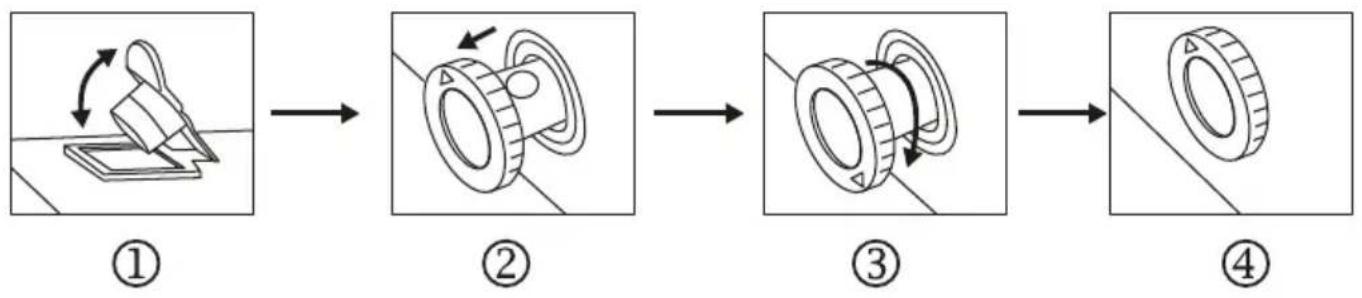
Defrost water drain:
flowchart
graph LR
    A["Step ①: Rotation of mechanical part"] --> B["Step ②: Rotation of bearing"]
    B --> C["Step ③: Rotation of bearing"]
    C --> D["Step ④: Rotation of bearing"]
- The defrost water drain outlet is placed on the underside of the freezer. Place a sufficiently large water container near the drain outlet.
- Extract the water conduit by 20-25mm until the water hole can be seen.
- Rotate 180°. Defrost water flows from the drain pipe.
- After defrosting is done, make sure there is no more water coming out before put the water conduit in place and make the arrow point upward.
CLEANING
Before cleaning, unplug the appliance and remove any loose items.
Preferably use a soft cloth dampened with lukewarm water and a mild detergent. Never use abrasive cleaning products. Wipe with a soft cloth dampened with water. Avoid getting water into the control panel.
The lid gasket requires regular cleaning to prevent discoloration and to ensure its longevity. Use clear water. After cleaning the cover seal, check that it still fulfills its role.
The ventilation grid must be clean. Clean it with a vacuum cleaner.
In case of prolonged absence, unplug, empty and clean the appliance and leave the lid open to prevent the creation of unpleasant odors.
VII. TROUBLESHOOTING
| Failure | Possible cause | Solution |
| No control lamp is on. | The device is off.Power outage; fuse blown or circuit breaker tripped; taken poorly. | Check the plug and socket.Check the power supply.Check the fuse or circuit breaker. |
| The temperature in the freezer is too high. | The ventilation grille is blocked. The lid of the device is not properly closed.Too much frozen food was placed in the freezer at the same time.Too much frost and ice.The thermostat is set to too hot. | Ensure the free flow of air.Close the lid and wait a few hours.Wait a few hours.Defrost the appliance.Set the thermostat to a lower temperature. |
| The temperature in the freezer is too low. | The thermostat is set to a temperature that is too cold.The lid touches food in the freezer. | Set the thermostat to a higher temperature.Move the food and make sure the lid closes securely. |
| The device produces a lot of frost | The local is very humid.Foods give off moisture. | Ventilate frequently or carry the freezer in a less humid room.Review the food packaging. |
| The lid does not open. | Underpressure in the device. | Wait 2 or 3 minutes until the underpressure has disappeared and try again. |
| Vibrations and unusual noises. | The device is not placed on a flat surface.The device lacks space.The baskets or partition are not fixed. | Place the freezer on a level, stable and horizontal floor.Remove the freezer from furniture and appliances that interfere with it. Check the stability of loose objects. |
VIII. DISPOSAL
natural_image
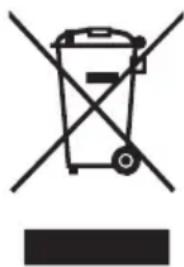
Symbol of a trash bin crossed with no text or numbers, representing waste sorting or disposal (no text present)This logo affixed to the product means that it is a device whose treatment as a waste falls within the framework of the directive 2012/19 / EU of July 4, 2012, relative to the waste of electrical and electronic equipment (WEEE). This means that this product must be supported by a selective collection system in accordance with the European directive mentioned above in order to be either recycled or dismantled in order to reduce any impact on the environment.
Hazardous substances in electrical and electronic equipment can have potentially harmful effects on the environment and human health.
Thus, at the end of the life of this appliance, it must not be disposed of with unsorted municipal waste. Recovery and collection systems are made available to you by local authorities (waste disposal centers) and distributors.
This device must not be thrown on public roads. You have the obligation to use the selective collection systems available to you.
IX. GUARANTEE
Your refrigeration appliance is guaranteed by the manufacturer for a period of 24 months from the date of purchase (proof of purchase dated as proof).
WARRANTY EXCLUSIONS:
The warranty does not cover wear parts of the product, nor problems or damage resulting from:
(1) surface deterioration due to normal wear and tear of the product;
(2) defects or deterioration due to contact of the product with food or liquids and due to corrosion caused by rust;
(3) any unauthorized incident, abuse, misuse, modification, disassembly or repair;
(4) any improper maintenance operation, use not in accordance with the instructions concerning the product or connection to an incorrect voltage;
(5) any use of accessories not supplied or approved by the manufacturer.
Information: The guarantee cannot be applied in the absence of the nameplate and / or the serial number of the device.
REPAIR SERVICES
In the event of a malfunction during the period of the manufacturer's warranty: any request for support must be made to the professional reseller from whom you purchased your product.
After the expiration of the manufacturer's warranty period: consult the document "Spare parts and repair" in the documentation relating to your refrigeration appliance available on the site www.oceanic.eu
SPARE PARTS
The spare parts needed to repair your refrigeration appliance are available for at least 7 years, in accordance with the European regulation on the ecodesign of refrigeration appliances.
Consult the document "Spare parts and repairs" in the documentation relating to your refrigeration appliance available on the site www.oceanic.eu, it will provide you with information on:
- the duration of availability for each spare part
- how to order spare parts
- professional repair services
SPARE PARTS AND REPAIR – Freezer appliance
Date : 19/10/2023
| Reference number OCEACCF99W3 | |||
| Model number BD-100 | |||
| Type of refrigeration appliance | Chest freezer 99L | ||
| Nature of the spare part | Availability period^(1) | Availability for professional repairers | Availability to end users |
| Thermostat(s) 7 years | √ | ||
| Temperature sensor(s) 7 years | √ | ||
| Printed circuit board(s) 7 years | √ | ||
| Light source(s) 7 years | √ | ||
| Door handle(s) 7 years | √ | √ | |
| Door hinge(s) 7 years | √ | √ | |
| Tray(s) 7 years | √ | √ | |
| Bin(s) 7 years | √ | √ | |
| Door seal(s) 10 years | √ | √ | |
(1) from the date on which the last unit of the model was placed on the market.
PROCEDURE FOR ORDERING SPARE PARTS - Professional repairers :
Schneider Consumer Services, email : p.blanc@schneiderconsumer.com
Delivery time: 15 working days from receipt of order.
PROCEDURE FOR ORDERING SPARE PARTS - End user :
→ Schneider Consumer Services, email : p.blanc@schneiderconsumer.com
Delivery time: 15 working days from receipt of order.
Professional repair services:
In the event of a malfunction during the manufacturer's warranty period: all claims should be made to the professional dealer from whom you purchased your product.
After the expiry of the manufacturer's warranty period, you can use the following repair services:
Schneider Consumer Services,

- AVANT LA PREMIERE UTILISATION
- IMPORTANT WARNINGS AND SAFETY ADVICE
- We encourage you to read this user guide carefully and completely before installing and using your device.
- Never forget:
- WARNING: When positioning
- WARNING: Do not locate
- Refrigerant
- Danger; risk of fire / flammable material
- Suitable for food contact
- Information on the meaning of the conformity marking
- SUMMARY
- DESCRIPTION OF THE DEVICE
- TECHNICAL CHARACTERISTICS
- TECHNICAL SHEET RELATING TO THE REGULATION ON ENERGY LABELING: 2019/2016/EU
- b. UNPACKING THE APPLIANCE AND DISPOSING OF THE EMBALLAGIC ELEMENTS
- c. CLEANING THE APPLIANCE:
- INSTALLATION
- BEFORE OPERATION
- Setting up
- AMBIENT TEMPERATURE
- VENTILATION
- INSTRUCTIONS TO USE
- Temperature control
- Note:
- Refrigeration mode conversion:
- USAGE TIPS
- Freezer
- Defrosting
- Noticed
- Using the ice cube tray:
- Tips for reducing energy consumption to a minimum
- CLEANING AND MAINTENANCE
- ICING
- Defrost water drain:
- CLEANING
- DISPOSAL
- GUARANTEE
- WARRANTY EXCLUSIONS:
- REPAIR SERVICES
- SPARE PARTS
- SPARE PARTS AND REPAIR – Freezer appliance
- PROCEDURE FOR ORDERING SPARE PARTS - Professional repairers :
- PROCEDURE FOR ORDERING SPARE PARTS - End user :
- Professional repair services:
Brand : CONTINENTAL EDISON
Model : OCEACCF99W3
Category : Freezer