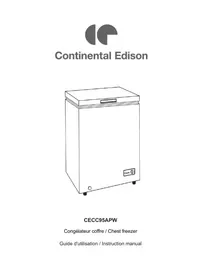
CECC95APW - Freezer CONTINENTAL EDISON - Free user manual and instructions
Find the device manual for free CECC95APW CONTINENTAL EDISON in PDF.


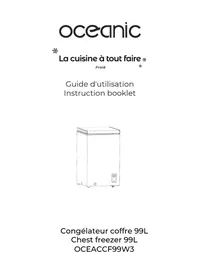
| Product type | Chest freezer |
| Brand | Continental Edison |
| Model | CECC95APW |
| Dimensions (W x D x H) | 574 x 845 x 564 mm |
| Net weight | 27 kg |
| Power supply | 220-240 V~, 50 Hz |
| Energy class | A+ |
| Annual consumption | 160 kWh/year |
| Useful capacity | 91 L |
| Freezing capacity | 4.5 kg/24h |
| Power failure autonomy | 27.5 h |
| Climate class | ST (16 °C to 38 °C) |
| Refrigerant gas | R600a (isobutane) 42 g |
| Noise level | 42 dB(A) |
| Installation type | Freestanding |
| Defrosting | Manual |
| Temperature setting | Thermostat 1 to 7 (1 warm, 7 cold) |
| Indicators | Lights: green (power), blue (compressor), red (alarm) |
| Super freeze function | Yes (via button) |
| Included accessories | Basket, defrosting tray |
Frequently Asked Questions - CECC95APW CONTINENTAL EDISON
User questions about CECC95APW CONTINENTAL EDISON
0 question about this device. Answer the ones you know or ask your own.
Ask a new question about this device
Download the instructions for your Freezer in PDF format for free! Find your manual CECC95APW - CONTINENTAL EDISON and take your electronic device back in hand. On this page are published all the documents necessary for the use of your device. CECC95APW by CONTINENTAL EDISON.
USER MANUAL CECC95APW CONTINENTAL EDISON
Attention: Risque incendie
- FR (version originale)
- EN (translated from the original)
IMPORTANT WARNINGS AND SAFETY ADVICE
We encourage you to read this user guide carefully and completely before installing and using your device.
It is important that this user guide is kept with the device for any new consultation. If this unit is to be transferred to another person, make sure that the user guide follows the unit so that the new user can be informed of the operation of the unit.
In this user guide, the following symbols are used:
| Important information about your personal safety and how to avoid damage to the device | |
| i | General information and advice |
| Environmental information | |
| Fire hazard | |
| Risk of electric shock | |
| Do not cover the device |
Read this guide carefully before using the device to know exactly what to do and what not to do. Improper use of the device can be dangerous, especially for children.
- This device is intended for use in domestic applications.
- This device may be used by children 8 years of age or older and by persons with reduced physical, sensory or mental capacity or lack of experience or knowledge, if they are properly supervised if instructions for the safe use of the apparatus have been given to them and the risks involved have been apprehended. Children should not play with the device. Cleaning and user maintenance should not be performed by unattended children.
- Children should be supervised to ensure that they do not play with the appliance.
- WARNING: Keep the ventilation openings free in the enclosure of the appliance or in the installation structure. CAUTION: Do not use mechanical devices or other means to speed up the defrosting process other than those recommended by the manufacturer. CAUTION: Do not damage the refrigeration circuit.
-
WARNING: Do not use electrical appliances inside the food storage compartment unless they are of the type recommended by the manufacturer.
-
If the power cable is damaged, it must be replaced by the manufacturer, its after-sales service or similarly qualified persons in order to avoid a hazard.
-
Do not store explosive substances such as aerosols containing flammable propellants in this device.
-
Never allow children to operate or play with the appliance.
- Never clean parts of the device with flammable fluids. Fumes pose a fire hazard or may cause explosions.
- Do not store or use gasoline or other flammable gases or liquids in or near this appliance. Fumes can cause a fire or explosion.
-
Do not install this unit in a location with extreme weather conditions such as: insufficient ventilation, temperatures below 16^ or above 38^ .
-
This product complies with current European safety standards for electrical appliances. It has been subjected to extensive testing and meticulous testing to assess its safety and reliability.
- Before connecting the device, check that the data on the type plate corresponds to that of your installation. The packaging materials are
recyclable, do not abandon them in the environment, bring them to a specialized center for recycling.
- The electrical safety of this appliance is only ensured when it is connected to an electrical installation equipped with a grounding plug in good condition, according to the current standard. If in doubt, have a qualified technician inspect the system thoroughly.
-
The use of this device, like that of any electrical device, involves observing certain basic rules:
-
Do not touch the device with wet or damp hands or feet;
- Do not pull on the power cable to disconnect the plug from the socket;
- Do not leave the unit exposed to atmospheric agents;
- Do not allow the device to be used by children without supervision;
-
Do not unplug or plug the plug into the wall outlet with wet hands; before carrying out any cleaning or maintenance operation, disconnect the appliance from the power supply by disconnecting the plug or switching off the main switch of the installation; The outlet must remain accessible after installation of the appliance.
-
In case of breakdown or malfunction, switch off the device and do not damage it.
-
The power plug must always remain accessible after installation of the device.
Refrigerant
ATTENTION: RISQUE D'INCENDIE
Caution: Fire risk
The refrigerant gas contained in the circuit of this unit is isobutane (R600a), a low-pollution but flammable gas. When transporting and installing the unit, take care not to damage any part of the refrigerant circuit.
Do not use sharp or sharp tools to defrost the unit. Do not use any electrical devices inside the device. If the refrigeration system is damaged:
- Turn off the refrigerator.
- Do not use a flame near the unit.
- Avoid sparks - do not light electrical appliances or electric lamps.
- Ventilate the room immediately.
For installation, handling, cleaning and disposal of the device, refer to the following chapters of the user's guide.

Suitable for food contact
Information on the meaning of the conformity marking

The marking CC indicates that the product meets the main requirements of the European Directives: 2014/35/EU (Low Voltage), 2014/30/EU (Electromagnetic Compatibility), 2011/65/EU (Restriction of use of certain substances in equipment electronic)
SUMMARY
Important warnings and safety advice -1-
I. Description of the device -8-
II. Technical characteristics -9-
III.Before first use -11-
a. Transport and start-up -11-
b. Unpacking the device and disposing of -11- the packaging elements
c. Cleaning the appliance -11-
IV. Installation -12-
V. Instructions to use -14-
VI. Maintenance and cleaning -16-
VII. Troubleshooting -18-
VIII.Disposal -19-
IX. Warranty -20-
This user guide is available in the following languages:
-
FR (original version)
-
EN (translated from the original)
Any other translation would be a translation of the original version.
This user guide, any modifications or any new version, is available on our website.
I. DESCRIPTION OF THE DEVICE
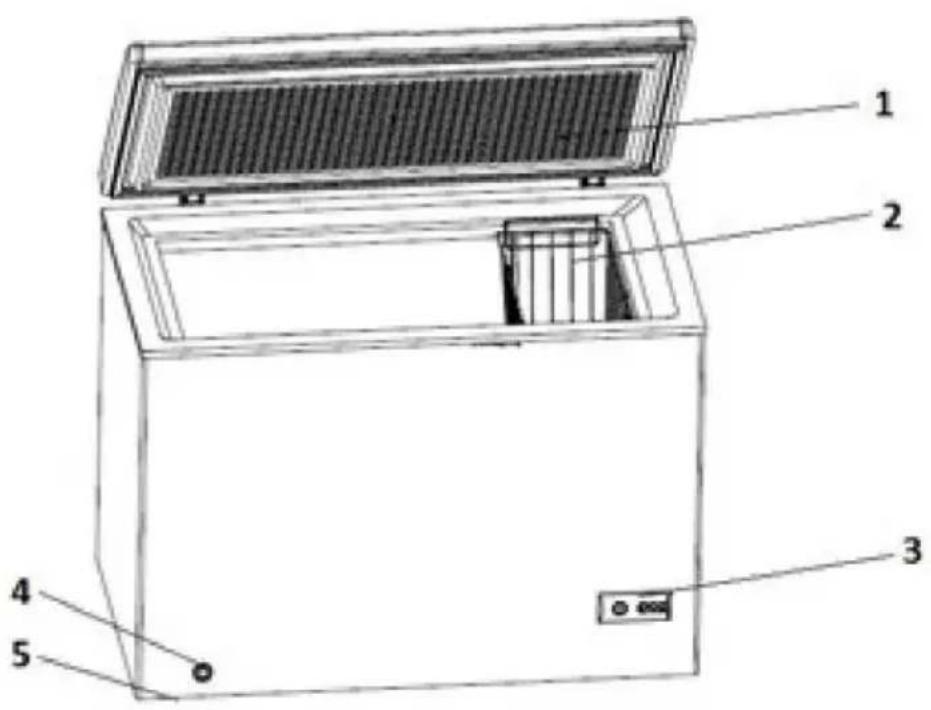
-
Door
-
Drain plug
2.Cart
-
Feet
-
Control Panel
II. TECHNICAL CHARACTERISTICS
TECHNICAL DATA:
| Mark Continental Edison | |
| Reference CECC95APW | |
| Power supply | 220-240V~ |
| Electric power 50Hz | |
| Dimensions WxDxH 574 x 845 x 564 mm | |
| Net weight 27 kg | |
| Type of installation | Freestanding |
TECHNICAL DATA SHEET RELATING TO ENERGY:
| Mark: Continental Edison | |
| Commercial reference: CECC95APW | |
| Model: | BD-95JA |
| Refrigerant category: | 9, Chest freezer |
| Energy efficiency class: | A+ |
| Energy consumption: | 160 kWh per year, calculated on the basis of the result obtained for 24 hours under standardized test conditions. The actual energy consumption depends on the conditions of use and the location of the device. |
| Useful volume of the refrigerator (l) | 91 |
| No Frost No | |
| Climatic class: | ST This device is intended for use at an ambient temperature of 10 °C to 38 °C. |
| Acoustic emissions in air (dB (A) re 1 pW): | 42 dB(A) |
| Type of installation: | Freestanding |
| Refrigerant gas: | R600a (42g) |
| Insulating: Cyclopentane | |
| Autonomy 27,5 hr | |
| Freezing power 4,5 kg/24h |
When transporting this unit, take it by the base and gently tilt it up to 45^ . Do not lift the appliance by the door handle. Do not put the unit in a fully horizontal position or upside down. Push the refrigerator on the wheeled legs to move it.
Attention: After transporting the refrigerator, you must wait at least 8 hours before putting it into service.
b. UNPACKING THE DEVICE AND DISPOSING OF THE PACKAGING ELEMENTS

-
Remove all packing material around the appliance as well as the protective elements inside the appliance compartments.
-
Carton board and sheets of paper are recyclable. They must be thrown in the collection bins provided for this purpose.
- The materials bearing the symbol are recyclable:
PE<= polyethylene; >PS<= polystyrene; >PP<= polypropylene This means that they can be recycled by depositing them in appropriate collection containers.
- Other packaging materials (adhesive, fasteners, etc.) should be disposed of with household waste.
To know more: www.quefairedemesdechets.fr
c. CLEANING THE APPLIANCE:
Clean all parts of the refrigerator with water and a mild detergent solution. Rinse it thoroughly and dry it with a soft cloth.
Note: The electrical parts of the device can be cleaned only with a dry cloth.
IV. INSTALLATION
BEFORE OPERATION
Before using your new device, please read the following instructions carefully: they contain important information regarding safety, installation, operation and maintenance.
Keep this manual in a safe place; you may need it later.
Upon receipt, check that the device is not damaged. Damage due to transport must be notified to your supplier before using your freezer.
Remove the packaging. Clean the inside of the appliance with lukewarm water and non-aggressive dishwashing detergent. Rinse with clear water and dry thoroughly (see cleaning chapter). Use a soft cloth.
If the freezer has been stored in cold environment (below +5^ ), it will need a period of adaptation of at least 1 hour before it is started.
If the freezer has been transported to the side, leave it in normal position for 12 hours before turning it on.
Setting up
IMPORTANT: The installation of this unit requires the intervention of several people.
For reasons of safety and operation, the device must not be placed outdoors.
Place the unit horizontally on a level and stable floor in a dry, well-ventilated room (max 75% RH).
Never place the appliance near heat sources such as stoves or radiators, and avoid placing it in direct sunlight or near other heat sources.
AMBIENT TEMPERATURE
The climatic class is indicated on the nameplate. It indicates in which ambient temperature range the freezer operates optimally. If the ambient temperature is below freezing, the freezer will not operate normally.
| Climatic class | Permissible ambient temperature |
| SN +10 °C to +32 °C | |
| N +16 °C to +32 °C | |
| ST +16 °C to +38 °C | |
| T +16 °C to +43 °C | |
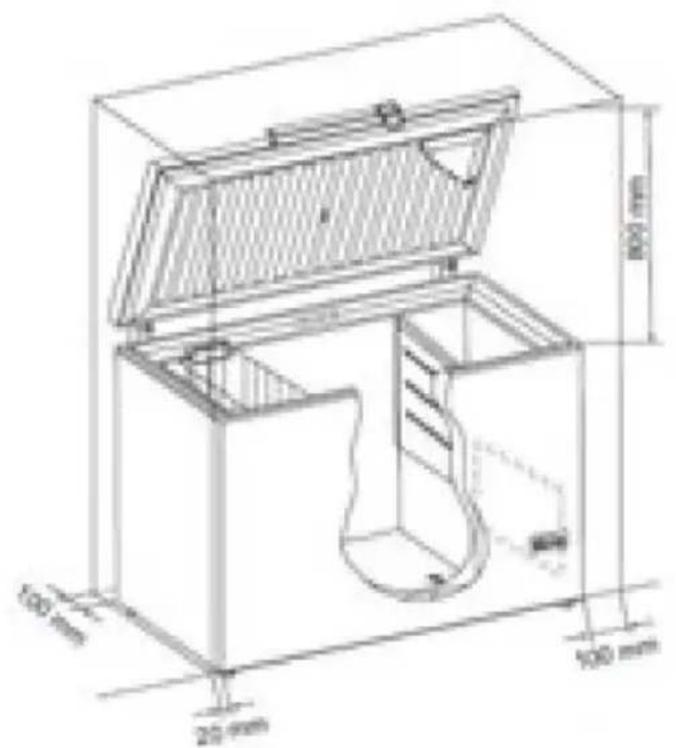
VENTILATION
It is important that the unit is well ventilated and that air can circulate freely above, below and around the unit. The figure shows how to ensure the necessary air circulation around the freezer.
V. INSTRUCTIONS TO USE
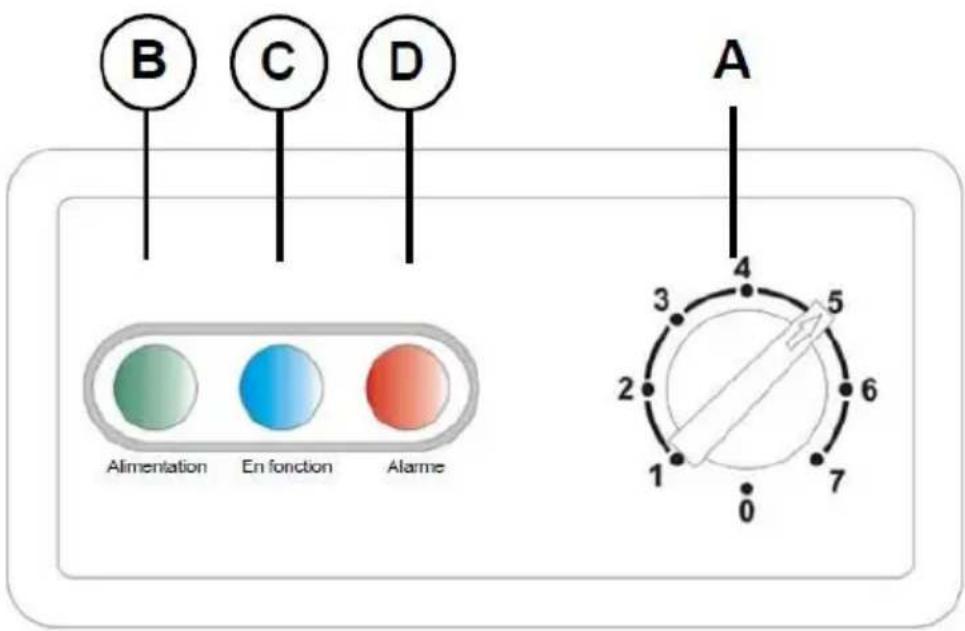
(A) - The thermostat sets the temperature in the freezer.
(B) - Green light (POWER) indicates that the unit is switched on.
(C) - Blue LED (ON) indicates that the compressor is running.
(D)- Red light (ALARM) indicates that the temperature internal is at -12^ or warmer.
Power-on indication (B) - The green light is on when the freezer is plugged into the power outlet.
Running compressor indication (C) - The YELLOW indicator lights up when the compressor is running.
Alarm indicator (D) - The red light comes on when the temperature inside the freezer is high, for example: the freezer door was not closed for a long time, or when the product was first used.
TEMPERATURE ADJUSTMENT
To adjust the temperature, turn the thermostat knob from 1 to 7 (the coldest). The operation can be done easily with a coin. The closer the thermostat knob is to 7, the lower the temperature. To reach the correct setting, measure the temperature of the highest placed package in the middle of the freezer.
This must not be higher than -18^
USAGE TIPS
Freezer
In order to preserve all their qualities, food products must be frozen at -18^ as quickly as possible.
The freezing capacity of the appliance is indicated on the rating plate in kg / 24 hours.
Use only good quality food products. Meat, poultry, fish, vegetables, fruits, dairy products and ready meals are ideally suited for freezing. Foods with a high concentration of water, such as salads, radishes, grapefruit, apples, cucumbers and pears, are not suitable for freezing.
Pack products in airtight containers, freezer bags, etc. Adapt the size of the portions to their use. Do not freeze vegetables or meat in portions weighing more than 2.5kg . Avoid moisture from bags and bags to prevent them from "sticking" together. Place the products in such a way that they are as little as possible in contact with each other, in order to accelerate their freezing. Evacuate the air contained in the packaging to prevent drying of the surface of the products.
Place the goods to be frozen in the freezer module or regularly along the walls of the tank.
Do not forget to note the content, quantity and date on each package. It is advisable to divide the different products into categories. That is to say it is better to combine vegetables with vegetables, meat with meat, etc.
Leave at least 5 mm space under the cover by stacking the products.
Thawing
Frozen fruits and vegetables should not be thawed before use, but immersed directly in boiling water.
As far as the meat is concerned, it is best to take it out of the freezer the day before its use and place it for thawing in the chest freezer: thus obtaining optimal hygiene and perfect preservation of the quality of the meat.
Note
Aerosols and cans containing a liquid in which carbon dioxide is dissolved must not be frozen because of the risk of explosion.
VI. MAINTENANCE AND CLEANING
ICING
The humidity brought by the products and by the ambient air causes over time the formation of frost and ice in the apparatus. A thin layer of frost or ice does not affect the operation of the freezer, but the thicker the layer becomes, the higher the energy consumption. A thin layer of ice can be removed with a plastic wiper.
Never use an electrical appliance or sharp object that could damage the inside of the appliance.
When the frost or ice layer reaches a thickness of 4 to 5mm , the freezer must be defrosted. Defrosting is recommended when the freezer is near or completely empty.
Proceed as follows:
- Turn off the power.
- Take out the frozen products. Keep them in the chest freezer or well packaged to minimize defrosting.
- Leave the lid open.
- Place the partition under the spout of the defrost duct.
- Place a container of hot (non-boiling) water in the freezer, close the lid and wait about 30 minutes, then remove the frost with a plastic scraper.
- To prevent overflowing of water on the floor during defrosting, monitor the water collection tray. Cover the floor around the defrost water spout to protect it from ice and splash. When all ice has melted, clean the freezer with dishwashing liquid that is largely diluted with water. Wipe with a soft cloth.
- Turn on the power. If the amount of frozen food that needs to be returned to the freezer is large, press the Superfreeze button.
- Wait about five minutes after turning the machine back on before putting frozen products back in.
Tips for reducing energy consumption to a minimum
A low ambient temperature makes energy consumption lower.
A low temperature in the device makes the power consumption higher.
Recommended temperature -18 °C
- Defrost the appliance when ice formation is more than 5mm .
- Do not open the lid more than necessary.
Regularly check the tightness of the lid
Cool drinks and hot foods before placing them in the freezer.
Thaw frozen products in the chest freezer.
- Place frozen food in the chest freezer during defrosting of the freezer.
CLEANING
Before cleaning, unplug the appliance and remove any loose items.
Use warm water with a little dishwashing liquid without perfume (max 65^ ). Never use abrasive cleaners. Use a soft cloth. Rinse with clear water and dry thoroughly. Avoid getting water into the control panel.
The lid gasket requires regular cleaning to prevent it from fading and to ensure longevity. Use clear water. After cleaning the lid gasket, check that it still performs its purpose.
The ventilation grille must be clean. Clean it with a vacuum cleaner.
In case of prolonged absence, unplug, empty and clean the appliance and leave the lid open to prevent the creation of unpleasant odors.
VII. TROUBLESHOOTING
| Failure | Possible cause | Solution |
| No control lamp is on. | The device is off. Power outage; fuse blown or circuit breaker tripped; taken poorly. | Check the plug and socket. Check the power supply. Check the fuse or circuit breaker. |
| The temperature in the freezer is too high. | The ventilation grille is blocked. The lid of the device is not properly closed. Too much frozen food was placed in the freezer at the same time. Too much frost and ice. The thermostat is set to too hot. | Ensure the free flow of air. Close the lid and wait a few hours. Wait a few hours. Defrost the appliance. Set the thermostat to a lower temperature. |
| The temperature in the freezer is too low. | Superfreeze function is activated. The thermostat is set to a temperature that is too cold. The lid touches food in the freezer. | Stop the Superfreeze function. Set the thermostat to a higher temperature. Move the food and make sure the lid closes securely. |
| The device produces a lot of frost | The local is very humid. Foods give off moisture. | Ventilate frequently or carry the freezer in a less humid room. Review the food packaging. |
| The lid does not open. | Underpressure in the device. | Wait 2 or 3 minutes until the underpressure has disappeared and try again. |
| Vibrations and unusual noises. | The device is not placed on a flat surface. The device lacks space. The baskets or partition are not fixed. | Place the freezer on a level, stable and horizontal floor. Remove the freezer from furniture and appliances that interfere with it. Check the stability of loose objects. |
VIII. DISPOSAL
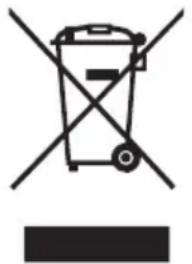
This logo affixed to the product means that it is a device whose treatment as a waste falls within the framework of the directive 2012/19 / EU of July 4, 2012, relative to the waste of electrical and electronic equipment (WEEE). This means that this product must be supported by a selective collection system in accordance with the European directive mentioned above in
order to be either recycled or dismantled in order to reduce any impact on the environment.
Hazardous substances in electrical and electronic equipment can have potentially harmful effects on the environment and human health.
Thus, at the end of the life of this appliance, it must not be disposed of with unsorted municipal waste. Recovery and collection systems are made available to you by local authorities (waste disposal centers) and distributors.
This device must not be thrown on public roads. You have the obligation to use the selective collection systems available to you.
IX. GUARANTEE
The warranty does not cover the wear parts of the product, nor the problems or damage resulting from:
- superficial deterioration due to normal wear of the product;
- defects or deterioration caused by contact with the product with liquids and corrosion caused by rust or the presence of insects;
- any incident, misuse, misuse, alteration, disassembly or unauthorized repair;
- any unsuitable maintenance operation, use not in accordance with the product instructions or connection to incorrect voltage;
- any use of accessories not supplied or not approved by the manufacturer.

The warranty will be void if the nameplate and / or serial number of the product is removed.
Continental Edison - 120-126 Quai de Bacalan - CS 11584 - 33000 Bordeaux Imported by SCHNEIDER CONSUMER GROUP
12, rue Jules Ferry, 93110 Rosny-sous-Bois, FRANCE

Continental Edison
www.continentaledison.fr

CECC95APW_01-2019_v2