
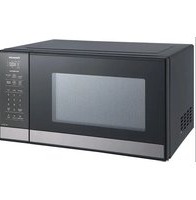
NN-E48NBM - Microwave PANASONIC - Free user manual and instructions
Find the device manual for free NN-E48NBM PANASONIC in PDF.


| Product Type | Microwave oven |
| Brand | Panasonic |
| Model | NN-E48NBM |
| External dimensions (W x D x H) | 469 x 380 x 280 mm |
| Cooking compartment dimensions (W x D x H) | 329 x 326 x 236 mm |
| Cavity volume | 25 L |
| Glass turntable diameter | 288 mm |
| Net weight | 12 kg |
| Power supply | 230 V, 50 Hz |
| Maximum power consumption | 1400 W |
| Microwave output power | 900 W (IEC-60705) |
| Operating frequency | 2450 MHz |
| Noise level | LWA 63 dB |
| Main functions | Microwave cooking (5 power levels), auto defrost, auto menu (8 programs), multi-stage cooking, timer, Quick 30 function, Add Time |
| Safety | Child safety lock, automatic shut-off in case of smoke/flame, thermal safety device |
| Maintenance and cleaning | Clean interior with a damp cloth, do not use abrasive products or steam cleaner. Wash glass turntable and roller ring regularly |
| Spare parts | Glass turntable, roller ring, lamp (replacement by a technician) |
| Repairability | Repairs only by a qualified technician. Do not disassemble the cover |
| General information | Household use only. Flat surface, 15 cm space above. Do not use without food |
Frequently Asked Questions - NN-E48NBM PANASONIC
User questions about NN-E48NBM PANASONIC
0 question about this device. Answer the ones you know or ask your own.
Ask a new question about this device
Download the instructions for your Microwave in PDF format for free! Find your manual NN-E48NBM - PANASONIC and take your electronic device back in hand. On this page are published all the documents necessary for the use of your device. NN-E48NBM by PANASONIC.
USER MANUAL NN-E48NBM PANASONIC
Operating Instructions (Original instructions)
■ Important safety instructions. Before operating this oven, please read these instructions and precautions carefully and keep for future reference. ■ Warning! The appliance should be inspected for damage to the door seals and door seal areas and if these areas are damaged the appliance should not be operated until it has been repaired by a service technician trained by the manufacturer. ■ Warning! Do not attempt to tamper with or make any adjustments or repairs to the door, control panel housing, safety interlock switches or any other part of the oven. Do not remove the outer panel from the oven which gives protection against exposure to microwave energy. Repairs should only be carried by a qualified service person. ■ Warning! Liquids and other foods must not be heated in sealed containers since they are liable to explode. ■ Warning! When heating liquids, e.g. soup, sauces and beverages in your oven, overheating the liquid beyond boiling point can occur without evidence of bubbling. This could result in a sudden boil over of the hot liquid.
■ Warning! The contents of feeding bottles and baby food jars are to be stirred or shaken. The temperature has to be checked before consumption to avoid burns.
■ Warning! The appliance shall be disconnected from its power source during service and when replacing parts. Following the removal of the supply plug, the plug should remain visible to the service operator to ensure that inadvertent reconnection is avoided.
■ Warning! Ensure that the appliance is switched off before replacing the lamp to avoid the possibility of electric shock.
■ This appliance can be used by children aged from 8 years and above and persons with reduced physical, sensory and mental capabilities or lack of experience and knowledge if they have been given supervision or instruction by a person responsible for their safety concerning the use of the appliance in a safe way and understand the hazards involved. Children shall not play with the appliance. Cleaning and user maintenance shall not be made by children without supervision. Keep the appliance and its cord out of reach of children less than 8 years.
■ When this oven is installed, it should be easy to isolate the appliance from the electricity supply by pulling out the plug or operating a circuit breaker. ■ If the supply cord is damaged, it must be replaced by the manufacturer or its service agent or a similarly qualified person in order to avoid a hazard. ■ Do not place this oven near an electric or gas cooker range. ■ This oven is intended for counter-top use only. It is not intended for built-in use or for use inside a cupboard. ■ The oven must be placed on a flat, stable surface 85 cm above the floor, with the rear of the oven placed against a back wall. If one side of the oven is placed flush to a wall, the other side or top must not be blocked. Allow 15 cm of space on the top of the oven. ■ When heating food in plastic or paper containers, keep an eye on the oven as these types of containers can ignite if overheated. ■ If smoke is emitted or a fire occurs in the oven, press Stop/Reset and keep the door closed in order to stifle any flames. Disconnect the power cord, or shut off power at the fuse or circuit breaker panel.
■ This appliance is intended to be used in household and similar applications such as: - staff kitchen areas in shops, offices and other working environments; - farm houses; - by clients in hotels, motels and other residential environments; - bed and breakfast type environments.
■ Do not cook eggs in their shells or whole hard-boiled eggs by microwave. Pressure may build up and the eggs may explode, even after the microwave heating has ended.
■ Clean the inside of the oven, door seals and door seal areas regularly. When food splatters or spilled liquids adhere to the oven walls, door seals and door seal areas, wipe them off with a damp cloth. Mild detergent may be used if they get very dirty. The use of harsh detergent or abrasive is not recommended.
■ DO NOT USE COMMERCIAL OVEN CLEANERS.
Failure to maintain the oven in a clean condition could lead to deterioration of surfaces that could affect the life of the appliance and possibly result in a hazardous situation.
A steam cleaner is not to be used for cleaning.
■ Do not use harsh, abrasive cleaners or sharp metal scrapers to clean the oven door glass since they can scratch the surface, which may result in shattering of the glass.
■ This appliance is not intended to be operated by means of an external timer or separate remote-control system.
■ Only use utensils that are suitable for use in microwave ovens.
■ The microwave oven is intended for heating food and beverages only. Take care when heating foods low in moisture, e.g. bread items, chocolate, biscuits and pastries. These can easily burn, dry out or catch on fire if cooked too long. We do not recommend heating foods low in moisture such as popcorn or poppadoms. Drying of food, newspapers or clothing and heating of warming pads, slippers, sponges, damp cloth, wheat bags, hot water bottles and similar may lead to risk of injury, ignition or fire.
The oven lamp must be replaced by a service technician trained by the manufacturer. DO NOT attempt to remove the outer casing from the oven.
Metal containers or dishes with metallic trim should not be used during microwave cooking. Sparking will occur.
Contents
Installation and connection....7
Placement of your oven....7
Important safety instructions.... 8
Parts of your oven 12
Control panel 13
Setting the clock 14
Child safety lock 14
Microwave cooking and defrosting 15
Multi-stage cooking.... 17
Quick 30 feature 18
Add time feature 18
Using the timer 19
Auto programmes....21
Auto defrost 21
Auto menu 22
Questions and answers....25
Care of your oven....26
Specifications 27
Thank you for purchasing a Panasonic appliance.
Panasonic Corporation Osaka, Japan
Importer: Panasonic Marketing Europe GmbH
Panasonic Testing Centre,
Winsbergring 15, 22525 Hamburg, Germany
Installation and connection
Examine your microwave oven
Unpack the oven, remove all packing material, and examine the oven for any damage such as dents, broken door latches or cracks in the door. If you find any damage, notify your dealer immediately. Do not install a damaged microwave oven.
Earthing instructions
Important!
THIS UNIT HAS TO BE PROPERLY EARTHED FOR PERSONAL SAFETY.
If your AC outlet is not earthed, it is the personal responsibility of the customer to have it replaced with a properly earthed wall socket.
Operation voltage
The voltage has to be the same as specified on the label on the oven. If a higher voltage than specified is used, it may cause a fire or other damages.
Placement of your oven
This oven is intended for counter-top use only. It is not intended for built-in use or for use inside a cupboard.
- Place the oven on a flat and stable surface more than 85 cm above the floor.
- When this oven is installed, it should be easy to isolate the appliance from the electricity supply by pulling out the plug or operating a circuit breaker.
- For proper operation, ensure a sufficient air circulation for the oven.
Counter-top use:
Allow 15 cm of space on the top of the oven, 10 cm at the back and 5 cm on both sides.
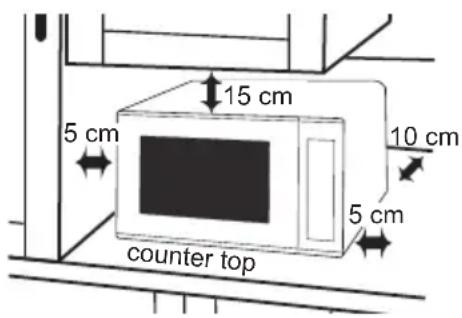
If one side of the oven is placed flush to a wall, the other side or top must not be blocked.
- Do not place this oven near an electric or gas cooker range.
- The power cord should not touch the outside of the oven. Keep the cord away from hot surfaces. Do not let the cord hang over the edge of a table or work top. Do not immerse the cord, plug or oven in water.
- The feet should not be removed.
- This appliance is intended to be used in household and similar applications such as:
- staff kitchen areas in shops, offices, and other working environments;
- farm houses;
- by clients in hotels, motels, and other residential environments;
- bed and breakfast type environments. Do not use outdoors.
Placement of your oven
- Avoid using the oven in high humidity.
- Do not block the air vents. If these openings are blocked during operation, the oven may overheat. In this case, the oven is protected by a thermal safety device and resumes operation only after cooling down.
- This appliance is not intended to be operated by means of an external timer or separate remote-control system.
Important safety instructions
- The door seals and seal areas should be cleaned with a damp cloth. The appliance should be inspected for damage to the door seals and door seal areas and if these areas are damaged the appliance should not be operated until it has been repaired by a service technician trained by the manufacturer.
- Do not attempt to tamper with or make any adjustments or repairs to the door, control panel housing, safety interlock switches or any other part of the oven. Do not remove the outer panel from the oven which gives protection against exposure to microwave energy. Repairs should only be carried out by a qualified service person.
- Do not operate this appliance if it has a damaged CORD OR PLUG, if it is not working properly, or if it has been damaged or dropped. It is dangerous for anyone other than a service technician trained by the manufacturer to perform repair service.
- If the supply cord is damaged, it must be replaced by the manufacturer, its service agent or a similarly qualified person in order to avoid a hazard.
- Liquids and other foods must not be heated in sealed containers since they are liable to explode.
- This appliance can be used by children aged from 8 years and above and persons with reduced physical, sensory and mental capabilities or lack of experience and knowledge if they have been given supervision or instruction by a person responsible for their safety concerning the use of the appliance in a safe way and understand the hazards involved. Children shall not play with the appliance. Cleaning and user maintenance shall not be made by children without supervision. Keep the appliance and its cord out of reach of children less than 8 years.
Use of your oven
■ Do not use the oven for any reason other than the preparation of food. This oven is specifically designed to heat or cook food. Do not use this oven to heat chemicals or other non-food products. ■ Before use, check that utensils/containers are suitable for use in microwave ovens. ■ When the oven is not being used, do not store any objects inside the oven in case it is accidentally turned on. ■ The appliance must not be operated WITHOUT FOOD IN THE OVEN. Operation in this manner may damage the appliance. ■ If smoke is emitted or a fire occurs in the oven, press Stop/Reset and keep the door closed in order to stifle any flames. Disconnect the power cord, or shut off power at fuse or circuit breaker panel.
Fan motor operation
■ After using the oven, the fan motor may rotate for a few minutes to cool the electric components. This is normal, and you can take out food even though the fan motor operates. You can continue using the oven during this time.
Oven light
■ When it becomes necessary to replace the oven light, please consult your dealer.
Accessories
■ The oven comes equipped with a variety of accessories. Always follow the directions given for use of the accessories.
Glass tray
■ Do not operate the oven without the roller ring and the glass tray in place. ■ Never use another type of glass tray than the one specially designed for this oven. ■ If the glass tray is hot, let it cool before cleaning or placing in water. ■ The glass tray can turn in either direction. ■ If the food or cooking vessel on the glass tray touches the oven walls and stops the tray rotating, the tray will automatically rotate in the opposite direction. This is normal. ■ Do not cook foods directly on the glass tray unless indicated in recipes. Always place food in a microwave safe dish.
Roller ring
■ Do not remove the roller ring from the cavity floor. ■ The roller ring and the oven floor should be cleaned frequently to prevent noise and build-up of remaining food. ■ The roller ring must always be used for cooking together with the glass tray.
Important safety instructions
■ If you accidentally remove the roller ring, place the roller ring gently into the hole in the centre of the oven and locate it on the spindle beneath.
Flat processing is applied on the spindle to firmly hold the roller ring during operation.
Cooking time
■ The cooking time depends on the condition, temperature, amount of food and on the type of cookware. ■ Begin with the minimum cooking time to help prevent overcooking. If the food is not sufficiently cooked you can always cook it for a little longer.
■ Important!
If the recommended cooking time is exceeded, the food will be spoiled and in extreme circumstances could catch fire and possibly damage the interior of the oven.
Small quantities of foods
■ Small quantities of food or foods with low moisture content can burn, dry out or catch on fire if cooked too long. If materials inside the oven should ignite, keep the oven door closed, turn the oven off and remove the plug from the socket.
Foods low in moisture
■ The microwave oven is intended for heating food and beverages only. Take care when heating foods low in moisture, e.g. bread items, chocolate, biscuits and pastries. These can easily burn, dry out or catch on fire if cooked too long. We do not recommend heating foods low in moisture such as popcorn or poppodums. Drying of food, newspapers or clothing and heating of warming pads, slippers, sponges, damp cloth, wheat bags, hot water bottles and similar may lead to risk of injury, ignition or fire.
Eggs
■ Do not cook eggs in their shells and whole hard-boiled eggs by MICROWAVE. Pressure may build up and the eggs may explode, even after the microwave heating has ended.
Piercing skin
■ Food with non porous skins, such as potatoes, egg yolks and sausages must be pierced before cooking by MICROWAVE to prevent bursting.
Meat thermometer
■ Use a meat thermometer to check the degree of cooking of roasts and poultry only when the meat has been removed from the oven. Do not use a conventional meat thermometer in the microwave oven because it may cause sparking.
Liquids
■ When heating liquids, e.g. soup, sauces and beverages in your microwave oven, overheating the liquid beyond boiling point can occur without evidence of bubbling. This could result in a sudden boil over of the hot liquid.
To prevent this possibility the following steps should be taken:
a Avoid using straight-sided containers with narrow necks. b Do not overheat. c Stir the liquid before placing the container in the oven and again halfway through the cooking time. d After heating, allow it to stand in the oven for a short time, stir again before carefully removing the container.
Paper/plastic
■ When heating food in plastic or paper containers, keep an eye on the oven as these types of containers ignite if overheated. ■ Do not use recycled paper products (e.g. Kitchen Roll) unless the paper product is labelled as safe for microwave oven use. Recycled paper products may contain impurities which may cause sparks and/or fires during use. ■ Remove wire twist-ties from roasting bags before placing the bags in the oven.
Utensils/foil
■ Do not heat any closed cans or bottles because they might explode. ■ Metal containers or dishes with metallic trim should not be used during microwave cooking. Sparking will occur. ■ If you use any aluminium foil, meat spikes or metalware the distance between them and the oven walls and door should be at least 2 cm to prevent sparking.
Feeding bottles/baby food jars
■ The top and teat or lid must be removed from feeding bottles or baby food jars before placing in the oven. ■ The contents of feeding bottles and baby food jars are to be stirred or shaken. ■ The temperature has to be checked before consumption to avoid burns.
Parts of your oven
1. Door Release Button
Press to open the door. Opening the door during cooking will stop the cooking process without cancelling the programme. It is quite safe to open the door at any time during a cooking programme and there is no risk of microwave exposure. Cooking resumes after the door is closed and Start/Set is pressed.
2. Oven window
- Air vents
- Microwave feed guide (Do not remove.)
- External air vents
- Control panel
- Power supply cord
- Plug
- Glass tray
- Roller ring
- Menu label
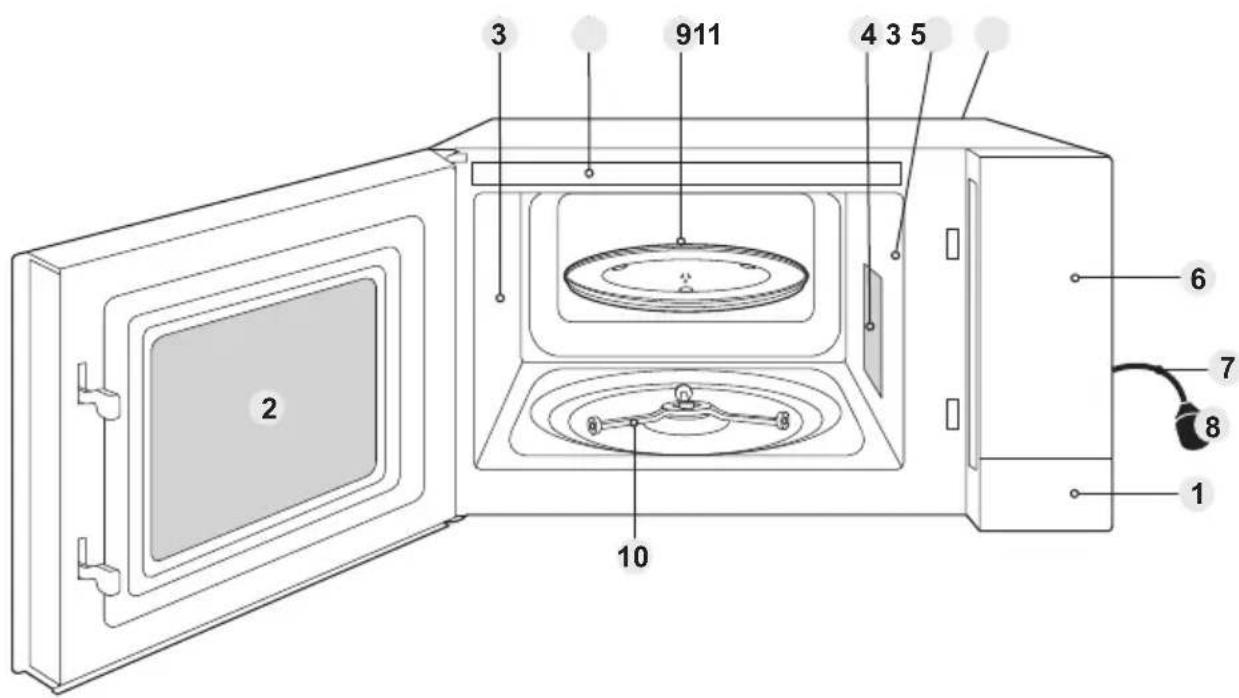
Identification label is attached on the oven.
Note
This illustration is for reference only.
Control panel
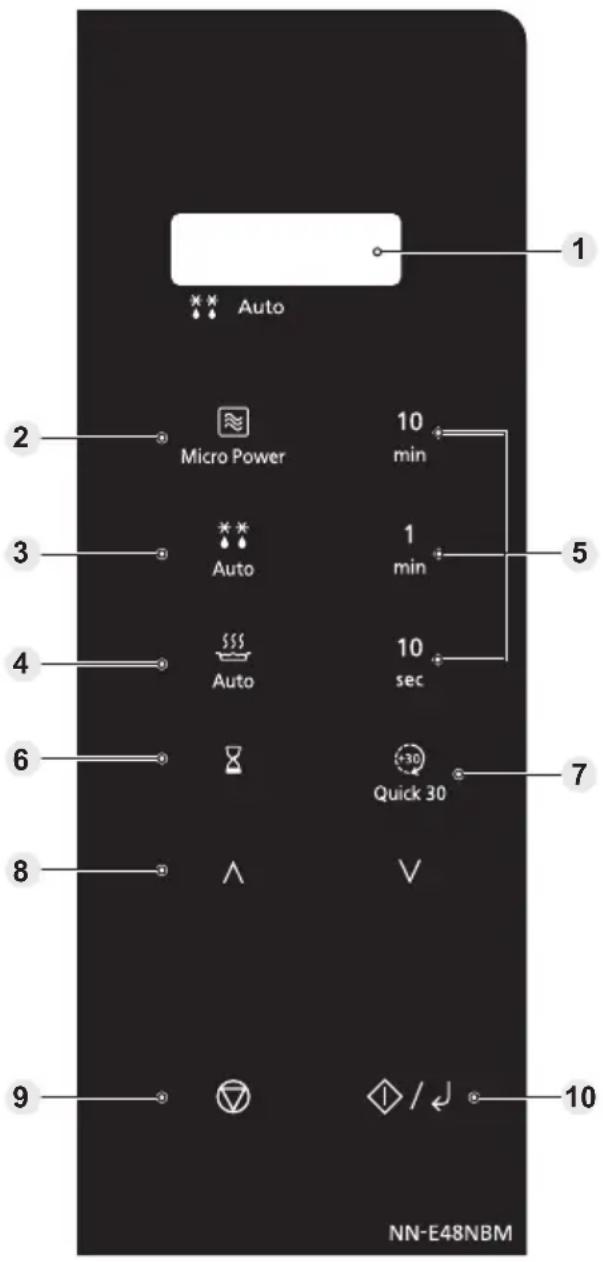
- Your control panel may have differences in appearance, but the words on the pads and functionality will be the same.
Beep sound
When a pad is pressed correctly a beep will be heard. If a pad is pressed and no beep is heard, the unit has not or cannot accept the instruction. The oven will beep twice between programmed stages. At the end of any complete programme, the oven will beep 5 times and "End" will be displayed.
1 Display window 2 Micro Power pad 3 Auto Defrost pad 4 Auto Menu pad 5 Time pads 6 Timer/Clock pad 7 Quick 30 pad 8 Up/Down pads 9 Stop/Reset pad Before Cooking
One press clears your instructions. During Cooking
One press temporarily stops the cooking process. Another press cancels all your instructions and a dot or the time of day will appear in the display.
10 Start/Set pad
One press allows oven to begin operation. If door is opened or Stop/Reset is pressed once during oven operation, Start/Set must be pressed again to restart oven.
Note
If Start/Set is not pressed for 6 minutes after cooking programme setting, the oven will automatically cancel the cooking programme. The display will revert back to clock or dot.
Setting the clock
When the oven is first plugged in, "88.88" appears in display.
![graph LR A["Square with vertical bar"] --> B["∧"] B --> C["V"] C --> D["Diamond/arrow"] D --> E["∧"] E --> F["V"]](/content/2026/04/669765/images/08c8a3cfb773b4282691f5ee0864233887354b4087f18904d3b17c894e01d097.jpg)
Press Timer/Clock twice.
Hour starts to blink.
Press Up/Down to set hours.
Press Start/Set. Minute starts to blink.
Press Up/Down to set minutes.

Press Start/Set.
Time of day is now locked into the display.
Notes
- To reset time of day, repeat the whole step above.
- The clock will keep the time of day as long as the oven is plugged in and electricity is supplied.
- This is a 24 hour clock, i.e. 2 pm = 14:00 not 2:00.
Child safety lock
This feature will make the oven controls inoperable; however, the door can be opened. Child safety lock can be set when the display shows a dot or the time.
To Set:
Press Start/Set 3 times within 10 seconds.
The time of day will disappear. Actual time will not be lost. 'L ---' is indicated in the display.
To Cancel:

Press Stop/Reset 3 times within 10 seconds.
The time of day will reappear in the display.
Microwave cooking and defrosting
The glass tray must always be in position when using the oven.



Press Micro Power to select the desired power level.
Set the cooking time. Refer to “Setting the cook time/timer time” below.
Press Start/Set. The time counts down in the display.
Press Power Level Max. time available
| once 900 W High 30 minutes | |
| twice 200 W Defrost 99 minutes 50 seconds | |
| 3 times 500 W Medium 99 minutes 50 seconds | |
| 4 times 400 W Low 99 minutes 50 seconds | |
| 5 times 100 W Warm 99 minutes 50 seconds |
Notes
- The oven will automatically work on 900 W (High) MICROWAVE power if a cooking time is entered without the power level previously being selected.
- While cooking, the glass tray may vibrate. This will not affect cooking performance.
- For MULTI-STAGE COOKING, refer to page 17.
- STANDING TIME can be programmed after MICROWAVE power and time setting. Refer to page 19.
- DO NOT use microwave only with any metal accessory in the oven.
- Always check the food during defrosting by opening the door then restarting. It is not necessary to cover food during defrosting. To ensure an even result, stir, turn or separate several times during defrosting. For large joints and poultry, turn halfway through defrosting and protect ends and tips with aluminium foil.
- When the microwave oven is operated at 900 W (High) microwave power for long time, the microwave oven automatically adjust the power to protect the components of the microwave oven.
■ Setting the cook time/timer time
When you set the cook time or the timer time, use following keys according to your needs.
Press each Time pad repeatedly according to the time value you want to set.
Press Quick 30 to set cooking time in 30-second increments.

After you enter a time value with each Time pad or Quick 30, you can adjust the time values with the Up/Down pads.
Microwave cooking and defrosting
Defrosting Guidelines
Standing times
Individual portions of food may be cooked almost immediately after defrosting. It is normal for large portions of food to be frozen in the centre. Before cooking, allow to stand for a minimum of one hour. During this standing time, the temperature becomes evenly distributed and the food is defrosted by conduction. N.B. If the food is not going to be cooked immediately, store it in the refrigerator. Never refreeze defrosted food without first cooking it.
Joints and poultry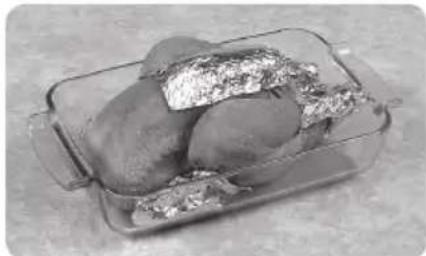
It is preferable to place the joints on an upturned plate or plastic rack so that they are not resting in the juices. It is essential to protect delicate or projecting parts of this food with small pieces of foil to prevent these parts from cooking. It is not dangerous to use small pieces of foil in your oven, provided they do not come into contact with the oven walls.
Minced meat or cubes of meat and seafood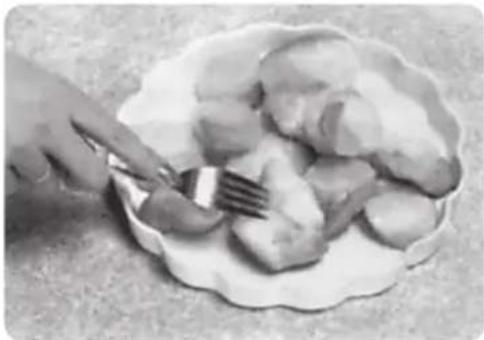
Since the outside of these foods quickly defrosts, it is necessary to separate them, break the blocks into pieces frequently while defrosting and remove them when they have defrosted.
Small portions of food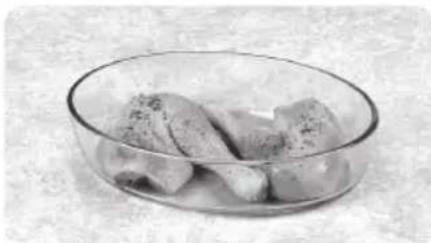
Chops and chicken pieces must be separated as soon as possible so that they defrost evenly throughout. Fatty parts and the ends defrost more quickly. Place them near the centre of the turntable or protect them.
Bread
Loaves will require standing time to allow the centre to thaw. Standing time can be shortened if slices are separated and rolls and loaves cut in half.
Multi-stage cooking
This feature allows you to programme up to 3 stages of cooking continuously.
Example: To continually set 900 W (High) power for 2 minutes, 500 W (Medium) power for 3 minutes and 100 W (Warm) power for 2 minutes.
![graph LR A["Micro Power"] --> B["Press twice."] B --> C["Set the cooking time*"] C --> D["10 min"] C --> E["1 min"] C --> F["10 sec"] style A fill:#f9f,stroke:#333 style B fill:#ccf,stroke:#333 style C fill:#cfc,stroke:#333 style D fill:#fcc,stroke:#333 style E fill:#fcc,stroke:#333 style F fill:#fc…](/content/2026/04/669765/images/59724ec4cfdecbfdd508fe1de848af14e38d0279429459021123065abbd7675d.jpg)
![graph LR A["Micro Power"] --> B["Press Micro Power twice to select 500 W (Medium) power."] B --> C["Set the cooking time*"] C --> D["Press 3 times."] D --> E["10 min"] D --> F["1 min"] D --> G["10 sec"]](/content/2026/04/669765/images/e9cbee8a26c250fdefe47f9aaa8ac4a0ceae9a60861218c09251089cb3f3352e.jpg)
![graph LR A["Press Micro Power"] --> B["Press twice"] B --> C["Set the cooking time*"] C --> D["Press Start/Set. The time for the first stage counts down in the display."] style A fill:#f9f,stroke:#333 style B fill:#ccf,stroke:#333 style C fill:#cfc,stroke:#333 style D fill:#fcc,stroke:#333](/content/2026/04/669765/images/6c901f7f6b93a853e2580aaed50b3634d6908e87a8712058fb4dc6c9e8bdc9a0.jpg)
* Refer to "Setting the cook time/timer time" on page 15.
Notes
- AUTO PROGRAMMES cannot be used with MULTI-STAGE COOKING.
- When operating, 2 beeps will sound between each stage, and 5 beeps will sound after all stages have finished.
- 900 W (High) MICROWAVE power can be set only once in MULTI-STAGE COOKING.
Quick 30 feature
This feature allows you to set cooking time in 30 seconds increments up to 5 minutes at 900 W (High) power.


Press Quick 30 until the desired cooking time appears in the display.
Press Start/Set.
The time counts down in the display.
Add time feature
This feature allows you to add cooking time during cooking.
During cooking, press 1 min or 10 sec.
Cooking time will be added up to 5 minutes.
Note
ADD TIME feature is not available for AUTO PROGRAMMES.
Using the timer
This feature operates as a KITCHEN TIMER or allows you to programme the STANDING TIME/DELAY START.
Kitchen timer
Example: To count 5 minutes.
![graph LR A["Hourglass"] --> B["10 min"] B --> C["1 min"] C --> D["10 sec"] D --> E["/↓"]](/content/2026/04/669765/images/4007bc5af1a7f573771ae2320a2819ccee6e1d9234b77ac01a5c02e049fb64c8.jpg)
Press Timer/Clock. Set the desired amount of time* (up to 99 minutes 50 seconds). Press Start/Set. The time counts down without the oven operating. * Refer to "Setting the cook time/timer time" on page 15.
Standing time
Example: To stand for 5 minutes after cooking at 500 W (Medium) MICROWAVE power for 3 minutes.
![graph LR A["Micro Power"] --> B["10 min"] B --> C["1 min"] C --> D["10 sec"] E["Press 3 times."] --> C](/content/2026/04/669765/images/ba9d0597d28e664c623abfae36680465f21f26d21db5dc085c502a6ac30988d7.jpg)
Press Micro Power 3 times to select 500 W (Medium) power. Set the desired cooking time*.
![graph LR A["Start"] --> B["8"] B --> C["10 min"] C --> D["1 min"] D --> E["10 sec"] E --> F["/↓"]](/content/2026/04/669765/images/38ed7ad95c03f4973e0dab092f85c672167fc01529b56d3131c6cdc8b31e2f0d.jpg)
Press Timer/Clock. Set the desired amount of standing time* (up to 99 minutes 50 seconds). Press Start/Set. Cooking starts. After cooking, standing time will count down without the oven operating. * Refer to "Setting the cook time/timer time" on page 15.
Using the timer
Delay start
Example: To start cooking at 500 W (Medium) MICROWAVE power for 3 minutes after 5 minutes of standing time.
![graph TD A["Press Timer/ Clock."] --> B["10 min"] B --> C["1 min"] C --> D["10 sec"] D --> E["Set the desired amount of delay time*.<br>(up to 99 minutes 50 seconds)"] F["Press Micro Power 3 times to select 500 W (Medium) power."] --> G["10 min"] G --> H["1 min"] H --> I["10 sec"] I --> J["Set the d…](/content/2026/04/669765/images/15894975bcc77f37a6d8889a482cb3015590002b795cbbfc534d1c967722622b.jpg)
* Refer to "Setting the cook time/timer time" on page 15.
Notes
- MULTI-STAGE COOKING can be programmed including STANDING TIME or DELAY START.
- Even if the oven door is opened during KITCHEN TIMER, STANDING TIME or DELAY START, the time in the display window will continue to count down.
- STANDING TIME/DELAY START cannot be programmed before/after any AUTO PROGRAMME.
Auto programmes
With this feature you can defrost/reheat/cook food according to the weight. Select the category and set the weight of the food. The weight is programmed in grams. The oven determines MICROWAVE power level and cooking time automatically. For quick selection, the weight starts from the most commonly used weight for each category. Do not include the weight of any added water or the container weight.

Notes
- The AUTO PROGRAMMES must ONLY be used for foods described.
- Only defrost/cook foods within the weight ranges described.
- Always weigh the food rather than relying on the package information.
- Most foods benefit from a STANDING TIME. After cooking with an AUTO PROGRAMME, allow heat to continue conducting to the centre.
Auto defrost



Select the desired Auto Defrost programme.
The AUTO PROGRAMME number appears in the display.
Set the weight of the frozen food.
The weight counts up/down in 10 g increments.
Press Start/Set.
Remember to stir or turn the food during defrosting.
| Programme Instructions | |
1. Small Pieces 1 press 1 press | Weight: 200 - 1000 gFor defrosting small pieces of meat, escallop, sausages, minced meat, steak, chops, fish fillets (each 100 g to 400 g).Press Auto Defrost once. Set the weight of the food and press Start/Set. Turn and shield at beeps. Allow to stand for 15 to 30 minutes. |
2. Big Piece  2 presses 2 presses | Weight: 600 - 1600 gFor defrosting big piece of meat, whole chicken, meat joint. Press Auto Defrost twice. Set the weight of the food and press Start/Set. Whole chicken and meat joint will require shielding during defrosting. Protect wings, breast and fat with smooth pieces of aluminium foil secured with cocktail sticks. Do not allow the foil to touch the walls of the oven. Standing time of 1 to 2 hours should be allowed before cooking, so that the centre of the food thaws out. Turn and shield at beeps. |
Auto programmes
| Programme Instructions | |
3. Bread/Cake 3 presses 3 presses | Weight: 100 - 600 gFor defrosting bread (whole, slices, rolls) and cakes. Cream cakes and iced cakes are unsuitable for this programme.Place the bread or cake on a large plate or shallow dish.Press Auto Defrost 3 times. Set the weight of the food and press Start/Set. Turn at beeps. Allow bread to stand for 10 (white light bread) to 30 minutes (dense rye bread). Cut large loaves in half during standing time. |
Auto menu





Select the desired Auto Menu programme*.
The AUTO PROGRAMME number appears in the display.
Press Start/Set to confirm the setting.
Set the weight of the food.
The weight counts up/down in 10 g increments.
Press Start/Set. The time counts down in the display.
* After pressing the Auto Menu pad, you can also use the Up/Down pads to select the Auto Menu programme.
Note
As some variations may occur in food, check that food is thoroughly cooked and piping hot before serving.
| Programme Instructions | |
1. Chilled Meal 1 press 1 press | Weight: 200 - 800 gFor reheating a pre-cooked meal. All foods must be pre-cooked. Foods should be at refrigerator temperature approx. +5 °C. Reheat in container as purchased. Follow manufacture's directions for preparation. If transferring food to a dish, cover with pierced cling film. Place container on glass tray. Press Auto Menu once and press Start/Set. Set the weight of the food and press Start/Set. Stir at beeps. Stir again at end of programme and allow a few minutes standing time. Large pieces of meat/fish in a thin sauce may require longer cooking. This programme is not suitable for starchy foods such as rice, noodles or potatoes. Meals in irregular bowl shaped containers may need longer cooking. |
2. Frozen Meal  2 presses 2 presses | Weight: 300 - 600 gFor reheating a frozen pre-cooked meal. All foods must be pre-cooked and frozen (-18 °C). Reheat in container as purchased. Follow manufacture's directions for preparation. If transferring food to a dish, cover with pierced cling film. Place container on glass tray. Press Auto Menu twice and press Start/Set. Set the weight of the food and press Start/Set. Stir at beeps and cut the blocks into pieces. Stir again at end of programme and allow a few minutes standing time. Large pieces of meat/fish in a thin sauce may require longer cooking. This programme is not suitable for starchy foods such as rice, noodles or potatoes. Meals in irregular bowl shaped containers may need longer cooking. |
3. Fresh Vegetables 3 presses 3 presses | Weight: 100 - 800 gFor cooking fresh vegetables like carrots, broccoli, cauliflower and green beans. Place prepared vegetables in a suitable sized container. Sprinkle with 1 tbsp water per 100 g vegetables. Cover with cling film. Pierce cling film with a knife once in the centre and 4 times around the edge. Press Auto Menu 3 times and press Start/Set. Set the weight of the food and press Start/Set. Stir at beeps. |
4. Frozen Vegetables 4 presses 4 presses | Weight: 100 - 800 gFor all types of frozen vegetables, like frozen peas, sweetcorn or mixed vegetables. Place prepared vegetables into a suitable size microwave safe casserole and add 2-6 tbsp of water if desired. Cover with a well fitting lid. Place the casserole on glass tray. Press Auto Menu 4 times and press Start/Set. Set the weight of the food and press Start/Set. Stir at beeps. At the end of cooking, let it covered and stand for 3 to 5 minutes. |
5. Fresh Fish 5 presses 5 presses | Weight: 200 - 700 gFor cooking fresh fish filets and steaks. Place in a suitable sized container. Add 1-3 tbsp liquid. Cover with cling film. Pierce cling film once in the centre and 4 times around the edge. Press Auto Menu 5 times and press Start/Set. Set the weight of the food and press Start/Set. Allow a few minutes standing time. |
6. Potatoes 6 presses 6 presses | Weight: 200 - 600 gFor cooking potatoes. Pare potatoes well and cut into even size pieces. Place in a suitable size microwave safe casserole and add 1-3 tbsp of water. Cover with lid or cling film. Place the casserole on glass tray. Press Auto Menu 6 times and press Start/Set. Set the weight of the food and press Start/Set. Stir at beeps. |
Auto programmes
| Programme Instructions | |
7. Chicken 7 presses 7 presses | Weight: 200 - 800 gFor cooking chicken pieces such as wings, drumsticks, thighs, half breasts etc. Pierce the chicken pieces well with fork before cooking. Place prepared chicken pieces in a suitable size microwave safe dish. Add 1-5 tbsp oil if desired. Cover with cling film pierced twice. Place the dish on glass tray. Press Auto Menu 7 times and press Start/Set. Set the weight of the food and press Start/Set. Turn at beeps. |
8. Casserole Rice 8 presses 8 presses | Weight: 100 - 300 gRiceRecommended WaterDish Size100 g 150 ml 3 litre200 g 300 ml 3 litre300 g 450 ml 3 litreFor cooking white rice including short grain, long grain, jasmine rice and basmati rice. Place rice in a suitable size microwave safe casserole. Add recommended water listed above. Allow at least 1/2 depth of volume for evaporation to prevent boiling over. Cover with lid. Place the casserole on glass tray. Press Auto Menu 8 times and press Start/Set. Set the weight of the food and press Start/Set. Stand 5 minutes after cooking. |
Questions and answers
Q: Why won't my oven turn on?
A: When the oven does not turn on, check the following:
- Is the oven plugged in securely? Remove the plug from the outlet, wait 10 seconds and reinsert.
- Check the circuit breaker and the fuse. Reset the circuit breaker or replace the fuse if it is tripped or blown.
- If the circuit breaker or fuse is all right, plug another appliance into the outlet. If the other appliance works, there probably is a problem with the oven. If the other appliance does not work, there probably is a problem with the outlet. If it seems that there is a problem with the oven, contact an authorised Service Centre.
Q: My oven causes interference with my TV. Is this normal?
A: Some radio and TV interference might occur when you cook with the oven. This interference is similar to the interference caused by small appliances such as mixers, vacuums, blow dryers, etc. It does not indicate a problem with your oven.
Q: The oven won't accept my programme. Why?
A: The oven is designed not to accept an incorrect programme. For example, the oven will not accept a 4th stage.
Q: Sometimes warm air comes from the oven vents. Why?
A: The heat given off from the cooking food warms the air in the oven cavity. This warmed air is carried out of the oven by the air flow pattern in the oven. There are no microwaves in the air. The oven vents should never be blocked during cooking.
Care of your oven
- The oven should be unplugged before cleaning.
- Clean the inside of the oven, door seals and door seal areas regularly. When food splatters or spilled liquids adhere to the oven walls, door seals and door seal areas wipe off with a damp cloth. Mild detergent may be used if they get very dirty. The use of harsh detergent or abrasive is not recommended. Avoid cleaning the microwave feed guide area situated on the right hand side of the cavity wall. DO NOT USE COMMERCIAL OVEN CLEANERS.
- Do not use harsh, abrasive cleaners or sharp metal scrapers to clean the oven door glass since they can scratch the surface, which may result in shattering the glass.
- The outside oven surface should be cleaned with a damp cloth. To prevent damage to the operating parts inside the oven, water should not be allowed to seep into the ventilation openings.
- If the Control Panel becomes dirty, clean it with a soft cloth. Do not use harsh detergents or abrasives on the Control Panel. When cleaning the Control Panel leave the oven door open to prevent the oven from accidentally turning on. After cleaning press Stop/Reset to clear display window.
- If steam accumulates inside or around the outside of the oven door, wipe with a soft cloth. This may occur when the oven is operated under high humidity conditions and in no way indicates a malfunction of the unit.
- It is occasionally necessary to remove the glass tray for cleaning. Wash the tray in warm soapy water or in a dishwasher.
- The roller ring and oven cavity floor should be cleaned regularly to avoid excessive noise. Simply wipe the bottom surface of the oven with mild detergent and hot water then dry with a clean cloth. The roller ring may be washed in mild soapy water. Cooking vapours collect during repeated use but in no way affect the bottom surface or roller ring wheels. Do not remove the roller ring from the cavity floor for cleaning.
- A steam cleaner is not to be used for cleaning.
- This oven should only be serviced by qualified personnel. For maintenance and repair of the oven contact the nearest authorised dealer.
- Failure to maintain the oven in a clean condition could lead to deterioration of surfaces that could affect the life of the appliance and possibly result in a hazardous situation.
- Keep air vents clean at all times. Check that no dust or other material is blocking any of the air vents on the top, bottom or rear of the oven. If air vents become blocked this could cause overheating which would affect the operation of the oven and possibly result in a hazardous situation.
Specifications
Power Source: 230 V, 50 Hz
Power Consumption:
Maximum; 1400 W
Output: 900 W (IEC-60705)
Outside Dimensions:
469 mm (W) x 380 mm (D) x 280 mm (H)
Oven Cavity Dimensions:
329 mm (W) x 326 mm (D) x 236 mm (H)
Overall Cavity Volume: 25 L
Glass Tray Diameter: 288 mm
Operating Frequency: 2450 MHz
Net Weight: 12 kg
Noise:
LWA 63 dB
Weight and dimensions shown are approximate.
Specifications subject to change without notice.
This product is equipment that fulfills the European standard for EMC disturbances (EMC = Electromagnetic Compatibility) EN 55011. According to this standard, this product is equipment of group 2, class B and is within required limits. Group 2 means that radio-frequency energy is intentionally generated in the form of electromagnetic radiation for the purpose of warming or cooking food. Class B means that this product may be used in normal household areas.
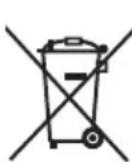
Information on Disposal for Users of Waste Electrical & Electronic Equipment (private households)
This symbol on the products
and/or accompanying documents means that used electrical and electronic products should not be mixed with general household waste.
For proper treatment, recovery and recycling, please take these products to designated collection points, where they will be accepted on a free of charge basis.
Alternatively, in some countries you may be able to return your products to your local retailer upon the purchase of an equivalent new product.
Disposing of this product correctly will help to save valuable resources and prevent any potential negative effects on human health and the environment which could otherwise arise from inappropriate waste handling. Please contact your local authority for further details of your nearest designated collection point.
Penalties may be applicable for incorrect disposal of this waste, in accordance with national legislation.
For business users in the European Union
If you wish to discard electrical and electronic equipment, please contact your dealer or supplier for further information.
Information on Disposal in other Countries outside the European Union
This symbol is only valid in the European Union.
If you wish to discard this product, please contact your local authorities or dealer and ask for the correct method of disposal.
Panasonic Testing Centre,
Panasonic Testing Centre,
© Panasonic Corporation 2022
PN:
F0622-0
Printed in P.R.C.
- CONTENTS
- THANK YOU FOR PURCHASING A PANASONIC APPLIANCE
- INSTALLATION AND CONNECTION
- EXAMINE YOUR MICROWAVE OVEN
- EARTHING INSTRUCTIONS
- IMPORTANT
- THIS UNIT HAS TO BE PROPERLY EARTHED FOR PERSONAL SAFETY
- OPERATION VOLTAGE
- PLACEMENT OF YOUR OVEN
- COUNTER-TOP USE
- IMPORTANT SAFETY INSTRUCTIONS
- USE OF YOUR OVEN
- FAN MOTOR OPERATION
- OVEN LIGHT
- ACCESSORIES
- GLASS TRAY
- ROLLER RING
- COOKING TIME
- SMALL QUANTITIES OF FOODS
- FOODS LOW IN MOISTURE
- EGGS
- PIERCING SKIN
- MEAT THERMOMETER
- LIQUIDS
- PAPER/PLASTIC
- UTENSILS/FOIL
- FEEDING BOTTLES/BABY FOOD JARS
- PARTS OF YOUR OVEN
- DOOR RELEASE BUTTON
- OVEN WINDOW
- NOTE
- CONTROL PANEL
- BEEP SOUND
- START/SET PAD
- SETTING THE CLOCK
- PRESS START/SET
- NOTES
- CHILD SAFETY LOCK
- TO SET
- PRESS START/SET 3 TIMES WITHIN 10 SECONDS
- TO CANCEL
- PRESS STOP/RESET 3 TIMES WITHIN 10 SECONDS
- MICROWAVE COOKING AND DEFROSTING
- SETTING THE COOK TIME/TIMER TIME
- DEFROSTING GUIDELINES
- STANDING TIMES
- BREAD
- MULTI-STAGE COOKING
- QUICK 30 FEATURE
- ADD TIME FEATURE
- USING THE TIMER
- KITCHEN TIMER
- STANDING TIME
- DELAY START
- AUTO PROGRAMMES
- AUTO DEFROST
- SELECT THE DESIRED AUTO DEFROST PROGRAMME
- SET THE WEIGHT OF THE FROZEN FOOD
- AUTO MENU
- QUESTIONS AND ANSWERS
- CARE OF YOUR OVEN
- SPECIFICATIONS
- WEIGHT AND DIMENSIONS SHOWN ARE APPROXIMATE
- INFORMATION ON DISPOSAL FOR USERS OF WASTE ELECTRICAL & ELECTRONIC EQUIPMENT (PRIVATE HOUSEHOLDS)
- FOR BUSINESS USERS IN THE EUROPEAN UNION
- INFORMATION ON DISPOSAL IN OTHER COUNTRIES OUTSIDE THE EUROPEAN UNION
Brand : PANASONIC
Model : NN-E48NBM
Category : Microwave