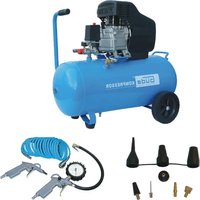
300/09/50 12-TLG - Compressor Güde - Free user manual and instructions
Find the device manual for free 300/09/50 12-TLG Güde in PDF.


| Product type | Oil-lubricated piston compressor, portable |
| Weight | Approx. 32 kg |
| Air tank | 50 liters |
| Power supply | 230 V, 50 Hz, IP20 |
| Motor power | 1.5 kW (P1 S3 60%) |
| Maximum pressure | 8 bar |
| Max. suction capacity | Approx. 235 L/min |
| Effective flow rate | Approx. 165 L/min |
| Number of cylinders | 1 |
| Sound level (LWA) | 92 dB |
| Air connections | 2 |
| Standard equipment | Pressure switch, 2 pressure gauges, pressure reducing valve, safety valve, purge valve, check valve, air filter |
| Maintenance: oil change | Every 100-200 operating hours (first change after 10 h) |
| Maintenance: air filter | Clean every 2000 operating hours |
| Maintenance: tank draining | At least once a month |
| Safety | Use with residual-current device (RCD) mandatory; do not use in rain; safety goggles recommended |
| Spare parts | Use only genuine Güde parts; after-sales service available at www.guede.com |
| Warranty | According to included warranty certificate |
Frequently Asked Questions - 300/09/50 12-TLG Güde
User questions about 300/09/50 12-TLG Güde
0 question about this device. Answer the ones you know or ask your own.
Ask a new question about this device
Download the instructions for your Compressor in PDF format for free! Find your manual 300/09/50 12-TLG - Güde and take your electronic device back in hand. On this page are published all the documents necessary for the use of your device. 300/09/50 12-TLG by Güde.
USER MANUAL 300/09/50 12-TLG Güde
Deutsch D 7
Translation of the original instructions
COMPRESSOR SET
Français F 39
DE
Please read carefully the following Operating Instructions before putting the appliance into operation.
A.V.2
Any reprints, even partial, are subject to approval. Technical changes reserved.
| GB | Do you have any technical questions? Claim? Do you need spare parts or instructions for operation?We are ready to help you quickly and without unnecessary bureaucracy at our site www.guede.com in the part Service. Please help us in helping you. In order to identify your machine in case of a claim we need its serial number, product number and year of production. All the data mentioned can be found at the type plate. Please write them down bellow to have them always handy: | ||
| Serial number: | Product number: | Year of production: | |
| Phone.: +49 (0) 79 04 / 700-360 Fax: +49 (0) 79 04 / 700-51999 E-Mail: support@ts.guede.com | |||
Marking:
Product safety:
| CE | |
| Product corresponds to appropriate standards of the European Union |
Prohibitions:
| General prohibition(in connection with any other icon) | Do not use when raining |
Warning:
| Warning/Attention | Warning against dangerous electric voltage |
Commands:
| Read the Operating Instructions before use | Use protective gloves |
Environment protection:
| Dispose the waste professionally in order not to pollute the environment. | Packing cardboard material may be delivered to collecting centres for recycling. |
| Any damaged or disposed electric or electronic devices must be delivered to appropriate collection centres. |
Package:
| Protect against humidity This side up | |
Technical specification:
 |  | |||
| Network connector | Weight | |||
 |  | |||
| Engine power | Suction | |||
 | [c7z7] | |||
| effective delivery quantity | Maximum Pressure | |||
 | ||||
| Boiler Content | ||||
Appliance
300/09/50 compressor
Mobile piston compressor with oil lubrication, direct drive,
2 compressed air connectors.
Equipment (standard):
Air-pressure switch, 2 manometers, reducer, safety-valve, sludge valve, clack-valve, air filter and discharge valve.
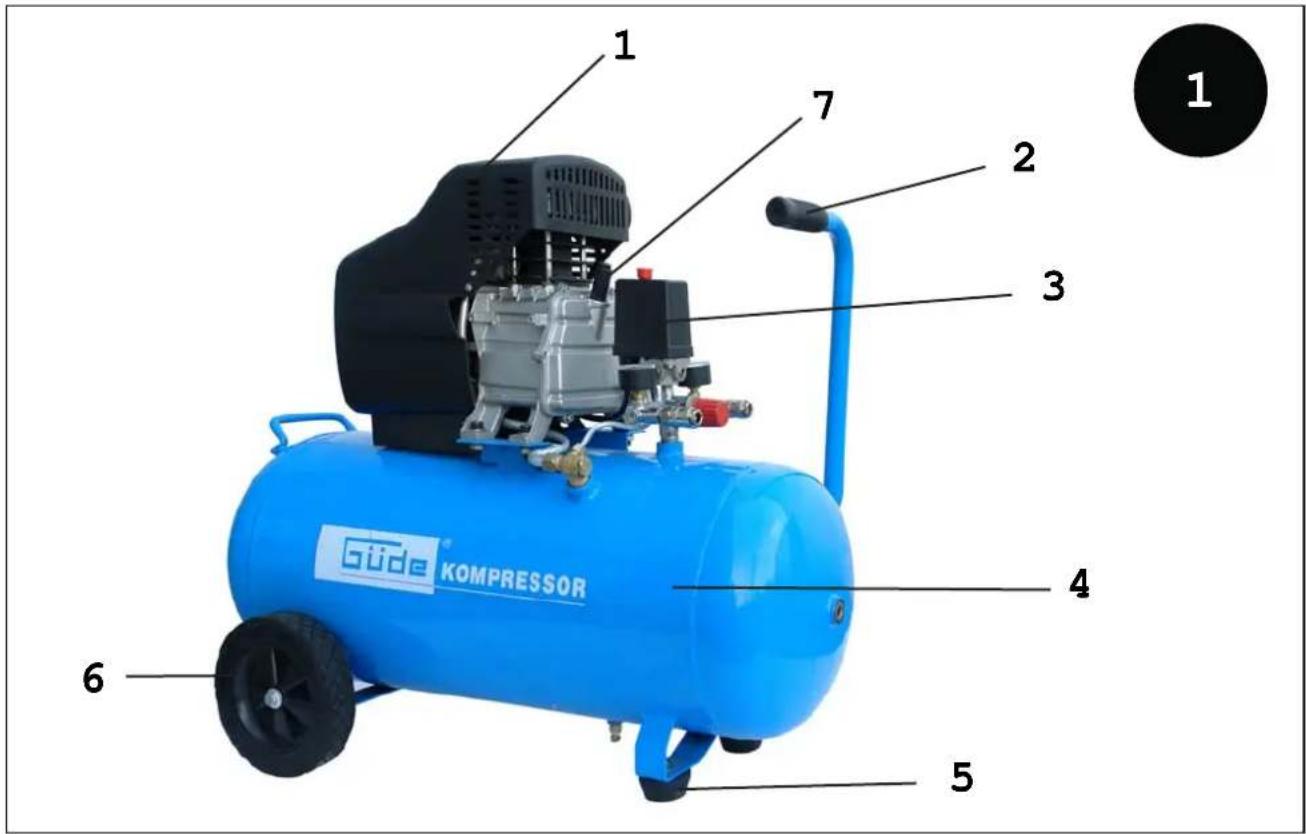
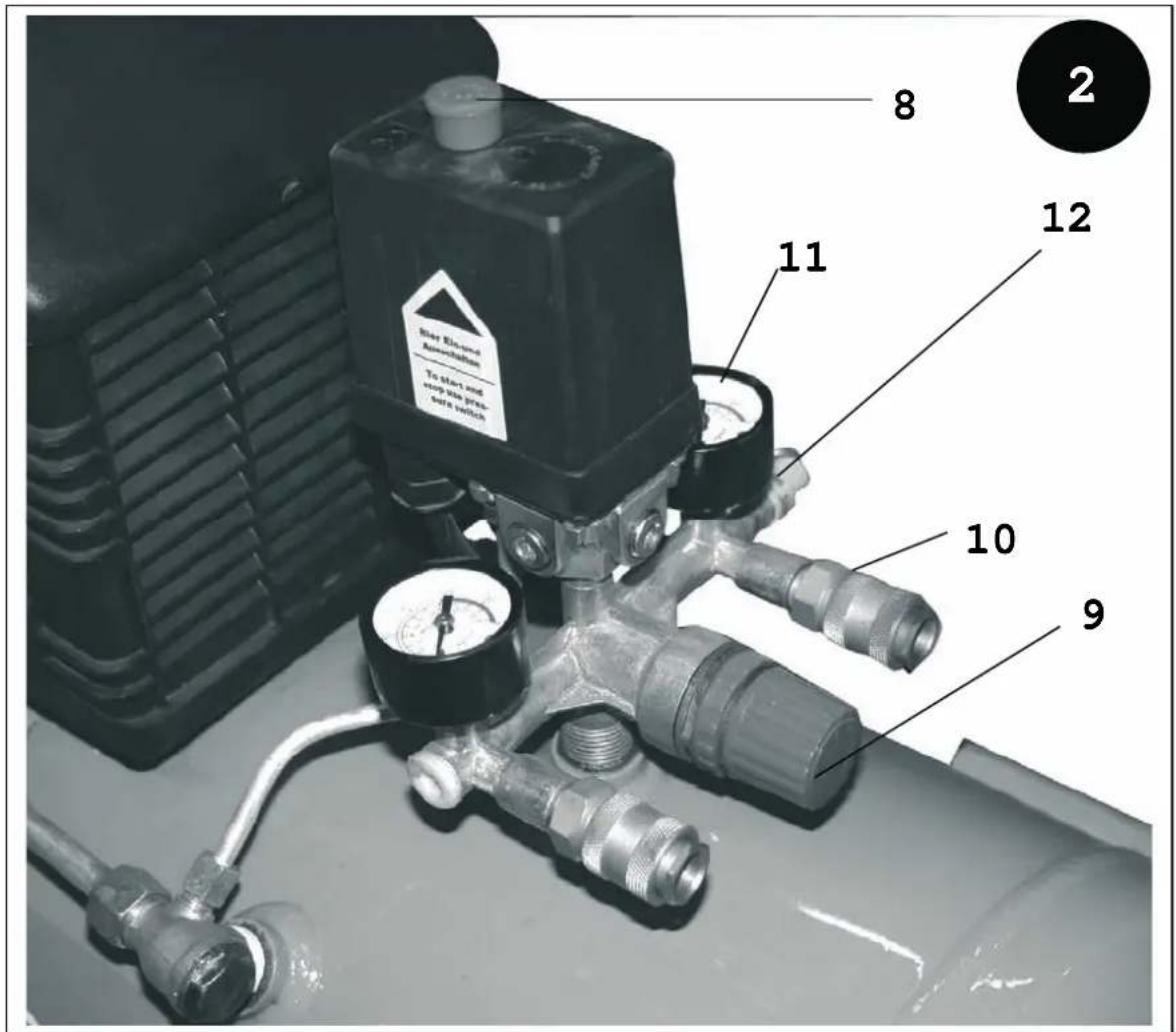
Device Description (pic. 1/2)
- Engine cover
- Carrying handle
- Air-pressure switch with
- Air jet
- Foot
- Transport wheels
- Oil filler
- ON/OFF button
- Pressure regulator
- Compressed air connector
- Manometer
- Purge valve

EU Declaration of Conformity
Wolpertshausen, Germany, hereby declare the conception and construction of the below-mentioned appliances correspond - at the type of construction being launched - to appropriate basic safety and hygienic requirements of EC Directives. In case of any change to the appliance not discussed with us the Declaration expires.
Marking of appliances: 300/09/50 Order No. 71160
Date/producer signature: 01.04.2009
Signed by: Mr Arnold, Managing Director

Appropriate EU Directives:
2006/42/EC
87/404/EC
2006/95/EC
Harmonised standards used:
EN 1012-1:1996
EN 60204-1:2006
Guarantee
Guarantee claims as per guarantee list attached.
Technical data
| 300/09/50 | |
| Connection: 230 V | |
| Frequency / Protection: 50 Hz/IP 20 | |
| maximum performance 1,5 kW/P1 S3(60%) | |
| Boiler Content: 50l | |
| Maximum Suction: ca. 235 l/min | |
| Maximum pressure: 8 bar | |
| Power supply: ca. 165 l/min | |
| Cylinders: 1 | |
| Noise value indication: | LWA 92 dB |
| Weight: ca. 32 kg | |
| SKU: 71160 | |
General safety instructions
The Operating Instructions need to be thoroughly read before first use of the appliance. If you have any doubts concerning the appliance connection and handling please contact the producer (service department).
Installation instructions
- Check whether the appliance has not been damaged during transport.
- Immediately report any damage to the carrier that has supplied the compressor.
- Before putting the appliance into operation, it is necessary to check the oil level in the compressor pump.
- The compressor needs to be installed near an appliance.
- Long air ducts and long service cables (extension cables) are not recommended.
• Make sure the suction air was clean and with no dust. • Do not install the compressor in a humid or wet room. - The compressor can only be used in suitable rooms (with good ventilation, ambient temperature of +5°C to 40°C). There must be no dust, acids, fumes, explosive or inflammable gases.
- The compressor is suitable to be used in dry rooms. Using the compressor at places with spraying water is inadmissible.
TO ENSURE HIGH SAFETY LEVEL, CAREFULLY FOLLOW THESE INSTRUCTIONS:

Attention: Use with FI (safety switch against
stray current) only!
ATTENTION!
- Keep the workplace clean and tidy. Mess in the workplace and work-table increases the risk of accidents and injuries.
- Pay attention to conditions of environment in which you are working. Do not use electric tools and appliances in a humid and wet environment. Ensure sufficient lighting. Do not expose electric tools to rain or high air humidity. Do not switch electric tools on near flammable liquids or gases.
- Do not let foreign people get near the machine. Keep visitors and persons around, especially children
and ill or weak people in a safe distance you're your workplace.
- Ensure safe storage of tools. Store machines you do not use to a dry place, erected if possible, so they are not accessible to other persons.
• Always use the right appliance for every work. Do not use e.g. small appliances or equipment for works that actually need to be executed with big appliances. Use the appliances solely for purposes they have been designed to. Do not overload the appliance!
- Beware of the feeder cable. Do not pull the cable. Do not use it for pulling the plug out. Keep the cable out of reach of thermal sources, oil and sharp edges.
- Avoid unintentional switching on. Before connecting the plug to socket always make sure the appliance is off on the device switch.
- Use only special extension cables outdoors. For outdoor use, you need special extension cables, suitable for this purpose and properly marked.
- Be always careful. Pay attention to what you are doing. Use your common sense when working. Do not use electric tools if you are tired.
- Beware of any damaged parts. Inspect the appliance before use. Are any parts damaged? In case of slight damage, seriously consider whether the appliance is going to work safely and faultlessly.
- Prevent electric shocks. Prevent bodily contact with earthed objects, e.g. water pipes, heaters, cookers and fridges.
- Use approved parts only. Use identical spare parts only at maintenance and repairs. Contact an authorised service centre for that purpose.
- Warning! Any use of accessories and extensions not explicitly recommended in these Operating Instructions can represent a threat to persons and objects.
- Do not lean from your place
Avoid any abnormal poise. Ensure a safe posture and keep continuous balance.
- Do not keep adjusting spanner in the appliance Before switching on, check whether you have taken adjusting spanners and tools away from the appliance.
Safety instructions for first putting into operation
- First of all, pull the plug out of socket before any adjusting and maintenance.
• Children must not use the machine.
• After removing the pack, check whether the appliance and all its parts are in a perfect state.
• Always wear protective glasses and ear protectors
Always wear protective glasses or corresponding protection of eyes and ears. Never aim with the compressed air blast at your body or other persons or animals. The air blast can speed up foreign objects – they can dangerously let fly.
• Always use protective equipment against electric shock Do not use the compressor near water or in a wet environment.
- Compressor shut-down
Before any repairs, revisions, maintenance, cleaning or exchange of construction parts, disconnect the compressor from voltage and completely decompress the air jet.
- Unintentional switching the appliance on
Do not transport the compressor if connected to voltage or if the air jet is pressurised. Before connecting the compressor to voltage make sure the pressure sensor switch is in the OFF position.
• Proper storage of the compressor
When the compressor is not used, store it to a dry place protected against climatic influences. Keep out of reach of children.
- Working clothes
Do not wear wide pieces of clothes and jewels as they can get caught in construction parts.
- Careful maintenance of the compressor

Unconditionally follow all lubrication actions.
Regularly check the line cord. If damaged, have it repaired or replaced in the customer service centre. Make sure the outside of the compressor shows no visible damage. If it does, contact the nearest customer service centre.
- Outdoor use
If you use your compressor outdoors it is allowed to explicitly use extension cables designed for outdoor use with appropriate marking. Attention: it is necessary to use a cable with sufficient cross section (min. 1.5 2 mm); at cables longer than 10 m there can be problems at machine start-up at unfavourable temperatures.
- Focus
Work carefully and use common sense. Do not use the compressor when you are tired. It is not allowed to use the compressor when impaired, intoxicated or under influence of medicines, able to induce tiredness.
- Check whether the parts are not faulty or untight
If protective equipment or other compressor parts are damaged they need to be checked before putting them back into operation and you must make sure their operation is reliable.
All damaged parts need to be repaired or replaced by the customer service centre or replaced according to instructions included in the Operating Instructions.
- Correct use of the compressor
At operating the compressor, follow all instructions of this manual. Prevent children or persons not familiarised with the manner of its work from using the compressor.
- Keep the air terminal unit clean
Keep the engine air terminal unit clean. Clean it regularly if you use the compressor in a heavily polluted environment.
- Use the compressor at rated voltage
Use the compressor at voltage specified on the label with electric data. If you use the compressor at voltage higher than the nominal value the engine can overheat.
- Running appliance must never be unattended
- Do not use the compressor when faulty
If the running compressor makes any strange noise or has strong vibrations or seems to be faulty in any other manner it is necessary to immediately switch it off; have the cause identified in the nearest customer service centre.
- Do not clean plastic parts with solvents
Solvents like petrol, thinners, diesel oil or other substances containing alcohol can damage plastic parts of the compressor. That is why you should not clean plastic parts with these substances but, if necessary, use soap suds or suitable liquids.
- Use original spare parts only
Should you use spare parts by other producers, all your claims arising from the guarantee will expire. Use of foreign spare parts can lead to malfunction of the compressor. Original spare parts are available at our contracting partners.
- Do not make any changes on the compressor
Do not make any changes on the compressor. Always contact the customer service centre with any repair. Any disallowed change can negatively influence the compressor output but also cause serious injuries if made by a person without sufficient technical knowledge.
- Do not touch hot parts of the compressor
Do not touch the piping, engine and other hot parts of the compressor or there is a risk of burns.
Do not leave the appliance unattended as it can become a source of danger.
- At maintenance and repair of safety and protective devices it is necessary to correctly assemble them immediately after finishing these works.
- It is unconditionally necessary to know regulations for the prevention of accidents valid in the given place of use as well as all those, generally recognised regulations.
- Before using the appliance, you necessarily need to check the safety equipment. Inspect whether just slightly damaged parts can really work properly.
- Unless provided otherwise in these Operating Instructions, the damaged parts and safety equipment must be repaired or replaced by an authorised service centre.
- Have any damaged switches replaced in an authorised service centre.
- The appliance corresponds to all appropriate safety provisions. Repairs can only be executed by qualified electricians in authorised service centres using original spare parts. Failing which, there is a risk of accident.
Safety instructions for work with compressed air and blow guns
- Compressors and piping reach high temperatures at operation. Any contact with them leads to burns.
- Compressor-sucked gases and fumes must not contain any admixtures as they can cause fire or explosion in the compressor.
- When loosening the hose coupling it is necessary to hold the hose coupling by hand to prevent injury as a result of hose shoot-out.
- Always wear protective glasses when working with the blow gun. Foreign objects and blown-away parts can cause slight injuries.
- Do not blow with your blow gun at persons and do not use it for cleaning clothes on your body.
Safety instructions at colour spraying
- Do not work with varnishes and solvents with a flash point below 21°C.
- Do not heat varnishes and solvents.
- If you work with any deleterious liquids it is necessary to use filtration appliances (face masks) as your protection.
- Follow information on protective measures given by producers of these substances, too.
- It is necessary to follow the specified data on packages of processed materials and markings of dangerous substances. Eventually, it is necessary to take additional protective measures, especially wearing suitable clothes and masks.
- It is not allowed to smoke in the workplace during spraying.
• Colour fumes are also very combustible. - Sources of danger like fires, open light and machines with flying sparks need to be avoided.
- Do not store or consume food and beverages in the workplace. Colour fumes are harmful.
- The workplace needs to have a size of more than 30 m 3 and sufficient air change be guaranteed at spraying and drying. Do not spray against the wind. At spraying of combustible or dangerous colours, always observe provisions of the local police.
- The PVC delivery hose must not come into contact with media such as the testing petrol, butanol and methylene chloride (shortened service life).
Operation of pressure tanks
- The operator of a pressure tank must keep it in a proper state, use, treat it correctly, ensure necessary maintenance and repair it immediately and take necessary safety measures depending on the given circumstances.
- An auditing body can order appropriate control measures in individual cases.
- Do not use the pressure tank if it shows any faults that could threaten employees or third parties.
- The pressure tank needs to be regularly checked for damage or rust.
- If you identify any damage please contact the customer service workshop.
Behaving in emergency
Introduce first aid corresponding to injuries and seek a qualified medical person as soon as possible. Protect the injured person against other injuries and calm him/her down.
Use as designed
For blowing and soft works with compressed air, in clay-modelling, for wall airbrush, airbrush varnishing, tire pressure rating, etc.
Residual risks and safeguards
Direct electric contact
Faulty cable or plug can lead to a life-threatening electric shock.
Have the faulty cable or plug replaced by a professional. Use the appliance on a connector with a safety switch against stray current (FI) only.
Indirect electric contact
Injuries by conductive parts at exposed electric or faulty construction parts.
Always pull the plug out of socket at maintenance. Use with an FI switch only.
Insufficient local lighting
Insufficient lighting represents a high safety risk.
Always ensure sufficient lighting when working with the appliance.
Disposal
The disposal instructions are based on icons on the appliance or its package. The description of their meanings can be found in the "Marking on Appliance" Chapter.
Transport package disposal
The package protects the appliance against damage during transport. Package materials are usually selected in terms of environment protection and disposal manner and can be recycled.
Putting the package back into circulation saves raw materials for the material and cuts costs for material processing.
Parts of the package (e.g. foils, styropor) can be dangerous for children. There is a risk of suffocation! Keep parts of the package out of reach of children and dispose them as quickly as possible.
Handling requirements
The operating staff must carefully read the Operating Instructions before using the appliance.
Qualification
Apart from the detailed instruction by a professional no special qualification is necessary for using the appliance.
Minimum age
Only persons over 16 years of age can work with the appliance. An exception includes youngsters if they work within their professional education whose purpose is to obtain knowledge supervised by a trainer.
Training
Using the appliance only requires corresponding training by a professional or following of the Operating Instructions. No special training is necessary.
Transport and storing
- At longer storing, the appliance needs to be thoroughly cleaned and placed in a manner that no unauthorised persons could access it.
- Never store and transport the compressor horizontally and under pressure!
- The pressure in the air jet can be reduced at cooling the compressed air.
Assembly / first putting into operation (pic. 3-8, 10)

Check the oil level at every start-up!!!

Before putting the compressor into operation, it is necessary
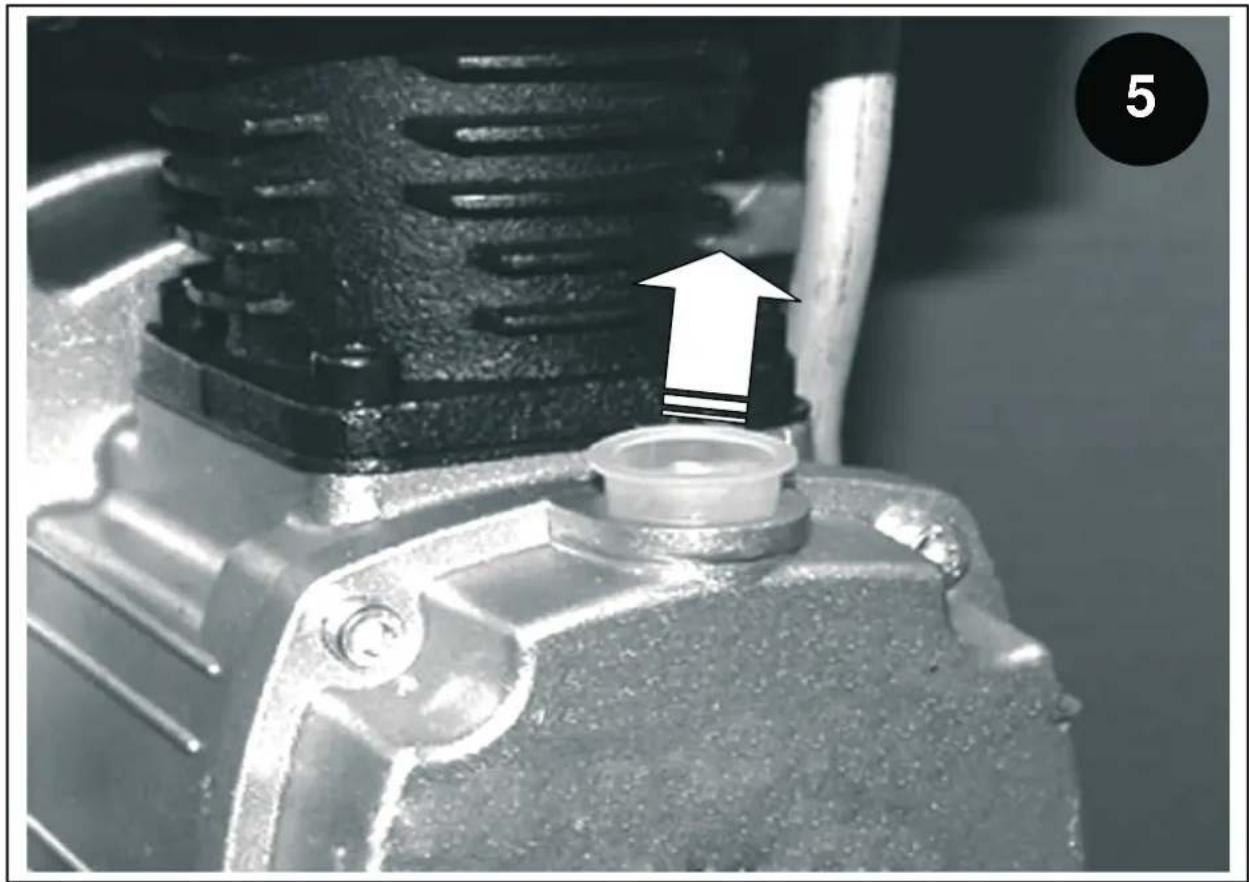
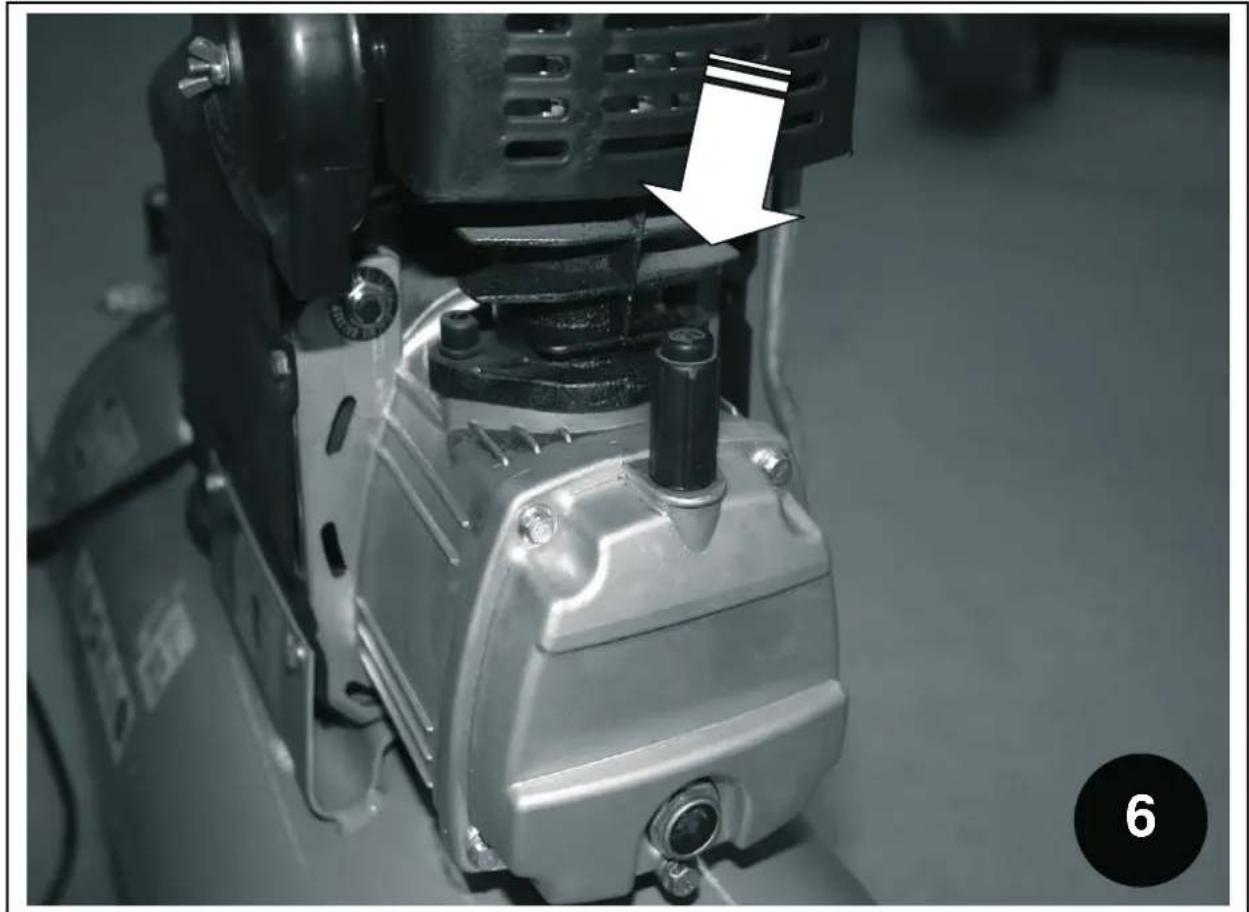
to replace the transport peg of the oil with an oil fill mouth and correct oil level needs to be ensured.
Position the compressor on a horizontal, flat and sufficiently high working surface to prevent compressor oil flowing out.
Due to transport, the compressor is not supplied in a completely assembled state.
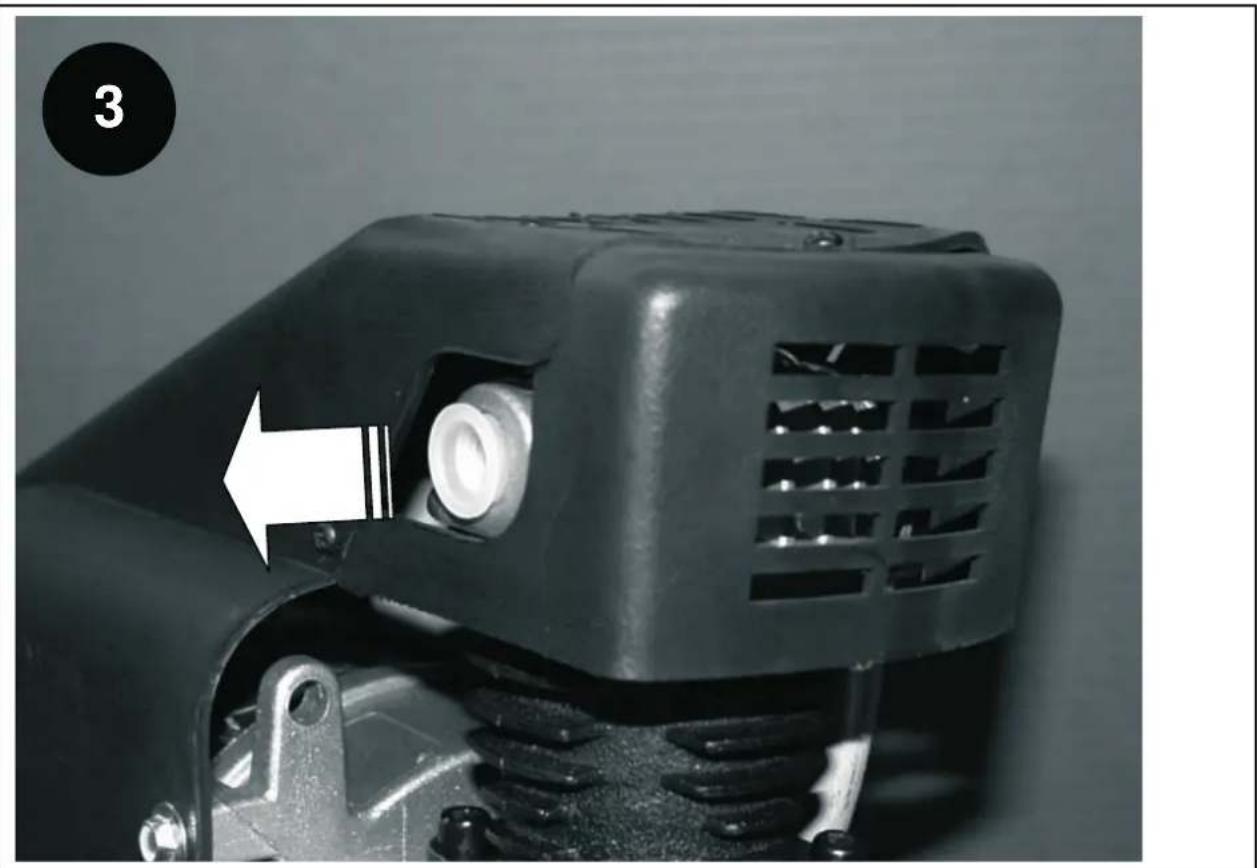
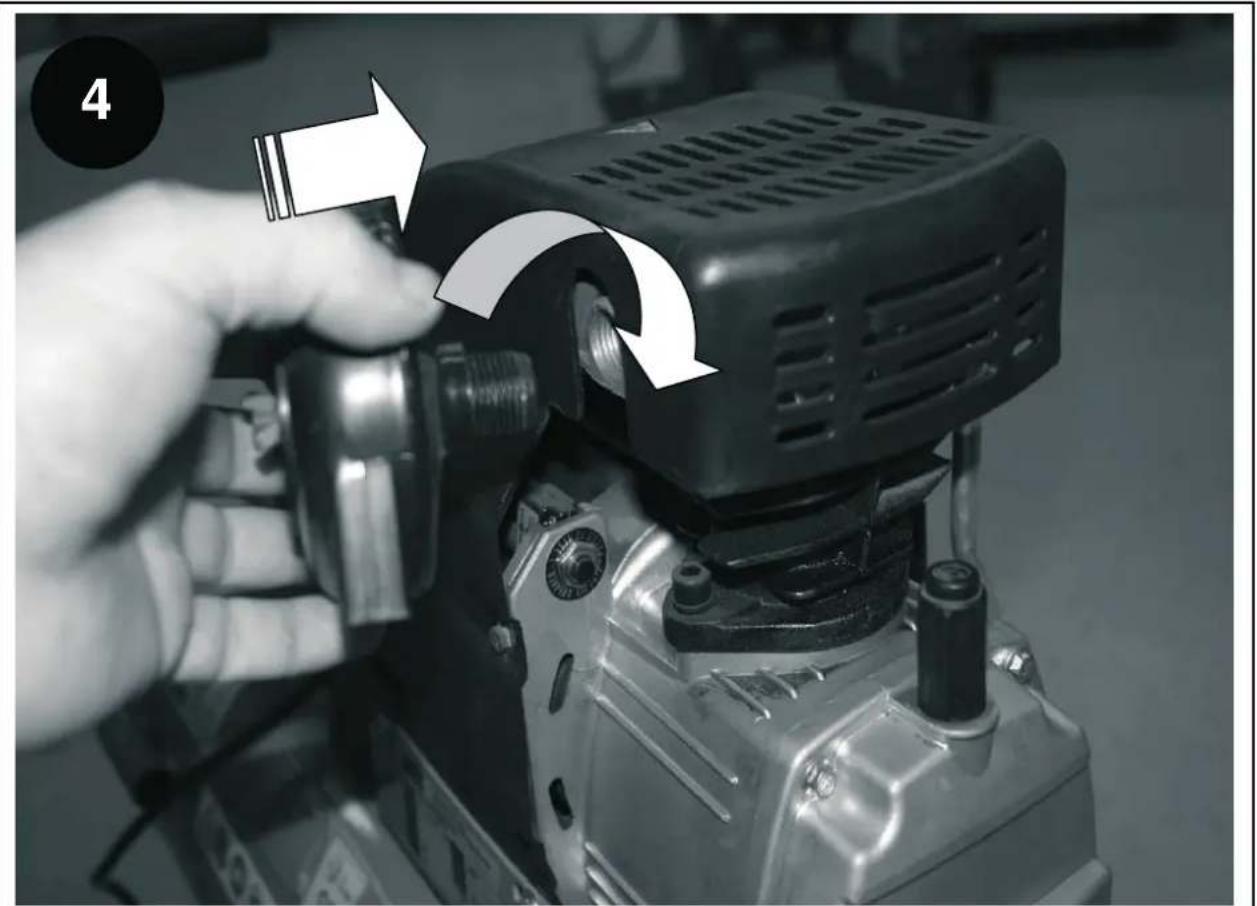
The air filter needs to be first assembled:
You must take the transport peg of the air filter out and screw the attached air filter on instead. Put the air filter on the thread and tighten it clockwise with your hand. If you immediately find out the air filter can only hardly be tightened please check again whether it is cleanly put on the thread as, failing which, the plastic thread on the air filter can get damaged. It is recommended to clean the air filter each 2,000 service hours (the required position of the suction inlet can be fixed by tightening the wing-nut).
Now you need to mount the oil tank peg:
You must take the transport peg of the oil tank out and insert the attached peg instead the correct oil level needs to be ensured, too. Proceed as follows:
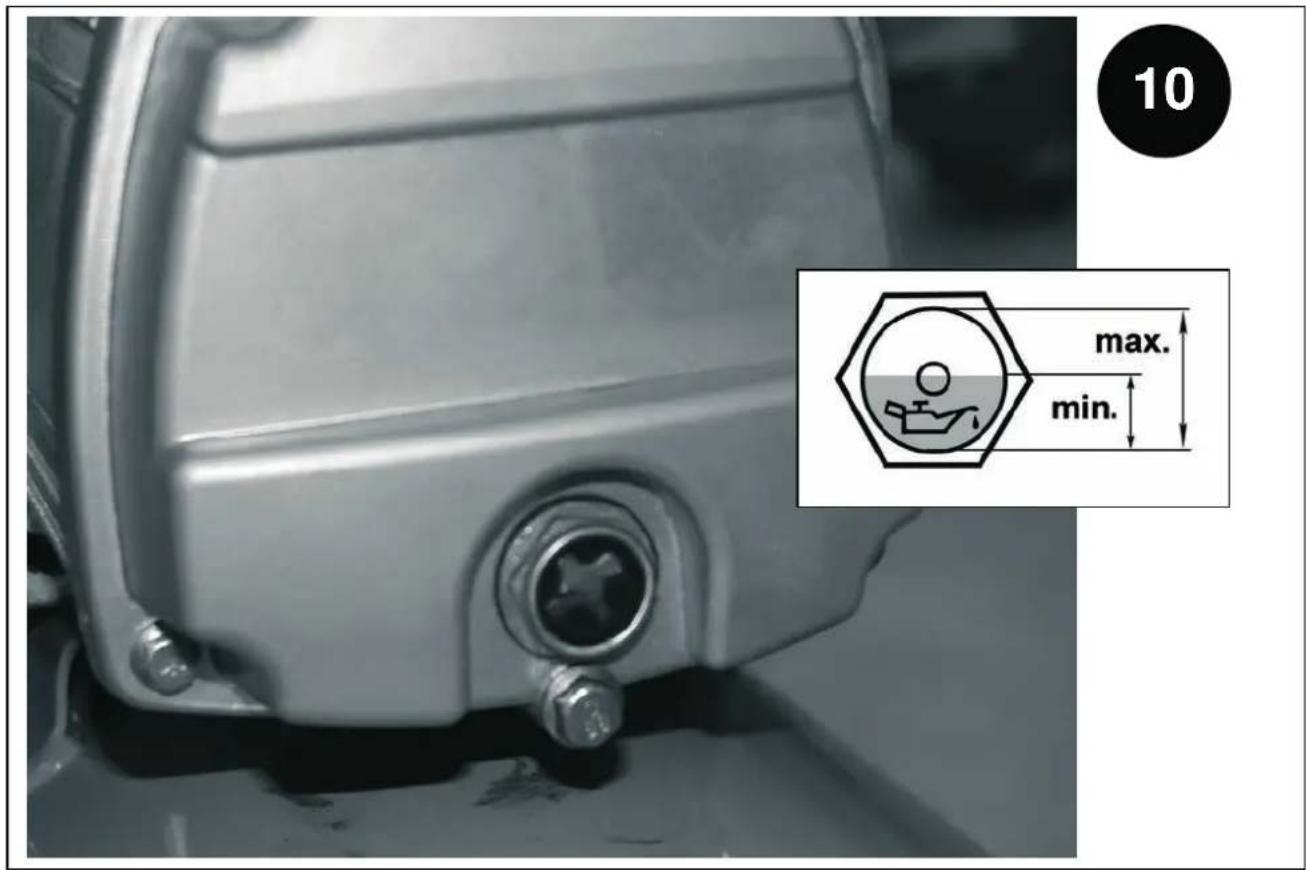
Take the transport oil peg out. Pour oil as much as to the marking in the aperture. Then mount the oil fill mouth. When emptying or changing the oil, screw the drain screw out.
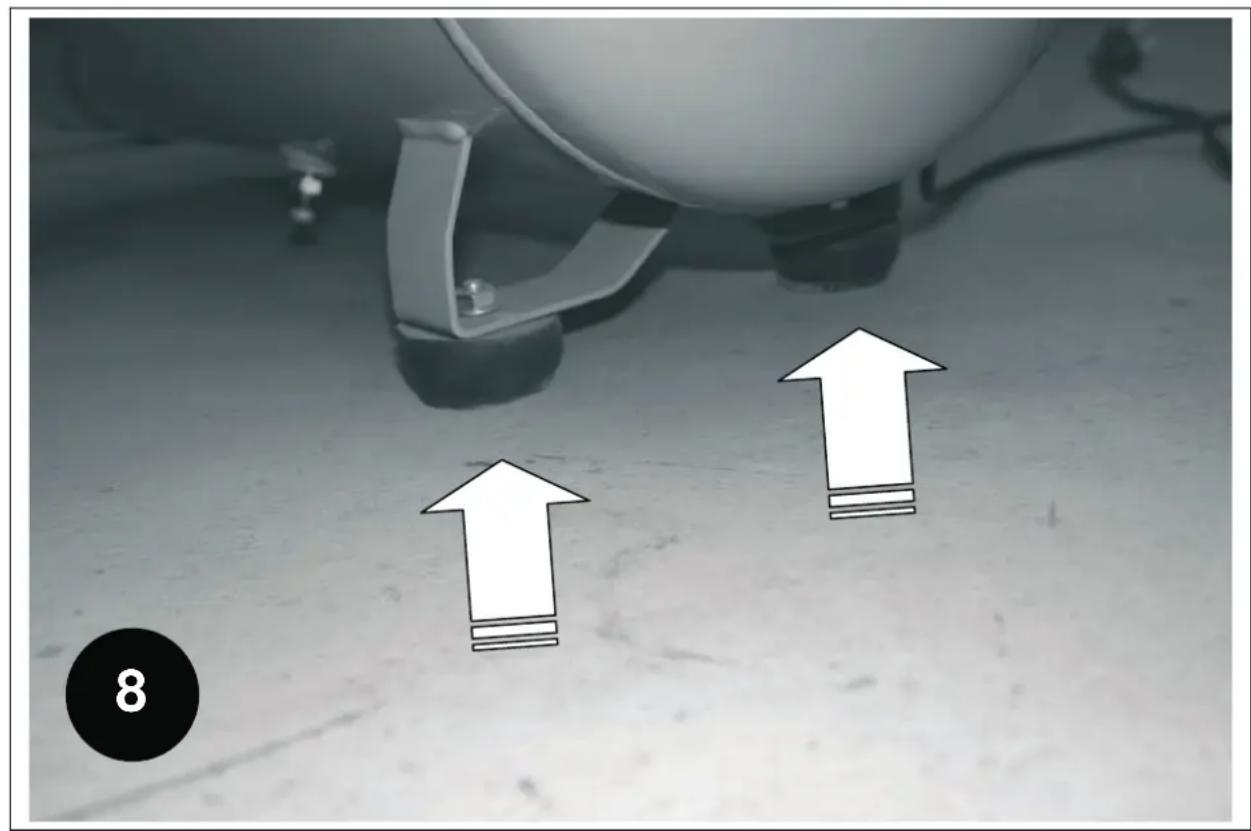
Assembly of the transport wheels and the feet (Fig. 7 / 8)
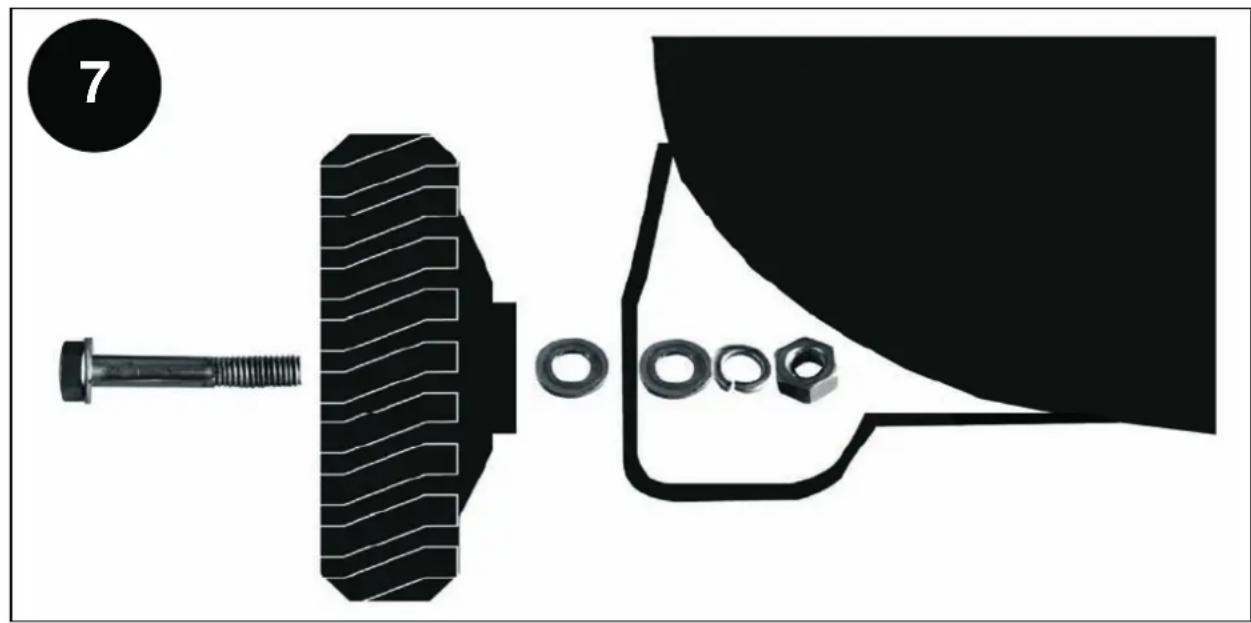
Screw the transport wheels on each side with the supplied nuts and washers to (you need a wrench is not included in the package is). In Figure 7 you see the order of the Wheel:
- bolt through the hole in the wheel press
- Disc enclose
- wheel with screw and washer through the hole of the axle lead.
- washer on the bolt end slide
• Spring ring screws on the end slide
- Mother and turn well tighten.
Stand mount
The feet are as in (Fig. 8) to see tightened.
Oil change (pic. 10)

Since arriving on the piston can chip, it is lately necessary after the first 10 hours of operation to carry out an oil change. We recommend you are our compressor (SKU: 40056). Later, adding on the operation of the compressor, all 100 hours of operation an oil change place. In order by out oil changes, open the drain screw (16) and the process of waste oil in a suitable container.

Observe strictly the rules for disposal of waste dispose of it properly in a waste oil collection
Unscrew the drain screw is now firmly back on and fill oil up to the mark on the dipstick

In winter we recommend a lubricity oils to start the cold season to help!
Handling (pic. 1,2)

Turn the compressor never about the power, wise no discharge of the unit is done. Without charge, the electric motor through the back pressure e!

The plug needs to be pulled out of socket before djusting or maintenance of the compressor.
Switching on or off
- The compressor can be switched on by pulling the switching button and switched off by pushing the button.
Working pressure control
- The working pressure can easily be adjusted, turn the rotary knob in the + direction, by this the working pressure is increased. Turn the rotary knob in the - direction, by this the working pressure is decreased. There is an automatic safety valve releasing pressure at overpressure. The pressure can be released by hand by pulling the valve ring.
ATTENTION:
Ensure necessary volume delivered of your pneumatic appliance! The pressure itself IS NOT decisive for a
faultless or sufficient operation. Switching the compressor on for a short time following a long shut-down without using it is normal! Have any scheduled repairs explicitly executed by a trained professional staff.
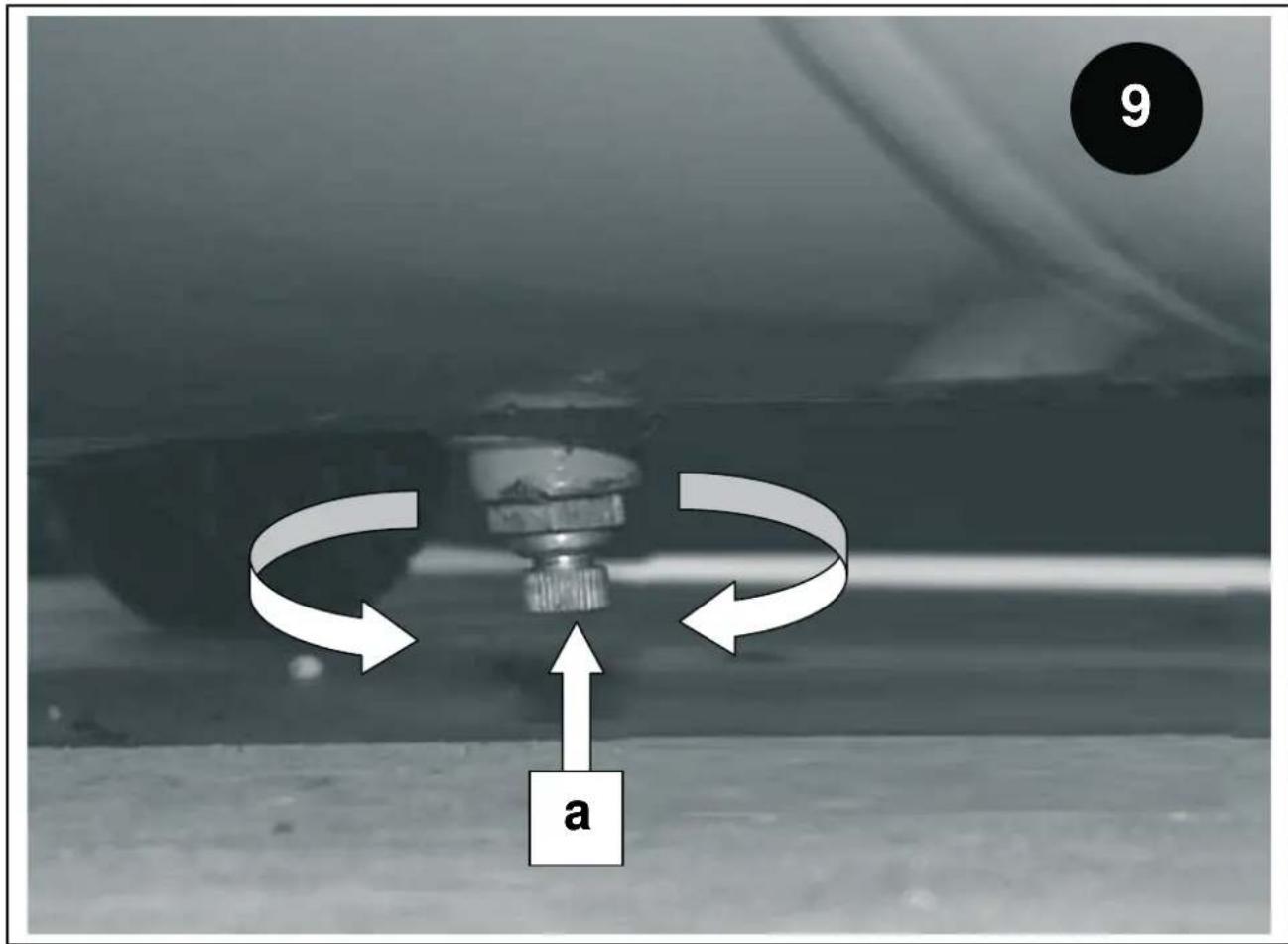
Inspections and maintenance (pic. 9)
Always pull the plug out of socket before each work on the appliance. Before any long period of not using of the compressor it is necessary to give a few oil drops on the air filter washer – compressor cylinder walls will prematurely be lubricated at the next start.
- To clean the plastic parts, use a damp cloth. Do not use any cleaners, solvents or sharp objects.
- After each use, remove any settled dust from air holes and mobile parts with a soft brush.
Regularly lubricate all mobile metal parts with oil.
After each use
Remove dust from air holes and mobile parts.
Regularly
Lubricate mobile metal parts with oil (multipurpose oil)
Check whether all screws are firmly tightened.
Regularly (at least once a month) remove condensation from the air jet otherwise your rust guarantee will expire – apart from this activity, the compressor is maintenance-free (due to the air jet surface, the condensation can get brown).
-
Pull the plug out of socket!
-
Open the sludge valve (pic. 9/a) at low voltage in the air jet (max. 1 bar) and completely empty the condensation (use a suitable container)
-
Close the valve.
Overheating fuse:
If the compressor has any technical defect or is burdened with a continuous run the current supply is automatically interrupted by a thermal switch. Should this situation occur, it is suitable to disconnect the compressor from network and leave it cool down for app. 5 minutes. If the compressor fails to start after some time of working leave it cool down for other 3 minutes.
Air-pressure switch:
The compressor is fitted with an automatic air-pressure switch that is switched off by the compressor after reaching a maximum service pressure and switched on at repeated need of air. Switching pressure of 6 bar, max. pressure of 8 bar.
Air filter
Sometimes it is necessary to clean the air filter insertion. To do that, take the wing-nut out of the air filter cover and remove the foam filter. The filter can be cleaned with warm soap suds. Dry and reinsert the foam filter. Fix the air filter cover again.
FR
- DE
- PLEASE READ CAREFULLY THE FOLLOWING OPERATING INSTRUCTIONS BEFORE PUTTING THE APPLIANCE INTO OPERATION
- A.V.2
- MARKING
- APPLIANCE
- DEVICE DESCRIPTION (PIC. 1/2)
- EU DECLARATION OF CONFORMITY
- APPROPRIATE EU DIRECTIVES
- HARMONISED STANDARDS USED
- GUARANTEE
- GENERAL SAFETY INSTRUCTIONS
- INSTALLATION INSTRUCTIONS
- TO ENSURE HIGH SAFETY LEVEL, CAREFULLY FOLLOW THESE INSTRUCTIONS
- ATTENTION: USE WITH FI (SAFETY SWITCH AGAINST
- STRAY CURRENT) ONLY
- ATTENTION
- DO NOT LEAN FROM YOUR PLACE
- SAFETY INSTRUCTIONS FOR FIRST PUTTING INTO OPERATION
- ALWAYS WEAR PROTECTIVE GLASSES AND EAR PROTECTORS
- COMPRESSOR SHUT-DOWN
- UNINTENTIONAL SWITCHING THE APPLIANCE ON
- PROPER STORAGE OF THE COMPRESSOR
- WORKING CLOTHES
- UNCONDITIONALLY FOLLOW ALL LUBRICATION ACTIONS
- DO NOT LEAVE THE APPLIANCE UNATTENDED AS IT CAN BECOME A SOURCE OF DANGER
- SAFETY INSTRUCTIONS FOR WORK WITH COMPRESSED AIR AND BLOW GUNS
- SAFETY INSTRUCTIONS AT COLOUR SPRAYING
- OPERATION OF PRESSURE TANKS
- BEHAVING IN EMERGENCY
- USE AS DESIGNED
- RESIDUAL RISKS AND SAFEGUARDS
- DIRECT ELECTRIC CONTACT
- INDIRECT ELECTRIC CONTACT
- INSUFFICIENT LOCAL LIGHTING
- DISPOSAL
- TRANSPORT PACKAGE DISPOSAL
- HANDLING REQUIREMENTS
- QUALIFICATION
- MINIMUM AGE
- TRAINING
- TRANSPORT AND STORING
- ASSEMBLY / FIRST PUTTING INTO OPERATION (PIC. 3-8, 10)
- THE AIR FILTER NEEDS TO BE FIRST ASSEMBLED
- NOW YOU NEED TO MOUNT THE OIL TANK PEG
- ASSEMBLY OF THE TRANSPORT WHEELS AND THE FEET (FIG. 7 / 8)
- STAND MOUNT
- OIL CHANGE (PIC. 10)
- HANDLING (PIC. 1,2)
- SWITCHING ON OR OFF
- WORKING PRESSURE CONTROL
- INSPECTIONS AND MAINTENANCE (PIC. 9)
- AFTER EACH USE
- REGULARLY
- OVERHEATING FUSE
- AIR-PRESSURE SWITCH
- AIR FILTER
- FR
Brand : Güde
Model : 300/09/50 12-TLG
Category : Compressor