
WP-DC34 - Camera CANON - Free user manual and instructions
Find the device manual for free WP-DC34 CANON in PDF.
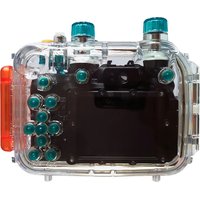


| Product Type | Waterproof Housing for Digital Camera |
| Brand | Canon |
| Model | WP-DC34 |
| Maximum Operating Depth | 40 meters (130 feet) |
| Materials | Polycarbonate, ABS, transparent glass plate, EPDM (gasket) |
| Dimensions (excluding protrusions) | 153.5 × 107.5 × 119.1 mm |
| Weight (housing only with diffusion plate) | Approximately 575 g |
| Operating Temperature | 0 to 40 °C |
| Waterproof Rating | IPX8 (IEC/JIS) |
| Gasket | EPDM O-ring, to be lubricated with the supplied silicone grease |
| Supplied Accessories | Waterproof housing, collar, wrist strap, diffusion plate, silicone grease, user manual |
| Main Functions | Allows underwater use of compatible Canon camera up to 40 m; access to all buttons and dials (zoom, shutter, modes, etc.) |
| Maintenance and Cleaning | Rinse with fresh water after use in sea; wipe with a soft cloth; do not wash the interior with water |
| Safety | Do not use deeper than 40 m; do not open underwater; check waterproofing before each use; replace gasket annually |
| Spare Parts and Repairability | Replaceable gasket (contact Canon); weight sold separately (WW-DC1, 4 recommended) |
| General Information | Designed for compatible Canon cameras; do not use as a floating device; store in a dry, dust-free place |
Frequently Asked Questions - WP-DC34 CANON
User questions about WP-DC34 CANON
0 question about this device. Answer the ones you know or ask your own.
Ask a new question about this device
Download the instructions for your Camera in PDF format for free! Find your manual WP-DC34 - CANON and take your electronic device back in hand. On this page are published all the documents necessary for the use of your device. WP-DC34 by CANON.
USER MANUAL WP-DC34 CANON
Photography
Playback
1 Press the ▶ (Playback) button.
For storage
- While every effort has been made to ensure that the information contained in this guide is accurate and complete, no liability can be accepted for any errors or omissions. Canon reserves the right to change the specifications of the hardware and software described herein at any time without prior notice.
- No part of this guide may be reproduced, transmitted, transcribed, stored in a retrieval system, or translated into any language in any form, by any means, without the prior written permission of Canon.
- Canon makes no warranties for damages resulting from corrupted or lost data due to a mistaken operation or malfunction of the camera, the software, memory cards, personal computers or peripheral devices.
Copyright © Canon Inc. 2009 All rights reserved.
Please read this manual carefully to operate the Waterproof Case correctly. Store this manual in a safe place for further reference once you have read it.
Introduction
- Thank you for purchasing this Waterproof Case. Once installed in the Waterproof Case, you can use your Canon Digital Camera in the rain, at the beach or on the ski slopes. You can also use it underwater at depths down to 40 meters (130 ft.) and in wet or dusty environments.
- Before you use the Waterproof Case, please make sure the case is functioning correctly and does not leak. Close the Waterproof Case before putting the camera inside it, and hold it underwater at an approximate depth of 15 cm (5.9 in.) for around three minutes to check for leaks. Perform a similar check after you install the camera. If it leaks, contact your Canon Customer Support Help Desk.
- Canon Inc., its subsidiaries and affiliates, and distributors of the Waterproof Case are not liable for any consequential damages arising from corrupted or lost data due to mistaken operation or malfunction of the Waterproof Case, the camera, the battery or the memory card that results in the failure of an image to be recorded. - Please carefully read the Camera User Guide supplied with your camera also.
Unpacking
The Waterproof Case is shipped with the items listed below. Please check your package now to confirm that it is complete. Contact your Canon dealer if anything is missing.
- Waterproof Case
- Neck Strap
- Wrist Strap
- Diffusion Plate • Silicone Grease for the Waterproof Seal
- User Guide (this guide)
Sold Separately
- Canon Waterproof Case Weight WW-DC1
When using the Waterproof Case to take photographs underwater, the weights prevent the case from floating. Please refer to the specifications (p. 19) for information regarding the number of weights recommended for installation. For information on attaching the weights, please refer to the user guide for the weights.
Safety Precautions
Before you use the Waterproof Case, thoroughly read these precautions to ensure correct use. The precautions described below are for ensuring safe use of the Waterproof Case and for preventing danger and damage to yourself and others. Thoroughly understand the details of these precautions before reading the rest of this manual.
- After you use the Waterproof Case, be sure to remove the camera from it. If you leave the Waterproof Case containing the camera in direct sunlight or in a high-temperature place, this may cause a fire or the case to burst.
- Do not use the Waterproof Case in place of a personal flotation device (life jacket).
- Do not use the neck strap underwater. Remove the neck strap and attach the wrist strap before use underwater. There is danger that the neck strap will become entangled and cause strangulation or another mishap.
- Do not use the Waterproof Case at water depths exceeding 40 meters (130 ft.). The case may malfunction, suffer damage or leak.
- Do not press the buttons or the lever of the Waterproof Case with unnecessary force when in the water. This may warp the casing and cause leaks.
- When cleaning the case, do not spray water at the waterproof seal under pressure. This may cause leaks.
- Do not disassemble or modify the Waterproof Case. This may cause leaks.
- Do not damage the waterproof seal, scratch its contact surfaces, or allow dirt, sand, hair or other debris to accumulate between the waterproof seal and the case. This may cause leaks.
- Do not use the Waterproof Case in water at temperatures above 40°C (104°F). Heat may warp the casing and cause leaks.
- Do not leave the Waterproof Case in direct sunlight, inside a car in hot weather, or near a heater. Heat may warp the casing and cause leaks. Cover it with a towel, for example, if you have to leave it in the sun.
Handling Precautions
- Do not drop or throw the Waterproof Case.
- Use only the supplied silicone grease. Use of other waterproofing products may impair the strength of the Waterproof Case. If any other waterproofing product is mistakenly applied, wipe it off immediately.
- Avoid opening or closing the Waterproof Case near water. When you are installing the camera or changing the memory card or the battery, choose a place with low humidity well away from salty sea air.
- Avoid using the Waterproof Case for long periods of time in hot temperatures.
- Battery life is reduced in cold temperatures. When you use the Waterproof Case in very cold places, keep it warm by putting it in a bag whenever you are not shooting. It is not advisable to use the Waterproof Case in temperatures below the freezing point.
- Moving the Waterproof Case rapidly between hot and cold temperatures may cause condensation (water droplets) to form on its internal surfaces. If this occurs, stop using the camera immediately as the condensation may cause a malfunction. Remove the camera from the Waterproof Case and wipe off the condensation from the Waterproof Case and the camera with a soft and dry cloth, and wait until the moisture evaporates completely before resuming use.
About Water Leakage
Stop shooting immediately if the Waterproof Case leaks. If you use the camera in this state, this may cause a fire or electric shocks. Never use it in this state. Thoroughly wipe the Waterproof Case interior and the camera dry. Please contact your Canon Customer Support Help Desk.
Waterproof Seal
- Debris (e.g. sand, dirt or hair) stuck to the waterproof seal may cause water leakage. Catching a single strand of hair or a tiny grain of sand in the seal can cause leaks.
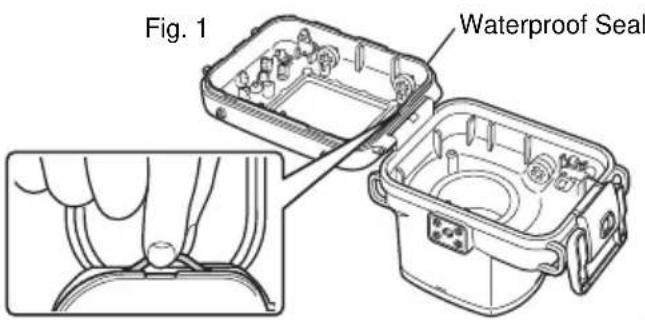
- When removing the seal from your Waterproof Case, use your fingers so you do not damage the waterproof seal (as shown in Fig. 1). Do not dig your fingernails into it or use pointed or metallic objects to remove it.
- Do not pull the waterproof seal. Pulling the seal may overstretch it, which may cause the case to not close properly and cause leaks.
- While mounting the waterproof seal, do not twist or pull the seal with force. Extreme care should be taken to ensure the waterproof seal is level around the mounting groove. Please check to ensure that the waterproof seal is working.
- Be careful not to apply too much grease. Applying too much grease to the seal may cause water leakage (about a droplet is sufficient).
- Do not use paper or cloth to apply the grease to the seal.
- A damaged or cracked waterproof seal may cause leaks. Please contact your Canon Customer Support Help Desk.
To ensure that the Waterproof Case remains waterproof, it is recommended to replace the seal once a year. Please contact your Canon Customer Support Help Desk.
Care and Maintenance
- Wash the exterior of the Waterproof Case with enough clean fresh water (tap water under 30 °C/ 86 °F, etc.) as soon as possible after using it. It is particularly advisable to soak it in fresh water for several hours after use in salt water to remove salt deposits. Please check that you have locked the catch securely to prevent water from entering the case. Wipe it dry with a soft cloth after washing. To avoid scratching the Waterproof Case, do not wipe it while any sand or grit remains on it. The metal parts may rust or the buttons may become hard to press if salt deposits remain. Wipe the interior of the case with a soft, dry cloth. Do not wash it with water.
Components
Front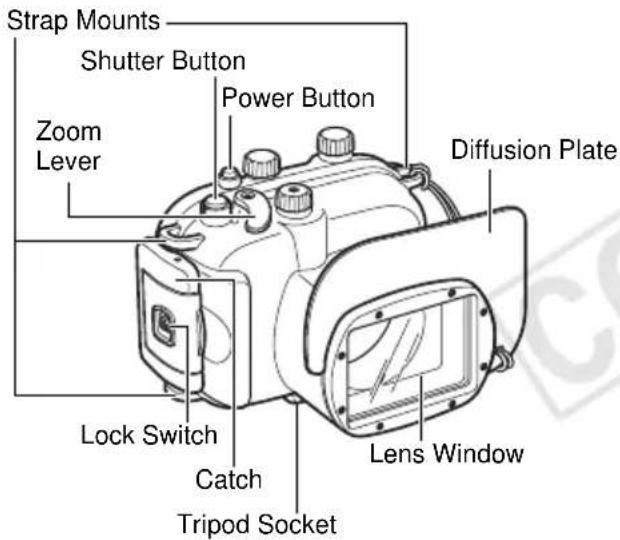
Lens Window
Since dirt or smudges on the lens window may show in photographs, keep the lens window clean by wiping it gently with a soft, dry cloth.
Back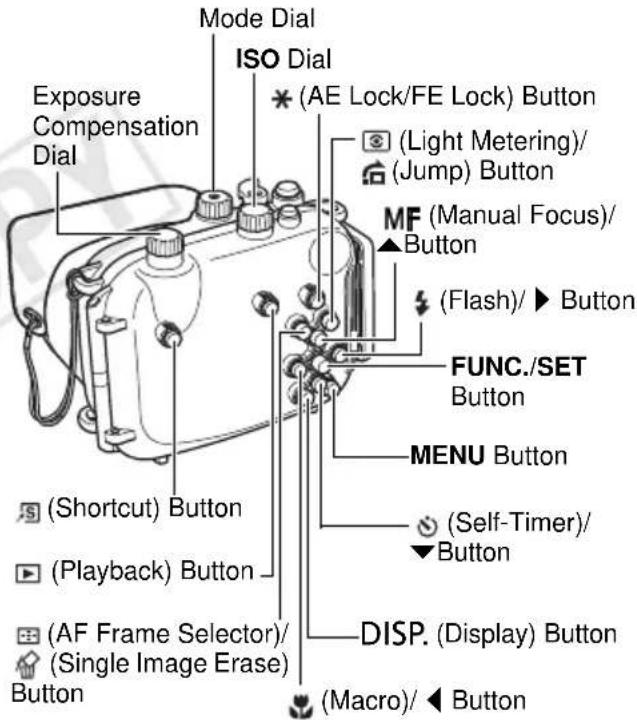
Preparations
Preparing the Camera
1 Confirm that the camera's power is off and open the memory card slot/battery cover.
2 Insert the battery, and the memory card.
- Please refer to the Camera User Guide for information regarding the installation methods for the battery and memory card.
- Use a battery that is adequately charged.
- Ensure you have enough storage space on your memory card to record your images.
3 Remove the camera's strap.
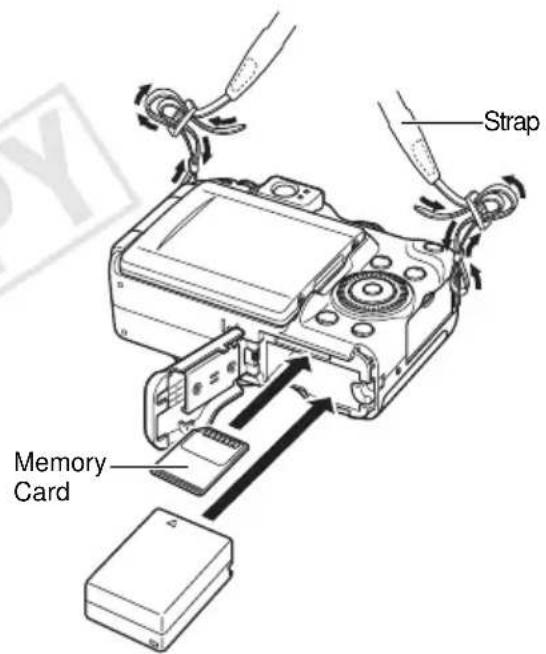
Inserting the camera while the strap is attached could trap the strap in the Waterproof Case closure and cause leaks.
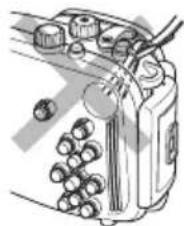
Do not use the camera's strap as a strap for the Waterproof Case.
Preparing the Waterproof Case
4 Fasten both ends of the neck strap to the strap mounts as shown, and adjust it to a comfortable length.
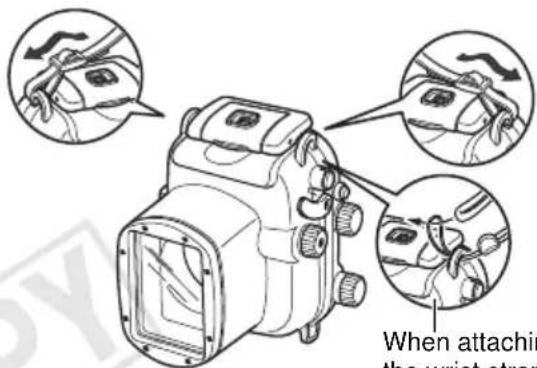
When attaching the wrist strap
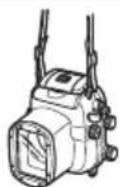
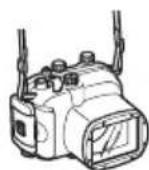
Use the neck strap when carrying the camera on the beach. Remove the neck strap and attach the wrist strap before use underwater. There is danger that the neck strap will become entangled and cause strangulation or another mishap.
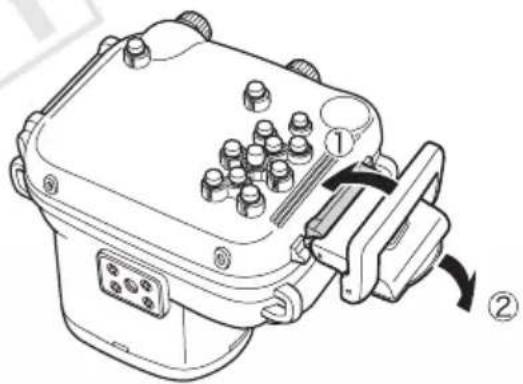
5 Slide the lock switch as shown, and release the catch to open the back cover.
- When using commercially available anticondensation products, the anticondensation solution should only be applied to the inside surface of the lens window using a soft cloth. If anticondensation solution comes in contact with any surface other than the inside of the lens window, wipe it off immediately with a soft, dry cloth, as it could lead to deterioration of the Waterproof Case.
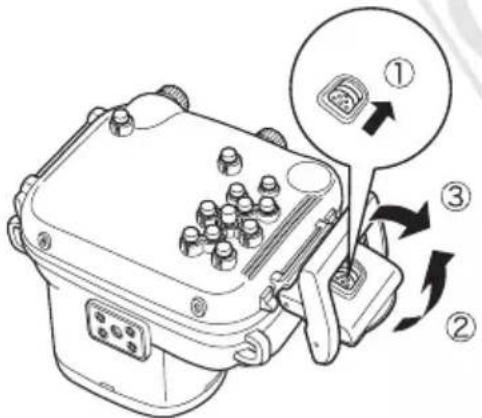
Apply a thin coat of grease to the entire seal before using the Waterproof Case in order to prevent abrasion and deterioration.
For waterproof seal handling precautions, see "Waterproof Seal" on page 6.
- Remove the waterproof seal.
- Using a cotton swab, wipe off any debris (e.g. sand, dirt or hair) which is present on the waterproof seal and on the seal mounting groove of the Waterproof Case.
- Apply a small amount (droplet) of grease to your fingertip.
- Evenly coat the entire surface of the waterproof seal, taking care not to scratch the surface.
- Place the waterproof seal back in the seal mounting groove of the Waterproof Case.
Installing the Camera
6 Open the LCD monitor, and insert the camera into the Waterproof Case as shown.
![graph TD A["①"] --> B["②"] B --> C["③"] C --> D["④"] D --> E["⑤"] style A fill:#f9f,stroke:#333 style B fill:#ccf,stroke:#333 style C fill:#cfc,stroke:#333 style D fill:#fcc,stroke:#333 style E fill:#ffc,stroke:#333](/content/2026/04/657609/images/58272f237a07ba68dc9bc8e722a401083fbbd690b3644fa80971fccc97a47920.jpg)
7 Close the Waterproof Case.
• Make sure that the waterproof seal and its contact surfaces are free of debris (e.g. sand, dirt or hair). Catching a single strand of hair or a tiny grain of sand in the seal can cause leaks. • Make sure that the catch is fastened properly.
Shooting
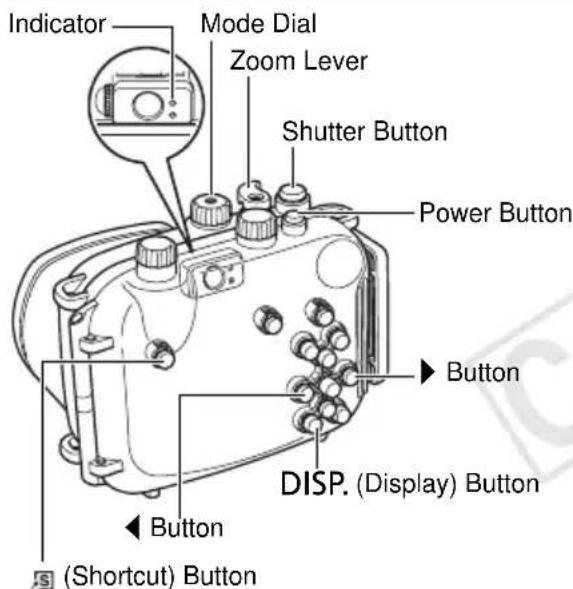
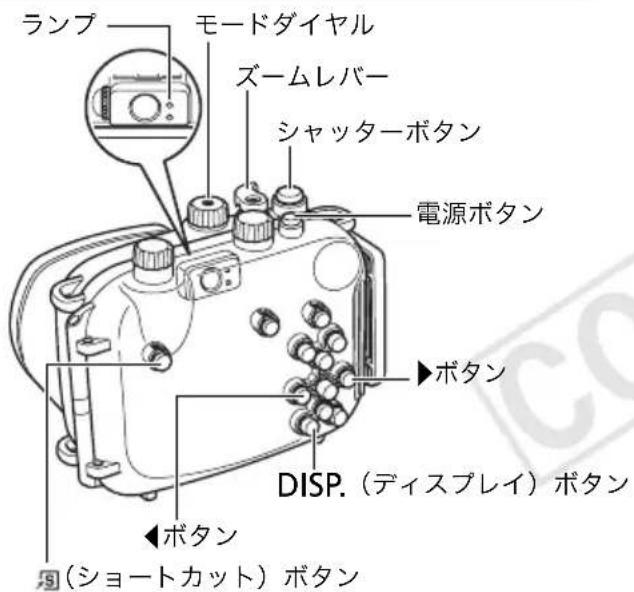
1 Press the power button to turn on the power.
2 Set the mode dial to the desired mode.
3 Adjust settings as required.
- Press the DISP. button to turn on the LCD monitor.
- You can adjust the zoom with the zoom lever.
Setting the Special Scene mode to (Underwater)
You can obtain more natural appearing coloration underwater if you set the Special Scene mode to ⚫ (Underwater). This mode selects the optimal white balance for marine lighting and tones down the blue colors.
- Set the mode dial to \$Special Scene mode).
- Pressing the (Shortcut) button, use the ◀ or ▶ button to select ⚫.
Shooting when the mode dial is set to ⚙, P, Tv, Av or M
You can set the white balance to (Underwater) using the FUNC. menu for the above modes.
Please note that you can set the white balance manually with the press of a single button if you assign the or (Custom White
Balance 1 or 2) function to the button. This is recommended for adjusting the white balance to the shooting conditions.
4 Use the LCD monitor to compose the shot. Press the shutter button halfway and wait until the upper indicator lights green or orange. After it lights, press the shutter button all the way.
- Make sure that the lens window is always clean.
- Ensure that your fingers and wrist strap do not obstruct the lens window, flash or diffusion plate when shooting.
- If the power saving function activates and shuts off the power, press the power button again.
- You cannot shoot images using the viewfinder.
- Even if you set the mode dial to 📄, you will not be able to take pictures correctly since you cannot use the finder.
Using the Control Dial
Using the control dial with the waterproof case differs slightly from that of the camera itself.
- When you want to turn the control dial clockwise, press the ▶ button while pressing the button.
- When you want to turn the control dial counterclockwise, press the ◀ button while pressing the button.
5 When you have finished using the camera, turn the camera off.
Using the Flash
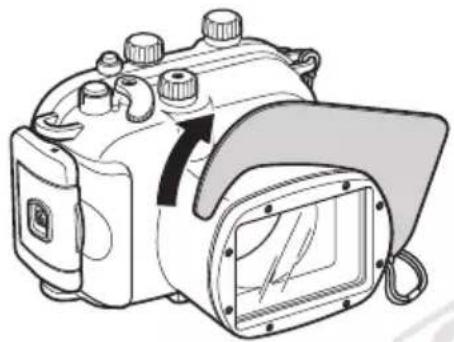
In order to evenly distribute light from the flash, please attach the diffusion plate.
- Do not scratch the surface of the diffusion plate, as this may prevent flash light from being diffused properly.
- When shooting with the flash, parts of the image may appear dark, so be sure to attach the diffusion plate before shooting. If the subject is too close to the camera, however, the diffusion plate may be less effective.
Attaching the Diffusion Plate
1 Thread the cord through the mount as shown.
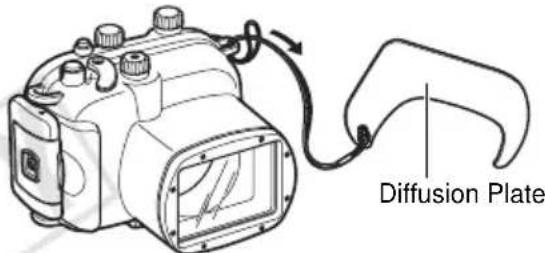
2 Insert the edge of the diffusion plate into the indentation.
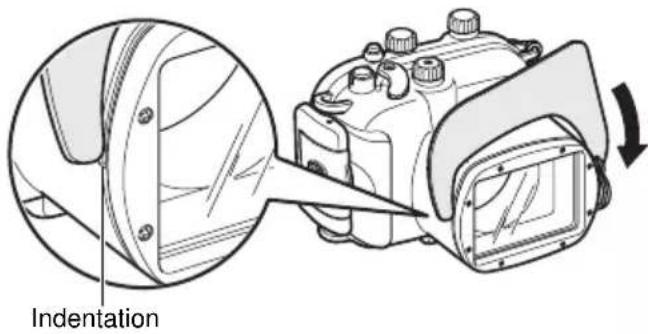
Removing the Diffusion Plate
Lift and remove the diffusion plate.
Playback
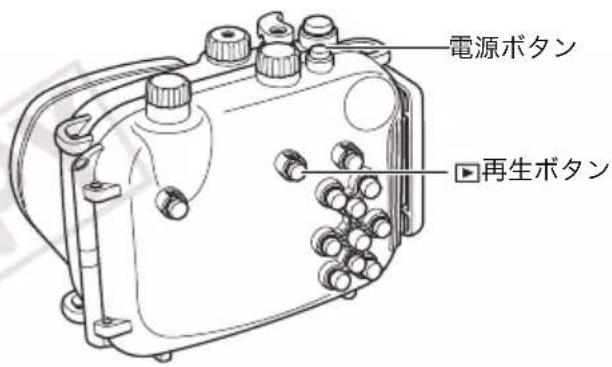
1 Press the ☐(Playback) button.
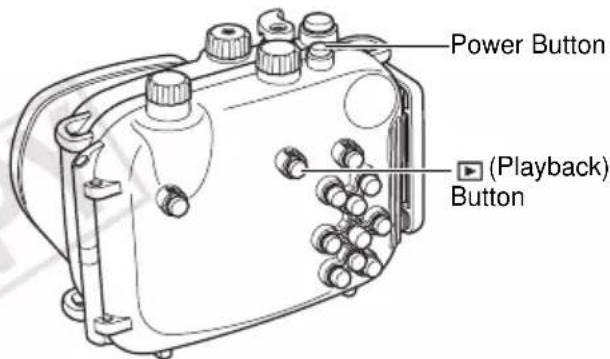
2 When you have finished using the camera, turn the camera off.
After you use the Waterproof Case, be sure to remove the camera from it. If you leave the Waterproof Case containing the camera in direct sunlight or in a high-temperature place, this may cause a fire or the case to burst.
Removing the Camera
1 After use, be sure to completely dry all the water from the Waterproof Case.
- Remove any dirt, sand, hair or other debris from the Waterproof Case, and wash it with clean, running tap water to remove salt deposits.
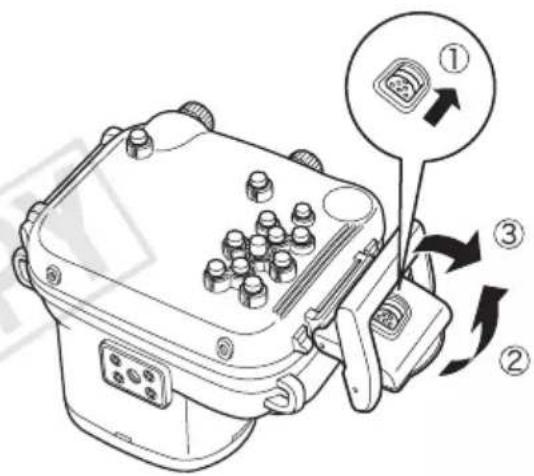
2 Slide the lock switch as shown, and release the catch to open the back cover. Remove the camera from the case.
- Be careful not to allow drops of water from your hair or body to fall on the camera or Waterproof Case interior when the case is open. - Do not wash the interior of the Waterproof Case with water. Wipe it with a soft, dry cloth.
Storage
- Store your Waterproof Case carefully, in an opened state to prevent the waterproof seal from deforming and to maintain its waterproof effect.
- Protect the waterproof seal from dust or scratches during storage.
- Do not store the Waterproof Case in hot, cold or humid places, or near substances such as naphthalene or insecticides.
Specifications
| Waterproof Capability: | |
| Meets IEC/JIS protection rating “IPX8” equivalentFor use within a depth of 40 m (130 ft.) | |
| Waterproofing: | Seal, O-ring, etc. |
| Main Materials: | Polycarbonate, ABS, clear plate glass, EPDM, etc. |
| Camera's Operating Temperature: | |
| 0 to 40 °C (32 to 104 °F) | |
| Dimensions: | 153.5 × 107.5 × 119.1 mm(6.04 × 4.23 × 4.69 in.)(excluding protrusions) |
| Volume: | Approx. 1150 cm3(38.9 fl. oz. (US)) |
| Weight: | Approx. 575 g (20.3 oz.)(Waterproof Case only*) |
Number of Separately Sold Waterproof Case Weights (WW-DC1) Recommended for Mounting: 4 weights
* Including diffusion plate - All data noted here are based on Canon's testing standards. - Product specifications and appearance are subject to change without prior notice.
MEMO
Deutsch
Disclaimer
Photography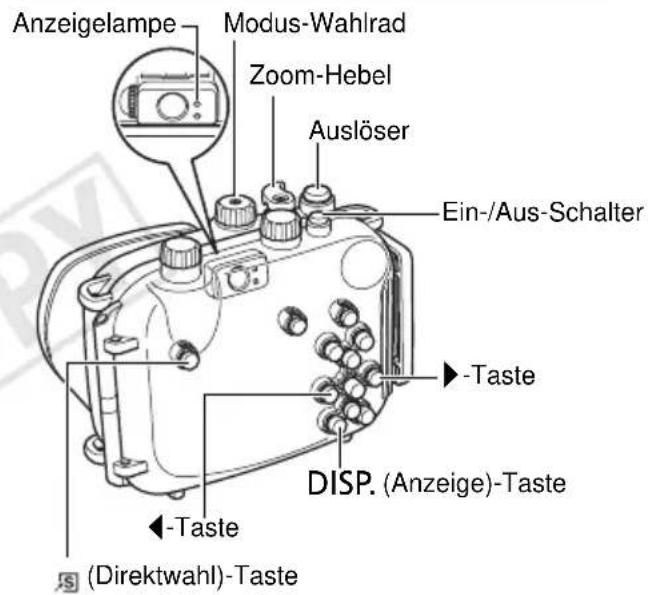
Playback
Storage
Photography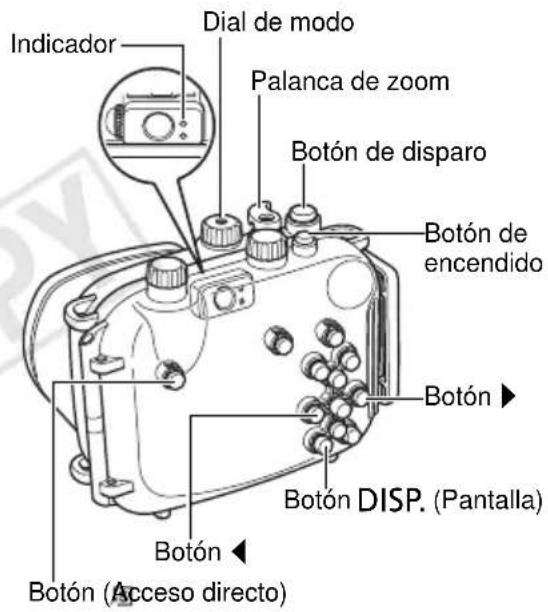
Reproduction
Storage
Shooting
Playback
Storage
Shooting
Playback
Storage
Do not use the camera strap as the strap for the waterproof case.
Preparing the waterproof case
Shooting
Precautions for storage
CDI-M442-010 XXXXXXXX © CANON INC. 2009 PRINTED IN JAPAN
PRINTED IN JAPAN
- PHOTOGRAPHY
- PLAYBACK
- FOR STORAGE
- INTRODUCTION
- UNPACKING
- SOLD SEPARATELY
- SAFETY PRECAUTIONS
- HANDLING PRECAUTIONS
- ABOUT WATER LEAKAGE
- WATERPROOF SEAL
- CARE AND MAINTENANCE
- COMPONENTS
- LENS WINDOW
- PREPARATIONS
- PREPARING THE CAMERA
- PREPARING THE WATERPROOF CASE
- SLIDE THE LOCK SWITCH AS SHOWN, AND RELEASE THE CATCH TO OPEN THE BACK COVER
- INSTALLING THE CAMERA
- CLOSE THE WATERPROOF CASE
- SHOOTING
- SHOOTING WHEN THE MODE DIAL IS SET TO ⚙, P, TV, AV OR M
- USE THE LCD MONITOR TO COMPOSE THE SHOT. PRESS THE SHUTTER BUTTON HALFWAY AND WAIT UNTIL THE UPPER INDICATOR LIGHTS GREEN OR ORANGE. AFTER IT LIGHTS, PRESS THE SHUTTER BUTTON ALL THE WAY
- USING THE CONTROL DIAL
- WHEN YOU HAVE FINISHED USING THE CAMERA, TURN THE CAMERA OFF
- USING THE FLASH
- ATTACHING THE DIFFUSION PLATE
- REMOVING THE DIFFUSION PLATE
- REMOVING THE CAMERA
- AFTER USE, BE SURE TO COMPLETELY DRY ALL THE WATER FROM THE WATERPROOF CASE
- SLIDE THE LOCK SWITCH AS SHOWN, AND RELEASE THE CATCH TO OPEN THE BACK COVER. REMOVE THE CAMERA FROM THE CASE
- STORAGE
- NUMBER OF SEPARATELY SOLD WATERPROOF CASE WEIGHTS (WW-DC1) RECOMMENDED FOR MOUNTING: 4 WEIGHTS
- MEMO
- DEUTSCH
- DISCLAIMER
- REPRODUCTION
- PRECAUTIONS FOR STORAGE
Brand : CANON
Model : WP-DC34
Category : Camera