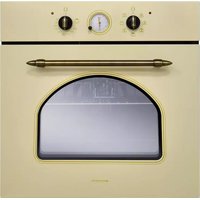
EMV56RC - Oven EAS Electric - Free user manual and instructions
Find the device manual for free EMV56RC EAS Electric in PDF.



| Brand | EAS Electric |
| Model | EMV56RC |
| Product type | Built-in multifunction oven |
| Interior volume | 56 liters |
| Interior dimensions (W x D x H) | 43.5 x 40 x 32 cm |
| Power supply | 220-240 V ~ 50/60 Hz |
| Maximum power | 2100-2520 W |
| Cooking modes | Upper and lower heating, Gentle cooking, Top heat, Grill, Grill with fan, Defrost |
| Timer | Analog timer up to 120 minutes with automatic shut-off |
| Interior light | 25 W bulb, type E14, resistant to 300°C |
| Removable door | Yes, for easy cleaning |
| Cleaning | Enamel interior, clean with soapy water, avoid abrasive products |
| Safety | Automatic shut-off at timer end, hot surfaces, grounding mandatory |
| Warranty | 3 years (Spain and Portugal) |
| Included accessories | Grid, baking tray |
Frequently Asked Questions - EMV56RC EAS Electric
User questions about EMV56RC EAS Electric
0 question about this device. Answer the ones you know or ask your own.
Ask a new question about this device
Download the instructions for your Oven in PDF format for free! Find your manual EMV56RC - EAS Electric and take your electronic device back in hand. On this page are published all the documents necessary for the use of your device. EMV56RC by EAS Electric.
USER MANUAL EMV56RC EAS Electric
natural_image
Simple line drawing of a rectangular box with two circles above it, no text or symbols present.EMV56RC
EMV56RN
Escanee para ver este manual en otros idiomas y actualizaciones Scan for manual in other languages and further updates Manuel dans d'autres langues et mis à jour Manual em outras línguas e actualizações
Contenido
natural_image
Technical line drawing of a cabinet or enclosure with two horizontal bars and a textured floor (no text or symbols)
INTRODUCTION TO THE APPLIANCE
3 Control panel and components
4 How to use your oven
5 MAINTENANCE OF THE OVEN
6 How to remove the oven door
6 Replacing the oven lamp
6 PRACTICAL COOKING ADVICE
6 Preheating
7 Using the grill
7 Baking cakes
8 Cooking fish and meat
8 Cooking table
9 SAFETY INSTRUCTIONS
11 INSTALLATION
11 Installation of built-in ovens
12 Electrical connection
13 TECHNICAL SPECIFICATIONS
14 COMMERCIAL GUARANTEE
We recommend that you read the instructions in this owner's manual carefully before use for the best performance and to extend the life of your appliance, as it will provide you with all the instructions you require to ensure its safe installation, use and maintenance. Always keep this owner's manual close to hand since you may need to refer to it in the future.
Control panel and components
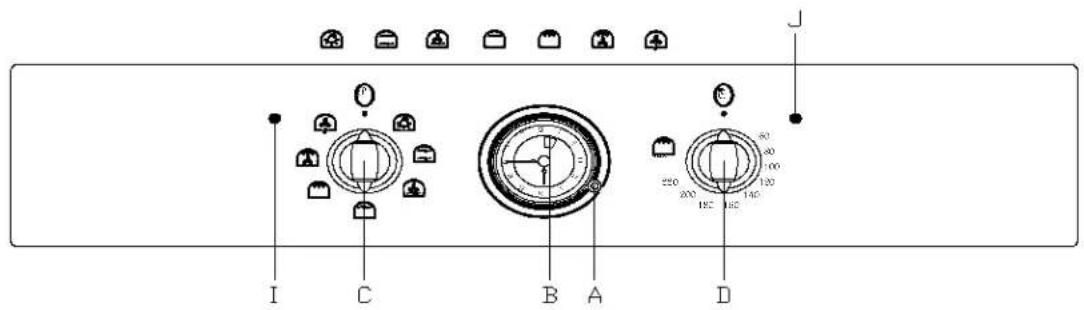

A. Timer knob
B. Timing pointer
C. Cooking mode selection knob
D. Cooking temperature selection knob
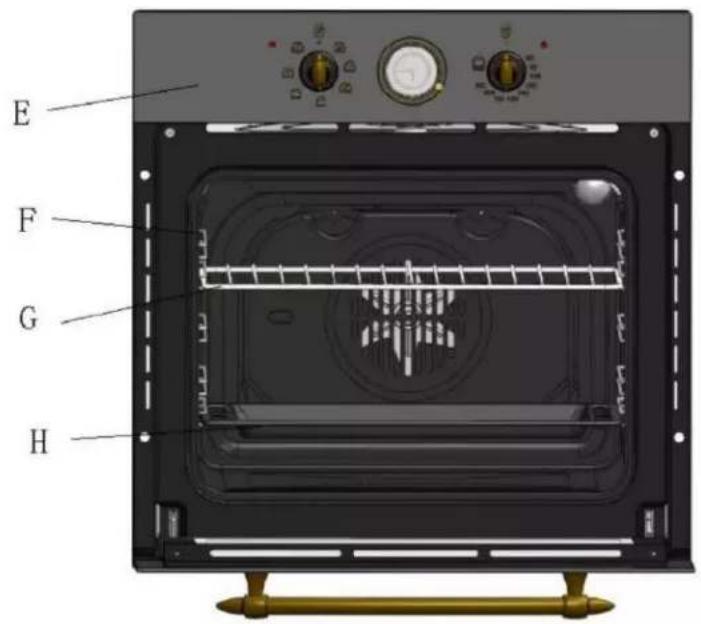
E. Control panel
F. Guides for sliding the racks or dripping pan
G. Oven rack
H. Dripping pan or baking sheet
I. Power indication light
J. Oven indication light
- When lit, it indicates the ovens is heating up to the temperature set
How to use your oven
This multi-function oven combines the advantages of traditional ovens with those of the more modern fan assisted models in a single appliance. It is an extremely versatile appliance that allows you to choose easily and safely between different cooking modes. The various features offered by the oven are selected by means of selector knob "C" and thermostat "D" situated on the control panel.
Notice: The first time you use your appliance, we recommend that set the thermostat to the highest setting and leave the oven on for about half an hour with nothing in it, with the oven door shut. Then, open the oven door and let the room air in. The odor that is often detected during this initial use is due to the evaporation of substances used to protect the oven during storage and until it is installed.
Notice: Place the dripping pan provided on the bottom shelf of the oven to prevent any sauce and/or grease from dripping onto the bottom of the oven only when grilling food or when using the rotisserie (only available on certain models). For all other types of cooking, never use the bottom shelf and never place anything on the bottom of the oven when it is in operation because this could damage the enamel. Place your cookware (dishes, aluminum foil, etc. etc.) on the grid provided with the appliance inserted especially along the oven guides.
Notice: to use the oven in manual mode (not using the end cooking time programmer); the symbol ⏻ must be aligned with the reference mark on the control panel.
Conventional mode 2100-2520W
Position of the thermostat knob "D": between 60°C and Max.
On this setting the top and bottom heating elements come on. This is the classic, traditional type of oven mode which has been perfected with heat distribution and reduced energy consumption. It is ideal when it comes to cooking dishes with fish or meat, which need to cook slowly or the addition of liquid. It remains the best system for baking cakes as well as fruit and cooking using covered casserole dishes for oven baking. When cooking in this mode, only use one pan or rack at a time, otherwise the heat distribution will be uneven. Using the different rack heights available, you can balance the amount of heat between the top and the bottom of the oven.
Delicate cooking 1220-1460W
Position of the thermostat knob "D": between 60°C and 250°C.
The bottom heating element and the fan come on. Suitable for pastries, cakes and non-dry sweets in baking tins or moulds. Excellent results are also obtained in cooking requiring above all heat from the bottom. You are advised to put the pan on a low level.
Top oven 940-1110W
Position of the thermostat knob "D": between 60°C and Max.
This mode can be used to brown food at the end of cooking.
Grill 2090-2520W
Position of the thermostat knob "D": Max.
The top central heating elements comes on .The extremely high and direct temperature of the grill makes it possible to brown the surface of meats and roasts while locking the juices in to keep them tender .The grill is also highly recommended for dishes that require a high temperature on the surface: beef steaks, veal, rib steak, filets, hamburgers etc...
You can cook food with the oven door ajar in this mode. Some grilling examples are included in the "Practical Cooking Advice" section.
Position of the thermostat knob "D": Between 60°C and 200°C.
The top central heating elements and the fan come on. This combination of features increases the effectiveness of the unidirectional thermal radiation of the heating elements through forced circulation of the air throughout the oven. This helps prevent food from burning on the surface, allowing the heat to penetrate right into the food. Excellent results are achieved with meats and vegetables, sausages, ribs, etc... Cook food in "Fan assisted grill mode" with the oven door shut.
Defrosting mode 45-55W
Position of the thermostat knob "D": -
The fan located on the bottom of the oven makes the air circulate at room temperature around the food. This is recommended for the defrosting of all types of food, but in particular for delicate types of food which do not require heat, such as for example: ice cream cakes, cream or custard desserts, fruit cakes. By using the fan, the defrosting time is approximately halved. In the case of meat, fish and bread, it is possible to accelerate the process using the Baking mode and setting the temperature to 80^-100^ .
End Cooking Time Knob (B) (only available on certain models)
This model is equipped with a timer to control when the oven shuts off during cooking. Position of timer knob B can be set between 10 and 120 minutes. At the end of the programmed length of time, the timer will sound and automatically turn off the oven.
Analog timer
Adjust the current time by pressing knob A and turn it anti-clockwise.
Turn the knob A anti-clockwise direction.
When turned from position ⚙ to position ⏻, the oven works without timer function.
By turning the knob from position ⚙ to 180-0, the timer works. When the pointer goes to 0 position, the oven stops working, and you will hear ringing sound.
By turning the knob A anti-clockwise to ⚙, the ringing sound will stop.
Before cleaning your oven, or performing maintenance, disconnect it from the power supply. To extend the life of your oven, it must be cleaned frequently, keeping in mind that:
- the enameled or stainless steel parts should be washed with lukewarm water, without using any abrasive powders or corrosive substances which could ruin them. Stainless steel could get stained. If these stains are difficult to remove, use special products available on the market. After cleaning, it is advisable to rinse thoroughly and dry.
- the inside of the oven should preferably be cleaned immediately after use, when it is still warm, with hot water and soap. The soap should be rinsed away and the interior dried thoroughly. Avoid using abrasive detergents (for example cleaning powders, etc) and abrasive sponges for dishes or acids (such as lime scale –remover, etc...) as these could damage the enamel. If the grease spots and dirt are particularly tough to remove, use a special product for oven cleaning, following the instructions provided on the packet.
- never use a steam cleaner for cleaning inside of oven.
- if you use your oven for an extended period of time, condensation may form. Dry it using a soft cloth.
- there is a rubber seal surrounding the oven opening which guarantees its perfect functioning. Check the condition of this seal on a regular basis. If necessary, clean it and avoid using abrasive products or objects to do so. Should it become damaged, please contact your nearest After-sales Service Center and avoid using the oven until it has been repaired.
- never line the oven bottom with aluminum foil, as the consequent accumulation of heat could compromise the cooking and even damage the enamel.
- clean the glass door using non-abrasive products or sponges and dry it with a soft cloth.
How to remove the oven door
For a more thorough clean, you can remove the oven door. Choose the remove and assemble method according to the different structure of oven door purchased. Proceed as follows:
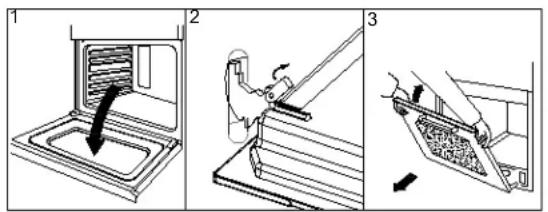
- Open the door fully;
- Lift up and turn the small levers situated on the two hinges;
- Grip the door on the two external sides, shut it slowly but not completely;
- Pull the door towards you, pulling it out of its seat;
Reassemble the door by following the above procedures backwards.
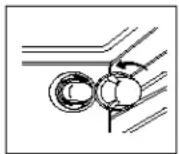
Replacing the oven lamp
Disconnect the oven from the power supply by means of the omni polar switch used to connect the appliance to the electrical mains; or unplug the appliance if the plug is accessible.
- Remove the glass cover of the lamp holder.
- Remove the lamp and replace with a lamp resistant to high temperatures (300°C) with the following temperatures: 220-240V, 25W and type E14.
- Replace the glass cover and reconnect the oven to the mains power supply.
Practical cooking advice
The oven offers a wide range of alternatives which allow you to cook any type of food in the best possible way. With time you will learn to make the best use of this versatile cooking appliance and the following directions are only a guideline which may be varied according to your own personal experience.
Preheating
If the oven must be preheated (this is generally the case when cooking leavened foods), the “Fast cooking” mode can be used to reach the desired temperature as quickly as possible in order to save on energy.
Once the food has been placed in the oven, the most appropriate cooking mode can then be selected. The "Fast Cooking" mode is functional, fast and practical when using pre-packed products, like frozen or pre-cooked food, along with other food items. You will find useful suggestion in the Practical Cooking Advice table on page 8.
Using the Grill
This multi-function oven offers you 2 different grilling modes.
Use the Grill mode 📋 placing the food under the center of the grill (situated on the 3rd or 4th rack form the bottom) because only the central part of the top heating element is turned on. Use the bottom rack (1st from the bottom), placing the dripping pan provided to collect any sauce and /or grease and prevent the same from dripping onto the oven bottom. When using this mode, we recommend you set the thermostat to the highest setting. However, this does not mean you cannot use lower temperatures, simply by adjusting the thermostat knob to the desired temperature.
Setting “fan assisted grill” 🙏 is extremely useful for grilling foods rapidly, as the distribution of heat makes it possible not only to brown the surface, but also to cook the bottom part. Moreover, it can also be used for browning foods at the end of the cooking process, such as adding that gratin finish to pasta bakes, for example. When using this mode, place the grid on the 2nd or 3rd oven rack from the bottom (see cooking table) then, to prevent fat and grease from dripping onto the bottom of the oven and thus smoke from forming, place a dripping-pan on the 1st rack from the bottom.
When using this mode, we advise you to set the thermostat to 200^ C, as it is the most efficient way to use the grill, which is based on the use of infrared rays. However, this does not mean you cannot use lower temperatures, simply by adjusting the thermostat knob to the desired temperature.
Therefore the best results when using the grill modes are obtained by placing the grid on the lower racks (see cooking table) then, to prevent fat and grease from dripping onto the bottom of the oven and smoke from forming, place a dripping-pan on the 1st oven rack from the bottom.
Baking Cakes
When baking cakes, always place them in a preheated oven. Make sure you wait until the oven has been preheated thoroughly (the end light "J" will turn off). Do not open the oven door during baking to prevent the cake from dropping. In general:
Pastry is too dry
Increase the temperature by 10^ C and reduce the cooking time.
Pastry dropped
Use less liquid or lower the temperature by 10^ C.
Pastry is too dark on top
Place it on a lower rack, lower the temperature, and increase the cooking time.
Cooked well on the inside but sticky on the outside
Use less liquid, lower the temperature, and increase the cooking time.
Pastry sticks to the pan
Grease the pan well and sprinkle it with a dusting of flour or use greaseproof paper.
I used more than one level (in the function “ventilated oven”) and they are not all at the same cooking point
Use a lower temperature setting. It is not necessary to remove the food from all the racks at the same time.
Cooking fish and meat
When cooking white meat, fowl and fish, use temperature setting from 180^ C to 200^ C. For red meat that should be well done on the outside while tender and juicy in the inside, it is a good idea to start with a high temperature setting ( 200^ C- 220^ C) for a short time, then turn the oven down afterwards.
In general, the larger the roast, the lower the temperature setting. Place the meat on the center of the grid and place the dripping pan beneath it to catch the fat.
Make sure that the grid is inserted so that it is in the center of the oven. If you would like to increase the amount of heat from below, use the low rack heights. For savory roasts (especially duck and wild game), dress the meat with lard or bacon on the top.
| Selector knob setting | Food to be cooked | Weight (in kg) | Cooking rack position from bottom | Preheating time (Minutes) | Thermostat knob setting | Cooking time (Minutes) |
1. Conventional  | Duck | 1 | 3 | 15 | 200 | 65-75 |
| Roast veal or beef | 1 | 3 | 15 | 200 | 70-75 | |
| Pork roast | 1 | 3 | 15 | 200 | 70-80 | |
| Biscuits (short pastry) | - | 3 | 15 | 180 | 15-20 | |
| Tarts | 1 | 3 | 15 | 180 | 30-35 | |
2. Top oven  | Browning food to perfect cooking | - 3/4 15 | 220 | - | ||
3. Defrosting  | All frozen food | |||||
4 Grill  | Soles and cuttlefish | 1 | 4 | 5 | Max | 8-10 |
| Squid and prawn kebabs | 1 | 4 | 5 | Max | 6-8 | |
| Cod filet | 1 | 4 | 5 | Max | 10 | |
| Grilled vegetables | 1 | 3/4 | 5 | Max | 10-15 | |
| Veal steak | 1 | 4 | 5 | Max | 15-20 | |
| Cutlets | 1 | 4 | 5 | Max | 15-20 | |
| Hamburgers | 1 | 4 | 5 | Max | 7-10 | |
| Mackerels | 1 | 4 | 5 | Max | 15-20 | |
| Toasted sandwiches | - | 4 | 5 | Max | 2-3 | |
| With rotisserie (where present) | ||||||
| Veal on the spit | 1.0 | - | 5 | Max | 80-90 | |
| Chicken on the spit | 1.5 | - | 5 | Max | 70-80 | |
| Lamb on the spit | 1.0 | - | 5 | Max | 70-80 | |
5. Fan Assisted Grill  | Grilled chicken | 1.5 | 3 | 5 | 200 | 55-60 |
| Cuttlefish | 1.5 | 3 | 5 | 200 | 30-35 | |
| With rotisserie (where present) | ||||||
| Veal on the spit | 1.5 | - | 5 | 200 | 70-80 | |
| Chicken on the spit | 2.0 | - | 5 | 200 | 70-80 | |
| Chicken (on the spit)+ potatoes (roasted) | 1.5 | - | 5 | 200 | 70-75 | |
| Lamb on the spit | - | 2 | 5 | 200 | 70-75 |
Note: cooking times are approximate and may vary according to personal taste. When cooking using the grill or fan assisted grill, the dripping pan must always be placed on the 1st oven rack from the bottom.
SAFETY INSTRUCTIONS
To maintain the efficiency and safety of this appliance, we recommend that you do the following:
- only call the Service Centers authorized by the manufacturer
- always use original spare parts
- in case of damage to the power cord, a special purpose cord or component bought from the manufacturer or maintenance department shall be used for replacement
When handling the appliance, we recommend you always use the purpose provided handles recessed into the sides of the oven to prevent harming people or damaging the appliance itself.
This appliance is designed for non-professional, house-hold use and its functions must not be changed.
The electrical system of this appliance can only be used safely when it is correctly connected to an efficient earthing system in compliance with current safety standards.
When the appliance is in use, the heating elements and some parts of the oven door become extremely hot. Make sure you don't touch them and keep children well away.
Heat will be generated during its working. Caution must be observed to avoid touch of the heating element.
The following items are potentially dangerous, and therefore appropriate measures must be taken to prevent children and the disabled from coming into contact with them:
■ Control panel;
■ Packaging (bags, polystyrene, nails, etc.);
- The appliance itself, immediately after use of the oven or grill due to the heat generated;
- The appliance itself, when no longer in use (potentially dangerous parts must be made safe).
Avoid the following:
- Touching the appliance with wet parts of the body;
■ Using the appliance when barefoot; -
Pulling on the supply cable to unplug it from the electrical outlet;
-
Improper or dangerous operations;
- Obstructing the ventilation or heat dissipation slots;
- Allowing power supply cables of small appliances to come into contact with the hot parts of the appliance;
- Exposing the appliance to atmospheric agents such as rain, or sunlight;
- Using the oven for storage purposes;
- Using flammable liquids near the appliance;
- Using adapters, multiple sockets and /or extension leads;
- Attempting to install or repair the appliance without the assistance of qualified personnel.
Qualified personnel must be contacted in the following cases:
- Installation (following the manufacturer's instructions);
- When in doubt about operating the appliance;
- Replacing the electrical socket when it is not compatible with the appliance plug.
- The temperature probe is a part of thermostat, if damaged; they shall be replaced overall by authorized service person.
Service Centers authorized by the manufacturer must be contacted in the following cases:
- If in doubt about the soundness of the appliance after removing it from its packaging;
- If the power supply cable has been damaged or needs replacing;
- If the appliance breaks down or functions poorly; ask for original spare parts.
It is a good idea to do the following:
- Steam cleaner cannot be used to clean the oven;
- Only use the appliance to cook food and nothing else;
- Check the soundness of the appliance after it has been unpacked;
- Disconnect the appliance from the electrical mains if it is not functioning properly and before cleaning or performing maintenance;
- When left unused, unplug the appliance form the electricity mains;
- Use oven gloves to place cookware in the oven or when removing it;
- Always grip the oven door handle in the center as the extremities of the same may be hot due to any hot air leaks;
- Make sure the knobs are in the “/” position when the appliance is not in use;
- Cut the power supply cable after disconnecting it from the mains when you decide not to use the appliance any longer.
The manufacturer may not be held responsible for any damage due to: Incorrect installation, improper, incorrect and irrational use.
Installation
Only a qualified person in compliance with the instructions provided must install the appliance. EAS ELECTRIC Smart Technology S.L. declines all responsibility for improper installation, which may harm persons and animals and damage property.
Important:
- The power supply to the appliance must be cut off before any adjustments or maintenance work is done on it;
- Air duct is supposed to use in ventilation.
Installation of Built-in Ovens
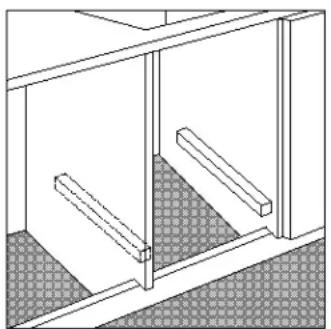
In order to ensure that the built-in appliance functions properly, the cabinet containing it must be appropriate. The figure below gives the dimensions of the cut-out for installation under the counter or in a wall cabinet unit.
Note: Installation in compliance with the consumption declaration. In order to ensure adequate ventilation, the back panel of the cabinet unit must be removed. Installing the oven so that it rests on two strips of wood is preferable. If the oven rests on a continuous, flat surface, there must be an aperture of at least 45×560mm.
natural_image
Isometric line drawing of a cabinet or enclosure with two horizontal bars and a textured floor (no text or symbols)
The panels of the adjacent cabinets must be made of heat-resistant material. In particular, cabinets with a veneer exterior must be assembled with glues which can withstand temperatures of up to 100^ C.
In compliance with current safety standards, contact with the electrical parts of the oven must not be possible once it has been installed.
All parts, which ensure the safe operation of the appliance, must be removable only with the aid of a tool.
To fasten the oven to the cabinet, open the door of the oven and attach it by inserting the 4 wooden screws into the 4 holes located on the perimeter of the frame.
Electrical connection
Those ovens equipped with a three-pole power supply cable are designed to operate with an alternating current. The wire for earthing the appliance is yellow-green in color.
Fitting on a power supply cable:
- Using a screwdriver, prize the bolt on the side tabs of the terminal board cover and pull open the cover;
- Remove the wire clamp screw and the three contact screws L-N and ± .
- Fasten the wires beneath the screw heads using the following color scheme: Blue (N) Brown (L) Yellow-Green (⊥)
- Fasten the supply cable in place with the clamp and close the cover of the terminal board.
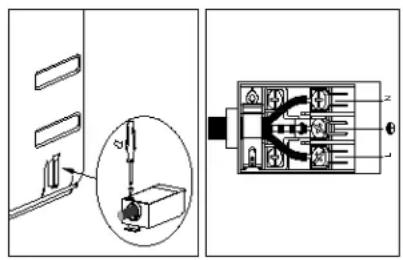
Connecting the supply cable to the mains
Install a standardized plug corresponding to the load indicated on the data plate. When connecting the cable directly to the mains, install an omni polar circuit breaker with a minimum contact opening of 3 mm between the appliance and the mains. The omni polar circuit breaker should be sized according to the load and should comply with current regulations (the earth wire should not be interrupted by the circuit breaker).
The supply cable should be positioned so that it does not reach a temperature of more than 50^ C with respect to the room temperature, anywhere along its length, or protected by insulation sleeping having an appropriate rating.
Before making the connection, check that:
- The electrical safety of this appliance can only be guaranteed if the cooker is correctly and efficiently earthed, in compliance with regulations on electrical safety. Always ensure that the earthing is efficient; if you have any doubts call in a qualified technician to check the system. EAS ELECTRIC Smart Technology S.L. declines all responsibility for damage resulting from a system which has not been earthed.
- Before plugging the appliance into the mains, check that the specifications indicated on the date plate (on the appliance and /or packaging) correspond to those of the electrical mains system of your home.
- Check that the electrical capacity of the system and sockets will support the maximum power of the appliance, as indicated on the data plate. If you have any doubts, call in a qualified technician.
- If the socket and appliance plug are not compatible, have the socket replaced with a suitable model by a qualified technician. The latter, in particular, will also have to ensure that the cross section of the socket cables are suitable for the power absorbed by the appliance. The use of adapters, multiple sockets and/or extensions, is not recommended. If their use cannot be avoided, remember to use only single or multiple adapters and extensions which comply with current safety regulations. In these cases, never exceed the maximum current capacity indicated on the single adapter or extension and the maximum power indicated on the multiple adapter. The plug and socket must be easily accessible.
Technical Specifications
Width: 43.5cm
Depth: 40cm
Height: 32cm
Inner volume of the oven: 56 liters
Voltage and Frequency of Power Supply: 220-240V \~50/60Hz or 50Hz

2100-2520W

2100-2520W

2100-2520W

2100-2520W

2100-2520W
natural_image
Symbol of a trash bin crossed out by two diagonal lines (no text or numbers present)
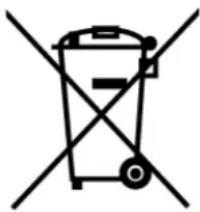
DISPOSAL: Do not dispose this product as unsorted municipal waste. Collection of such waste separately for special treatment is necessary.
The european directive 2012/19 /UE on wasted electrical and electronic equipments (WEEE), requires that household electrical appliances must not be disposed of in the normal unsorted municipal waste stream. appliances must be collected separately in order to optimize the recovery and recycling of the materials they contain, and reduce the impact on human health and the environment.
The crossed out “wheeled bin” symbol on the product reminds you of your obligation, that when you disposed of the appliances, it must be separately collected. Consumers should contact their local authority or retailer for information concerning the correct disposal of their old appliance.
Contenu

A. Bouton de la minuterie
natural_image
Isometric line drawing of a room with two horizontal bars and a textured floor (no text or symbols)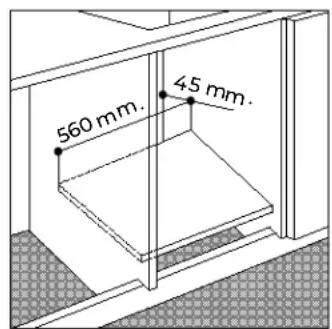
CONDITIONS DE LA GARANTIE
natural_image
Architectural line drawing of a two-story building facade with horizontal beams and a textured floor (no text or symbols)
Scan for manual in other languages and further updates:
- Contenido
- Control panel and components
- How to use your oven
- Analog timer
- How to remove the oven door
- Replacing the oven lamp
- Practical cooking advice
- Preheating
- Using the Grill
- Baking Cakes
- Pastry is too dry
- Pastry dropped
- Pastry is too dark on top
- Cooked well on the inside but sticky on the outside
- Pastry sticks to the pan
- Cooking fish and meat
- SAFETY INSTRUCTIONS
- Installation
- Important:
- Installation of Built-in Ovens
- Electrical connection
- Connecting the supply cable to the mains
- Technical Specifications
- Contenu
- CONDITIONS DE LA GARANTIE
Brand : EAS Electric
Model : EMV56RC
Category : Oven