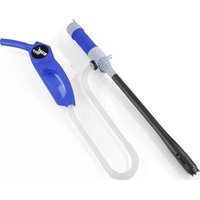
859262 - Pump Westfalia - Free user manual and instructions
Find the device manual for free 859262 Westfalia in PDF.



| Product type | Liquid transfer pump |
| Brand | Westfalia |
| Model | 859262 |
| Power supply | Batteries (not included) |
| Usage | Suction and transfer of light non-flammable liquids: water, antifreeze, diesel, gasoline |
| Maximum gasoline quantity | 5 liters |
| Maximum diesel or engine oil quantity | 200 liters |
| Material | Plastic (estimated) |
| Maintenance and cleaning | Check condition before each use; clean after use; remove batteries if not in use |
| Safety | Wear appropriate gloves; do not smoke near flammable liquids; do not use in explosive atmosphere; do not pump directly from a vehicle tank |
| Spare parts and repairability | Contact the manufacturer or an authorized service center |
| General information | Do not kink the hose; avoid hot and sharp surfaces; do not use if a component is damaged |
Frequently Asked Questions - 859262 Westfalia
User questions about 859262 Westfalia
0 question about this device. Answer the ones you know or ask your own.
Ask a new question about this device
Download the instructions for your Pump in PDF format for free! Find your manual 859262 - Westfalia and take your electronic device back in hand. On this page are published all the documents necessary for the use of your device. 859262 by Westfalia.
USER MANUAL 859262 Westfalia
natural_image
Two medical or laboratory devices: a black tool and a blue handheld device, both with white tubing (no text or symbols visible)
Original Instructions
Electric General Purpose Pump, battery-operated
Article No. 85 92 62
CE


natural_image
Illustration of a person in a suit using a tool to dig or write into water, with a hat nearby (no text or symbols)
Dear Customers
Instruction manuals provide valuable hints for using your new device. They enable you to use all functions, and they help you avoid misunderstandings and prevent damage.
Please take the time to read this manual carefully and keep it for future reference.
text_image
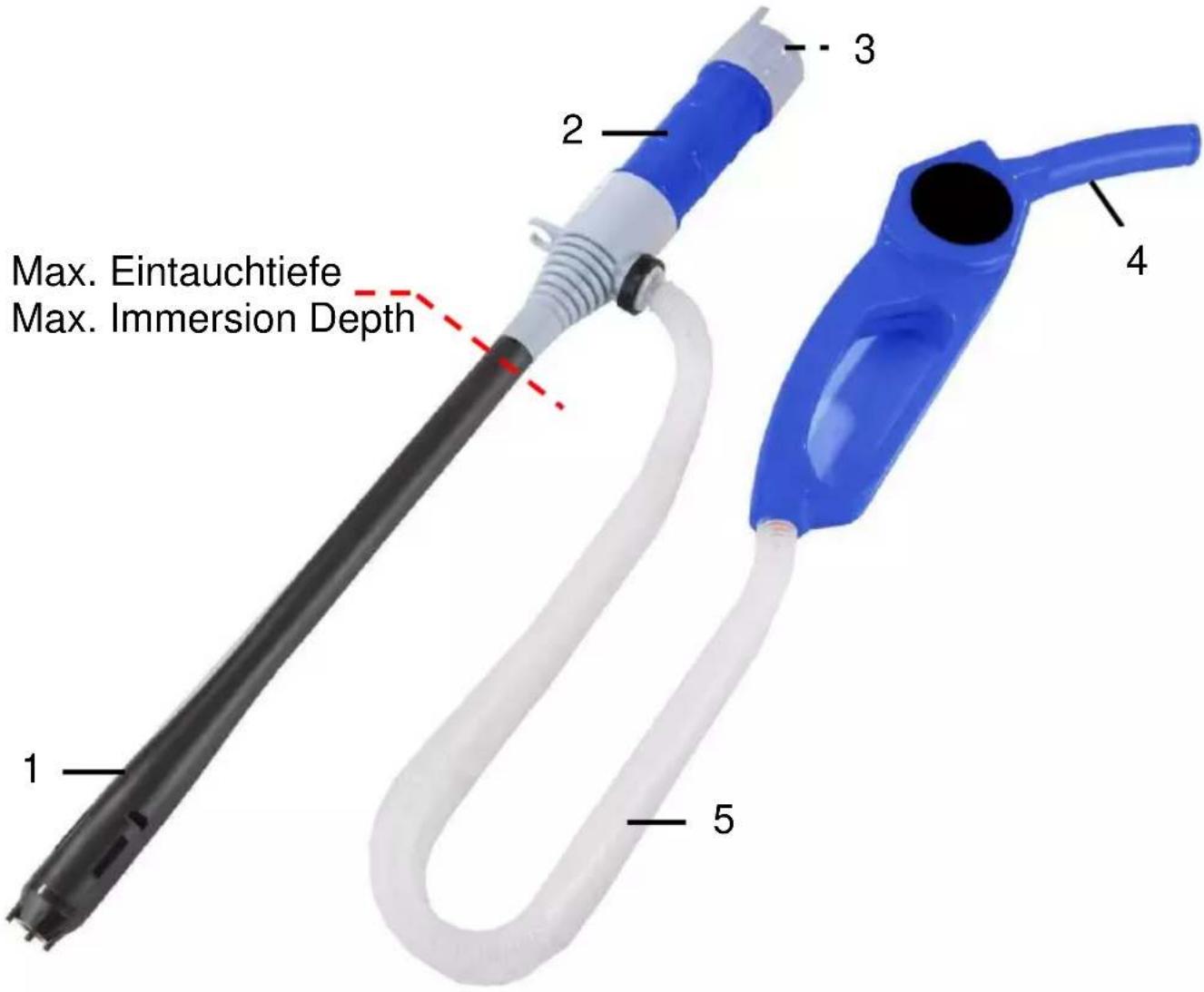
Max. Eintauchtiefe Max. Immersion Depth 1 2 3 4 5natural_image
Simple line drawing of a three chasing recycling symbol (no text or labels)Batteries and rechargeable batteries do not belong in household garbage.
For battery disposal, please check with your local council.
natural_image
Pure electrical circuit lines without any symbols
Please note the following safety notes to avoid mal- functions, damage or physical injury:
- Please read this manual carefully and use the unit only according to this manual.
■ Dispose of used packaging material carefully or store it out of the reach of children. There is a danger of suffocation!
- Persons with limited physical, sensorial or mental abilities are not allowed to use the unit, unless they are supervised and briefed for their safety by a qualified person how to use the unit. This article is not a toy. Do not let children play with it.
■ Only use the pump according to the intended use.
- The pump has been designed for extracting and transferring non-flammable liquids, such as water, anti-freeze, etc. and engine oil, petrol and diesel fuel from one container to another. The pump must not be used for drawing or transferring other flammable materials or food.
- Petrol or Diesel fuel may only be pumped outdoors from containers placed directly on the ground in non-hazardous quantities. For petrol this is no more than 5 litres and for engine oil and Diesel fuel this is no more than 200 litres.
- The pump must not be used to pump fuel out of the tanks of vehicles.
- The pump must not be used in explosive atmospheres.
■ Depending on the material to be pumped, it is necessary to wear safety gloves accordingly.
- Do not smoke in the presence of gasoline or other flammable vapours. Always also observe the safety notes that are valid for the material to be processed.
- Do not jam the hose in any way. Do not pinch the hose and keep it away from sharp edges and hot surfaces.

Safety Notes
■ Before each use check the pump for damage or leakages. Do not use the pump if a hose become damaged and leaks. Do not use the pump furthermore if any other components become damaged.
- Do not expose the article to strong mechanical stresses or to strong vibrations.
- Remove the batteries from the unit if you do not intend to use it for a longer period of time.
- Do not disassemble, burn, or short-circuit batteries. Do not mix fresh and spent batteries.

natural_image
Pure electrical circuit lines without any symbols
natural_image
Pure electrical circuit lines without any symbolstext_image
Diagram of a laboratory setup with a pipette and tubing, showing fluid flow and a red arrow indicating direction.


Benutzung
- The pump has been designed for extracting and transferring non-flammable liquids, such as water, anti-freeze, etc. and engine oil, petrol and diesel fuel from one container to another. The pump must not be used for drawing or transferring other flammable materials or food. Avoid sucking solids into the pump.
- Petrol or Diesel fuel may only be pumped outdoors from containers placed directly on the ground in non-hazardous quantities. For petrol this is no more than 5 litres and for engine oil and Diesel fuel this is no more than 200 litres.
- The pump must not be used to pump fuel out of the tanks of vehicles.
- The pump must not be used in explosive atmospheres.
- The intended use also includes an operation following the operating instructions.
- Any use beyond these parameters (different media, applying force) or any changes (reconstruction, no original accessory) can lead to serious risks and is regarded as use that is contrary to the intended purpose.
Operation
-
Open the battery compartment lid by turning the lid counter clockwise. Insert two batteries of the type LR20 (D) into the battery compartment and close the lid.
-
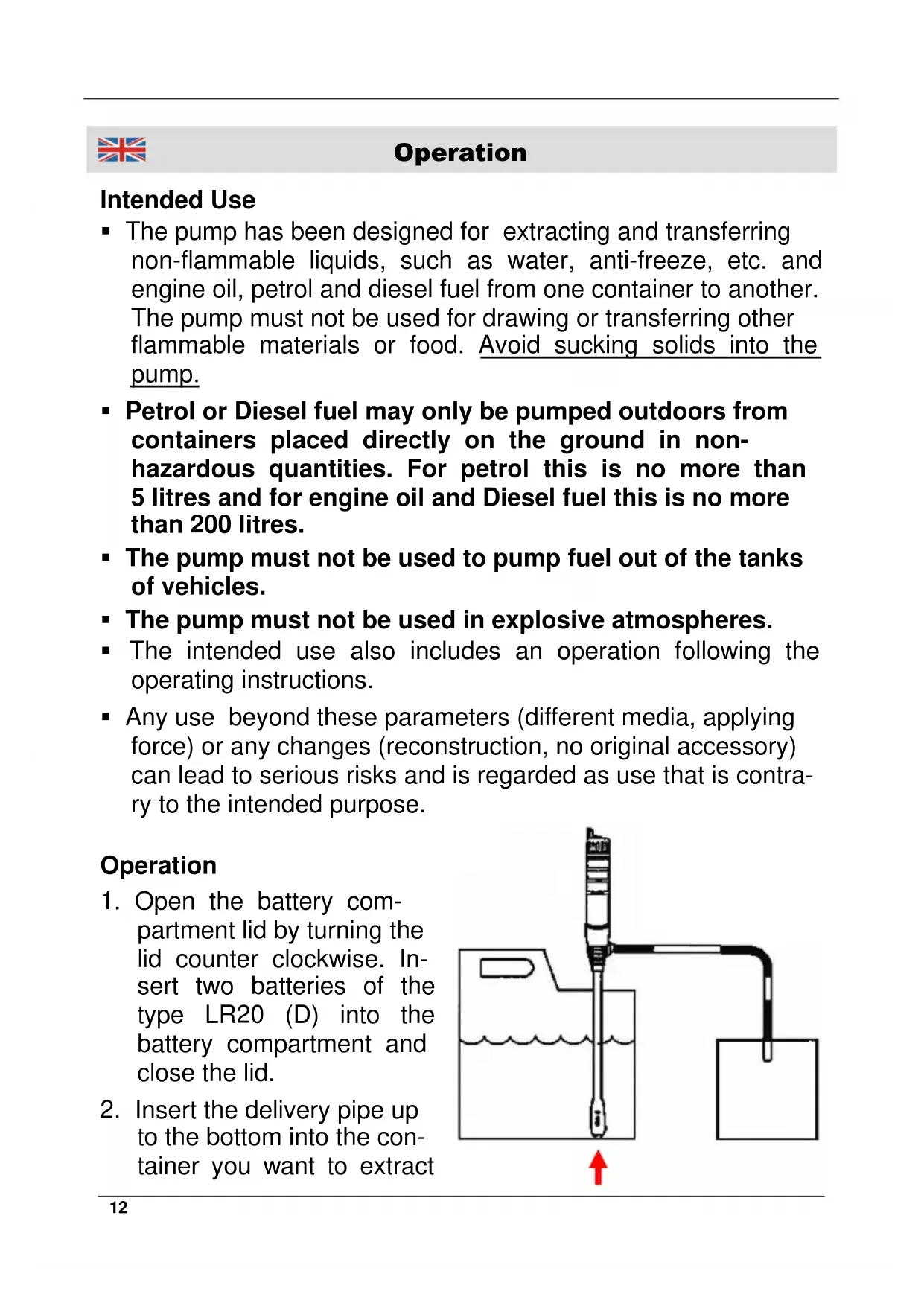
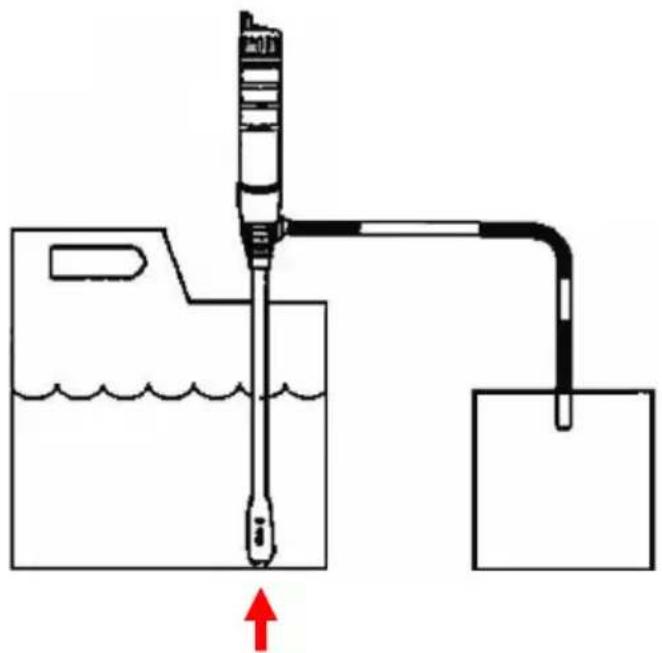
Insert the delivery pipe up to the bottom into the container you want to extract
text_image
Diagram of a laboratory setup with a pipette and tubing, showing fluid flow and a red arrow indicating direction.Operation
fluid from.
- Insert the spout into the container you want to fill.
- Press the ON/OFF button to ON in order to fill the container. The fluid is transferred via the delivery hose into the target container.
- Switch off the pump by pressing the switch to OFF.
List of Liquids the Pump is suitable for
| Liquid | Maximum Container Size | Remarks |
| Petrol / Gasoline | 5 l | Container must sit directly on the Ground |
| Diesel Fuel | 200 l | Container must sit directly on the Ground |
| Engine Oil | 200 l | Container must sit directly on the Ground |
| Solvents, Thinner and other flammable Liquids | May not be pumped | May not be pumped |
| Non-flammable Antifreeze and Cooling Fluids, Water, etc.. | Any Amount | |
| Foodstuffs, potable Water and other Liquids intended for Human Consumption | May not be pumped | May not be pumped |
Operation
Hints:
■ Make sure that the volume of the target container is sufficient to take the transferred liquid.
- Do not position the target container higher than the battery compartment.
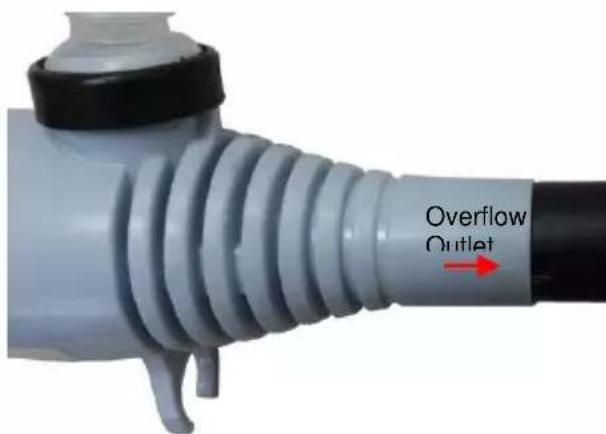
- In case the liquid backs up in the delivery hose, it may drain from the bottom of the “Overflow Outlet”. Do not touch this part of the hose.
■ Always wear protective gloves, safety goggles etc. during work.
■ Do not turn the pump upside down if liquid is still in the delivery hose.
- The pump is intended for short-term operation only.
■ Make sure the pump cannot run dry.
text_image
Overflow OutletCleaning and Storing
■ Before cleaning the pump, make sure the hose is completely empty.
■ After each use, rinse the pump and the hose thoroughly with water or cleaning agent according to the processed fluid. Do not disassemble the unit.
■ Store the pump indoors in a dry place that is protected from corrosion, dust, dirt and extreme temperatures.
■ Store the pump out of reach of children.
declare by our own responsibility that the product
Electric General Purpose Pump, battery-operated
Artikel No 85 92 62
Article No. 85 92 62
is according to the basic requirements, which are defined in the European Directives and their amendments.
2011/65/EU
Restriction of the Use of certain hazardous Substances in electrical and electronic Equipment (RoHS)
2004/108/EG
natural_image
Symbol of a trash bin crossed with two crossed lines, representing no waste or discharge (no text or labels)
Werter Kunde,
Please help avoid refuse.
If you at some point intend to dispose of this article, then please keep in mind that many of its components consist of valuable materials, which can be recycled.
Please do not discharge it in the garbage bin, but check with your local council for recycling facilities in your area.