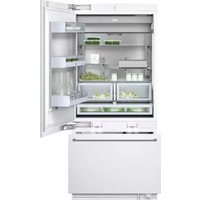
RB492701 - Refrigerator GAGGENAU - Free user manual and instructions
Find the device manual for free RB492701 GAGGENAU in PDF.



| Brand | Gaggenau |
| Model | RB492701 |
| Product type | Refrigerator / Freezer combination |
| Power supply | 110-120 V, 60 Hz, 10-16 A |
| Recommended refrigerator temperature | +37 °F (+3 °C) |
| Recommended freezer temperature | 0 °F (-18 °C) |
| Refrigerator temperature range | +35 °F to +46 °F (+2 °C to +8 °C) |
| Freezer temperature range | +7 °F to -9 °F (-14 °C to -23 °C) |
| Quick refrigeration | Yes |
| Quick freezing | Yes |
| Ice dispenser | Yes |
| Water filter | Yes, filter cartridge (model 9000 077 095) |
| Vacation mode | Yes |
| Energy saving mode | Yes |
| Lighting | LED, not user-replaceable |
| Defrosting | Automatic |
| Door type | 2 or 3 doors depending on model |
| Safety | Safety instructions for children, do not use sharp objects, do not steam clean |
| Maintenance | Clean with warm water and neutral dish soap |
| Spare parts | Available via Gaggenau customer service |
Frequently Asked Questions - RB492701 GAGGENAU
User questions about RB492701 GAGGENAU
0 question about this device. Answer the ones you know or ask your own.
Ask a new question about this device
Download the instructions for your Refrigerator in PDF format for free! Find your manual RB492701 - GAGGENAU and take your electronic device back in hand. On this page are published all the documents necessary for the use of your device. RB492701 by GAGGENAU.
USER MANUAL RB492701 GAGGENAU
Safety and warning information 3
Instructions on disposal 5
Installing the appliance 5
Ventilation 5
Connecting the appliance 5
Getting to know your appliance 7
Switching the appliance on 10
Set the language 10
Setting the temperature unit 11
Setting the temperature 11
Special functions 12
Alarm function 13
Refrigerator compartment 14
Fast cooling 14
"Cool-fresh" container 14
Freezer compartment 15
Freezing and storing food 15
Freezing fresh food 15
Fast freezing 16
Thawing frozen food 16
Ice maker 16
Water filter 17
Specification and performance data sheet 18
Interior fittings 20
Switching off and disconnecting the appliance 21
Defrosting 21
Cleaning the appliance 22
Odours 22
Light (LED) 23
Saving energy 23
Operating noises 23
Rectifying minor faults yourself 24
Customer service 26

Safety and warning information
Definition
WARNING:
This indicates that death or serious injury may result due to non-observance of this warning.
CAUTION:
This indicates that minor or moderately severe injury may result due to non-observance of this warning.
Before you switch on the appliance
Please read the instructions for use and installation carefully. They contain important information on how to install, use and maintain the appliance.
The manufacturer is not liable if you disregard the instructions and warnings in the operating instructions. Retain all documents for later use or for the subsequent owner.
Technical safety
If the power cord of this appliance is damaged, it must be replaced by the manufacturer, customer service or a similarly qualified person. Improper installations and repairs may put the user at considerable risk.
Repairs may be performed by the manufacturer, customer service or a similarly qualified person only.
Only original parts supplied by the manufacturer may be used. The manufacturer guarantees that only these parts satisfy the safety requirements.
Do not use multiple outlets, extension leads or adapters.
The appliance comes with a UL registered 3-wire power cord.
Never sever or remove the third (earth) conductor from the power cord.
The appliance requires a 3-pole socket. The socket may be connected by an electrician only.
Where there is a 2-pole standard wall socket, it is the personal responsibility of the customer to have this socket replaced with a correctly grounded 3-pole wall socket. Do not use any adapter plugs.
Important information when using the appliance
- Never use electrical appliances inside the appliance (e.g. heater, electric ice maker, etc.). Explosion hazard!
- Never defrost or clean the appliance with a steam cleaner! The steam may penetrate electrical parts and cause a short-circuit. Risk of electric shock!
- Do not use pointed and sharp-edged implements to remove frost or layers of ice. You could damage the refrigerant tubes. Leaking refrigerant may cause eye injuries or ignite.
- Do not store products which contain flammable propellants (e.g. spray cans) or explosive substances in the appliance. Explosion hazard!
- Do not stand on or lean heavily against base of appliance, drawers or doors, etc.
- Before cleaning the appliance, pull out the power cord plug or switch off the fuse. Do not pull out the power cord plug by tugging on the power cord.
- Store high-percentage alcohol tightly closed and standing up.
- Keep plastic parts and the door seal free of oil and grease. Otherwise, parts and door seal will become porous.
- Never cover or block the ventilation openings for the appliance.

Safety and warning information
- Avoiding placing children and vulnerable people at risk:
At risk are children, people who have limited physical, mental or sensory abilities, as well as people who have inadequate knowledge concerning safe operation of the appliance.
Ensure that children and vulnerable people have understood the hazards.
A person responsible for safety must supervise or instruct children and vulnerable people who are using the appliance.
Only children from 8 years and above may use the appliance.
Supervise children who are cleaning and maintaining the appliance.
Never allow children to play with the appliance.
- Do not store bottled or canned drinks (especially carbonated drinks) in the freezer compartment. Bottles and cans may burst!
- Never put frozen food straight from the freezer compartment into your mouth. Risk of low-temperature burns!
- Avoid prolonged touching of frozen food, ice or the evaporator pipes, etc. Risk of low-temperature burns!
Children in the household
- Keep children away from the packaging and its parts.
Danger of suffocation from collapsible boxes and foil! - Do not allow children to play with the appliance!
- If the appliance features a lock: keep the key out of the reach of children.
General information
The appliance is suitable
• for refrigerating and freezing food,
• for making ice.
This appliance is intended for use in the home and the home environment.
This appliance is intended for use at an elevation of no more than 2000 meters above sea level.
State of California Proposition 65 Warnings
This product can expose you to chemicals including vinyl chloride, which is known to the State of California to cause cancer and birth defects or other reproductive harm. For more information go to
www.P65Warnings.ca.gov
Instructions on disposal

Disposal of packaging
The packaging protects your appliance from damage during transport. All utilized materials are environmentally safe and recyclable. Please help us by disposing of the packaging in an environmentally friendly manner.
Please ask your dealer or inquire at your local authority about current means of disposal.

Disposal of your old appliance
Old appliances are not worthless garbage! Valuable raw materials can be reclaimed by recycling old appliances.

WARNING:
Redundant appliances
- Pull out the mains plug.
- Cut off the power cord and discard with the mains plug.
- Do not take out the trays and receptacles to prevent children from climbing in!
- To prevent children from locking themselves in the redundant appliance: Remove appliance doors!
- Do not allow children to play with the redundant appliance. Risk of suffocation!
Refrigerators contain refrigerant and gases in the insulation. Refrigerant and gases must be disposed of professionally. Ensure that tubing of the refrigerant circuit is not damaged prior to proper disposal.
Installing the appliance
Have a technician install and connect the appliance according to the enclosed installation instructions.

WARNING:
Do not install this appliance:
- outdoors,
- in an environment with dripping water,
- in rooms where there is a risk of frost.
Transport
The appliance is heavy. It must be secured during transport and installation.
Due to the appliance's weight and dimensions and to minimize the risk of injuries or damage to the appliance, at least two people are needed for safe installation of the appliance.
Installation location
A dry, well ventilated room is suitable as an installation location. The installation location should not be exposed to direct sunlight and not placed near a heat source, e.g. a cooker, radiator, etc. If installation near a heat source is unavoidable, use a suitable insulating plate or observe the following minimum distances to a heat source:
- 1 ^1/4 " (3 cm) to electric or gas cookers.
- 11^13/_16'' (30 cm) to oil or solid-fuel cookers.
The floor of the installation location must not give way; if required, reinforce floor.
Ventilation
The refrigeration unit is ventilated only via the ventilation grille in the base. Never cover the ventilation grille or place anything in front of it. Otherwise the refrigeration unit must work harder, increasing the power consumption.
Connecting the appliance
Have a technician install and connect the appliance according to the enclosed installation instructions.
Do not remove the transportation protection devices from the shelves and storage compartments until the appliance has been installed.
Always connect the water before the power.
Apart from statutory national regulations, you should stick to the connection terms relating to the local electricity and water companies.
After installing the appliance, wait at least 1 hour until the appliance starts up. During transportation the oil in the compressor may have flowed into the refrigeration system.
Before switching on the appliance for the first time, clean the interior of the appliance (see chapter "Cleaning the appliance").
Water connection
CAUTION:
Connect the appliance to a drinking water line. The water may be connected only by a competent fitter according to the local regulations of the appropriate water supply company.
A cold water connection is necessary for operating the automatic ice maker. The water pressure must be between 29 and 116 p.s.i. (2.0 and 8.0 bar).
The installation must correspond to the local plumbing regulations.
Note:
If the water pressure is above 116 p.s.i. (8 bar), install a suitable pressure limiter between drinking water connection and hose set.
Install a separate shut-off valve in the cold water supply line.
The shut-off valve should not be located behind the appliance. It is recommended that you mount the shut-off valve directly next to the appliance or at another place which is easily accessible.
When installing the water connection, observe the permitted installation areas for the water line.
For connection to the drinking water mains use only water pipes which are suitable for drinking water. Observe national regulations and the connection conditions of the local water supply companies.
Electrical connection
WARNING:
Risk of electric shock!
Connect the appliance to a grounded, 3-phase outlet only. Never remove the ground phase. Do not use any adapters. Do not use any extension leads.
WARNING:
Risk of electric shock!
Incorrect connection of the appliance may result in death, fire or electric shock. Improper connection of the protective conductor may result in electric shock. If you are in doubt as to whether the appliance has been properly grounded, have it tested by a qualified electrician or Customer Service technician.
WARNING:
Risk of electric shock!
If the length of the power cord is inadequate, never use multiple outlets or extension leads. Instead, please contact Customer Service for alternatives.
This appliance must be connected to a permanently installed outlet.
The outlet must be near the appliance and also freely accessible following installation of the appliance.
The appliance complies with protection class I. Connect it to a correctly installed outlet. Correct means: with a protective conductor, 110 V - 120 V/60 Hz alternating current. The outlet must be protected by a 10 A - 16 A fuse.
The appliance comes with a UL registered 3-wire power cord. The appliance requires a 3-pole outlet.
Please observe the following table with regard to this:
Appliance Maximum simultaneous load
Fridge-freezer 6 A
Check on the rating plate whether the indicated voltage and current type match the values of your power supply. The position of the rating plate can be found in the chapter entitled Customer Service.
WARNING:
Never connect the appliance to electronic energy saver plugs.
Our appliances can be used with mains and sine-controlled inverters. Mains-controlled inverters are used for photovoltaic systems which are connected directly to the national grid. Sine-controlled inverters must be used for isolated applications (e.g. on ships or in mountain lodges) which are not connected directly to the national grid.
Getting to know your appliance
These operating instructions refer to several models. The diagrams may differ.
2 door model
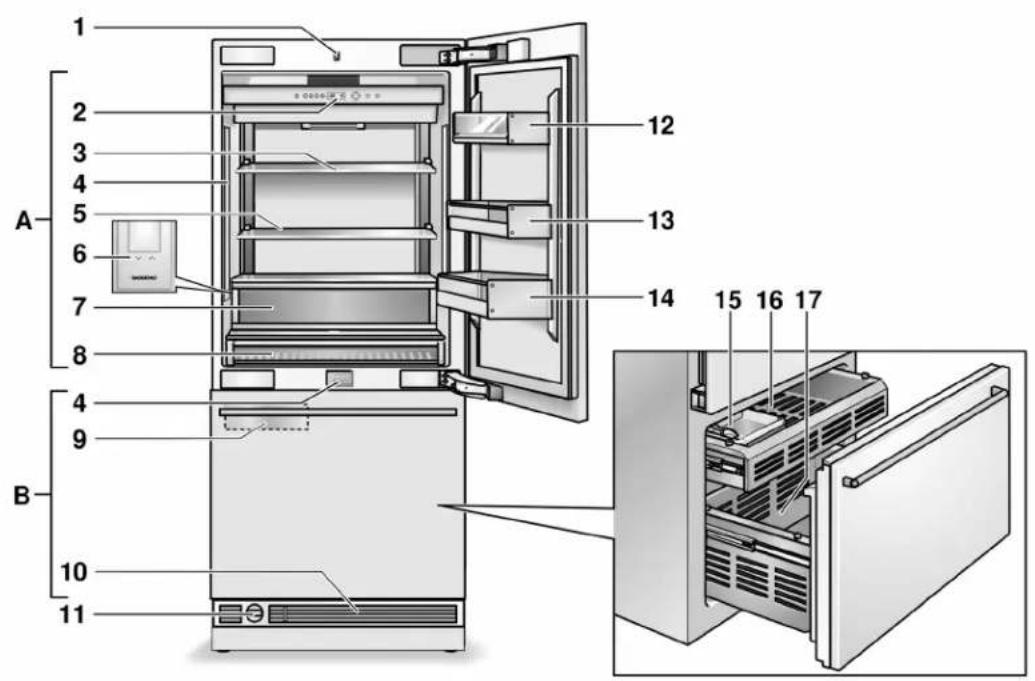
A Refrigerator compartment
16 Tray
B Freezer compartment
17 Door drawer
1 Light switch
2 Operating controls
3 Motorized compartment
4 Light (LED)
5 Glass shelf
6 Motorized compartment button
7 Fruit and vegetable container
8 "Cool-fresh" container
9 Ice maker
10 Ventilation
11 Water filter
12 Butter and cheese compartment
13 Door shelf
14 Storage compartments for large bottles
15 Ice cube container
3 door model
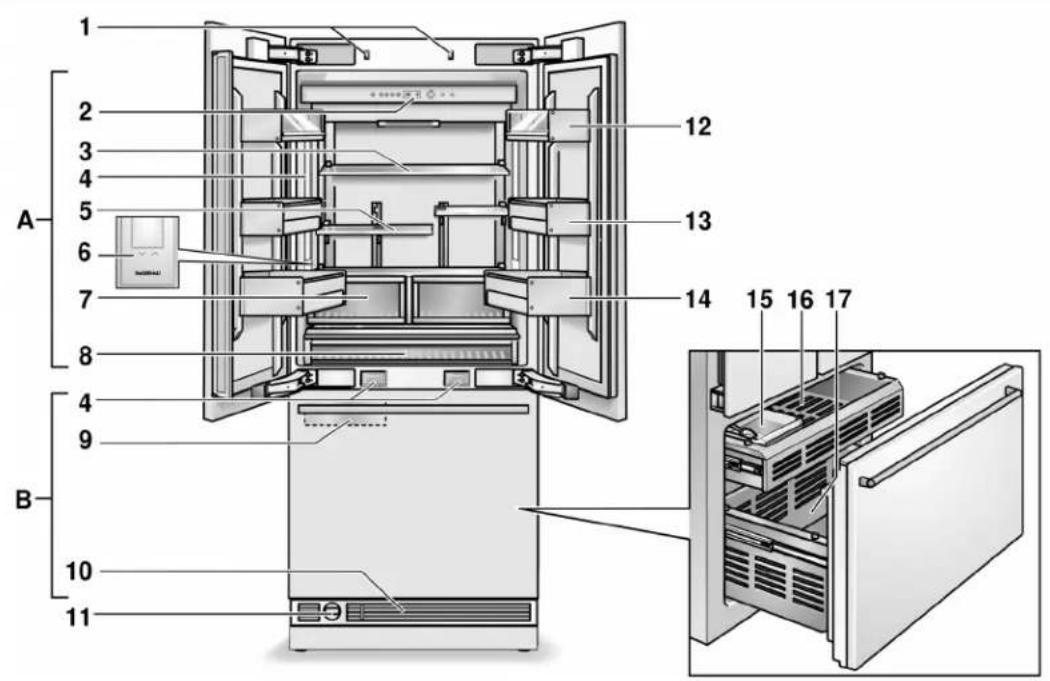
A Refrigerator compartment
B Freezer compartment
1 Light switch
2 Operating controls
3 Motorized compartment
4 Light (LED)
5 Glass shelf
6 Motorized compartment button
7 Fruit and vegetable container
8 "Cool-fresh" container
9 Ice maker
10 Ventilation
11 Water filter
12 Butter and cheese compartment
13 Door shelf
14 Storage compartments for large bottles
15 Ice cube container
16 Tray
17 Door drawer
Operating controls
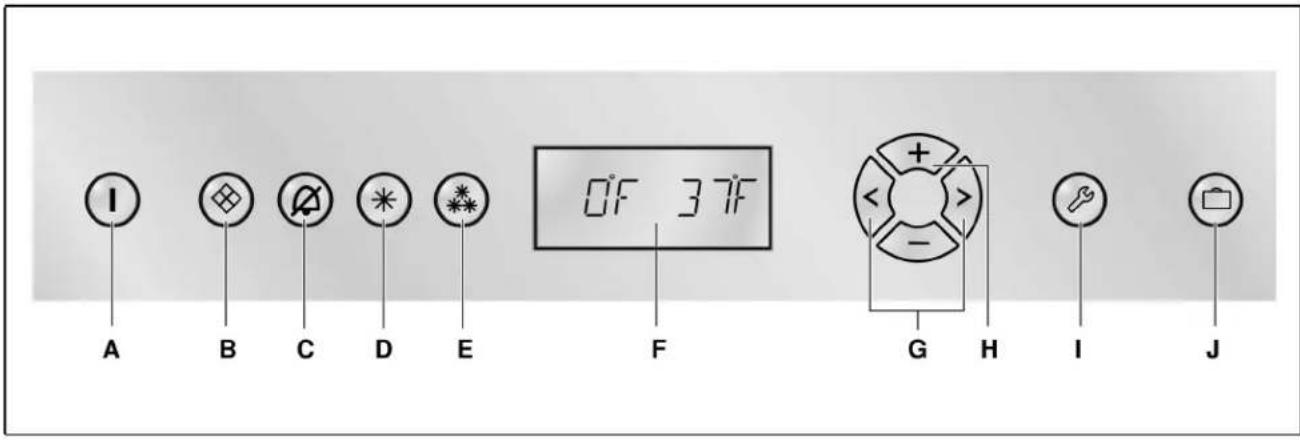
A On/Off button ①
Serves to switch the whole appliance on and off.
B Ice maker button ◎
Serves to switch the ice maker on and off (see chapter Ice maker).
C Alarm button ②
Used to switch off the warning signal, see chapter "Alarm function".
D Fast cooling button (\*)
Switches fast cooling on and off (see chapter Fast cooling).
E Fast freezing button
Switches fast freezing on and off (see chapter Fast freezing).
F Display panel
The temperatures in the refrigerator compartment and in the freezer compartment are shown in the display panel. Activated special functions are shown via "symbol".
The menus and setting options which are available are represented on the display panel in the setup mode, see chapter "Special functions".
G Selection buttons <>
The temperature setting is activated using the selection buttons, see chapter "Setting the temperature".
For selecting a menu in the setup mode (see chapter Special functions).
H Setting buttons +/-
The temperature can be changed using the setting buttons (see chapter Setting the temperature).
More settings can be selected in the setup mode, see chapter Special functions.
I setup button
This button starts and ends the setup mode. If the setup mode is ended using the setup button, the changes which have been made are stored.
J Holiday button
Is used to switch vacation mode on and off (see chapter Special functions, section Vacation mode).
Note:
A sound can be heard every time a button is actuated if this function is activated in the sound menu during the setup mode.
Symbols in the display field
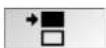
Refrigerator compartment display.
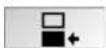
Freezer compartment display.
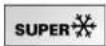
Fast cooling or fast freezing is active, see chapter Fast cooling and Fast freezing.
Holiday mode is activated, see chapter Special functions.
For the setting options in the set up mode, see chapter Special functions.

A warning message is displayed, see chapter Alarm function.
Ice maker is switched on, see chapter Ice maker.
Signal to the water filter is displayed, see chapter Water filter.
Switching the appliance on
Switch on the appliance with the On/Off button.
The appliance begins to cool. Light is switched on when the door is open.
The factory has recommended the following temperatures:
Refrigerator compartment: +37 °F
Freezer compartment: 0 °F

CAUTION:
Keep hands and fingers away from front and rear openings of the refrigerator door when closing. Risk of injury to hands or fingers.
Never allow children to climb on or play with the refrigerator door.
Operating tips
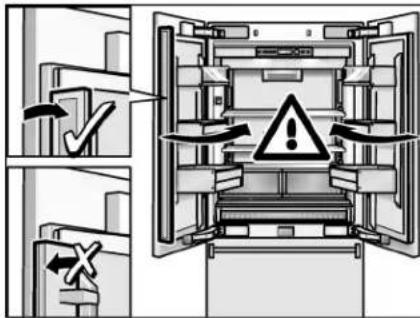
The appliance features a rail which is fitted to the left door.
The door of the refrigerator compartment can be opened without having to first open the right door.
A heating element is integrated into the bar in order to avoid condensation. This can be switched on and off (see chapter Special functions, section Door rail heater).

CAUTION:
To prevent damage to the appliance or the furniture fronts, fold the rail when closing the door.
Set the language
The display languages can be changed according to the table in the chapter Special functions, Setup mode.
In order to change the display language:
-
Press setup button ⏻.
-
Press the selection button < or >, until the set language is displayed.
-
Press the setting button + or -, until the desired language is displayed.
-
Press the setup button Ⓜ, in order to store the settings. The set temperature is displayed again in the display panel.
Setting the temperature unit
The temperature can be displayed in degrees Celsius (°C) or degrees Fahrenheit (°F).
- Press setup button Ⓞ. The first menu (temperature unit) is displayed.
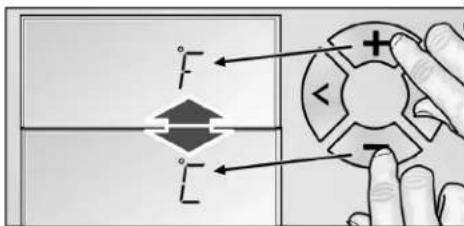
- Press the + or - setting button in order to switch between degrees Fahrenheit (°F) and degrees Celsius (°C).
- Press the setup button ⏻, in order to store the settings. The set temperature is displayed again in the display panel.
Setting the temperature
Refrigerator compartment
(can be selected from +35 °F to +46 °F)
We recommend a setting of +37 °F.
Perishable food should not be stored above +37 °F.
- Activate the setup mode with the selection button >.
- Set the temperature with the + (warmer) or - (cooler) selection buttons.
Freezer compartment
(can be selected from +7 °F to -9 °F)
We recommend a setting of 0 °F.
- Activate setup mode with the selection button <. The symbol ☐ is displayed.
- Set the temperature with the + (warmer) or - (cooler) setting buttons.
Special functions
The following special functions can be selected or displayed:
Setup mode
In Setup mode you can make your personal settings.
Switching on
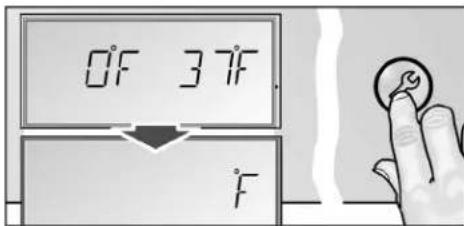
Press setup button ⏻.
The first menu (temperature unit) is displayed in the display panel.
Making settings
- Switch on setup mode.
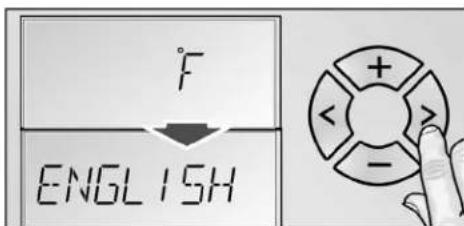
- Press the selection button < or >. The next menu is displayed and its current setting (mostly ON or OFF).
- Press the setting button + or -. The setting is stored, if the next menu is selected using < or >.
Switching off
Press setup button ⏻.
All of the changed settings are stored.
Note:
If no button is selected within 20 seconds, the setup mode ends automatically. All of the changed settings are stored. The set temperature is displayed again in the display panel.
Menus in the setup mode
The following settings can be made.
| Menu Possible setting | |
| Temperature unit °C (degrees Celsius) | |
| °F (degrees Fahrenheit) | |
| Language English | |
| French | |
| Spanish | |
| Sound On | |
| Off | |
| Energy saving mode (eco function) | On |
| Off | |
| Door rail heater (DRY DOOR) | On |
| Off | |
Vacation mode
If leaving the appliance for a long period of time, you can switch the appliance over to the energy-saving vacation mode.
When Vacation mode is switched on, the following settings are made:
The appliance works in energy saving mode.
• The illumination is switched off.
- Fast cooling or fast freezing is then ended (if activated).
Switching on
Press Holiday button ☐.
VACATION is displayed in the display panel.
Switching off
Press Holiday button ☐.
The previous settings and temperature values are once again activated.
Rest mode
When Rest mode is switched on, the following settings are switched off:
Ice maker
Acoustic signal
- Interior light
- Messages on the display panel
- The background illumination of the display panel is reduced
- Buttons are locked
Switching on
- Press the fast cooling button ⓧ and keep it held down.
- Press Holiday button ☐.
- Hold the fast cooling button ☒ down for 3 seconds longer. The VACATION symbol flashes on the display panel and RESTMODE is displayed.
Switching off
Press Holiday button ☐.
The previous settings and temperature values are once again activated.
Energy saving mode
If the energy saving function (eco function) is activated, the appliance switches to energy saving operation. This energy saving function is preset at the factory in order to reduce energy consumption. The background illumination of the fascia is likewise reduced.
Switching on
- Press setup button ⏻.
- Press the selection button >, until ECO MODE and the current setting (OFF) is displayed.
- Press the setting button +, in order to change the setting.
- Press the setup button ⏻, in order to store the setting. ECO is displayed in the display panel.
Switching off
- Press setup button ⏻.
- Press the selection button >, until ECO MODE and the current setting (ON) is displayed.
- Press the setting button —, in order to change the setting.
- Press the setup button Ⓞ, in order to store the setting.
Door rail heater
(for 3-door models only)
To prevent condensation, the door rail heater can be switched on and off as required.
Switching on
- Press setup button ⏻.
- Press the selection button >, until DRY DOOR and the current setting (OFF) is displayed.
- Press the setting button +, in order to change the setting.
- Press the setup button Ⓤ, in order to store the setting.
Switching off
- Press setup button ⏻.
- Press the selection button >, until DRY DOOR and the current setting (ON) is displayed.
- Press the setting button —, in order to change the setting.
- Press the setup button Ⓤ, in order to store the setting.
Alarm function
Switching off the warning signal
Press the alarm button Ⓞ to switch off the warning signal.
Door alarm
The door alarm switches on if an appliance door is left open for longer than three minutes. Close the door to switch off the warning signal.
Refrigerator compartment

WARNING:
Do not store explosive substances in the appliance. Risk of explosion!
The refrigerator compartment is the ideal storage location for ready meals, cakes and pastries, preserved food, condensed milk, hard cheese, fruit and vegetables sensitive to cold as well as tropical fruit.
When purchasing food, please note:
The "purchase freshness" is important for the shelf-life of your food.
In principle, the following applies: the fresher you store the food in the appliance, the longer it will remain fresh.
Therefore, when buying food, pay attention to the degree of freshness.
In the case of ready-made products and bottled goods, observe the best-before date or use-by date specified by the manufacturer.
Arranging food in the appliance
- Wrap or cover food before placing in the appliance. This will retain the aroma, colour and freshness of the food. In addition, flavours will not be transferred between foods and the plastic parts will not become discoloured.
- Allow warm food and drinks to cool down before placing in the appliance.
- Do not block air outlet openings with food in the refrigerator compartment, otherwise the air circulation will be impaired. Food which is stored directly in front of the air outlet openings may be frozen by the cold air flowing out.
- Avoid contact of oil and fat with the plastic parts and door seal.
Fast cooling
Fast cooling cools the refrigerator compartment as cold as possible for approx. 6 hours. Then the appliance automatically switches to the temperature set prior to fast cooling mode.
Switch on fast cooling mode, e.g.
- before placing large quantities of food in the refrigerator compartment.
• for fast cooling of drinks.
Switching on
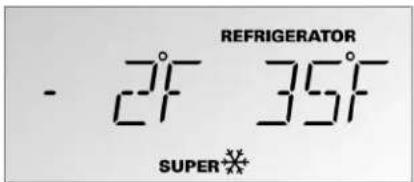
Press fast cooling button ⓧ.
The display panel indicates the symbol SUPER ^※ and the compartment for which the function was switched on.
Switching off
Press fast cooling button ⓧ.
"Cool-fresh" container
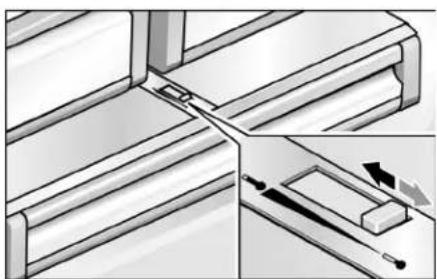
The "cool-fresh" container has a temperature of almost 32 °F. Ideal for storing fish, meat, sausage, cheese and milk.
The temperature in the "cool-fresh" container can be reduced slightly with the slide control.
We recommend the following controller position:
• COLD: Meat, sausage and poultry
- COLDER: Fish
natural_image
Technical illustration of a mechanical assembly with tool paths and components (no text or symbols)Freezer compartment

WARNING:
Do not store explosive substances in the appliance. Risk of explosion!

CAUTION:
Do not refreeze thawing or thawed food. Before freezing the food, first boil or fry it. Never keep frozen food longer than the maximum storage duration.
Use the freezer compartment
• To store frozen food.
• To make ice cubes.
• To freeze food.
Note:
Ensure that the freezer compartment door has always been closed properly! If the door is open, the frozen food will thaw. The freezer compartment will become covered in thick ice. Besides: energy is wasted due to the high power consumption!
Freezing and storing food
Purchasing frozen food
- The packaging must not be damaged.
- Pay attention to the expiration date.
- Temperature in the supermarket freezer must be 0 °F (-18 °C) or lower.
- If possible, transport frozen food in an insulated bag and place quickly in the freezer compartment.
Freezing fresh food
Freeze only fresh and undamaged food.
To retain the best possible nutritional value, flavor and color, vegetables should be blanched before freezing. Eggplants, peppers, zucchini and asparagus do not require blanching.
Literature on freezing and blanching can be found in bookstores.
Note:
Keep food which is to be frozen away from food which is already frozen.
- The following foods are suitable for freezing: Baked goods, fish and seafood, meat, game, poultry, vegetables, fruit, herbs, eggs without shells, dairy products such as cheese and butter, ready meals and leftovers such as soups, stews, cooked meat and fish, potato dishes, soufflés and desserts.
The following foods are not suitable for freezing: Vegetables that are usually consumed raw, such as lettuce or radishes, eggs in shells, grapes, whole apples, pears and peaches, hard-boiled eggs, yoghurt, soured milk, sour cream, crème fraîche and mayonnaise.
Packing frozen food
To prevent food from losing its flavor or drying out, place in airtight containers.
- Place food in packaging.
- Remove air.
- Seal the packaging.
- Label packaging with contents and date of freezing.
Suitable packaging:
Cling wrap, tubular film made of polyethylene, aluminum foil, freezer containers. These products are available from specialist outlets.
Unsuitable packaging:
Wrapping paper, greaseproof paper, cellophane, bin liners and used shopping bags.
Items suitable for sealing packaged food:
Rubber bands, plastic clips, string, cold-resistant adhesive tape, etc.
Bags and tubular film made of polyethylene (PE) can be sealed with a film heat sealer.
Shelf life of frozen food
Shelf life depends on the type of food.
At a temperature of 0^ F ( -18^ C):
- Fish, sausage, ready meals, cakes and pastries: up to 6 months
- Cheese, poultry and meat: up to 8 months
• Vegetables, fruit: up to 12 months
Fast freezing
Food should be frozen solid as quickly as possible in order to retain vitamins, nutritional value, appearance and flavor.
To prevent an undesirable temperature rise when placing fresh food in the freezer compartment, switch on fast freezing several hours beforehand. As a rule, 4–6 hours is adequate. 24 hours are necessary when using the maximum freezer capacity fully.
After 2 days the temperature set before fast freezing is automatically restored.
Switching on
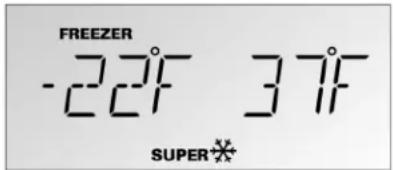
Press fast freezing button Ⓧ.
The display panel indicates the symbol SUPER and the compartment for which the function was switched on.
Switching off
Press fast freezing button ⚙.
Thawing frozen food
Depending on the type and application, you can select one of the following options:
at room temperature
• in the refrigerator
- in an electric oven with/without a hot air fan
- in a microwave.
CAUTION:
Do not refreeze partly or completely thawed food. Only food that has then been cooked (boiled or fried) may be refrozen.
Do not store the frozen produce for the max. storage period.
Ice maker
The ice maker makes ice cubes.
The ice maker starts to make ice cubes as soon as the appliance has reached the set temperature. If the ice cube container is full, the ice maker automatically switches off.
CAUTION:
Do not place bottles or food in the cube container in order to cool them quickly. The ice maker may block and be damaged.
Switching on
Note:
If the ice maker is used for the first time and/or a long period of not being used, do not use the ice which is produced in the first day for hygiene reasons. Throw the ice cubes away and clean the container!
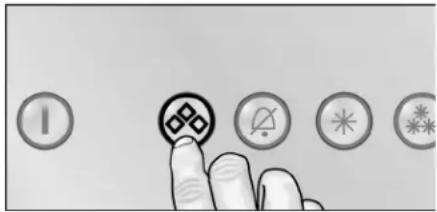
- Make sure that ice maker container is its place and locked into position.
- Press ice maker button Ⓧ. The symbol ICE is lit on the display panel.
natural_image
Hand pointing at five circular icons with abstract symbols (no text or labels)Switching off
Note:
Switching off for a prolonged period (> 2 days): The water supply to the appliance must be interrupted beforehand for 2–3 hours. This prevents stagnant water from collecting in the ice maker.
Note:
Switching off briefly, e.g. for cleaning: Place a bowl under the dispenser to catch ice cubes or condensation.
- Press ice maker button ☑.
- Empty ice cube container (see chapter Cleaning the ice cube container).
Water filter

WARNING:
Do not use the appliance in places where the water quality is risky or not sufficiently known about without suitable disinfection, before and after filtering.
A filter cartridge for filtering particles can be obtained from customer service or a specialist dealer.

CAUTION:
After installing a new filter, always discard the ice produced within the first 24 hours after switching on the ice maker.
- If the ice has not been used for a prolonged period, pour all ice cubes out of the container and also discard the ice produced within the next 24 hours.
- If the appliance or the ice has not been used actively for several weeks or months or if the ice cubes have an unpleasant taste or odor, change the water filter.
- Air trapped in the system may cause water to escape and the filter cartridge to be ejected. Caution when removing.
- The filter must be changed at least every 6 months.
Note:
After use, the water system is subject to low pressure. Be careful when removing the filter!
Exchanging the filter cartridge
- Turn the filter cap on the base of the appliance by 90-180° anti-clockwise.
- Pull out the filter cartridge.
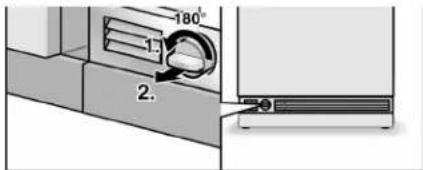
- Take a new filter cartridge from the packet and remove the protective cap.
- Take the filter cap off of the used filter cartridge.
- Place the filter cap on the fresh filter cartridge.
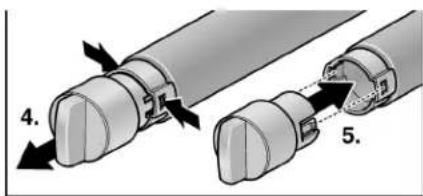
- With the filter cap in a horizontal position, feed the filter cartridge into the opening on the appliance base as far as it will go.
- Turn the filter cartridge 90-180° in a clockwise direction.
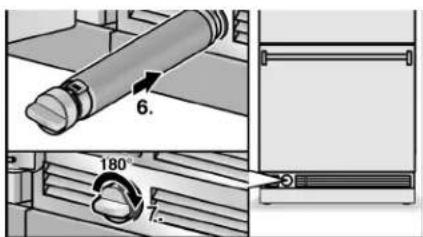
- Pour water out of the used filter cartridge. The filter cartridge can be disposed of in the household rubbish.
Note:
The appliance could be used without a water filter. If you select this option, replace the water filter with a particle cartridge. In this case the filter display can be deactivated to prevent the filter change display. To purchase a water filter replacement cartridge, contact your local dealer or call 1-800-578-6890.
Specification and performance data sheet
For filter model: 9000 077 095
Using replacement cartridge: 9000 077 104
The model was tested by NSF International with reference to ANSI/NSF Standards 42 & 53 and certified for a reduction in the substances cited below.
The concentration of the indicated substances which are dissolved in water and penetrate the system was reduced to a value below or equal to the permitted limit value in accordance with NSF/ANSI 42 and 53 for water discharged out of the appliance.
Note:
Even though the tests were conducted under standard laboratory conditions, the actual performance may deviate from these tests.

The system was tested and certified on model 9000 077 095 by NSF International with reference to ANSI/NSF Standard 53 for a reduction in cysts and turbidity, as well as with reference to ANSI/NSF Standard 42 for a reduction in the taste and odour of chlorine.
Nominal particle class: I
Nominal service life: 739.68 gallons (2,800 litres)
| Sub-stance | Average in inflow | Inflow concentration | Waste water concentration | Average reduction as % | Max. permitted concentration in waste water | Max. waste water | Min. reduction as % | NSF test |
| Cysts * 166,500 Min. 50,000/l 1 99.99 99.95 1 99.99 511077- | 03 | |||||||
| Particle class 1 particle size >0.5 to <1.0 μm | 5,700,000 At least 10,000 particles/ml | 30.583 99.52 >85% 69.000 98.9 511079- | 03 | |||||
| Taste of chlorine and turbidity | 1.9 2.0 mg/l +-10% | 0.05 97.3 >50% 0.06 | 96.84 | 511081- | 03 | |||
* Based on the use of Cryptosporium parvum ocysts.
Application guidelines / Water supply parameters::
Water pressure 30 - 120 psi
(207 - 827 kPa)
Water temperature * 33 °F - 100 °F
(0.6 °C - 38 °C)
Flow rate 0.75 gpm (2.83 l/min.)
- The system is to be installed and operated according to the guidelines recommended by the manufacturer.
● The filter is to be changed every 6-9 months. - Rinse new filter thoroughly for 5 minutes.
- More detailed information can be found on the warranty card.
Without appropriate disinfection before and after connecting it to the system, this product should NOT be used if the water is microbiologically contaminated or if the quality has not been ascertained. A system certified for cyst reduction should be used for disinfected water which possibly contains filterable cysts.
A one-year warranty is issued for the entire system (except disposable cartridge). With reference to disposable cartridges a warranty is issued for material and processing faults only. As the service life of disposable cartridges depends on the local water conditions, no warranty is issued for them.
More detailed information on the prices of spare parts is available from your appliance dealer or parts salesman on site.
Manufactured by:
Cuno Engineered Products
1000 Apollo Road
Eagan, MN 55121-2240 U.S.A.
Interior fittings
Glass shelf
Adjusting the height of the shelf:
- Lift the shelf front and move it upwards or downwards into the guiding positions.
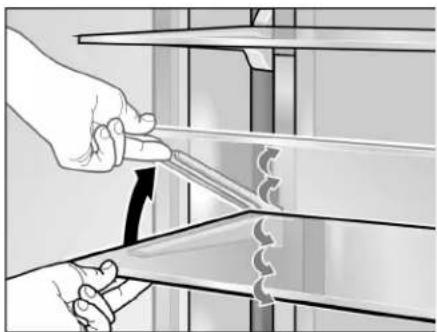
natural_image
Illustration of a hand holding a tool interacting with a multi-tiered shelf (no text or symbols visible)-
Lower the shelf front to the desired height. The holders engage into the guiding positions. Removing and re-inserting shelves:
-
Lift the shelf at the front and move it into the guiding positions as far as the openings.
- Remove the shelf forwards.
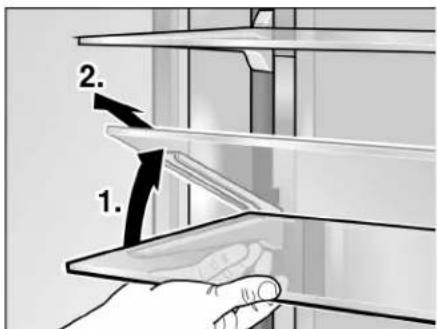
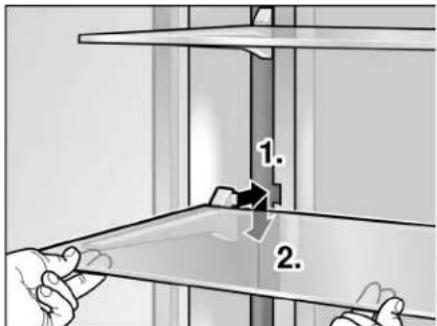
- Place the shelf into the guiding positions openings and press downwards.
- Set the shelf to the desired height.
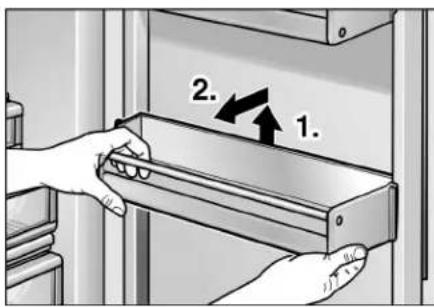
Door shelf
- Lift the container and remove.
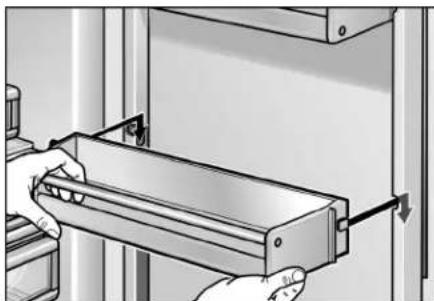
- Place the container at the desired height and press downwards.
natural_image
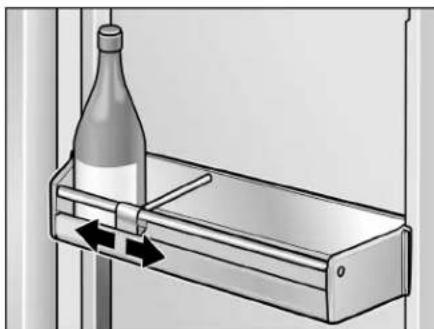
Illustration of hands installing a metal shelf panel into a cabinet (no text or symbols visible)Bottle holder
The bottle holder prevents bottles from falling over when the door is opened and closed.
natural_image
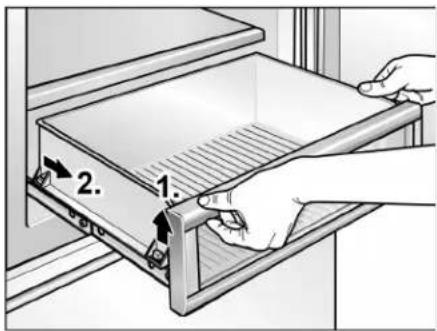
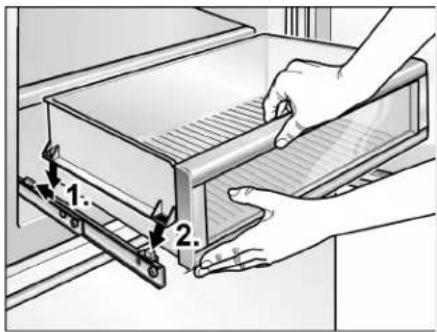
Diagram of a bottle being inserted into a container with directional arrows indicating flow (no text or symbols)Trays in the refrigerator compartment
- Lift tray slightly and take out.
-
Lift tray at front slightly and insert into the runners.
-
Lower tray and push back.
Trays in the freezer compartment
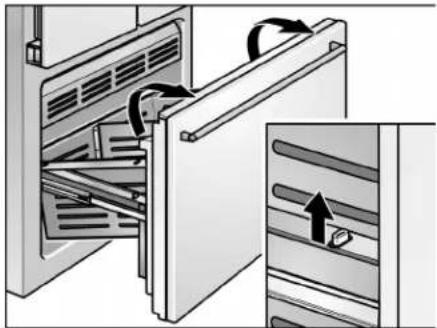
The trays in the freezer compartment can be taken out for cleaning.
The upper tray must first be removed before the door container can be taken out.
- Screw the closures by 90° on the pullout using a screwdriver.
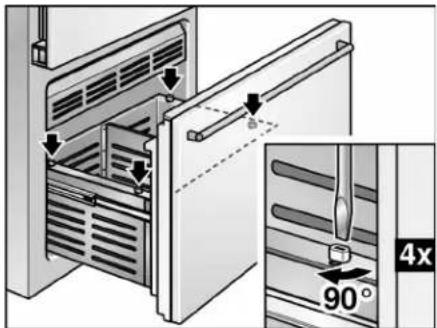
- Lift tray slightly and take out.
natural_image
Diagram of a refrigerator interior showing door, drawer, and shelf with arrows indicating rotation (no text or symbols)-
Lift tray at front slightly and insert into the runners.
-
Lower tray and push back.
-
Screw the closures by 90^ on the pullout using a screwdriver.
Switching off and disconnecting the appliance
Switching the appliance off
Press the On/Off button ①.
Pull out the mains plug.
Disconnecting the appliance
If you do not use the appliance for a prolonged period:
-
Before switching off, it is most important that you switch the water supply to the appliance off for a few hours.
-
Take all food out of the appliance.
-
Switch the appliance off.
-
Pull out mains plug or switch off fuse.
-
Empty and clean the ice cube container (see chapter Cleaning the appliance).
-
Clean the appliance interior (see chapter Cleaning the appliance).
-
Leave the appliance doors open to prevent odours from forming.
Defrosting
Defrosting is actuated automatically.
Cleaning the appliance

WARNING:
Never clean the appliance with a steam cleaner!

CAUTION:
Do not use abrasive, chloride or acidic cleaning agents or solvents.

CAUTION:
Do not use scouring or abrasive sponges. The metallic surfaces could corrode.

CAUTION:
Never clean shelves and containers in the dishwasher. The parts may become deformed!
Proceed as follows:
- Before cleaning: Switch the appliance off.
- Pull out power cord plug or switch off fuse.
- Take out the frozen food and store in a cool location. Place the ice pack (if enclosed) on the food.
- Wait until the layer of frost has thawed.
- Clean the appliance with a soft cloth, lukewarm water and a little pH neutral washing-up liquid. The rinsing water must not run into the light.
- Wipe the door seal with clear water only and then wipe dry thoroughly.
- After cleaning reconnect and switch the appliance back on.
- Put the frozen food back in the freezer compartment.
Interior fittings
All variable parts of the appliance can be taken out for cleaning (see chapter "Interior fittings").
Cleaning the ice cube container
If ice cubes have not been dispensed for a prolonged period, they will shrink, have a stale taste and stick together. Therefore, the ice cube container should be cleaned regularly.

CAUTION:
A full ice cube container is heavy.
- Remove the ice cube container.
-
Pull out the container, empty and clean with lukewarm water.
-
Thoroughly dry the container to prevent new ice cubes from sticking.
-
Insert the ice cube container. Ice cube production continues.
Odours
If you experience unpleasant odors:
- Switch the appliance off.
- Take all food out of the appliance.
- Clean interior (see chapter "Cleaning the appliance").
- Clean all packages.
- Seal strong smelling food in order to avoid odors from forming.
- Switch the appliance on again.
- Store food in the appliance.
- Check whether the formation of odors is still occurring after 24 hours.
- Change odor filter (see chapter "Exchange the odor filter").
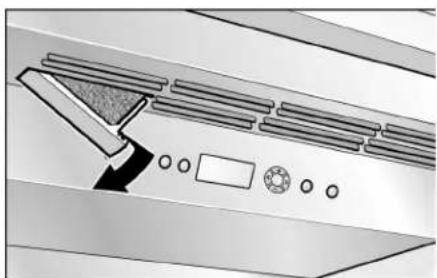
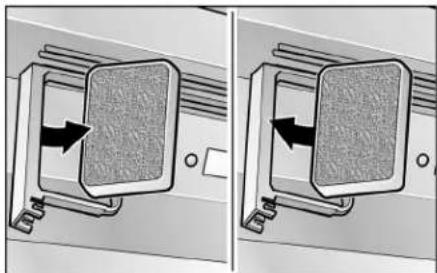
Exchange the odor filter
Spare filters are available from your dealer.
- Open the filter holder.
natural_image
Diagram of a ceiling-mounted air conditioner unit with cooling fan and fan (no text or labels)- Remove the used odor filter and replace with a new odor filter.
natural_image
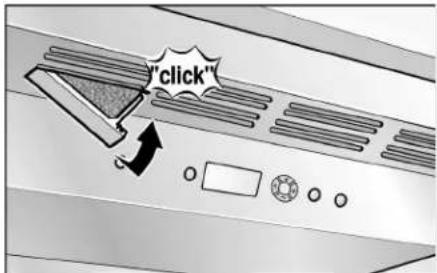
Diagram showing two views of a device with arrows indicating direction, no text or symbols present- Close the filter holder.
Light (LED)
Your appliance features a maintenance-free LED light.
These lights may be repaired by customer service or authorized technicians only.
Saving energy
- Install the appliance in a dry, ventilated room. The appliance should not be installed in direct sunlight or in the vicinity of heat sources (e.g. radiator, cooker). If required, use an insulating plate.
- Do not block the ventilation openings in the appliance.
- Allow warm food and drinks to cool down before placing them in the appliance.
- Thaw frozen food in the refrigerator compartment and use the low temperature of the frozen food to cool refrigerated food.
- Open the appliance as briefly as possible.
• Make sure that the freezer compartment door has always been closed properly! - The arrangement of the fittings does not affect the energy absorption of the appliance.
Operating noises
Completely normal noises
Droning
Motors are running (e.g. refrigeration units, fan).
Bubbling, humming or gurgling noises
Refrigerant is flowing through the tubing or water is flowing into the ice maker.
Clicking
Motor, switches or solenoid valves are switching on/off.
Rumbling
Ready ice cubes from the ice maker are falling into the ice cube container.
Preventing noises
The appliance is not level
Please align the appliance with a spirit level. Use the height-adjustable feet or place packing underneath them.
The appliance is not free-standing
Please move the appliance away from adjacent units or appliances.
Containers or storage areas wobble or stick
Check which parts are removable and, if necessary, re-insert them correctly.
Bottles or receptacles are touching each other
Move the bottles or receptacles slightly away from each other.
Rectifying minor faults yourself
Before you call customer service:
Check whether you can eliminate the fault yourself based on the following information.
Customer service will charge you for advice – even if the appliance is still under guarantee!
Appliance
| Fault Possible cause Remedial action | ||
| Appliance has no refrigeration capacity. | Appliance has been switched off. Press the On/Off button. | |
| Power failure. Check whether the power is on. | ||
| The light does not work. | The fuse has been switched off. Check the fuse. | |
| The display does not illuminate. | The mains plug has not been inserted properly. | Check whether the mains plug is secure. |
| The refrigeration unit is switching on more frequently and for longer. | Appliance opened frequently. Do not open the appliance unnecessarily. | |
| The ventilation openings have been covered. | Remove obstacles. | |
| Large quantities of fresh food are placed in the freezer. | Activate fast cooling and/or fast freezing. | |
| The light (LED) does not work. The LED lamp is defective. Call customer service. | ||
| Display indicates “E..”. Electronics have detected a fault. Call customer service. | ||
| Display indicates “LOW-POWER”. | The mains voltage falls below the permitted limiting value. | When the mains voltage reaches the stipulated value again, the warning message goes out. If the warning message lasts for longer, inform the energy supply company. |
| Display indicates “HIGHVOLT”. The mains voltage exceeds the permitted limiting value. | When the mains voltage reaches the stipulated value again, the warning message goes out. If the warning message lasts for longer, inform the energy supply company. | |
| Condensation forms on the rail on the left door. | Condensation of warm air. Switch on heater in the rail (see chapter “Special functions”, section “Door rail heater”). | |
Ice maker
| Fault Possible cause Remedial action | ||
| The ice maker doesn't work. Ice maker is not connected to the mains supply. | Call customer service. | |
| Ice maker does not contain any fresh water. | ||
| The freezer compartment temperature is too warm. | ||
| The ice maker does not make enough ice or the ice is deformed. | The appliance or ice maker has only just been switched on. | Approx. 24 hours is needed until ice production starts. |
| A lot of ice has been taken. Approx. 24 hours is needed until the ice cube container is filled again. | ||
| Low water pressure. Connect the appliance to the stipulated water pressure only (see chapter Connecting appli-ance, section Water connection). | ||
| The water filter is bunged up or used. Change the water filter. | ||
| Temperature in the freezer compartment is too warm. | Set temperature slightly colder in the freezer compartment. | |
| Ice cubes have accumulated on the rear panel of the ice cube container. | Distribute ice cubes in the ice cube container. If ice cubes are stuck to each other, loosen with a blunt implement. | |
| The ice maker does not make any ice. | The ice maker is switched off. Switch the ice maker on at the control panel. | |
| The appliance is not supplied with water. | Contact the installer or the water supply com-pany. | |
| Water supply has kinks. Turn off the water supply at the shut-off tap. Smoothen out the kinks, exchange where nec-essary. | ||
| Low water pressure. Connect the appliance to the stipulated water pressure only (see chapter Connecting appli-ance, section Water connection). | ||
| Temperature in the freezer space is too warm. | Set temperature slightly colder in the freezer compartment. | |
| Ice cube container is not properly inserted. | Check the position, re-insert where necessary. | |
| Incorrect shut-off tap installed. Incorrect taps can cause low water pressure and damage to the appliance. | ||
| Ice forms in the inflow hose to the ice maker. | Low water pressure. Connect the appliance to the stipulated water pressure only (see chapter Connecting appli-ance, section Water connection). | |
| Shut off tap incorrectly opened. Open shut off tap fully. | ||
| Water runs from the appliance. The water connection hose is not pro-erly sealed. | Replace the hose with a manufacturer's origi-nal part. | |
| Incorrect shut-off tap installed. Incorrect taps can cause low water pressure and damage to the appliance. | ||
Customer service
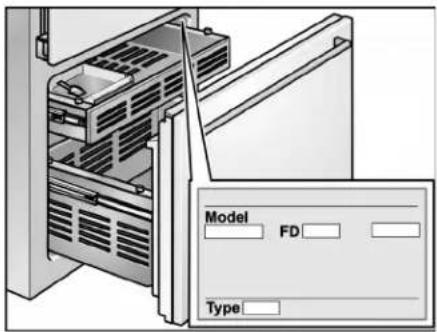
If required, we recommend that you have the door hinges changed over by our customer service. You can find out the costs for changing over the door hinges from your customer service.
Before you call customer service, see the chapter entitled "Rectifying minor faults yourself".
After checking according to the chapter "Rectifying minor faults yourself", additional help can be requested by calling the Gaggenau Customer Interaction Center, 1-877-442-4436 (toll-free), from anywhere in the USA.
In Canada contact your Gaggenau customer service or call 1-877-442-4436.
Write down the following information about your appliance so that you have it ready and can get better assistance if you require support from customer service.
Dealer's name:
Address:
Telephone number:
Purchase date:
Model number:
FD number:
Serial number
Type
www.P65Warnings.ca.gov
natural_image
Technical illustration of a mechanical assembly with tool and component details (no text or symbols)Extinction
Remarque :
Cuno Engineered Products
1000 Apollo Road
Eagan, MN 55121-2240 U.S.A.
Équipement
Clayette en verre
natural_image
Illustration of a hand holding a tool interacting with a multi-layered shelf (no text or symbols visible)natural_image
Illustration of hands installing a metal shelf panel with a pull arrow (no text or symbols)Porte-bouteilles
natural_image
Diagram of a bottle being inserted into a metal container, showing fluid flow direction (no text or symbols)natural_image
Diagram of a refrigerator interior showing door, drawer, and shelf with arrows indicating rotation (no text or symbols)natural_image
Diagram of a ceiling-mounted air duct with ventilation grilles and mounting holes (no text or symbols)natural_image
Two-panel diagram showing a device with directional arrows indicating movement or force (no text or symbols present)es Índice
www.P65Warnings.ca.gov
Ajuste del idioma
Desconexión
Pulsar la tecla «setup» Ⓥ.
natural_image
Technical illustration of a mechanical assembly with tool and component details (no text or symbols)natural_image
Hand pointing at five circular icons with symbols (unknown, leaf, asterisk, asterisk) on a plain background (no text or labels)Desconexión
Nota:
Cuno Engineered Products
1000 Apollo Road
Eagan, MN 55121-2240 U.S.A.
Equipamiento
Balda de vidrio
natural_image
Illustration of a hand using a tool to interact with a device on shelves (no text or symbols visible)natural_image
Illustration of hands installing a metal shelf panel with a directional arrow (no text or symbols)Contenedor de botellas
natural_image
Diagram of a bottle being inserted into a mechanical device (no text or symbols present)natural_image
Diagram of a refrigerator interior showing door, drawer, and shelf with arrows indicating rotation (no text or symbols)natural_image
Diagram of a ceiling-mounted air conditioner unit with cooling fins and indicator lights (no text or labels)natural_image
Diagram showing two views of a device with arrows indicating movement, no text or symbols presentGaggenau
1901 Main Street
Irvine, CA 92614
Telephone: 800-828-9165
www.gaggenau-usa.com


- Safety and warning information
- Definition
- WARNING:
- CAUTION:
- Before you switch on the appliance
- Technical safety
- Important information when using the appliance
- Children in the household
- General information
- State of California Proposition 65 Warnings
- Instructions on disposal
- Disposal of packaging
- Disposal of your old appliance
- Installing the appliance
- Transport
- Installation location
- Ventilation
- Connecting the appliance
- Water connection
- Note:
- Electrical connection
- Getting to know your appliance
- door model
- door model
- Operating controls
- A On/Off button ①
- B Ice maker button ◎
- C Alarm button ②
- D Fast cooling button (\*)
- E Fast freezing button
- F Display panel
- G Selection buttons <>
- H Setting buttons +/-
- I setup button
- J Holiday button
- Symbols in the display field
- Switching the appliance on
- Operating tips
- Set the language
- Setting the temperature unit
- Setting the temperature
- Refrigerator compartment
- Freezer compartment
- Special functions
- Setup mode
- Switching on
- Making settings
- Switching off
- Menus in the setup mode
- Vacation mode
- Rest mode
- Energy saving mode
- Door rail heater
- Alarm function
- Switching off the warning signal
- Door alarm
- When purchasing food, please note:
- Arranging food in the appliance
- Fast cooling
- "Cool-fresh" container
- Use the freezer compartment
- Freezing and storing food
- Purchasing frozen food
- Freezing fresh food
- Packing frozen food
- Suitable packaging:
- Unsuitable packaging:
- Items suitable for sealing packaged food:
- Shelf life of frozen food
- Fast freezing
- Thawing frozen food
- Ice maker
- Water filter
- Exchanging the filter cartridge
- Specification and performance data sheet
- Interior fittings
- Glass shelf
- Door shelf
- Bottle holder
- Trays in the refrigerator compartment
- Trays in the freezer compartment
- Switching off and disconnecting the appliance
- Switching the appliance off
- Disconnecting the appliance
- Defrosting
- Cleaning the appliance
- Proceed as follows:
- Cleaning the ice cube container
- Odours
- Exchange the odor filter
- Light (LED)
- Saving energy
- Operating noises
- Completely normal noises
- Droning
- Bubbling, humming or gurgling noises
- Clicking
- Rumbling
- Preventing noises
- The appliance is not level
- The appliance is not free-standing
- Containers or storage areas wobble or stick
- Bottles or receptacles are touching each other
- Rectifying minor faults yourself
- Customer service
- Extinction
- Remarque :
- Équipement
- Clayette en verre
- Porte-bouteilles
- es Índice
- Ajuste del idioma
- Desconexión
- Nota:
- Equipamiento
- Balda de vidrio
- Contenedor de botellas
Brand : GAGGENAU
Model : RB492701
Category : Refrigerator