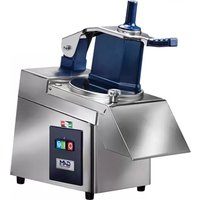
Cuocojet 415010 - Slicer GAM - Free user manual and instructions
Find the device manual for free Cuocojet 415010 GAM in PDF.



| Product type | Vegetable cutter / Slicer |
| Brand | GAM |
| Model | Cuocojet 415010 |
| Dimensions (W x D x H) | 235 x 520 x 560 mm (230V version) / 235 x 520 x 600 mm (400V version) |
| Net weight | 20 kg |
| Gross weight | 22 kg |
| Power supply | 230-400 V ~ 50 Hz (single-phase or three-phase depending on version) |
| Power | 0.55 kW (single-phase 230V) / 0.75 kW (three-phase 400V) |
| Production capacity | 200 to 400 kg/h |
| Cutting types | Slices, cubes, julienne, sticks, grated, shredded |
| Body material | Aluminum |
| Disc material | Stainless steel |
| Motor | Asynchronous |
| Noise level | 58 dB(A) |
| Safety devices | Emergency stop button, magnetic cover closure sensor, NVR device (anti-restart) |
| Included accessories | Ejection disc, interchangeable discs and grids (series E, D, H, Z, etc.) |
| Maintenance | Daily cleaning with sponge and neutral detergent; do not use water jets |
| Intended use | Fruits, vegetables, hard cheeses, bread, dried fruits, chocolate |
| Warranty | 12 months (commercial) |
| Manufacturer | Minerva Omega Group S.r.l., Via del Vetraio, 36 - 40138 Bologna, Italy |
| Compliance | CE, European directives |
Frequently Asked Questions - Cuocojet 415010 GAM
User questions about Cuocojet 415010 GAM
0 question about this device. Answer the ones you know or ask your own.
Ask a new question about this device
Download the instructions for your Slicer in PDF format for free! Find your manual Cuocojet 415010 - GAM and take your electronic device back in hand. On this page are published all the documents necessary for the use of your device. Cuocojet 415010 by GAM.
USER MANUAL Cuocojet 415010 GAM
"CUOCOJET" VEGETABLE-CUTTING MACHINE MANUAL

natural_image
Exterior view of a modern stainless steel robotic kitchen with blue control panel and control buttons (no text or symbols visible)EMGA
*415.010
1 PURPOSE AND CONTENT OF THE MANUAL 32
1.1 Symbols 32
1.2 Illustrations.... 32
1.3 Purpose of the Manual.... 32
1.4 Preservation.... 33
1.5 Updating the Manual.... 33
2 GENERAL DIRECTIONS 34
2.1 Manufacturer's data.... 34
2.2 Limits of liability 34
2.3 Identification plate 34
2.4 Definition of the operator.... 35
2.5 Warranty 35
2.6 Machine certificate 35
3 TECHNICAL FEATURES 36
3.1 Description of the machine 36
3.1.1 Recommended use 36
3.1.2 Description of components 36
3.1.3 Dimensions.... 37
3.2 Technical data.... 37
3.3 Disposal 37
3.4 Standard supply 38
3.4.1 Disk and grills 38
4 GENERAL SAFETY RULES 40
4.1 Workplace 40
4.2 Machine airborne noise.... 40
4.3 Risks residues.... 40
4.4 Personal Protective Equipment (PPE) 41
4.5 General precautions.... 41
4.6 Electrical hazards.... 42
4.7 Operator safety 42
4.8 Safety signs 43
4.9 Safety devices.... 43
4.9.1 Safety device checks.... 43
5 INSTALLATION 44
5.1 Transport and assembly 44
5.1.1 Packaging dimensions.... 44
5.1.2 Package contents.... 44
5.2 Reception.... 44
5.2.1 Lifting and handling the machine.... 45
5.3 Workplace....45
5.4 Installation.... 46
5.4.1 Electrical connection.... 46
5.5 First cleaning.... 46
5.6 Preliminary checks.... 46
5.7 Storage 46
6.1 Description of control panel 47
6.2 Preliminary checks.... 47
6.3 Operator's station 47
6.4 Starting up for the first time.... 47
6.5 Start-up 48
6.6 Insertion and removal of cutting tools 49
6.7 Machine start-up 50
6.7.1 Checks to be performed in case of start-up problems.... 51
6.8 Stopping procedure.... 52
7 MAINTENANCE AND CLEANING 52
7.1 Machine maintenance.... 52
7.1.1 Scheduled maintenance operations 52
7.2 Cleading.... 53
7.2.1 Cleaning sheet in accordance with HACCP procedure 55
1 PURPOSE AND CONTENT OF THE MANUAL
1.1 Symbols
For the safety of persons and property, special symbols have been used in the preparation of this documentation to focus attention from time to time on hazardous conditions, warnings or relevant information:

DANGER!
Danger with risk of injury or death.
Accident prevention regulations for the operator.
PAY CLOSE ATTENTION TO THE TEXT BLOCKS INDICATED BY THIS SYMBOL.

ELECTRICAL HAZARD!
Danger with risk of injury or death.
Accident prevention regulations for the operator.
PAY CLOSE ATTENTION TO THE TEXT BLOCKS INDICATED BY THIS SYMBOL.

ATTENTION
Possible damage to the machine and/or its components.
Pay attention.

WARNING
Warning or note on key functions or useful information related to the current operation.

POWER CUT-OFF!
It is compulsory to disconnect the electrical power supply before working on the machine. PAY THE UTMOST ATTENTION TO THE TEXT BLOCKS INDICATED BY THIS SYMBOL.
1.2 Illustrations
The illustrations in this publication are current as of the date of issue.
Due to continuous technical or commercial updates, components whose external shape may differ from that illustrated may be fitted to the machine covered by this manual, while retaining the functionality and adjustability of the components illustrated.

WARNING
The illustrations are purely indicative and may show the machine with the protective devices removed for better understanding.
1.3 Purpose of the Manual

WARNING
This document has been prepared in accordance with the regulations in force at the time of its publication.
The purpose of this manual is to provide the Customer with all the information necessary to use and operate the machine correctly, independently and safely.
The manual contains information regarding safety, technical aspects, operation and maintenance of the CUOCOJET-COLOSSEO machine. The Instructions for Use are an integral part of the machine and must accompany it throughout its useful life, until it is scrapped. Keep the Instructions for Use in an accessible place near the machine and known to all Operators.

ATTEINTION
Read this manual carefully and comply scrupulously with the indications described before any use, check and operation to be carried out on the machine.
Prevent the use of the machine by operators who are not familiar with the prescriptions contained in the instructions.
The correct use and the correct maintenance of the machine contribute to the good functioning and a longer life cycle of the machine. In case of doubt or for information, contact the nearest service center or contact the Minerva Omega Group S.r.l. after-sales service directly.
1.4 Preservation
The manual must be stored with care and in the immediate vicinity of the machine, must be accessible and known to all operators, protected from liquids and anything else that may affect its readability, and must be available for consultation at any time.
The manual and the Declaration of Conformity are an integral part of the machine and, therefore, must accompany it throughout its life cycle.
If the manual is lost or illegible, request a copy from Minerva Omega Group S.r.l..

WARNING
This document must be handed over to any subsequent owner of the machine.
1.5 Updating the manual
The information, descriptions and illustrations contained in this manual reflect the state of the art at the time the machine was marketed. The Manufacturer, in its constant efforts to improve its products and/or for market reasons, reserves the right to make changes to the machines at any time for technical or commercial reasons without prior notice and without entitling the Buyer to terminate the contract. In the event that, due to modifications to the machine installed at the Customer's premises, it becomes necessary to supplement, modify and/or update the contents of this manual, it will be the responsibility of the Manufacturer to provide the updated and revised chapters. It is the responsibility of the user, following the indications accompanying the updated documentation, to replace all copies held with those of the new revision level.
2 GENERAL DIRECTIONS
2.1 Manufacturer's data
MINERVA OMEGA GROUP S.r.l.
 | Via del Vetraio, 3640138 Bologna - Italy |
 | +39 051 530174 |
 | +39 051 535327 |
 | laminerva@laminerva.it |
 | www.minervaomegagroup.com |
2.2 Limits of liability
The Manufacturer is responsible for the machine in its initial configuration.
The use of non-original spare parts, modification of the machine, installation of any accessory equipment not supplied or authorised, and maintenance operations not carried out in compliance with the manual exempt the Manufacturer from any liability for injury or damage to persons or property.
The Manufacturer declines all liability for damage to persons or things caused by:
• improper use of the machine;
• total or partial disregard of the instructions provided;
• non-compliant use of the machine with respect to the regulations in force;
• use not in compliance with national laws on safety and accident prevention;
• tampering with even a single part of the machine;
- incorrect installation and/or connection to the intended power sources;
• use of non-original spare parts.
2.3 Identification plate
On the machine is applied a plate (1) that shows the identification data essential for any kind of request for assistance and/or spare parts by the Customer including
A) model;
B) serial number
C) year of construction
D) weight;
E) type of machine;
F) mains frequency in Hertz (Hz);
G) nominal voltage in Volts (V);
H) Rated current in amperes (A);
I) Rated power in kilowatts (kW).


WARNING
DO NOT remove, relocate or replace the identification plate with the Identification plate from another machine.
DO NOT change the data on the identification plate.
DO NOT clean the identification plate with any object that might make the data illegible.
2.4 Definition of the operator
Depending on the task (transport, lifting, installation, maintenance, etc.) the operator must possess a minimum level of competence (qualification) to be able to safely perform the task required of him.

OPERATOR
Properly trained personnel to operate, adjust, perform routine maintenance, and clean the machine.
Technical personnel who have acquired specific skills on the machine, both mechanical and electrical, and are able to mechanical and electrical, and is able to
- transport
• install
test - instruct
• intervene to solve problems and malfunctions.

ATTENTION
Operations or maneuvers performed with limited knowledge of machine operation could compromise operator safety and/or damage the machine.

DANGER!
Operations that represent a potentially hazardous situation for operators are highlighted by the symbol shown opposite.
2.5 Warranty

WARNING
- The warranty (See paragraph "9 Warranty Certificate"). is subject to the Manufacturer's receipt of a fully completed warranty certificate, with particular reference to the machine model and serial number.
- The Warranty entitles the Manufacturer to replace free of charge any mechanical component found to be defective upon examination by the Manufacturer. Transport costs for delivery/redelivery shall be borne by the Customer.
• Normal wear and tear components and electrical components are excluded from the Warranty.
• Repairs carried out.
The warranty is valid only if the following conditions are met:
J) the installation and start-up must be performed by the Technical Assistance Service of the dealer authorized by the Manufacturer.
K) Use must comply with the instructions in this manual.
L) No indemnity may be claimed for "consequential damage and any loss of profit".
The warranty is void
1) for improper use of the machine.
2) Total or partial non-compliance with the instructions provided;
3) For failure to comply with points A and B.
4) If the machine is subjected to operation with Voltage variations not between 95% and 105% of the Nominal value (Standard CEI 2-3 July 1988 in conformity with CENELEC HD 53.1.S2).
5) If the machine is:
• cleaned with water jets, steam or water mist:
- placed in a refrigerated environment (cold rooms, display cases and similar). See paragraph "4.1 Working environment".
6) If the machine is damaged by external causes (falls, shocks, etc.).
7) If the machine is tampered with by unauthorized personnel.
8) If original spare parts are not installed on the machine.
2.6 Machine certificate
The CE Machine certificate, supplied together with the machine in this manual, is the document with which the Manufacturer certifies, under his own responsibility, that he has complied with the necessary European Directives, Standards and Technical Specifications (indicated in the Declaration itself) so that the machine complies with the essential requirements for marketing and use in the European Union.
The Machine certificate must be considered an integral part of the machine and must accompany it until it is scrapped.
3 TECHNICAL FEATURES
3.1 Description of the machine
The CUOCOJET vegetable cutter cuts fruit and vegetables into slices, cubes and sticks. Draws and cubes mozzarella cheese. It grates hard cheeses, bread, shelled hazelnuts/almonds and chocolate.
The body, lid and lever are made of aluminum.
Components are made of materials suitable for food contact and are easily disassembled for quick cleaning.
3.1.1 Recommended use
The machine is built to process vegetables (excluding leaf vegetables) and hard cheeses by means of cutting discs suitable for the type of processing and size required.
Moreover, the machine can grate bread, dried fruit, shelled hazelnuts/almonds, chocolate and seasoned cheeses.

ATTENTION
- Any use other than that indicated is to be considered as not intended and may cause damage to the machine and the operators. It is advisable to always use only the accessories supplied.
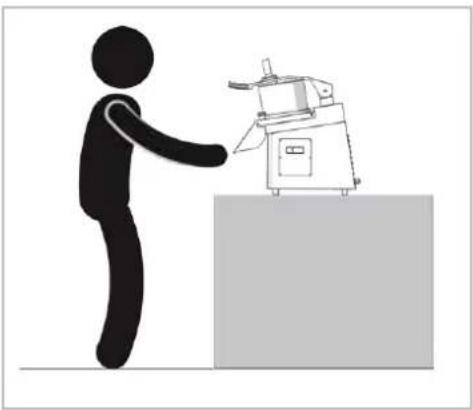
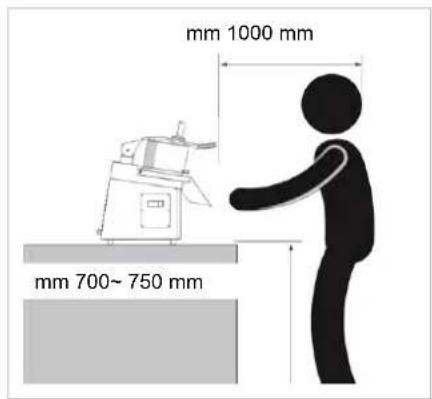
- The machine must always be operated by a single operator. To use the machine in safety conditions the operator must respect the working and control position shown in the figure.
natural_image
Silhouette of a person standing next to a machine on a platform (no text or symbols visible)3.1.2 Description of components
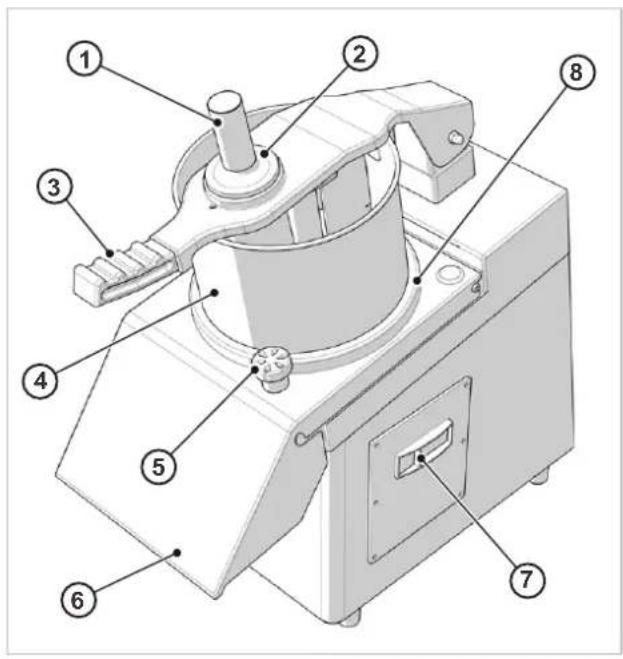
Rif. Descrizione
1 Pestle handle
2 Small Mouth Pestle
3 Pusher handle
4 Large vegetable feeding spout
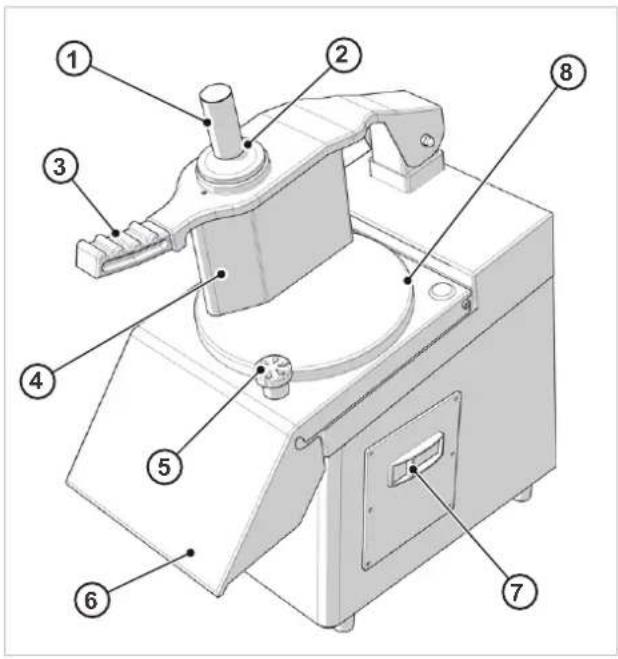
Rif. Descrizione
5 Closing knob
6 Discharge spout
7 Start and stop button
8 Disc protection cover
3.1.3 Dimensions
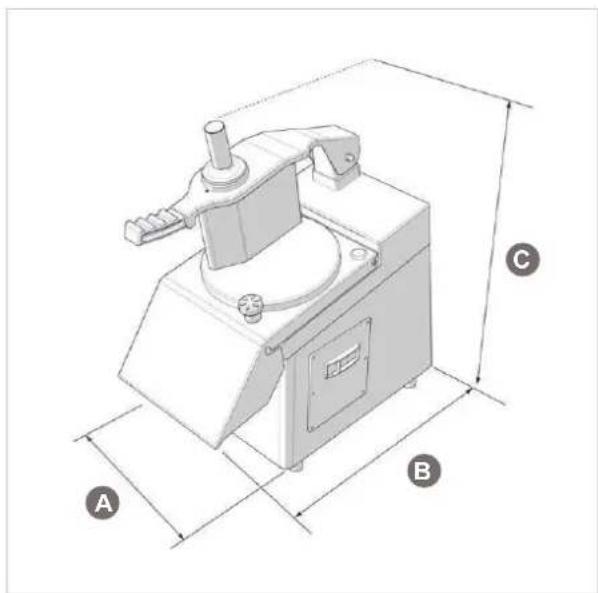

| CUOCOJETV230/V400 | CUOCOJET2V 400V | COLOSSEOV230 | COLOSSEOV400 | COLOSSEOV2V 400V | |
| A (mm) | 235 | 235 | 235 | 235 | 235 |
| B (mm) | 520 | 520 | 520 | 520 | 520 |
| C (mm) | 560 | 600 | 600 | 560 | 600 |
3.2 Technical data
| TechnicaldataCUOCOJET COLOSSEO | ||
| Average production capacity kg/hr 200 400 | ||
| Operating voltages 230-400V AC - 50 Hz | ||
| Single-phase machine installed power | 230V 50Hz 0.55kW (0.75HP)3.5A | 0.75kW (1HP) 6.5A |
| Three-phase machine installed power 230 230V 50Hz 0.55kW (0.75HP) 2.3A | ||
| Three-phase machine installed power 400 400V 50Hz 0.55kW (0.75HP) 1.3A | ||
| Three-phase machine installed power 400 2 speeds | 400 V 50 Hz 0.6/0.26kW (0.8 / 0.35HP) | |
| Net mass kg 20 | ||
| Average noise level | dB(A) | 58 |
| Total mass | kg 22 | |
3.3 Disposal

Pursuant to prevailing law and for the purpose of reducing waste environmental impact, machine disposal as urban waste is strictly forbidden. The machine may only be forwarded to special waste collection centres or returned to the distributor when purchasing a new machine. Machine markings clearly identify it as separately collectable waste. Improper or fraudulent disposal of the machine or of any of its parts is liable to criminal prosecution and other provisions under law. The main materials making up the machine are listed below.
| Materials | |||
| Al-Si alloy | Super cut steey | Plastic | Electric cable |
| Stainless steel | Steel to harden | Bearings | Motors |
| Steel alloy | Rubber | Brushings (b14) | Lubricating oil |
3.4 Standard supply
The machine is equipped with the tools and utensils listed below and suitable for all intended uses (processing, cleaning and maintenance):
- plastic pestle
- ejector disk
• disks and grids
3.4.1 Disk and grills
| Type Series Processing | ||
| Slicing disks | "E" 1 curved blade | E1S and E2S disks for salami, mushrooms, cabbage, chicory.E5 disk for tomatoes, lemons, oranges, apples, bananas, grapefruits, pineapples. |
| Slicing disks | "E" 1, 2 or 3 blades | For potato chips, potatoes, turnips, cabbages, cucumbers, carrots, artichokes, onions, mushrooms, zucchini, eggplants, fennels.Disks E1, E2, E3, E4, E6, E8, E10, E14 |
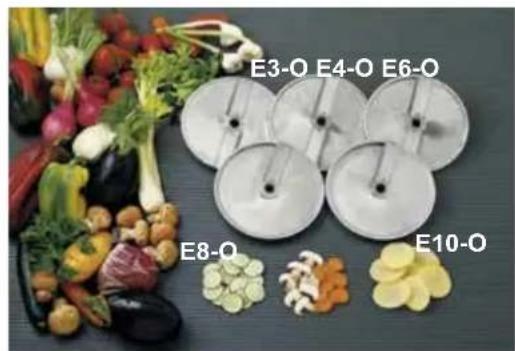
| Corrugated slicing disks | "E/O" 1 or 2 blades | To obtain wavy thick slices of fruit and vegetables.Disks E3/O, E4/O, E6/O, E8/O, E10/O |
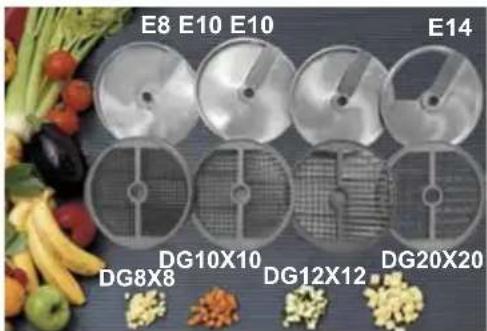
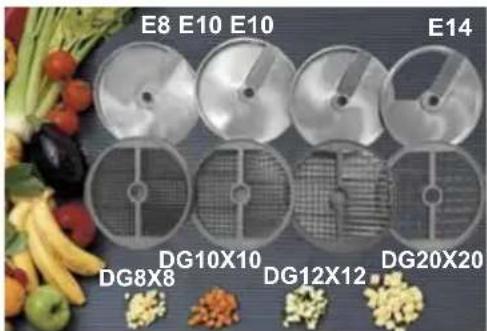
| Dicing disks | "D" | For soups, fruit salads, pickles. To be used in combination with an "E" disk (E8, E10, E14) to obtain cubes 8x8x8, 10x10x10, 12x12x14, 20x20x14mm Using an E/O disk you obtain cubes with 2 ridged sides.Disks D8X8, D10X10, D12X12, D20X20. |
| Dicing disks | "DG"(only for COLOSSEO) | For soups, fruit salads, pickles. To be used in combination with an "E" disk (E8, E10, E14) to obtain 8x8x8, 10x10x10, 12x12x14, 20x20x14mm cubes. Using an E/O series disk you can obtain cubes with 2 ridged sides.Disks DG8X8, DG10X10, DG12X12, DG20X20. |

natural_image
Assorted fresh vegetables arranged in four circular containers labeled E2 to E5, with no visible text or symbols on the objects themselves.
natural_image
Product photo of three white filter units (E8, E10, E14) with visible internal patterns and surrounding fresh vegetables (no text or symbols on the devices themselves)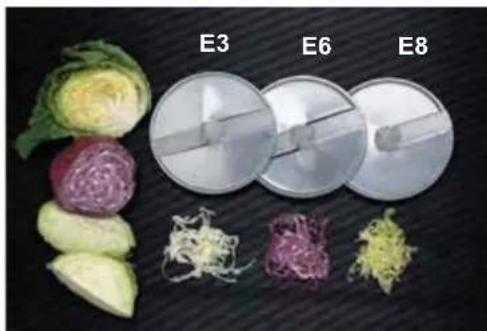
natural_image
Assorted vegetables and seedlings arranged on a dark surface, labeled E3, E6, E8 (no text or symbols on the main objects)
natural_image
Assorted fresh fruits and vegetables arranged on a dark surface, with three circular plates labeled E1S, E2S, and E1 (no text or symbols on the objects themselves)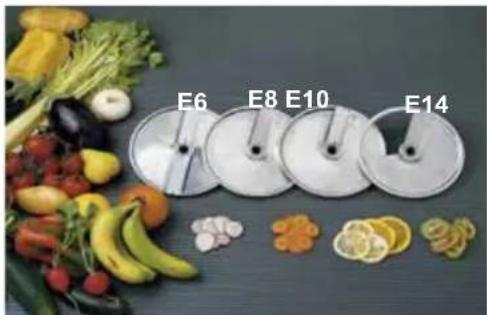

Type Series Processing
| Julienne disks "H" | For celery, zucchini, beets, bitter roots, carrots, potatoes, turnips. Disks H2.5 x 2.5 H4 X 4 H6 X 6 H8 X 8 H10 X 10 | |
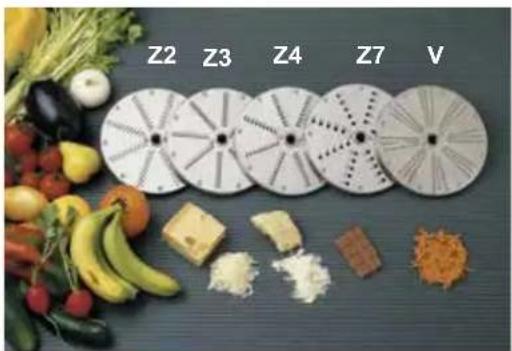
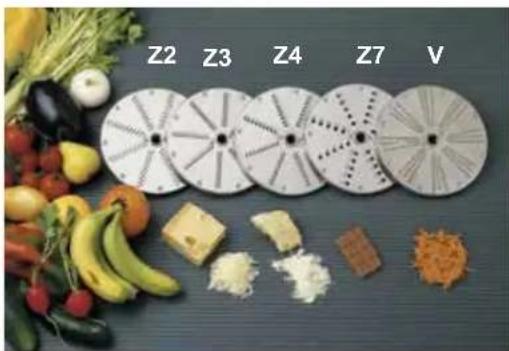
| DiGrating and shredding disks | "Z-V" | For carrots, celery, potatoes, turnips, beets, red cabbage, roots, Gruyere,....Disks Z2, Z3, Z4, Z7 "V" disk, for parmesan cheese, dry bread, shelled hazelnuts/almonds, chocolate. |
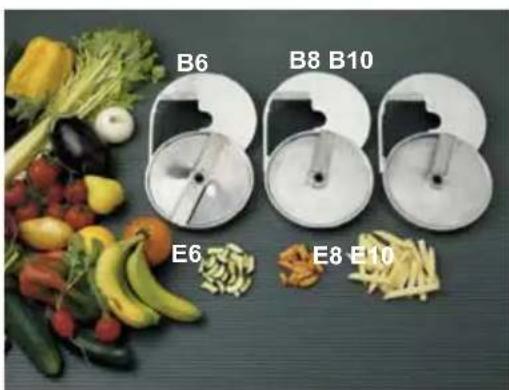
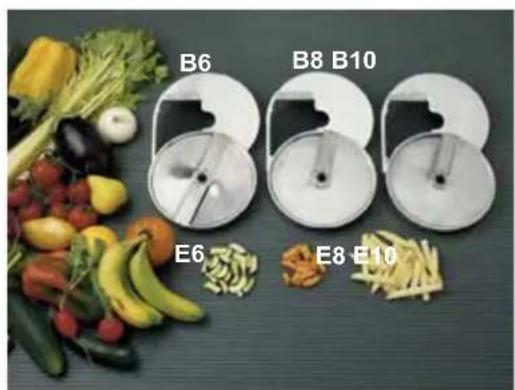
| Stick-cutting disks "B" | For frying potatoes, carrots, zucchini.Use in combination with an "E" disk (E6, E8, E10) to get 6 x 6, 8 x 8, 10 x 10 mm sticks. Using a disk from the E/O series you get sticks with 2 ridged sides.Disks B8 X 8, B10 X 10, B12 X 12 B20 X 20 | |
| Shredding disks "P-Z" e 4PZ" | For processed cheeses, various cheeses, mozzarella, etc.For mixed shredding: disks 4PZPZ7 "Spaghetti" cut: teflon coated disks 4PZ5, 2PZ8, 4PZ8.For all disks, the figure after the letter indicates the cutting height in mm. |
natural_image
Assorted fresh fruits and vegetables arranged in a row on a dark surface, including sliced slices, cheese, and dried fruit (no text or symbols visible)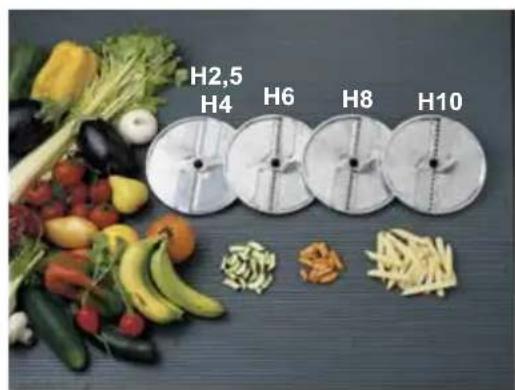

4 GENERAL SAFETY RULES

ATTENTION
The Manufacturer declines all responsibility for any damage to property and/or persons resulting from failure to observe the warnings given in the following chapter.

DANGER!
Follow all safety warnings in this chapter for safe use of the machine.
4.1 Workplace
The machine works properly within the following environmental values:
• Temperature between +5°C and +45°C.
• Humidity between 30% and 90%.
- Keep the working area tidy and sufficiently illuminated.
- Provide adequate space for working and circulation around the machine.

ATTENTION
The room where the machine is installed must not have dark areas, hazardous dazzling lights or stroboscopic effects arising from the lighting system in the room.
4.2 Machine airborne noise

WARNING
Continuous sound pressure level measured according to UNI EN ISO 3744.
Consult the data on the "Technical sheet" of the relevant products.
4.3 Risks residues
Despite the safety devices, accident prevention protections and warnings, there are still some residual risks that must be brought to the attention of operators during training, which are indicated by means of appropriate pictograms and which must be taken into account when using the machine:

DANGER!
• Electrocution / electrocution risk due to the presence of electrical energy;
- Risk of crushing / contusion due to falling tools during assembly and disassembly;
- Risk of cutting in case of access to moving parts, with the machine in operation and with safety devices not working or tampered with.

ATTENTION
The behavior of the operator or specialized personnel must scrupulously respect the accident prevention regulations of the country in which the machine is installed.
4.4 Personal Protective Equipment (PPE)
To safeguard the operator's health, it is compulsory to use PPE during machine use, cleaning and maintenance operations.

GLOVES
Protect your hands to avoid the risks of crushing, chipping and cutting when handling pieces and changing discs.

SHOES
Use of safety footwear to avoid risks generated by falling materials during machine lifting, transport and maintenance operations (especially during disassembly of parts).

INDUMENTS
Use of protective clothing to shield the body from hazards generated by materials in use.
4.5 General precautions

ATTENTION
Read the use and maintenance manual carefully before starting, using, maintaining or otherwise working on the machine.
There are no parts inside the machine on which the user must intervene in any way: the machine must only be opened by qualified technicians. Make sure that the voltage of the power outlet corresponds to that required by the machine (see the nameplate).
To avoid risks to persons or damage to the machine, follow the warnings and rules of conduct indicated below:
• Any unintended use of the machine is considered improper.
• The machine may only be used by authorized and trained personnel.
- The machine is not suitable for use by children or persons with reduced physical, mental or sensory capabilities, or lack of experience and knowledge, unless they are supervised and instructed in the use of the machine by a person responsible for their safety.
- Check that the plates and notices affixed to the machine are perfectly legible.
- Personnel should wear appropriate clothing and avoid:
- loose-fitting clothing;
- loose sleeves;
- neckties;
• scarves; - necklaces;
- bracelets;
- rings;
• long, unbound hair,(tie it up in a cap);
• For all cleaning and maintenance operations, it is compulsory to unplug the power cord from the wall socket.
- Do not use the machine if any malfunction is found.
- Do not let unauthorized persons approach and/or use the machine.
• In case of failure, have the machine repaired exclusively by a qualified technician.
• Use only original spare parts.
- Do not pour water or liquids directly on the machine.
- Do not place objects on the machine or its components.
- Do not use acid solutions that could damage the machine.
- Do not lean or try to climb on the machine.
• Turn off the machine immediately after use.
- Do not tamper with, inhibit or remove the safety devices (fixed and/or mobile protectors, guards, etc.) thus exposing other operators and exposed persons to residual risks.
- Do not remove or alter the safety signs (such as pictograms, warning signs, etc.) on the machine.
- Use Personal Protective Equipment (PPE) appropriate to the task at hand.
• In case of fire use a powder extinguisher. Do not use water.
4.6 Electrical hazards

ELECTRIC HAZARD!
There is 230V | 400V voltage inside the machine! Never use a water jet to wash the machine.

DISCONNECT POWER SUPPLY!
Do not carry out any type of intervention (maintenance, cleaning, etc.) on the live machine. Disconnect the power supply cable before working on the machine.
Regularly check the power cord for damage caused by aging, cracking, or peeling.
- If the power cord is damaged, replace it before using the machine.
• Use the same type of cable used by the Manufacturer, approved according to European standards.
• The cable must be replaced by qualified personnel.
- Do not use the machine if the power cord or plug is damaged or if the machine has been damaged in any way.
• Do not immerse the power cord or plug in water or any other liquid.
- Avoid contact of power cord with sharp edges and moving machine parts.
• If power cord becomes trapped underneath machine, STOP operating immediately. If cord is damaged, replace it.
- Do not pull cord to remove plug from outlet.
4.7 Operator safety
Before using the machine, the operator must be fully aware of the position and operation of all controls, and of the characteristics of the machine as described in chapter "6 OPERATION AND USE".
The operator must wear suitable clothing for the work environment and the situation in which he finds himself.
The areas where the operator is stationed must always be kept clear and clean of any oily residues.
Before starting the work shift, and in any case every eight working hours, it is necessary to check the presence and correct functioning of the safety devices present on the machine. These checks must be carried out directly by the operator working on the machine.
If there is more than one operator per shift, it is necessary to identify the one who must carry out the check.

DANGER!
Pay close attention to the safety plates.
The operator must always be fully aware of the hazards and risks involved in using the machine.

DANGER!
- Do not remove or tamper with protections and safety devices.
• Do not tamper with the electrical system.
- It is forbidden to use the machine in environments with an explosive atmosphere.
- Do not approach the moving parts of the machine with hair, chains, loose clothing, etc. to avoid dangerous tendencies to get caught,
It is forbidden to use the machine wearing metal mesh gloves or gloves with metal reinforcements.

DISCONNECT POWER SUPPLY!
It is forbidden to use the machine wearing metal gloves or gloves with metal reinforcements.
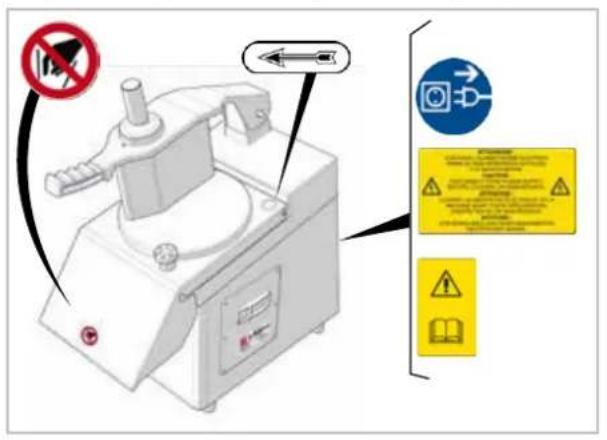
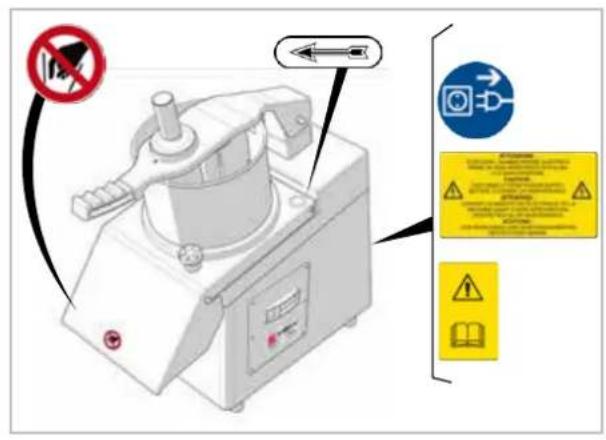
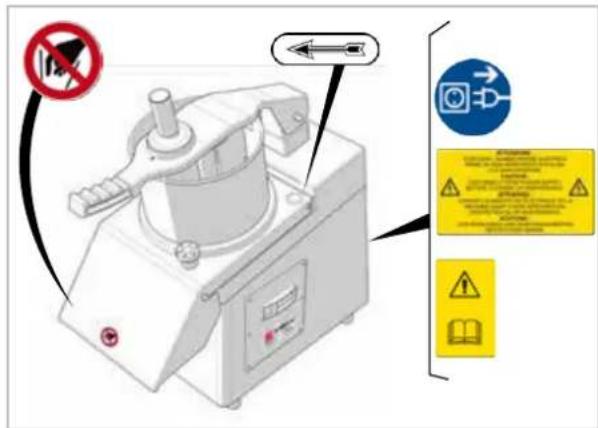
4.8 Safety signs

ATTENTION
The machine bears non-indelible "ATTENTION" stickers.
It is mandatory to read them before any use. If the stickers come off or become illegible, they must be replaced immediately.
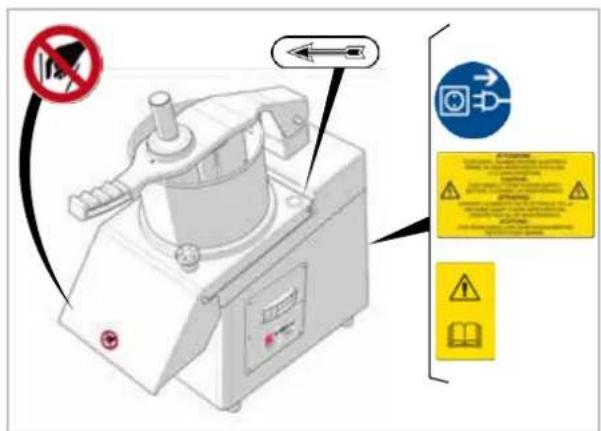
The picture alongside shows the positions of the pictograms on the machine.
4.9 Safety devices
The safety devices present on the machine are shown in the table below.
Ref. Description
1 Start and stop button
2 Cover closure sensor
- NVR device
4.9.1 Safety device checks
For safety checks, after verifying that no other personnel are near the machine, proceed as follows:

DANGER!
During safety checks, stay away from moving parts of the machine.

- Start and Stop button: switch on the machine by pressing the Start button and check that the machine starts, then stop the machine by pressing the Stop button and check that operation is interrupted.
- Coded magnetic sensor lid closure: Open the lid by pressing the Start button and verify that the machine does not start. Close the cover making sure to lock the cover knob in place, press the start button and verify that the machine is running properly.
- NVR (No Volt Release): switch on the machine, disconnect the plug from the power supply with the machine running, reconnect the plug again. The machine should not restart.
5 INSTALLATION

WARNING
Make these instructions known to all operators involved in the transport and installation of the machine.

DANGER!
Always wear suitable safety footwear with reinforced toe.
5.1 Transport and assembly
The machine, packaged in a cardboard box, is placed on a pallet and can be transported by means of a forklift with appropriate characteristics suitable for lifting.

DANGER!
After inserting the forks in the pallet, check the balance position of the machine by lifting it slightly to check its stability.
5.1.1 Packaging dimensions
| Model | Package dimension (cm) | Net weight(kg) | |||
| X | Y | Z | |||
| CUOCOJETV230/400 | COLOSSEOV400 | 31 60 53 22 | |||
| CUOCOJET2 VELOCITÀ | COLOSSEOV230/2V 400V | 31 60 60 24 | |||

5.1.2 Package contents
Ref. Description Quantity
1 Vegetable cutter CUOCOJET-COLOSSEO 1
2 Use manual 1

5.2 Reception
The packaging is made of suitable material and is carried out by expert personnel; the machines therefore leave complete and in perfect condition.
The goods travel at the risk and danger of the purchaser, even if delivered ex domicile of the latter. However, in order to check the quality of the transport services and in case it is insured, please observe the following warnings:
1) upon receipt of the machine, before proceeding with unpacking, immediately check whether the packaging is damaged. If so, withdraw the goods with reserve, producing photographic evidence of any apparent damage;
2) unpack the machine, checking the contents against the packing lists;
3) check that the machine components have not been damaged during transport and notify, within 3 days of receipt, any damage to the shipper by registered mail with return receipt, simultaneously presenting photographic evidence.
4) Similar information should also be sent by fax to Minerva Omega Group S.r.l..
Any dispute shall fall exclusively within the cognizance of the Bologna Law-Court (Italy).

WARNING
No information concerning damages suffered during transport will be taken into account after 3 days from delivery. No complaints will be accepted after 10 days from the receipt of the goods.
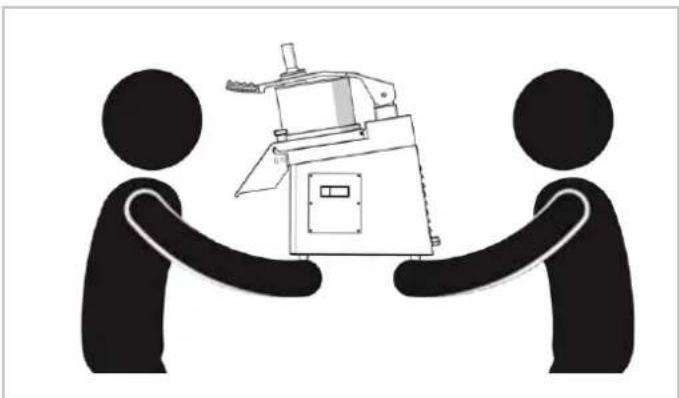
5.2.1 Lifting and handling the machine
The machine, once unpacked, must always be transported by two people as shown in the figure to the side. It is also possible to use a suitable trolley to support the weight.
natural_image
Two stylized human figures shaking hands around a machine, no text or symbols present
DANGER!
Pay attention to movements that could cause unbalancing or loss of grip with consequent danger of the machine falling and damaging things and persons. Given the weight of the machine, always handle with care!

Always wear suitable safety footwear with reinforced toe.

Always use protective gloves
5.3 Workplace
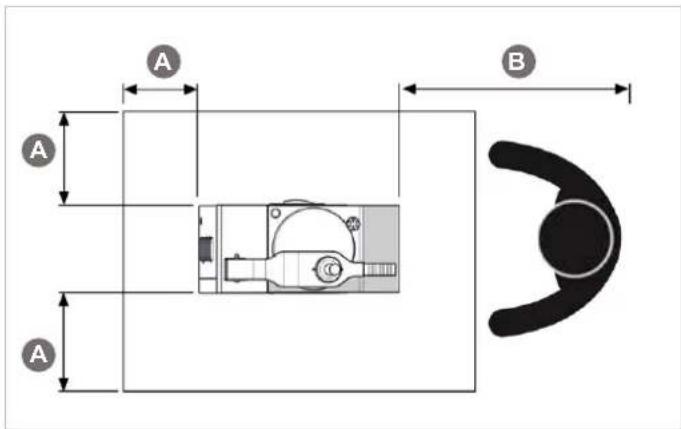
Position the machine near the installation area.
The machine must be placed on a work surface brought to level, and adequate to support the weight of the same, with height from the ground between 70-75 cm.
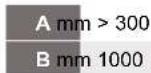
Leave all around the machine a space of at least 30 cm, on three sides, for cleaning and maintenance operations, while the position of the operator requires at least 1 m of space in front of the machine.

ATTENTION
- Beware of uncoordinated movements that may cause unbalance or loss of balance, with consequent danger of falling of the machine and damage to property or persons.
• Position the machine in a stable manner.
5.4 Installation
The only connection it requires is electric, inserting its plug into the mains socket. Once the plug is inserted into the mains socket, the power cable must not be in the operator's way.
5.4.1 Electrical connection

ELECTRICAL HAZARD!
The machine is a class "I" component, so is equipped with main electrical insulation. All metal machine parts are connected to one another and to the earth conductor in the cable and in the power plug.

ELECTRICAL HAZARD!
Verify and, if necessary, adjust the grounding system of the electric supply in the place where the machine is installed.

ATTENTION
The earth system of the sockets in the machine installation site is the responsibility of the customer.
Procedure for making the electrical connection:
1) place the machine near an easily accessible power outlet;
2) make the connection using the appropriate plug.
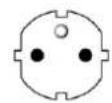
The machine can be equipped with different types of sockets, consult the technical sheets where the data necessary to choose the type, characteristics, rated current and setting of the overcurrent protection device are specified.

WARNING
Recommended protection:
- fuse 16 A;
• differential circuit breaker I_ 30 mA.
5.5 First cleaning

ATTENTION
The machine needs initial cleaning.
Clean the external surfaces and those of the internal ducts that will come into contact with the product, only with a sponge dampened with lukewarm water containing neutral detergent; for details see paragraph "7.2.1 Cleaning sheet in compliance with the HACCP procedure".
5.6 Preliminary checks
For a correct starting of the machine make sure that the following parts are correctly mounted and positioned:
Machine parts Verify
Cover Closed
Lever Lowered
Disc Correctly positioned
Grill (if necessary) Correctly positioned

DANGER!
It is forbidden to run the machine with no load, as the friction generated could compromise the correct operation of the machine and the safety of the operator.
5.7 Storage
Store the packed machine in a closed and covered environment, isolated from the ground by wooden crosspieces or similar. Current temperature and humidity (between -5^ and +60^ ; between 30% and 90%).

ATTENTION
Never turn the box upside down.
Always check the "TOP" arrow printed on the box.
If there is no packing, it must be positioned indoors in a stable place and covered with a sheet.
6 OPERATION AND USE
6.1 Description of control panel
The control panel is extremely simple, accessible and highly visible.
Description of control panel instruments:
Ref. Description
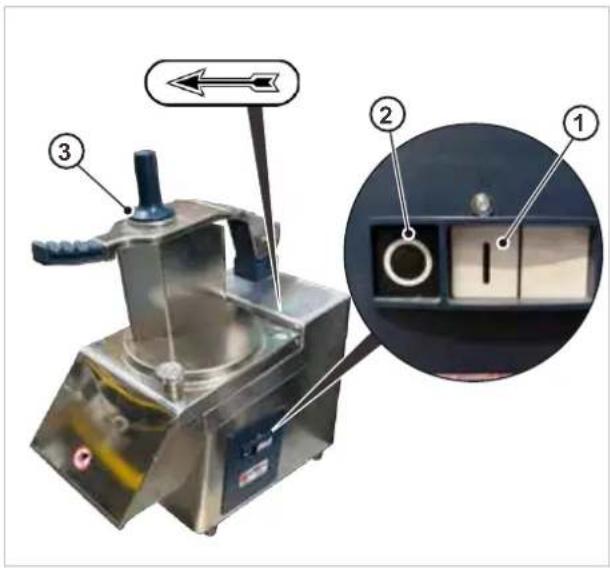
1 Start button
2 Stop button

natural_image
Industrial machine component with magnified inset showing internal components (no visible text or symbols)
DANGER!
Before starting the machine, the operator must have read and understood the instruction manual.
6.2 Preliminary checks
Before starting the machine, check:
• the correct positioning of the machine on the work surface;
• the correct electrical connection;
• the efficiency of the safety devices (emergency button, guards, etc.);
• that there are no tools or foreign material near or on the machine.
6.3 Operator's station
The operator position requires at least 1 m of space in front of the machine.

ATTENTION
Ensure that the machine is positioned at an optimum height (700 \~ 750 mm) so that the operator can assume an ergonomically correct posture.
6.4 Starting up for the first time
The machine is supplied with a power cable and can be fitted with a plug according to the country of destination. Some of the most widely used plugs are shown in the figure.
2P+÷-10/16A
250V\~

2P+÷-16A
6h/200÷250V\~

3P+ 12 -16A
6h/380÷415V\~

WARNING
To enable the machine user to choose the overcurrent protective device in the technical sheets, in accordance with current regulations, the data required for choosing the type, characteristics, rated current and adjustment of said device are specified.

Have the following procedure carried out by specialized personnel.
During the use of the machine it is MANDATORY to use the Personal Protection Devices.
6.5 Start-up

ATTENTION
To use the machine in safe conditions the Operator must respect the working and control position indicated on the previous page.
Carry out the preliminary checks (see paragraph "6.2 Preliminary checks")

DANGER!
- Do not tamper with the safety devices with tools or other objects (screwdrivers, knives, etc.) with the intention of reaching moving parts.
• Always wear suitable safety footwear with a reinforced toe. - Remove necklaces, bracelets, ties and scarves that hang excessively. Wrap or tie back long hair.
• Always use cut-resistant gloves when removing and installing discs. - After stopping using the stop button (2), the moving parts continue to move for a few moments. It is therefore mandatory to wait for all moving parts to actually stop.

ELECTRICAL HAZARD!
- Check that the electrical connections have been made correctly.
- Remember that it is forbidden for anyone to move the machine or carry out maintenance and cleaning operations while the machine is working; it is necessary to cut off power by means of the appropriate stop button and disconnect the plug.

WARNING
The machine components must be disassembled and cleaned at the end of the working process.
Reassemble them only when you have to start working again.
6.6 Insertion and removal of cutting tools
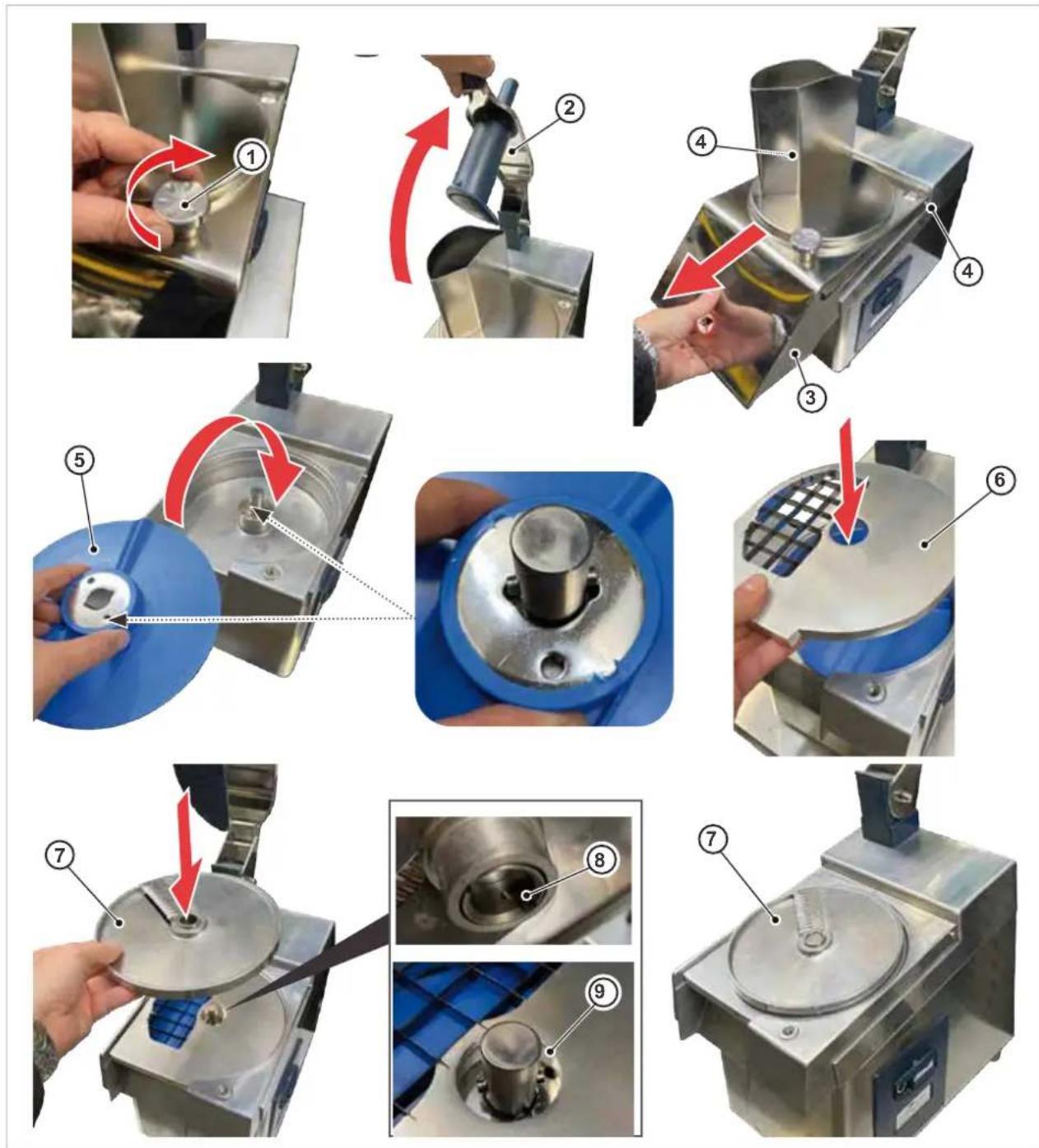
Proceed as follows:
1) Turn the knob (1) clockwise.
2) Lift the lever (2) completely
3) Slightly lift the cover (3) and pull it off the pins (4)
4) Insert the base (5) making sure that the drive pins on the hub fit into the existing holes on the disk.
5) If you want to cut cubes or sticks, mount the appropriate grid (6) (see "3.4 Standard supply").
6) Insert the cutting disc (7) according to the product to be processed
7) Turn the cutting disc clockwise until the bayonet coupling (8) engages correctly with the draw-in pin (9).
8) Insert the cover (3) into the pins (4).
9) Tighten the knob (1)
For removal, carry out the reverse procedure.
6.7 Machine start-up
To start the machine correctly, proceed as follows:
1) Insert the electrical plug into the power outlet.
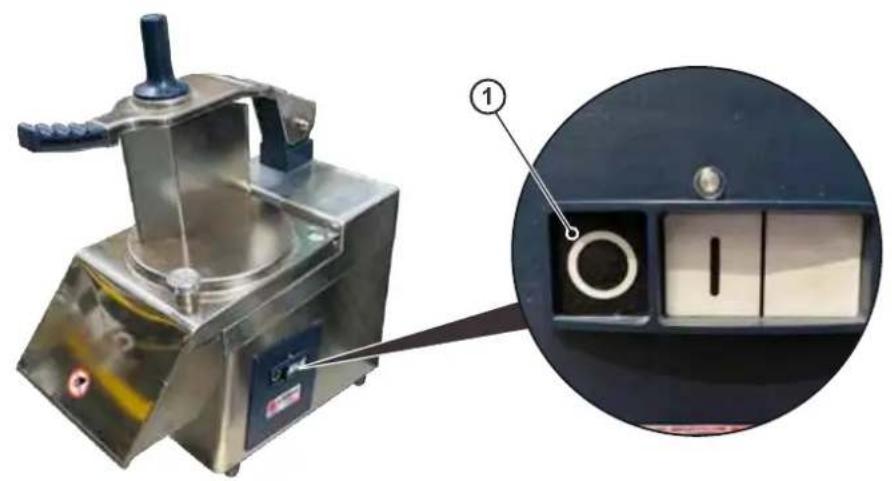
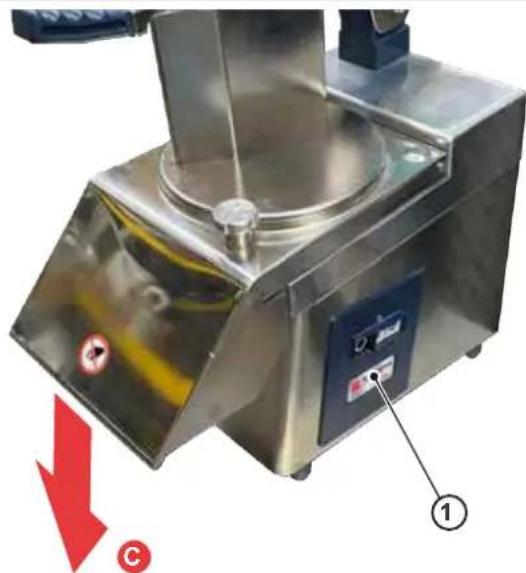
2) Press the power switch, (1) introduce the product into the opening and push with the presser or lever.
3) From the cylindrical opening (2) it is possible to introduce elongated products, for example carrots, zucchini and celery. Leave the lever (3) in the lowered position.
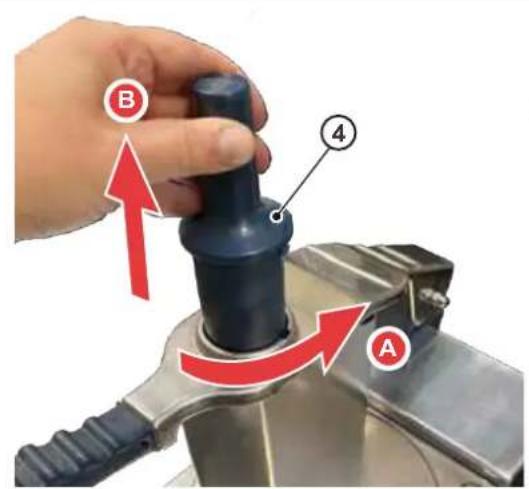
4) Unlock the presser (4) by turning it (A) counterclockwise and pull it (B) out of the housing.
5) Hold the presser (4) with one hand and insert the products with the other.
6) Press the products with the presser. (4)
7) Lock the presser (4) inside the lever (3) by turning it clockwise.

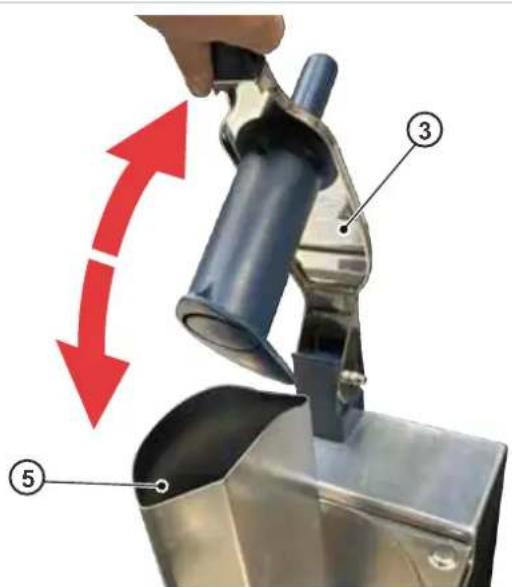
8) Large products can be inserted through the large opening (5).
9) Raise the lever (3).
10) Raising the lever (3) stops the motor, allowing safe loading. Introduce the product and press it with the lever (3) dosing the effort.
11) When the lever (3) comes down, the machine starts automatically.
12) To cut products of different hardnesses, it is advisable to work the soft ones first. To avoid incorrect cuts, always check that the product is correctly positioned in the openings, eliminate the harder ends of the vegetables to avoid clogging and introduce the long products into the cylindrical opening with the wider end at the top.
13) The product is ejected (C) from the outlet.
14) To stop the machine press the stop button. (1)

natural_image
Industrial stainless steel cutting machine with warning label and red downward arrow (no readable text or symbols)6.7.1 Checks to be performed in case of start-up problems
If the machine does not start, check:
• that the mains connection cable is correctly plugged in
• that the main switch of the mains is enabled
• that the connector of the machine is connected to the connector cover
• that the cover is perfectly closed
6.8 Stopping procedure
To stop the machine at the end of production, for maintenance or for various checks, press the stop button (1).
natural_image
Industrial machine with labeled components and a close-up inset showing internal compartments (no text or symbols visible)
WARNING
After having stopped the machine, by means of the stop button, the machine will continue to move for a few moments due to inertia; therefore it is compulsory to wait for all moving parts to actually stop.
The stop button also has the function of stopping the machine in case of emergency.
7 MAINTENANCE AND CLEANING

DANGER!
During the maintenance and cleaning operations of the machine it is MANDATORY to use the Personal Protective Equipment.
7.1 Machine maintenance
For maintenance work not described in the instruction manual and for any repairs that may be necessary, always contact the dealer where you purchased the product or contact Minerva Omega Group S.r.l. to be directed to the nearest authorized service center.
Customer Service can be reached via two telephone lines at 051 53.31.01 and will provide you with the names of authorized maintenance technicians in your area to whom you can turn for quick assistance.

DANGER!
- Replace stickers that have become detached from the machine or are illegible.
- If, for any reason, the machine is out of order, affix a sign indicating the fault.
Before putting the machine back into service, check that all the safety devices are efficient and always make sure that the electrical panels, all the guards, all the protection covers are closed, as foreseen by the manufacturer, by means of: screws, bolts, quick locks, etc.

ATTENTION
Ordinary and extraordinary maintenance operations must be carried out by qualified personnel authorised by the manufacturer of the machine.

ELECTRICAL HAZARD
Any maintenance must always be carried out when the machine is disconnected from the power supply.
7.1.1 Scheduled maintenance operations
The operations described below must be carried out in accordance with the times indicated. Failure to comply with the requirements will exempt the manufacturer from any liability under the Warranty. All the operations described must be carried out by a single operator; this is essential to guarantee the necessary protection against errors due to incorrect coordination of the various actions.
| Frequency Type of di intervention Method of intervention Who | |||
| Daily, at the beginning of the shift | Verify proper operation of control panel. | Act on the buttons and check for proper operation. | Operator |
| Verify the integrity of the safety systems. | Inspection. Operator | ||
| Daily, at the beginning of the shift | Cleaning of the machine. | It is advisable to disassemble and thoroughly clean all machine components (internal and external) every day with warm water and neutral detergent, without leaving them to soak.Dry everything thoroughly. | Operator |
| Monthly Check the feet. | The stability of the machine is entrusted to the integrity of the support feet: therefore check their state of preservation. | Operator | |
All interventions not expressly listed in this manual are to be considered as extraordinary maintenance interventions, such as for example
• interventions following failures of electrical components or motors interventions following failures of pneumatic components;
• interventions following faults in mechanical components.

DANGER!
If a fault occurs that requires the manufacturer's intervention, always put the machine in "Isolation for maintenance" status. Never attempt to carry out repairs or makeshift replacements; this could entail serious dangers for the people exposed and for the machine.
NEVER USE WATER JETS

ATTENTION
Extraordinary maintenance operations require specific skills and must be carried out by qualified personnel authorized by the manufacturer of the machine.

WARNING
For technical assistance, contact the manufacturer directly using the references indicated in the manual.
7.2 Cleaning

ELECTRICAL HAZARD!
Before carrying out any cleaning operation, the machine must be disconnected from the power supply.

WARNING
Cleaning operations must be carried out in accordance with the company's HACCP plan.

DANGER!
The use of Personal Protection Equipment is MANDATORY during machine cleaning operations.

ATTENTION
- Never use direct jets of water for any cleaning operation.
- Do not use metal wool pads or abrasive detergents.
- It is ABSOLUTELY FORBIDDEN to use unsuitable detergents to clean objects and accessories used for human consumption.
- Never use products containing hydrocarbons, alcohol or solvents.
• To avoid damage to electrical and electronic parts, avoid wetting the control buttons. - Do not bring the discs into contact with each other to avoid damaging the blades.
Clean the machine thoroughly as follows:
1) Turn the knob (1) clockwise.
2) Lift the lever (2) completely
3) Slightly lift the cover (3) and pull it off the pins (4)
4) Turn the cutting disc (5) counterclockwise until the bayonet coupling (6) disengages from the drive pin (7).
5) Very carefully remove the cutting disc (5).
6) Very carefully remove the grille (8) (if present).
7) Rotate the drive shaft (9) until the existing holes on the disc are aligned with the drive pins on the hub
8) Remove the drive shaft (9)
9) Wash discs thoroughly in hot water.
10) Brush discs with a brush.
11) Clean all operating elements of the machine with a sponge lightly soaked in a small amount of detergent and sanitizer
12) Wipe off any residue of cleaning substance with a clean, damp sponge cloth
13) Rinse frequently in hot running water.


natural_image
Close-up of a hand holding a circular device with a grid-patterned cover and blue internal components, no visible text or symbols.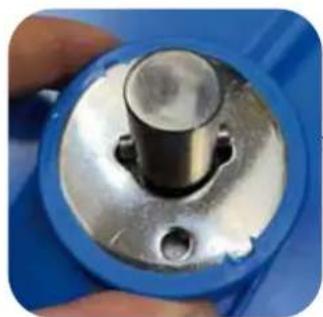
natural_image
Close-up of a mechanical component with a metallic cylindrical shaft and central hub, held by a hand (no visible text or symbols)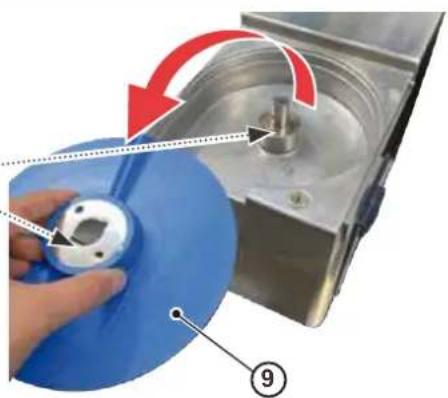
natural_image
Close-up of a mechanical component with blue circular base and red curved arrows indicating rotation or adjustment (no text or symbols)7.2.1 Cleaning sheet in compliance with HACCP procedure
| Surface Product Product type and how it works How to apply Frequency | ||||
| Metal(steel, stainless steel, anodised aluminium) | Neutral or slightly alkaline detergent | Products made with anionic and non-ionic surfactants, containing EDTA, sodium silicate, synergists, suitably diluted in water. 90% biodegradable; with product pH in water between 9 and 12.The surfactant dissolves dirt, which is subsequently rinsed off with water. | Apply the product using a soft sponge or a nonwoven or microfibre cloth.Leave for 5 minutes and rinse with water. | At the end of each shift or according to company HACCP frequency |
| Plastic(polyethylene) | Disinfecting* | Products suitable for plastic, containing quaternary ammonium salts suitably diluted in water.The anti-bacterial action interferes with the metabolic reactions of proteins and with the permeability of the cell membranes. They are incompatible with anionic surfactants as they become ineffective when mixed with them.Do not mix quaternary ammonium compounds with normal detergents. | Apply or spray the product onto the surface using a soft sponge or a paper yarn fabric cloth.Leave for 5 minutes and rinse with water. | Daily. |
| Metal(painted) | ||||
| Transparent plastic(Lexan,Plexiglas) | Neutral or slightly alkaline detergent | Products containing anionic and non-ionic surfactants suitably diluted in water.The surfactant dissolves dirt, which is subsequently rinsed off with water. | Apply the product using a soft sponge or a nonwoven or microfibre cloth.Leave for 5 minutes and rinse with water. | At the end of each shift or according to company HACCP frequency |
| Disinfecting* | Products suitable for plastic, containing quaternary ammonium salts suitably diluted in water.The anti-bacterial action interferes with the metabolic reactions of proteins and with the permeability of the cell membranes. They are incompatible with anionic surfactants as they become ineffective when mixed with them.Do not mix quaternary ammonium compounds with normal detergents. | Apply or spray the product onto the surface using a soft sponge or a paper yarn fabric cloth.Leav for 5 minutes and rinse with water. | Daily. | |

ATTENTION
Please remember to scrupulously check the label of the products used in disinfection, checking in particular that the following wording is written on the label:
• Disinfectant, Surgical Medical Device;
• Registration number with the Ministry of Health;
• "for use in the food industry";
• doses and times of use;
• composition, manufacturer, lot and date of production;
• safety warnings for use.

DANGER!
- For cleaning, we recommend the use of non-aggressive detergents and disinfectants that do not contain alkalis (e.g. caustic soda), acidic or chlorinated compounds (e.g. hypochlorite) or organic solvents (e.g. acetone, alcohol, ether).
- Do not remove dirt with abrasive cloths or metal sponges. It is forbidden to use products in compound solutions.
• Before using any product, read the technical data sheet and the safety data sheet on the packaging.
1 OBJET ET CONTENU DU MANUEL 58
1.1 Symboles 58
1.2 Illustrations....58
1.3 Object du manuel....58
1.4 Conservation....59
1.5 Mise à jour du manuel....59
2 INFORMATIONS GÉNÉRALES 60
natural_image
3D diagram of a mechanical component with a threaded insert and a pointed tip, showing no text or symbols.

AVERTISSEMENT
natural_image
Silhouette of a person standing next to a machine on a platform (no text or symbols)Ref. Description
Ref. Description
natural_image
Five circular filter units labeled E8, E10, E14, D8X8, D10X10, D12X12, arranged on a dark surface with fresh vegetables and fruits in the background (no text or symbols on the devices themselves)
natural_image
Three circular trays labeled E3, E6, and E8 showing different types of vegetable or food items arranged on a dark surface (no text or symbols on the objects themselves)
natural_image
Assorted vegetables and food items arranged on a dark surface, including fruits, vegetables, and sliced slices (no text or symbols visible)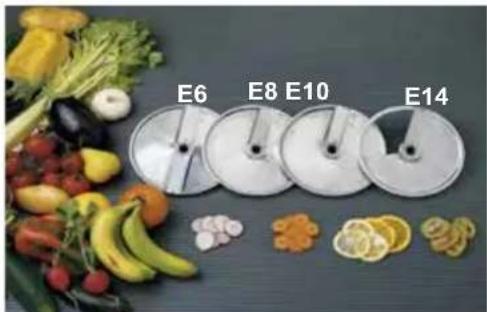
Type Serie Utilisation

4 RÈGLES GÉNÉRALES DE SÉCURITÉ

ATTENTION
5.2 Réception
natural_image
Two stylized human figures shaking hands around a machine, no text or symbols present
DANGER!
natural_image
Industrial machine component with magnified inset showing internal components (no visible text or symbols)
DANGER!
6.5 Mise en service

ATTENTION


natural_image
Industrial stainless steel cutting machine with warning label and red downward arrow (no readable text or symbols)natural_image
Industrial stainless steel cutting machine with close-up inset showing internal components (no visible text or symbols)natural_image
Silhouette of a person standing next to a machine on a platform (no text or symbols visible)Ref. Beschreibung
Ref. Beschreibung
natural_image
Product photo of five different filter units (E8, E10, E14, D8X8, D10X10, D12X12) with fresh vegetables and fruits in the background (no text or symbols on main objects)
natural_image
Assorted vegetables and seedlings arranged in three circular trays labeled E3, E6, E8, showing different shapes (cabbage, rose, flower) against a dark background.
natural_image
Assorted fresh vegetables and food items arranged on a dark surface, labeled E1S, E2S, and E1 (no text or symbols on the objects themselves)

natural_image
Assorted fresh vegetables and food items arranged on a dark surface, including fruits, tomatoes, cheese, and vegetables (no text or symbols visible)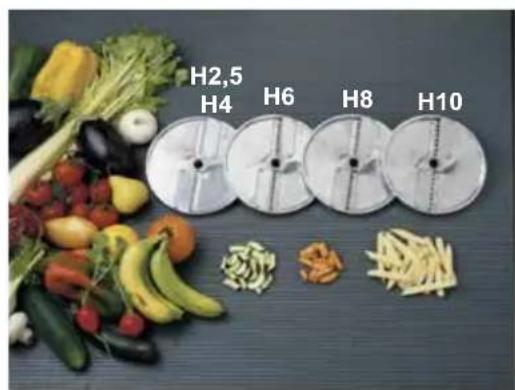
5.2 Empfang
natural_image
Two stylized human figures shaking hands around a machine, no text or symbols present
GEFAHR!
natural_image
Exterior view of a stainless steel industrial machine with an inset close-up showing internal components (no text or symbols visible)
GEFAHR!
6.5 Inbetriebnahme

VORSICHT
natural_image
Industrial stainless steel cutting machine with warning label and red downward arrow (no readable text or symbols)natural_image
Industrial stainless steel cutting machine with close-up inset showing internal components (no visible text or symbols)
WARNUNG
- "CUOCOJET" VEGETABLE-CUTTING MACHINE MANUAL
- PURPOSE AND CONTENT OF THE MANUAL 32
- GENERAL DIRECTIONS 34
- TECHNICAL FEATURES 36
- GENERAL SAFETY RULES 40
- INSTALLATION 44
- MAINTENANCE AND CLEANING 52
- PURPOSE AND CONTENT OF THE MANUAL
- Symbols
- DANGER!
- ELECTRICAL HAZARD!
- ATTENTION
- WARNING
- POWER CUT-OFF!
- Illustrations
- Purpose of the Manual
- ATTEINTION
- Preservation
- Updating the manual
- GENERAL DIRECTIONS
- Manufacturer's data
- Limits of liability
- Identification plate
- Definition of the operator
- OPERATOR
- Warranty
- Machine certificate
- TECHNICAL FEATURES
- Description of the machine
- Recommended use
- Description of components
- Rif. Descrizione
- Dimensions
- Technical data
- Disposal
- Standard supply
- Disk and grills
- GENERAL SAFETY RULES
- Workplace
- Machine airborne noise
- Risks residues
- Personal Protective Equipment (PPE)
- GLOVES
- SHOES
- INDUMENTS
- General precautions
- Electrical hazards
- Operator safety
- Safety signs
- Safety devices
- Ref. Description
- Safety device checks
- INSTALLATION
- Transport and assembly
- Packaging dimensions
- Package contents
- Ref. Description Quantity
- Reception
- Lifting and handling the machine
- Workplace
- Installation
- Electrical connection
- First cleaning
- Preliminary checks
- Machine parts Verify
- Storage
- OPERATION AND USE
- Description of control panel
- Preliminary checks
- Operator's station
- Starting up for the first time
- Start-up
- Insertion and removal of cutting tools
- Proceed as follows:
- Machine start-up
- Checks to be performed in case of start-up problems
- Stopping procedure
- MAINTENANCE AND CLEANING
- Machine maintenance
- ELECTRICAL HAZARD
- Scheduled maintenance operations
- Cleaning
- OBJET ET CONTENU DU MANUEL 58
- INFORMATIONS GÉNÉRALES 60
- AVERTISSEMENT
- RÈGLES GÉNÉRALES DE SÉCURITÉ
- Réception
- Mise en service
- Ref. Beschreibung
- Empfang
- GEFAHR!
- Inbetriebnahme
- VORSICHT
- WARNUNG
Brand : GAM
Model : Cuocojet 415010
Category : Slicer