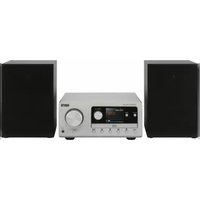
DABMAN i300 CD - Hi-Fi System Telestar - Free user manual and instructions
Find the device manual for free DABMAN i300 CD Telestar in PDF.


| Product type | Hi-Fi system with CD player, DAB+/DAB/FM/Internet radio, Bluetooth |
| Dimensions (W x D x H) | 437 x 83 x 31 mm |
| Weight | 2.6 kg |
| Power supply | 220–240 V AC, 50/60 Hz |
| Radio reception | DAB/DAB+ (band III 174–240 MHz), FM 74–108.1 MHz (RDS), Internet radio (25,000 stations) |
| CD player | Audio CD and MP3, compatible with CD-R/RW, finalized single session |
| Bluetooth | Bluetooth connection for audio streaming from an external device |
| Network | Wi-Fi 802.11 b/g/n, WEP/WPA/WPA2, Ethernet RJ45 |
| Display | Colour display with status bar |
| Controls | Navigation dial (SCROLL&SELECT), remote control with AAA batteries |
| Speakers | 2 passive speakers included (RCA stereo cable) |
| Audio inputs | AUX IN (3.5 mm jack) |
| Audio outputs | Headphone socket (3.5 mm jack), Line Out RCA stereo |
| Main functions | 30 presets, dual alarm, programmable sleep timer, equalizer (presets + custom), DRC, repeat, shuffle, UPnP/DLNA, UNDOK app |
| Care and cleaning | Unplug before cleaning; use a soft dry cloth; do not use liquids or solvents |
| Safety | Do not open the casing; use only the supplied power adapter; avoid moisture and heat sources; keep out of reach of children |
| Spare parts and repairability | Contact TELESTAR customer service: 02676/95 20 101 or service@telestar.de |
| General information | Brand: Telestar, model: DABMAN i300 CD, statutory warranty, hotline support, firmware update via Internet |
Frequently Asked Questions - DABMAN i300 CD Telestar
User questions about DABMAN i300 CD Telestar
0 question about this device. Answer the ones you know or ask your own.
Ask a new question about this device
Download the instructions for your Hi-Fi System in PDF format for free! Find your manual DABMAN i300 CD - Telestar and take your electronic device back in hand. On this page are published all the documents necessary for the use of your device. DABMAN i300 CD by Telestar.
USER MANUAL DABMAN i300 CD Telestar
DABMAN i300 CD
V1 27/09/19

INHALT
TELESTAR Service Center,
Am Weiher 14,
56766 Ulmen
e-mail: service@telestar.de
Anzahl Erklärung
5. WICHTIGSTE FUNKTIONEN
5.1. Lautstärke
Zur Info: von Routern, SSID, MAC & IPs
SSID Broadcast (WLAN)
8.14 ALARM
16.3. ENTSORGUNG VON BATTERIEN

CONTENT
- PREFACE....63
1.2. Proper use....63 - SAFETY INFORMATION 64
2.1. Explanation of symbols 64
2.2. Safety information 65
2.3. Operational safety 65
2.4. Connecting the device....67
2.5. Protecting the device against damage 67
2.6. Risk of injury 68
2.7. Notes on the radio interface.... 68
2.8. Handling batteries 69
2.9. Cleaning the device 70
2.10. Legal information....70 - SCOPE OF DELIVERY 71
- IMAGE 72
4.1. Radio 72
4.2. Remote control.... 74 - KEY FUNCTIONS 76
5.1.Volume 76
5.2. Switching modes 76
5.3. Menu operation 77
5.3. Mute the device 77 - WHAT DO YOU NEED? 78
- FIRST START-UP 78
7.1 Network settings 82
7.1.1. Changing options on the router 82
7.1.2. The Network Setup Wizard 83
7.1.3.WIFI connection 84
7.1.4. Setting up the wireless connection on the radio....84
7.1.5.Manually setting up the wireless connection on the radio 85
7.1.6.WPS 86 - GENERAL OPERATION.... 87
8.1 Display 87
8.2 List view 88
8.3 Playback display.... 88
8.4 Receiving DAB/DAB+ stations 89
8.4.1. Store DAB/DAB+ 90
8.4.2. Selecting saved stations 90
8.4.3. Adjust station order 91
8.5 Receiving FM stations 91
8.6 Receive Internet radio....92
E
8.6.1. Internet radio station selection....92
8.6.2. Adding internet radio favourites 93
8.6.3. Open internet radio favourites 93
8.6.3. Adding a new Internet radio URL 93
8.7 Podcast & Radio-On-Demand....94
8.8 Digital Media Player ( playback from UPnP server).... 94
8.9 Favourites.... 94
8.10 Podcasts 95
8.11 History 95
8.12 Music player (UPnP) 95
8.13 Sleep timer / snooze 96
8.14 ALARM....97
8.15 CD Player 97
8.15.1. General Information about CDs/MP3 CDs. 97
8.15.2.Play a CD....98
8.15.3 Set a track.... 99
8.15.4 Quick scan 99
8.15.5. Repeat function 99
8.15.6.Shuffle playback 99
8.15.7. Notes on the CD 100
9.0 SETTINGS....100
- BLUETOOTH.... 105
10.1 Establish a Bluetooth connection.... 105
10.2 Playing media via Bluetooth.... 106
-
AUDIO INPUT.... 106
-
USING THE APP UNDOK 107
-
TROUBLESHOOTING....108
14.STORAGE 109
-
BRAND INFORMATION.... 109
-
DISPOSAL....109
16.1. DISPOSING of the packaging 109
16.2. DEVICE DISPOSAL 109
16.3. DISPOSING of the batteries.... 110
-
TECHNICAL DATA 111
-
SERVICE AND SUPPORT 112
-
CE LABELLING.... 113
-
GLOSSARY....114
1. PREFACE
Valued customer,
Thank you for choosing this product.
Please read these instructions carefully and
store them in order to consult them at a later time.
These operating instructions are part of the device! Should you sell or pass on the device, make sure to hand on the operating instructions as well.
1.2. Proper use
This product is an electronic entertainment device.
The device serves as a receiver for DAB/DAB+/UKW, plays audio files that are saved on a USB storage medium or on a network drive or to playback audio and data CDs.
Any other use or operation of the device is seen as not intended and may cause personal injuries or material damages.
Do not use this device for any other purpose.
Only use the device indoors.
The device is intended for private use, and thus non-commercial use, only.
We assume that the user of the device has some general knowledge about using electronic entertainment equipment. Any liability is voided in the case of non-proper use of the device.
2. SAFETY INFORMATION
2.1. Explanation of symbols

| Symbol | meaning |
 DANGER! DANGER! | This signal word describes a hazard with a high level of risk, that may lead to death or severe injury if not followed.. |
 WARNING! WARNING! | This signal word describes a hazard with a medium level of risk, that may lead to death or severe injury if not properly followed. |
 ATTENTION! ATTENTION! | This signal word describes a hazard with a low level of risk, that may lead to minor or moderate injuries if not properly followed. |
 NOTE! NOTE! | This signal word warns against possible material damages and indicates specific instructions to operate the device. |
 | This sign warns against danger. |
 | Protection class II Electric devices with a protection class II have an increased or double insulation at the rated insulation voltage between the active and touchable parts (VDE 0100 component 410, 412.1). They are usually not connected to the protective conductor. Even if they have electrically conductive surfaces, they are protected against contact with live parts through an increased or double insulation. |
 | Products labelled with this symbol meet the requirements of the guidelines of the European Community. |
 | Devices with this symbol may only be used indoors in a dry environment. |
2. SAFETY INFORMATION
2.2. Safety information

WARNING!
Inspect the device prior to use.
Should there be any damage or a defect on the device it may not be used.
Risk of injury!
There is a risk of injury for children and persons with reduced physical, sensory or mental capacities (for example partially disabled, older persons with limited physical or mental abilities) or a lack of experience and knowledge.
Store the device in a place that is out of reach for children.
This device may be used by children as of the age of 8 as well as by persons with reduced physical, sensory or mental abilities or a lack of experience and/or knowledge, if they are supervised or instructed regarding the safe use of the device and have understood the related risks.
Never allow children to use the device unsupervised.
Risk of choking!
The packaging material is not a toy!
Store the used packaging materials (bags, polystyrene parts etc.) out of reach for children. Children may not play with the packaging.
The packaging foil poses a particular risk of choking.
2.3. Operational safety

DANGER!
There is a risk of injuring oneself through electrocution on the live parts.
There is a risk of electrocution or fire due to unintentional short circuiting.
Check the device for damages prior to every use.
Should you detect visible damages or the device has visible damages, do not use it.
Should you detect a technical or mechanical problem please contact the TELESTAR service.
Only use the power unit that was included! Never use a different power unit.
Never open the casing of the device.
If there is a malfunction, immediately unplug the device from the power supply. To do so, promptly unplug the power unit from the power socket and the device.
Only use replacement parts and accessories that are shipped and approved by us.
Do not physically alter the device and do not use any spare parts or additional devices that were not explicitly approved or shipped by us.
Do not use the device in areas that have a high explosion risk.
These include, for example, petrol storage areas, petrol stations, or areas in which solvents are stored or processed.
Do not use the device in areas with air that is polluted with particles (e.g. flour or wood-chip dust). Performance errors may become apparent in the shape of the device becoming hot or smoke developing from the device or the power unit.
Loud or unusual sounds may also be a sign of a malfunction.
In such an event, immediately remove the power unit from the socket.
Only touch the casing of the power unit. Never pull the power unit's plug from the socket.
The device may not be used after a malfunction, until a trained person has inspected or repaired it.
If you introduce the device to a cold or warm
environment, moisture may develop inside the device. In such an event, wait approximately one hour before using the device.
Should you be gone for a longer period or in the event of a thunderstorm, unplug the device.
Take care to prevent moisture, water or splash water from coming into contact with the device and ensure that receptacles filled with water -
e.g. vases - are not placed on or near the power unit.
In the event that foreign objects or liquid should enter the
device or power unit, immediately unplug the power unit. Have a qualified specialist inspect the device before using it again.
Otherwise there is a risk of electrocution.
Make sure that the device and power unit is not at risk of
dripping or splash water and that there are no open flames (e.g. lit candles) near the device or the power unit.
The power unit must never be touched or grabbed with wet or moist hands.
2.4. Connecting the device
Only plug the device into properly
installed, earthed and electrically secured power sockets.
Please keep the power source (socket) easily accessible.
Do not bend or squeeze any cables.
Before using the device, check whether the voltage specification on the device corresponds to your local power voltage. The specifications on the power unit must correspond to the local power grid.
Only plug the device into a properly installed grid socket with 220-240 V alternating current, 50-60 Hz.
Place the radio on a solid, even surface.
The device consumes power in standby mode.
To fully switch off the device, the power plug must be pulled from the socket or the power unit on the back of the device must be switched off.
2.5. Protecting the device against damage

NOTE!
Unfavourable surrounding conditions, such as moisture, excessive heat or a lack of ventilation may damage the device.
Only use the device in dry rooms.
Avoid direct proximity to heat sources, such as radiations, open fires (e.g. from candles), devices with a strong magnetic field, such as
loudspeakers.Do not expose the device to extreme conditions,
such as direct sunlight, severe humidity, moisture, extremely high or low temperatures, open flames.
Ensure sufficient distance to other objects
to prevent the device from being obstructed, so that sufficient air ventilation is guaranteed.
Avoid direct sunlight and places
with an exceptional amount of dust.
Do not place any heavy objects on the device or the power unit.
Do not use the device in areas that have a high explosion risk.
These include, for example, petrol storage areas, petrol stations, or areas in which solvents are stored or processed.
Do not use the device in areas with air that is
polluted with particles (e.g. flour or wood-chip dust)
2.6. Risk of injury

WARNING!
Excessive sound pressure levels when using ear- or headphones may lead to damaging or loss of hearing.
Listening with earphones or headphones at an increased volume over a longer period of time may injure the user.
Please check the volume before putting the earphones or headphones in or onto the ears.
Set the volume at a lower level and only raise the volume to a point that is still comfortable.
2.7. Notes on the radio interface
The device generates an electro-magnetic field.
Please pay attention to any indications in your surroundings that may prohibit or restrict the use of electronic devices.
This may be the case in hospitals, petrol stations and patrol depots or airports, for example.
If there are such warning signs, promptly unplug the device from the power source.
The components contained in the device generate electro-magnetic energy and magnetic fields. These may inhibit medical devices such as a cardiac pacemaker or defibrillator. Therefore, please maintain sufficient and safe distance between the radio and medical devices.
Should you have reason to believe that the radio has caused a disruption of a medical device, immediately switch off and unplug the radio from the power source
2.8. Handling batteries
Only use the type of battery that was part of the delivery.

Risk of injury!
An improper use or handling of batteries may cause a risk of injury!
Never open batteries, short-circuit these or toss them into
flames. Never charge these batteries. There is a risk of explosion when charging these batteries.
Make sure to note the polarity! Take care to properly
connect the plus (+) and minus (-) poles, to avoid a short circuit.
Only use the batteries specified for this
product. Remove batteries from the device if it is not in use for a longer period of time.
Immediately remove drained or leaking batteries from the device.
Leaking batteries pose a risk of acid-related injuries.
Store new as well as used batteries out of children's reach.
Swallowing batteries poses a risk of internal
injuries. The battery acid contained inside the batteries may cause injuries if it comes into contact with skin.
After accidental swallowing or if there are signs of skin burns, rinse the affected area with sufficient clear water and seek medical attention immediately.
Batteries are not toys!
Always keep new and used batteries away from children.
Remove leaking batteries from the device and clean the contact points before inserting new batteries.
Improper use of batteries may pose a risk of explosion!
Only use batteries of the same type.
Please refrain from combining new and old batteries in one device.
Pay attention to the correct polarisation when inserting batteries.
Never charge these batteries.
Batteries should be stored in a cool and dry place.
Never toss batteries into fire.
If the device is not used for a longer period of time please remove the batteries from the device.
Never expose the batteries to major heat or direct rays of sunlight.
Batteries may not be bent or opened.
Stop using the remote if the battery lid no longer closes properly.


WARNUNG!

Only use batteries of the same type.
Please refrain from combining new and old batteries in one device.
Pay attention to the correct polarisation when inserting batteries.
Never charge these batteries.
Batteries should be stored in a cool and dry place.
Never toss batteries into fire.
If the device is not used for a longer period of time please remove the batteries from the device.
Never expose the batteries to major heat or direct rays of sunlight.
Batteries may not be bent or opened.
Stop using the remote if the battery lid no longer closes properly.
2.9. Cleaning the device
Unplug the device from the socket prior to cleaning.
Use a dry, soft cloth to clean the
device. Please refrain from using liquids when cleaning
the device.Do not use any solvent or cleaning agents, as these may damage the surface or labelling on the device.
Children may not clean the device.
2.10. Legal information
The device is intended for us in all countries of the European Union as well as Switzerland, Norway, Liechtenstein and Iceland.
The range of radio signals to be received meets all legal regulations of these countries.
If the device is to be used in a different country, the laws of that country must be considered and complied with.
3. SCOPE OF DELIVERY
Please remove all parts from the packaging and
completely dispose of all packaging materials.
Please contact us if one or more of the specified parts are
missing:
TELESTAR Service Center,
Am Weiher 14,
56766 Ulmen
e-mail: service@telestar.de
Amount Explanation
1 DABMAN i300 CD
1 Remote control
2 Loudspeaker
1 Instruction manual
1 Warranty certificate
1 Connection cable cinch audio
- IMAGE
4.1. Radio
E
![[WPS]igibir_PW500_ODDCF [WPS]FRITZ!Box 7312 [WPS]FRITZ!Box Fon WLA [WPS]Pistole TS-Gast ①②③④⑤ ⑥⑦⑧⑨⑩⑪⑫⑬⑭⑮⑯⑰⑱⑲⑳⑴](/content/2026/04/636300/images/6ecd4b135a549909073a9f5a305b89ecb41e96aff6a39e47d56c24c3e8963111.jpg)
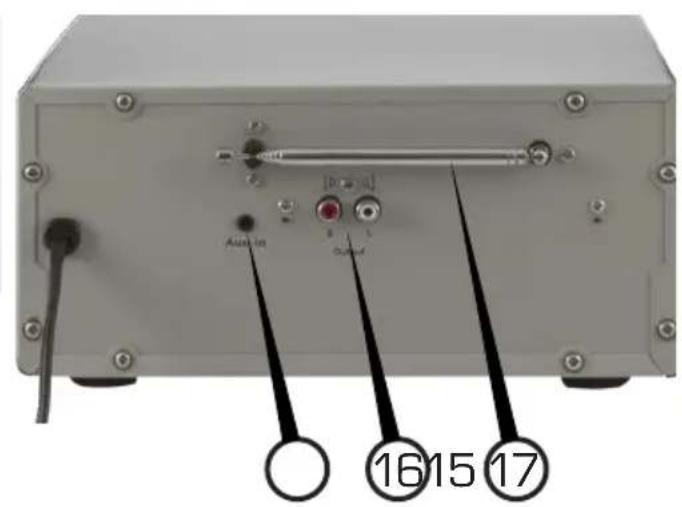
4. IMAGE
- Power button on/off
Switch the device on or into standby mode with this button.
- Mode
Switch between the various modes here.
-
Colour display
-
Navigation wheel with a push function (SCROLL&SELECT)
Navigate the device's menu by using this wheel. By pushing the wheel you confirm your entry or selection.
- Volume regulator
Adjust the volume by turning the button.
- PRESET button
Switch to one of the individually stored favourite stations here.
- Eject button
Press this button to open and close the CD tray.
- Select previous track/ quick rewind
Use this button to select the next track or fast rewind.
- Stop
Stops the playback.
- Select next track/ fast forward
Use this button to select the next track or fast forward.
- Play/Pause
Starts or pauses playback
- CD tray
Insert an audio CD here.
- Menu/Info
Activate the device's menu with this button.
Additional information is shown in the display by using this button.
- Headphone connection
Insert headphones here to listen to the music played back from the radio through your headphones.
If headphones are connected, music playback via the device's speakers is interrupted.
- AUX IN
Connect an external audio source here such as an MP3 player, smartphone or tablet with a 3.5mm AUX cinch cable.
- Loudspeaker connection
Connect the two included loudspeakers via these connections.
- FM/DAB antenna
4. IMAGE
4.2. Remote control

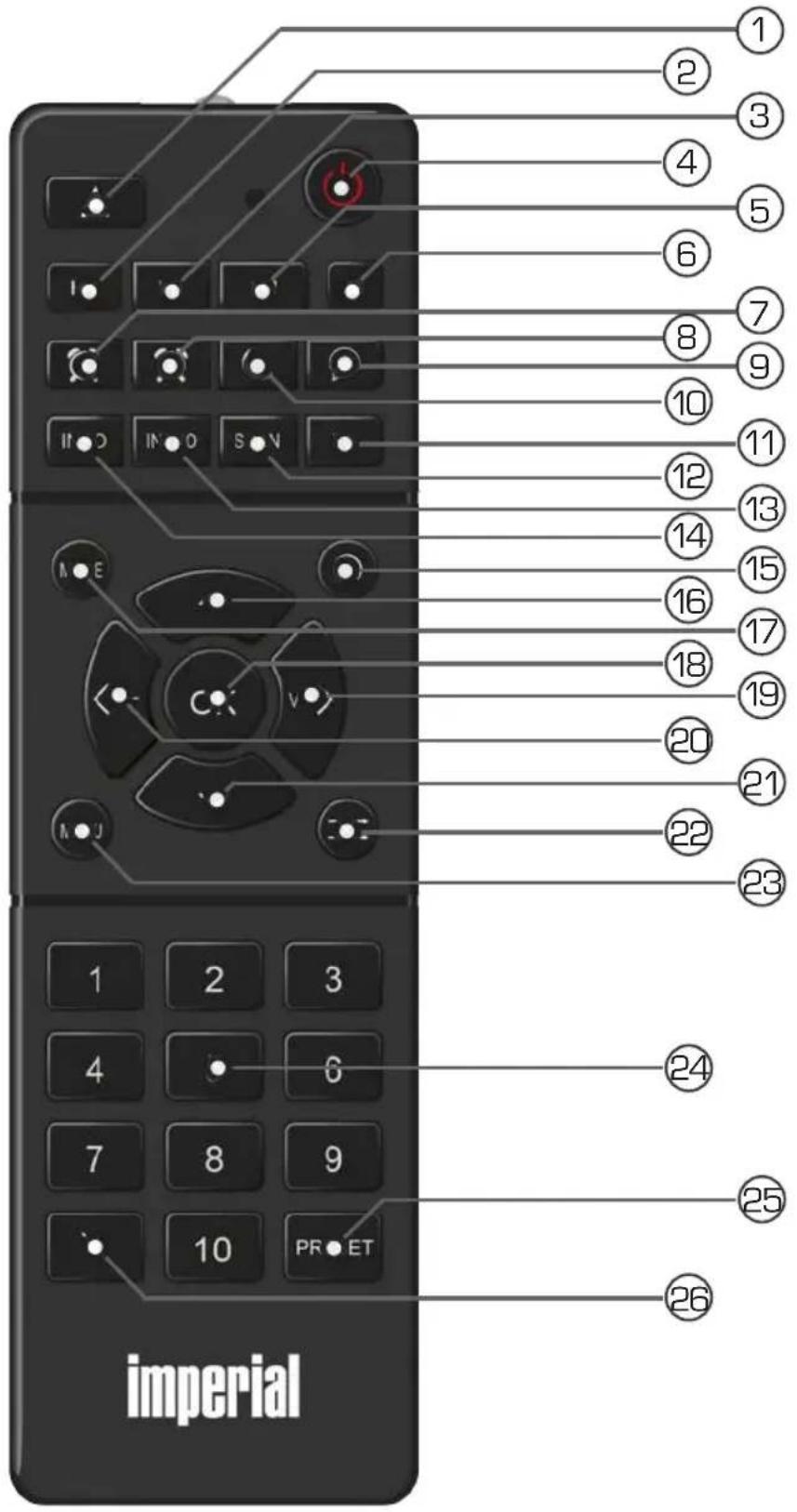
4. IMAGE
1. Eject button
Press this button to open and close the CD tray.
2. Select previous track/ quick rewind
Use this button to select the next track or fast rewind.
3. Play/Pause
Starts or pauses playback
4. Standby button
Switch the device on or off using this button.
5. Select next track/ fast forward
Use this button to select the next track or fast forward.
6. Stop
Stops the playback.
7. Alarm clock 1
Use this button to activate the alarm function.
8. Alarm clock 2
Use this button to activate the alarm function.
9. Sleep
Use these buttons to switch the Sleep Timer of the device on or off.
10. SNOOZE
Press this button to activate the snooze function of the active alarm clock.
11. EQ equaliser function
You can activate the equaliser function with this button and change custom sound settings.
12. SCAN
Start a DAB+ or FM station scan using this button.
13. INTRO
14. INFO
Additional information is shown in the display by using this button.
15. Back
Goes back one step within a menu or cancels a setting.
16. Navigation upwards
This button allows you navigate upwards through the menu.
17. Mode
Switch between different modes.
18.0K
Confirm an entry or selection with this button.
19. Navigation/ increase volume
Use this button to navigate through the menu or to increase the volume.
4. IMAGE
20. Navigation/ decrease volume
Use this button to navigate through the menu or to decrease the volume.
21. Navigation downwards
This button allows you navigate downwards through the menu.
22. Shuffle
Activate shuffle playback here.
23. Menu
Activate the device's menu with this button.
-
Number pad
-
PRESET button
Switch to one of the individually stored favourite stations here.
26. Mute
Mutes the device's sound.
Note:
Many of the radio's functions can be controlled via an app for mobile devices in addition to the remote control, provided you have a mobile device with an Android or IOS operating system.
Please read chapter 12 for more details.

5. KEY FUNCTIONS
5.1. Volume
Adjust the volume using the VOL+/VOL- buttons on the remote control or on the device.
5.2. Switching modes
Press the MODE button on the remote control or on the device to switch between the different modes: DAB radio, FM radio, music plyer, Internet radio, Bluetooth, CD and AUX IN.
Please note that the MODE button calls up the function described above in the factory setting.
5.3. Menu operation
The menu is divided into the main menu, the submenu of the currently selected source and the system settings that apply to all sources.
The operation within the menu is done with the knob [4] on the device or with the up/down arrow buttons (16/21) and the OK button (18) on the remote control.
To open the submenu of the selected source, press and hold the MENU button on the device for approx. 2 seconds or press the MENU button on the remote control.
The submenu of the currently selected source contains source-specific settings and options. From here, you can access the
main menu and from there the >System settings.
Move the marker up and down by turning the SCROLL&SELECT knob right and left or by pressing the arrow buttons on the remote control.
By pressing the SCROLL&SELECT knob or the OK button on the remote control, you can confirm your selection. If you changed a value, you can save it by pressing the SCROLL&SELECT knob or the OK button.
If there is an arrow (>) next to a menu item, you can access further settings or functions by pressing the SCROLL&SELECT knob or the OK button.
To exit the menu, press the MENU button. Depending on the current submenu or option you are in, you may have to press the MENU button several times.
If you would like to cancel your settings without storing any changes, press the MENU button or alternatively the back (15) button on the remote control.
5.3. Mute the device
You can mute the volume with the mute [26] button. 'Mute' will be shown in the display and the status bar.
A repeat button press switches the sound back on.
6. WHAT DO YOU NEED?
Your DABMAN i300 CD is a network device, which should be integrated into your network like all such devices.
By integrating it into your home network that is connected to the internet more than 25,000 radio station are available to you.
However, you can also just use your radio as a DAB+ receiver.
The DAB+ reception at your location should suffice for this.
Information about the DAB+ reception in your region can be found on www.digitalradio.de for example.
E
To connect the device to the Internet, you need the following:
- An Internet connection (e.g. DSL, ideally with a flat rate)
• A router for Internet access,
a so-called WIFI router (Wireless LAN) for wireless operation - For a WIFI integration: Your network key (WEP, WPA or WPA2)
Like any key, it serves to protect against unauthorised access and has been set up with your network.
To access a network secured in this way, the key must be entered into the radio later on.
If your network does not have a key,
the device can connect to the Internet without entering it.
Note:
If you are unsure if your network uses such a key,
just try without entering one first! If the device does not work afterwards, repeat the setup procedure. You should know the key then, however, if necessary, ask the person who set up your network for help.
The WIFI password can often be found on the router's bottom side, unless the key has been changed manually.
7. FIRST START-UP
The radio can be controlled using both the device buttons as well as the remote control. The remote control is the more convenient and easier way to operate the DABMAN i300 CD. For this reason, this manual mainly explains how to set up and operate the radio using the included remote control.
Plug the radio into a wall outlet and connect the power supply.
During the first start-up, a setup wizard starts which will guide you through the initial setup.
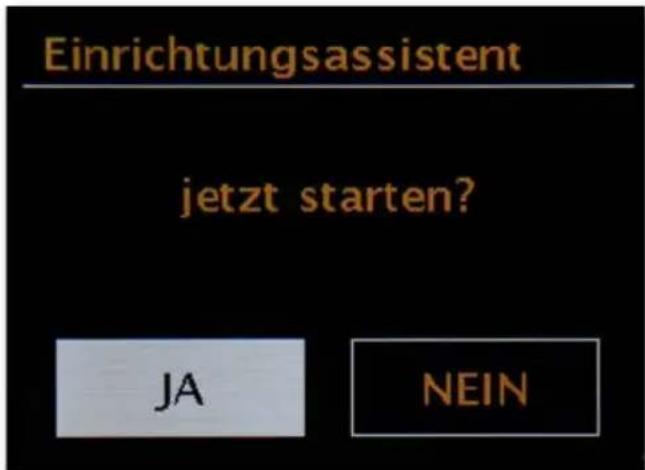
Select the answer using the navigation wheel or the
'Left' and 'Right' buttons on the remote control.
In the next step, select the 12h or 24h time format.
You can retrieve the current time from the Internet or from a DAB+ station. This ensures that the radio is always set to the correct and current time.
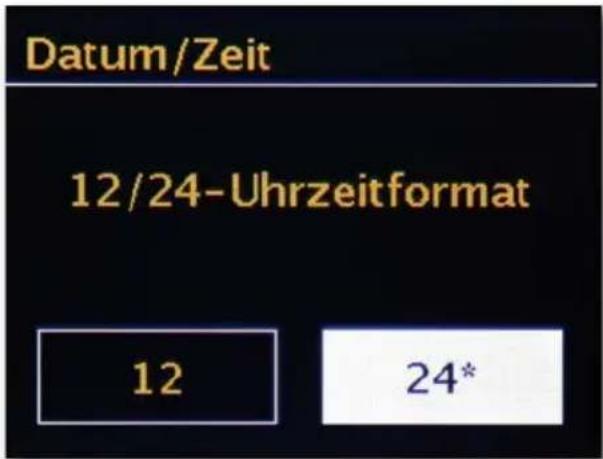
In this case please select 'Update by the Internet' or 'Update by DAB'.
If you prefer to manually set the time, please select 'No update'.
In the next step, please select your time zone.
For Germany select UTC + 1:00 and confirm with OK.
In the next step, select whether to automatically connect the radio to the network the next time you switch it on.
To connect to the Internet, in the next step confirm that you live in 'most of Europe'.
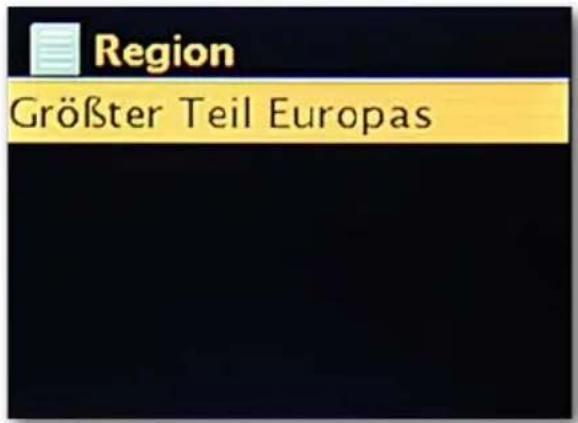
The device then searches for all available networks.
Please select your WIFI network on the display and confirm with OK.
![SSID [WPS]igibit_PW500_ODDCF [WPS]FRITZ!Box 7312 [WPS]FRITZ!Box Fon WLA [WPS]Pistole TS-Gast](/content/2026/04/636300/images/c573cbf2404f3b31ddbcab425dd5a090c6b85c67f79fbeabb697e5db0a5ccb98.jpg)
After selecting the desired network, you must enter the password to connect to the WIFI.
Navigate the selection as usual using the navigation wheel.
Confirm the completed key with OK.
The 'OK' field can also be reached via the navigation wheel.
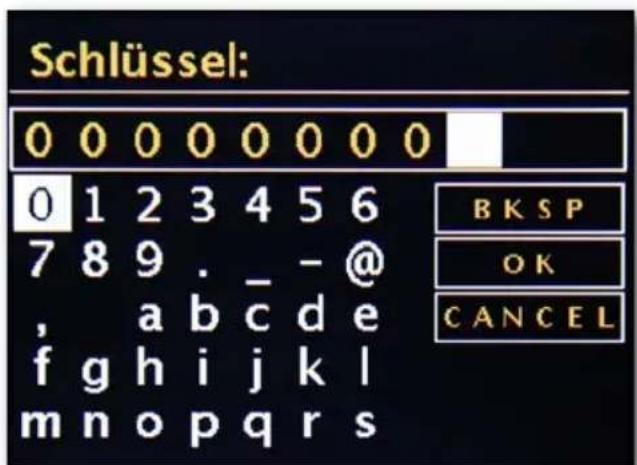
Following a successful setup, Internet radio stations will be available.
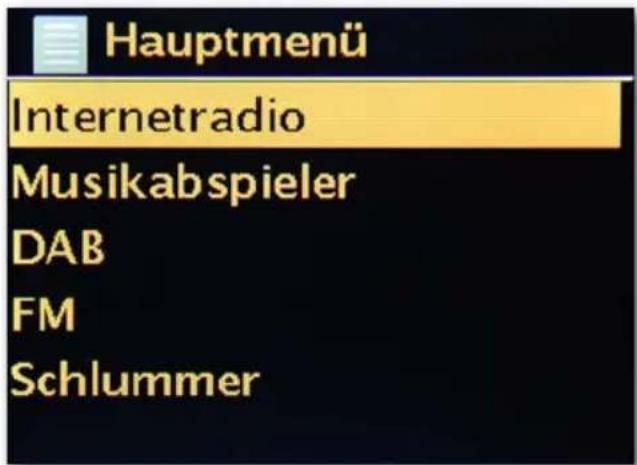
Select 'Internet Radio' from the main menu and confirm your selection.
In the following menu, you can either jump directly to one of the recent stations, display the complete station list, show the system settings
or - if you have changed your mind - return to the main menu.
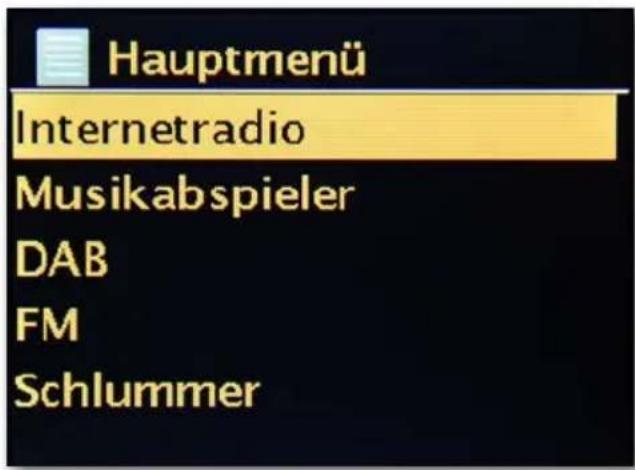
If you decide on the station list, navigate to the station of your choice in the submenu that follows - depending on your personal taste.
Due to the large number of available stations worldwide, our database is clearly sorted by countries, genres, popular stations, etc. and is always kept up to date.
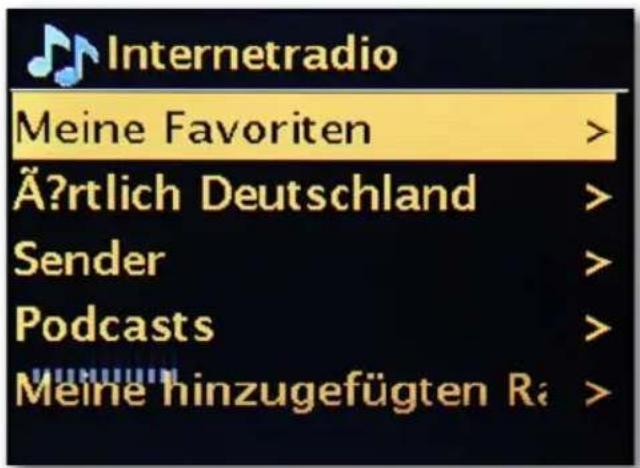
The playback begins after your selection.
The playback screen provides information about the station being played and, if transmitted, the
station or artist and title of the song being played.
To adjust the volume during playback, use the volume control on the device or the buttons on the remote control.
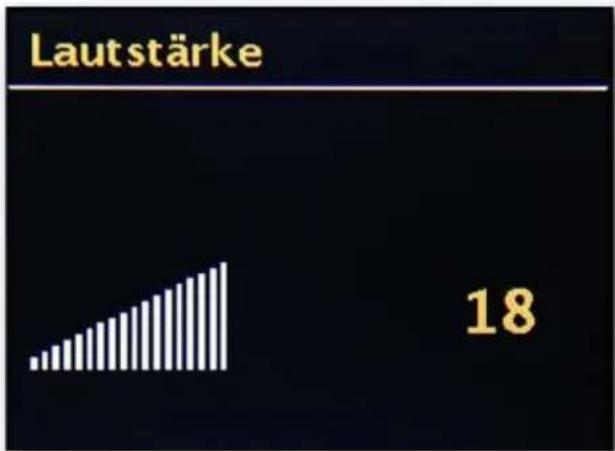
E
7.1 Network settings
Further information: about routers, SSID, MAC & IPs
The brief explanations listed here, together with the glossary in the appendix, are designed to help you better understand the decisions and settings that need to be made in your network.
Some points are only relevant in connection with a wireless network.
Refer to this chapter as needed.
7.1.1. Changing options on the router
In any case it is necessary that you are familiar with the router - or the administrator of the router - so that you can make settings and know how to handle the device. You only need to enter a specific
address (e.g. 192.168.0.1) into the web browser to access a convenient interface where you can set all options.
SSID broadcast (WIFI)
As is also listed in the technical glossary, SSID is an abbreviation for the network name, so all wireless network devices within range will be shown to you: here is a network with this identifier. However, on some routers, it is also possible to suppress the display of this name. This option is usually called SSID Broadcast and can be enabled or disabled. If the broadcast is switched off, you must know this name in order to enter it manually during setup on the DABMAN i300 CD.
Device ID: the MAC address
The MAC address is a unique identifier of each network
device. These addresses are permanently burned into the devices and therefore almost unchangeable.
That is why this identifier is suitable for configuring a router in such a way that it only allows devices with a noted identifier to access the network or the Internet. In this case, the router would have to be given this MAC address of the DABMAN device so that it can fulfil its purpose and use the network connection and access data in the network. The respective DABMAN's ID is located on a sticker on the back of the device.
Static IP
Under certain conditions it makes sense to perpetually
find a device at the same address. In fact, most networks are now set up in such a way that the ID address of the TCP/IP protocol, the so-called IP address, is assigned dynamically. This means that the respective device is assigned any valid IP address via a so-called DHCP server during the initial connection setup and as long as this is not used anywhere else, it remains with this IP address.
The user does not notice anything, everything happens completely automatically. However, if a network is based on static IPs, i.e. not on dynamically assigned IP addresses, there are usually precise rules as to which numbers
may be selected. The DABMAN i300 CD also has such an IP address.
If the network wants a static IP address, you have to know the rules for assigning it.
7.1.2. The Network Setup Wizard
Since the DABMAN i300 CD as a network device does not yet have any information about the possible network environments from which it draws its content, you will automatically proceed to the network setup wizard after it has been switched on for the first time and the language has been selected:
As in all other menus of the DABMAN, you can use the navigation wheel or the 'Up' and 'Down' or 'Left' and 'Right' buttons on the remote control to move through the selection. Confirm by pressing the navigation wheel or OK on the remote control.
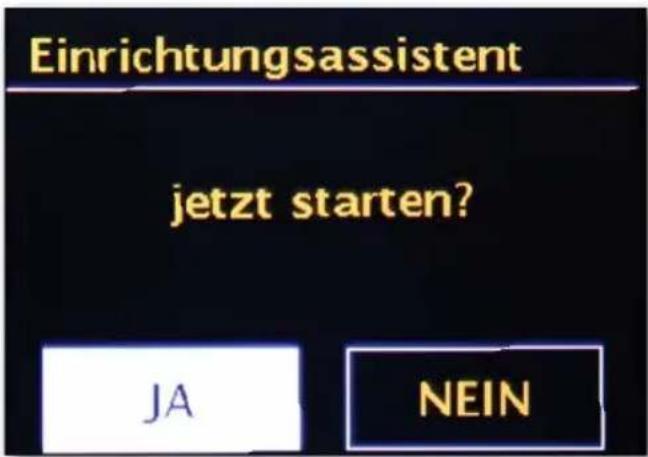
The wizard now automatically connects to your router and obtains its network address from the DHCP server. Every device that wants to join the network needs such a 'house number' so that the data can be delivered correctly.
7.1.3. WIFI connection
A wireless signal is always transmitted directly from point to point or from antenna to antenna. The quality of a wireless connection therefore depends on any obstacles that have to be overcome in the air or on the way from the DABMAN to the opposite device. This means that a setup position with a shorter distance can in fact result in a poorer connection.
If, for example, more walls or other sources of interference have to be
overcome, the signal quality decreases despite the shorter distance:
However, the following applies: the more transmission power the router has, the greater the reception range!
E
7.1.4. Setting up the wireless connection on the radio
To integrate the device into your network, the DABMAN i300 CD starts the wizard for connecting to your network.
It starts by listing all the networks found.
You should find yours among them, too.
It'll look something like this:
![SSID [WPS]igibit_PW500_ODDCF [WPS]FRITZ!Box 7312 [WPS]FRITZ!Box Fon WLA [WPS]Pistole TS-Gast](/content/2026/04/636300/images/de8e52981cf2f69e1e2c705e222b0a36076bc352682ad3e486c9d75b88af3142.jpg)
Now please select the network which you would like to connect to. If the network you are looking for does not appear, you can use the 'Rescan' menu item to repeat the search.
After selecting the network, you must now enter the network password. At the least if your WIFI router has been encrypted.
The passwords for your WIFI router are entered via the navigation wheel:
By turning the wheel you select the letters and numbers; by pressing the wheel you confirm
your entry, You can find the special characters by scrolling on with the wheel.
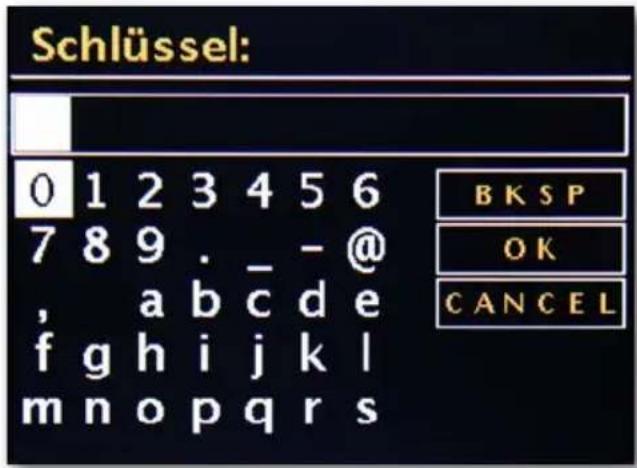
Once the password has been completely entered, go to the [ok] field. Please do not confirm each letter with [ok] as this would lead to cancelling the entry.
After confirming with the OK button, the DABMAN i300 CD sends the password to the router ('Please wait' is displayed), which - after successful adjustment - logs in the DABMAN i300 CD ('Connected' is displayed).
If everything was successful, the network setup wizard will display the message
'Settings completed'. Pressing the navigation wheel takes you back to the main menu.
Your entries and settings are stored in the device and do not have to be made a second time. The next time you switch on the
DABMAN i300 CD, it will automatically find your router and dial into the network.
7.1.5. Manually setting up the wireless connection on the radio
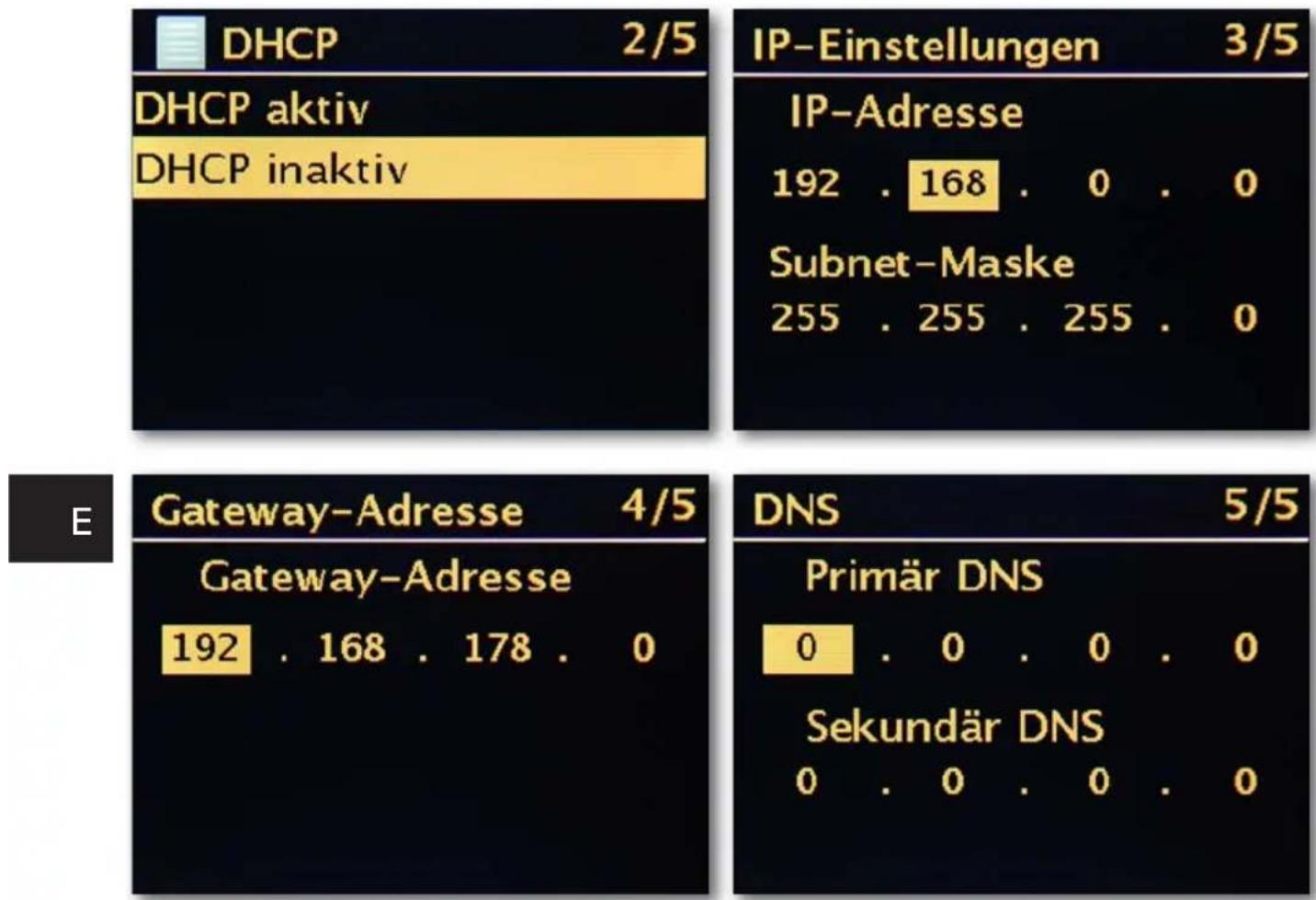
In some networks, static IP addresses are distributed for certain access conditions - the administrator will tell you what these should be.
See 'static IP'
Please select Switch off DHCP in the following menu. Here you can enter the corresponding values
with the navigation wheel.
To reach large numbers (e.g. 192) faster, turn the wheel to the left. To move to the next window, press the wheel or the OK button on your remote control once.
After that, the gateway address must be specified.
Now just enter the DNS address.
Now a connection is established and the settings are saved in the DABMAN.
7.1.6.WPS
WPS is an easy way to set up the DABMAN i300 CD in a network. For the connection to work, please note that your router must also support this protocol.
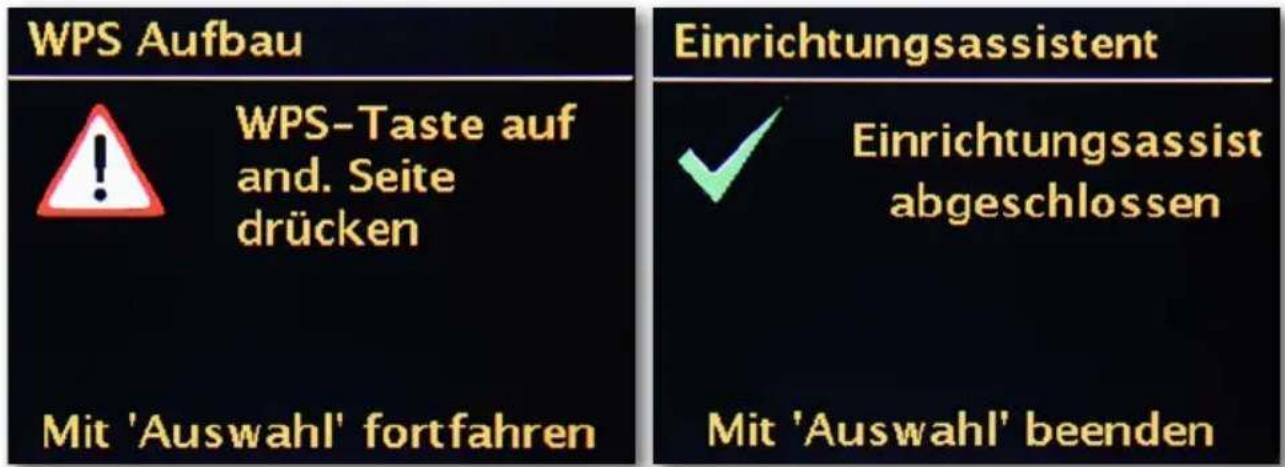
To use this connection setup, please press the WPS button (PBC) on your router and then press OK on your DABMAN i300 CD.
Regarding your router's configuration, please refer to the corresponding manual.
In this chapter we would like to familiarise you with the display of the DABMAN so that you always have an overview.
Status bar
The status bar is at the bottom of the screen.
There you will see the current directory you are currently in.
If you have selected a playback mode, the current time is displayed in addition to the mode.
If you have stored the station on a station button in Internet radio mode,
the respective number is displayed in the footer [e.g. P3]. If you play music from the network, you will see the message 'UPNP'. In addition, you will also find the currently selected connection type in the lower right corner.




Anzeige
Connection type: WIFI (with signal strength)
1 station selected on station button 1
10
Sleep timer active (10 more minutes)
Alarm clock 1 active
UPNP - Operation [music from the network]
Repeat all tracks
Shuffle playback
8.2 List view
There is a list view in all selection menus. Further navigation levels are indicated by an arrow symbol (>). For orientation purposes the status bar displays the name of the menu you are currently in.
After successful selection of a source, the playback starts and the display changes:
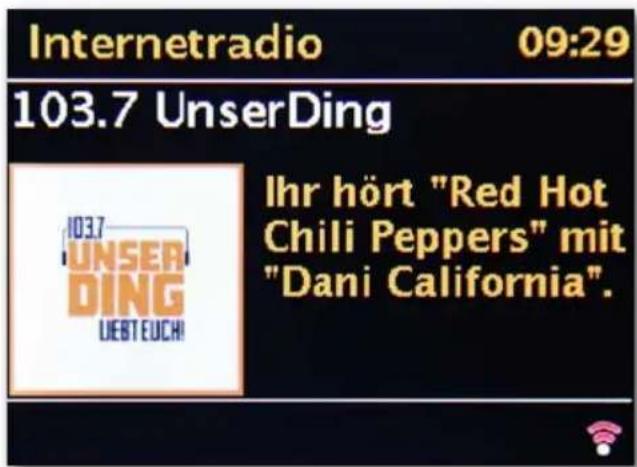
Now you will be shown information such as the station name, artist and track. For more information, press the [Info] button at the top of your DABMAN i300 CD. This then displays additional information about the reception quality, the technical data of the stream, the programme and the music genre preferred and the utilisation of the playback buffer.
Use the respective buttons on the DABMAN i300 CD case or the remote control to adjust the
volume. If you turn down the volume completely to zero, the message 'Muted' appears, so the radio no longer emits any sound. Alternatively, you can also use the mute button on the remote control.

8.4 Receiving DAB/DAB+ stations
Scan / full scan
Use the navigation wheel to select 'DAB' from the main menu and confirm by pressing the navigation wheel. Then select 'Full scan' and the radio will find all DAB and DAB+ stations available in your reception area.
Station list
In the DAB menu you will find the sub-item 'Station list'. By pressing the navigation wheel, you can select from the stations found in the scan.
You can call up the next or previous station with the navigation wheel directly on the radio or on the remote control, without first having to return to the station list.
E
Cleaning the station list / invalid reset
If a question mark appears before the station name in the station list, the DABMAN i300 CD cannot receive this station. This may be due to a poor reception, but also to a change on the part of the broadcasters.
To prevent unavailable stations from being displayed in the station list in a confusing way, select the submenu item ‘Clean up station list’ in the DAB menu and confirm the security prompt with ‘Yes’.
Station order
The subitem 'Station order' in the DAB menu lets you decide whether you prefer to have the radio stations in the station list sorted in alphanumeric order or by individual ensembles (i.e. groups of stations broadcast together in a 'package') or by valid stations (stations without a question mark in
front of the station name).
DRC
DRC is short for Dynamic Range Control. This function allows
you to adjust volume differences between different DAB+/DAB stations, resulting in a more homogeneous listening experience.
Press the MENU button and select > DRC to
select the desired compression rate.
Use the navigation wheel to select the compression rate:
DRC high - high compression
DRC low - low compression
DRC off - compression switched off.
Confirm using the OK button.
8.4.1. Store DAB/DAB+
The favourites memory can store up to 30 stations in the DAB range.
The stored station are retained even after a power failure.
Set the desired stations.
Press and hold the PRESET button on the device until the Favourites Memory List appears.Use the SCROLL&SELECT knob to select a memory location
1...30 and press the SCROLL&SELECT knob.
[saved] appears in the display.
Alternatively:
Press and hold one of the number buttons on the remote control until [saved] appears on the display.
Repeat the procedure to save more stations.
8.4.2. Selecting saved stations
Briefly press the PRESET button on the device.
Use the SCROLL&SELECT knob to select a storage slot location 1...30 and press the SCROLL&SELECT knob to play the stored station.
Alternatively:
Press the desired number button 1 ... 12 on the remote control. If you have not stored a station on the selected programme slot, [save slot empty] appears in the display.
Press the INFO button repeatedly until the signal strength is displayed:
![Bluetooth Audio 0000 Bluetooth Heutiges Datum: [Nicht beigt] Signal strength](/content/2026/04/636300/images/7bb7c8e1f39ea420689b85543874281f48f3090a8164a3b4b3b728a3d8abe8c1.jpg)
Minimum signal strength
The level of the bar indicates the current level.
Stations whose signal strength is below the required minimum signal strength do not send a sufficiently strong signal. You may need reorientate the antenna once more.
Via the menu item 'Set manually' you can select the receivable stations individually and display their signal strength.
This way, you can optimally align the telescopic antenna towards stations that are difficult to receive at your radio's location. This means that stations that have not yet been found in a scan can still be found and played.
To do so, select MENU > Set Manually and then select a station frequency. The signal strength of this frequency will be displayed.
Pressing the INFO button several times switches through different information such as programme type, multiplex name, frequency, signal error rate, data bit rate, programme format, date, DLS.
8.4.3. Adjust station order
Press the MENU button, and then press the button to select station order.
Select a sorting type and confirm your selection with OK.
8.5 Receiving FM stations
Scan
Use the navigation wheel to select 'FM' from the main menu and confirm by pressing the navigation wheel. By pressing the navigation wheel, you can access the next available station. Your DABMAN i300 CD has RDS and can display the station name (if broadcast).
Scan settings
If you press the Back button of your radio (optionally of the remote control) while the FM radio is playing, you can specify in the submenu 'Scan setting' whether the device should only consider stations with good transmission quality for the scan.
Audio settings
If FM reception is generally poor, you can specify in the ‘Audio setting’ sub-item that the stations are only to be played back in mono and no longer in stereo. This can significantly reduce the noise in the signal.
Manual station search
As an alternative to a scan, you can use the Skip Back/Skip Forward buttons either directly on the radio or on the remote control to select specific frequencies and thus find the stations located there.
Receiving time information via DAB, FM or Internet
You do not need to set the integrated clock of the DABMAN i300 CD yourself, as many broadcasters transmit a coded time signal together with their programme. However, this only works if you receive the corresponding stations in sufficient quality.
Use the navigation wheel to select 'System settings' in the main menu, then 'Date/Time' and finally 'Auto update'. Now you can choose whether you want to receive the time signal from radio stations via DAB/DAB+, FM or the Internet.
8.6 Receive Internet radio
In the previous section we already explained the impressive possibilities of the Internet radio function of your DABMAN i300 CD. The big advantage over the traditional way of listening to Internet radio via your computer's web browser is that your DABMAN i300 CD accesses the Internet WITHOUT the computer running - simply via your router, which establishes the connection to the Internet.
The list of Internet radio stations is constantly updated and expanded. This ensures that, with all the changes that the Internet is constantly subject to, there is always an up-to-the-minute and, above all, reliably functioning range of Internet radio stations. When accessing the Internet radio menu, the radio automatically calls up the current version directly online, thus ensuring that it is always up to date. Use the usual navigation to zap through the station list, which is already sorted.
If you come across a station that you would like to find again, simply press one of the station keys during playback for approx. 2 seconds to store the estimated one and call it up again later if necessary using the same number key.
An asterisk (*) then appears in the bottom line of the display, followed by the respective station key - e.g. ‘*1’. Further options for managing favourites will also be presented later.
8.6.1. Internet radio station selection
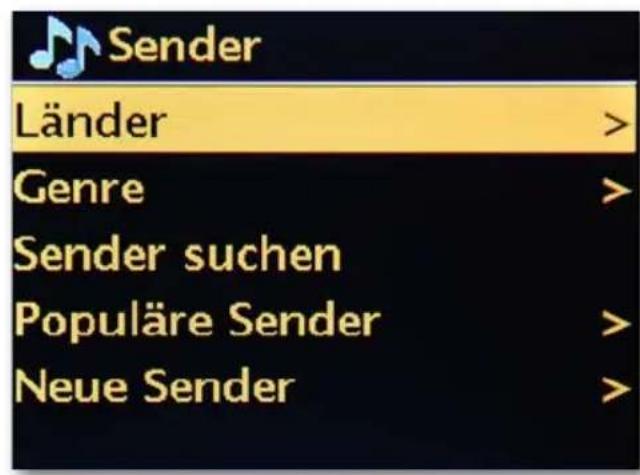
There are various ways to find the right station from the abundance of stations. Under [Local Stations Germany] you will only find national stations.
And since there are a lot of them, we have sorted them for you again according to music style and content.
Press and hold the PRESET button on the device until the [save presettings] is shown in the display.
You can now use the SCROLL&SELECT knob or the up/down arrow buttons on the remote control to select one of 30 favourite saves slots.
To save the station, press the OK button when the marker is in the desired Favourites save slot. The display then shows [saved].
Alternatively:
Press and hold a number button on the remote control to store a station on one of the corresponding number buttons.
Press the INFO button to obtain additional information about the currently playing station.
8.6.3. Open internet radio favourites
Briefly press the PRESET button on the device and use the SCROLL&SELECT knob or the up/down arrows on the remote control to select a station from the preset list. Press the OK button to play that station.
Alternatively:
Press and hold one of the number buttons on the remote control to directly select the station.
8.6.3. Adding a new Internet radio URL
In order to add a new URL of a radio station, please register your
DABMAN i300 CD on www.wifiradio-frontier.com. You can request your personal access code under the Help menu item on the radio. With the access code you can then register your radio and add a new URL.
The new station appears on your radio under 'My added stations'.
8.7 Podcast & Radio-On-Demand
Radio On Demand - This literally means ‘radio on demand’ and is an apt synonym for podcasting, mainly in the English-speaking world. Thus, for example, popular individual productions of the daily radio offer - also by large and well-known radio stations - are prepared and made available online as podcasts - available at any time.
As a listener, you are no longer tied to fixed transmission times in conventional broadcasting, but can access available content at any time this way.
The variety of content is massive and grows every day. Perhaps an interesting alternative to classical radio: Not only radio broadcasters offer their content in this way, but there are also recordings of lectures at universities, language courses, comedy productions or simply acoustic diaries in the portfolio.
8.8 Digital Media Player [playback from UPnP server]
Server software running on a computer or other device lets you share music files for network playback. In the case of the DABMAN i300 CD, it must be a UPnP compatible server (UPnP: Universal Plug and Play) which provides the data.
A simple file share, as known from the Windows network world, is not readable this way. In contrast to an inflexible static file sharing, the DABMAN i300 CD offers a flexible sorting via a virtual UPnP media server, which makes the manageability of your library more flexible by comparison: a track can be found via the artist, the genre, the album and even by means of the folder structure.
8.9 Favourites
Your DABMAN i300 CD has its own favourites list, which can be found in the menu under 'InternetRadio'. To create favourites, press and hold the navigation wheel or OK button on the remote control for a few seconds. Once a favourite is stored, the radio acknowledges it in the display with the message 'Favourite added'.
To remove a favourite, select it from the Favourites menu (highlighted in white) and press and hold the navigation wheel or OK button on the remote control for a few seconds. A ‘Remove favourite’ menu will appear.
Please note that contents of UPnP servers cannot be saved as favourites because they are not permanently available.
8.10 Podcasts
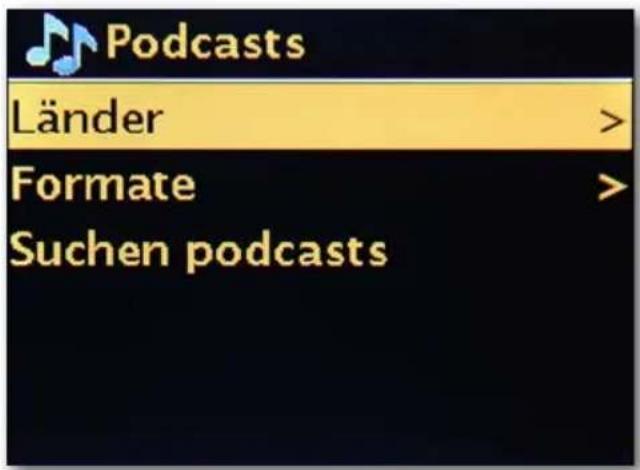
With your DABMAN i300 CD, you can subscribe not only to radio stations and broadcasts, but also to podcasts from around the world. As you can see, the podcasts in [Countries] are sorted by continent.
Under [Formats] you can also search for a specific topic.
You can also - as with radio stations - search for a podcast you know by entering its name.
E
8.11 History
The recently played tracks and received radio stations are listed under the menu item 'Last listened to'. That way, even those stations can be found without any problems that are believed to be lost forever following a brief memory loss.
8.12 Music player [UPnP]
UPnP allows the user to receive data from the network. For example, if you have shared your music collection on your computer with a UPnP programme (e.g. Windows Media Player 11/12), you can access and play tracks from the living room or kitchen with the DABMAN i300 CD. If the music library is stored centrally on a network hard drive (NAS), this even works without a computer.
As a network player, your radio then directly accesses the music tracks on the drive.
![Telestar DABMAN i300 CD - Music player [UPnP] - 1](/content/2026/04/636300/images/03318ac1c09d3657d626cb81c252487cf41fcf8a760d4f0b77611052b3829080.jpg)
The [Music player] menu item can be accessed via either the main menu or the Mode button, which can be found both on your DABMAN i300 CD and on the remote control. If you choose this option, you will be offered two icons:
Internet radio and music player.
In the music player menu, you can access media shared on your network and also set the playback mode.
Make your choice using the navigation wheel or the 'Left/right' buttons of the remote control. If you wait for too long, the screen with return to the main menu.
8.13 Sleep timer / snooze
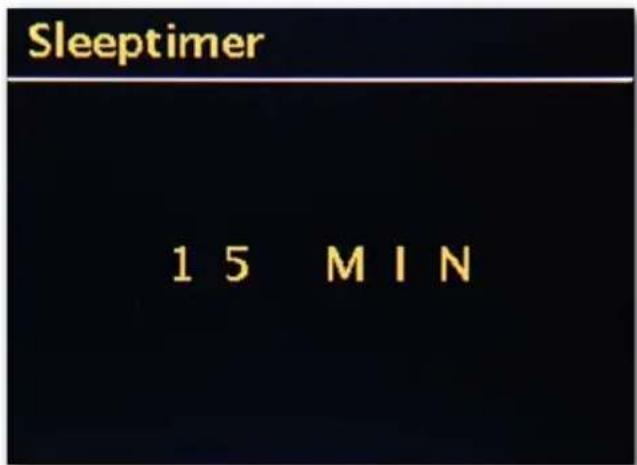
Once activated, this will ensure that the DABMAN i300 CD switches off automatically after the preset time, which is especially advantageous if you have fallen asleep in the meantime. You can extend the snooze time up to one hour in 15-minute increments; the default setting, of course, is 'snooze off'.
8.14 ALARM
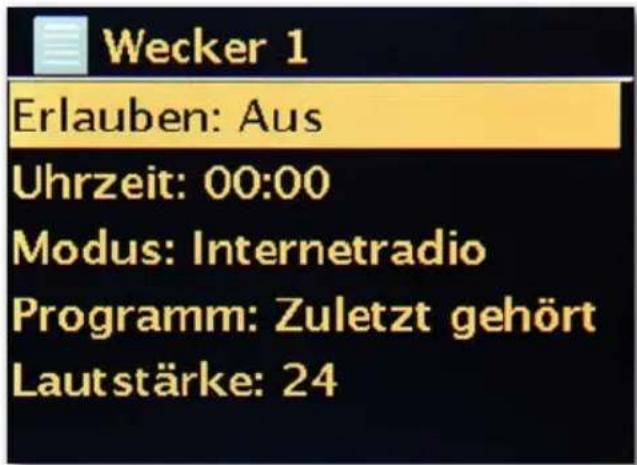
The radio features 2 integrated alarm clocks.
The alarm can be activated and the time set in the menu.
An alarm sound, the last station you listened to or your favourites are available as the source. To adjust the volume, the source is played and you can adjust the desired level by using the navigation wheel.
8.15.1. General Information about CDs/MP3 CDs
The DABMAN i300 CD is suitable for music CDs recorded with audio data
(CD-DA or MP3 for CD-R and CD-RW). MP3 formats must be created with ISO 9660
Level 1 or Level 2. Multisession CDs cannot be read.
In MP3 mode, the terms 'Folder' = album and 'track' are decisive. 'Album' corresponds to the folder on the PC, 'track' to the file on the PC or a CD-DA title.
The device alphabetically sorts the albums or tracks of an album by name. If you prefer a different order, change the name of the track or album and put a number in front of the name.
When burning audio data onto a CD-R and CD-RW, a number of problems can arise that can sometimes interfere with a smooth playback.
This is caused by faulty software and hardware settings
or the blank CD used. If such errors occur, you should contact the customer service of your CD burner/burning software manufacturer or look for appropriate information - e.g. on the Internet.
When making audio CDs, observe the legal principles and do not
violate the copyrights of third parties.
The device can play CDs with MP3 data and normal audio CDs
(CD-DA). Do not use other extensions such as *.doc, *.txt, *.pdf etc.
when converting audio files to MP3. Music files with the ending *.AAC, *.DLF, *.M3U and *.PLS or *.WMA cannot be played.
Due to the variety of different encoder software, it cannot be guaranteed that every MP3 file can be played without problems.
If the track/file is faulty, the next track/file is played.
It is advantageous to burn the CD at low speed when burning and to create and finalise the CD in a single session.
The CD player is compatible with CD, CD-R/RW and MP3 CD media. You can play all the discs mentioned
here (disc size 12 cm CDs, playing time 74 min.) on this device.
E
When transporting the device, remove the disc from the drive.
This will prevent damage to the CD player and the disc.
The playback quality of MP3 CDs depends on the bit rate setting and the burning software used.
8.15.2. Play a CD
Press the MENU button, and then select Main Menu > CD.
To insert a CD, press the eject button on the device or on the remote control and carefully insert the CD with the label on the top into the tray.
Make sure that the CD is not crooked.
To insert or remove the CD, please only touch the edge of the CD.
Wait until the CD contents have been completely read to ensure that all required information has been read from the CD. This may take some more time in the case of MP3 CDs especially.
Press the Play/Pause button on the remote control [11] to start/pause playback (the play time flashed in the display).
Press the STOP button on the remote control (6) to stop playback.
The display shows the total number of tracks.
Always stop playback before removing a CD.
If there is no playback, the DABMAN i300 CD will enter standby mode after approx. 15 minutes.
8.15.3 Set a track
You can select folders/albums using the arrow buttons on the remote control.
Use the Track Skip Forward/Back [3, 6] buttons on the remote control to skip to the next or previous track.
The display shows the track number set in each case (F = folder/album, T = track).
8.15.4 Quick scan
You can run a fast forward or backward search in the current track to find a specific part. Playback does not occur during the search.
Hold the Track Skip Forward/Back (15, 5) buttons on the remote control to run a fast forward / backward within the track for as long as you hold the button.
8.15.5. Repeat function
You can choose to repeat a track, the entire folder/album (MP3 CDs only), or all tracks on the CD.
To do this, press the Back button on your remote control (15) repeatedly. The selected mode is shown in the display (Repeat trackCE, Repeat folder/album
Repeat all tracks J
To switch the function off again, press the Back button (15) button repeatedly until the Repeat indicator disappears.
8.15.6. Shuffle playback
With the random function you can play the tracks of a CD in any mixed order.
During playback, press the Shuffle button (22) on the remote control repeatedly until the random playback icon appears on the display. To switch the function off again, press the Shuffle button (22) once more.
8.15.7. Notes on the CD
Always store the CD in its case and only touch the edges.
The surface shimmering in rainbow colours must not be touched and should always be clean. Do not stick paper or tape to the label side of the disc.
The CD should be kept away from direct sunlight and heat sources such as radiators.
A CD must also not be placed in a car parked directly in the sun, as the inside temperature in the car can rise extremely high. Clean fingerprints and dust on the recorded side with a clean, dry cleaning cloth.
Do not use disc care products such as disc spray, cleaning fluids, antistatic spray or solvents such as petrol, thinner or other commercially available chemicals to clean CDs. Stubborn stains can potentially be removed with a damp chamois leather.
Wipe from the centre towards the disc's edges. Circular movements during cleaning cause scratches. These can cause playback errors.
9.0 SETTINGS
In this extensive menu you will find information about your DABMAN i300 CD and can make and save settings on the device.
Equalizer
The equalizer allows you to adjust the sound of the DABMAN to your liking.
The different programs balance the bass, midrange and treble differently, so there is something for every ear. For the outputs that are not amplified (analog, digital) the equaliser is of course not considered, the sound is reproduced here without alteration in any case.
The following equaliser options are available: Normal, Middle, Jazz, Rock, Soundtrack, Classic, Pop, News.
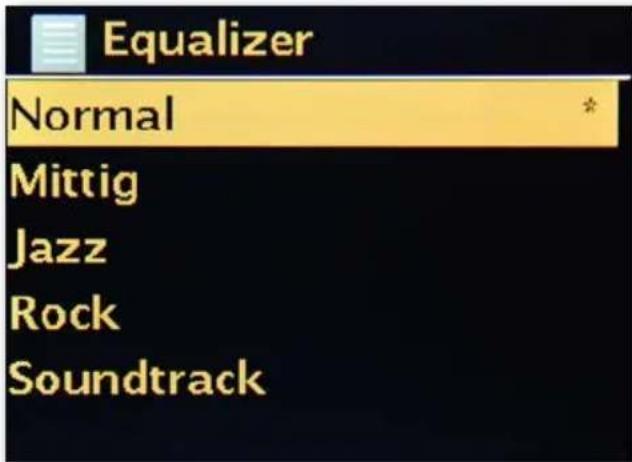
If none of the presets are to your liking, you can also create and save your own under 'My Equaliser Configuration'.
Basses and trebles can each be raised or lowered by 14 dB.
You can then retrieve your saved settings by selecting
'My Equaliser'.
Internet settings
Here you can adjust the network settings of your radio.
Network assistant
If desired or necessary, you can choose a different network here.
In the case of WIFI networks that you have previously logged into, you will not have to enter any password.
PBC WIFI setup
PBC stands for Push Button Configuration. Here you can connect your DABMAN i300 CD
via WPS (WIFI protected setup) to a router, if this is supported. Further relevant information is provided in your router's manual.
Display settings
This shows all the relevant information about the current connection of your DABMAN i300 CD with the network. There you can check whether the WIFI or DHCP is active or see your MAC address, SSID, IP address or the primary DNS.
WIFI region
In part, other countries (or hemispheres) use different WIFI frequencies
or broadcasting levels. So should you take your device to the United States, for example, it is sensible to inform your DABMAN i300 CD about this.
Manual settings
Here you can switch between 'Cable' and 'wireless', activate or deactivate DHCP or do a few other things.

NetRemote PIN setup
Here you can change the PIN for the remote access to your DABMAN i300 CD.
The default setting is '1234'.
Should you use this function, we highly recommend changing this rather unoriginal password.
Remove network profiles
Would you like to lend your DABMAN i300 CD to someone else but remove access to your network beforehand? You can easily do that here.
Maintain the network connection
In standby mode, the DABMAN i300 CD can maintain or disconnect from an Internet connection. If you do not maintain an Internet connection in standby mode, the DABMAN i300 CD will need to reconnect to the Internet each time it is switched on.
The DABMAN i300 CD thus needs a bit more time until you can hear the first station. If you maintain an Internet connection, the switching on process is significantly faster.
Time / date settings
You can adjust the date and time settings in this menu option. You already made this changes in the Setup Wizard at the beginning - but perhaps you would like to take your DABMAN i300 CD with you on your holiday, you are moving to a new place or forgot to switch on the daylight savings changes. You can make these changes under [Set time/date].
The manual settings are made by using the navigation wheel and with the push function. After a successful entry, the clock and the time are set and will be kept as accurately as possibly.
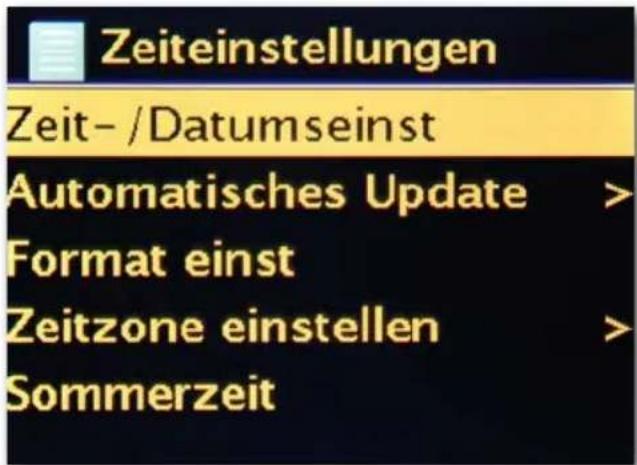
If you prefer a more convenient approach, you can retrieve the time and date from the web via [time / date sync]. Who really has a clock at home that is set perfectly?
The radio automatically used the so-called NTP server to synchronise (NTP stands for Network Time Protocol).
Set the format
Should you wish to change the time format, this can be done under [Set format]. Choose between the 24- and American 12-hour format.
Please note that the AM and PM addition is not displayed in the 12-hr format.
Under [Set time zone] you can choose your current time zone.
Starting with CET (Central European Time) you can choose any zone around the globe! If you live in
Germany, ‘Berlin’ is likely the right option. Even if you live in a different city. Do you live in a summer daylight savings zone? Then inform your DABMAN i300 CD device of this under the menu item [summer time], so that you will have be shown the correct time - even should you forget to change the time in spring and autumn. The Back button will return you to Settings.
Sleep timer
This setting determines whether the DABMAN i300 CD is automatically or manually switched off. The default setting is [off] and [2 hours], [4 hours], [5 hours] and [6 hours] are available.
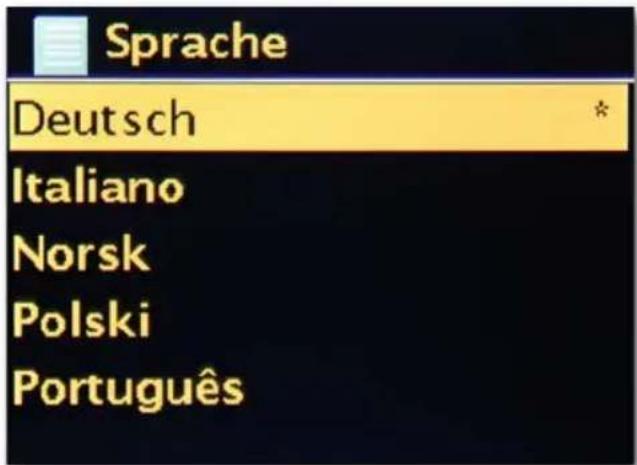
Language
Here you can select the language for the menu in the DABMAN i300 CD. The following languages are available: German, English, Spanish, French, Italian and Dutch.
Use the navigation wheel to scroll through the list and confirm with the push function. With the i300 CD Back-Button you can return to the system settings.
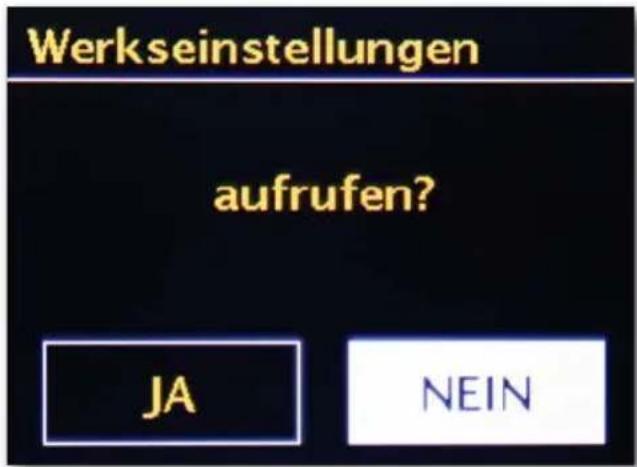
Factory settings
Here you ran restore the radio's factory settings. This comes in handy is you have changed settings that may prevent the device's optimal functioning. The device is returned to its factory settings with this option.
Please note that all custom settings will be lost by restoring the factory settings.
You can confirm the security question by choosing Yes. Select No if you would like to cancel the process.
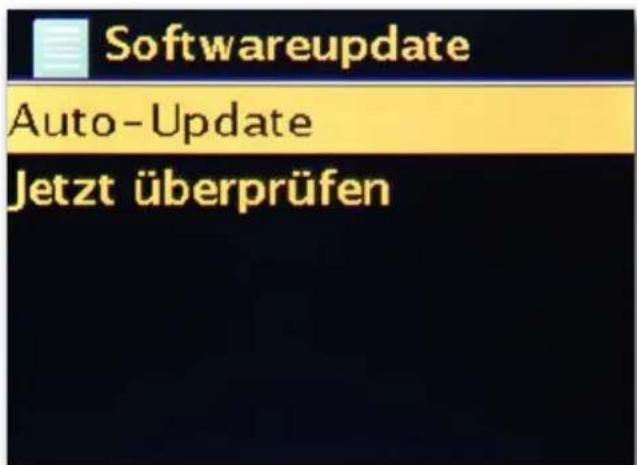
There is nothing that cannot be improved!
That is why you should feel free to update the DABMAN i300 CD's firmware.
When calling up this menu, the DABMAN i300 CD will connect to the update server to check whether an update is available. Following that, you can either install these or view additional information. The system will restart after a successful installation.
If you prefer to not do this manually all the time, please select 'Automatic updates'. If you prefer doing this yourself from time to time, then click on 'Search for updates'.
WARNING:
All settings made by you are lost during a firmware update.
(e.g. network profiles, station favourites, equaliser settings). These have to be mage again after the update
Here you can set the duration that will be waited before the device switches [to] from the list view to the playback view.
Device information
This menu displays all information relevant to the device. There you will find the installed firmware version and the hardware ID of your DABMAN i300 CD.
The information found here is also very helpful should you require support.
Press the Back button to return to the settings.
Backlight timeout (sec)
Here you can set when to automatically switch off the lighting of the colour display. You can either switch off the automatic setting completely [On] or select between 10 and 180 seconds.
Operating state
Here you can select how bright the display is to be illuminated in the operating state.
Three levels are available: [High], [Medium] and [Low]. The default setting is [High]
Standby state
Here you can select how bright the display is to be illuminated in the standby state.
Two levels are available: [Medium] and [Low]. The default setting is [Medium]
10. BLUETOOTH
The DABMAN i300 CD BT can also be connected to an external device (e.g. smartphone/tablet) via Bluetooth.
Via the Bluetooth connection, the radio can play media
(locally stored MP3 files, streamed music, web radio) on an external device.
The Bluetooth mode is recommended if you are near the radio with a device to be connected and no network connection is available.
Select Bluetooth from the menu.
A Bluetooth connection must be established before you can send audio files to the radio via Bluetooth.
10.1 Establish a Bluetooth connection
If you have selected Bluetooth mode on the radio,
it is in pairing mode and will search for Bluetooth devices to connect to.
Now activate the Bluetooth function of the external device to be connected (for further details, please refer to the operating manual of that device). Search for 'DABMAN i300 CD' in the list of available devices, select it and establish the connection. In the radio display, a Bluetooth symbol appears in the lower left corner.
![Bluetooth Audio 00:00 Bluetooth Heutiges Datum: [Nicht belegt]](/content/2026/04/636300/images/533a32f905e5e8a045bb5b8988ceef0b1af02afae7a72c5ee500e81c834fc6b3.jpg)
E
10.2 Playing media via Bluetooth
If you have established a Bluetooth connection as described in Chapter 10.1, you can play music files stored on an external device via the DABMAN i300 CD.
To do so, proceed as follows:
Start playback of the music on the external device by switching to the corresponding playback function (MP3 player, etc.) or select a track from the respective playlist and start playback.
11. AUDIO INPUT
You can play the sound of an external device on the DABMAN i 300 CD.
Connect the external device to the audio input on the rear panel of the radio.
Press the MODE button repeatedly until [AUX IN] appears on the display. Alternatively:
Press the MENU button, and then select Main Menu AUX IN.
To optimally set the volume, use both the volume adjuster on the radio as well as the connected device.
Please note that a very low volume setting of the connected device and a correspondingly higher volume setting of the radio will also amplify annoying noise/interference to a greater extent and thus be heard more clearly. We thus recommend adjusting the volume of the DABMAN i300 CD e.g. on a DAB+ or FM station, switching to the audio input and then adjusting the volume of the connected device so that the total volume of the audio input roughly corresponds to the volume of the DAB+/FM station. This way you can also avoid major volume differences when switching between the DABMAN i300 CD functions.
12. USING THE APP UNDOK
You can easily control your DABMAN i300 CD radio via an app
that is available for Android and IOS in addition
to the immediate control and remote control.
Download the UNDOK app from the google play store for Android
OS, or via iTunes for IOS and install the app on your Smartphone/Tablet.
Make sure that the radio and your mobile tablet are registered on the same network.
Start the app.
When starting the app, it automatically detects the i300 CD if it is registered in the same network.
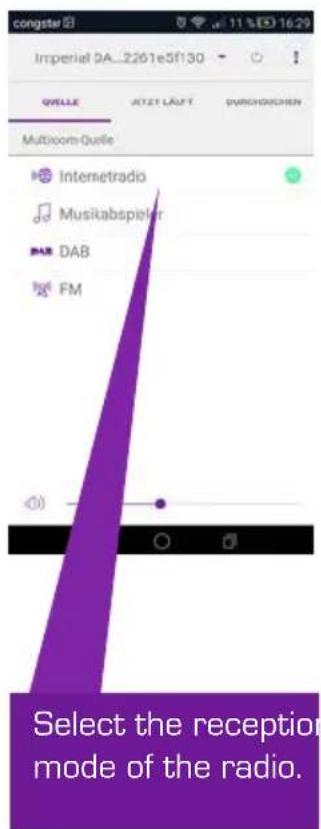
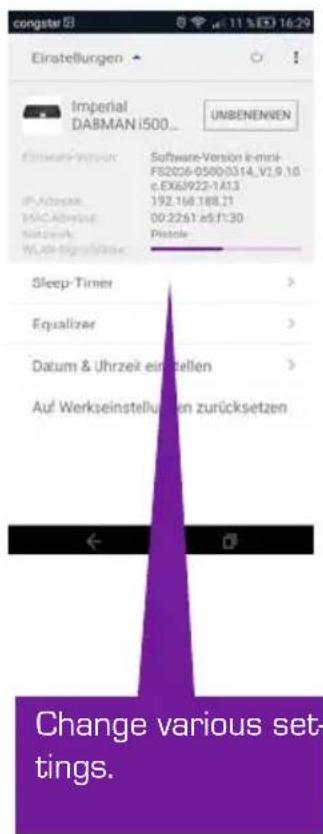
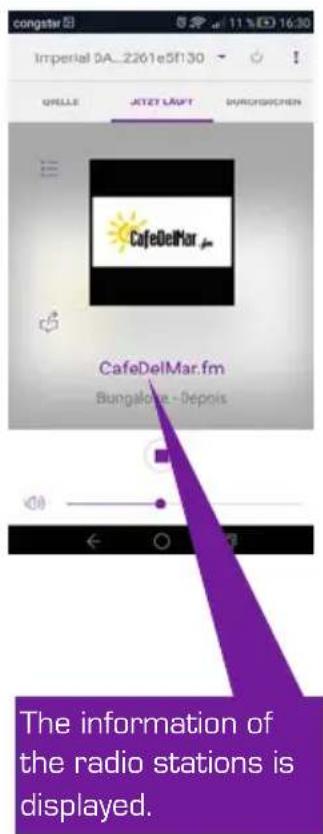
Note:
This description corresponds to the app as at time of printing.
In the course of updates to the app's software,
the appearance and functions may change.
13. TROUBLESHOOTING
| Symptom | Possible cause and remedy |
| Empty displayRadio no reacting to operation | Connect the powerusing the includedpower unit. |
| Remote control does not work | Battery is empty or not inserted properly. Please check that the batteries have been inserted the right way around. |
| DAB+ reception interrupted | No stationsRun a scanAntenna not fully extracted.Change the radio's location (e.g. near a window),run another scan search. |
| FM reception inter-rupted | Antenna not fully extended, pull the FM antenna out to its full length.Change the location of the radio |
| Poor audio quality when playing music | File with low bit rate. Check the audio file.Tip: The bitrate should be 192kbit/s or higher for MP3 files. |
| Volume too low Check | the volume setting on the i300 CD. Check the volume setting of the paired device from which you are playing the music. |
| No network connection can be made | Check the WIFI functioning.Activate the DHCP function of the router to which the radio is to be registered.There may be an active firewall in the network. |
14. STORAGE
When not in use, please remove the power unit from the socket, disconnect the radio's cable from the device and store the device in a dry place, protected against dust. If the device is not in use for a longer period of time, the battery must be removed from the remote control.
15. BRAND INFORMATION
Google Play Store ® and Android ® are registered trademarks of Google Inc.
itunes Store is a service mark of Apple Inc.
IOS ® is a registered trademark of Cisco in the USA and other countries and is used under license.
Other product and company names mentioned herein are trademarks or registered trademarks of their respective owners.
16.DISPOSAL
16.1. DISPOSING OF THE PACKAGING
The packaging consists exclusively
of materials that can be recycled.
Please dispose of these properly according to the
'Dual system'.

16.2. DEVICE DISPOSAL
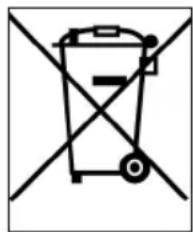
The symbol on the right of a crossed out waste bin indicates that this device is subject to Directive 2012 / 19 / EU EU.
This directive specifies that this device,
at the end of its
service life but must be taken to specific collection centres,
recycling centres or waste disposal companies.
This type of disposal is free of charge. Protect the environment
and ensure a proper disposal.
Further information is available at your local waste collection company or your city or municipal office.

16.3. DISPOSING OF THE BATTERIES
Batteries and power units may not be disposed of with household waste. The symbol on the right means that you as a consumer are required to dispose of all batteries and battery packs separately.
Suitable collection bins are provided at specialist retailers and numerous numerous public facilities.
Information about the disposal of old batteries and power units is also available at specialist waste disposal companies and city and municipal offices.
This type of disposal is free of charge. Protect the environment and ensure a proper disposal.

An additional chemical symbol Pb (lead) or Hg (mercury) beneath the crossed-out waste bin indicates that the battery/ power unit contains a share of more than 0.0005% mercury or 0.004% lead.
17. TECHNICAL DATA
| Internet radio | |
| Chip set | Frontier silicon chip setapprox. 25,000 Internet radio stations availableMP3 (bit rate up to 320 Kbits/s, sampling rate up to 48 KHz) |
| Audio codecs | AAC/AAC+ (bit rate up to 320 Kbits/s, sampling rate up to 48 KHz)WMA (bit rate up to 320 Kbits/s, sampling rate up to 48 KHz)UPnP/ DLNA compatibleIEEE 802.11b/gWPA/WPA2/WEP (64/128 bit key) |
| WiFi | |
| DAB/DAB+/FM | |
| DAB | Sensitivity up to -100dBm |
| DAB+ | Sensitivity up to -101dBm |
| FM | Sensitivity up to -100dBm |
| Decoding | |
| Reception range | DAB Band III 174 MHz- 240 MHzFM 74 MHz - 108.1 Mhz |
| Connections | |
| Line out | Cinch stereo R/L |
| WIFI | 10/100 Mbps (RJ45) |
| Power supply | 10-240 V AC 50 /60 Hz primary |
| Dimensions | |
| Dimensions WxHxD | 437mm x 83mm x 31mm |
| Weight | 2.6 kg |
| Remote control battery | |
| Type AAA | |
18. SERVICE AND SUPPORT
Dear customer!
Thank you for choosing one of our products. Our product meets the legal requirements and has been manufactured under constant quality control. The technical data correspond to the current status at the time of printing. Subject to changes.
The warranty period for the DABMAN i300 CD corresponds to the legal regulations at the time of purchase.
We also offer a HOTLINE telephone service with professional support.
E
Professional specialists are ready to offer their assistance in our service area. Here you can ask any questions you may have about IMPERIAL products and get suggestions on troubleshooting.
Our technical staff is available to answer you questions from Mondays - Fridays from 08:00 - 16:45 under the following phone number:
02676 / 95 20 101
or at the email address: service@telestar.de
If the Service Hotline is unable to assist you, please send your DABMAN i300 CD to the following address, preferably in its
original packaging but packed for safe transport:
TELESTAR - DIGITAL GmbH
Service Center
Your device is labelled with the CE mark and complies with all required EU standards.
TELESTAR DIGITAL GmbH hereby declares
that the DABMAN i300 CD device
complies with the essential requirements and
other relevant provisions
of RoHS Directive 2011/65/EU, RE Directive 2014/53/EU as well as the
ErP Directive 2009/125/EC.
The Declaration of Conformity for this product is available at:
An access point is a network component to which
the WIFI clients (terminal devices) connect in order to exchange data with the Internet or other clients. It is identified by means of the SSID. The DABMAN can connect to an AP to receive data from various other computers in the local network or audio streams from the Internet.
DHCP
An abbreviation that stands for Dynamic Host Configuration Protocol and enables the dynamic assignment of IP addresses and configuration parameters of a computer using a suitable server. DHCP enables the integration of an additional network component without configuration. The configuration assistant of the DABMAN enables DHCP so that no further configuration parameters are required.
IEEE 802.11 b/g
Describes the industry standard for wireless networks.
The Institute of Electrical and Electronics Engineers is the publisher. Within this context, b denotes a maximum data transfer rate of 11 Mbit/s and g 54 Mbit/s. Our DABMAN supports these two standards.
IP (IP address) — (Internet Protocol)
refers to a transmission protocol commonly used in computer networks.
Each client receives an IP address (like a house number) which occurs as a sequence of four pairs of numbers separated by a period (e.g. 127.80.1.34).
This assignment is done automatically with DHCP. If the DABMAN is not configured via DHCP, the IP address can be entered manually.
LAN
A LAN (Local Area Network) is a computer network in a limited area (usually a cable-based network).
MAC address
(Media Access Control Address) is the hardware address of each network component that is used for
unique identification. It is fixed and cannot be changed.
Since the DABMAN is a network component, it also has a fixed MAC address. This can be found on the underside of the device.
Router A router is a connection computer that ensures that data packages sent within a network are forwarded to the correct target computer (client). A router often links different networks with each other, for example WIFI and LAN. The DABMAN is also such a client that receives its data packages in this way.
SSID (ESSID)
Service Set Identifier (SSID) or Network Name is a radio
network identifier based on IEEE 802.11. Each wireless LAN has a configurable SSID or ESSID (Extended Service Set Identifier) to uniquely identify the wireless network. Hence it represents the network's name.
The radio automatically detects all found networks, but also offers the option to enter an SSID manually.
UPnP
This abbreviation stands for Universal Plug and Play and is based on a number of standardised network protocols. It is used for the manufacturer-independent control of devices (stereo system, printer, router, house systems) via an IP-based network. The radio is a UPnP device that can receive data by means of the appropriate software.
WEP encryption
(Wired-Equivalent-Privacy) describes an encryption standard
for WIFIs. Of course, DABMAN WEP can also receive and interpret WEP-encrypted data.
WPA encryption
Like WEP, WPA is a standard for encryption and
authentication. WPA was developed to address the basic weaknesses of WEP encryption. WPA can therefore be regarded as the safe successor to WEP.
WPS WiFi Protected Setup is a standard for a simple and secure way of connecting in a wireless network.
WiFi
Certificate for WIFI products that comply with IEEE802.11 standards and are compatible with
other products. The radio also meets the technical standards of the WIFI consortium.
WIFI
Also known as Wireless LAN or Wireless Local Area Network, it is a wireless local area network used to transmit data.
imperial®
www.telestar.de
F
CONTENU
- PRÉFACE....121
5. FONCTIONS PRINCIPALES
5.1. Volume sonore
SSID Broadcast (W-LAN)
8.14 ALARME
16.2. MISE AU REBUT DE L'APPAREIL
16.3. ÉLIMINATION DES PILES
directive ErP 2009/125/CE.

INDICE
- PREMESSA.... 179
TELESTAR Service Center, Am Weiher 14,
56766 Ulmen
e-mail: service@telestar.de
Numero Descrizione
5. FUNZIONI IMPORTANTI
5.1. Volume
SSID Broadcast (WLAN)
8.14 SVEGLIA
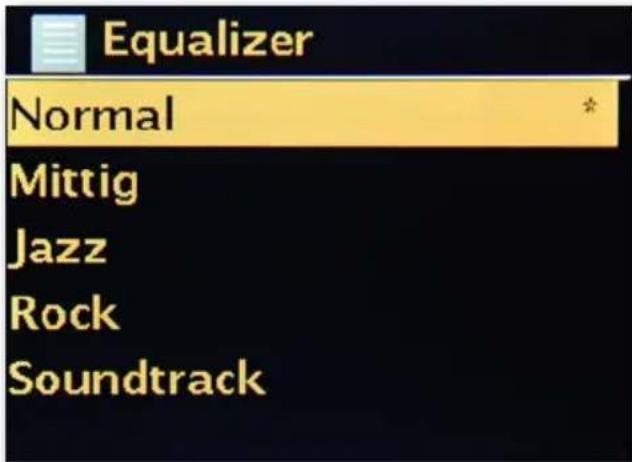
normale, medio, jazz, rock, soundtrack, classico, pop, news.
16.2. SMALTIMENTO DEL DISPOSITIVO
16.3. SMALTIMENTO DELLE BATTERIE
Access Point (AP/POP)

INHOUD
TELESTAR Service Center,
Am Weiher 14,
56766 Ulmen
e-mail: service@telestar.de
Aantal Verklaring
4. AFBEELDINGEN
5. BELANGRIJKSTE FUNCTIES
5.1. Geluidsvolume
7.1 Netwerkinstellingen
Ter info: van routers, SSID, MAC & IPs
SSID Broadcast (WLAN)
8.14 ALARM
16.2. AFDANKING VAN HET APPARAAT
16.3. AFDANKING VAN BATTERIJEN
Stand: September 2019
All technical data and functions described in this manual reflect the current state at time of printing and may be changed without prior notice.
We are not liable for any misprints or mistakes.
Reproduction and duplications are only permitted with the express permission of TELESTAR-DIGITAL GmbH.
As at: September 2019


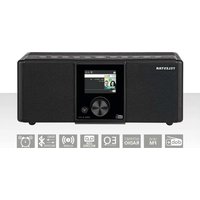

- INHALT
- ANZAHL ERKLÄRUNG
- WICHTIGSTE FUNKTIONEN
- LAUTSTÄRKE
- ZUR INFO: VON ROUTERN, SSID, MAC & IPS
- SSID BROADCAST (WLAN)
- 8.14 ALARM
- ENTSORGUNG VON BATTERIEN
- CONTENT
- E
- PREFACE
- PROPER USE
- SAFETY INFORMATION
- EXPLANATION OF SYMBOLS
- WARNING
- RISK OF INJURY
- RISK OF CHOKING
- OPERATIONAL SAFETY
- DANGER
- THERE IS A RISK OF INJURING ONESELF THROUGH ELECTROCUTION ON THE LIVE PARTS
- CONNECTING THE DEVICE
- PROTECTING THE DEVICE AGAINST DAMAGE
- NOTE
- NOTES ON THE RADIO INTERFACE
- HANDLING BATTERIES
- WARNUNG
- CLEANING THE DEVICE
- LEGAL INFORMATION
- SCOPE OF DELIVERY
- AMOUNT EXPLANATION
- IMAGE
- REMOTE CONTROL
- EJECT BUTTON
- SELECT PREVIOUS TRACK/ QUICK REWIND
- PLAY/PAUSE
- STANDBY BUTTON
- SELECT NEXT TRACK/ FAST FORWARD
- STOP
- ALARM CLOCK 1
- ALARM CLOCK 2
- SLEEP
- SNOOZE
- EQ EQUALISER FUNCTION
- SCAN
- INTRO
- INFO
- BACK
- NAVIGATION UPWARDS
- MODE
- 18.0K
- NAVIGATION/ INCREASE VOLUME
- NAVIGATION/ DECREASE VOLUME
- NAVIGATION DOWNWARDS
- SHUFFLE
- MENU
- MUTE
- KEY FUNCTIONS
- VOLUME
- SWITCHING MODES
- MENU OPERATION
- MUTE THE DEVICE
- WHAT DO YOU NEED
- FIRST START-UP
- 7.1 NETWORK SETTINGS
- FURTHER INFORMATION: ABOUT ROUTERS, SSID, MAC & IPS
- CHANGING OPTIONS ON THE ROUTER
- SSID BROADCAST (WIFI)
- STATIC IP
- THE NETWORK SETUP WIZARD
- WIFI CONNECTION
- SETTING UP THE WIRELESS CONNECTION ON THE RADIO
- MANUALLY SETTING UP THE WIRELESS CONNECTION ON THE RADIO
- 7.1.6.WPS
- STATUS BAR
- ANZEIGE
- 8.2 LIST VIEW
- 8.4 RECEIVING DAB/DAB+ STATIONS
- SCAN / FULL SCAN
- STATION LIST
- CLEANING THE STATION LIST / INVALID RESET
- STATION ORDER
- DRC
- STORE DAB/DAB
- SELECTING SAVED STATIONS
- ADJUST STATION ORDER
- 8.5 RECEIVING FM STATIONS
- SCAN SETTINGS
- AUDIO SETTINGS
- MANUAL STATION SEARCH
- RECEIVING TIME INFORMATION VIA DAB, FM OR INTERNET
- 8.6 RECEIVE INTERNET RADIO
- INTERNET RADIO STATION SELECTION
- OPEN INTERNET RADIO FAVOURITES
- ADDING A NEW INTERNET RADIO URL
- 8.7 PODCAST & RADIO-ON-DEMAND
- 8.8 DIGITAL MEDIA PLAYER [PLAYBACK FROM UPNP SERVER]
- 8.9 FAVOURITES
- 8.10 PODCASTS
- 8.11 HISTORY
- 8.12 MUSIC PLAYER [UPNP]
- 8.13 SLEEP TIMER / SNOOZE
- GENERAL INFORMATION ABOUT CDS/MP3 CDS
- PLAY A CD
- 8.15.3 SET A TRACK
- 8.15.4 QUICK SCAN
- REPEAT FUNCTION
- SHUFFLE PLAYBACK
- NOTES ON THE CD
- 9.0 SETTINGS
- EQUALIZER
- INTERNET SETTINGS
- NETWORK ASSISTANT
- PBC WIFI SETUP
- DISPLAY SETTINGS
- WIFI REGION
- MANUAL SETTINGS
- NETREMOTE PIN SETUP
- REMOVE NETWORK PROFILES
- MAINTAIN THE NETWORK CONNECTION
- TIME / DATE SETTINGS
- SET THE FORMAT
- SLEEP TIMER
- LANGUAGE
- FACTORY SETTINGS
- DEVICE INFORMATION
- BACKLIGHT TIMEOUT (SEC)
- OPERATING STATE
- STANDBY STATE
- BLUETOOTH
- 10.1 ESTABLISH A BLUETOOTH CONNECTION
- 10.2 PLAYING MEDIA VIA BLUETOOTH
- AUDIO INPUT
- USING THE APP UNDOK
- TROUBLESHOOTING
- STORAGE
- BRAND INFORMATION
- 16.DISPOSAL
- DISPOSING OF THE PACKAGING
- DEVICE DISPOSAL
- DISPOSING OF THE BATTERIES
- TECHNICAL DATA
- SERVICE AND SUPPORT
- DHCP
- IEEE 802.11 B/G
- IP (IP ADDRESS) — (INTERNET PROTOCOL)
- LAN
- MAC ADDRESS
- SSID (ESSID)
- UPNP
- WEP ENCRYPTION
- WPA ENCRYPTION
- WIFI
- IMPERIAL®
- CONTENU
- FONCTIONS PRINCIPALES
- VOLUME SONORE
- SSID BROADCAST (W-LAN)
- 8.14 ALARME
- MISE AU REBUT DE L'APPAREIL
- ÉLIMINATION DES PILES
- INDICE
- NUMERO DESCRIZIONE
- FUNZIONI IMPORTANTI
- 8.14 SVEGLIA
- SMALTIMENTO DEL DISPOSITIVO
- SMALTIMENTO DELLE BATTERIE
- ACCESS POINT (AP/POP)
- INHOUD
- AANTAL VERKLARING
- AFBEELDINGEN
- BELANGRIJKSTE FUNCTIES
- GELUIDSVOLUME
- 7.1 NETWERKINSTELLINGEN
- TER INFO: VAN ROUTERS, SSID, MAC & IPS
- AFDANKING VAN HET APPARAAT
- AFDANKING VAN BATTERIJEN
Brand : Telestar
Model : DABMAN i300 CD
Category : Hi-Fi System