OD5007 - Color sensor IFM - Free user manual and instructions
Find the device manual for free OD5007 IFM in PDF.


| Product type | Color sensor |
| Brand | IFM |
| Model | OD5007 |
| Detection principle | Direct reflection or reflex (with reflector) |
| Range | Up to 12.5 mm (moving object); up to 200 mm (with reflector) |
| Light source | Red LED |
| Number of switching outputs | 1 or 3 (depending on version) |
| Supply voltage | 12…30 V DC |
| Power consumption | < 50 mA |
| Response time | < 0.2 ms |
| Tolerance setting | 5 positions (1 = narrow, 3 = standard, 5 = wide) |
| Programming | Teach button + channel selector (Out1/2/3) |
| Synchronization input (AT) | 12...Vmax to disable, ≤2 V or unconnected to enable |
| External programming input (ET) | 12...Vmax for programming, ≤2 V or unconnected for RUN mode |
| Indicators | Function LED (Out/OK) and red light spot LED |
| Housing material | Plastic (ABS) |
| Dimensions (L x W x H) | 50 x 50 x 20 mm (approximate) |
| Weight | Approx. 50 g |
| Operating temperature | -25...+60 °C |
| Protection rating | IP67 |
| Cleaning | Clean with a soft, dry cloth; avoid solvents |
| Repairability | Spare parts not available; sealed device, replace if defective |
Frequently Asked Questions - OD5007 IFM
User questions about OD5007 IFM
0 question about this device. Answer the ones you know or ask your own.
Ask a new question about this device
Download the instructions for your Color sensor in PDF format for free! Find your manual OD5007 - IFM and take your electronic device back in hand. On this page are published all the documents necessary for the use of your device. OD5007 by IFM.
USER MANUAL OD5007 IFM
Functions and features
The colour sensor detects coloured objects and materials without contact in diffuse-reflection or retro-reflective mode.
Mounting
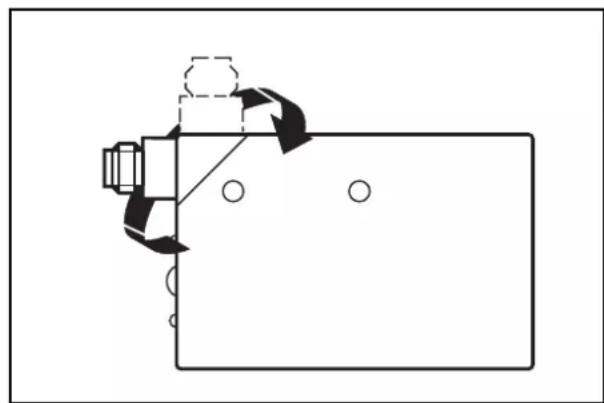
Mount the colour sensor in such a way that the object to be detected makes as little lateral and vertical movement as possible. Consider the specified sensing range. Transparent objects can be better detected by means of a suitable reflector. Mount the reflector opposite the colour sensor so that the light beam strikes the centre of the reflector.
In the case of moving objects the direction of movement should be transverse to the sensor to achieve optimum repeatability (this only applies to sensors with a sensing range of 12.5mm ).
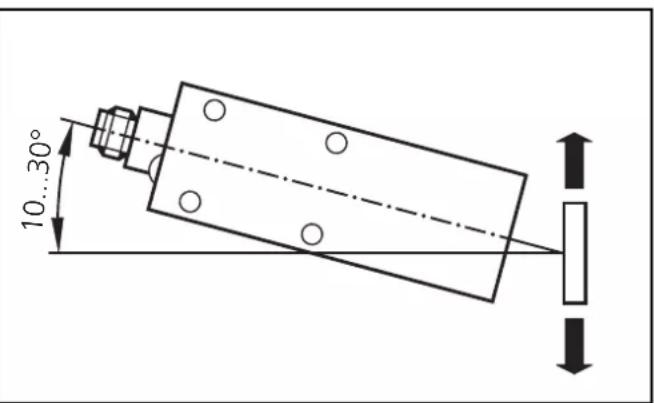
In the case of shiny object surfaces the sensor should be mounted at an angle of inclination of 10 ... 30^ referred to the object.
Electrical connection

Disconnect power and connect the sensor as indicated on the type label.
The input AT (activation trigger = synchronising signal) can be used for triggering the sensor via an external voltage signal.
Sensor deactivated: 12V < AT < U Vmax Sensor activated: AT ≤ 2 V or unused Response time: < 0.2 ms
The input ET (External Teach) can be used for programming the reference colour for the output out1 via an external voltage signal.
Activate teach-in: 12V < ET < U Vmax RUN mode: ET ≤ 2 V or unused Pulse duration: 0.5ms
Controls and indicators
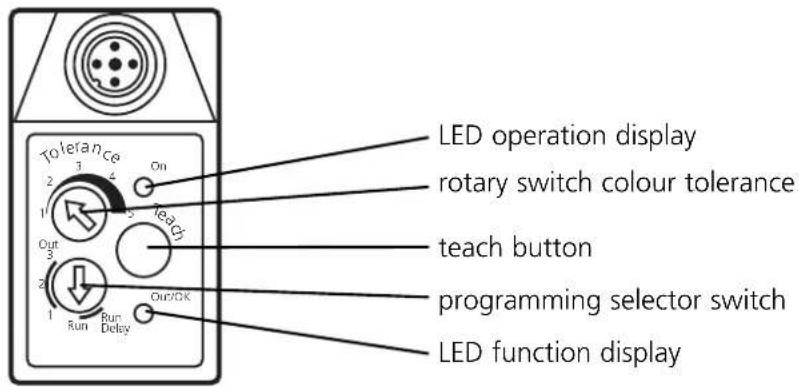
Setting and programming
1
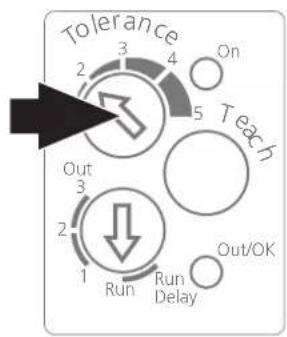
Set the rotary switch colour tolerance (Tolerance) to the requested colour resolution.
1 = small tolerance range for detecting small colour shades
3 = basic setting
5 = large tolerance range for detecting colour families or colour groups
2
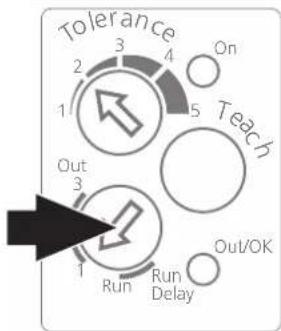
Set the programming selector switch to the colour channel to be adjusted (switching output Out1, Out2 or Out3).
For units with only one switching output set the programming selector switch to Out1.
3
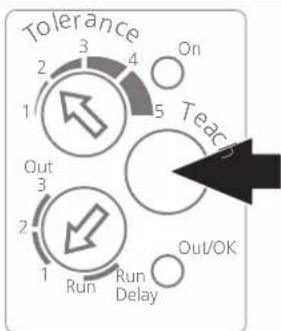
Press the Teach button.
A red light spot shows on the object.
Release the Teach button, the light spot disappears.
| 4 | Tolerance 1/2 3/4 Teach Out 1 Run Delay | After a successful teach-in operation the function display (Out/OK) comes on. If it flashes, the intensity is too high. Incline the sensor by 10 ... 30° and repeat the teach-in operation. If the function display is not lit, the intensity is too low. Select a lighter mark. Only for retro-reflective mode If the function display flashes, increase the distance sensor/object or sensor/reflector or use a smaller reflector. If the function display is not lit, reduce the distance sensor/object or sensor/reflector or use a larger reflector. |
| 5 | Tolerance 1 2 3 4 Teach 1 Run Out Delay | Set the programming selector switch to Run or Run Delay (20 ms switch-off delay). For sensors with several switching outputs repeat the programming for the other switching outputs accordingly. The colour tolerance can be individually determined for each switching output. The sensor is ready for operation. If the switching output is activated, the function display is lit (Out/OK). If the tolerance setting is to be changed subsequently, programming must be made again with the tolerance setting changed. |
Brand : IFM
Model : OD5007
Category : Color sensor