
150144 - Sandblaster Westfalia - Free user manual and instructions
Find the device manual for free 150144 Westfalia in PDF.



| Product type | Pneumatic sandblasting gun |
| Brand | Westfalia |
| Model | 150144 |
| Maximum working pressure | 8 bars |
| Supply | Compressed air (1/4" quick coupling) |
| Use | Private (domestic) |
| Body material | Aluminum alloy or steel |
| Dimensions (L x W x H) | Approximately 20 x 10 x 5 cm |
| Weight | Approximately 0.5 kg |
| Nozzle diameter | 6 mm (estimated) |
| Main functions | Sandblasting, stripping metal, wood, stone surfaces |
| Abrasive feeding system | External suction (requires a tank or vacuum cleaner) |
| Maintenance and cleaning | Clean after each use, check seals and nozzle |
| Safety | Wear safety goggles, gloves, helmet and hearing protection; do not point at people or animals; do not use near flames |
| Spare parts | Nozzles, seals, handle (original accessories recommended) |
| Repairability | Contact Westfalia customer service for any repair |
| General information | User manual available in multiple languages, free download at notice-facile.com |
Frequently Asked Questions - 150144 Westfalia
User questions about 150144 Westfalia
0 question about this device. Answer the ones you know or ask your own.
Ask a new question about this device
Download the instructions for your Sandblaster in PDF format for free! Find your manual 150144 - Westfalia and take your electronic device back in hand. On this page are published all the documents necessary for the use of your device. 150144 by Westfalia.
USER MANUAL 150144 Westfalia
natural_image
Blue Westfalia® welding torch with black handle and gold end cap (no text or symbols on the tool itself)
Original Instructions
Air Sand Blaster
Article No. 15 01 44


natural_image
Illustration of a person in camouflage gear digging with a shovel, surrounded by water and vegetation (no text or symbols)
Dear Customer
Instruction manuals provide valuable hints for using your new device. They enable you to use all functions, and they help you avoid misunderstandings and prevent damage.
Please take the time to read this manual carefully and keep it for future reference.
text_image
Westfalia® 1 2 ON OFF 3 4 5 6 7 8 9


Intended Use...... Page 9
Before first Use ...... Page 9
Start-up Page 9
Air Pressure and Air Volume...... Page 10
Maintenance, Lubrication and Care ...... Page 11
Storing...... Page 11
Technical Data Page 12

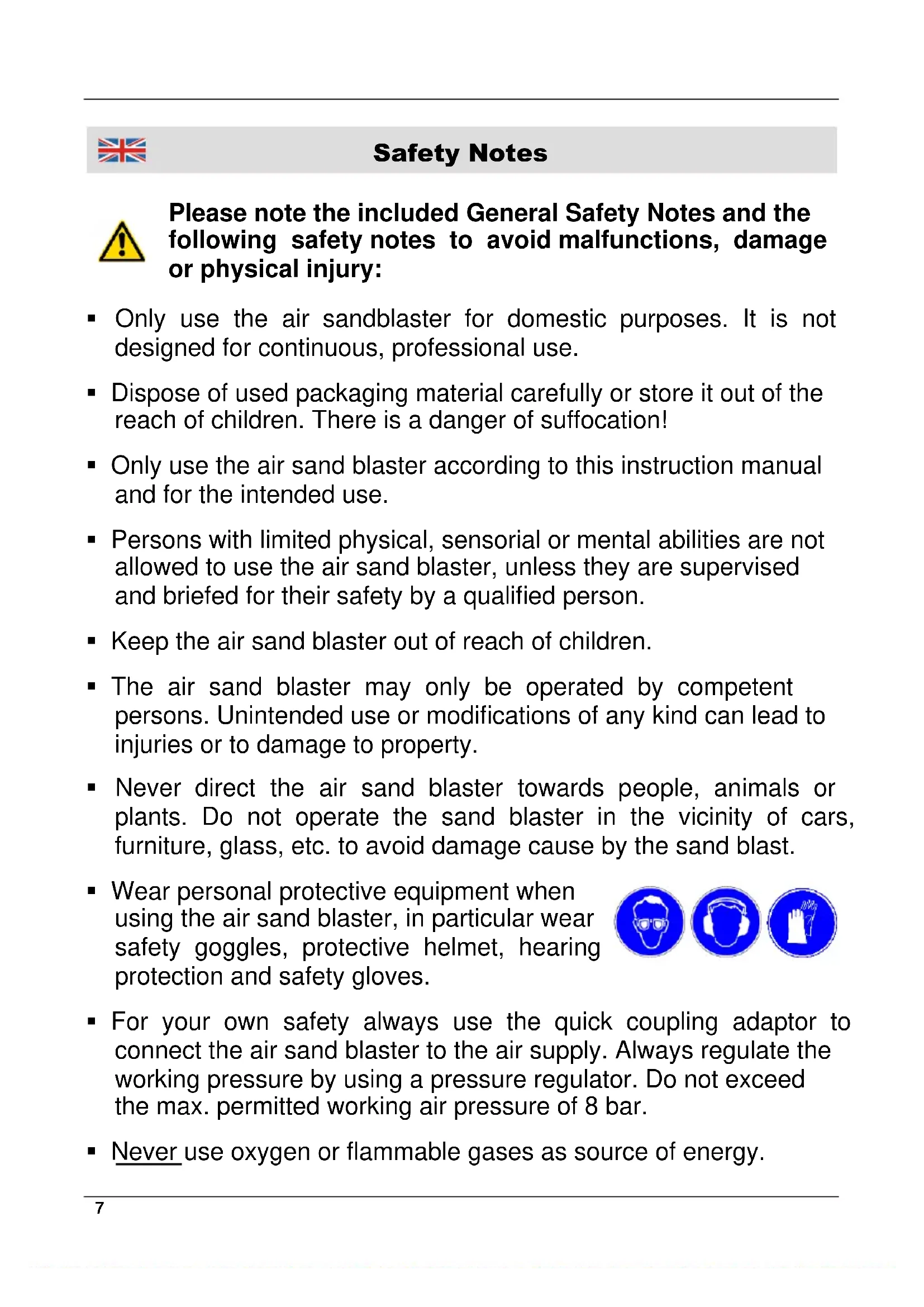
Please note the included General Safety Notes and the following safety notes to avoid malfunctions, damage or physical injury:
- Only use the air sandblaster for domestic purposes. It is not designed for continuous, professional use.
- Dispose of used packaging material carefully or store it out of the reach of children. There is a danger of suffocation!
- Only use the air sand blaster according to this instruction manual and for the intended use.
- Persons with limited physical, sensorial or mental abilities are not allowed to use the air sand blaster, unless they are supervised and briefed for their safety by a qualified person.
- Keep the air sand blaster out of reach of children.
- The air sand blaster may only be operated by competent persons. Unintended use or modifications of any kind can lead to injuries or to damage to property.
- Never direct the air sand blaster towards people, animals or plants. Do not operate the sand blaster in the vicinity of cars, furniture, glass, etc. to avoid damage cause by the sand blast.
- Wear personal protective equipment when using the air sand blaster, in particular wear safety goggles, protective helmet, hearing protection and safety gloves.
- For your own safety always use the quick coupling adaptor to connect the air sand blaster to the air supply. Always regulate the working pressure by using a pressure regulator. Do not exceed the max. permitted working air pressure of 8 bar.
- Never use oxygen or flammable gases as source of energy.

natural_image
Three blue circular icons with white safety symbols: a person wearing glasses, a helmet with headphones, and a hand holding a tool (no text or numbers present)
Safety Notes
- Check if all connections and hoses are mechanically secured and if they are functioning properly. Loose hoses may cause severe injuries.
- Disconnect the air sand blaster from the compressed air source before doing any maintenance work or when not in use.
- Do not modify the air sand blaster in any way and do not use it for any unintended use. Only use original accessory. Not recommended accessory can bear a risk of danger.
- Never carry the unit with the hose. Carry it with the housing.
- Keep the handle dry and free from oil or grease.
- Do not use the air sand blaster near flammable liquids, gases or dust. Sparks may ignite the dust or fumes.
- Stay alert! Watch what you are doing. Use common sense.
- Do not use the air sand blaster any further in case of damage. Do not open the unit and do not try to repair them yourself. In case of questions or problems contact a professional or our customer service.
Intended Use
- The air sand blaster is a tool driven by compressed air. It is designed for versatile use. The air sand blaster is suitable for sand-blasting of iron, sheet metal, metal objects, etc.
- The intended use also includes an operation following the operating instructions.
- Any use beyond these parameters (different media, applying force) or any changes (reconstruction, no original accessory) can lead to serious risks and is regarded as use that is contrary to the intended purpose.
Before first Use
Unpack the air sand blaster and the required accessory and check all parts for any damage in transit. Dispose of packaging materials or store them out of reach of children. Plastic bags etc. may become a deadly toy for children.
Start-up
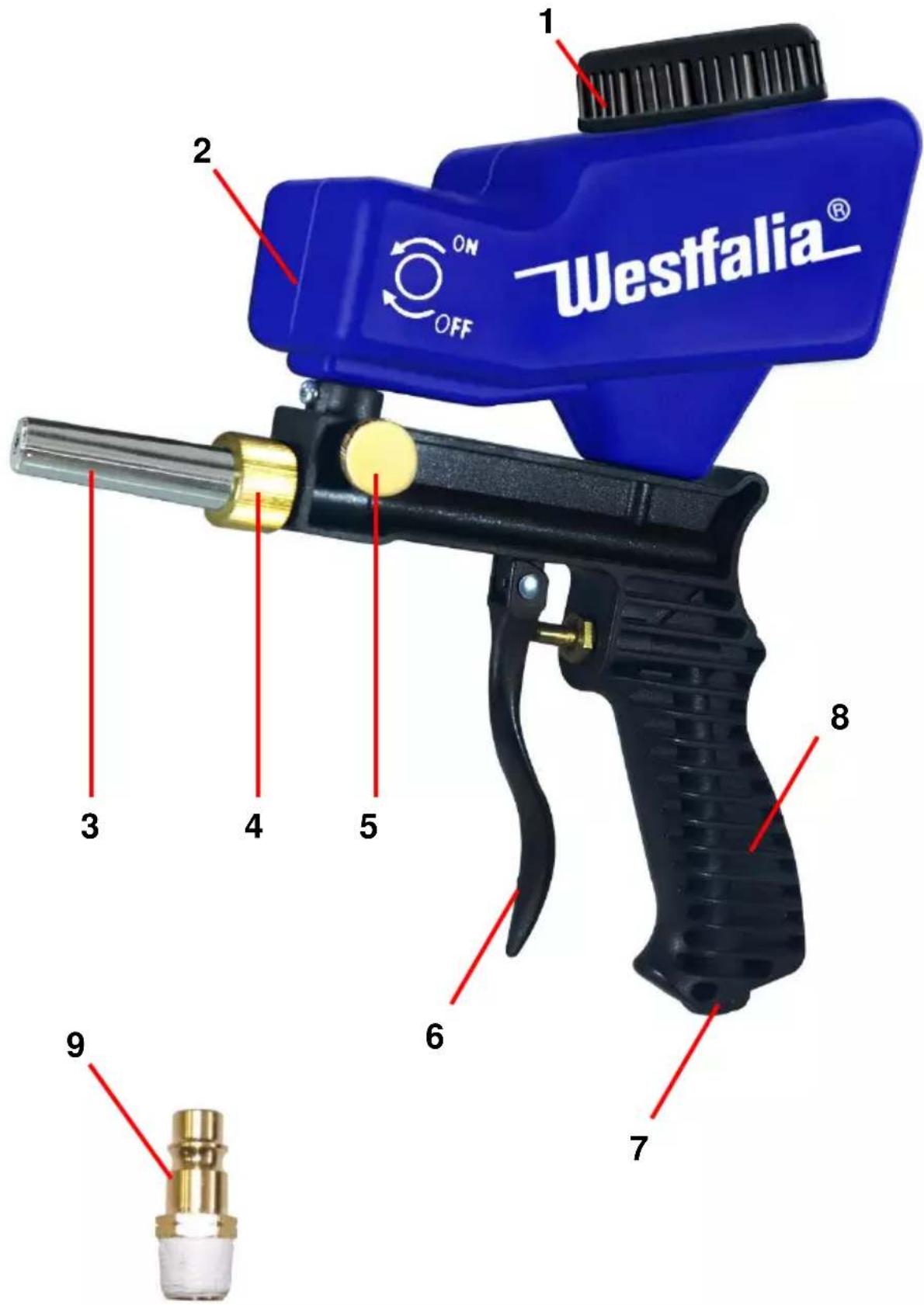
- Turn the regulator (5) clockwise to close it.
- Screw the air quick coupling adaptor (9) on the compressed air connection (7) of the sand blaster.
- Turn the lid (1) counter clockwise and remove it.
- Fill the grinding material container (2) with appropriate grinding material.
- Close the grinding material container with the lid.
- Connect the air hose to the compressed air generator and to the quick coupling adaptor of the air sand blaster. Power up the generator.
- Turn the regulator counter clockwise to open it.
Operation
- Lead the air sand blaster to the workpiece and press the trigger (6) to start the delivery of air and to start-up the sand blaster. The more you press the trigger, the stronger the sand blast will be. If necessary, perform some test runs on an unused workpiece before work.
- Release the trigger to stop the delivery of air and to stop sand blasting.
- Turn the regulator clockwise to close it.
- After use, disconnect the tool from the compressed air generator.
- Then clean the air sand blaster with a moist cloth.
Air Pressure and Air Volume
- Operate the air sand blaster with a pressure of 6 bar using a compressor with an air suction capacity of at least 200 l/min. When using higher pressure for operating the air tool than the max. permitted pressure of 8 bar, its self life will be reduced drastically. The ideal capacity is provided by compressors with a suction capacity of 300 – 400 l/min.
- Only use air hoses with an inner diameter of at least 9 mm. When setting up the air pressure, always keep in mind that the pressure will decrease by approx. 0.6 bar when using a 10 m long hose with an inner diameter of 9 mm.
Maintenance, Lubrication and Care
- To ensure proper functionality and a long lifetime, diligent maintenance is essential.
- For operating pneumatic tools, clean air is required. Corrosion residues, dust and dirt from the pneumatic pipes reduce the efficiency of the tool and will cause technical problems. An upstream maintenance unit consisting of filter and pressure regulator valve removes moisture and dirt from the air and controls the working pressure.
■ After use, clean the air sand blaster with a moist cloth. - Do not use abrasive or aggressive chemicals as benzene or thinner, which may dissolve plastic parts.
- Do not allow liquids to enter the unit and never immerse it into liquids. Water in the compressed air inlet can damage the machine. Therefore it is recommended to drain the air lines and the compressor in regular intervals! Also clean the air filters in regular intervals.
- The air sand blaster requires clean and oil-free air. So do not use an oil-fog lubricator within the air supply system.
- If possible, only use compressed air hoses for the air supply that previously have not been used with other air tools which required an oil-fog lubrication system.
- Lubricate the moving parts of the trigger mechanism and the regulator from time to time.
- Clean the nozzle (3) in regular intervals. To do so, turn the ring nut (4) counter clockwise and pull out the nozzle.
Storing
- Store the air sand blaster in a dry location that is protected from dust and dirt.


* Sound and vibration emissions may differ from the declared values during use depending on the ways in which the tool is used.

natural_image
Three blue circular icons with white safety symbols: a person wearing glasses, a person wearing headphones, and a hand gesture (no text or numbers)
Please help avoid waste materials.
If you at some point intend to dispose of this article, then please keep in mind that many of its components consist of valuable materials, which can be recycled.
Please do not discharge it in the rubbish bin, but check with your local council for recycling facilities in your area.