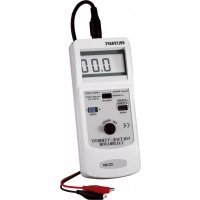
CC421 - Multimeter VOLTCRAFT - Free user manual and instructions
Find the device manual for free CC421 VOLTCRAFT in PDF.


| Product type | Calibration multimeter |
| Brand | Voltcraft |
| Model | CC421 |
| Display | LCD 3 digits, max ±199.9, height 13 mm |
| Dimensions (L x W x H) | 185 x 78 x 38 mm (with fold-out stand, without cables) |
| Weight | Approx. 265 g (with battery, without cables) |
| Power supply | 9 V block battery, type NEDA 1604 6F22 / 006P / 6LR61 |
| Operating temperature | 0 °C to +50 °C, RH < 80 % non-condensing |
| Guaranteed accuracy temperature | +23 °C ±5 K |
| Main functions | DC current source (0-19.99 mA / 24 mA), DC voltage source (-199.9 mV to +199.9 mV), DC current measurement (up to 24 mA), 2-wire loop current measurement |
| Current ranges (source/measure) | 19.99 mA (0.01 mA resolution) or 24.0 mA (0.1 mA resolution) |
| Voltage range (source) | -199.9 mV to +199.9 mV, resolution 0.1 mV |
| Voltage source accuracy | ±(0.25% + 1 digit) |
| Current source accuracy | ±(0.25% + 1 digit) for 19.99 mA, ±(0.50% + 1 digit) for 24.0 mA |
| Current measurement accuracy | ±(0.25% + 1 digit) for 19.99 mA, ±(0.50% + 1 digit) for 24.0 mA |
| Max load impedance (current source) | 500 Ohm for 0-19.99 mA, 400 Ohm for 20-24 mA |
| 2-wire loop supply | 12 VDC ±2 V |
| Safety | Compliant with EN 61010-1; short-circuit protection; max measurable voltage 35 VDC |
| Maintenance and cleaning | Soft, lint-free, antistatic cloth; do not use products containing carbon, gasoline, or alcohol |
| Battery replacement | Yes, battery compartment with screw; 9 V battery |
| Recommended calibration | Once a year |
Frequently Asked Questions - CC421 VOLTCRAFT
User questions about CC421 VOLTCRAFT
0 question about this device. Answer the ones you know or ask your own.
Ask a new question about this device
Download the instructions for your Multimeter in PDF format for free! Find your manual CC421 - VOLTCRAFT and take your electronic device back in hand. On this page are published all the documents necessary for the use of your device. CC421 by VOLTCRAFT.
USER MANUAL CC421 VOLTCRAFT
© Copyright 2008 by Voltcraft®
GB Impressum /legal notice in our operating instructions
These operating instructions are a publication by Voltcraft®, Lindenweg 15, D-92242 Hirschau/Germany, Phone +49 180/586 582 7 (www.voltcraft.de).
All rights including translation reserved. Reproduction by any method, e.g. photocopy, microfilming, or the capture in electronic data processing systems require the prior written approval by the editor. Reprinting, also in part, is prohibited.
These operating instructions represent the technical status at the time of printing. Changes in technology and equipment reserved.
© Copyright 2008 by Voltcraft®
© Copyright 2008 by Voltcraft®
© Copyright 2008 by Voltcraft®
01_1208_02/HK
GB This operating manual belongs to this product. It contains important information on the commissioning and handling of the device. Please bear this in mind; also when passing this product on to other people.
Therefore, please keep this operating manual for future reference!
The table of contents on page 23 gives an overview of the topics of this operating manual with the page numbers indicated.
By purchasing the Current Calibrator CC - 421 you have acquired a high-precision calibration tool for you measurement device(s) designed according to the state of the art. The current source can supply up to 24 mA max. at 400 ohm. DC current measurement up to 24 mADC and loop current measurements also up to 24 mADC can be performed with the 2-conductor loop being supplied with 12 VDC from the device. The current calibrator can also be applied as DC voltage source from -199.9 to +199.9 mVDC.
The current calibrator was designed according to EN 610610 – 1 (= DIN VDE 0411 / Part 1). The measurement device is EMC-tested and thus corresponds to the requirements of the relevant national and European guidelines. Conformity has been proved; the relevant documents are in the possession of the manufacturer.
To preserve this condition and to enable safe operation, you as the user must observe these operating instructions!
For a fast response of your technical enquiries please contact or consult our Technical Advisory Service:
Germany: Tel. + 49 9604 / 40 88 80
Fax + 49 9604 / 40 88 48
E-mail: tkb@conrad.de
Mon to Thurs 8.00am to 4.30pm
Fri 8.00am to 2.00pm
Proper use
- Operates as DC source up to 19.99 mA max. at 500 ohm or 24 mA max. at 400 ohm.
- Measuring DC currents up to 24 mA max.
- Measuring 2-conductor loop currents up to 24 mA max. at a loop voltage of 12 VDC (±2VDC) from the current calibrator.
- Performing measurements under unfavourable ambient conditions is not permissible. Unfavourable ambient conditions are:
- Moisture or excessive air humidity
- Dust and combustible gases, fumes or solvents
- Thunderstorms or similar conditions such as strong electrostatic fields etc.
A use other than the one described above is not permissible and causes damages to the measuring device(s). Furthermore, it involves hazards such as short-circuit, fire, electric shock, etc.! The entire product must not be changed or modified! The safety instructions must be adhered to!
Controls
Illustration (fold-out page)
- LC-display (liquid crystal display), 3 1/2-digit up to 199.9 max.
- Sliding switch for adjusting the functions mA-MEASURE (mA current measurement)– Power/mA-MEASURE (mA-loop current measurement) – CURRENT SOURCE – VOLTAGE SOURCE
- Sliding switch "POWER" for "O" (= device off) and "I" (= device on)
- Sliding switch for adjusting the current range and thus the (digit-)resolution
-
Adjusting knob (helipot) for adjusting the output current at the current source or the output voltage at the voltage source.
-
Battery cover
- Input / output of the current calibrator
- Four-pole plug of the connecting cable.
- So-called alligator clips red (+) and black (-) of the connecting cable
Table of contents
Introduction 21
Proper use 22
Controls (fold-out page). 22
Table of contents. 23
Safety instructions....23
Handling, commissioning 26
Disposal....33
Troubleshooting....33
Technical data, measurement tolerances ..... 34
Safety instructions

The guarantee claim becomes invalid for damages due to non-observance of these operating instructions! We do not assume liability for consequential damages!
We do not assume liability for property damages or personal injuries caused by improper use or non-observance of the safety instructions. In all such cases guarantee claims become invalid.
- The device is designed pursuant to VDE 0411 Part 1 = EN and IEC 61010-1, protective measures for electronic measuring devices and has left the factory in compliance with all relevant safety regulations. To preserve this state and to guarantee safe operation, the user must observe the safety instructions and warnings contained in this operating manual.
- Current measurements are only permissible in electric circuits fused by 25 mA and in which no voltages greater than 35 VDC occur.
- The measurement device must not be used in installations of the overvoltage category III according to IEC 664. The measuring device and the connecting cable are not protected against arc explosions (IEC 1010-2-031, section 13.101).
- Measurement devices and their accessories must be kept out of reach of children!
- In industrial facilities, the safety regulations laid down by the professional trade association for electrical equipment and facilities must be observed.
- In schools, training facilities, do-it-yourself and hobby workshops, test devices and accessories are to be used only under supervision of trained personnel.
- Use extreme caution when measuring voltages >25 V for AC and >35 V for DC voltages! These voltages might already cause a lethal electric shock when touching electric leads.
- Before changing the test range, disconnect the test probes and the adapter from the object under test.
- Before performing a measurement, check your measuring device, test leads and adapter for damage(s).
- Do not operate the device in premises or under unfavourable ambient conditions, where combustible gases, fumes or dust exist or are likely to exist. For your own safety, you must prevent the measuring device, the test leads and the adapter from becoming damp or wet. Do not operate the device in the direct vicinity of:
a) strong magnetic fields (speakers, magnets)
b) electromagnetic fields (transformers, motors, coils, contactors, electromagnets, etc.)
c) electrostatic fields (charge/discharge)
d) transmitting antennas or high-frequency generators
These influences might cause incorrect measured values.
- Only use the test leads supplied with your measuring device when performing measurements. Only these are permissible.
- If there is reason to believe that safe operation has become impossible, the device must be put out of operation and must be secured against unintended operation. It can be assumed that safe operation is no longer possible,
- if the device shows visible damages
- if the device no longer works
- after prolonged storage under unfavourable conditions, or
- after it was exposed to extraordinary stress caused by transport.
- Never turn on the device immediately after it has been brought from a cold into a warm room. Condensation water that forms might destroy your device. Leave the device switched off and wait until it has reached room temperature.
Handling Commissioning
The current calibrator can be operated by only three sliding switches and a helipot. By using the switches, the current range is adapted, the function set and the device is switched on and off. Via the potentiometer the current value of the current source is adjusted or the voltage value of the voltage source.
A "FUNCTION"
- If the switch is set to "mA MEASURE", the current calibrator is applied as mA meter. DC currents up to 20 (19.99) mA with two decimal positions and up to 24 (24.0) mA with one decimal position can be measured and indicated.
- If the switch is set to "Power/mA MEASURE", loop current measurements of two-conductor loops with their own supply can be performed. Here, the current calibrator supplies a DC voltage of 12 V and determines the current in the loop up to 24.0 mA max.
- If the switch is set to "CURRENT SOURCE", the current calibrator serves as current source in order to calibrate other measuring devices connected in the mA test range.
- If the switch is set to "VOLTAGE SOURCE", the current calibrator is used as voltage source. The device supplies then an adjustable DC current in the range of -199.9mV up to +199.9mV . Thus it enables the calibration of mV ranges (see panel meter).
B "RANGE"
This switch changes the current range of the current source or the test range for DC current measurements. Two ranges are available: up to 19.99 mA (two decimal positions) and up to 24 mA (one decimal position).
C "POWER"
This switch turns the current calibrator on and off. After a short initialization period, the device is ready for use.
D "CAL. ADJUST"
Via this helipot, the output current for use as current source and the output voltage for use as voltage source can be adjusted. Turning the adjusting knob to the right, increases the output values. A turn to the left effects a decrease of the output values.
Performing measurements, operation as "source"
mA DC measurements
To measure low direct currents up to 24 mADC max. proceed as follows:
a) Connect the connecting cable (flat side of the plug housing down) with the current calibrator which is turned off. Make sure that the connection is tightly made.
b) Set the "FUNCTION" switch to "mA MEASURE" (leftmost position)
c) Set the "RANGE" switch to the right position for two decimal positions up to 19.99 mA max. or to the left position for one decimal position and 24mA max.
d) Set the "POWER" switch to "I" to turn the current calibrator on. Following a very short initialization period, the measuring device is ready to operate.
e) Connect the alligator clips of the connecting cable in series to the object under test (see below illustration).
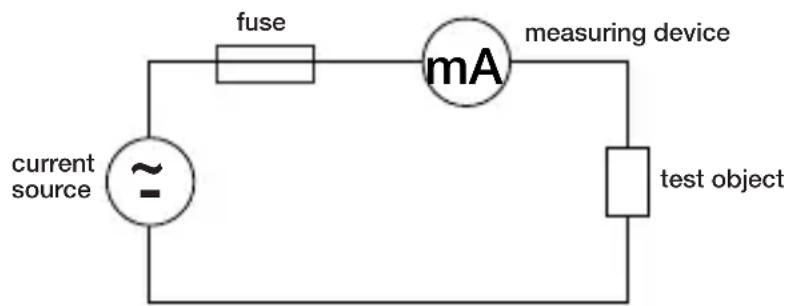

Caution!
If during DC measurements a "-" sign appears before the measured value, the measured current is negative (or the test leads are interchanged). Do not measure currents in electric circuits where voltages greater than 35 VDC might occur as otherwise your life might be seriously endangered under unfavourable circumstances. Never measure currents greater than 24 mA. Only measure currents smaller than or equal to 24 mA in electric circuits fused by 25 mA, quick acting.
mA loop current measurement
To measure loop currents in 2-conductor loops up to 24mADC max. proceed as follows:
a) Connect the connecting cable (flat side of the plug housing down) with the current calibrator which is turned off. Make sure that the connection is tightly made.
b) Set the "FUNCTION" switch to "Power / mA MEASURE".
c) Set the "RANGE" switch to the right position for two decimal positions up to 19.99 ~mA max. or to the left position for one decimal position and 24 ~mA max.
d) Open the 2-conductor loop to be measured (see also illustration) and connect the alligator clips ("+" = red, "-" = black) of the connecting cable in series to the object under test. The measurement voltage for supplying the loop is generated by the current calibrator (12 VDC).
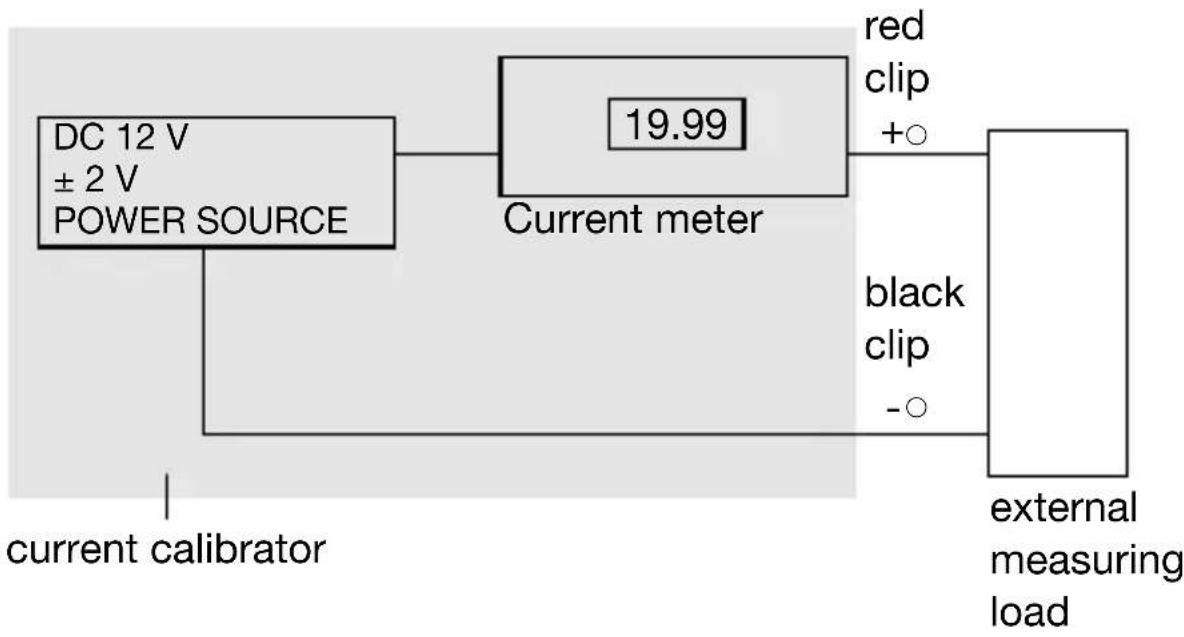
flowchart
graph LR
    A["DC 12 V<br>±2 V<br>POWER SOURCE"] --> B["Current meter"]
    B --> C["red clip +○"]
    B --> D["black clip -○"]
    B --> E["external measuring load"]
    F["current calibrator"] --> A
    B --> G["19.99"]
e) Set the "POWER" switch to "I" to turn the current calibrator on. Following a very short initialization period, the measuring device is ready to operate.

Caution!
If during DC measurements a "-" sign appears before the measured value, the measured current is negative (or the test leads are interchanged). Do not measure currents in electric circuits where voltages greater than 35 VDC might occur as otherwise your life might be seriously endangered. Never measure currents greater than 24 mA. Only measure currents smaller than or equal to 24 mA in electric circuits fused by 25 mA, quick acting.
Power source
The most important function of the current calibrator is to align (calibrate) a connected multimeter in its mA test range by means of a high-accuracy measurement current that can be adjusted. For this purpose, proceed as follows:
a) Connect the connecting cable (flat side of the plug housing down) with the current calibrator which is turned off. Make sure that the connection is tightly made.
b) Set the "FUNCTION" switch to "CURRENT SOURCE" and the helipot "CAL.ADJUST" to the leftmost position.
c) Set the "RANGE" switch to the right position for two decimal positions up to 19.99 mA max. or to the left position for one decimal position and 24mA max.
d) Set the "POWER" switch to "I" to turn the current calibrator on. Following a very short initialization period, the measuring device is ready to operate.
e) Connect the alligator clips of the connecting cable to the test leads of the multimeter to be calibrated (turned off) and set it to mADC measurement.

Caution
The test leads of the multimeter to be calibrated must be connected to the multimeter's current measurement input (observe "+" and "-").
f) A current flow is now indicated on the current calibrator because the electric circuit is now closed via the connected measuring device or rather via its shunt (if fuse ok). Adjust the desired calibration current by turning the CAL-ADJUST knob to the right, e.g. to 19 mA. The value reading is now applied at the output of the current calibrator.
g) Turn the connected multimeter on and align it, if necessary.
Voltage source
A further special feature of this current calibrator is its capability of being applied as high-precision adjustable voltage source. For
example, the so-called (digital) panel meters with a maximum input voltage of "+" or "-" 199.9 mV can thus be calibrated relatively easily. Proceed as follows:
a) Connect the connecting cable (flat side of the plug housing down) with the current calibrator which is turned off. Make sure that the connection is tightly made.
b) Set the "FUNCTION" switch to "VOLTAGE SOURCE" and the helipot "CAL.ADJUST" to the leftmost position.
c) Set the "POWER" switch to "I" to turn the current calibrator on. Following a very short initialization period, the measuring device is ready to operate.
d) A negative ("-") or positive (+") voltage is now indicated by the current calibrator. Set the desired output voltage by turning the CAL-ADJUST knob to the right, e.g. to 100.0 V. The value reading is now applied at the output of the current calibrator.
e) Connect the alligator clips of the connecting cable either to a panel meter (digital measurement components) or to the test probes of a multimeter (turned off) to be calibrated and set the multi-meter to mVDC measurement.
f) Turn on the multimeter to be calibrated.
Maintenance, battery replacement, setting up the calibrator
a General
To ensure the accuracy of the Current Calibrator CC – 142 for a long time, it should be re-calibrated once a year. The battery and fuse
replacement is described below. To clean the device, the display window, and the test leads, use a clean, lint-free, antistatic and dry cloth.

Caution!
Do not use carbon-containing cleaning agents, benzines, alcohols or the likes as they attack the surface of the measurement device. Furthermore, the fumes are detrimental to the health and explosive. Do not use sharp tools, screwdrivers, metal brushes, etc. for cleaning.
b Battery replacement
A 9-V block battery is required for operating the current calibrator. If the low-battery indicator "BAT" appears a few hours before the battery is empty (from approx. 7.5 V), the battery needs to be replaced. For this purpose, proceed as follows:
- Disconnect the measuring device from the test circuit,
- disconnect the test leads from the measuring device,
- turn it off and
- loosen the screw of the battery cover by using an appropriated screwdriver (for recessed-head screws).
- Lift the battery cover. The battery compartment is now open.
- Put on throw-away gloves, remove the old battery and disconnect it from the connecting clip.
- Replace it by a new, fresh battery, attach it to the connecting clip (observe correct polarity).
- After the battery replacement/installation, close the battery compartment carefully. Make sure that the cables of the connecting clip are not jammed.

Caution!
Do not operate the current calibrator when it is open. Do not leave empty batteries in the measurement device. Even leak-proof batteries may corrode and set free chemicals that are hazardous to your health or destroy the battery compartment.
Empty batteries are to be considered as special waste and, therefore, must be disposed of in an ecologically sound manner. For this purpose, special collecting boxes are provided at specialist retail shops and also in several supermarkets or recycling collection centers.
c Setting up the measuring device (oblique position)
On its rear side the measuring device features a handle which can be swung out to support the device at an easy-to-read angle.
Disposal
If, despite correct power supply (9-V block battery) the Current Calibrator CC – 421 does not work anymore or is irreparable, it must be disposed of according to the relevant statutory regulations.
Troubleshooting
The Current Calibrator CC - 421 is a state-of-the-art measurement device of the latest generation. However, problems or faults may occur. Therefore, we present strategies in the following how to eliminate some of the problems relatively easily; you must observe the safety instructions!
| Problem Possible solution | |
| No measurement possible Are the test leads connected tightly to the measurement jacks? | |
| No display when device is Is turned on | the battery empty? |
| No current display Is the current measurement range of the connected measuring device high-resistive or is its fuse defective? | |
Technical data and measurement tolerances
A Technical data
Display. 3 1/2-digit LCD up to ± 199.9 max. (LCD = liquid crystal display), digit height 13 mm
Measurement speed .....: 2.5 measurements per sec
Low-battery indicator .....: BAT below ....VDC ±0,5 V
Battery required.....: 9-V block battery, type: NEDA 1604 6F22 or 006P or 6LR61
Operating temperature .....: 0 °C to +50 °C, rel. air humidity < 80%, non-condensing
Temperature for guaranteed
accuracy .....: +23 °C ±5 K (=Kelvin)
Weight .....: approx. 265 g (with battery, without connecting cable)
Dimensions (W X D X H) .....: 185 x 78 x 38 mm (Handle swung in, without test leads)
B Measurement tolerances
Accuracy indicated in ±(% related to the final range value + number of digits = dgt(s) ) Accuracy is valid for 1 year at a temperature of +23 °C ±5 K, at a rel. air humidity below 80 %, non-condensing.
Operational Range Accuracy Resolution mode, DC -199.9 mV ±(0.25%+1dgt 0.1 mV voltage source to +199.9 mV
The supply impedance of the connected measuring device should not go beyond 1 kohm..
DC current 19.99 mA ±(0.25%+1dgt) 0.01 mA source 24.0 mA ±(0.50%+1dgt) 0.1 mA
Supply impedance up to 500 ohm in the range between 0 and 19.99 mA Supply impedance up to 400 ohm in the range between 20 mA and 24.0 mA
DC current 19.99 mA ±(0.25%+1dgt) 0.01 mA measurements 24.0 mA ±(0.50%+1dgt) 0.1 mA
DC current 19.99 mA ±(0.25%+1dgt) 0.01 mA source, two-24.0 mA ±(0.50%+1dgt) 0.1 mA conductor-loop
Output voltage 12 VDC ±2 V in the loop; measurement of the loop current

Caution!
Exceeding the maximum input ratings or a short-circuit of the source impedance can damage the current calibrator.
F Introduction
Cher client,
- GB Impressum /legal notice in our operating instructions
- Proper use
- Controls
- Table of contents
- Safety instructions
- Handling Commissioning
- A "FUNCTION"
- B "RANGE"
- C "POWER"
- D "CAL. ADJUST"
- Performing measurements, operation as "source"
- mA DC measurements
- Caution!
- mA loop current measurement
- Power source
- Caution
- Voltage source
- Maintenance, battery replacement, setting up the calibrator
- a General
- b Battery replacement
- Disposal
- Troubleshooting
- Technical data and measurement tolerances
- A Technical data
- B Measurement tolerances
- F Introduction
Brand : VOLTCRAFT
Model : CC421
Category : Multimeter