
Cereal And Co RK203 - Rice cooker TEFAL - Free user manual and instructions
Find the device manual for free Cereal And Co RK203 TEFAL in PDF.



| Product type | Rice cooker |
| Brand | Tefal |
| Model | Cereal And Co RK203 |
| Capacity | 10 cups (1.8 L) or 5.5 cups (1 L) depending on version |
| Functions | Rice cooking, steaming, slow cooking, automatic keep warm |
| Included accessories | Measuring cup, rice spoon, steaming basket, condensation collector, spoon rest |
| Inner pot material | Non-stick |
| Inner lid | Removable for cleaning |
| Steam vent | Disassembles into two parts for cleaning |
| Condensation collector | Removable, empty after each use |
| Control panel | Mode selector (rice/steam, slow cook), control switch, cooking and keep warm indicator lights |
| Cleaning the inner pot | Dishwasher safe or hand wash with non-abrasive sponge |
| Cleaning the accessories | Steaming basket, collector, spoon and cup are dishwasher safe |
| Safety | Automatic shut-off after cooking, automatic keep warm, lid locking |
| Inner pot maintenance | Use plastic or wooden utensils, do not cut food in the pot, avoid vinegar |
| Precautions | Do not touch the hot plate when plugged in, do not open lid during cooking, use only the provided inner pot |
Frequently Asked Questions - Cereal And Co RK203 TEFAL
User questions about Cereal And Co RK203 TEFAL
0 question about this device. Answer the ones you know or ask your own.
Ask a new question about this device
Download the instructions for your Rice cooker in PDF format for free! Find your manual Cereal And Co RK203 - TEFAL and take your electronic device back in hand. On this page are published all the documents necessary for the use of your device. Cereal And Co RK203 by TEFAL.
USER MANUAL Cereal And Co RK203 TEFAL
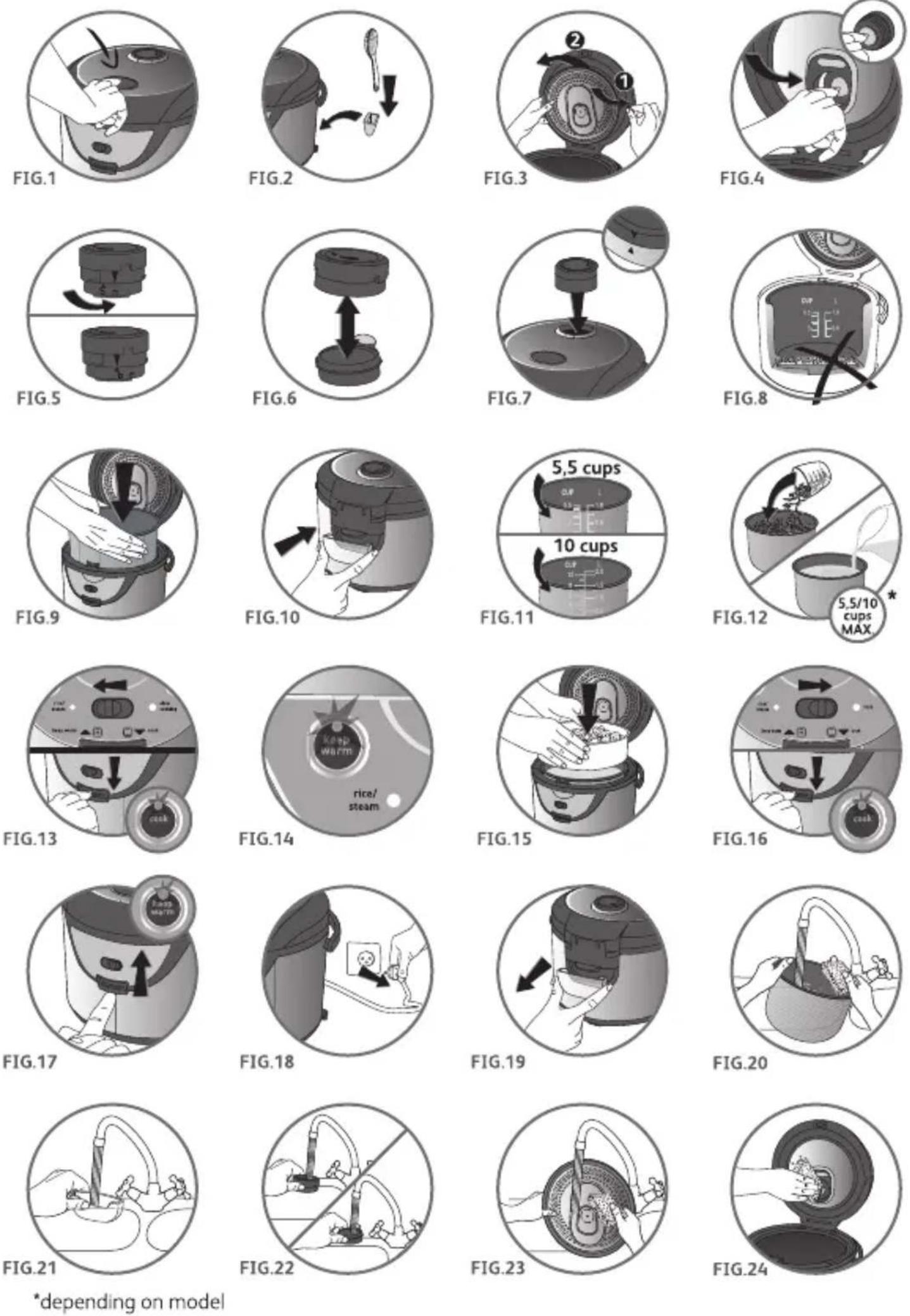
Description
- Steam basket
- Graduation for water and rice
- Removable non-stick bowl
- Rice spoon
- Lid opening button
- Lid
- Inner removable lid
- Measuring cup
- Micro pressure valve
- Condensation collector
- Handle
-
Spoon support
-
Power cord
- Hotplate
- Sensor
- Control panel
a. Keep warm indicator light
b. RICE/STEAM cooking mode
c. Mode switch
d. Cooking indicator light
e. SLOW COOKING mode
f. Control switch
Before the first use
Unpack the appliance
- Remove the appliance from the packaging and unpack all the accessories and printed documents.
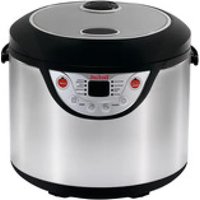
- Open the lid by pressing the opening button located on the lid – Fig.1.
- Install the spoon support: insert the plastic hook of the support in the hole located on the bottom of the product, and slide it downwards – Fig.2.
Read the instructions and carefully follow the operating method.
Clean the appliance
- Remove the non-stick bowl, the inner removable lid and the micro pressure valve. To remove the inner lid, press the release clip on the right side to release the lid – Fig.3.
- After removing the inner lid, push up the micro-pressure valve through the hole on the underside of the lid with a finger – Fig.4. To separate the upper and lower parts of the micropressure valve, rotate the valve in the unlocking direction by turning the upper triangle until it is aligned with the open padlock symbol then separate – Fig.5 and Fig.6.
- Clean the bowl, the inner removable lid, the micro pressure valve and all the accessories with a sponge and washingup liquid. Wipe the outside of the appliance and the metal parts of the lid with a damp cloth.
- Dry carefully.
- Replace the micro-pressure valve. Align the upper triangle with unlocked padlock of the micropressure valve to close up the two parts, then rotate in locking direction until the upper triangle is aligned with the locked padlock which indicates the two parts are locked, then re-fit the micropressure valve down into the lid – Fig.7. Make sure that the triangle in the
micropressure valve is aligned with the triangle on the lid and firmly push down until it fits in place.
- Replace the inner removable lid by fitting the tab on the left side into the slot on the lid, then push in the lid until it the tab on the right clicks into place. The wider side of the seal must be uppermost when fitting the lid.
Using your rice cooker
For all 3 functions
- Carefully wipe the outside of the bowl (especially the bottom). Make sure that there are no foreign residues or liquid underneath the bowl and on the hotplate – Fig.8.
- Place the bowl into the appliance – Fig.9, making sure that it is correctly positioned.
- Slightly rotate the bowl in both directions, so as to ensure good contact between the bottom of the bowl and the hotplate.
- Check that the condensation collector is correctly placed in position, if not, please install it by pushing firmly into the groove – Fig.10.
- Close and lock the lid.
- Plug in the appliance.
- Do not switch on the appliance until all of the above stages have been completed.
- Avoid to switch on the appliance with an empty cooking bowl.
- Do not touch the heating plate when the product is plugged.
Never place your hand on the steam vent during cooking, as there is a danger of burns. Only use the inner pot provided with the appliance. Do not pour water or put ingredients in the appliance without the bowl inside.
Rice Cooking
Measuring the ingredients - Max capacity of the bowl
- The graduated markings on the inside of the bowl are given in liters and cups, these are used for measuring the amount of water when cooking rice – Fig.11.
- The plastic cup provided with your appliance is for measuring rice and the table states the quantity of rice required for the number of servings. 1 level measuring cup of rice weighs about 150 g.
- For best results, we recommend using ordinary rice rather than "easy cook" type of rice which tends to give a stickier rice and may adhere to the base.
- To cook only 1 cup of white rice (serves 2 small or 1 large
portion) because there isn't the mark of 1 cup in the cooking pot, you should use 1 measuring cup of white rice and then add 1 1/2 measuring cup of water. With some types of rice it is normal for a little rice to stick on the base when cooking 1 cup of rice. To cook other quantity of white rice, refer to cooking guide below.
- The maximum quantity of water + rice should not exceed the 5.5 cup or 10 cup mark inside the bowl – Fig.11. Depending on the type of rice, quantities of water may need adjustment. See the table below.
- Rinse the rice thoroughly before cooking.
COOKING GUIDE FOR WHITE RICE - 5,5 CUPS
| Measuring cups of white rice | Weight of white rice | Water level in the bowl (+ the rice) | Serves | Approximative cooking time* |
| 1 150 g | see the | advise above | 1per.-2per. | 20 min |
| 2 300 g 2 | cup mark | 3per.-4per. | 25 min | |
| 3 | 450 g 3 cup | mark 4per.-5per. 30 min | ||
| 4 | 600 g 4 cup | mark 5per.-6per. 35 min | ||
| 5.5 825 g | 5.5 cup mark | 8per.-10per. 40 min | ||
COOKING GUIDE FOR WHITE RICE - 10 CUPS
| Measuring cups of white rice | Weight of white rice | Water level in the bowl (+ the rice) | Serves | Approximative cooking time* |
| 2 300 g 2 | cup mark | 3per.-4per. | 25 min | |
| 4 | 600 g 4 cup | mark 5per.-6per. 35 min | ||
| 6 | 900 g 6 cup | mark 8per.-10per. 34 min | ||
| 8 | 1200 g 8 cup | mark 13per.-14per. 37 min | ||
| 10 | 1500 g | 10 cup mark | 16per.-18per. | 40 min |
* The rice cooker will automatically determine the exact cooking time depending on the quantity of water and rice placed in the bowl.
To cook rice
The cooking time given in the table above is a rice cooking time guide.
- Place the appliance on a flat, stable, heat-resistant work surface away from water splashes and any other sources of heat.
- Pour the required quantity of rice into the bowl using the measuring cup provided. Then fill with cold water up to the corresponding “CUP” mark printed in the bowl (See cooking guide above) – Fig.12.
- Close the lid.
Note: Always put the rice first otherwise you will have too much water.
- Check that the appliance is plugged in. Side the mode switch to the left to choose "RICE/STEAM" mode – Fig.13 and then press downwards on the control switch, the cooking indicator illuminates showing that cooking has begun – Fig.13.
- When cooking finished, it will turn to keep warm automatically, the "KEEP WARM" indicator light is on – Fig.14.
- After each use empty and clean the condensation collector.
The rice cooker itself determines the exact cooking time depending on the quantity of water and ingredients placed in the bowl (see cooking table above for a guide to timing). When all of the water has been absorbed by the rice, the appliance stops the cooking process automatically and enters into the "KEEP WARM" mode (the "KEEP WARM" indicator light comes on).
for best results when cooking rice
- Measure the rice and rinse it thoroughly under running water in a sieve for a long time (except for risotto rice which should not be rinsed). Then place the rice in the bowl together with the corresponding quantity of water.
- Make sure that the rice is well distributed in the bowl to allow even cooking.
- Add salt to water: depending on personal taste.
- Water may be substituted with stock. If using stock, there is risk of rice browning in the bowl.
- Do not open the lid during cooking as steam will escape and this will affect the cooking time and the taste.
- On completion of cooking, the “KEEP WARM” indicator light is on, stir the rice and then leave it in the rice cooker for a few minutes longer in order to get perfect rice with separate grains.
Steam cooking (for vegetables, fish, etc.)
Measuring the ingredients
- The maximum quantity of water in the bowl should not exceed the maximum CUP mark shown in "CUP" on the bowl – Fig.11. Exceeding this level may cause overflow during use.
- The water level should be lower than the steam basket.
Preparation
- Pour water into the bowl, never exceed the maximum CUP mark.
- Place the steam basket in the bowl – Fig.15.
- Add the ingredients in the steam basket.
To steam cook
- Close the lid.
- Slide the mode switch to the left to choose “RICE/STEAM” mode – Fig.13 and then press downwards on the control switch, the cooking indicator illuminates showing that cooking has begun – Fig.13.
- After the time you estimate ok for steam cooking, you can end the steam cooking mode by lifting the control switch to its top position. The “KEEP WARM” indicator light comes on and the appliance turns to keep warm function.
- When there is no more water in the cooking pot, it will turn to keep warm automatically, the “KEEP WARM” indicator light is on –Fig.14.
Slow Cooking
To slow cook
- Slide the switch to the right to choose “SLOW COOKING” mode – Fig.16 and then press downwards on the control switch, the cooking indicator illuminates showing that cooking has begun – Fig.16.
- To finish cooking procedure, lift upwards on the control switch to its top position. The “KEEP WARM” indicator light comes on and the appliance turns to keep warm function – Fig.17.
Keep warm function
On completion of cooking, for rice or steam cooking, the appliance enters automatically to the “KEEP WARM” function. The control switch comes up to its top position and the “KEEP WARM” indicator light comes on. For soup cooking, it will turn to keep warm function when you turn upwards on the control switch to its top position and the “KEEP WARM” indicator light comes on. The food is thus kept warm until ready to serve. Be careful that “KEEP WARM” long time (1 hour maximum) would affect the quality of rice. To switch off this function, unplug the appliance – Fig.18.
On completion of cooking
- Open the lid.
- Serve the food using the plastic spoon supplied with the appliance and close the lid.
- The food remaining in the bowl will keep warm for any next servings.
- Don't forget to unplug the appliance after keep warm.
Never remove the bowl after cooking without protective oven gloves.
Cleaning and Maintenance
Condensation collector
- The condensation collector should be emptied and cleaned after each use.
- To remove the collector, press on each side of the plastic cover and remove – Fig.19.
- To put the collector back, push firmly into the groove.
Bowl, condensation collector, inner removable lid, micro pressure valve and the steam basket
EN
- After removing the inner lid, push up the micro-pressure valve through the lid hole with finger from underside of the lid – Fig.4, rotate the micro-pressure valve in unlocking direction until the upper triangle is aligned with the opened padlock and finally separate the upper and lower parts of the micro-pressure valve – Fig.5.
- Use hot water, washing up liquid and a sponge to clean the bowl – Fig.20, the condensation collector – Fig.21, the micro pressure valve – Fig.22, the inner removable lid – Fig.23, the spoon and the cup. Scouring powders and metal sponges are not recommended.
- If food has stuck to the bottom, allow the bowl to soak for a while before washing it.
- The non-stick bowl, the steam basket, the condensation collector, the spoon and the cup are dishwasher safe.
- Dry the bowl carefully.
- Do not immerse the appliance in water, nor pour water into it.
Taking care of the non-stick bowl
- To keep the non-stick coating quality of the bowl for as long as possible, it is recommended not to cut food in it.
- Use plastic or wooden utensils and not metal ones when stirring or serving food to avoid damaging the bowl surface.
- To avoid any risk of corrosion, do not pour vinegar into the bowl.
- The colour of the bowl surface may change after using for the first time or after long period of use. This change in colour is due to the action of steam and water and does not have any effect on the use of the Rice Cooker, nor is it dangerous for your health. It is perfectly safe to continue using it.
- Do not use handblender directly into the non-stick bowl to mix vegetables.
Cleaning and care
of the other parts of the appliance
- Unplug the appliance before cleaning.
- Clean the outside of the Rice Cooker, the inside of the lid – Fig.24 and the cord with a damp cloth and wipe dry. Do not use abrasive products.
- Do not use water to clean the interior of the appliance body as it could damage the heat sensor.
Technical troubleshooting guide
| Malfunction description Causes Solution | ||
| Any indicator lamp off and no heating. | Rice cooker not plugged. | Verify the main plug is well engaged in the product body. |
| Any Indicator lamp off and heating. | Problem of The connection of the indicator lamp or Indicator lamp is damaged. | Send to authorized service center for repair. |
| Cooking Indicator lamp off, keep warm indicator on. | Cook button is not in cooking position. | Put the cook button in low position (cooking). |
| Steam leakage during using. | Lid is badly closed. | Open and close again the lid. |
| Micropressure valve not well positioned or uncomplete. | Stop the cooking (unplug the product) and check the valve is complete (2 parts locked together) and well positioned. | |
| Lid or micropressure valve gasket is damaged. | Send to authorized service center for repair. | |
| Rice half cooked or overtime cooking. | Too much or not enough water compared to rice quantity. | Refer to IFU for water quantity. |
| Rice half cooked. | Selector button on position “soup”. | Change selector button position to “rice/steam”. |
| Automatic warm-keeping fails (product stay in cooking position, or no heating). | Send to authorized service center for repair. | |
| Water leakage on the table. | Condensation collector missing or condensation collector overflow. | Empty the condensation collector for each use verify good positioning of the condensation collector. |
Remark : if inner bowl is deformed, do not use it anymore and get a replacement bowl from the authorized service center for repair.
Description


- DESCRIPTION
- BEFORE THE FIRST USE
- UNPACK THE APPLIANCE
- CLEAN THE APPLIANCE
- USING YOUR RICE COOKER
- FOR ALL 3 FUNCTIONS
- RICE COOKING
- MEASURING THE INGREDIENTS - MAX CAPACITY OF THE BOWL
- TO COOK RICE
- NOTE: ALWAYS PUT THE RICE FIRST OTHERWISE YOU WILL HAVE TOO MUCH WATER
- FOR BEST RESULTS WHEN COOKING RICE
- STEAM COOKING (FOR VEGETABLES, FISH, ETC.)
- MEASURING THE INGREDIENTS
- PREPARATION
- TO STEAM COOK
- SLOW COOKING
- TO SLOW COOK
- KEEP WARM FUNCTION
- ON COMPLETION OF COOKING
- CLEANING AND MAINTENANCE
- CONDENSATION COLLECTOR
- BOWL, CONDENSATION COLLECTOR, INNER REMOVABLE LID, MICRO PRESSURE VALVE AND THE STEAM BASKET
- TAKING CARE OF THE NON-STICK BOWL
- CLEANING AND CARE
- OF THE OTHER PARTS OF THE APPLIANCE
Brand : TEFAL
Model : Cereal And Co RK203
Category : Rice cooker