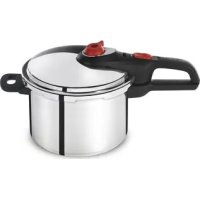
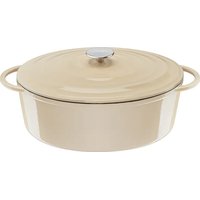
P26146 - Saucepan TEFAL - Free user manual and instructions
Find the device manual for free P26146 TEFAL in PDF.

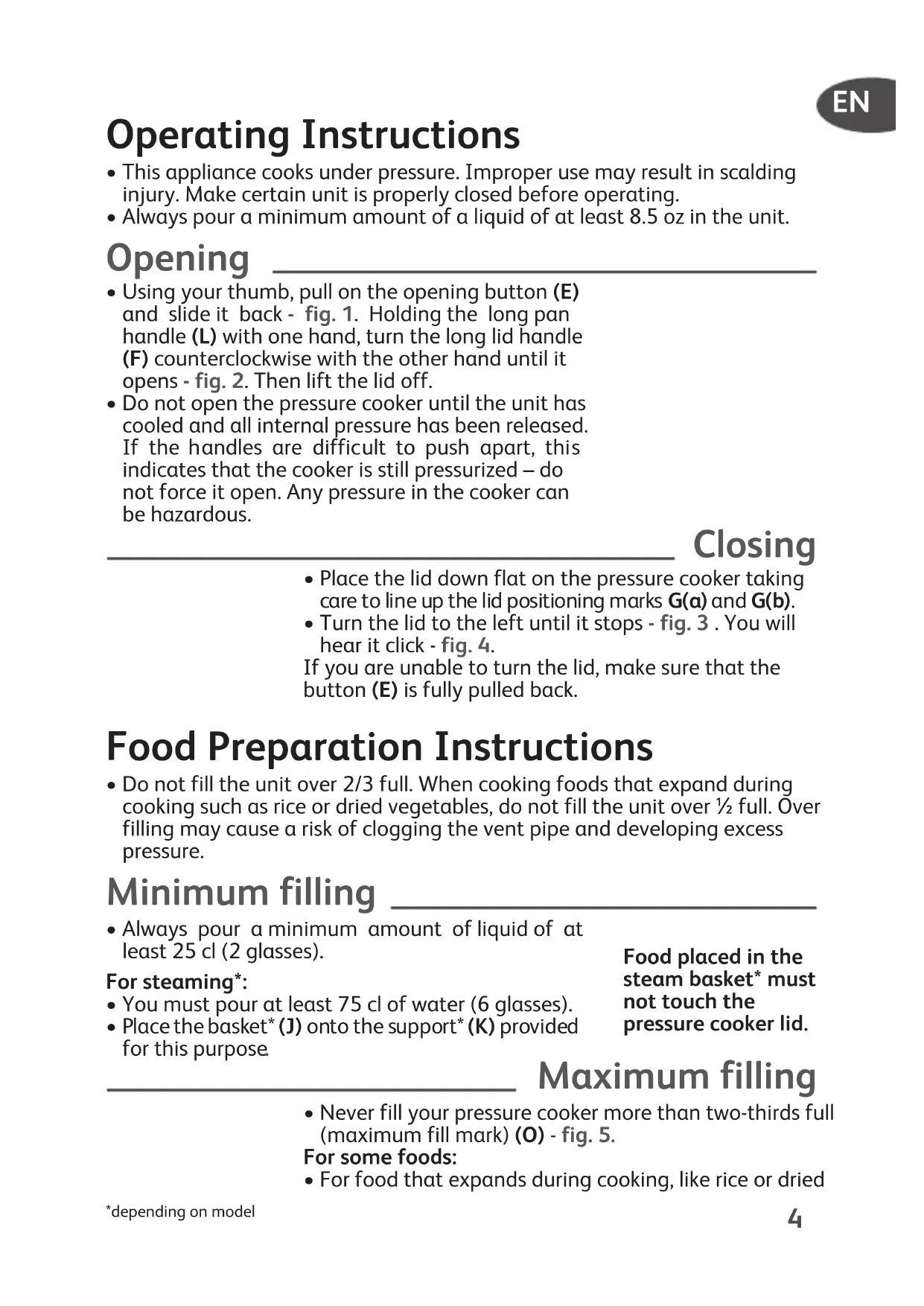


| Product type | Pressure cooker |
| Brand | Tefal |
| Model | P26146 |
| Capacity | 6 qt (5.7 L) |
| Bowl diameter | 22 cm |
| Bottom diameter | 16 cm |
| Operating pressure | 80 kPa (12 psi) |
| Maximum safety pressure | 150 kPa (22 psi) |
| Material | Aluminum |
| Compatible heat sources | Gas, electric plate, tubular plate |
| Safety | Pressure indicator, safety valve, closing/opening safety |
| Included accessories | Steamer basket, trivet |
| Care and cleaning | Hand wash with warm soapy water; do not put in dishwasher |
| Spare parts | Lid gasket (ref. X9010602) |
| Warranty | 10 years on the bowl against manufacturing defects |
| Repairability | T-fal authorized service centers |
| Weight | Not specified (estimated ~2.5 kg) |
Frequently Asked Questions - P26146 TEFAL
User questions about P26146 TEFAL
0 question about this device. Answer the ones you know or ask your own.
Ask a new question about this device
Download the instructions for your Saucepan in PDF format for free! Find your manual P26146 - TEFAL and take your electronic device back in hand. On this page are published all the documents necessary for the use of your device. P26146 by TEFAL.
USER MANUAL P26146 TEFAL
natural_image
Exterior view of a stainless steel cooking pot with black handle and lid (no text or symbols visible)User's Guide - Guía del usuario - Guide d'utilisation
Para los modelos:
P26106 - P26146 - P26145
P26206 - P26246 - P26245
www.t-fal.com.mx
www.t-fal.ca
www.t-falusa.com
Descripción - Description - Description
*según modelo *depending on model *selon le modèle
natural_image
Diagram showing hands operating a mechanical component with an arrow indicating direction (no text or symbols present)fig. 1 fig. 2 fig. 3
natural_image
Illustration of a hand using a pliers to lift a mechanical component, with an arrow indicating motion (no text or symbols present)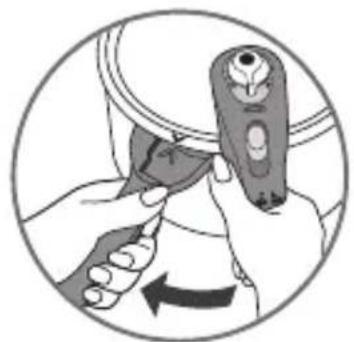
natural_image
Illustration of a hand holding a medical device with an arrow indicating rotation (no text or symbols present)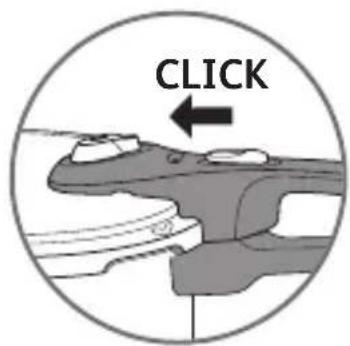
fig. 4
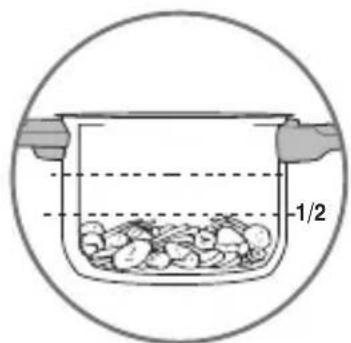
fig. 5 fig. 6
natural_image
Circular diagram showing a mechanical or electrical component with an arrow indicating clockwise rotation (no text or symbols)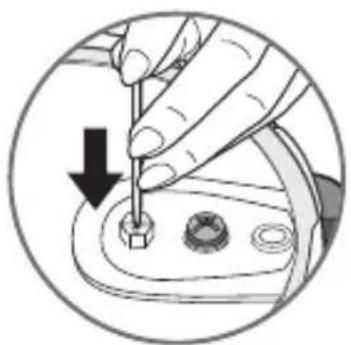
natural_image
Close-up of a hand using a screwdriver to adjust a small component (no text or symbols visible)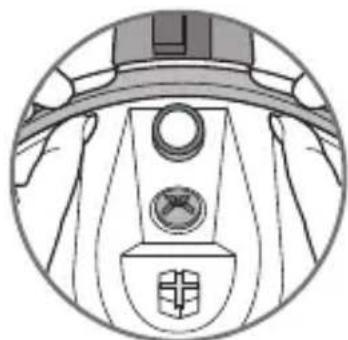
natural_image
Technical line drawing of a mechanical component with no visible text or symbolsfig. 10
natural_image
Illustration of two hands holding a curved object, no text or symbols presentfig. 11 fig. 12
natural_image
Illustration of hands using a faucet to clean or repair a circular component (no text or symbols)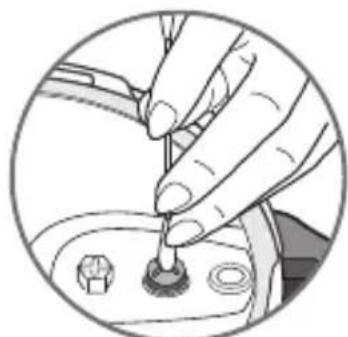
natural_image
Illustration of a hand using a tool to press or install a component on a button (no text or symbols visible)fig. 13
natural_image
Illustration of a mechanical device emitting smoke or vapor, enclosed in a circular frame (no text or symbols)fig. 14 fig. 15
natural_image
Cross-sectional diagram of a mechanical component with a central shaft and flange (no text or symbols)*según modelo *depending on model *selon le modèle
IMPORTANT SAFEGUARDS
When using pressure cookers, basic safety precautions should always be followed :
- Read all instructions.
- This product has been designed for domestic use only.
- Do not touch hot surfaces. Use handles or knobs.
- Close supervision is necessary when the pressure cooker is used near children.
- Do not place the pressure cooker in a heated oven.
- Extreme caution must be used when moving a pressure cooker containing hot liquids.
- Regularly check that the handles of the pressure cooker are fitted correctly. Tighten them if necessary.
- Regularly check that the pan handles are fixed properly. Tighten if necessary.
- Use heat source(s) that are compatible with your pressure cooker, in line with the instructions for use.
- Never make a recipe with milk in your pressure cooker.
- Do not use rock salt in your pressure cooker, but rather add table salt when the cooking is nearly finished.
- Never fill your pressure cooker more than two-thirds full (maximum fill mark).
- When cooking food with a thick texture (chick peas, rhubarb, compotes, etc.) the pressure cooker should be shaken slightly before opening to ensure that the food does not spurt out.
- Always check that valves are clear before use. Refer to section "Before cooking".
- Use only original T-FAL spare parts suitable for your model. In particular, use a T-FAL pan and lid.
- Alcohol vapors are flammable. Bring to a boil for about 2 minutes before placing the lid. Watch your appliance when preparing alcohol-based recipes.
- Do not use your pressure cooker to store acidic or salty food before and after cooking to avoid damaging your pan.
- Do not use pressure cooker for other than intended use.
-
This appliance cooks under pressure. Improper use may result in scalding injury. Make certain unit is properly closed before operating. See “Operating Instructions.”
-
Do not fill the unit over 2/3 full. When cooking foods that expand during cooking such as rice or dried vegetables, do not fill the unit over 12 full. Over filling may cause a risk of clogging the vent pipe and developing excess pressure. See “Food Preparation Instructions.”
- Be aware that certain foods, such as applesauce, cranberries, pearl barley, oatmeal or other cereals, split peas, noodles, macaroni, rhubarb, or spaghetti can foam, froth, and sputter, and clog the pressure release device (steam vent). These foods should not be cooked in a pressure cooker.
- Always check the pressure release devices for clogging before use.
- Do not open the pressure cooker until the unit has cooled and all internal pressure has been released. If the handles are difficult to push apart, this indicates that the cooker is still pressurized – do not force it open. Any pressure in the cooker can be hazardous. See “Operating Instructions”.
- Do not use this pressure cooker for pressure frying with oil.
- When the normal operating pressure is reached, turn the heat down so all the liquid, which creates the steam, does not evaporate.
- Always pour a minimum amount of a liquid of at least 8.5 oz in the unit. See "Operating Instructions".
SAVE THESE INSTRUCTIONS.
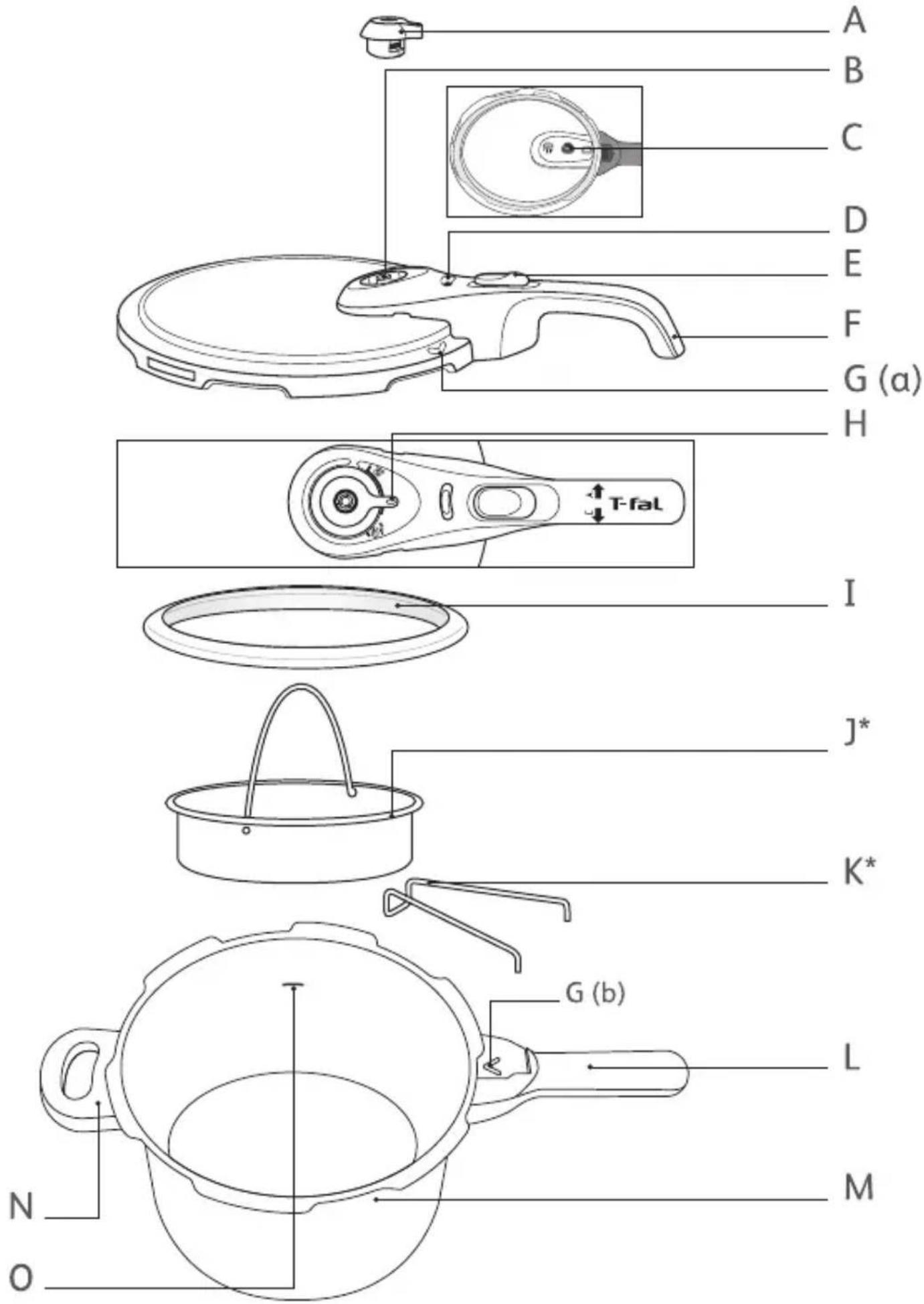
Descriptive diagram
A. Operating valve
B. Steam release outlet
C. Safety valve
D. Pressure indicator
E. Opening button
F. Long lid handle
G(a). Lid positioning mark
G(b). Mark for positioning the lid on the pan
H. Operating valve positioning mark
I. Lid seal
J. Steam basket*
K. Tripod*
L. Long pan handle
M. Pan
N.Short pan handle
- Maximum fill mark
Specifications
Pressure cooker base diameter – references
| Capacity | Pan diameter | Base diameter | Aluminum model | Color model |
| 4,7 qt / 4,5 L | 22 cm / 8,6" | 16 cm / 6,3" | P26106 | P26206 |
| 6 qt / 5,7 L | 22 cm / 8,6" | 16 cm / 6,3" | P26146 | P26246 |
| 8 qt / 7,6 L | 24 cm / 9,4" | 18 cm / 7" | P26145 | P26245 |
Technical information: maximum operating pressure: 80 kPa (12 psi) / Maximum safety pressure: 150 kPa (22 psi).
Compatible heat sources
GAS
ELECTRIC COIL

- On gas, the flame should not extend beyond the diameter of the pan.
- For all heat sources, make sure that your pressure cooker is well centered.
T-FAL accessories
| Accessory Reference number | |
| Seal X9010602 | |
- To replace other parts or for repairs, contact a T-FAL Approved Service Center.
- Use only original T-FAL parts suitable for your model.
Operating Instructions
- This appliance cooks under pressure. Improper use may result in scalding injury. Make certain unit is properly closed before operating.
• Always pour a minimum amount of a liquid of at least 8.5 oz in the unit.
Opening
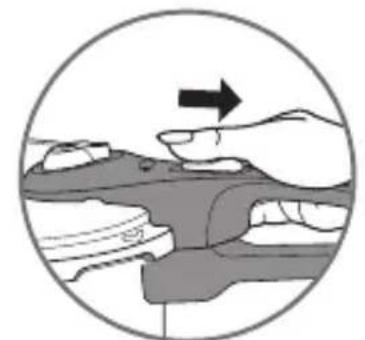
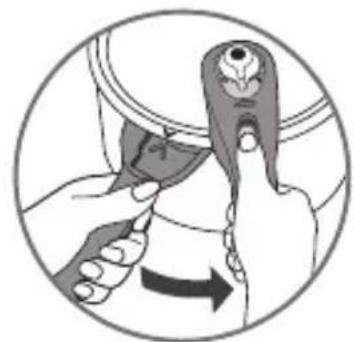
- Using your thumb, pull on the opening button (E) and slide it back - fig. 1. Holding the long pan handle (L) with one hand, turn the long lid handle (F) counterclockwise with the other hand until it opens - fig. 2. Then lift the lid off.
- Do not open the pressure cooker until the unit has cooled and all internal pressure has been released. If the handles are difficult to push apart, this indicates that the cooker is still pressurized – do not force it open. Any pressure in the cooker can be hazardous.
Closing
- Place the lid down flat on the pressure cooker taking care to line up the lid positioning marks G(a) and G(b).
- Turn the lid to the left until it stops - fig. 3. You will hear it click - fig. 4.
If you are unable to turn the lid, make sure that the button (E) is fully pulled back.
Food Preparation Instructions
- Do not fill the unit over 2/3 full. When cooking foods that expand during cooking such as rice or dried vegetables, do not fill the unit over 12 full. Over filling may cause a risk of clogging the vent pipe and developing excess pressure.
Minimum filling
- Always pour a minimum amount of liquid of at least 25 cl (2 glasses).
For steaming\*:
- You must pour at least 75 cl of water (6 glasses).
- Place the basket* (J) onto the support* (K) provided for this purpose
Food placed in the steam basket* must not touch the pressure cooker lid.
Maximum filling
- Never fill your pressure cooker more than two-thirds full (maximum fill mark) (O) - fig. 5.
For some foods:
- For food that expands during cooking, like rice or dried
vegetables or stewed fruit, etc., never fill your pressure cooker more than half full - fig. 5.
- For soups, we recommend you carry out a fast decompression (refer to section "End of cooking").
Using the operating valve (A)
natural_image
Illustration of a hand pressing down on a mechanical component with directional arrows (no text or symbols)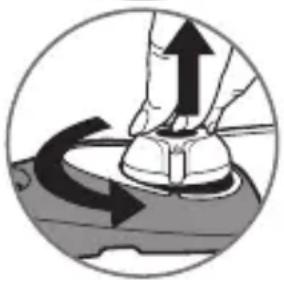
natural_image
Illustration of a hand pressing down on a mechanical component with an upward arrow, no text or symbols present.To fit the operating valve (A):
Caution: these operations must be carried out when the appliance is cold and not in use.
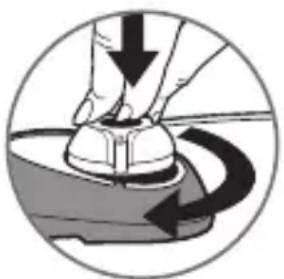
- Place the operating valve (A) while lining up the positioning mark (H) as shown in the diagram on the left.
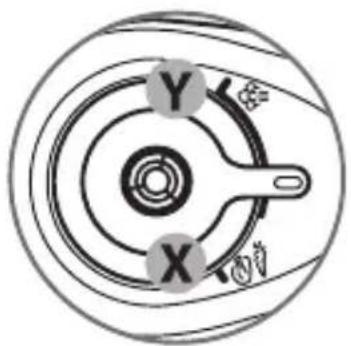
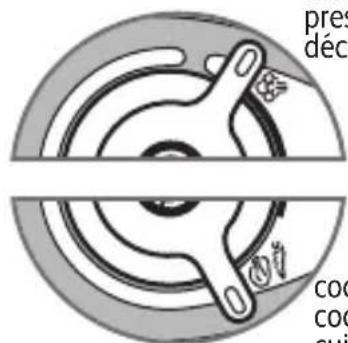
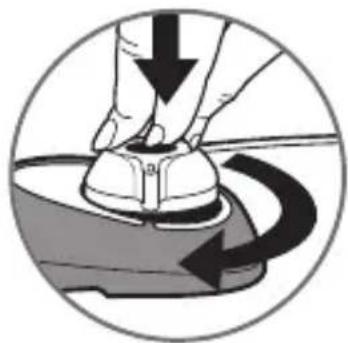
- Press down on the valve and turn to the required position X - fig. 6 - 7.
To remove the operating valve:
Caution: these operations must be carried out when the appliance is cold and not in use.
- Press down on the valve and turn it to align its positioning mark (H) as shown in the diagram on the left.
- Remove the valve.
First use
Dark spots on the aluminum that may appear after using the product do not compromise its safety. To control the problem, follow these steps:
- Place the basket support* (K) in the bottom of the pan and place the basket* (J) on top of it.
- Fill two-thirds of the pan (O) with water (maximum fill mark).
- Add 2 tablespoons of baking soda.
- Close the pressure cooker.
- Move the operating valve (A) to a stop after the pictograms (mark)X fig. 6 - 7.
- Place the pressure cooker on a heat source set to maximum power.
- When steam starts escaping through the valve, reduce the heat source and set the timer to 20 minutes.
• After 20 minutes, turn off the heat.
- Gradually turn the valve (A)- fig. 8 choosing the speed at which you want to release the pressure until the valve stops after the pictogram (mark) - fig. 6 - 7.
- When the pressure indicator (D) drops back, your pressure cooker is no longer under pressure.
- Open the pressure cooker - fig. 1 - 2.
- Rinse the pressure cooker with water and dry.
This maintenance can be done periodically.
- Before each use of the pressure cooker, remove the valve (A) (refer to section “Using the operating valve”) and check visually and in plain daylight that the steam release outlet (B) is not blocked. If necessary, clean it with a toothpick - fig. 9.
- Check that the marble in the safety valve (C) can move freely - fig. 13: refer to section “Cleaning and maintenance”.
- Close the pressure cooker - fig. 3 and make sure it is closed properly.
- Move the operating valve (A) to a stop after the pictograms Ⓞ (mark)X fig. 6 - 7.
- Place the pressure cooker on a heat source set to maximum power.
During cooking
- When steam escapes through the operating valve (A) continuously, and a regular hissing sound (PSCHHHT) is heard, reduce the heat source.
- Set a timer for the cooking time stated in your recipe.
- Once the cooking time is up, turn off the heat.
End of cooking
If food or liquid starts to spray out while you are releasing the steam, return the operating valve (A) to the position xfig. 6 et 7 - and then release the pressure slowly making sure nothing else spurts out.
natural_image
Simple line drawing of a mechanical device with a lever and base, no text or symbols presentWhen the pressure cooker is under pressure, take great care when moving it without shaking it.
To release the steam:
- Slow pressure release:
- Gradually turn the valve (A) choosing the speed at which you want to release the pressure until the valve reaches the mark - fig. 6 - 7. When the pressure indicator (D) drops back, your pressure cooker is no longer under pressure.
- Fast pressure release:
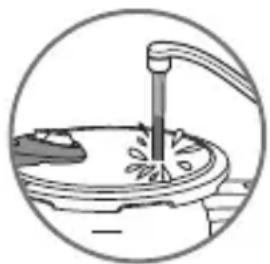
- You can place your pressure cooker under cold running water to speed up the decompression as shown in the diagram on the left. When the pressure indicator (D) drops again, your pressure cooker is no longer under pressure.
- You can open your pressure cooker.
- When cooking frothy or starchy foods, do not release the pressure. Wait for the pressure indicator (D) to drop before opening. Reduce the recommended cooking time a little.
Cleaning and maintenance Cleaning the pressure cooker
To ensure the correct operation of your pressure cooker, follow these cleaning and maintenance recommendations after each use.
- Wash the pressure cooker after each use using warm, soapy water. Follow the same procedure for the basket*.
- Never use bleach or products containing chlorine.
- Do not overheat your pan when empty.
To clean the inside of the pan:
- Wash with a scouring pad and dishwashing liquid.
- The presence of stains on the inside of the pressure cooker base has no effect on the quality of the metal. This is simply a scale deposit. To remove these deposits, you can use a scouring pad and some diluted vinegar.
To clean the outside of the pan:
- Wash using a sponge and dishwashing liquid.
To clean the lid:
- Wash the lid under a gentle stream of running warm water using a sponge and dishwashing liquid and rinse well.
To clean the lid seal:
• After each use, clean the seal (I) and its groove.
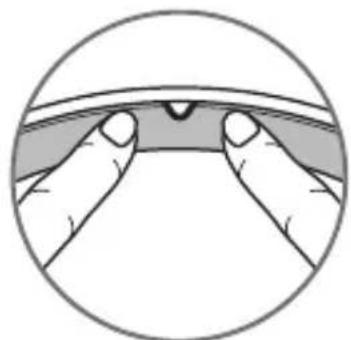
- To refit the seal, refer to the drawingsfig. 10 - 11.
To clean the operating valve (A):
- Remove the operating valve (A): Refer to section "Using the operating valve".
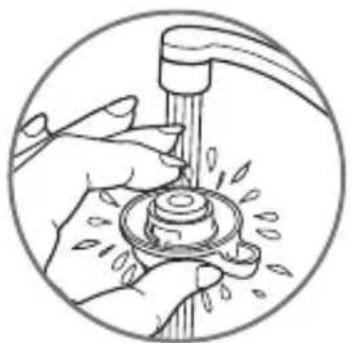
- Wash the operating valve (A) under running tap water- fig. 12.
To clean the steam release outlet on the lid (B):
- Remove the valve (A).
- Visually inspect the steam release outlet in daylight to make sure that it is clear and round. If necessary, clean it with a toothpick - fig. 9.
The browning and marks which may appear following long use do not affect the operation of the pressure cooker.
To make blackening of aluminum disappear from already used products: repeat "first use" instructions with baking soda.
Never put the pan, the lid and the seal in the dishwasher.
For a longer pressure cooker life, do not overheat your pressure cooker pan when it is empty.
For the models covered outside (colored tank) the bleaching or the change of color in time does not present disadvantage to the use.
Never use a sharp or pointed object to do this.
To clean the safety valve (C):
- Clean the part of the safety valve located inside the lid by placing it under running water.
- Check its proper operation by slightly pressing down on the pin, which must sink without difficulty - fig. 13.
You must have your pressure cooker checked in a T-FAL Approved Service Center after 10 years of use.
To change the seal of your pressure cooker:
- Change the seal of your pressure cooker every year or if it has any cuts.
- Always use an original T-FAL seal suitable for your model.
To store your pressure cooker:
- Turn the lid over on the pan.
Safety
Your pressure cooker is fitted with several safety devices:
- Closing safety:
- If the appliance is not closed properly, the pressure indicator (D) cannot rise and as a result the pressure cooker cannot be put under pressure.
- Opening safety:
- If the pressure cooker is under pressure, the opening button (E) cannot be pressed. Never force the pressure cooker open. Above all do not interfere with the pressure indicator (D).
- Two safety devices against overpressure:
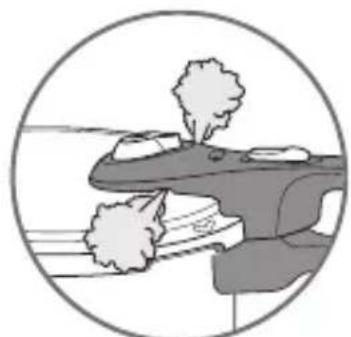
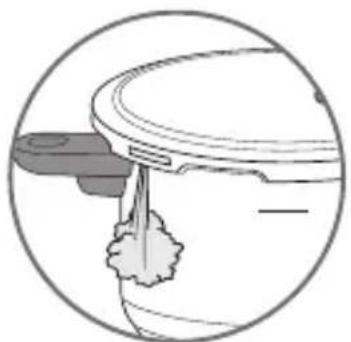
- First device: the safety device (C) releases the pressure and steam escapes horizontally from above the lid - fig. 14.
- Second device: the seal (I) allows steam to escape vertically along the pan - fig. 15.
If one of the overpressure safety systems is triggered:
- Turn off the heat source.
- Let the pressure cooker cool down completely.
- Open.
- Check and clean the operating valve (A), the steam release outlet (B), the safety valve (C) and the seal (I) - fig. 9 - 12 - 13.
Recommendations for use
1 - Steam is very hot when it leaves the operating valve.
2 - As soon as the pressure indicator rises, you can no longer open your pressure cooker.
3 - As with any cooking utensil, ensure close supervision if you are using the pressure cooker near children.
4 - Watch out for the jet of steam.
5 - To move the pressure cooker, use the two pan handles.
6 - Never leave food in your pressure cooker.
7 - Never use bleach or products containing chlorine, as these will alter the quality of the material.
8 - Never put the lid, the pan and the basket* in the dishwasher.
9 - Do not leave the lid soaking in water.
10 - Change the seal every year or if it has any cuts.
11 - You must only clean your pressure cooker when it is cold and empty.
12 - It is essential to have your pressure cooker checked in a T-FAL Approved Service Center after 10 years of use.
- When used under the conditions set out in these instructions, the pan of your new T-FAL pressure cooker comes with a 10 years-warranty against:
- Any defects relating to the metal structure of your pan
- Any premature deterioration of the metal base
- For other parts, a one year parts and labor warranty is provided (except where applicable law in your own country states otherwise). This warranty covers any defects or manufacturing faults.
- The contractual warranty cover is provided only on presentation of a valid proof of purchase which shows the date of purchase.
The warranty cover excludes:
- Any damage consecutive to a failure to follow the major recommendations made or due to negligent use, especially:
-Knocks, falls, placing in an oven, etc.
-Placing the lid, the pan and/or basket* in the dishwasher.
- The bleaching or the change of color in time for colored tanks.
- Only T-FAL Approved Service Centers are authorized to provide service under warranty.
- Please call the Helpline number for the address of your nearest T-FAL Approved Service Center:
Groupe SEB Canada - Customer Service
345 Passmore Ave. - Toronto ON - CANADA
- M1V3N8 - 1800.418.3325
Regulatory marking
| Marking Location | |
| Identification of manufacturer and commercial brand | Lid handle and pan handle. |
| Production year and batch Inside of the lid. | |
| Model referenceMaximum safety pressure (PS)Maximum operating pressure (PF) | On the lid. |
| Problems Recommendations | |
| If your pressure cooker has been heated under pressure without any liquid in it: | Have your pressure cooker checked by a T-FAL Approved Service Center. |
| If the pressure indicator has not risen and nothing is escaping through the valve during cooking: | This is normal during the first few minutes.If the phenomenon persists, check that:- The heat source is sufficiently high; if not, increase it.- The quantity of liquid in the pan is sufficient.- The operating valve is in position -Xfig. 6 - 7.- The pressure cooker is properly closed.- The seal or the edge of the pan is not damaged. |
| If the pressure indicator has risen and nothing is escaping through the valve during cooking: | This is normal during the first few minutes.If the phenomenon persists, place your appliance under cold water, (p. 18). Then open.Clean the operating valve and the steam release outlet - fig. 9 and check that the safety valve pin sinks without difficulty. |
| If steam leaks from around the lid, check: | The correct closure of the lid.The position of the lid seal.The condition of the seal; replace it if necessary.The cleanliness of the lid, seal and its groove in the lid, the safety valve and the operating valve.The condition of the edge of the pan. |
| If you are unable to open the lid: | Check that the pressure indicator is in the lowered position.If not, decompress and if necessary cool down the pressure cooker under a cold water jet, (p. 18). |
| If the food is not cooked or is burned, check: | The cooking time.The power of the heat source.The correct position of the operating valve.The quantity of liquid. |
| If food has burned in the pressure cooker: | Leave the pan to soak before cleaning it.Never use bleach or products containing chlorine. |
Table of Cooking Times
Vegetables
| Cooking FRESH PRODUCE | |||
| Artichoke | - steam* | 18 min. | |
| - immersion** | 15 min. | ||
| Asparagus | - immersion | 5 min. | |
| Beets | - steam | 20 - 30 min. | |
| Broccoli | - steam | 3 min. | |
| Brussels sprouts | - steam | 7 min. | |
| Cabbage, green | sliced - steam | 6 min. | |
| leaves - steam | 7 min. | ||
| Carrots | sliced - steam | 7 min. | |
| Cauliflower | - immersion | 3 min. | |
| Celery | - steam | 10 min. | |
| - immersion | 6 min. | ||
| Courgettes | - steam | 6 12 min. | |
| - immersion | 2 min. | ||
| Endives | - steam | 12 min. | |
| Green beans | - steam | 8 min. | |
| Leek | sliced - steam | 2 12 min. | |
| Mushrooms | sliced - steam | 1 min. | |
| whole - immersion | 1 12 min. | ||
| Peas | - steam | 1 12 min. | |
| Potatoes | quartered | - steam | 12 min. |
| - immersion | 6 min. | ||
| Pumpkin (mashed) | - immersion | 8 min. | |
| Rice | - immersion | 7 min. | |
| Spinach | - steam | 5 min. | |
| - immersion | 3 min. | ||
| Turnips | - steam | 7 min. | |
| - immersion | 6 min. | ||
| White beans semi-dry | - steam | 20 min. | |
*steam = in the steam basket*
**immersion = in water
Meat - Fish
| FRESH | |
| Beef (roast 35 oz) 10 min. | |
| Chicken (whole 42 oz) 20 min. | |
| Lamb (leg 46 oz) 25 min. | |
| Pork (roast 35 oz) 25 min. | |
| Salmon (4 steaks 21 oz) 6 min | |
| Tuna (4 steaks 21 oz) 7 min |
PRECAUCIONES IMPORTANTES
natural_image
Illustration of a hand pressing down on a mechanical component with directional arrows (no text or symbols)natural_image
Illustration of a hand pressing down on a mechanical component with an upward arrow, no text or symbols present.natural_image
Simple line drawing of a kitchen sink with a tool, no text or symbols presentTel: (55) 52.59.23.87
- Retirez la soupape.
natural_image
Illustration of hands pressing down on a mechanical component with a curved arrow indicating motion (no text or symbols)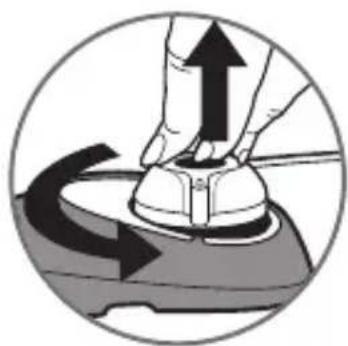
natural_image
Illustration of hands pressing down on a mechanical component with an upward arrow (no text or symbols)natural_image
Diagram of a mechanical device with a lever and fan, showing motion or vibration (no text or symbols)345 Passmore Ave. - Toronto ON - CANADA
- M1V3N8 - 1800.418.3325



- IMPORTANT SAFEGUARDS
- SAVE THESE INSTRUCTIONS.
- Descriptive diagram
- Specifications
- Compatible heat sources
- T-FAL accessories
- Operating Instructions
- Opening
- Closing
- Food Preparation Instructions
- Minimum filling
- For steaming\*:
- Maximum filling
- For some foods:
- Using the operating valve (A)
- To fit the operating valve (A):
- To remove the operating valve:
- First use
- During cooking
- End of cooking
- To release the steam:
- Cleaning and maintenance Cleaning the pressure cooker
- To clean the inside of the pan:
- To clean the outside of the pan:
- To clean the lid:
- To clean the lid seal:
- To clean the operating valve (A):
- To clean the steam release outlet on the lid (B):
- To clean the safety valve (C):
- To change the seal of your pressure cooker:
- To store your pressure cooker:
- Safety
- If one of the overpressure safety systems is triggered:
- Recommendations for use
- The warranty cover excludes:
- Regulatory marking
- Table of Cooking Times
- Vegetables
- PRECAUCIONES IMPORTANTES
Brand : TEFAL
Model : P26146
Category : Saucepan