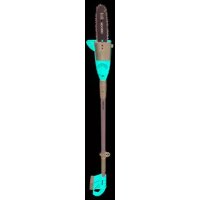
USER MANUAL GCLC 1815 T EINHELL
GB Original operating instructions Pole-mounted cordless pruner
natural_image
Diagram showing a wooden plank with a downward arrow indicating force or direction (no text or symbols present)
natural_image
Close-up of a person's seatbelt buckle being adjusted, with arrows indicating the buckle piece (no text or symbols visible)
D
Inhaltsverzeichnis
- Safety information
- Layout and items supplied
- Intended use
- Technical data
- Before starting the equipment
- Operation
- Working with the chainsaw
- Maintenance
- Cleaning, storage and ordering of spare parts
- Disposal and recycling
- Troubleshooting guide
GB
Danger!
When using equipment, a number of safety precautions must be observed to avoid injuries and damage. Please read these original operating instructions and safety information with due care. Keep these operating instructions in a safe place so that the information is available at all times. If you give the equipment to any other person, please hand over these original operating instructions and the safety information as well. We cannot accept any liability for damage or accidents which arise due to failure to follow these instructions and the safety information.
For the relevant safety information please refer to the booklet included in delivery!
Danger!
Read all the safety regulations and instructions. Failure to adhere to the safety information and instructions set out below may result in electric shock, fire and/or serious injury.
Keep all the safety information and instructions in a safe place for future use.
This equipment is not designed to be used by people (including children) with limited physical, sensory or mental capacities or those with no experience and/or knowledge unless they are supervised by a person who is responsible for their safety or they have received instructions from such a person in to how to use the equipment safely. Children must always be supervised in order to ensure that they do not play with the equipment.
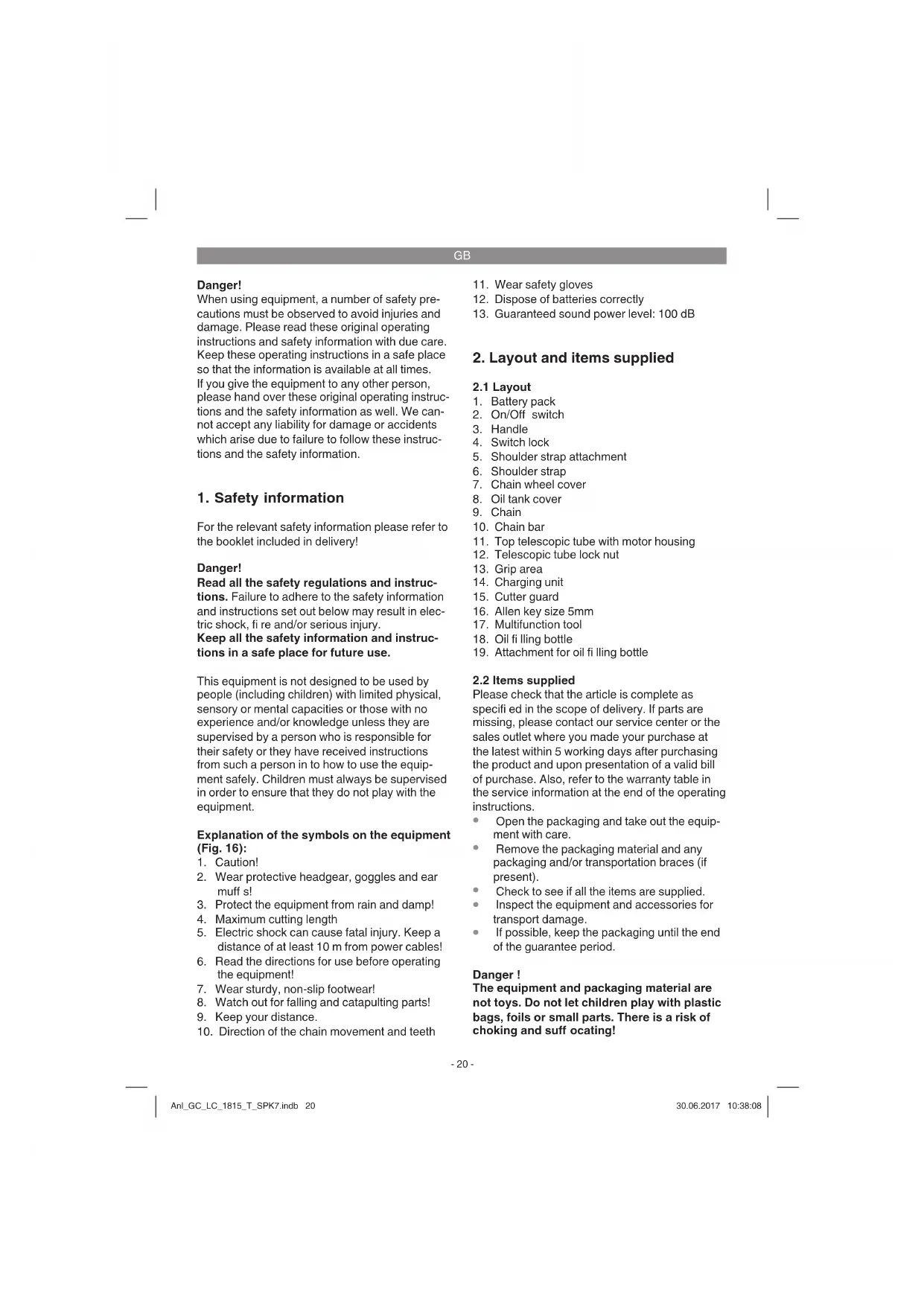
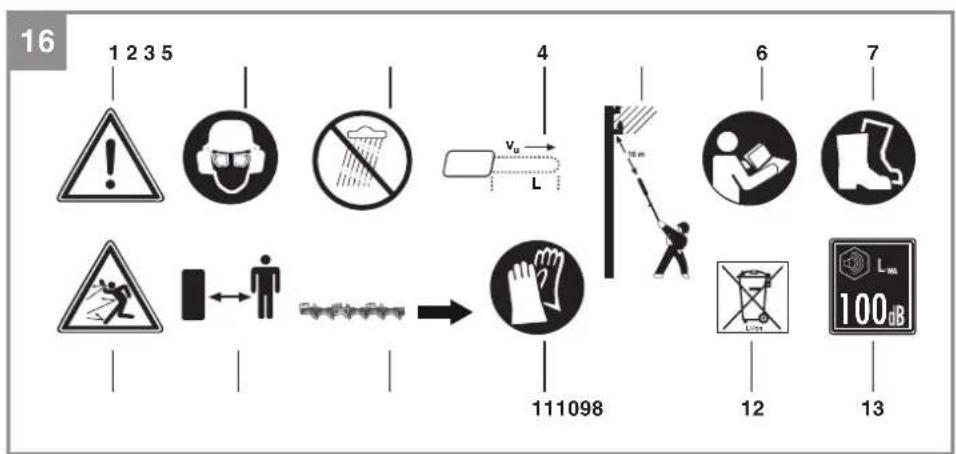
Explanation of the symbols on the equipment (Fig. 16):
- Caution!
- Wear protective headgear, goggles and ear muff s!
- Protect the equipment from rain and damp!
- Maximum cutting length
- Electric shock can cause fatal injury. Keep a distance of at least 10 m from power cables!
- Read the directions for use before operating the equipment!
- Wear sturdy, non-slip footwear!
- Watch out for falling and catapulting parts!
- Keep your distance.
-
Direction of the chain movement and teeth
-
Wear safety gloves
- Dispose of batteries correctly
- Guaranteed sound power level: 100 dB
2. Layout and items supplied
2.1 Layout
- Battery pack
- On/Off switch
- Handle
- Switch lock
- Shoulder strap attachment
- Shoulder strap
- Chain wheel cover
- Oil tank cover
- Chain
- Chain bar
- Top telescopic tube with motor housing
- Telescopic tube lock nut
- Grip area
- Charging unit
- Cutter guard
- Allen key size 5mm
- Multifunction tool
- Oil fi lling bottle
- Attachment for oil fi lling bottle
2.2 Items supplied
Please check that the article is complete as specified in the scope of delivery. If parts are missing, please contact our service center or the sales outlet where you made your purchase at the latest within 5 working days after purchasing the product and upon presentation of a valid bill of purchase. Also, refer to the warranty table in the service information at the end of the operating instructions.
- Open the packaging and take out the equipment with care.
- Remove the packaging material and any packaging and/or transportation braces (if present).
- Check to see if all the items are supplied.
- Inspect the equipment and accessories for transport damage.
- If possible, keep the packaging until the end of the guarantee period.
Danger!
The equipment and packaging material are not toys. Do not let children play with plastic bags, foils or small parts. There is a risk of choking and suffocating!
GB
• Original Operating Instructions
Safetyinformation
• Cordless pole-mounted pruner
- Accessories
3. Intended use
The pole-operated pruner (telescopic branch chainsaw) is designed for lopping off tree branches. It is not suitable for extensive sawing work, felling trees or sawing any materials other than wood.
The equipment may be used only for its intended purpose. Any other use is deemed to be a case of misuse. The user/operator and not the manufacturer will be liable for any damage or injuries of any kind resulting from such misuse.
Please note that our equipment has not been designed for use in commercial, trade or industrial applications. Our warranty will be voided if the equipment is used in commercial, trade or industrial businesses or for equivalent purposes.
4. Technical data
Cutter bar length: 242 mm
Max. cutting length: 200 mm
Chain pitch: 3/8", 33 teeth
Chain thickness: (0.043") 1.1 mm
Sprocket wheel: 6 teeth, 3/8"
Cutting speed at rated rpm: 170 m/min
Oil tank capacity: 20 cm ^3
Net weight without cutter rail + chain: .....4.2 kg
Saw chain: Oregon/91VG033X, Oregon/91P033X
Oregon/91PJ033X, Oregon/90JG033X,
Oregon/90PX033X
Cutter bar: .....Oregon 084LNEA089 (552737);
Hong Guang HH6-Y33-50-ML06K
Protection class: ....III
Lithium-ion battery Einhell GC-LC 1815 T
Voltage: 18 V DC
Capacity: 1.5 Ah
Charging unit Einhell NG-GC-LC 1815 T
Input voltage: 100-240V\~, 50/60 Hz
Power rating: 50 W
Output voltage: 21 V DC
Output current: 1.8 A
Danger!
Sound and vibration
L_pA,d sound pressure level 79 dB(A)
K_pA uncertainty 3 dB(A)
L_wA,d sound power level 100 dB(A)
Wear ear-muff s.
The impact of noise can cause damage to hearing.
Total vibration values (vector sum of three directions) determined in accordance with ISO 22867.
Handle under load
Vibration emission value a_n=2.0 m/s^2
K uncertainty = 1.5 m/s ^2
The specified vibration value was established in accordance with a standardized testing method. It may change according to how the electric equipment is used and may exceed the specified value in exceptional circumstances.
The specified vibration value can be used to compare the equipment with other electric power tools.
The specified vibration value can be used for initial assessment of a harmful effect.
Reduce noise generation and vibration to a minimum!
- Use only equipment that is in perfect condition.
- Maintain and clean the equipment regularly.
• Adapt your way of working to the equipment.
• Do not overload the equipment.
• Have the equipment checked if necessary.
- Switch off the equipment when not in use.
• Wear protective gloves.
Caution!
Residual risks
Even if you use this electric power tool in accordance with instructions, certain residual risks cannot be rules out. The following hazards may arise in connection with the equipment's construction and layout:
- Lung damage if no suitable protective dust mask is used.
- Damage to hearing if no suitable ear protection is used.
- Health damage caused by hand-arm vibrations if the equipment is used over a pro-
GB
longed period or is not properly guided and maintained.
5. Before starting the equipment
Warning! Do not fit the battery until the pole-operated pruner has been fully assembled and the chain tension has been set. Always wear protective gloves when working on the pruner to protect yourself against injury.
Carefully unpack all parts and check that they are complete (Fig. 1).
5.1 Assembly of the shoulder strap (Fig. 2)
Hook the fastener (A) of the shoulder strap into the shoulder strap attachment (5).
5.2 Assembly of the cutter rail and the saw chain
• Using the Allen key (16), remove the two fixing screws for the chain wheel cover (Fig. 3).
• Take off the chain wheel cover.
- Lay the chain as shown in the groove which runs around the cutter rail (Fig. 4).
- Insert the cutter rail and chain as shown in the mounting in the chainsaw (Fig. 5). At the same time guide the chain around the chain wheel (Fig. 5/item C) and hook the cutter rail into the chain tensioning bolt (Fig. 5/item D).
- Attach the chain wheel cover and fasten it by hand with the fixing screws.
Caution! Do not fully tighten the fastening screws until after you have adjusted the chain tension (see section 5.3).
5.3 Tensioning the saw chain
Caution! Always remove the battery from the device before inspection and adjustment. Always wear protective gloves when working on the pruner to protect yourself against injury.
- Undo the fixing screws of the chain wheel cover a few turns (Fig. 3).
- Adjust the chain tension with the chain tensioning screw (Fig. 6/item E). Turning the screw clockwise increases the chain tension, turning it counter-clockwise decreases the chain tension. The saw chain is correctly tensioned if it can be lifted around 2mm in the middle of the cutter rail (Fig. 7).
- Tighten the fixing screws for the chain wheel cover.
Caution! All the chain links must lie properly in the guide groove of the cutter bar.
Notes on tensioning the chain:
The chain must be properly tensioned to ensure safe operation. When the saw chain can be raised by around 2 mm in the middle of the cutter bar, you know that the chain tension is ideal. As the saw chain heats up during cutting and thus changes in length, check the chain tension no less than every 10 minutes and adjust it again as required. This applies in particular to new saw chains. When you have fi nished working, slacken the chain again as it will shorten when it cools down. This will help to prevent damage to the chain.
5.4 Saw chain lubrication
Caution! Always remove the battery from the device before inspection and adjustment. Always wear protective gloves when working on the pruner to protect yourself against injury.
Caution! Never operate the chain if it is not lubricated with saw chain oil! Use of the pole-operated pruner without saw chain oil or if the oil level is below the „min“ mark will damage the chainsaw.
Caution! Be aware of the temperature conditions: Different lubricants with completely different viscosities are required at different ambient temperatures. At lower temperatures you will need low viscosity oils in order to achieve a sufficient lubricating fi Im. However, if the same low viscosity oil is used during the summer it will become even thinner due to the ambient temperatures alone, and as a result the lubricating fi Im could break down, causing the chain to overheat and become damaged. In addition, the lubricating oil will burn and cause unnecessary pollution.
Filling the oil tank
- Power saw chain oil into the oil filling bottle (Fig. 1/item 18) and screw the attachment (Fig. 1/item 19) onto the oil filling bottle. Cut a little bit off the tip of the attachment (Fig. 1/item 19).
- Set the pole-mounted pruner on an even surface.
- Clean the area around the oil tank lid (Fig. 1/ item 8) and remove the lid.
- Fill the tank (Fig. 8/item F) with saw chain oil. In the process, make sure that no dirt enters the tank, as this could cause the oil nozzle to become blocked.
- Screw the oil tank lid (Fig. 1/item 8) back on again.
GB
5.5 Battery
The equipment is fitted with a lithium-ion battery. The battery pack is completely closed and maintenance free.
Charging the rechargeable battery
- (Fig. 9) Take the battery pack (1) out of the equipment. To do so, press the pushlock buttons (H) on the side and pull the battery downwards (a).
- Check that your mains voltage is the same as that marked on the rating plate.
- Insert the power plug of the charger into a socket outlet. The green charging indicator will come on.
- (Fig. 10) Insert the charging plug (K) into the socket provided on the battery (1). The red charging indicator will come on. The battery pack can become a little warm during the charging. This is normal.
- The charger will end the charging process automatically when the battery is fully charged (after approx. 1 hour). The green charging indicator will come on.
- Remove the charging plug from the battery.
- Pull the power plug of the charger out of the socket outlet.
• (Fig. 9) To refit the battery pack, press it into the housing (b) until it engages.
If the rechargeable battery pack fails to charge, check whether there is voltage at the socket outlet.
If you still fail to charge the battery pack, please return the complete tool together with the battery charger to our Customer Service Center.
Timely recharging of the battery will help it serve you well for a long time. You must recharge the battery pack when you notice that the performance of the equipment drops.
Never allow the battery pack to become fully discharged. This will cause it to develop a defect.
6. Operation
Please note that the statutory regulations governing noise abatement may differ from one location to another.
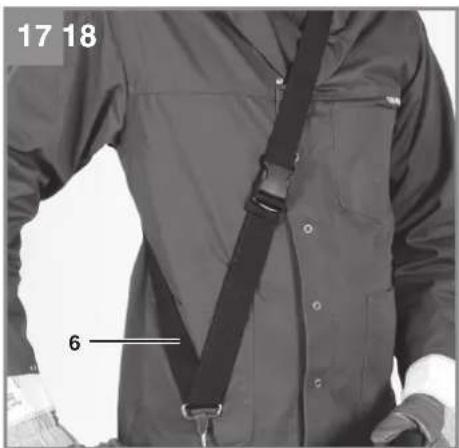
6.1 Using the shoulder strap
Caution! Always use the shoulder strap when working with the equipment. Switch off the equipment before you take off the shoulder strap (risk of injury).
- Slip the shoulder strap (6) over your shoulder.
- Adjust the length of the shoulder strap so that the strap attachment is at waist level (Fig. 17).
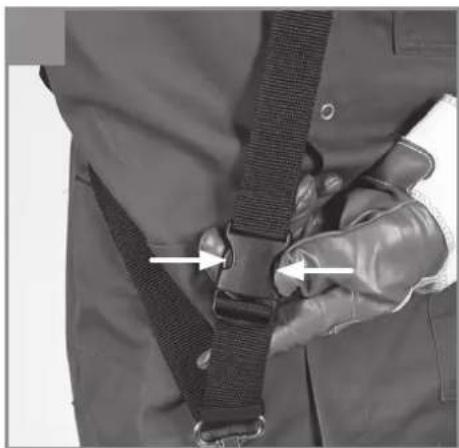
- The shoulder strap is equipped with a buckle. Press the hooks together (Fig. 18) if you need to put down the equipment quickly.
6.2 Setting the telescopic tube (Fig. 11)
- Undo the telescopic tube lock nut (12) by turning it counter-clockwise (a).
- Pull out the top telescopic tube (11) until it reaches the required working height.
- Tighten the telescopic tube lock nut (12) again by turning it clockwise (b). The telescopic tube must be tightly locked.
6.3 Switching on/off
Switching on
- Hold the pole-operated pruner firmly with one hand on the handle (Fig. 1/item 3) and the other hand on the grip area (Fig. 1/item 13).
• (Fig. 12) Pull back the switch lock (4) and press the ON/OFF switch (2).
Switching off (Fig. 12)
Release the ON/OFF switch (2) and then the switch lock (4).
7. Working with the chainsaw
Preparations
To ensure that you can work safely, check the following points before every use:
Condition of the chainsaw
Inspect the chainsaw before the start of work for damage to the housing, the power cable, the saw chain and the cutter rail. Never use a chainsaw which is obviously damaged.
GB
Oil container
Check the oil level in the oil container. Both before and during your work make sure that there is always sufficient oil in the system. To avoid damaging the chainsaw, never run the saw if there is no oil in the system or if the oil drops below the „min“ mark. On average, a single filling will last around 15 minutes depending on the number of pauses in cutting and the loads involved.
Chain
Check the tension of the saw chain and the condition of the cutting elements. The sharper the chain, the easier and more controllable it is to operate the chainsaw. The same also applies to the chain tension. For greater safety you must check the chain tension before your work and at least every 10 minutes during your work. New chains in particular tend to expand more.
Safety clothing
Always wear appropriate tight-fi tting safety clothing such as special trousers which protect against cuts, protective gloves and safety shoes.
Hearing protection and protective goggles.
Wear a protective helmet with integral face and hearing protection. This will offer protection against falling branches and recoiling branches.
Safe working
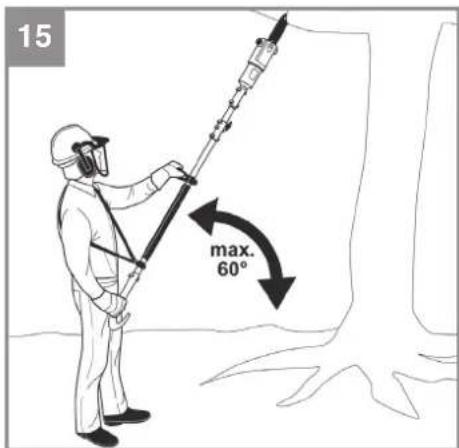
- To ensure that you can work in safety you must use the equipment at a working angle of max. 60° (Fig. 15).
- Never stand under the branch you want to saw.
- Use special caution when working with branches under tension and splintering wood.
- Possible risk of injury caused by falling branches and catapulting pieces of wood.
- When the equipment is in operation, keep other persons and animals away from the danger zone.
- The equipment is not protected from electric shock through contact with high-voltage cables. Keep a minimum distance of 10 m from live cables. Electric shock can cause fatal injury.
- When working on slopes always stand to the upper or left or right side of the branch you want to cut.
- Hold the equipment as close as possible to your body. This will help you to keep your balance.
Cutting techniques
- When removing branches, hold the equipment at an angle of max. 60° to the horizontal to avoid being hit by a falling branch (fig. 15).
- Start with the bottom branches on the tree. This will make it easier for the cut branches to drop.
- After completing a cut, the weight of the saw will abruptly increase for the operator as the saw is no longer supported by the branch. This can result in you losing control over the saw.
- Remove the saw from the cut only with the saw chain still running. This will prevent the saw from getting jammed.
• Never cut with the tip of the saw.
- Never cut into the bulging branch collar. This will prevent the tree from healing.
Sawing off smaller branches (Fig. 13):
Place the contact surface of the saw onto the branch. This will prevent the saw from making jerky movements when you begin a cut. Exerting slight pressure, guide the saw from the top to the bottom through the branch.
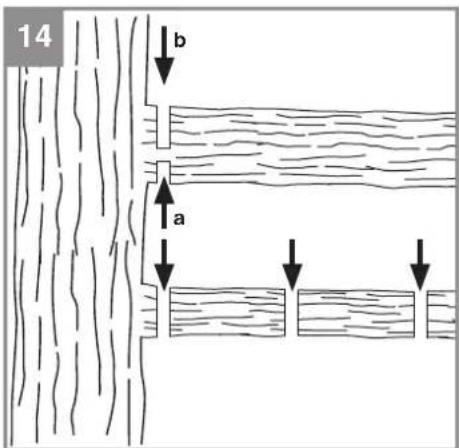
Sawing off large and long branches (Fig. 14):
Carry out a relief cut when working on large branches.
Start by sawing through 1/3 of the branch diameter (a) from the top to the bottom with the top side of the cutter rail. Then saw towards the first cut (b) from the top to the bottom with the bottom side of the cutter rail.
Saw off long branches in several steps to keep control over the impact location.
Kick-back
The term „kick-back“ describes what happens when the running chainsaw suddenly kicks upward and backward. Usually this is caused by contact between the tip of the cutter bar and the workpiece or by the saw chain becoming trapped. In the event of kick-back, large forces occur suddenly and violently. As a result, the chainsaw usually reacts uncontrollably. This can often result in very serious injuries to the worker or persons in the vicinity. The risk of kickback is at its greatest when the saw is positioned for a cut in the region of the tip of the cutter bar, as the leverage effect is greatest there. It is therefore safest to position the saw as flat as possible.
GB
Danger!
- Make sure that the chain tension is always correctly adjusted.
- Only use a chainsaw if it is in perfect working order.
- Only work with a saw chain that has been properly sharpened in accordance with the instructions.
- Never cut with the upper edge or the tip of the cutter bar.
- Always hold the chainsaw firmly with both hands.
Cutting wood which is under tension
Special care is required when cutting wood which is under tension. Cutting wood which is under tension can release the tension, causing the wood to react out of control. In the worst case this can result in severe and even fatal injuries. This type of work must be performed only by specially trained persons.
8. Maintenance
8.1 Replacing the saw chain and cutter rail
The cutter bar needs to be replaced if the guide groove of the cutter bar is worn. Proceed as described in the section "Assembly of the cutter rail and the saw chain".
8.2 Checking the automatic chain lubrication
You should check the operation of the automatic chain lubrication system on a regular basis in order to guard against overheating and the damage this can cause to the cutter bar and the chain. Point the tip of the cutter bar at a smooth surface (a board or a cut tree face) and allow the chainsaw to run. If you see a growing oil stain on the smooth surface, the automatic chain lubrication system is working properly. If no clear oil trace is evident then please refer to the corresponding instructions in "Troubleshooting". If the information contained there still fails to remedy the situation, please contact our service department or another similarly qualified workshop.
Caution! Do not actually touch the surface with the tip of the cutter bar when performing this test. Keep a safe distance (approx. 20 cm).
8.3 Sharpening the saw chain
Working eff ectively with the chainsaw is only possible if the chain is in good condition and sharp. This also reduces the risk of kickback.
The chain can be re-sharpened by any dealer. Do not attempt to sharpen the chain yourself unless you have the necessary special tools and experience.
9. Cleaning, storage and ordering of spare parts
9.1 Cleaning
- Regularly clean the tensioning mechanism by blowing it out with compressed air or cleaning it with a brush. Do not use any tools for cleaning.
- Keep the handles free of oil so that you can maintain a firm grip.
- Clean the equipment as required with a damp cloth and, if necessary, mild washing up liquid.
Danger!
- Remove the battery before cleaning.
- Never immerse the equipment in water or other liquids in order to clean it.
9.2 Storage
- If you are not going to use the chainsaw for an extended period of time, remove the chain oil from the tank. Briefly immerse the saw chain and the cutter bar into an oil bath and then wrap them in oil paper.
- Store the equipment and accessories out of the reach of children in a dark and dry place at above freezing temperature. The ideal storage temperature is between 5 and 30 °C.
9.3 Ordering replacement parts
Please provide the following information on all orders for spare parts:
• Model/type of unit
• Article number of unit
• ID number of unit
• Part number of the required spare part
For our latest prices and information please go to www.isc-gmbh.info
GB
10. Disposal and recycling
The equipment is supplied in packaging to prevent it from being damaged in transit. The raw materials in this packaging can be reused or recycled. The equipment and its accessories are made of various types of material, such as metal and plastic. Defective components must be disposed of as special waste. Ask your dealer or your local council.
11. Troubleshooting guide
Danger!
Before troubleshooting, switch off the equipment and remove the battery.
The table below contains a list of fault symptoms and explains what you can do to remedy the problem if your equipment fails to work properly. If the problem still persists after working through the list, please contact your nearest service workshop.
| Fault Possible cause Remedy | |
| Chainsaw does not work at all | -Batteryempty- Battery is not correctly inserted | -Chargebattery- Remove battery and insert again (see 5.5) |
| Chainsaw operates intermittently | - Loose connection (external)- Loose connection (internal)- ON/OFF switch defective | - Consult a specialist workshop.- Consult a specialist workshop.- Consult a specialist workshop. |
| Saw chain is dry - No oil in the tank- Vent in the oil tank cap is blocked- Oil outlet is blocked | - Top up with oil- Clean the oil tank cap- Clear the oil outlet | |
| Chain/guide bar is hot | - No oil in the tank- Vent in the oil tank cap is blocked- Oil outlet is blocked- Chain is blunt- Chain is overtensioned | - Top up with oil- Clean the oil tank cap- Clear the oil outlet- Re-sharpen or replace the chain- Check the chain tension |
| Chainsaw judders, vibrates or does not saw properly | - Chain is undertensioned- Chain is blunt- Chain is worn- Saw teeth point in the wrong direction | - Adjust the chain tension- Re-sharpen or replace the chain- Replace the chain- Refit the chain with the teeth facing in the correct direction |
GB

For EU countries only
Never place any electric power tools in your household refuse.
To comply with European Directive 2012/19/EC concerning old electric and electronic equipment and its implementation in national laws, old electric power tools have to be separated from other waste and disposed of in an environment-friendly fashion, e.g. by taking to a recycling depot.
Recycling alternative to the return request:
As an alternative to returning the equipment to the manufacturer, the owner of the electrical equipment must make sure that the equipment is properly disposed of if he no longer wants to keep the equipment. The old equipment can be returned to a suitable collection point that will dispose of the equipment in accordance with the national recycling and waste disposal regulations. This does not apply to any accessories or aids without electrical components supplied with the old equipment.
This consignment contains lithium-ion batteries.
In accordance with special provision 188 this consignment is not subject to the ADR regulations. Handle with care. Danger of ignition in case of damage to the consignment package. If the consignment package is damaged: Check and if necessary repackage. For further information contact: 0049 1807 10 20 20 66 (fixed network 14 ct/min, mobile phone max. 42 ct/min) Outside Germany charges will apply instead for a regular call to a landline number in Germany.
The reprinting or reproduction by any other means, in whole or in part, of documentation and papers accompanying products is permitted only with the express consent of the iSC GmbH.
Subject to technical changes
GB
We have competent service partners in all countries named on the guarantee certificate whose contact details can also be found on the guarantee certificate. These partners will help you with all service requests such as repairs, spare and wearing part orders or the purchase of consumables.
Please note that the following parts of this product are subject to normal or natural wear and that the following parts are therefore also required for use as consumables.
| Category Example | |
| Wear parts* Cutter bar, Battery | |
| Consumables* Saw chain | |
| Missing parts | |
* Not necessarily included in the scope of delivery!
In the effect of defects or faults, please register the problem on the internet at www.isc-gmbh.info. Please ensure that you provide a precise description of the problem and answer the following questions in all cases:
• Did the equipment work at all or was it defective from the beginning?
• Did you notice anything (symptom or defect) prior to the failure?
• What malfunction does the equipment have in your opinion (main symptom)?
Describe this malfunction.
GB
Warranty certifi cate
Dear Customer,
All of our products undergo strict quality checks to ensure that they reach you in perfect condition. In the unlikely event that your device develops a fault, please contact our service department at the address shown on this guarantee card. You can also contact us by telephone using the service number shown. Please note the following terms under which guarantee claims can be made:
- These guarantee terms apply to consumers only, i.e. natural persons intending to use this product neither for their commercial activities nor for any other self-employed activities. These warranty terms regulate additional warranty services, which the manufacturer mentioned below promises to buyers of its new products in addition to their statutory rights of guarantee. Your statutory guarantee claims are not affected by this guarantee. Our guarantee is free of charge to you.
- The warranty services cover only defects due to material or manufacturing faults on a product which you have bought from the manufacturer mentioned below and are limited to either the rectification of said defects on the product or the replacement of the product, whichever we prefer. Please note that our devices are not designed for use in commercial, trade or professional applications. A guarantee contract will not be created if the device has been used by commercial, trade or industrial business or has been exposed to similar stresses during the guarantee period.
-
The following are not covered by our guarantee:
-
Damage to the device caused by a failure to follow the assembly instructions or due to incorrect installation, a failure to follow the operating instructions (for example connecting it to an incorrect mains voltage or current type) or a failure to follow the maintenance and safety instructions or by exposing the device to abnormal environmental conditions or by lack of care and maintenance.
- Damage to the device caused by abuse or incorrect use (for example overloading the device or the use or unapproved tools or accessories), ingress of foreign bodies into the device (such as sand, stones or dust, transport damage), the use of force or damage caused by external forces (for example by dropping it).
-
Damage to the device or parts of the device caused by normal or natural wear or tear or by normal use of the device.
-
The guarantee is valid for a period of 24 months starting from the purchase date of the device. Guarantee claims should be submitted before the end of the guarantee period within two weeks of the defect being noticed. No guarantee claims will be accepted after the end of the guarantee period. The original guarantee period remains applicable to the device even if repairs are carried out or parts are replaced. In such cases, the work performed or parts fitted will not result in an extension of the guarantee period, and no new guarantee will become active for the work performed or parts fitted. This also applies if an on-site service is used.
-
To make a claim under the guarantee, please register the defective device at: www.isc-gmbh.info. Please keep your bill of purchase or other proof of purchase for the new device. Devices that are returned without proof of purchase or without a rating plate shall not be covered by the guarantee, because appropriate identification will not be possible. If the defect is covered by our guarantee, then the item in question will either be repaired immediately and returned to you or we will send you a new replacement.
Of course, we are also happy offer a chargeable repair service for any defects which are not covered by the scope of this guarantee or for units which are no longer covered. To take advantage of this service, please send the device to our service address.
Also refer to the restrictions of this warranty concerning wear parts, consumables and missing parts as set out in the service information in these operating instructions.
F
Sommaire
..... Oregon/91VG033X,Oregon/91P033X
..... Oregon/91PJ033X, Oregon/90JG033X,
Oregon/90PX033X
Barra: ..... Oregon 084LNEA089 (552737);
Hong Guang HH6-Y33-50-ML06K
Subject to change without notice
Archive-File/Record: NAPR012442
Documents registrar: Josef Landauer
Wiesenweg 22, D-94405 Landau/Isar
EH 06/2017 (02)