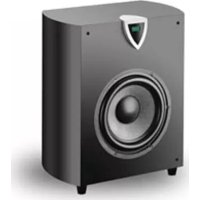
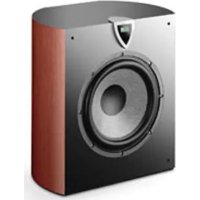
Profile SW 904 - Subwoofer FOCAL - Free user manual and instructions
Find the device manual for free Profile SW 904 FOCAL in PDF.


| Brand | Focal |
| Model | Profile SW 904 |
| Product type | Active subwoofer |
| Speaker technology | "W" cone (Focal patent) in glass-glass composite with foam |
| Port | Front and rear profile for powerful bass without distortion |
| Acoustic wadding | High efficiency for excellent internal damping |
| Cabinet construction | Multi-ply bent MDF for rigidity and absence of standing waves |
| Filter | OPC® with optimized phase for precise sound image |
| Connections | High reliability, accepts bare cables up to 4 mm or spades |
| Included accessories | Height-adjustable decoupling spikes |
| Break-in period | Recommended: approximately 20 hours at medium level with bass-heavy music |
| Maintenance and cleaning | Dusting with dry cloth; stains with damp cloth; no solvents, detergents, alcohols |
| Usage precautions | Avoid proximity to heat sources; do not block ports |
| Recommended positioning | Avoid corners and close walls; symmetry with respect to listening area |
| Warranty (France) | 2 years from purchase date, non-transferable |
Frequently Asked Questions - Profile SW 904 FOCAL
User questions about Profile SW 904 FOCAL
0 question about this device. Answer the ones you know or ask your own.
Ask a new question about this device
Download the instructions for your Subwoofer in PDF format for free! Find your manual Profile SW 904 - FOCAL and take your electronic device back in hand. On this page are published all the documents necessary for the use of your device. Profile SW 904 by FOCAL.
USER MANUAL Profile SW 904 FOCAL
natural_image
Line drawings of four different household items: a cylindrical box, a vertical tube with a pointed tip, a rectangular box, and a closed box (no text or symbols)Français page 13

CE
| Page | |
| Running-in period | 5 |
| Specifications | 5 |
| Positioning | 7 |
| Optimization | 7 |
| Connections | 7 |
| User instructions | 7 |
| Choice of speakers | 9 |
| Central channel placement | 9 |
| Effect channel speakers's place | 9 |
| Magnetic disturbance | 9 |
| Accessories | 8 |
| User precautions | 8 |
| About amplifiers | 10 |
| Cable | 10 |
| Conditions of guarantee | 10 |
| Specifications | 11 |
| Notes | 20 |
| International Guarantee | 24 |
F
Thank you for choosing Focal loudspeakers. We are pleased to share with you our philosophy: "the Spirit of Sound". These high-performance speakers feature the latest technical developments from Focal in terms of speaker design, whether it is for high fidelity or home theater systems. In order to enjoy the maximum of their performance, we advise you to read this user's manual and to keep it carefully so that you can consult it later.
D
The Focal-JMIab guarantee only applies if the enclosed guarantee card is returned to us within 10 days of purchase.
Running-in period
The drivers used in the loudspeaker are complex mechanical devices and require a run-in period before they deliver their best performance. They must get adapted to the temperature and humidity conditions of their environment. This breaking-in period depends on the encountered conditions and can last several weeks. In order to shorten this period, we advise you to let your loudspeakers operate for about twenty hours at medium level, playing standard musical programmes, but with a large amount of bass.
Once the components of the loudspeakers are completely stabilized, it is possible to enjoy the real performance of your loudspeakers.
Specifications
Aluminum / Magnesium inverted dome tweeter: inverted dome technology is exclusive to Focal. It allows an optimized energy transfer. Aluminum / Magnesium dome with Poron ^® surround reveals outstanding performance thanks to a more dynamic and softer tweeter.
"W" cone (midrange and woofer): technology of "W" composite cone is a Focal patent. "W" means "Verre-Verre", because of the 2 glass leafs affixed to both sides of a structural foam. Profile uses the latest "W" cone's upgrades: new proportioning of glass leaf, new foam thickness.
Bended, multi-fold MDF cabinet structure: toughness and optimal damping.
OPC ^® (optimum phase crossover): phase optimization for a precise, natural and stable soundstage and image.
Front and rear profiled port tubes: for a vigorous bass reproduction without any distortion effect.
Highly efficient acoustic wadding: excellent internal damping, deeper and tighter bass.
Stainless steel fixing screws: non-corroding, even in humid climate.
Highly reliable input sockets.
Decoupling spikes.
PROFILE
User manual
Positioning
The loudspeakers have been engineered to deliver the most faithful sound reproduction, whether they are used for music or home cinema. In order to enhance their performance, to guarantee a high quality of listening, sound image and tone balance, it is important to note the following basic rules.
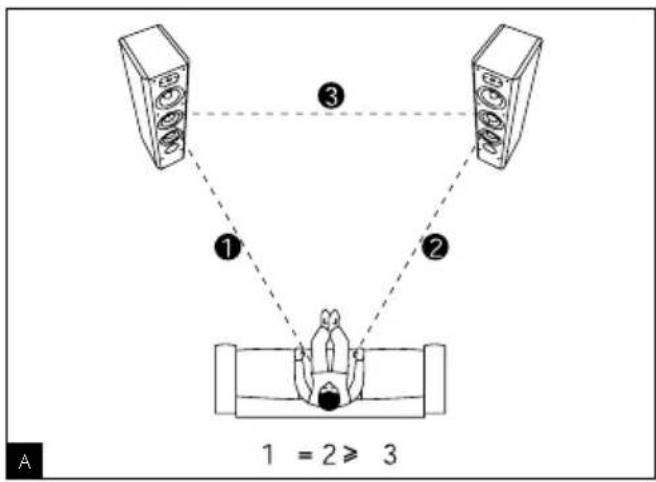
The listening area must be located at the summit of an equilateral triangle whose two other points of insertion are determined by the position of each speaker. Nevertheless, it is possible to modify these distances to find an ideal compromise according to the particular disposition of the room (fig. A).
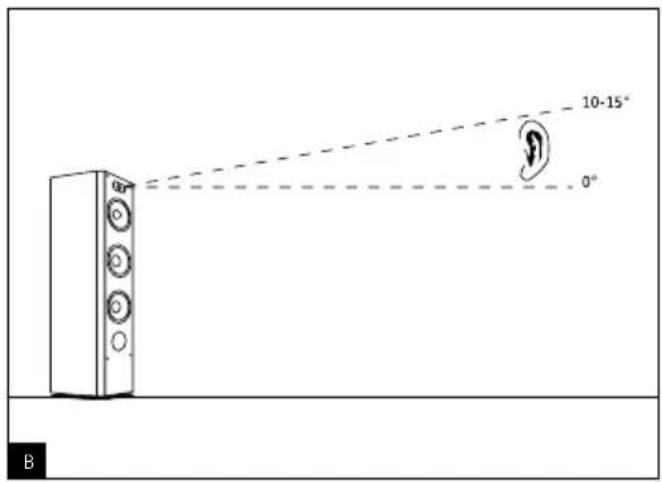
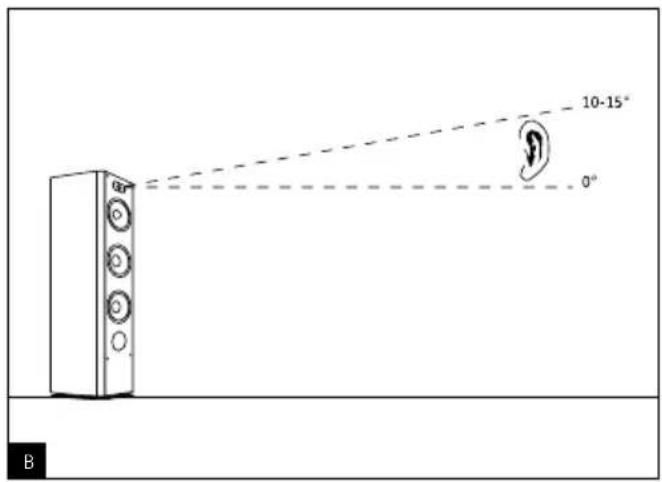
Each loudspeaker must be placed at the same height and on the same floor plan. The tweeter should be at the same height as the listener's ear, when the listener is in their usual listening area (fig. B).
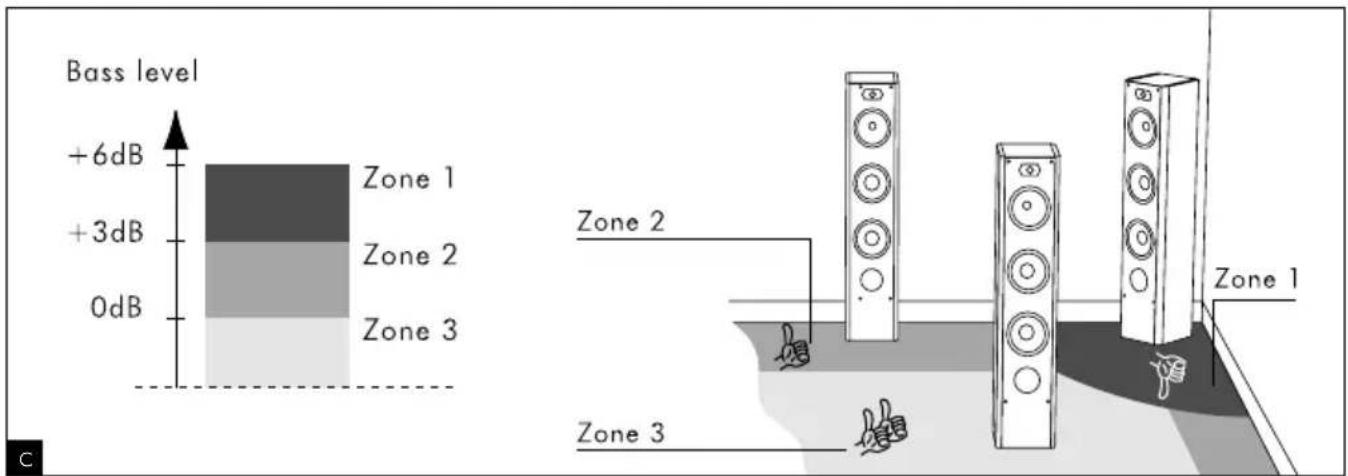
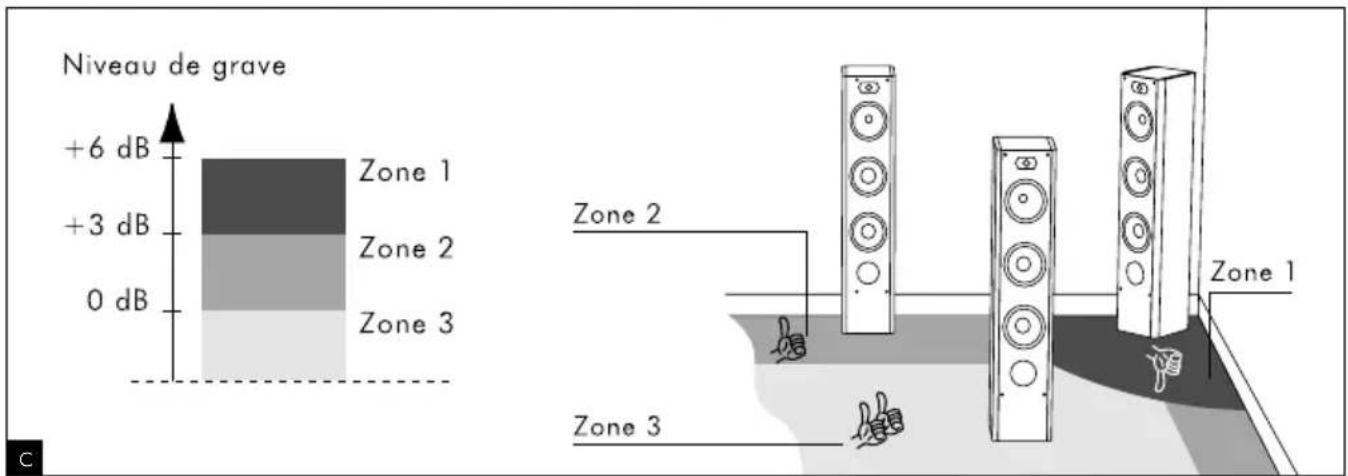
Avoid placing the loudspeakers too close to the room's corners or walls. This will induce some unwanted room resonance and artificially increase bass response. On the contrary, if the bass level proves to be insufficient, it is possible to move the speakers closer to the walls to adjust the bass level (fig. C).
Optimization
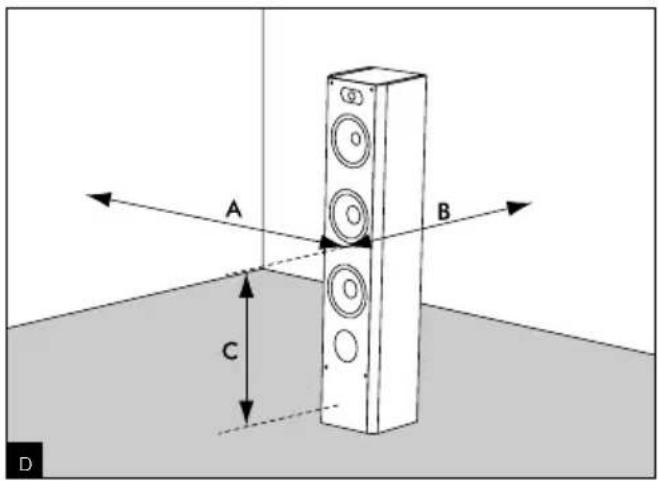
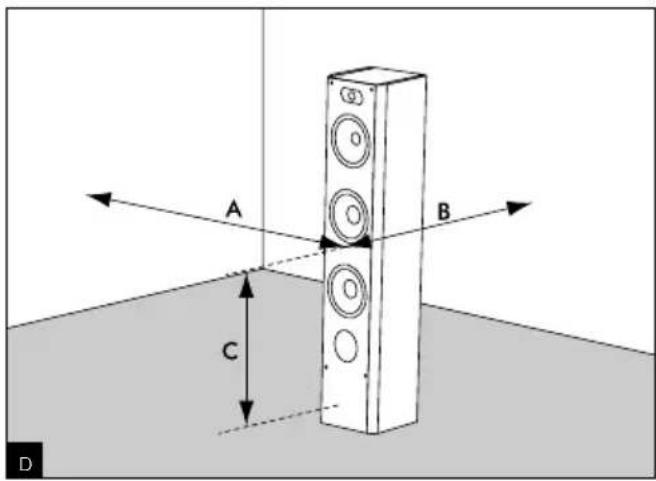
To please the perfectionists, we shall give an optimum positioning formula: if A is the distance from the boomer centre to the closest wall (floor or wall), B the intermediate distance and C the longest distance (A<B<C), the relation B^2=AC determines the ideal position of the speakers (fig. D).
• Example 1:
The boomer centre is 60cm (24") from the floor (B=60cm) (mini speaker on a foot), standing 50cm (20") from the back wall (A=50cm), the side wall will be ideally 72cm (28") (C=B ^2 /A=72cm).
• Example 2:
the boomer centre is 30cm (12") from the floor (column speaker) (A=30cm), 1m (39") from the back wall (C=1m), the clearance with respect to the side walls will be B= =54.7cm (22").
Important
Stylish driver protective caps conjoined to the loudspeaker. Do not remove for optimized performance.
Connections
The Profile input sockets ensure reliable multipurpose connections for stripped cables as well as for plugs.
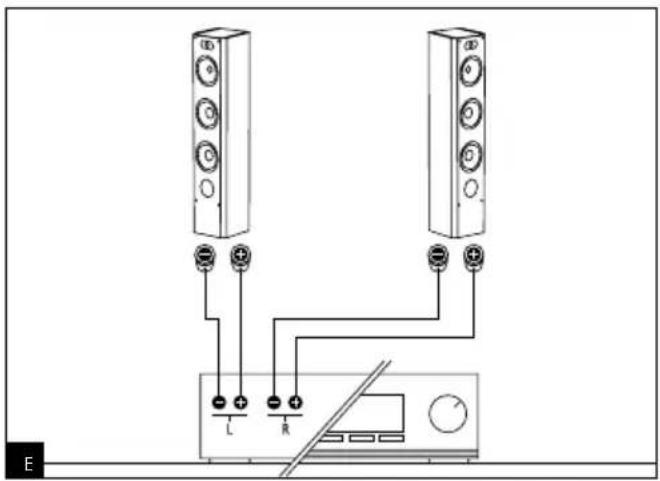
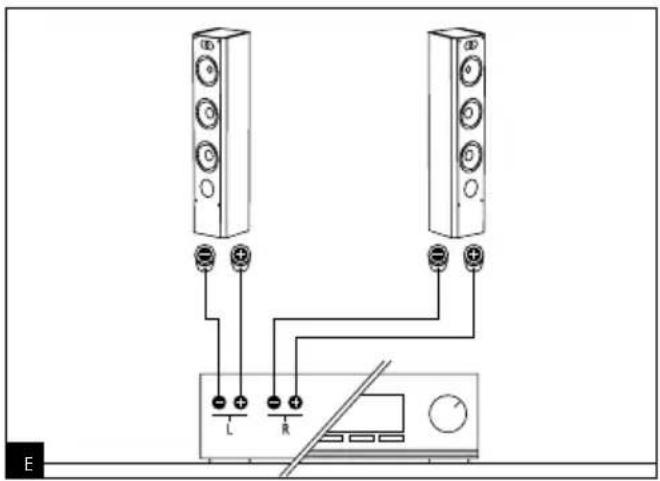
It is imperative to respect the connector polarity of both the loudspeaker and amplifier. The positive terminal "+" must be connected to the corresponding amplifier's terminal and the negative terminal "-" to the negative terminal (fig. E). Stereo image, soundstaging and bass perception would be seriously compromised if these conditions were not respected.
User instructions
The sound rendition of the loudspeaker depends strongly upon the listening room's acoustics, the place of the loudspeakers and the listening area. These factors can be modified in order to correct or enhance a desired effect.
Should the soundstage be imprecise or not centred, try to move the loudspeakers closer to each other.
Harsh or aggressive sound means that your listening room is probably too reflective. Try to use any absorbing materials (such as tapestries, sofa, wall coverings, curtains...) combined with reflective materials to absorb or diffuse resonances.
Should the sound be "flat" or muffled, there are too many absorbing materials in the listening room. The sound appears to be closed-in, with a narrow stereophonic image. Try to find a better compromise between absorbing and reflective materials within your listening room.
Generally the wall to the rear of the speakers should be made up of reflective materials so that the sound image exhibits satisfying volume and width. On the contrary the wall on the rear of the listener should be absorbing in order to avoid reflections damaging the perception of the stereo soundstage. These reflections may limit the impression of depth of the sound image. Furniture, such as bookshelves should be ideally placed along the side walls in order to diffuse sound waves and to prevent some frequencies from being amplified, especially in vocal range (it removes "flutter echo").
PROFILE
User manual
natural_image
Diagram of a film strip setup with two circular components and alignment lines (no text or symbols)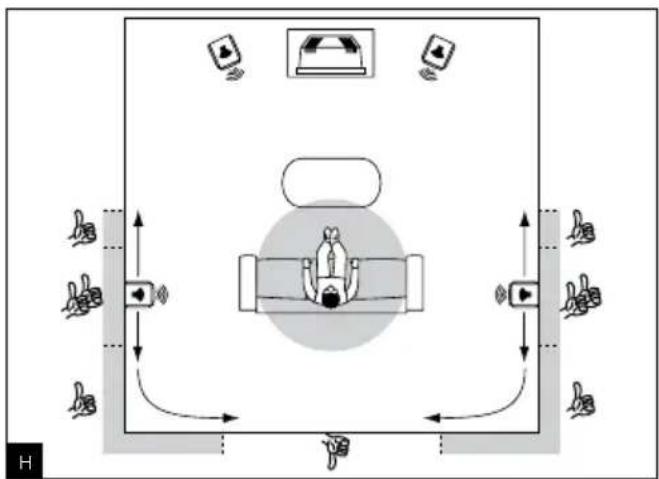
flowchart
graph TD
    A["坐床"] --> B["楼梯"]
    B --> C["楼梯"]
    C --> D["楼梯"]
    D --> E["楼梯"]
    E --> F["楼梯"]
    F --> G["楼梯"]
    G --> H["楼梯"]
    H --> I["楼梯"]
    I --> J["楼梯"]
    J --> K["楼梯"]
    K --> L["楼梯"]
    L --> M["楼梯"]
    M --> N["楼梯"]
    N --> O["楼梯"]
    O --> P["楼梯"]
    P --> Q["楼梯"]
    Q --> R["楼梯"]
    R --> S["楼梯"]
    S --> T["楼梯"]
    T --> U["楼梯"]
    U --> V["楼梯"]
    V --> W["楼梯"]
    W --> X["楼梯"]
    X --> Y["楼梯"]
    Y --> Z["楼梯"]
flowchart
graph TD
    A["Room 1"] --> B["Room 2"]
    B --> C["Room 3"]
    C --> D["Room 4"]
    D --> E["Room 5"]
    E --> F["Room 6"]
    F --> G["Room 7"]
    G --> H["Room 8"]
    H --> I["Room 9"]
    I --> J["Room 10"]
    J --> K["Room 11"]
    K --> L["Room 12"]
    L --> M["Room 13"]
    M --> N["Room 14"]
    N --> O["Room 15"]
    O --> P["Room 16"]
    P --> Q["Room 17"]
    Q --> R["Room 18"]
    R --> S["Room 19"]
    S --> T["Room 20"]
    T --> U["Room 21"]
    U --> V["Room 22"]
    V --> W["Room 23"]
    W --> X["Room 24"]
    X --> Y["Room 25"]
    Y --> Z["Room 26"]
    Z --> AA["Room 27"]
    AA --> AB["Room 28"]
    AB --> AC["Room 29"]
    AC --> AD["Room 30"]
    AD --> AE["Room 31"]
    AE --> AF["Room 32"]
    AF --> AG["Room 33"]
    AG --> AH["Room 34"]
    AH --> AI["Room 35"]
    AI --> AJ["Room 36"]
    AJ --> AK["Room 37"]
    AK --> AL["Room 38"]
    AL --> AM["Room 39"]
    AM --> AN["Room 40"]
    AN --> AO["Room 41"]
    AO --> AP["Room 42"]
    AP --> AQ["Room 43"]
    AQ --> AR["Room 44"]
    AR --> AS["Room 45"]
    AS --> AT["Room 46"]
    AT --> AU["Room 47"]
    AU --> AV["Room 48"]
    AV --> AW["Room 49"]
    AW --> AX["Room 50"]
natural_image
Diagram showing a person seated in a chair facing a speaker and sound wave, with no text or symbols present.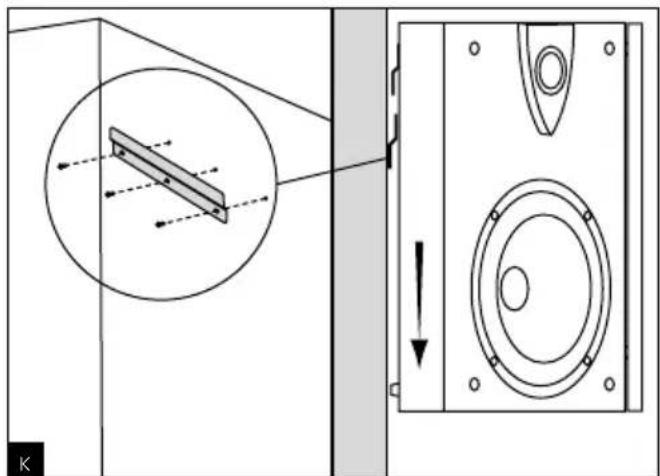
natural_image
Technical diagram showing a mechanical assembly with a circular component and a speaker, no text or symbols present.Choice of speakers
Yours loudspeakers have been engineered to work with stereo systems as well as with home theater systems. If you already own a pair of stereo Profile loudspeakers and wish to purchase a complete home theater system, it is of the utmost importance that you use the central and effect loudspeakers of the same product line. It is the sole possible condition to bring to your system a perfect tonal homogeneity and a realistic and coherent reproduction of tri-dimensional effects within the listening room.
Central channel placement
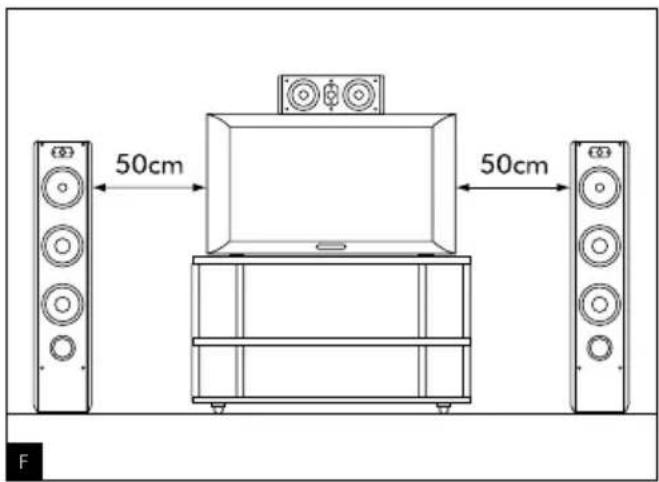
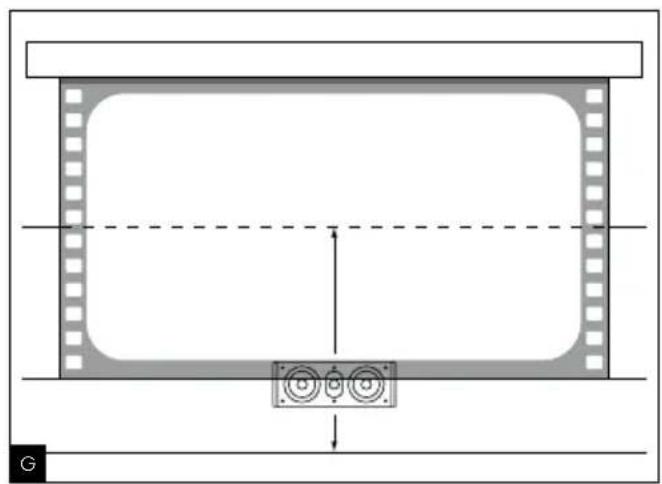
Central channel speakers should be placed close to the TV-screen to obtain a proper placement and a realistic reproduction of the dialog. They could be placed below or above the TV-screen if your TV-unit permits (fig. F).
If a standart projection screen is used, the central channel speaker must be placed under the screen.
If an acoustically transparent projection screen is used, the central channel speaker can be placed behind and at the bottom of the screen (fig. G).
Effect channel speakers's place
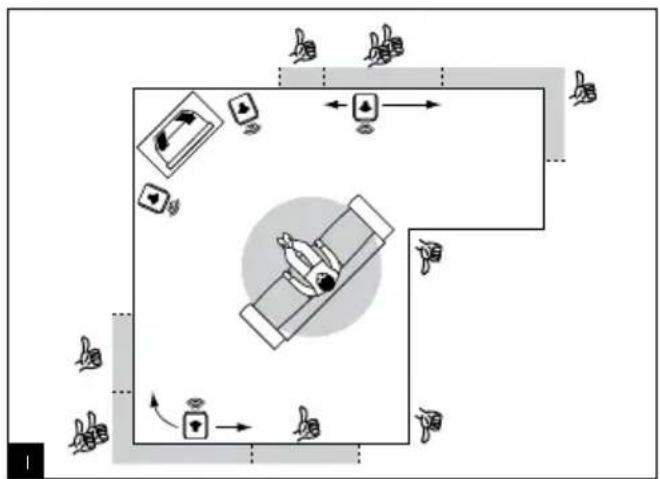
The soundtrack mix for a film or music encoded in multichannel format is very complex and allows the listener to benefit from a wide range of special sound effects, which require the use of effect channel speakers. In order to obtain a realistic 3D soundstage, the placement of the speakers is decisive, even when confronted with a restrictive disposition of the listening room.
For enhanced performance, the following elements should be noted.
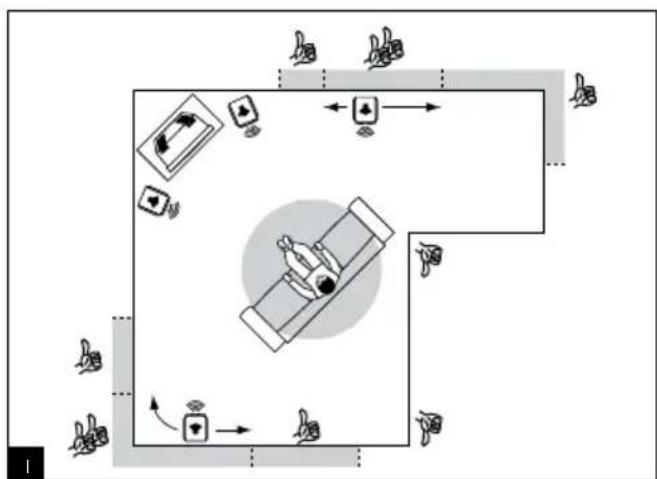
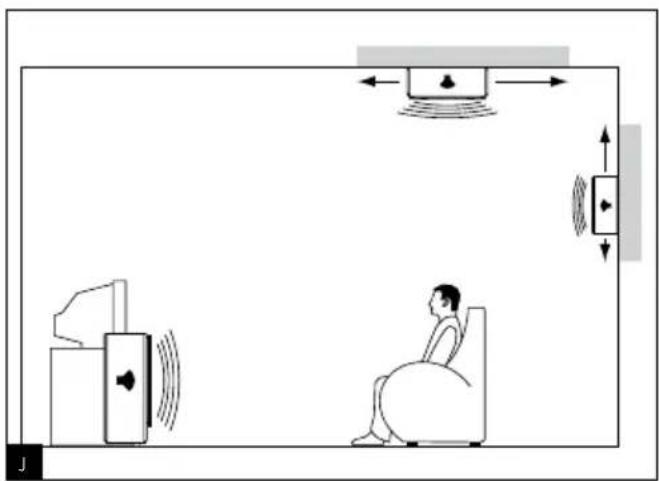
Avoid placing the effect speakers too far from the listening area otherwise the sound perception will be altered. In order to obtain surround effects, with great sound density we advise you to place the speakers against the sidewalls on each side of the listening room (fig. H, I).
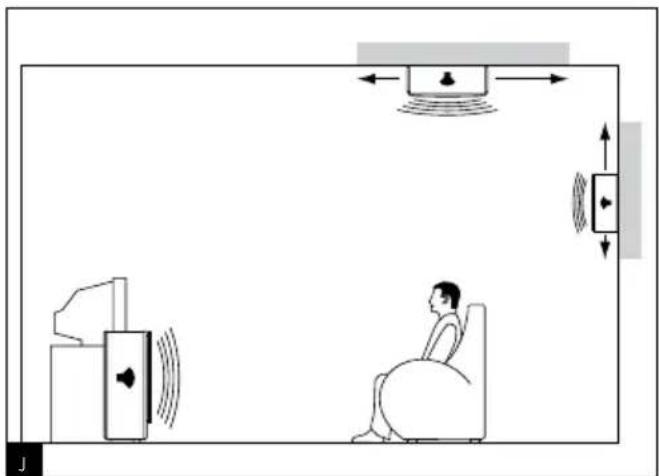
Place the effect speakers at a suitable height, slightly above the listener's ears (fig. J).
The SR 908 dedicated surround speaker is provided with a wall mounting kit (fig. K).
A / V amplifiers include compensation systems, which allows to set the delay applied on each channel. In certain conditions, the distance between each speaker and the listening area may vary.
The latest high-level film soundtracks are now mixed in 6.1. This system requires the use of one or two central surround channel speakers (depending on the amplifier) which should be placed behind the listening area. If two effect speakers are used simultaneously, make sure that they are not too far from each other (less than one meter; 40 inches) in order to obtain the best results.
Magnetic disturbance
In home theater systems, the magnetic radiation of the loudspeakers must be taken into consideration.
Floorstanding speakers which are fully magnetically shielded, all other loudspeakers generate a magnetic leak that can interfere with household appliances, some of which are sensitive to this phenomenon. It is strongly advised not to place front loudspeakers closer than 50cm to your TV screen.
Frame geometry as well as colours can be severely distorted by a magnetic field if the loudspeaker is placed too close to the TV. In case of problems, some TV screens (or computer monitor) feature a degauss control, but not systematically.
Accessories
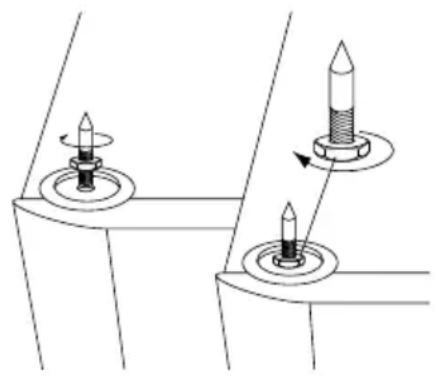
Floorstanding loudspeaker systems include four decoupling spikes (cones) and should be screwed, if necessary, into the four metal inserts situated on the base of the loudspeaker. These spikes ensure a better stability for floorstanding speakers, particularly if the floor is not perfectly flat and smooth. This stability improves clarity in bass and midrange by decoupling the system from the floor and thus reducing floor-born resonances. This required stability allows the energy delivered by the woofer's cone to be integrally converted into sound. The enclosed spikes are adjustable in height. After having adjusted the height of the spikes, don't forget to lock them with the locknut.
When the use of the spikes proves to be necessary, we advise you to place a piece of metal (such as a coin) between the floor and the spike in order to avoid scratching a tiled floor.
Bookshelf speakers can be placed on an optional stand specially developed for them.
natural_image
Diagram showing two mechanical components with rotating parts and a central bolt, no text or symbols presentUser precautions
The tweeter is made up of a relatively soft Aluminum/Magnesium alloy and has a "shape memory" that enables it to rapidly take its initial shape again after slight impacts. However we advise you not to remove the speaker grille in order to keep the dome protected. If the dome surface is damaged, tweeter performance may be compromised.
As the loudspeaker's covering materials are strong, scratch and stain-resistant, maintenance is easy and consists only in cleaning the covering with a dry cloth. If the enclosure is stained, we simply recommend the use of a damp cloth.
Never use any solvents, detergents, alcohol or corrosive products, scrappers or scouring powder to clean the surface of the loudspeaker.
Avoid placing the loudspeakers near a heat source.
About amplifiers
Contrary to what one might think, it is not a too powerful amplifier that might damage a loudspeaker, but rather a lack of power. Actually if the output level of the amplifier is too high it will saturate and distort which will irremediably damage the tweeter.
The power handling and frequency response of the loudspeakers is good enough to highlight the qualities or weak points of the amplifiers they are combined with. Let your retailer help you make the right choice, matching your personal taste and budget.
Cable
Don't underestimate the importance of the cable: make sure you choose the appropriate section and length. Let your retailer advise you.
Conditions of guarantee
All Focal-JMlab loudspeakers are covered by guarantee drawn up by the official Focal-JMlab distributor in your country. Your distributor can provide all details concerning the conditions of guarantee. Guarantee cover extends at least to that granted by the legal guarantee in force in the country where the original purchase invoice was issued.

Your Focal-JMlab product was developed and manufactured with high-quality materials and components which can be recycled and/or re-used. This symbol indicates that electrical and electronic equipment must be disposed of separately from normal garbage at the end of its operational lifetime. Please dispose of this product by bringing it to your local collection point or recycling centre for such equipment. This will help to protect the environment in which we all live.
Profile 908 Profile 918
| Type 2-way bass-reflex bookshelf loudspeaker | 2^1/2 -way bass-reflex floor standing loudspeaker | |
| Drivers 1^st Al/Mg inverted dome tweeter 6^1/2st "W" cone mid-bass, 1^1/4st voice coil | 1^st Al/Mg inverted dome tweeter 6^1/2st "W" cone mid-bass, 1^1/4st voice coil 6^1/2st "W" cone woofer, 1^1/2st voice coil | |
| Frequency response ( ± 3 dB) 50 to 30.5kHz 40 to 30.5kHz | ||
| Sensitivity (2.83V/1m) 89dB 90dB | ||
| Nominal impedance 8 8Ω | ||
| Minimum impedance 3.7 at 200Hz 3.2 at 110Hz | ||
| Max power handling 90 Watts 175 Watts | ||
| Crossover frequency 2600Hz 180Hz / 2600Hz | ||
| Dimensions (HxWxD) | 15.3x9x10.8" (390x230x275mm) | 39x9x13.8" (990x230x350mm) |
| Net weight | 18.7lb (8.5kg) 43lb (19.5kg) | |
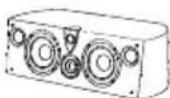
Profile CC 908
| Type 3-way bass-reflex shieldedcenter channel | 2-way sealed surround loudspeaker, wall mounting | |
| Drivers 1" Al/Mg inverted dome tweeter | Two 1'' Al/Mg inverted dome tweeter | |
| 3" "W" cone midrange, 1" voice coil | Two 6 ^1/2 ""W" cone mid-bass, | |
| Two 6 ^1/2 " "W" woofers, 1" voice coil | 1 ^1/4 "" voice coil | |
| Frequency response (±3dB) 65 to 30.5kHz 75Hz to 30.5kHz | ||
| Sensitivity (2.83V/1m) 91dB 91dB | ||
| Nominal impedance 8Ω 8Ω | ||
| Minimum impedance 4.2Ω at 150Hz 5.2Ω at 350Hz | ||
| Max power handling 150 Watts | 175 Watts | |
| Crossover frequency 500Hz / 2600Hz | 2600Hz | |
| Dimensions (HxWxD) | 8.1x24.9x12.8" (205x632x324mm) | 11 ^5/8 x15 ^7/8 x7 ^5/8 "(295x403x194mm) |
| Net weight | 31.9lb (14.5kg) | 19.4lb (8.8kg) |
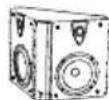
Profile SR 908
natural_image
Diagram of a film strip setup with a central display unit and directional arrows (no text or symbols)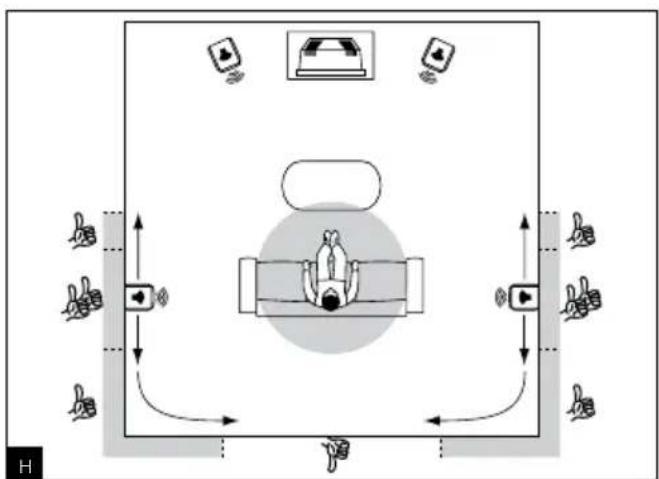
flowchart
graph TD
    A["Person in circular room"] --> B["Left Room"]
    A --> C["Right Room"]
    B --> D["Left Box"]
    C --> E["Right Box"]
    D --> F["Up/Down Arrow"]
    E --> G["Down/Down Arrow"]
    style A fill:#f9f,stroke:#333
    style B fill:#ccf,stroke:#333
    style C fill:#ccf,stroke:#333
    style D fill:#dfd,stroke:#333
    style E fill:#dfd,stroke:#333
    style F fill:#dfd,stroke:#333
    style G fill:#dfd,stroke:#333
flowchart
graph TD
    A["Room 1"] --> B["Room 2"]
    B --> C["Room 3"]
    C --> D["Room 4"]
    D --> E["Room 5"]
    E --> F["Room 6"]
    F --> G["Room 7"]
    G --> H["Room 8"]
    H --> I["Room 9"]
    I --> J["Room 10"]
    J --> K["Room 11"]
    K --> L["Room 12"]
    L --> M["Room 13"]
    M --> N["Room 14"]
    N --> O["Room 15"]
    O --> P["Room 16"]
    P --> Q["Room 17"]
    Q --> R["Room 18"]
    R --> S["Room 19"]
    S --> T["Room 20"]
    T --> U["Room 21"]
    U --> V["Room 22"]
    V --> W["Room 23"]
    W --> X["Room 24"]
    X --> Y["Room 25"]
    Y --> Z["Room 26"]
    Z --> AA["Room 27"]
    AA --> AB["Room 28"]
    AB --> AC["Room 29"]
    AC --> AD["Room 30"]
    AD --> AE["Room 31"]
    AE --> AF["Room 32"]
    AF --> AG["Room 33"]
    AG --> AH["Room 34"]
    AH --> AI["Room 35"]
    AI --> AJ["Room 36"]
    AJ --> AK["Room 37"]
    AK --> AL["Room 38"]
    AL --> AM["Room 39"]
    AM --> AN["Room 40"]
    AN --> AO["Room 41"]
    AO --> AP["Room 42"]
    AP --> AQ["Room 43"]
    AQ --> AR["Room 44"]
    AR --> AS["Room 45"]
    AS --> AT["Room 46"]
    AT --> AU["Room 47"]
    AU --> AV["Room 48"]
    AV --> AW["Room 49"]
    AW --> AX["Room 50"]
natural_image
Diagram showing a person seated in a chair facing a speaker with sound waves, and another speaker emitting sound waves from a wall-mounted device (no text or symbols present)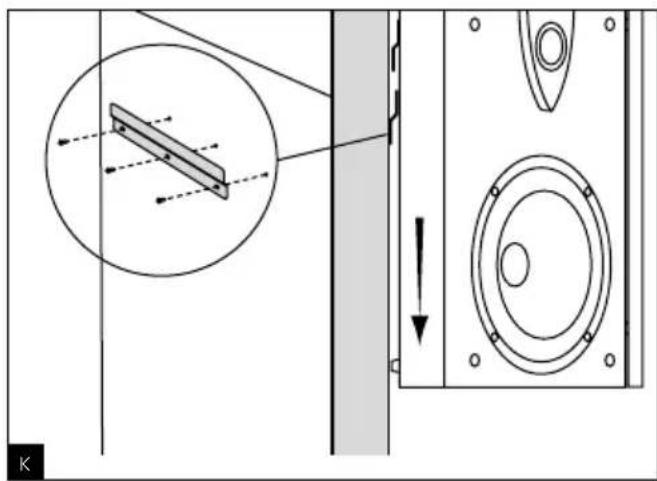
natural_image
Technical diagram showing a mechanical assembly with a circular component and a speaker chamber, no text or symbols present.Choix des enceintes
natural_image
Diagram showing two mechanical components with rotating parts and a central bolt, no text or symbols presentInternational Guarantee
The Focal guarantee only applies if this page is returned to us within 10 days purchase, to the following address:
Name of dealer: Town:
Date of purchase: Purchase price:
Your name: Age: Occupation: ____ ____
Your complete address: ____
Your email address:
Details of your installation (brand, model):
- iPod, iPad, iPhone®: ____ - Other music players: ____
■ Tuner / Web Radio: ____. ■ DVD: ____.
■ Blu Ray: ____. ■ CD / SACD: ____. - Satellite / TNT: ____, - Flat screen: ____.
■ Amplifier: ____ ■ Others: ____.
Your decision for purchasing this Focal model was made according to:
□ Dealer's advice Friend's advice □
□ Visit to an exhibition, show Press article □
□ Listening in auditorium Already own Focal products
□ Reliability / Quality Documentation □
☐ Reputation French produce ☐
□ Guarantee Quality / Price ratio □
□ Design / Finishes Other □ ____
Sound
In case of purchase of new equipment, what were your former speakers?
Explain in a few words why you choose Focal...
Further comments:
Now it's possible to register on line : www.focal.com/warranty


- F
- D
- The Focal-JMIab guarantee only applies if the enclosed guarantee card is returned to us within 10 days of purchase.
- Running-in period
- Specifications
- PROFILE
- User manual
- Positioning
- Optimization
- • Example 1:
- • Example 2:
- Important
- Connections
- User instructions
- Choice of speakers
- Central channel placement
- Effect channel speakers's place
- Magnetic disturbance
- Accessories
- User precautions
- About amplifiers
- Cable
- Conditions of guarantee
- Choix des enceintes
- International Guarantee
- Details of your installation (brand, model):
- Your decision for purchasing this Focal model was made according to:
Brand : FOCAL
Model : Profile SW 904
Category : Subwoofer