OB5031 - Switch IFM - Free user manual and instructions
Find the device manual for free OB5031 IFM in PDF.



| Product type | Fiber optic amplifier / Switch |
| Brand | IFM |
| Model | OB5031 / efector200 OBF |
| Dimensions (approx.) | 60 x 30 x 20 mm |
| Weight (approx.) | 50 g |
| Power supply | 10-30 V DC |
| Main functions | Contactless detection of objects and materials, switching signal, adjustment of switching threshold via push-button |
| Output | PNP, normally open / closed depending on programming |
| LED indicators | Red (error, short circuit, internal error), Yellow (switching status), Green (availability) |
| Electrical connection | 3-wire cable: BN (brown) = +, BU (blue) = -, BK (black) = output |
| Programming | By connecting the output wire according to diagram page 15 of the manual |
| Mounting | On standard profile (DIN rail) or mounting device |
| Compatible fiber optics | IFM type FE-50 and FT-50-AAJ |
| Range | Depending on the fiber optic used |
| Protection | IP65 (cover closed) |
| Maintenance and cleaning | Clean with a dry, lint-free cloth. Do not use aggressive agents. |
| Safety | Disconnect power before any connection or maintenance |
| Spare parts and repairability | ifm fiber optics FE-50 and FT-50-AAJ. Repair by the manufacturer only. |
| General information | Manual available for free download as PDF on notice-facile.com |
Frequently Asked Questions - OB5031 IFM
User questions about OB5031 IFM
0 question about this device. Answer the ones you know or ask your own.
Ask a new question about this device
Download the instructions for your Switch in PDF format for free! Find your manual OB5031 - IFM and take your electronic device back in hand. On this page are published all the documents necessary for the use of your device. OB5031 by IFM.
USER MANUAL OB5031 IFM
Operating instructions
Switching amplifier for fibre optics
Controls and indicators 7
Mounting
Mount the fibre optics 8
Electrical connection 8
Setting of the switching threshold 9, 10
Connection 15
8
Français
The switching amplifier senses objects and materials without contact and indicates their presence by a switching signal.
- Only for the connection of the ifm fibre optics type FE-50 and FT-50.
- Sensing range depends on the fibre optic.
Controls and indicators
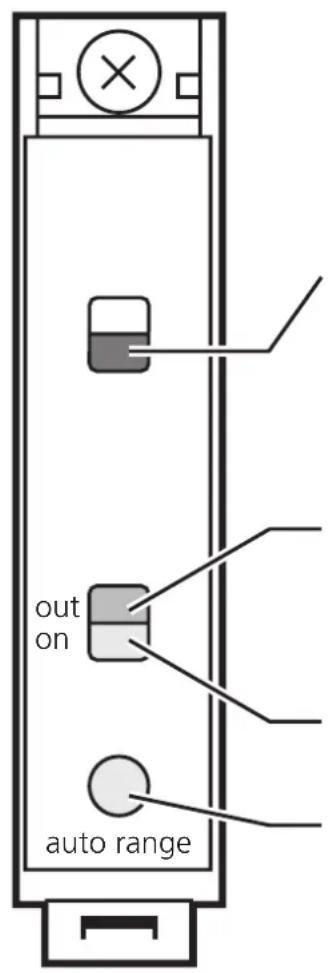
red LED:
- indicates the setting mode
- lights in the uncertain reception zone (maladjustment, soiling of the lens)
- flashes quickly: output short-circuited
- flashes slowly: internal malfunction
yellow LED:
switching status, lights when the output is switched
green LED:
lights when ready for operation
push button: starts the manual setting of the switching threshold
Mounting
Mount the unit on a DIN rail or by means of a mounting fixture.
Mount the fibre optics:
- Loosen the screw A.
- Push the fibre optics into the sensor holes B until you feel a stop and hold them.
- Tighten the screw A.
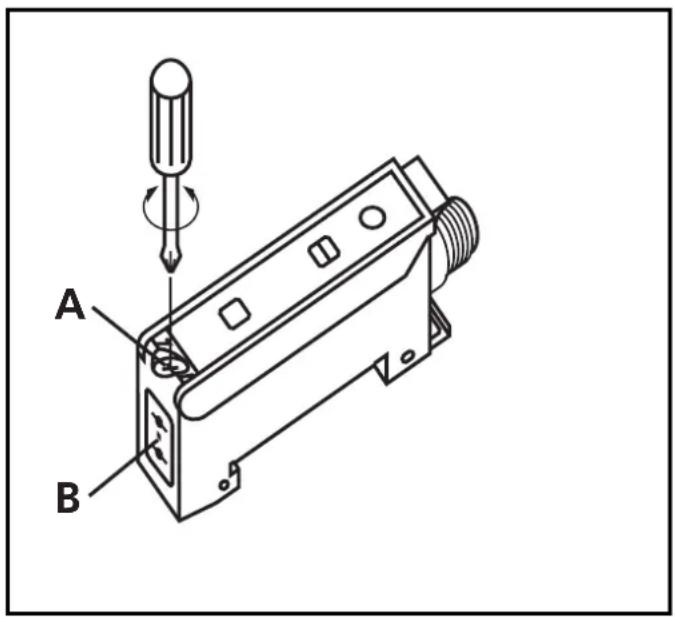

If the fibre optics are not in contact with the internal optics, the sensing range is reduced.
Electrical connection
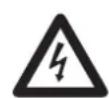
Isolate the power, then connect the unit as specified (see the last page or the type label).
- Core colours (for sensors with cable connection): BN = brown, BU = blue, BK = black.
- Programming of the output function by wiring (see the page 15 or the type label).
Setting of the switching threshold (1)
- Objects move through the detection area
- Diffuse reflection fibre (FT ...) and through-beam fibre (FE ...)
The unit detects input signals of various intensity in any sequence and calculates the optimum switching threshold.
| 1 | Allow the objects to pass through the detection area. Press until the red LED flashes. | Yellow and green LEDs flash alternately (= unit is in the programming mode). |
| 2 | Press once. | Yellow and green LEDs go out for a short time, then flash again alternately. |
| 3 | Press once. | Yellow and green LEDs go out for a short time, then the green LED is on (= unit is in the operating mode). |

If the setting of the switching threshold is not possible (e.g. object signal and background signal are about the same), the red LED flashes after step 3. The unit then passes into the operating mode with the switching threshold being unchanged.
Setting of the switching threshold (2)
- Stationary objects
- Diffuse reflection fibre (FT ...) and through-beam fibre (FE ...) The unit detects input signals of various intensity in any sequence and calculates the optimum switching threshold.
| 1 | Press until the red LED flashes. | Yellow and green LEDs flash alternately (= unit is in the programming mode). | |
| 2 | Place the object into the detection area.* Press once. | Yellow and green LEDs go out for a short time, then flash again alternately. |
| 3 | Remove the object.* Press once. | Yellow and green LEDs go out for a short time, then the green LED is on (= unit is in the operating mode). | |
| out on then the green LED is on (= unit is in the operating mode). |
- You can also proceed in reverse order: first setting without the object, then with the object.

If the setting of the switching threshold is not possible (e.g. object signal and background signal are about the same), the red LED flashes after step 3. The unit then passes into the operating mode with the switching threshold being unchanged.
Operation
Only open the cover to make adjustments. Close it after the adjustment has been made in order to maintain the protection IP65.
Check whether the unit functions properly.


Brand : IFM
Model : OB5031
Category : Switch