EasyManual
CPB 6K0.1N - Scale Kern - Free user manual and instructions
Find the device manual for free CPB 6K0.1N Kern in PDF.



User questions about CPB 6K0.1N Kern
0 question about this device. Answer the ones you know or ask your own.
Ask a new question about this device
Download the instructions for your Scale in PDF format for free! Find your manual CPB 6K0.1N - Kern and take your electronic device back in hand. On this page are published all the documents necessary for the use of your device. CPB 6K0.1N by Kern.
USER MANUAL CPB 6K0.1N Kern
Further language versions you will find online under www.kern-sohn.com/manuals
- Addition in Summenspeicher
8.1 Determination of the reference weight by weighing ................................................ 31
8.2 Numeric entering of the reference weight .............................................................. 333 CPB-N / CPB-DM-BA-def-2432 English
8.3 Automatic correction of the reference weight (verifiable models only) ..................... 34
Stabilization time 2 sec. Warm-up time 120 min. Minimum unit weight at piece counting under laboratory conditions* 100 mg 250 mg 500 mg Minimum unit weight at piece counting under normal conditions** 1 g 2,5 g 5 g Minimum piece weight 100 mg 250 mg 500 mg Reference quantity freely selectable Input Voltage 220 V – 240 V AC 50 Hz Mains adapter Secondary voltage 12 V, 500 mA Rechargeable battery (optional) Operating time Background illumination on: 60 h Background illumination off: 70 h Loading time of battery 12 h Auto-Off (battery) Options: 3, 5, 15, 30 min. Dimensions fully mounted (W x D x H) 320 x 350 x 125 mm Weighing surface 294 x 225 mm Permissible ambient condition 0° C to + 40° C Humidity of air max. 80 % relative (not condensing) Net weight (kg)
Stabilization time 2 sec. Warm-up time 10 min. Minimum unit weight at piece counting under laboratory conditions* 100 mg 250 mg 500 mg Minimum unit weight at piece counting under normal conditions** 1 g 2,5 g 5 g Minimum piece weight 100 mg 250 mg 500 mg Reference quantity freely selectable Input Voltage 220 V – 240 V AC 50 Hz Mains adapter Secondary voltage 12 V, 500 mA Rechargeable battery (optional) Operating time Background illumination on: 60 h Background illumination off: 70 h Loading time of battery 14 h Auto-Off (battery) Options: 3, 5, 15, 30 min. Dimensions fully mounted (W x D x H) mm 320 x 350 x 125 mm Weighing surface 294 x 225 mm Permissible ambient condition -10° C to + 40° C Humidity of air max. 80 % relative (not condensing) Net weight (kg)
- Minimum unit weight at piece counting under laboratory conditions: ➢ Perfect ambient conditions to perform high resolution counting ➢ No dispersion of counted parts weight **Minimum unit weight at piece counting under normal conditions: ➢ Unstable ambient conditions (wind gusts, vibrations) ➢ Dispersion of counted parts weightCPB-N / CPB-DM-BA-def-2432 6 English 2 Appliance overview
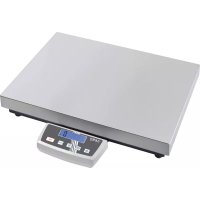
1. Weighing plate / rechargeable battery compartment
(under weighing plate)
6. Mains adapter connection
Models CPB-DM Weight Reference weight Quantity
Here the weight of the load is displayed in [kg]. The arrows above the symbols show:
Battery very low NET Net weight
Here, the reference weight of a sample is displayed in [g]. This value is either entered by user of calculated by balance. The arrows above the symbols show:
Reference weight placed on balance too small PRESET Stored target quantity / target weight
Number of pieces placed on balance too small PRE TARE Tare in memory PIECE WEIGHT Piece weight in memory
2.1.3 Display quantity
Here, all the pieces placed on balance are immediately displayed by number. The arrows above the symbols show:
- Addition in sum memory
- Call up total memory
- Output to external device (printer) or PC
- Enter reference weight through weighing
The balance you purchased is intended to determine the weighing value of material to be weighed. It is intended to be used as a “non-automatic balance”, i.e. the material to be weighed is manually and carefully placed in the centre of the weighing plate. As soon as a stable weighing value is reached, the weighing value can be read.
Our balances are non-automatic balances and not provided for use in dynamic weighing processes. However, the balances can also be used for dynamic weighing processes after verifying their individual operative range, and here especially the accuracy requirements of the application. Do not leave permanent load on the weighing plate. This may damage the measuring system. Impacts and overloading exceeding the stated maximum load (max) of the balance, minus a possibly existing tare load, must be strictly avoided. Balance may be damage by this. Never operate the balance in explosive environment. The serial version is not explosion protected. The structure of the balance may not be modified. This may lead to incorrect weighing results, safety-related faults and destruction of the balance. The balance may only be used according to the described conditions. Other areas of use must be released by KERN in writing.
Warranty claims shall be voided in case
- Our conditions in the operation manual are ignored
- The appliance is used outside the described uses
- The appliance is modified or opened
- Mechanical damage or damage by media, liquids, natural wear and tear
- The appliance is improperly set up or incorrectly electrically connected
- The measuring system is overloaded11 CPB-N / CPB-DM-BA-def-2432 English
3.4 Monitoring of Test Resources
In the framework of quality assurance the measuring-related properties of the balance and, if applicable, the testing weight, must be checked regularly. The responsible user must define a suitable interval as well as type and scope of this test. Information is available on KERN’s home page (www.kern-sohn.com with regard to the monitoring of balance test substances and the test weights required for this. In KERN's accredited DKD calibration laboratory test weights and balances may be calibrated (return to the national standard) fast and at moderate cost. 4 Basic Safety Precautions
4.1 Pay attention to the instructions in the Operation Manual
Carefully read this operation manual before setup and commissioning, even if you are already familiar with KERN balances. Versions in other languages are non-binding translations. The only binding version is the original document in German.
4.2 Personnel training
The appliance may only be operated and maintained by trained personnel. 5 Transport and storage
5.1 Testing upon acceptance
When receiving the appliance, please check packaging immediately, and the appliance itself when unpacking for possible visible damage.
Keep all parts of the original packaging for a possibly required return. Only use original packaging for returning. Prior to dispatch disconnect all cables and remove loose/mobile parts. Reattach possibly supplied transport securing devices. Secure all parts such as the glass wind screen, the weighing platform, power unit etc. against shifting and damage.CPB-N / CPB-DM-BA-def-2432 12 English 6 Unpacking, Setup and Commissioning
6.1 Installation Site, Location of Use
The balances are designed in a way that reliable weighing results are achieved in common conditions of use. You will work accurately and fast, if you select the right location for your balance. On the installation site observe the following:
- Place the balance on a firm, level surface.
- Avoid extreme heat as well as temperature fluctuation caused by installing next to a radiator or in the direct sunlight.
- Protect the balance against direct draughts due to open windows and doors.
- Avoid jarring during weighing.
- Protect the balance against high humidity, vapours and dust.
- Do not expose the device to extreme dampness for longer periods of time. Non-permitted condensation (condensation of air humidity on the appliance) may occur if a cold appliance is taken to a considerably warmer environment. In this case, acclimatize the disconnected appliance for ca. 2 hours at room temperature.
- Avoid static charge of goods to be weighed or weighing container.
- Do not operate in areas with hazard of explosive material or in potentially explosive atmospheres due to materials such as gasses, steams, mists or dusts.
- Keep away chemicals (such as liquids or gasses), which could attack and damage the balance inside or from outside.
- In the event of the occurrence of electromagnetic fields, static charges (e.g., when weighing / counting plastic parts) and unstable power supply, large display deviations (incorrect weighing results, as well as damage to the scale) are possible. Change location or remove source of interference.
Carefully remove the balance from the packaging, remove plastic cover and setup balance at the intended workstation.
Level balance with foot screws until the air bubble of the water balance is in the prescribed circle.13 CPB-N / CPB-DM-BA-def-2432 English
Ensure that transport guard has been removed (only existing in 6 kg models)
To loosen the transport guard screw out transport screw [1] anticlockwise. For transportation carefully screw-in transport screw clockwise till to the stopper and then fix it using locknut.
6.2.2 Scope of delivery
6.3 Mains connection
Power is supplied via the external mains adapter. The stated voltage value must be the same as the local voltage. Only use original KERN mains adapters. Using other makes requires consent by KERN.
6.4 Rechargeable battery operation (optional)
The internal battery is charged with the supplied mains cable. Before the first use, the rechargeable battery should be charged by connecting it to the mains power cable for at least 12 hours. The operating time of the battery is about. 70h. Charging time until complete recharging ca. 12h. AUTO-OFF function can be selected after 3, 5, 15, 30 min. to save the rechargeable battery (see chap.12). If an arrow appears on the weight display above the battery symbol or "bat lo" when turning on the balance, this is an indication that the capacity of the rechargeable battery will soon be exhausted. The balance will be ready to operate for about another 10 hours, then it will switch off automatically. Connect the power cable as soon as possible to load the rechargeable battery. The LED display under the piece number window informs you during charging about the charging status of the rechargeable battery. red: Battery is almost discharged green: Battery is completely discharged
6.5 Connection of peripheral devices
Before connecting or disconnecting of additional devices (printer, PC) to the data interface, always disconnect the balance from the power supply. With your balance, only use accessories and peripheral devices by KERN, as they are ideally tuned to your balance.
6.6 Initial Commissioning
A warming up time of 2 hours after switching on stabilizes the measuring values. The accuracy of the balance depends on the local acceleration of gravity. Strictly observe hints in chapter Adjustment.15 CPB-N / CPB-DM-BA-def-2432 English
As the acceleration value due to gravity is not the same at every location on earth, each balance must be coordinated - in compliance with the underlying physical weighing principle - to the existing acceleration due to gravity at its place of location (only if the balance has not already been adjusted to the location in the factory). This adjustment process must be carried out for the first commissioning, after each change of location as well as in case of fluctuating environment temperature. To receive accurate measuring values it is also recommended to adjust the balance periodically in weighing operation. Procedure when adjusting: Observe stable environmental conditions. A warming up time (see chapter 1) is required for stabilization. Ensure that there are no objects on the weighing plate. Provide calibration weight, for details, see chapter 1 "Technical Data. "
6.7.1 Models CPB-N (non verified models)
Operation Display Switch on balance and during self-check press the TARE key
Use the numeric keys to enter password:
- Default password "0000" Should this password entry not be possible, enter a personal password; (entry using function F6 PKn see. chap.11.1). Also possible to continue the adjustment process with TARE-button.
CPB-N / CPB-DM-BA-def-2432 16 English Press the TARE button, the acceleration value due to gravity is displayed.
Put the adjustment weight (see chap. 1) carefully in the center of the weighing plate, „PASS“ will be displayed. While the balance carries out a self test, remove the adjustment weight.
After successful adjustment the balance automatically returns to weighing mode. In case of an adjustment error or incorrect adjusting weight the display will show an error message; repeat adjustment process.
The adjustment is locked for verified balances. Carrying out adjustment requires that the seal is destroyed and the adjusting switch is pressed when turning on the scale. For position of adjusting switch, see chap. 6.9.1. Attention: After destruction of the seal the balance must be re-verified by an authorised agency and a new verification wire/seal mark fitted before it can be reused for applications subject to verification.
Operation Indication Switch-on balance and during the selftest actuate the adjustment switch and press the TARE button
Use the number keys to enter password: either
- Personal password, enter under function F6 PKn see chap.12 Confirm with TARE button
CPB-N / CPB-DM-BA-def-2432 18 English TARE button, „UnLoAD“ appears Press the TARE key anew „LoAd“ as well as the currently set adjustment weight appear flashing either
- In order to change, enter the desired weight value of the adjustment weight by the numeric keyboard and confirm on the TARE button. In order to achieve high-quality weighing results in the sense of the measuring technology, it is recommended to select the nominal value as high as possible. We recommend 80 % max.
(Example) Carefully place adjusting weight in the centre of the weighing plate Wait for stability display, then press the TARE button While the balance carries out a self test, remove the adjustment weight.
After successful adjustment the balance automatically returns to weighing mode. In case of an adjustment error or incorrect adjusting weight the display will show an error message; repeat adjustment process.
6.8 Linearization (non-verified models only)
Linearity shows the greatest deviation of a weight display on the scale to the value of the respective test weight according to plus and minus over the entire weighing range. If linearity deviation is discovered during a testing instrument control, you can improve this by means of linearization.
- Carrying out linearization is restricted to specialist staff possessing well acquainted with the workings of weighing scales.
- The test weights to be used must be adapted to the weighing scale’s specifications; see chapter 3.4 “testing instruments control”.
- Observe stable environmental conditions. Stabilisation requires a certain warm-up time.
- After successful linearization you will have to carry out calibration; see
chapter 3.4 “Testing instruments control”
Tab. 1: Adjustment points Adjustment weight
Operation Display How to carry out linearization: Switch on balance and during self-check press the TARE key
CPB-N / CPB-DM-BA-def-2432 20 English Press TARE button, the acceleration value due to gravity is displayed. Press the TARE key anew
„LoAd 0“ appears, after a short time a signal will sound and „LoAd 1“ appears
First adjustment weight (s. tab. 1) after a short time a signal will sound and „LoAd 2“ appears Second adjustment weight after a short time again a signal will sound and „LoAd 3“ appears.
Third adjustment weight after a short time again a signal will sound and „LoAd 4“ appears.
Forth adjustment weight after a short time again a signal will sound and „LoAd 3“ appears. Forth adjustment weight after a short time a signal will sound and „LoAd 2“ appears.
Third adjustment weight after a short time a signal will sound and „LoAd 1“ appears
(Example) 21 CPB-N / CPB-DM-BA-def-2432 English Second adjustment weight after a short time a signal will sound and „LoAd 0“ appears. First adjustment weight After successful linearization the balance automatically returns to weighing mode.
General introduction: According to EU directive 2009/23/EG balances must be verified if they are used as follows (legally controlled area): a) For commercial transactions if the price of goods is determined by weighing. b) For the production of medicines in pharmacies as well as for analyses in the medical and pharmaceutical laboratory. c) For official purpose. d) For manufacturing final packages. In cases of doubt, please contact your local trade in standard. After verification the balance is sealed at the indicated positions. Verification of the balance is invalid without the "seal".
Verification notes: An EU type approval exists for balances described in their technical data as verifiable. If a balance is used where obligation to verify exists as described above, it must verified and re-verified in regular intervals. Re-verification of a balance is carried out according to the respective national regulations. The validity for verification of balances in Germany is e.g. 2 years. The legal regulation of the country where the balance is used must be observed! Balances with obligation to verify must be taken out of operation if:
- The weighing result of the balance is outside the error limit. Therefore, in regular intervals load balance with known test weight (ca. 1/3 of the max. load) and compare with displayed value.
- The reverification deadline has been exceeded.23 CPB-N / CPB-DM-BA-def-2432 English
6.9.1 Adjustment switch and seals
Possible seals: enforced, and or
3. Verification switch
4. Verification wire
6.10 Checking the balance verification settings
For the adjustment, the balance must be switched over to service mode.
In the service mode the parameters of the balance can be modified. The service parameters may not be modified, as this could damage the balance settings.
In calibrated scales the service mode is locked individually for each switch. To disable the access lock, destroy the seal and actuate the switch. For position of switch see chap. 6.9.1. Attention: After destruction of the seal the balance must be re-verified by an authorised agency and a new verification wire/seal mark fitted before it can be reused for applications subject to verification.CPB-N / CPB-DM-BA-def-2432 24 English
6.11 Service mode (verified models)
This overview of the service parameters is merely for checking the parameters set by the appropriate Bureau of Standards. No changes may be made. Access to menu: Switch-on balance and during the selftest press the TARE button
Use the number keys to enter password: either
- Personal password, enter under function F6 PKn see chap.12 Confirm with TARE button
Select function: Press to select the individual functions showing the current settings one by one. Change / save settings: Confirm selected function by pressing . Select desired setting by pressing and confirm by pressing or cancel by pressing . Exit menu: Using the balance returns into the weighing mode.25 CPB-N / CPB-DM-BA-def-2432 English Overview for service parameter:
F4 AU Add-up mode and data output AU on* Automatic summation mode b9600*, b600, b1200, b2400, b4800 LP 50 EnG CHi Not documented
Pre-Tare Pt oFF* Pretaring value off: Always use this setting Pt on Pretaring value on
Password Pin 1* Enter the new password Pin 2 Confirm the new password
F8 oFF Auto Off oF 0* Automatic shutdown off oF 3 Automatic shutdown after 3 min oF 5 Automatic shutdown after 5 min oF 15 Automatic shutdown after 15 min oF 30 Automatic shutdown after 30 minCPB-N / CPB-DM-BA-def-2432 26 English F9 Grv
F10 bEP Audio signal ok* Signal sound, when the load is within the set range Low Signal sound, when the load is below the lower limit value
Signal sound, when the load is beyond the set range HiGH Signal sound, when the load is above the upper limit value
F14 AUW* off Automatic correction of reference weight
*F14 Only available for calibratable models. Calibratable models end with M.27 CPB-N / CPB-DM-BA-def-2432 English 7 Operation Mode
7.1 Switch on/off and set zero
Operation Indication
1. Switch on balance
Press ON/OFF switch and hold briefly (at the bottom right side of the balance) The balance will carry out a self-test
As soon as the weight display shows "0" in all the three display windows your balance is ready to weigh.
Operation Display Place load onto weighing plate
Read weighing result
If weighing values are stable the arrow will be displayed above the - symbol. If the goods are heavier than the weighing range, the display will show "QL" (=Overload), and a whistle is sounded.CPB-N / CPB-DM-BA-def-2432 28 English
7.3 Weighing with taring
The dead weight of any weighing container may be tared away by pressing a button, so that the following weighings show the net weight of the goods to be weighed. Operation Indication Place empty tare container on the weighing plate. The total weight of the container is displayed.
The weight of the container is now internally saved. The zero display and the arrows above the symbols - - will appear.
Place the goods to be weighed into the tare container.
Read the weight of the goods on the display.
- The taring process can be repeated any number of times, e.g. when adding several components for a mixture (adding). The limit is reached when the whole weighing range is exhausted.
- The tare value will be rounded off according to the readability of the weighing scales.29 CPB-N / CPB-DM-BA-def-2432 English Reset display to "0":
The total weight of the container is tared away. Add more components into the weighing container (adding).
Now read off the weight of the added item to be weighed on the display.
Delete tare value: Unload the weighing platform and press .CPB-N / CPB-DM-BA-def-2432 30 English
7.4 Display background illumination
The balance has the following possibilities of setting for the display background illumination: Keep pressed in weighing mode. The last selected setting will be shown. Press to select the following settings:
Select desired setting by . The setting is taken over and the balance changes into weighing mode.31 CPB-N / CPB-DM-BA-def-2432 English 8 Piece counting With pieces counting you can either count parts into a container or remove parts from a container. To count a greater number of parts the average weight per part has to be determined with a small quantity (reference quantity). The larger the reference quantity, the higher the counting exactness. High reference must be selected for small parts or parts with considerably different sizes.
8.1 Determination of the reference weight by weighing
Set reference: Place a known number of pieces on the balance as reference Wait for the stability display, than enter the number of individual items via the numeric keypad. Confirm within 5 sec: „SAMP“ is shortly displayed;
The reference weight will be determined and displayed.
CPB-N / CPB-DM-BA-def-2432 32 English Count the items: Tare if necessary, place weighing good and read off the number of items. Weight placed on balance: Reference weight: Quantity placed on balance:
The display value can be printed out by connecting an optional printer and pressing . Printout example KERN YKB-01N: Item counter NO.
Weight placed on balance
Quantity placed on balance PCS
- If necessary, the reference weight will be calculated anew when more pieces are placed whose quantity is less than the placed reference material. This reference optimisation will be indicated by a signal sound.
- The reference weight is only determined with stable weighing values
- If weighing values are under zero, the piece counter display shows a negative number of items. Delete reference Press , the reference weight will be deleted.33 CPB-N / CPB-DM-BA-def-2432 English
8.2 Numeric entering of the reference weight
If you know the reference weight/piece you can enter this via numeric keys. Set reference: Enter reference weight via number keys Confirm within 5 sec:
Count the items: Tare if necessary, place weighing good and read off the number of items. Weight placed on balance: Reference weight: Quantity placed on balance:
The display value can be printed out by connecting an optional printer and pressing . Printout example KERN YKB-01N: Item counter NO.
Weight placed on balance
Quantity placed on balance PCS
8.3 Automatic correction of the reference weight (verifiable models only)
The balance has the possibility to correct the deviation automatically if the reference weight differs from the previously adjusted value of the reference weight.
- Menu setting: [ F14 AQ Qn], see chap. 6.11 Service mode*
Set reference: Place a known number of pieces on the balance as reference Wait for the stability display, than enter the number of individual items via the numeric keypad. Confirm within 5 sec: „SAMP“ is shortly displayed;
The reference weight will be determined and displayed.
Put on more items to be weighed, the balance will correct the reference weight and an acoustic signal sounds, if it has been activated under menu item „F13 bee“
(example) *F14 Only available for calibratable models. Calibratable models end with M.35 CPB-N / CPB-DM-BA-def-2432 English 9 Totalization This function allows you to execute several weighing procedure. After that, the total items number, the total weight and the number of weighing procedures will be displayed.
- Menu setting: [F4 AU QFF], see chap. 12.2.1
Determine the average piece weight (see chap. 8.1) or enter manually (see chap.
Place weighing goods A.
Wait for stability display, then press . The displayed values are added into the summation memory and edited, when an optional printer is connected. Weight, number of weighing procedures (ACC 1) as well as the quantity of items are displayed for 2 sec..
Currently placed weight
Currently placed quantity of itemsCPB-N / CPB-DM-BA-def-2432 36 English Printout example KERN YKB-01N: Number weighing processes NO.
Weight placed on balance
Quantity placed on balance PCS
Remove the weighed good. More weighed goods can only be added when the display ≤ zero. Place goods to be weighed B.
Wait for stability display, then press . The displayed values are added into the summation memory and edited, when an optional printer is connected. Total weight, number of weighing procedures (ACC 2) as well as total items number appear for 2 sec.
Printout example KERN YKB-01N: Number weighing processes NO.
Weight placed on balance
Quantity placed on balance PCS
pcs37 CPB-N / CPB-DM-BA-def-2432 English Add more weighed goods as described before. Please note that the weighing system must be unloaded between the individual weighing procedures. You can repeat this process until the capacity of the weighing system is exhausted. Display sum total: Press , total weight, number of weighing procedures and total number of items will be displayed shortly. Press during this display for data output.
Number of weighing procedures
Number weighing processes NO.
Total number of pieces PCS
Delete total added memory Press , the total weight, number of weighing procedures as well as total number of items are displayed. During this display press . The data in the summation memory are deleted.CPB-N / CPB-DM-BA-def-2432 38 English
9.2 Automatic adding-up
With this function the individual weighing values are automatically added into the summation memory when the balance is unloaded without pressing and edited, when an optional printer is connected.
Menu settings: [ F4 AU QN]
Add up: Place weighing goods A. After the standstill control sounds a signal tone. Unload the weighing good, the weighing value is added into the summation memory (ACC1) and printed out. Place goods to be weighed B. After the standstill control sounds a signal tone. Unload the weighing good, the weighing value is added into the summation memory (ACC2) and printed out. Add more weighed goods as described before. Please note that the balance must be unloaded between the individual weighing procedures. This process can be repeated 99 times or until the weighing range of the balance is exhausted.
For how to display and delete the total sum, as well as a printout example, see chap. 9.1.39 CPB-N / CPB-DM-BA-def-2432 English 10 Weighing to target quantity or target weight and tolerance check An acoustic signal is sounded as soon as the number of items placed or a certain weight value reaches or exceeds/drops below a pre-set limit (depending on the settings in menu F10) Options:
- OK Signal sound, when the load is within the set range
- Low Signal sound, when the load is below the lower limit value
- NG Signal sound, when the load is beyond the set range
- High Signal sound, when the load is above the upper limit value
10.1 Tolerance check for target quantity
Select target number mode: Keep pressed, the set mode will appear
Determine lower limit value for target item number: Enter the lower limit value via the numeric keyboard, e.g.: 60 Pcs Press Press repeatedly until the balance is in weighing mode41 CPB-N / CPB-DM-BA-def-2432 English Start tolerance check Determine the average piece weight (see chap. 8.1) or enter manually (see chap. 8. 2). Place the load, wait until the acoustic signal sounds, depending on the settings in the menu „F10“ (see chap. 11.2, only for non-verified models). Delete limit values: For all limit values enter „0“ and confirm using the TARE button.
10.2 Tolerance check for target weight
Select target weight mode: Keep pressed, the set mode will appear
Check psc - Tolerance check for target item number Press Check off – Tolerance check switched off Press Check net -: Tolerance check for target weightCPB-N / CPB-DM-BA-def-2432 42 English Select target weight mode: By keeping pressed the desired tolerance weighing mode can be selected:
- Check off – Tolerance check switched off
Set limit values: Determine upper limit value for target weight: Press repeatedly and confirm via the TARE button until „Hi nEt“ appears:
Press repeatedly until the balance is in weighing mode
Start tolerance check Place the load, wait until the acoustic signal sounds, depending on the settings in the menu „F10“ (see chap. 11.2, only for non-verified models). Delete limit values: For all limit values enter „0“ and confirm using the TARE button.CPB-N / CPB-DM-BA-def-2432 44 English 11 Menu (non verifiable models) Access to menu: Switch-on balance and during the selftest press the TARE button.
Use the number keys to enter password: either
- Personal password, enter under function F6 PKn see chap.12 Confirm with TARE button
Select function: Press to select the individual menu items showing the current settings one by one. Change / save settings: Confirm selected function by pressing . Select desired setting by pressing and confirm by pressing or cancel by pressing . Exit menu: Using the balance returns into the weighing mode.45 CPB-N / CPB-DM-BA-def-2432 English
F4 AU Add-up mode and data output AU on* Automatic summation mode b9600*, b600, b1200, b2400, b4800 LP 50 EnG CHi not documented
F5 AZn Zeroing range 2d* Automatic zero-setting, selectable between 0.5d, 1d, 2d and
F8 oFF Auto Off oF 0* Automatic shutdown off oF 3 Automatic shutdown after 3 min oF 5 Automatic shutdown after 5 min oF 15 Automatic shutdown after 15 min oF 30 Automatic shutdown after 30 minCPB-N / CPB-DM-BA-def-2432 46 English F9 Gru Gravity
F10 bEP Audio signal ok* Signal sound, when the load is within the set range Low Signal sound, when the load is below the lower limit value
Signal sound, when the load is beyond the set range HiGH Signal sound, when the load is above the upper limit value
- default setting47 CPB-N / CPB-DM-BA-def-2432 English 12 Data output RS 232 C The balance is typically equipped with a RS 232C interface. Weighing data can be edited according to menu setting or automatically or by pressing via the interface. This data exchange is asynchronous using ASCII - Code. The following conditions must be met to provide successful communication between the weighing balance and the printer.
- Use a suitable cable to connect the weighing balance to the interface of the printer. Faultless operation requires an adequate KERN interface cable.
- Communication parameters (baud rate, bits and parity) of weighing balance and printer have to match, see chap. 11.2, Menu block „F4 AU“
12.2 Remote control instructions
The remote control commands are sent from the remote control unit to the balance as ASCII code. After the balance having received the commands, it will send the following data. Take into account that the following remote control commands must be sent without a subsequent CR LF.
Tare placed weighing vessel
Before cleaning, please disconnect the appliance from the operating voltage. Please do not use aggressive cleaning agents (solvents or similar agents), but a cloth dampened with mild soap suds. Ensure that no liquid penetrates into the device and wipe with a dry soft cloth. Loose residue sample/powder can be removed carefully with a brush or manual vacuum cleaner. Spilled weighing goods must be removed immediately.
The appliance may only be opened by trained service technicians who are authorized by KERN. Before opening, disconnect from power supply.
Disposal of packaging and appliance must be carried out by operator according to valid national or regional law of the location where the appliance is used.
Should other error messages occur, switch balance off and then on again. If the error message remains inform manufacturer.CPB-N / CPB-DM-BA-def-2432 50 English 14 Instant help In case of an error in the program process, briefly turn off the balance and disconnect from power supply. The weighing process must then be restarted from the beginning. Fault Possible cause The displayed weight does not glow.
- The balance is not switched on.
- The mains supply connection has been interrupted (mains cable not plugged in/faulty).
- Power supply interrupted.
- No batteries inserted. The displayed weight is permanently changing
- Draught/air movement
- Table/floor vibrations
- Weighing plate has contact with other objects.
- Electromagnetic fields / static charging (choose different location/switch off interfering device if possible) The weighing result is obviously incorrect
- The display of the balance is not at zero
- Adjustment is no longer correct.
- Great fluctuations in temperature.
- Electromagnetic fields / static charging (choose different location/switch off interfering device if possible)51 CPB-N / CPB-DM-BA-def-2432 English 15 Declaration of conformity
To view the current EC/EU Declaration of Conformity go to:
The scope of delivery for verified weighing balances (= conformity- rated weighing balances) includes a Declaration of Conformity.CPB-N / CPB-DM-BA-def-2432 2 Français
- Courant d´air/circulation d´air