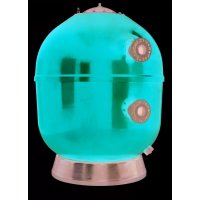
Vesubio - Water filter ASTRALPOOL - Free user manual and instructions
Find the device manual for free Vesubio ASTRALPOOL in PDF.



| Product type | Pool sand filter |
| Brand | AstralPool |
| Model | Vesubio |
| Use | Pool water filtration |
| Material | Plastic (filter body and valve) |
| Valve type | 6-position multiport valve |
| Valve positions | Filter, Wash, Rinse, Recirculate, Drain, Closed |
| Filter media | Silica sand grain size 0.5 to 0.7 mm |
| Normal filtration pressure | 0.8 kg/cm² (11.4 PSI) |
| Wash pressure | 1.3 kg/cm² (18.5 PSI) |
| Connection | Plastic pipes with Teflon seals (do not use iron or putty) |
| Installation | 0.50 m below water level, on horizontal surface, near pool |
| Routine maintenance | Sand cleaning with ASTRAL Filnet solid or liquid |
| Sand change | Approximately every 3 years |
| General maintenance | Replace seals and parts if necessary; do not use solvents |
| Winterizing | Drain water, remove lid for ventilation |
| Safety | Do not operate without water, do not handle while plugged in, do not sit on it |
| Pump required | Yes (not included) |
| Assembly precautions | Do not overtighten nuts; use sealing gaskets |
| Repairability | Spare parts available: seals, lid, pressure gauge, multiport valve |
Frequently Asked Questions - Vesubio ASTRALPOOL
User questions about Vesubio ASTRALPOOL
0 question about this device. Answer the ones you know or ask your own.
Ask a new question about this device
Download the instructions for your Water filter in PDF format for free! Find your manual Vesubio - ASTRALPOOL and take your electronic device back in hand. On this page are published all the documents necessary for the use of your device. Vesubio by ASTRALPOOL.
USER MANUAL Vesubio ASTRALPOOL
natural_image
Close-up of water droplets on a plain surface (no text or symbols)SAND FILTERS
HIGH SPEED FILTERING
FILTRES A SABLE
A PASSAGE RAPIDE
FILTROS DE ARENA
MANUAL DE INSTRUÇÕES E MANUTENÇÃO
MONTAJ VE BAKIM EL KITABI
NÁVOD NA INSTALACI A ÚDRŽBU
WHAT HAPPENS TO THE WATER IN YOUR POOL?
This should be a question of prime consideration for all pool owners. In the past some pools did not use filtering systems, the owner was faced with the problem of refilling the pool with clean water when this became necessary. Refilling the pool was laborious, meanwhile the owner had an unsanitary pool with unpleasant bathing owing to the poor clarity of the water. Today pool owners demand absolute hygiene, crystal clear water and economy of effort. These objectives are achieved by effective filtration and chemical treatment of the pool water.
After filling the pool with clean water in the summer, two basic factors can take place due to the exposure of water to the sun and the air.
1.- Biological contamination. The water is contaminated by micro-organisms which may be airborne or introduced by bathers.
These parasites reproduce rapidly in still warm water and algae may form giving a greenish appearance to the pool water.
2.- Rainfall and wind may introduce dust, with leaves and seeds which muddy and pollute the pool water.
These two factors generate in little time an unsanitary swimmingpool and unpleasant bathing.
Solutions to the problem:
Maintain the correct level of sanitiser (chlorine, brom, oxygen...) in the water to combat existing micro-organisms by its disinfecting action.
As chlorine is the more common method, it will be taken as the reference point.
2.- "PHYSICAL" TREATMENT
Provide the pool with a filtration system (filter and pump) to remove suspended particles from the water.
PH LEVEL
The pH level is an indicator of acidity or alkalinity present in the water. The neutral value is 7.0. a pH of 0-7 means levels of acidity whilst 7-14 gives levels of alkalinity. The pool usual readings vary between 6.8 and 8.4.
Why pH is important?
"THE IDEAL PH VALUE IN A POOL SHOULD BE BETWEEN 7.2 AND 7.6".
As previously stated, sufficient residual chlorine must exist in the pool to destroy unwanted microorganisms, in fact the chlorine will only act as a bactericide when the pool water has a pH of between 7.2 and 7.6.
There are other reasons which call for a correct pH level: Once above 7.6, calcium in the pool will precipitate to a visible cloudy form (accentuated in hard water areas).
This gives a milky appearance to the water, and hinders the filtering, deposits may also appear on the pool walls and fittings.
Once the pH level falls below 7.0 the pool water becomes corrosive causing eye irritation and affecting mucous membranes. There is also a long term threat to metallic parts in the pool.
The quality of the pool water is highly dependent on maintaining the correct pH level.
CHLORINE
Standards for the amount of residual (free) chlorine in the pool water may vary from country to country, depending on health authority regulations. Typical legal requirements are between 0.2 and 0.6 parts per million, (i.e. 0.2-0.6 milligrams per litre).
What is understood by free or residual chlorine?
Even after the filtering process, certain bacteria remains to be destroyed by the disinfecting action of the chlorine which is usually acting on the bacteria in the form of hyperchloric acid.
A quantity of chlorine that is added to the water (in excess of that needed to destroy bacteria and oxidize organic material) remains free to combat new bacteria introduced by bathers or atmospheric agents.
This chlorine remaining in the water in the form of hyperchloric acid is known as free, residual chlorine.
FILTRATION
It is essential that the filtration is accompanied by chemical treatment of the pool water.
The two processes are complimentary to each other.
WORKING PRINCIPLES
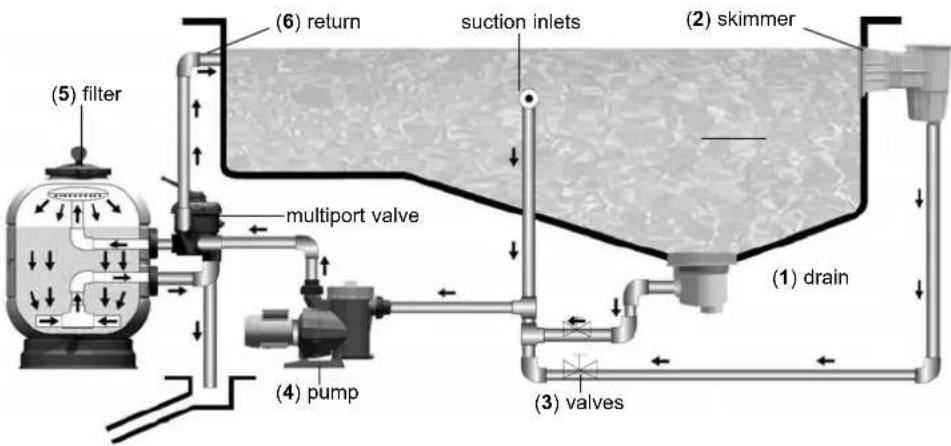
A suction is taken from the main drains (1) on the bottom of the pool and the skimmers (2) at the pool surface and fed via separate pipework with their corresponding valves (3), through the pump (4) to the sand filter (5).
After filtration, the water is returned to the pool via return inlets (6), which are installed on the opposite side of the pool to the skimmers and main drains.
Once in the filter, the water is circulated downwards through silica sand and suspended particles are retained.
The filter sand needs to be washed at intervals to remove the particles it has retained backwash.
This is achieved by reversing the flow through the filter and directing the water containing the dislodged particles to drain.
When the filter pressure reaches over 1,3 Kg/cm ^2 means that the sandfilter needs to be backwashed.
Bearing these principles in mind, the following installation and operation instructions should not represent any problem.
INSTALLATION
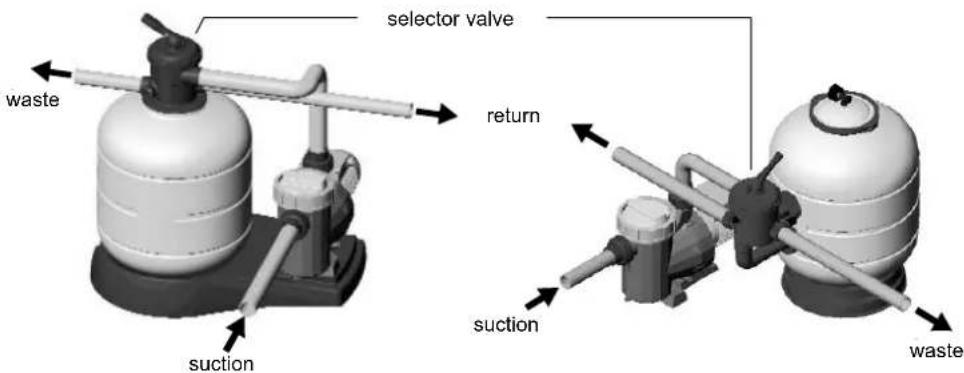
The filter should be installed as close as possible to the swimming pool and preferably at a level of 0,50 metres below the surface of the water in the swimming pool. Make sure there is drainage available at the place where the filter is to be installed.
IMPORTANT: Do not use an iron and hemp pipe for the selector valve connection, it is essential to use plastic accessories and TEFLON tape. Pipe terminals are available threaded fixing in 1 ½ " and 2".
Always leave enough space round the filter in order to perform the necessary examinations and maintenance during the filter's life.
ASSEMBLY
Follow these indications for a correct assembly of the filter:
1.- Place the filter on a horizontal and clean surface.
2.- Place the filter in its final location.
3.- In case of a filter with a lateral valve, install the selector valve in the filter. Make sure that the joints between the valve and the filter are correctly placed.
4.- Perform the three connections of the selector valve: pump piping to the valve, valve to the waste drain and valve to the pool return. Each of these three outlets is clearly identified on the valve.
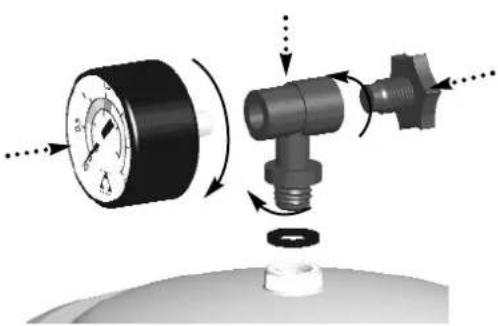
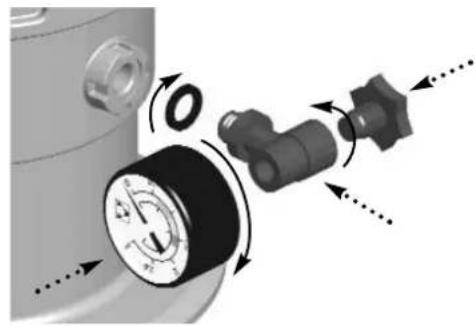
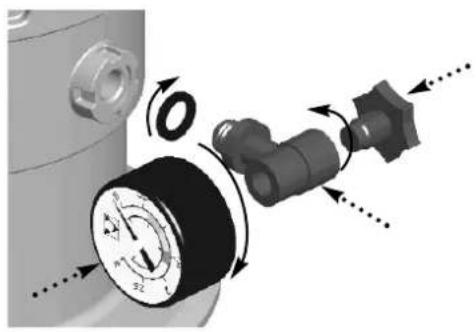
5.- Set the manometer T, the joint, the manometer and the air drainage (see exploded view). It is not necessary to use Teflon tape, as the watertightness is guaranteed in this case by the joint. Do not tighten the manometer T with a tool, as manually will be sufficient.
ENGLISH
natural_image
Mechanical assembly diagram showing a pressure gauge and valve mechanism (no text or symbols)Assembly of the manometer (with lateral valve)
natural_image
Mechanical assembly diagram showing a valve mechanism with rotating components (no text or symbols)Assembly of the manometer (with top valve)
SAND LOAD
In order to obtain maximum efficiency from your filter, it should be filled with silica sand with a grain size classification of 16 / 32 inches. With the quantity indicated on the plate specifying the characteristics; proceed as follows:
1.- Load up when the filter is installed in position and the connection pipes have been joined.
2.- Take off the lid and joint.
3.- Fill the filter with water to half capacity.
4.- Pour the required quantity of sand inside the filter.
5.- Clean the seating of the lid joint.
6.- Fix the filter lid in place.
FILTRATION PROCESS
The selector valve has a handle of 6 positions that selects any of the necessary operations to obtain the maximum efficiency from the filter.

IMPORTANT: Always switch off the pump, when changing the position of the selector valve.
FILTRATION
With the pump switched off, place the handle of the selector valve in the FILTERING position.
Switch on the pump.
During this operation, it is advisable to observe the pressure gauge from time to time as this indicates the degree of saturation of the filter. When the pressure reaches 18.5 PSI a "BACKWASH" should be carried out. The main drain and skimmer valves will be regulated according to the quantity of floating material found on the surface of the water. Bear in mind that with the main drain valve fully open there will be little suction from the skimmers. If the surface sweep of the skimmers is to be stronger, reduce the flow from the main drain.
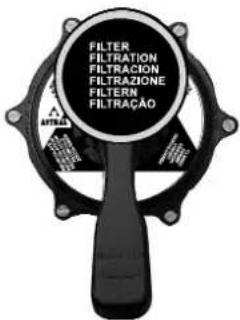
1,3 kg/cm ^2 - 18,5 PSI: This pressure indicates that it is necessary to "BACKWASH".
BACKWASH
Each load of sand forms thousands of channels which pick up all the material contained and caught up in the filtering process, the number of free channels allowing the water to pass is continually decreasing. This is why the pressure rises progressively until it reaches 1,3 Kgs/cm². At this pressure the filtering sand is unable to collect any more impurities and must be cleaned as follows:
Turn the selector valve to the "BACKWASH" position and with the main drain and return valves open, switch on the pump and run it for 2 minutes. When this operation is completed, the dirt blocking the filter will have been removed.
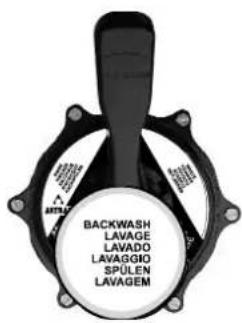
ENGLISH
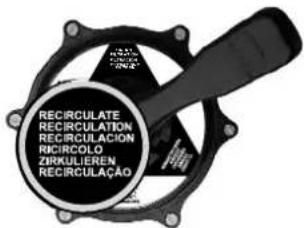
RECIRCULATE
In this position, the selector valve allows the water from the pump to go directly to the swimming pool without passing through the inside of the filter.
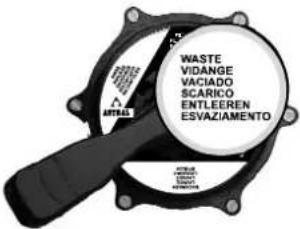
If the swimming pool needs to be drained, this can be done using the filter pump. In order to do this, the selector valve should be in the "WASTE" position. The motor is run with the main drain valve fully open, for the pump to have sufficient suction. For the pump to suction, keep the prefilter and the main drain pipes full of water. Before drainage, make sure that the skimmer valves and the bottom cleaner valves are closed.
RINSE
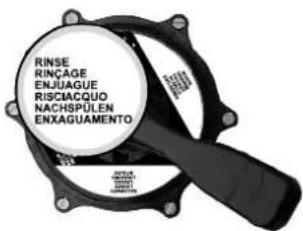
After the carrying out the "BACKWASH" operation on the filter and placing the installation in the "FILTER" position, the water flowing into the swimming pool will be cloudy for a few seconds, so to prevent it from reaching the swimming pool there is a "RINSE" position for the selector valve which is operated as follows: immediately after the "BACKWASH" put the valve in the "RINSE" position and switch on the pump for 1 minute, after which the pump is switched off and the valve placed in the "FILTER" position.
This position ensures that the filtered water goes directly to the drain.
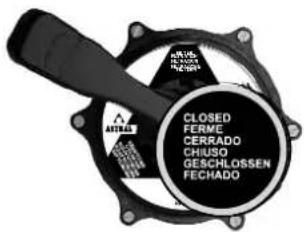
CLOSED
As its name indicates, this position is for closing off the water from the filter to the pump and it is used for opening the collector prefiltre of the pump.
START-UP
When the filter has been loaded, the sand must be washed. Proceed as follows:
1.- Place the selector valve in the "LAVADO" (BACKWASH) position.
2.- Open the valves controlling the swimming pool suction pipes and run the pump for 4 minutes.
3.- Stop the pump, place the handle of the selector valve into the "RINSE" position and rinse for 1 min. Then, stop the pump and place the handle of the selector valve into "FILTRATION" (FILTERING) position.
When this has been done, the filter will be ready to start the filtering cycles for the water in the swimming pool.

IMPORTANT: The pump should be switched off when the position of the selector valve han-is being changed.
MAINTENANCE
Do not use solvents for cleaning the filter, this could damage the filter, especially its finish.
Always replace the joints and pieces that may not be in good condition.
Backwash and rinse when needed, as per the instructions specified in this manual.
Clean the sand every year for a better performance with solid or liquid ASTRAL Filnet product. It's recommended to change the sand inside the filter approximately every 3 years.
ENGLISH
Winter period:
In order not to damage the filter during the winter period, please follow the instructions below:
Perform a backwash and a rinse as previously detailed.
Remove the water from the filter.
Take off the lid to ventilate the filter in the period of inactivity.
When you need to start up the filter again after a period of inactivity, follow the instructions stated in the paragraph "START UP".
THE MOST COMMON PROBLEMS
| EFFECT POSSIBLE CAUSE SOLUTION | ||
| The filter only provides a small volume of the filtered water. Vacuum heads have poor suction. | Prefilter blocked. Clean filter. | |
| Motor turning the wrong way. | Check by the arrow on the body of the prefilter which way the motor is turning, if this is not correct, reverse the motor connections*. | |
| Suction pipes are blocked. Proceed to clean. | ||
| The pressure rises rapidly during a filter cycle. | Water pH is high (Cloudy water). | Decrease the pH with ASTRAL pH-MINOR. |
| Lack of chlorine (Greenish coloured water). | Add chlorine. | |
| The pressure gauge varies considerably. | The pump is taking in air. | Check for leaks in the prefilter and suction pipes. |
| Suction is half closed. | Check that the suction valves are completely open. | |
*If there is no arrow, the direction of the motor can be checked as follows:
Stand in front of the pump, i. e. where the inlet pipe is situated (with the motor behind). Make sure that the direction of the motor is anticlockwise.
SAFETY WARNINGS
Never start up the system without water.
Whenever you operate the filter or the selector valve, switch off the pump first.
Never allow children or adults to sit on the system.
Do not connect the filter directly to the water network, as the pressure of the water may be too high and exceed the maximum work pressure allowed by the filter.
Do not clean the lid with solvents, as it may damage its properties (finish, transparency ...).
As all the connections are made with joints, it is not necessary to tighten the nuts excessively in order to avoid that some plastic pieces could break.
QU'ARRIVE-T-IL À L'EAU DE VOTRE PISCINE?
natural_image
Mechanical assembly diagram showing a pressure gauge and valve mechanism (no text or symbols)natural_image
Mechanical assembly diagram showing a valve mechanism with rotating components and directional arrows (no text or symbols)natural_image
Mechanical assembly diagram showing a pressure regulator with rotating components and directional arrows (no text or symbols)natural_image
Mechanical component diagram showing a rotary knob and adjustment mechanism (no text or symbols)natural_image
Mechanical assembly diagram showing a pressure regulator with rotating components and a base component (no text or symbols)natural_image
Mechanical assembly diagram showing a rotating component with directional arrows indicating motion (no text or symbols)Montage des Manometeres (Bei Top-Ventil)
SAND EINFÜLLEN
natural_image
Mechanical assembly diagram showing a pressure regulator and valve mechanism (no text or symbols)Montagem manómetro (válvula lateral)
natural_image
Mechanical assembly diagram showing a rotating component with directional arrows indicating motion (no text or symbols)Montagem manómetro (válvula top)
CARGA DE AREIA
natural_image
Diagram of a pressure regulator with rotating valve and adjustment knob (no text or symbols)natural_image
Mechanical assembly diagram showing a valve mechanism with rotating components and directional arrows (no text or labels)Montáž manometru u filtru s ventilem Top
PÍSKOVÁ NÁPLŇ
natural_image
Close-up of a pressure gauge with dual scales and a warning symbol (no readable text or numbers)RECIRKULACE (RECIRCULATION)
ČESKY
ZAVŘENO (CLOSED)
natural_image
Diagram of a pressure regulator with directional arrows indicating motion (no text or symbols)natural_image
Mechanical assembly diagram showing a valve, pipe fitting, and bolt mechanism (no text or symbols)
- WHAT HAPPENS TO THE WATER IN YOUR POOL?
- 2.- "PHYSICAL" TREATMENT
- PH LEVEL
- Why pH is important?
- CHLORINE
- What is understood by free or residual chlorine?
- FILTRATION
- WORKING PRINCIPLES
- INSTALLATION
- ASSEMBLY
- ENGLISH
- SAND LOAD
- FILTRATION PROCESS
- BACKWASH
- RECIRCULATE
- RINSE
- CLOSED
- START-UP
- MAINTENANCE
- Winter period:
- SAFETY WARNINGS
- QU'ARRIVE-T-IL À L'EAU DE VOTRE PISCINE?
- SAND EINFÜLLEN
- CARGA DE AREIA
- PÍSKOVÁ NÁPLŇ
- RECIRKULACE (RECIRCULATION)
- ČESKY
- ZAVŘENO (CLOSED)
Brand : ASTRALPOOL
Model : Vesubio
Category : Water filter