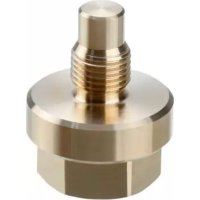
E30508 - Welding accessory IFM - Free user manual and instructions
Find the device manual for free E30508 IFM in PDF.



| Product type | Welding adapter with welding plug |
| Brand | IFM |
| Model | E30508 |
| Intended use | Mounting sensors in tanks or pipe systems |
| Material | Stainless steel (estimated) |
| Dimensions (outer diameter) | To be determined based on the application (hole drilled to the outer diameter of the fitting) |
| Weight | Not specified |
| Power supply | None (passive accessory) |
| Welding temperature | May exceed 65 °C (149 °F) |
| Recommended tightening torque | 25 to 35 Nm (depends on lubrication, sealing, and load) |
| Welding procedure | With welding plug for heat dissipation and sealing area protection |
| Main functions | Allows sensor mounting, protects sealing area during welding |
| Maintenance and cleaning | Clean sealing areas, use appropriate lubricating paste, check thread |
| Safety | Risk of burns during welding; do not mount the sensor during operation; follow safety instructions |
| Spare parts and repairability | Welding plug included (E30508); sensor not included; in case of defect, replace the fitting |
| General information | User manual of 25 pages, available in FR, DE, EN |
Frequently Asked Questions - E30508 IFM
User questions about E30508 IFM
0 question about this device. Answer the ones you know or ask your own.
Ask a new question about this device
Download the instructions for your Welding accessory in PDF format for free! Find your manual E30508 - IFM and take your electronic device back in hand. On this page are published all the documents necessary for the use of your device. E30508 by IFM.
USER MANUAL E30508 IFM
Operating instructions Welding adapter and welding aid
(Ref. 11447887 / 00 12 / 2021)

natural_image
Technical line drawing of a mechanical component with hexagonal head and threaded base (no text or symbols)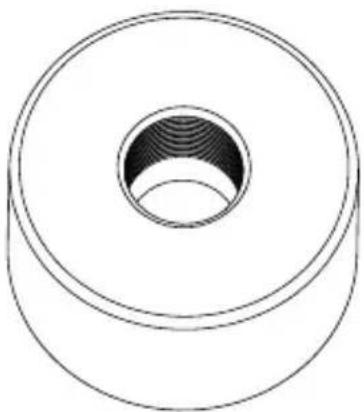
natural_image
Technical line drawing of a mechanical component with concentric rings and a central recessed hole (no text or symbols)Inhalt
VORSICHT!

natural_image
Technical line drawing of a precision tool interacting with a hexagonal nut and circular target (no text or symbols)natural_image
Technical line drawing of a mechanical tool interacting with a circular component (no text or symbols)natural_image
Technical line drawing of a mechanical assembly with a robotic arm (no text or symbols)DE
natural_image
Technical line drawing of a mechanical component with a labeled section A (no text or symbols beyond label)1 Preliminary note ....2
1.1 Symbols used ....2
2 Safety instructions ....3
3 Intended use ....4
3.1 Basic notes ....4
4 Installation....4
4.1 Welding operation with welding aid ....5
5 Mount sensor ....7
6 Set-up....8
1 Preliminary note
1.1 Symbols used
▶ Instruction
Reaction, result
[...] Designation of keys, buttons or indications
→ Cross-reference

Important note
Non-compliance may result in malfunction or interference

Information
Supplementary note

CAUTION
Warning of personal injury.
Slight reversible injuries may result.
2 Safety instructions
- The product described is a subcomponent for integration into a system.
- The system architect is responsible for the safety of the system.
-
The system creator undertakes to perform a risk assessment and to create documentation in accordance with legal and normative requirements to be provided to the operator and user of the system. This documentation must contain all necessary information and safety instructions for the operator, the user and, if applicable, for any service personnel authorised by the architect of the system.
-
Read this document before setting up the product and keep it during the entire service life.
- The product must be suitable for the corresponding applications and environmental conditions without any restrictions.
- Only use the product for its intended purpose (→ Intended use).
- Only use the product for permissible media.
- If the operating instructions or the technical data are not adhered to, personal injury and/or damage to property may occur.
- The manufacturer assumes no liability or warranty for any consequences caused by tampering with the product or incorrect use by the operator.
- Installation, set-up, operation and maintenance of the product must be carried out by personnel qualified and authorised for the respective activity.
- Protect the product against damage.
3 Intended use
The welding adapter allows the installation of sensors in tanks or piping systems.
3.1 Basic notes

If the tank or pipe system is treated after the adapter has been welded in (e.g. grinding, pickling, sand-blasting, glass bead blasting or applying procedures such as powder coating, painting etc.):
- Make sure that the inside and sealing area of the adapter are clean and not damaged. Appropriate measure: using the welding aid ( 4.1).

- The welding operation must be carried out by authorised personnel.
- The welding operation must be carried out carefully and according to state-of-the-art technology.
- During welding and the following cooling phase the sensor must not be in place.
- The surfaces must be free from any contamination.
- Welding materials must be suitable for the adapter and wall material.

The requirements in the specifications, of common practice, in regulations, norms, of intended use and the application must be applied.
They determine the welding procedure, the welding material, the connection category and connection type, including chamfer, welding penetration depth and demands on the surface.
4 Installation

CAUTION!
During the welding operation, the adapter and the welding aid can increase in temperature to over 65 °C ( 149 °F ).
Risk of burns.
▶ Let the adapter and the welding aid cool down.
4.1 Welding operation with welding aid

The basic notes and guidelines must be adhered to ( 3.1).

- The welding method must be suitable for the welding task and the power of the welding equipment must be adapted to the material thickness.
• The adapter must not warp.
- During welding, avoid overheating of the adapter and observe sufficient cooling phases.
- The sealing area of the adapter must not be damaged by weld spatter or similar. The sealing area should be sufficiently protected before starting the welding process ( 3.1).
▶ Bore a hole in the pipe or tank wall with the outside diameter of the adapter.

▶ Basic notes ( 3.1).
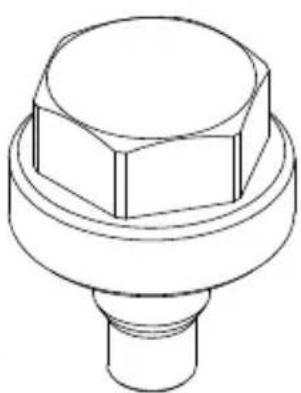
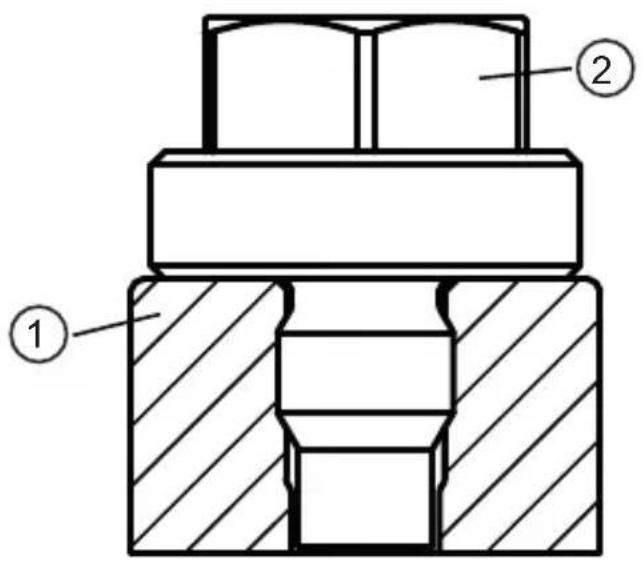
▶ Insert welding aid E30508 (for heat conduction and protection of the sealing edge) and tighten by hand.
Welding adapter (1) with mounted welding aid (2):

Please take into account the required space when using a connection cable with an angled socket. For this purpose, align the adapter prior to the welding operation to determine the end position of the electrical sensor connection.
▶ Screw the sensor into the adapter with the specified tightening torque ( Operating instructions of the sensor).
▶ Connect the connection cable to the sensor.
▶ Align the unit.
▶ Mark the alignment at the welding adapter and the pipe/tank.
▶ Remove the sensor from the adapter.
▶ Carry out the welding operation.

The positioning may change when the sensor is removed and then the original orientation is not guaranteed.
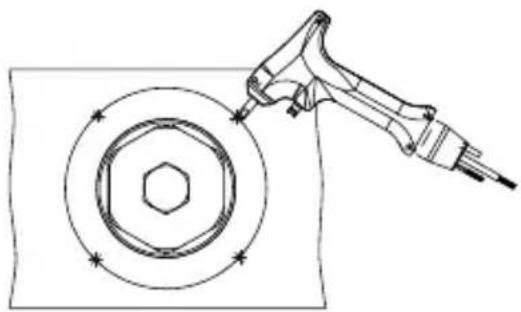
▶ Fix the adapter in several spots with a sufficient adhesive force. Apply the fixing points at equal distance opposite each other.
natural_image
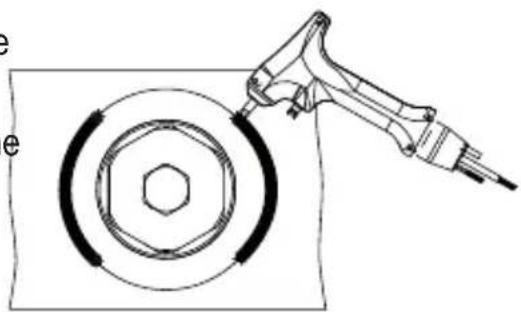
Technical line drawing of a precision tool interacting with a hexagonal nut and circular target (no text or symbols)▶ Apply the welding seams between the fixing points opposite each other.
▶ Ensure sufficient intervals between the individual sections to avoid glowing through or warping of the adapter due to overheating.
natural_image
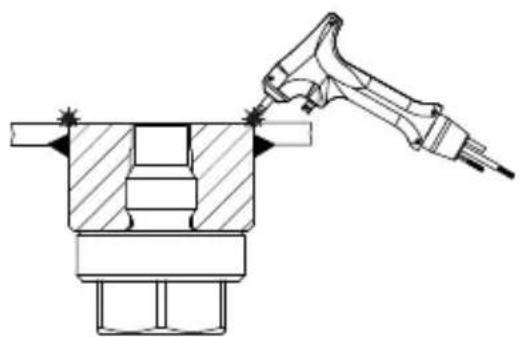
Technical line drawing of a mechanical assembly with a tool and concentric circles (no text or symbols)▶ If possible: weld the inside.
natural_image
Technical line drawing of a mechanical assembly with a robotic arm (no text or symbols)▶ Let the adapter and the welding aid cool down.
▶ Remove the welding aid.
▶ Remove deposits from the adapter thread.
▶ Screw in the sensor by hand in order to check for dimensional accuracy and functionality of the thread. If the tightening torque is too high, do not use any tool, but check the thread and replace the adapter, if necessary.
UK
5 Mount sensor

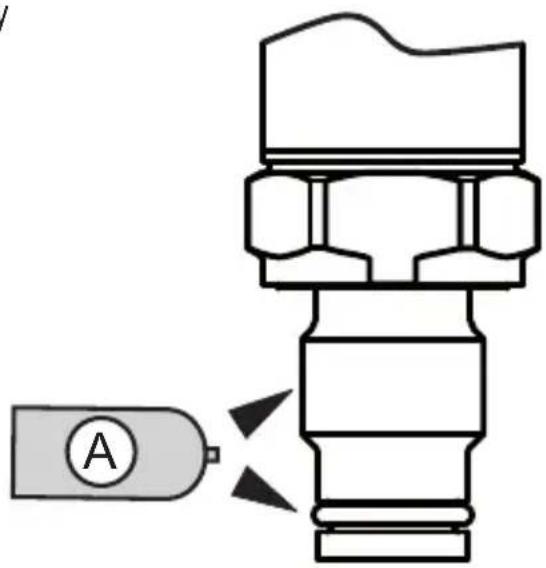
A lubricating paste is required to install the sensor. It must be suitable and approved for the given application and compatible with the elastomers used (e.g. seal).
▶ Ensure cleanliness of the sealing areas.
▶ Use lubricating paste (A) sparingly and apply to threaded parts and the sealing ring.
natural_image
Technical diagram of a mechanical component with a labeled part (A) and directional arrows indicating flow or movement (no text or symbols beyond label)▶ Tighten firmly. Recommended tightening torque: 25...35 Nm.
Depends on the lubrication, the seal and the pressure load!

Too much torque may impair the seal and lead to the sensor being damaged.

If the sealing area is damaged: replace the adapter.
6 Set-up
▶ Before set-up check the tank or pipe for ingress resistance.
▶ Perform a pressure test with screwed-in dummy plug or sensor.
▶ Set-up of the sensor: → Operating instructions of the sensor.
UK


Contenu
PRUDENCE!

natural_image
Technical line drawing of a precision tool interacting with a hexagonal nut and circular target (no text or symbols)natural_image
Technical line drawing of a mechanical assembly with a tool and circular components (no text or symbols)natural_image
Technical line drawing of a mechanical assembly with a welding torch (no text or symbols)natural_image
Technical diagram of a mechanical component with a labeled part (A) and directional arrows indicating flow or movement (no text or symbols beyond label)Brand : IFM
Model : E30508
Category : Welding accessory