
C500 - Digital Camera HP - Free user manual and instructions
Find the device manual for free C500 HP in PDF.


| Product Type | Digital camera |
| Brand | HP |
| Model | C500 |
| Resolution | 5.0 megapixels (estimated) |
| Optical Zoom | 3x (estimated) |
| LCD Screen | 2.4 inches (estimated) |
| Shooting Modes | Photo, Video (720p), Audio recording |
| Scene Modes | Auto, Program, and other modes available via the menu |
| Image Stabilizer | Yes, built-in stabilizer |
| Built-in Flash | Yes |
| Built-in Microphone | Yes |
| Built-in Speaker | Yes |
| Memory Support | SD/SDHC card, class 6 recommended for HD video |
| Power Source | 2 AA batteries |
| Dimensions (approx.) | 94 x 62 x 30 mm (estimated) |
| Weight (approx.) | 130 g (without batteries, estimated) |
| PC Compatibility | Windows and Mac (via software provided on CD-ROM) |
| Connectivity | USB port |
| Video Output | Not specified (likely composite) |
| Tripod | Tripod mount (screw at bottom) |
| Care and Cleaning | Clean the lens with a soft, dry cloth. Avoid moisture. |
| Safety | Turn off the device before inserting or removing the memory card or batteries. |
| Spare Parts and Repairability | Contact an authorized HP service center or the original point of sale. |
Frequently Asked Questions - C500 HP
User questions about C500 HP
0 question about this device. Answer the ones you know or ask your own.
Ask a new question about this device
Download the instructions for your Digital Camera in PDF format for free! Find your manual C500 - HP and take your electronic device back in hand. On this page are published all the documents necessary for the use of your device. C500 by HP.
USER MANUAL C500 HP
c500
Digital Camera
Quick Start Guide
For more details about the camera operation and troubleshooting, please read the User Manual located on the CDROM disc included with your camera or visit http://www.hp.com/support and download it for the camera support page.
Tour of Your HP Camera
Front View
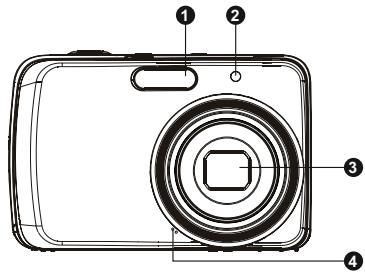
- Flash
- Self-timer LED / AF Assist Lamp
- Lens
- Microphone
Back View
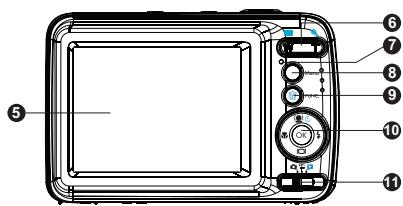
- LCD Screen
- Zoom Toggle
- LED Indicator
- Menu Button
- Function / Delete Button
- OK Button / 4-way Navigation Control
- Mode Selector Switch

Photo Mode

Video Mode

Playback Mode
Top View
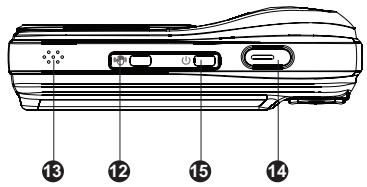
- Stabilizer Button
- Speaker
- Shutter Button
- Power Button
Bottom View
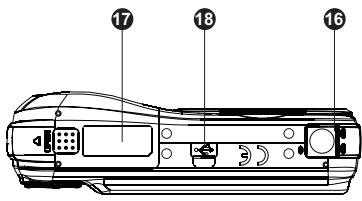
- Tripod Screw Hole
- Battery/Memory Card Compartment Door
- USB Port
Left/Right View
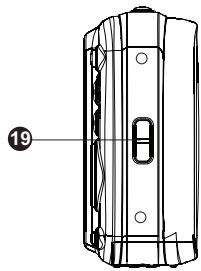

- Strap Ring
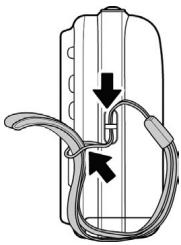
1. Getting Started Attach the Camera Strap
To reduce the risk of dropping the camera, it is strongly recommended to attach and use the provided camera strap
Inserting the Batteries
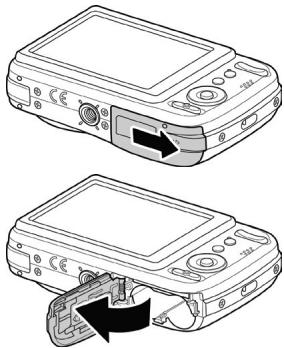
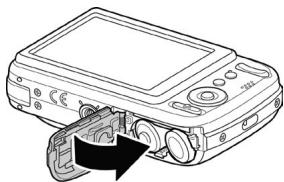
Follow these instructions to insert the batteries into the battery/memory card compartment.
-
If the batteries are already installed, make sure to power off the camera before removing and inserting recharged or new batteries.
-
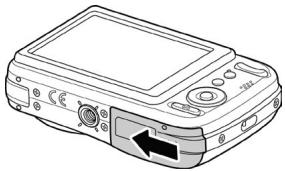
Open the battery/memory cardcompartment at the bottom of the camera as illustrated.
- Insert the batteries into the compartment with correct orientation as illustrated.
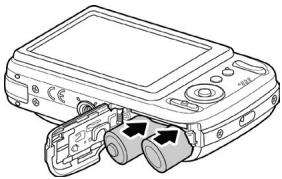
- Close and secure the battery/memory card compartment.
Inserting an SD/SDHC Memory Card
It is highly recommended that the camera storage is expanded by inserting a SD or SDHC memory card. These memory cards are available at most consumer store and online locations.
-
Make sure to power off the camera before proceeding. Inserting the memory card while powered on may damage the card and camera.
-
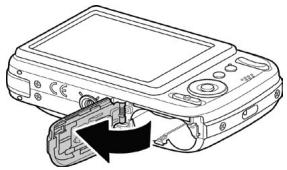
Open the battery/memory card compartment at the bottom of the camera.
-
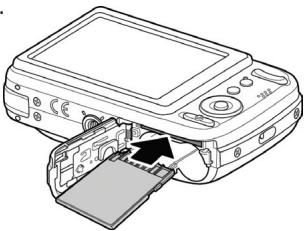
Insert the SD/SDHC card into the memory card slot with the metallic connectors facing the front side of the camera as illustrated below.
-
Push the SD/SDHC card into the memory slot until it clicks into place. If the card does not click into place, repeat the previous step to ensure proper orientation.
-
Close the battery/memory card compartment.

The 720p video recording capability of this camera requires a class 6 (High Speed) SD/SDHC memory card.
- To remove the SD/SDHC card
- Make sure to power off the camera before proceeding. Removing the memory card while powered on may damage the card and camera.
- Open the battery/memory cardcompartment.
- Gently push the card until it clicks and pushes our of position.
- Carefully pull out the card.
2. Initial Settings
When the camera is powered up for the first time, please set the display language and date & time.
Setting the Language
- Use the 4-way navigation control to move through the selections.
- Highlight the desired language and press the OK button OK to select.
Setting the Date & Time
- Use the 4-way navigation control to move through the selections and to change the setting values.
- Press OK button OK when finished. This will save your date and time settings.
- If necessary, press Menu button ☐ Menu to close the menu.
At this point, the camera settings are set to the default automatic mode and is ready to take photos and videos.
Modes
This camera has a three mode selector switch. The different modes are:
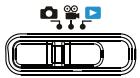
Photo Mode
- Slide the mode switch to [ ] take photos and record audio clips by selecting Voice REC from scene modes.
Video Mode
- Slide the mode switch to [ 😊] record videos.
Playback Mode
- Slide the mode switch to [▶] view and edit captured images or playback videos and audio clips.
The recording of voice memo attached to images is also available in this mode.
3. Taking Photos
This camera is designed to make the experience of taking photos simple and quick. It's Auto mode feature will optimise the internal settings so that in most situations, it can take photos with ease. This camera also has additional modes and features that extend the capabilities for the more experienced user.
- Power on the camera by pressing the Power button ⏻☐.
- Slide the Mode switch to Photo mode [ ]
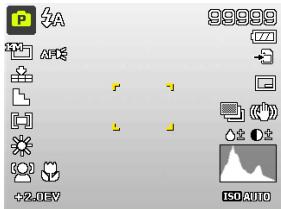
- Frame the shot using the focus bracket on the LCD monitor.
-
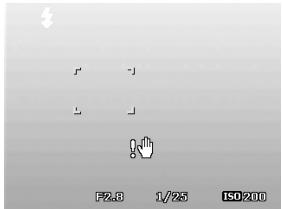
Lightly pressing the Shutter button down to the halfway position will start the automatic focus and adjustments to the exposure level. When the camera has successfully completed this automatic routine, the focus bracket will turn green. If the automatic focus and exposure routine is not successful, the bracket will turn red. If this occurs, simply release the shutter and repeat this step until the bracket turns green. In some situations, lighting and contrast may be insufficient for the camera to successfully complete the auto focus and exposure level routine. If this occurs, try better lighting.
-
Pressing the Shutter button ⏻ down fully will take the photo. If you take the photo when the bracket is red, the focus and exposure may not be correct.
If the shake warning icon 🎨 appears, hold the camera steadily, with your arms at your side or use a tripod to stabilize the camera to reduce the risk of blurred photos.
4. Using the Function Menu
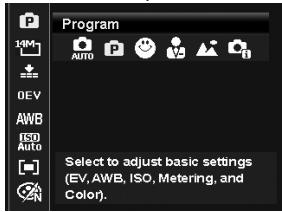
The Function Menu is used to quickly adjust basic capture settings while in Photo and Video mode. In Photo mode, the Function menu displays the last 6 scene modes used as well as allow changes to be made in resolution and file compression quality settings, (EV compensation, Auto White Balance (AWB), ISO settings, Metering, and Color mode may be available for different scene modes). In Video mode, the function menu displays and allows changes to be made to Video resolution setting, AWB, Metering, and Color mode.

FUNC.
- Press the FUNC button of your camera to launch the Function Menu.
-
Press the FUNC button again to close the menu.
-
The Menu bar displays the current status of the camera settings. Only the available functions for the settings are shown as icon on the menu bar.
- The available options for each item on the menu bar are shown in the Menu options.
- Use the 🎨 or ↓ key to move through the menu selections then press the OK button

to save and apply the changes.
Menu Options
Menu Bar
5. Playback
Playback the photos, video and audio clips on the LCD screen.
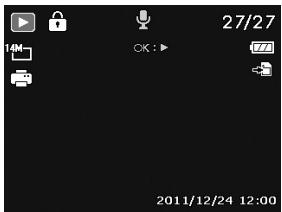
Viewing in Single Navigation
The Single navigation mode displays the image one by one on the LCD monitor. To view images/videos/audio clips, follow the steps below.
- Slide the Mode switch to Playback mode ▶.
- The camera's LCD screen with display an image. To understand the icons and other information on the screen, please see "Photo Mode Screen Layout" in the electronic User Manual on the software CD-ROM.
Still Image
-
Use the 🎨 or ↓ keys to view next/previous image/video/audio.
-
To play a movie or audio clip, press the OK button OK.
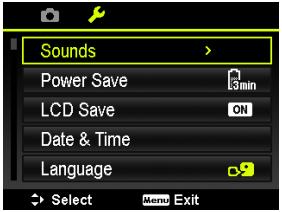
6. Using the Setup Menu
You can access the Setup menu whether you are in Record or Playback mode.
The Setup menu allows to configure general camera settings.
- To enter the Setup Menu:
- Press Menu button ☐ Menu to launch the Record/Playback Menu.
- Use the 🎨 or ↓ keys to switch the menu tab to Setup menu.
- Use the |0| or [●] Ⓧ keys to move through the menu selections.
-
To select an item, press the OK button Ⓞ or ↓ key.
-
Change the submenu settings using the 4-way navigation control.
-
Press the OK button Ⓞ to save and apply settings.
Getting Help
Should you have a technical support question or your HP Digital Camera require service within the warranty period, please contact the original point of purchase or an authorized HP reseller in your country. If service is not available at those locations, please contact an HP Branded Product warranty agent from the support contact list provided below. A service agent will work with you to troubleshoot your issue and if necessary, issue a Return Material Authorization (RMA) number in order to replace your HP Branded Product. For warranty claims, you will be required to provide a copy of your original dated sales receipt as proof of purchase and the issued RMA number. You will be responsible for shipping charges when shipping the product to the service center. The service agent will provide you with an address and you will also be responsible for any shipping charges to the warranty service center. Once your product is received by this service center, a replacement unit will be shipped back to you typically within 5 business days.
| Contact/phone Support: | |
| Language | Contact/phone Support: |
| 中文 | simp.chinese@hpodd.com |
| trad.chinese@hpodd.com | |
| Deutsch | deutsch@hpodd.com |
| Nederlands | hollands@hpodd.com |
| English | english@hpodd.com |
| Español | espanol@hpodd.com |
| Français | francais@hpodd.com |
| Italiano | italiano@hpodd.com |
| 日本語 | nippon@hpodd.com |
| 한국어 | korean@hpodd.com |
| Português | portugues@hpodd.com |
| Svenska | svensk@hpodd.com |
| Contact/phone Support: | |||
| Country | Language | Number | |
| Europe Region (EMEA) | |||
| België | Nederlandsk/ Deutsch | + 32 2700 1724 | |
| Deutschland | Deutsch | + 49 6950073896 | |
| España | Español | + 34 914533458 | |
| France | Français | + 33 171230454 | |
| Ireland | English | + 353 1850882016 | |
| Italia | Italiano | + 39 269682189 | |
| Nederland | Nederlandsk | + 31 202015093 | |
| Schweiz | Deutsch/ Français/ Italiano | + 41 18009686 | |
| UK | English | + 44 2073652400 | |
| North America | |||
| United States | English | 1.866.694.7633 | |
| Canada | English and Français | 1.866.694.7633 | |
| Country | Language | City | Number |
| México | Español | Mexico City | 52.55.1204.8185 |
| Guadalajara | 52.33.1031.3872 | ||
| Monterrey | 52.81.1107.2639 | ||
| Venezuela | Español | Caracas | 58.212.335.4574 |
| Colombia | Español | Bogota | 57.1.508.2325 |
| Perú | Español | Lima | 51.1.705.6232 |
| Chile | Español | Santiago | 55.11.5504.6633 |
| Brasil | Português | Sao Paolo | 55.11.5504.6633 |
| Argentina | Español | Buenos Aires | 54.11.6091.2399 |
- TOUR OF YOUR HP CAMERA
- TOP VIEW
- GETTING STARTED ATTACH THE CAMERA STRAP
- INSERTING THE BATTERIES
- INSERTING AN SD/SDHC MEMORY CARD
- TO REMOVE THE SD/SDHC CARD
- INITIAL SETTINGS
- SETTING THE LANGUAGE
- SETTING THE DATE & TIME
- MODES
- PHOTO MODE
- VIDEO MODE
- PLAYBACK MODE
- TAKING PHOTOS
- USING THE FUNCTION MENU
- FUNC
- PLAYBACK
- VIEWING IN SINGLE NAVIGATION
- USING THE SETUP MENU
- TO ENTER THE SETUP MENU
- GETTING HELP
Brand : HP
Model : C500
Category : Digital Camera