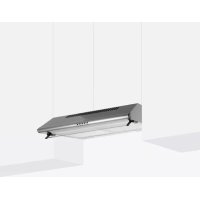
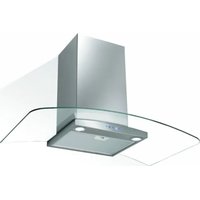
USER MANUAL GHC631IX Glem Gas
- Thanks very much for choosing our product, please carefully read the following important information regarding installation safety and maintenance. And Keep this information booklet accessible for further consultations.
RANGE HOOD INSTRUCTION MANUAL
Dear Customer,
If you follow the recommendations contained in this Instruction Manual, our appliance will give you constant high performance and will remain efficient for many years to come.
RECOMMENDATIONS AND SUGGESTIONS
INSTALLATION
* The manufacturer will not be held liable for any damages resulting from incorrect or improper installation.
* Please read this instruction manual before installing and using this range hood. Please keep this instruction manual in a safe place for future reference.
* This range hood can be used either in the Ducted Mode (ducting fumes to the outside) or in the Recirculation Mode (internal recycling). The choice of modes can be left to the customers.
* Only a qualified and trained service technician can undertake the work of installation and servicing.
* Check that the main voltage corresponds to the one indicated on the rating plate fixed inside the hood.
* Do not connect the hood to exhaust ducts carrying combustion fumes (boilers, fireplaces, etc.)
* If the hood is used in conjunction with non-electrical appliances (e. g. gas burning appliances), a sufficient degree of ventilation must be guaranteed in the room in order to prevent the backflow of exhaust gas. The kitchen must have an opening directly with the open air in order to guarantee the entry of clean air.
* The minimum distance is 750mm from the range hood to a gas hob, and is 650mm to an electric hob. If the installation instructions for gas hobs specify a greater distance, this must be taken into account.
NOTICE: Two or more people are required to install or move this appliance. Failure to do so can cause physical injuries.
USE
* The range hood has been designed only for domestic use to eliminate kitchen fumes.
* Never use the hood for purposes other than what it has been designed for.
* Never leave high naked flames under the hood when it is in operation.
* Adjust the flame intensity to direct it onto the bottom of the pan only; making sure that it does not engulf the pan sides.
* Deep fat fryer must be continuously monitored during use: overheated oil can burst into flame.
* The hood should not be used by children or persons not instructed in its correct use.
MAINTENANCE
* Proper maintenance of the range hood will assure proper performance of the unit.
* Disconnect the hood from the main supply before carrying out any maintenance work.
* Clean and/or replace aluminum grease filters and activated charcoal filters after specified period of time.
* Clean the hood using a damp cloth and a neutral liquid detergent.
* DISPOSAL: Do not dispose this product as unsorted municipal waste. Collection of such waste separately for special treatment is necessary.
WARNING!!
In certain circumstances electrical appliances may be a danger hazard.
* Do not check the status of the filters while the range hood is operating.
* Do not touch the light bulbs after appliance use.
* Do not disconnect the appliance with wet hands.
* Avoid free flame, as it is damaging for the filters and a fire hazard.
* Constantly check food frying. Overheated oil may become a fire hazard.
* Disconnect the electrical plug prior to any maintenance.
* Children don't recognize the risks of electrical appliances. Therefore use or keep the appliance only under supervision of adults and out of the reach from children.
* Don't use this product outdoors.
* This appliance is not intended for use by persons (including children) with reduced physical, sensory or mental capabilities, or lack of experience and knowledge, unless they have been given supervision or instruction, concerning use of the appliance by a person responsible for their safety. Children should be supervised to ensure that they do not play with the appliance.
* There shall be adequate ventilation of the room when the range hood is used at the same time as appliances burning gas or other fuels.
* There is a fire risk if cleaning is not carried out in accordance with instructions.
CHARACTERISTICS
DIMENSIONS
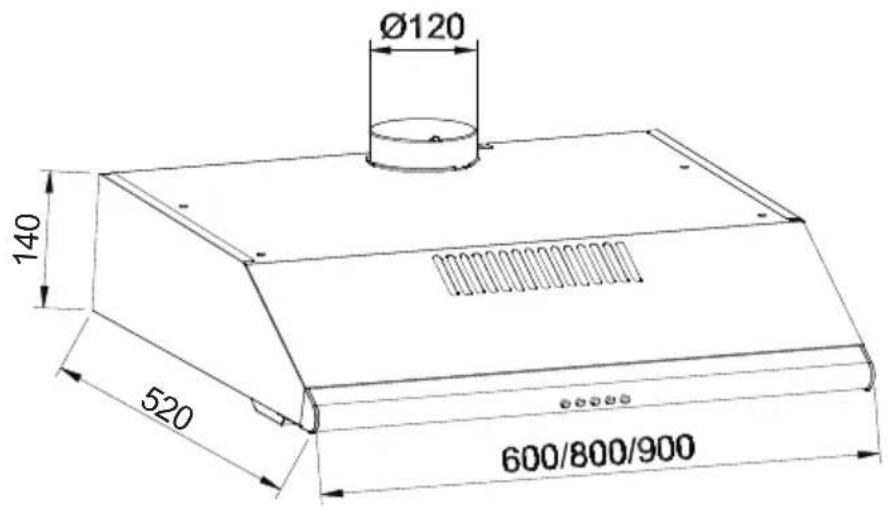
INSTALLATION & USE
DESCRIPTION / CONNECTIONS
The hood may be installed in the Ducting or the Recalculating version.
FOR SINGLE MOTOR MODEL
It depends on the which wind part is installed on the range hood.
There are two wind pads for each range hoods, A and B.
With wind pad A installed, the range hood is in recirculation mode.
With wind pad B installed, the range hood is in ducting mode.
The other one will be packed in the parts bag as spare parts
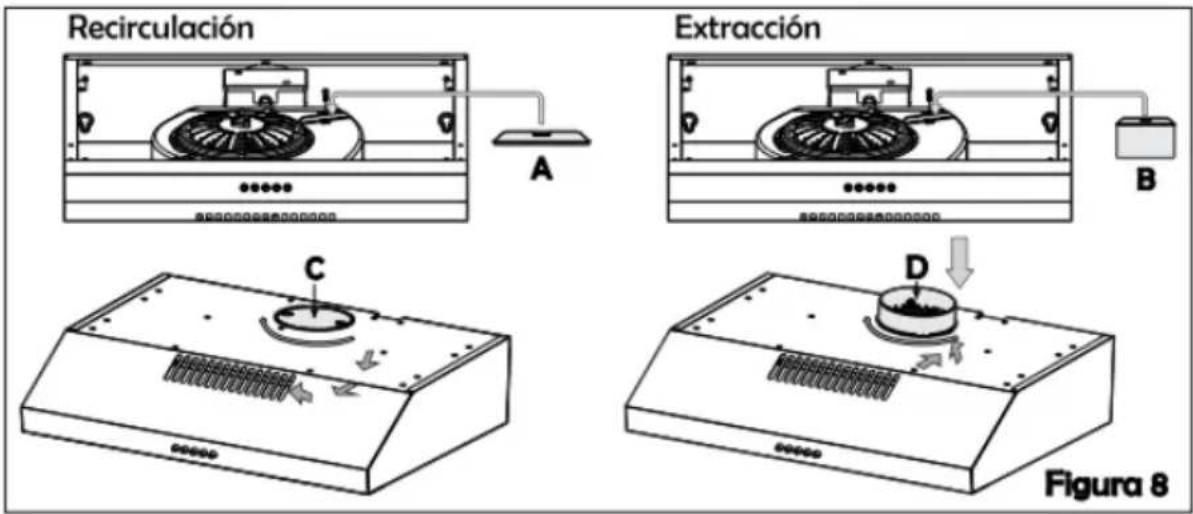
We recommend you: CHECK THAT THE WIND PAD IS CORRECT. The wind pad is found on the motor unit and must be installed with wind pad A in the case of RECIRCULATING mode.
If change to exhaust way, disassemble the metal lamp board first, then change the part A to part B, which is as spare in the manual bag. Take away the air outlet cover and install the air outlet adapter with no-return valve.
FOR TWIN MOTORS MODEL
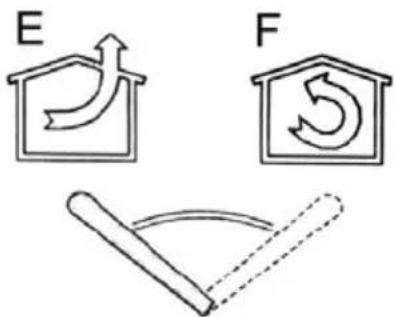
CHECK THAT THE
DUCTING-RECIRCULATING LEVER IS IN
THE RIGHT POSITION: The lever is found on the motor unit and must be positioned on the symbol F in the case of installation in recirculating version.
flowchart
graph TD
    E["House with upward arrow"] --> F["Building with curved arrow"]
    F --> G["Break structure with dashed line"]
If change to exhaust way, rotate the lever to ducting mode, symbol E. Then take away one of the air outlets on top or rear. Install the air outlet adapter with no-return valve.
- Also remember that the use of charcoal filter/s is not necessary with the ducting version; if these are fitted, please remove them.
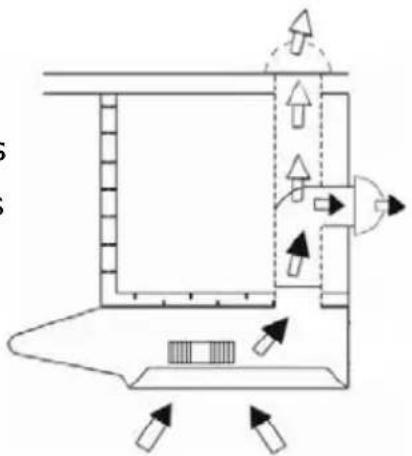
Ducting version
The hood draws the cooking fumes saturated with fumes and odor, through the grease filters and expels it to the outside through an outlet pipe. With this version the charcoal filters are not required.
natural_image
Pure schematic diagram of a mechanical or electrical component with directional arrows and no text or symbols
-
Decide where the ductwork will run between the hood and the outside.
-
A straight, short duct run will allow the hood to perform most efficiently.
-
Long duct runs, elbows, and transitions will reduce the performance of the hood. Use as few of them as possible. Larger ducting may be required for best performance with longer duct runs.
-
The air must not be discharged into a flue that is used for exhausting fumes from appliances burning gas or other fuels Regulations concerning the discharge of air have to be followed. Check with the local authority and building codes for exhaust ducting requirements.
-
Install a roof/wall cap. Connect round metal ductwork to cap and work back towards hood location.
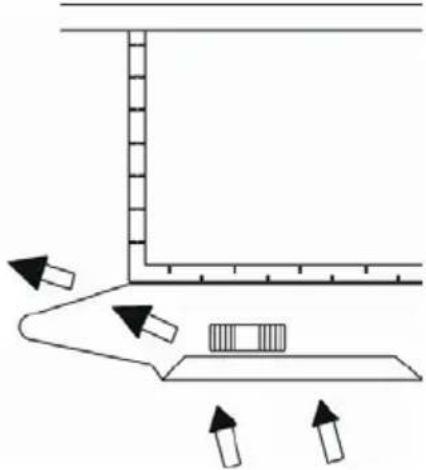
Recalculating version
The hood draws cooking fumes saturated with fumes and odor through the
grease filters and charcoal filters and returns clean air into the room. For constant efficiency, the charcoal filters must be replaced periodically.
Caution: No need for plastic or rigid metal ducting.
natural_image
Pure technical diagram showing a mechanical or architectural component with arrows indicating motion, no text or symbols present.
-
Install the charcoal filter.
-
Please note that the air is re-circulated into the room through the front vents.
Decide from the outset on the type of installation (recirculation or ducting). For greater efficiency, we recommend you install the hood in the ducting version.
Electrical Connection
* Electrical wiring must be done by a qualified person(s) in accordance with all applicable codes and standards. Turn off electrical power at service entrance before wiring.
* If the supply cord is damaged, it must be replaced by the manufacturer, its service agent or similarly qualified persons in order to avoid a hazard.
* Do not use the plug and an extension cord other than the ones initially supplied with the hood.
INSTALLATION
Before beginning installation, to better handle the hood, we advise removing the filter.
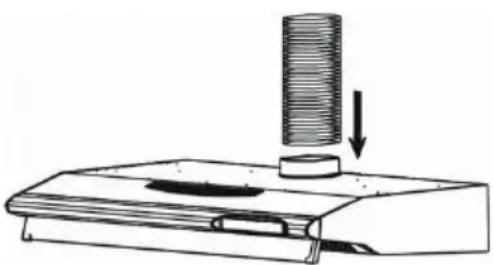
Before fixing, the outlet exhaust duct for air evacuation to the outside must be installed.
natural_image
Diagram of a mechanical component with a cylindrical shaft and downward arrow, no text or symbols present
Use an outlet exhaust duct with: - minimum indispensable length; - Minimum possible bends (maximum angle of bend: 90°); - certified material (according to local, building & fire regulations); and as smooth as possible inside. It is also advisable to avoid any drastic changes in duct cross-section (recommended diameter: 125mm).
Drill the hole in the kitchen unit for the air outlet (133 mm diameter).
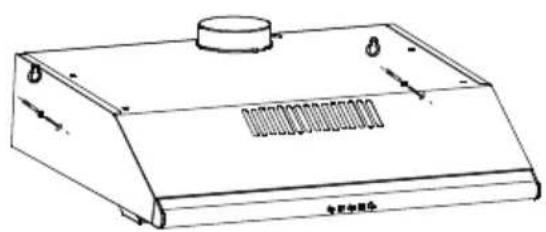
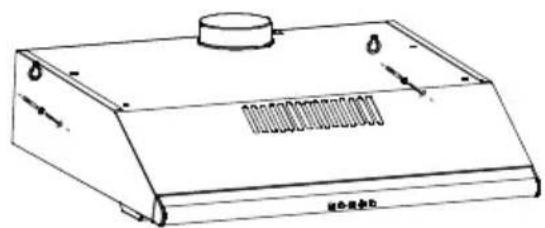
Proceed with fixing the hood: Based on your requirements, you can fit the hood on the wall or on a wall unit of your kitchen. IMPORTANT: Respect the distance between the hob and lower part of the hood which must be at least 650mm.
Fixing to the wall
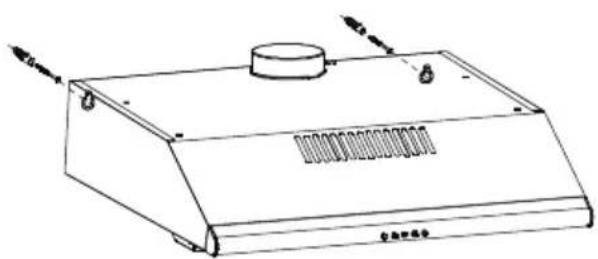
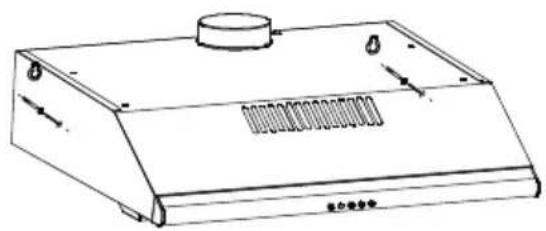
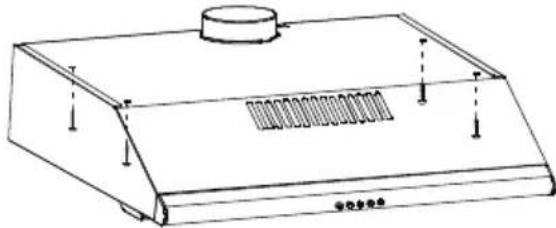
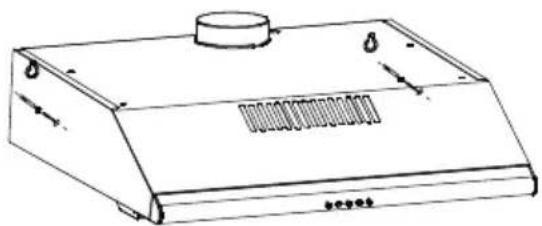
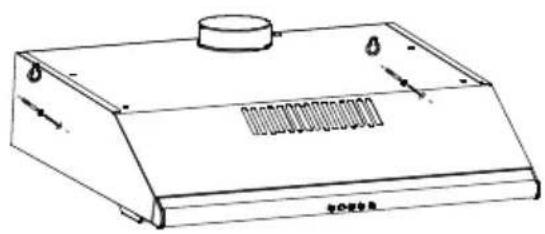
- Draw a line on the wall in vertical line with your hob. Mark the 4 holes to be drilled in the wall, respecting the distances indicated; Make the 4 holes and fit the 4 screw anchors provided. Take 2 of the screws provided and insert them in the topmost screw anchors without, however, screwing them down completely. Hang the hood on the 2 screws; Working from inside the hood, tighten the 2 screws completely.
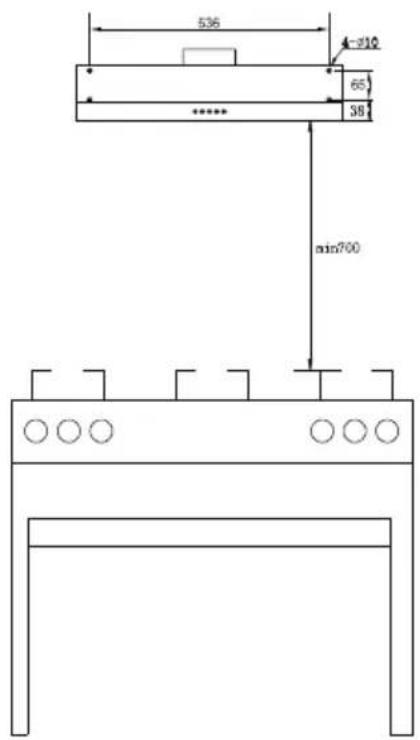
- Make the electrical connection.
natural_image
Line drawing of a kitchen or oven structure with a cylindrical top and ventilation grilles (no text or symbols)
natural_image
Line drawing of a kitchen range hood with ventilation slots and a cylindrical top (no text or symbols)
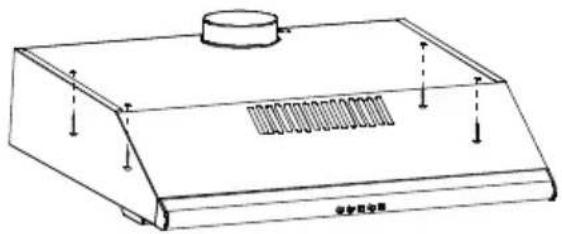
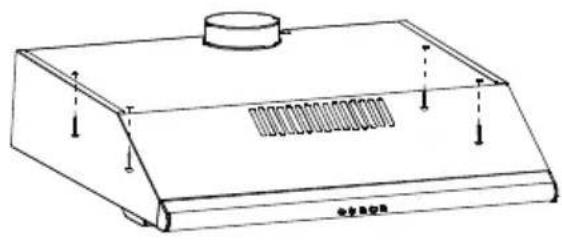
Fitting under wall unit
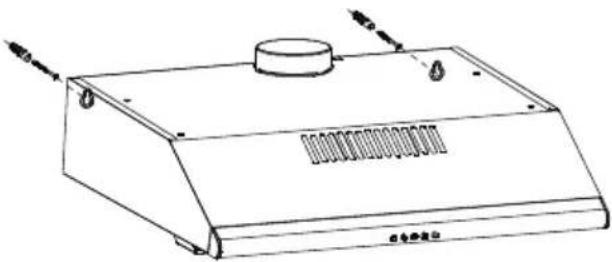
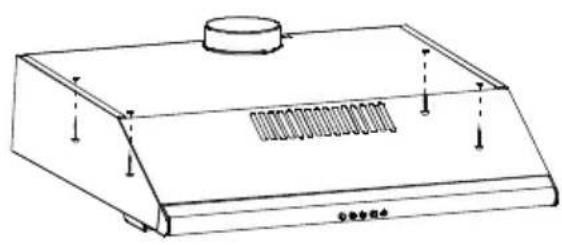
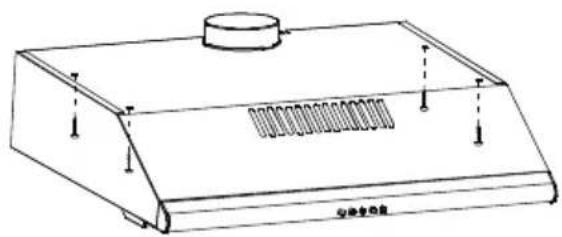
- Drill 4 holes in the wall unit, respecting the distance indicated. Push the hood up against the wall unit and insert the 4 screws operating from inside the wall unit. Connect a flexible tube to the hood flange, using a metal hose clamp. Tube and hose clamps are not provided.

- Make the electrical connection.
natural_image
Line drawing of a kitchen range hood with ventilation slots and a cylindrical top (no text or symbols)
natural_image
Line drawing of a kitchen air conditioner unit with ventilation slots and a top-mounted lid (no text or symbols)
Installation is now complete.
Notice:
-Exhaust air must not be discharged into a flue which is used for exhausting fumes from appliance burning gas or other fuels.
-If the instructions for installation for the gas hob specify a greater distance than 650mm, this has to be taken into account.
-The regulations concerning the discharge of exhaust air have to be followed.
OPERATION
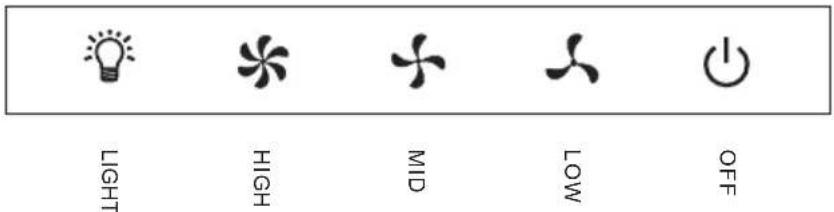
The hood is operated using the push button on the front panel.
The light switch turns the lamps on and off.
The fan switch turns the fan on to three speed settings:
GREASE FILTER
The grease filters should be cleaned frequently (every two months of operation, or more frequently for heavy use). Use a warm detergent solution.
Grease filters are washable.
LAMPS
The range hood requires one LED bulb for single motor model (AC 230V, 4W Max).
The range hood requires two LED spot for twin motors model (AC 230V, 8W Max)
natural_image
Pure schematic diagram of a mechanical or electrical component with no text, numbers, or symbols
natural_image
Diagram showing a mechanical or architectural component with directional arrows and no visible text or symbols
natural_image
Diagram of a mechanical press or clamping device with a cylindrical component and downward arrow indicating motion (no text or symbols)
natural_image
Line drawing of a kitchen air conditioner unit with ventilation slots and a cylindrical top (no text or symbols)
natural_image
Technical line drawing of a rectangular kitchen or oven with a cylindrical top and ventilation slots (no text or symbols)
natural_image
Line drawing of a kitchen or oven unit with a cylindrical top and ventilation grilles (no text or symbols)
natural_image
Line drawing of a kitchen fan with ventilation slots and a top-mounted lid (no text or symbols)
RECOMMANDATIONS ET SUGGESTIONS
INSTALLATION
flowchart
graph TD
    E["House with upward arrow"] --> F["House with circular arrow"]
    F --> G["Roll of paper with dashed line"]
natural_image
Pure schematic diagram of a mechanical or electrical component with directional arrows and no text or symbols
natural_image
Diagram showing a mechanical or architectural component with arrows indicating motion or force direction (no text or symbols present)
natural_image
Diagram of a mechanical press or clamping device with a cylindrical component and downward arrow indicating force or motion (no text or symbols present)
natural_image
Line drawing of a kitchen range hood with ventilation slots and a cylindrical top (no text or symbols)
natural_image
Line drawing of a cabinet or fan with a lid, ventilation slots, and a handle (no text or symbols)
natural_image
Line drawing of a rectangular kitchen fan with a cylindrical top and ventilation grille (no text or symbols)
natural_image
Line drawing of a kitchen range hood with ventilation slots and a top-mounted fixture (no text or symbols)
natural_image
Simple line drawing of two elongated objects with curved lines, no text or symbols present
natural_image
Pure schematic diagram of a mechanical or electrical component without any text, numbers, or symbols
natural_image
Diagram showing a mechanical or architectural component with directional arrows and a rectangular block, no text or symbols present.
natural_image
Diagram of a mechanical press or clamping device with a cylindrical component and downward arrow indicating motion (no text or symbols)
natural_image
Line drawing of a rectangular kitchen appliance with a cylindrical top and ventilation slots (no text or symbols)
natural_image
Line drawing of a kitchen range hood with ventilation slots and a cylindrical top (no text or symbols)
natural_image
Line drawing of a kitchen fan with a cylindrical top and ventilation grille (no text or symbols)
natural_image
Line drawing of a kitchen range hood with ventilation slots and a cylindrical top (no text or symbols)
*frame Saudi Arabia Minimum Maximum Minimum Minimum Minimum Minimum Minimum Minimum Minimum Minimum Minimum Minimum Minimum Minimum Minimum Minimum Minimum Minimum Minimum Minimum Minimum Minimum Minimum Minimum Minimum Minimum Minimum Minimum Minimum Minimum Minimum Minimum Minimum Minimum Minimum Minimum Minimum Minimum Minimum Minimum Minimum Minimum Minimum Minimum Minimum Minimum Minimum Minimum Minimum Minimum Minimum Minimum Minimum Minimum Minimum Minimum Minimum Minimum Minimum Minimum Minimum Minimum Minimum Minimum Minimum Minimum Minimum Minimum Minimum Minimum Minimum Minimum Minimum Minimum Minimum Minimum Minimum Minimum Minimum Minimum Minimum Minimum Minimum Minimum Minimum Minimum Minimum Minimum Minimum Minimum Minimum Minimum Minimum Minimum Minimum Minimum Minimum Minimum Minimum Minimum Minimum Minimum Limit Number
natural_image
Diagram showing a mechanical or architectural component with directional arrows indicating movement or force (no text or symbols present)
natural_image
Line drawing of a rectangular kitchen or oven with a central lid and ventilation slots (no text or symbols)
natural_image
Line drawing of a kitchen fan with ventilation slots and a cylindrical top (no text or symbols)
natural_image
Line drawing of a rectangular kitchen appliance with a cylindrical top and ventilation slots (no text or symbols)
natural_image
Line drawing of a kitchen air conditioner unit with ventilation slots and a top-mounted lid (no text or symbols)