ManualGo.com
MWHUK08CRN8BCJ9 - Air Conditioning MIDEA - Free user manual and instructions
Find the device manual for free MWHUK08CRN8BCJ9 MIDEA in PDF.


Download the instructions for your Air Conditioning in PDF format for free! Find your manual MWHUK08CRN8BCJ9 - MIDEA and take your electronic device back in hand. On this page are published all the documents necessary for the use of your device. MWHUK08CRN8BCJ9 by MIDEA.
USER MANUAL MWHUK08CRN8BCJ9 MIDEA
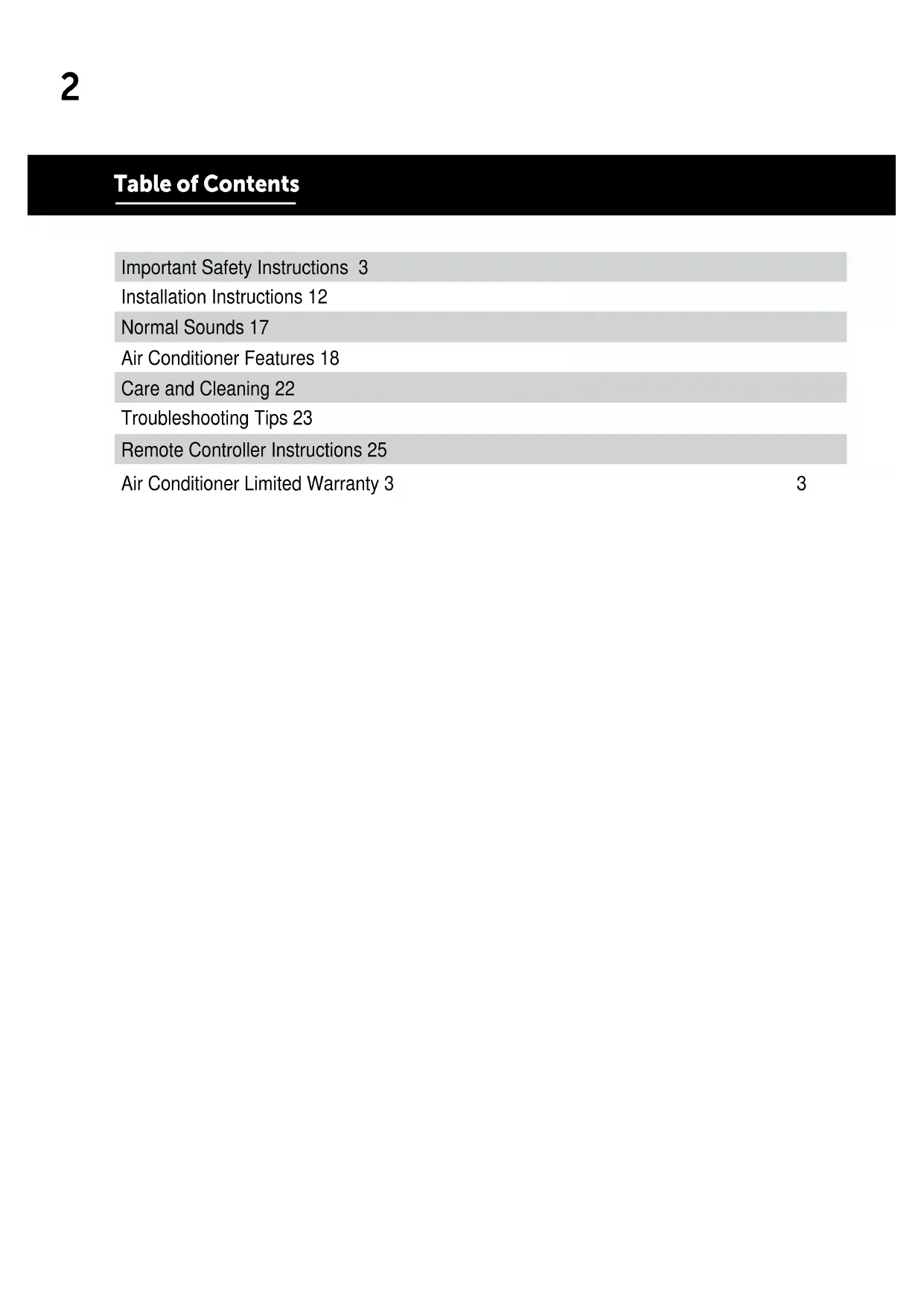
Fre e 3 months extension of the original limited warranty period!* Simply text a picture of your proof of purchase to:1-844-224-1614 *The warranty extension is for the three months immediately following the completion of the product’s original warranty period. Individuals do not need to register the product in order to get all the rights and remedies of registered owners under the original limited warranty.2 Table of Contents Important Safety Instructions 3 Installation Instructions 12 Normal Sounds 17 Air Conditioner Features 18 Care and Cleaning 22 Remote Controller Instructions 25 Air Conditioner Limited Warranty 3 Troubleshooting Tips 23
Inside you will find many helpful hints on how to use and maintain your air conditioner properly. Just a little preventive care on your part can save you a great deal of time and money over the life of your air conditioner. You'll find many answers to common problems in the chart of troubleshooting tips. If you review our chart of Troubleshooting Tips first, you may not need to call for service at all. To prevent injury to the user or other people, or property damage, the following instructions must be followed. Incorrect operation due to ignoring instructions may cause harm or damage. The seriousness is classified by the following indications. This symbol indicates the possibility of death or serious injury. Always do this. Never do this. CAUTION This symbol indicates the possibility of injury or damage to property. WARNING WARNING Plug in power plug properly. Do not modify power cord length or share the outlet with other appliances. Always ensure effective grounding. Unplug the unit if strange sounds, smell, or smoke comes from it. Keep firearms away. Ventilate room before operating air conditioner if there is a gas leakage from another appliance. Otherwise, it may cause electric shock or fire due to excess heat generation. It may cause electric shock or fire due to heat generation. Incorrect grounding may cause electric shock. It may cause fire and electric shock. It may cause fire. It may cause explosion, fire, and burns. It may cause electric shock or fire due to heat generation. It may cause electric shock. It may cause failure of machine or electric shock. It may cause fire and electric shock. It may cause fire and electric shock. It may cause electric shock or fire. If the power cord is damaged, it must be replaced by the manufacturer or an authorised service centre or a similarly-qualified person in order to avoid a hazard. This could damage your health. Incorrect installation may cause fire and electric shock. It may cause electric shock. It may cause an explosion or fire. It may cause failure and electric shock. Do not operate or stop the unit by inserting or pulling out the power plug. Do not operate with wet hands or in damp environment. Do not allow water to run into electric parts. Do not use the socket if it is loose or damaged. Do not use the power cord close to heating appliances. Do not damage or use an unspecified power cord. Do not direct airflow directly on room occupants. Always install circuit breaker and a dedicated power circuit. Do not open the unit during operation. Do not use the power cord near flammable gas or combustibles, such as gasoline, benzene, thinner, etc. Do not disassemble or modify unit.
IMPORT When the air filter is to be removed, do not touch the metal parts of the unit.It may cause an injury.Do not clean unit when power is on as it mayc ausefi re an del ectricsh ock,it may cause an injury.Operation with windows opened may cause wetting of indoor and soaking of household furniture.When the unit is to be cleaned, switch off, and turn off the circuit breaker.Use caution when unpacking and installing.Do not clean the air conditioner with water.Water may enter the unit and degrade the insulation. It may cause an electric shock.This could injure the pet or plant.Failure to do so may cause electric shock and damage.Do not put a pet or house plant where it will be exposed to direct air flow.Ventilate the room well whenused together with a stove, etc.An oxygen shortage may occur.Do not use this air conditioner to preserve precision devices, food,pets, plants, and art objects. It may cause deterioration of quality, etc. It may cause failure of product or fire.Do not use for special purposes.If water enters the unit, turn the unit off at the power outlet and switch off the circuit breaker. Isolate supply by taking the power-plug out and contact a qualified service technician.
It may cause failure of appliance or accident.Appearance may be deteriorated due to change of product colour or scratching of its surface.If bracket is damaged, there is concern of damage due to falling of unit.There is danger of fire or electric shock.Operation without filters may cause failure.It contains contaminants and could make you sick.Stop operation and close the window in storm or hurricane. Do not use strong detergent such as wax or thinner, but use a soft cloth.Ensure that the installation bracket of the outdoor appliance is not damaged due to prolonged exposure.Hold the plug by the head of the power plug when taking it out. Turn off the main power switch when not using theunit for a long time.
Always insert the filters securely. Clean filter once every t wo w eeks. Do not place heavy objects on the power cord and ensure that the cord is not compressed.Do not drink water drained from air conditioner. This appliance is not intended for use by persons (including children) with reduced physical, sensory or mental capabilities or lack of experience and knowledge, unlesst heyh aveb eengi vensu pervision or instruction concerning use of the appliance by a person responsible for their safety. Children should be supervised to ensure that they do not play with the appliance. If the supply cord is damaged, it must be replaced by the manufacturer, its service agent or similarly- qualified persons in order to avoid a hazard. CAUTION CAUTION Do not place obstacles around air-inlets or inside of air-outlet. The appliance shall be installed in accordance with national wiring regulations. Do not operate your air conditioner in a wet room such as a bathroom or laundry room. The appliance with electric heater shall have at l east 3'(1 m) s paceto anyco mbustible materials. Contact an authorised service technician for repair or maintenance of this unit. Contact an authorised installer for installation of this unit. Sharp edges could cause injury. IMPORTANT SAFETY INSTRUCTIONS-Do not use means to accelerate the defrosting process or to clean, other than those recommended by the manufacturer. -The appliance shall be stored in a room without continuously operating ignition sources (for example: open flames, an operating gas appliance) and ignition sourcesor (for example:an operating electric heater) close to the appliance. The appliance shall be stored in a room without continuously operating ignition sources (for example: open
lames, an operating gas appliance or an operating electric heater). -Do not pierce or burn. -Be aware that the refrigerants may not contain an odour. -Compliance with national gas regulations shall be observed. -Keep ventilation openings clear of obstruction. -The appliance shall be stored so as to prevent mechanical damage from occurring. -A warning that the appliance shall be stored in a well-ventilated area where the room size corresponds to the room area as specified for operation. -Any person who is involved with working on or breaking into a refrigerant circuit should hold a current valid certificate from an industry-accredited assessment authority, which authorises their competence to handle refrigerants safely in accordance with an industry recognised assessment specification.
Servicing shall only be performed as recommended by the equipment manufacturer. Maintenance and repair requiring the assistance of other skilled personnel shall be carried out under the supervision of the person competent in the use of flammable refrigerants. -DO NOT modify the length of the power cord or use an extension cord to power the unit. DO NOT share a single outlet with other electrical appliances. Improper power supply can cause fire or electrical shock. -Please follow the instruction carefully to handle, install, clear, service the air conditioner to avoid any damage or hazard. Flammable Refrigerant R32 is used within air conditioner. When maintaining or disposing the air conditioner, the refrigerant (R32
r R290) shall be recovered properly, shall not discharge to air directly. -No any open fire or device like switch which may generate spark/arcing shall be around air conditioner to avoid causing ignition of the flammable refrigerant used. Please follow the instruction carefully to store or maintain the air conditioner to prevent mechanical damage from occurring.
Flammable refrigerant -R32 is used in air conditioner. Please follow the instruction carefully to avoid any hazard.
IMPORTANT SAFETY INSTRUCTIONSWARNINGS (for using R290/R32 refrigerant only)
Explanation of symbols displayed on the unit(For the unit adopts R32/R290 Refrigerant only): WARNING This symbol shows that this appliance used a flammable refrigerant. If the refrigerant is leaked and exposed to an external ignition source, there is a risk of fire. CAUTION This symbol shows that the operation manual should be read carefully. CAUTION This symbol shows that a service personnel should be handling this equipment with reference to the installation manual. CAUTION This symbol shows that information is available such as the operating manual or installation manual. 1.Transport of equipment containing flammable refrigerants See transport regulations 2.Marking of equipment using signs See local regulations 3.Disposal of equipment using flammable refrigerants See national regulations. 4.Storage of equipment/appliances The storage of equipment should be in accordance with the manufacturer's instructions. 5.Storage of packed (unsold) equipment Storage package protection should be constructed such that mechanical damage to the equipment inside the package will not cause a leak of the refrigerant charge. The maximum number of pieces of equipment permitted to be stored together will be determined by local regulations. 6.Information on servicing 1)Checks to the area Prior to beginning work on systems containing flammable refrigerants, safety checks are necessary to ensure that the risk of ignition is minimised. For repair to the refrigerating system, the following precautions shall be complied with prior to conducting work on the system. 2)Work procedure Work shall be undertaken under a controlled procedure so as to minimise the risk of a flammable gas or vapour being present while the work is being performed. 3)General work area All maintenance staff and others working in the local area shall be instructed on the nature of work being carried out. Work in confined spaces shall be avoided. The area around the workspace shall be sectioned off. Ensure that the conditions within the area have been made safe by control of flammable material. 4)Checking for presence of refrigerant The area shall be checked with an appropriate refrigerant detector prior to and during work, to ensure the technician is aware of potentially flammable atmospheres. Ensure that the leak detection equipment being used is suitable for use with flammable refrigerants, i.e. non-sparking, adequately sealed or intrinsically safe. 5)Presence of fire extinguisher If any hot work is to be conducted on the refrigeration equipment or any associated parts, appropriate fire extinguishing equipment shall be available to hand. Have a dry powder or CO2 fire extinguisher adjacent to the charging area. 6)No ignition sources No person carrying out work in relation to a refrigeration system which involves exposing any
IMPORTANT SAFETY INSTRUCTIONS7)Ventilated area Ensure that the area is in the open or that it is adequately ventilated before breaking into the system or conducting any hot work. A degree of ventilation shall continue during the period that the work is carried out. The ventilation should safely disperse any released refrigerant and preferably expel it externally into the atmosphere. 8)Checks to the refrigeration equipment Where electrical components are being changed, they shall be fit for the purpose and to the correct specification. At all times the manufacturer's maintenance and service guidelines shall be followed. If in doubt consult the manufacturer's technical department for assistance. The following checks shall be applied to installations using flammable refrigerants: The charge size is in accordance with the room size within which the refrigerant containing parts are installed; The ventilation machinery and outlets are operating adequately and are not obstructed; If an indirect refrigerating circuit is being used, the secondary circuit shall be checked for the presence of refrigerant; Marking to the equipment continues to be visible and legible. Markings and signs that are illegible shall be corrected; Refrigeration pipe or components are installed in a position where they are unlikely to be exposed to any substance which may corrode refrigerant containing components, unless the components are constructed of materials which are inherently resistant to being corroded or are suitably protected against being so corroded. 9)Checks to electrical devices Repair and maintenance to electrical components shall include initial safety checks and component inspection procedures. If a fault exists that could compromise safety, then no electrical supply shall be connected to the circuit until it is satisfactorily dealt with. If the fault cannot be corrected immediately but it is necessary to continue operation, an adequate temporary solution shall be used. This shall be reported to the owner of the equipment so all parties are advised. Initial safety checks shall include: That capacitors are discharged: this shall be done in a safe manner to avoid possibility of sparking; That there no live electrical components and wiring are exposed while charging, recovering or purging the system; That there is continuity of earth bonding. 1)During repairs to sealed components, all electrical supplies shall be disconnected from the equipment being worked upon prior to any removal of sealed covers, etc. If it isabsolutely necessary to have an electrical supply to equipment during servicing, then a permanently operating form of leak detection shall be located at the most critical point to warn of a potentially hazardous situation. 2)Particular attention shall be paid to the following to ensure that by working on electrical components, the casing is not altered in such a way that the level of protection is affected. 7.Repairs to sealed components
pipe work that contains or has contained flammable refrigerant shall use any sources of ignition in such a manner that it may lead to the risk of fire or explosion. All possible ignition sources, including cigarette smoking, should be kept sufficiently far away from the site of installation, repairing, removing and disposal, during which flammable refrigerant can possibly be released to the surrounding space. Prior to work taking place, the area around the equipment is to be surveyed to make sure that there are no flammable hazards or ignition risks. No Smoking signs shall be displayed.8. Repair to intrinsically safe components Do not apply any permanent inductive or capacitance loads to the circuit without ensuring that this will not exceed the permissible voltage and current permitted for the equipment in use. Intrinsically safe components are the only types that can be worked on while live in the presence of a flammable atmosphere. The test apparatus shall be at the correct rating. Replace components only with parts specified by the manufacturer. Other parts may result in the ignition of refrigerant in the atmosphere from a leak.
Check that cabling will not be subject to wear, corrosion, excessive pressure, vibration, sharp edges or any other adverse environmental effects. The check shall also take into account the effects of aging or continual vibration from sources such as compressors or fans.
10. Detection of flammable refrigerants
Under no circumstances shall potential sources of ignition be used in the searching for or detection of refrigerant leaks. A halide torch (or any other detector using a naked flame) shall not be used.
11. Leak detection methods
The following leak detection methods are deemed acceptable for systems containing flammable refrigerants. Electronic leak detectors shall be used to detect flammable refrigerants, but the sensitivity may not be adequate, or may need re-calibration. (Detection equipment shall be calibrated in a refrigerant-free area.) Ensure that the detector is not a potential source of ignition and is suitable for the refrigerant used. Leak detection equipment shall be set at a percentage of the LFL of the refrigerant and shall be calibrated to the refrigerant employed and the appropriate percentage of gas (25 % maximum) is confirmed. Leak detection fluids are suitable for use with most refrigerants but the use of detergents containing chlorine shall be avoided as the chlorine may react with the refrigerant and corrode the copper pipe-work. If a leak is suspected, all naked flames shall be removed/ extinguished. If a leakage of refrigerant is found which requires brazing, all of the refrigerant shall be recovered from the system, or isolated (by means of shut off valves) in a part of the system remote from the leak. Oxygen free nitrogen (OFN) shall then be purged through the system both before and during the brazing process.
12. Removal and evacuation
When breaking into the refrigerant circuit to make repairs or for any other purpose conventional procedures shall be used. However, it is important that best practice is followed since flammability is a consideration. The following procedure shall be adhered to: Remove refrigerant; Purge the circuit with inert gas; Evacuate; Purge again with inert gas; Open the circuit by cutting or brazing.
This shall include damage to cables, excessive number of connections, terminals not made to original specification, damage to seals, incorrect fitting of glands, etc. Ensure that apparatus is mounted securely. Ensure that seals or sealing materials have not degraded such that they no longer serve the purpose of preventing the ingress of flammable atmospheres. Replacement parts shall be in accordance with the manufacturer's specifications. NOTE: The use of silicon sealant may inhibit the effectiveness of some types of leak detection equipment. Intrinsically safe components do not have to be isolated prior to working on them.a) Become familiar with the equipment and its operation. b) Isolate system electrically. c) Before attempting the procedure ensure that: Mechanical handling equipment is available, if required, for handling refrigerant cylinders; All personal protective equipment is available and being used correctly; The recovery process is supervised at all times by a competent person; Recovery equipment and cylinders conform to the appropriate standards. d) Pump down refrigerant system, if possible. e) If a vacuum is not possible, make a manifold so that refrigerant can be removed from various parts of the system. f) Make sure that cylinder is situated on the scales before recovery takes place. g) Start the recovery machine and operate in accordance with manufacturer's instructions. h) Do not overfill cylinders. (No more than 80 % volume liquid charge).
i) Do not exceed the maximum working pressure of the cylinder, even temporarily.
j) When the cylinders have been filled correctly and the process completed, make sure that the cylinders and 13.Charging procedures In addition to conventional charging procedures, the following requirements shall be followed. Ensure that contamination of different refrigerants does not occur when using charging equipment. Hoses or lines shall be as short as possible to minimise the amount of refrigerant contained in them. Cylinders shall be kept upright. Ensure that the refrigeration system is earthed prior to charging the system with refrigerant. Label the system when charging is complete (if not already). Extreme care shall be taken not to overfill the refrigeration system. Prior to recharging the system it shall be pressure tested with OFN. The system shall be leak tested on completion of charging but prior to commissioning. A follow up leak test shall be carried out prior to leaving the site. 14.Decommissioning Before carrying out this procedure, it is essential that the technician is completely familiar with the equipment and all its detail. It is recommended good practice that all refrigerants are recovered safely. Prior to the task being carried out, an oil and refrigerant sample shall be taken in case analysis is required prior to re-use of reclaimed refrigerant. It is essential that electrical power is available before the task is commenced.
The refrigerant charge shall be recovered into the correct recovery cylinders. The system shall be flushed with OFN to render the unit safe. This process may need to be repeated several times. Compressed air or oxygen shall not be used for this task. Flushing shall be achieved by breaking the vacuum in the system with OFN and continuing to fill until the working pressure is achieved, then venting to atmosphere, and finally pulling down to a vacuum. This process shall be repeated until no refrigerant is within the system. When the final OFN charge is used, the system shall be vented down to atmospheric pressure to enable work to take place. This operation is absolutely vital if brazing operations on the pipe-work are to take place. Ensure that the outlet for the vacuum pump is not close to any ignition sources and there is ventilation available.15.Labelling Equipment shall be labelled stating that it has been de-commissioned and emptied of refrigerant. The label shall be dated and signed. Ensure that there are labels on the equipment stating the equipment contains flammable refrigerant. 16.Recovery When removing refrigerant from a system, either for servicing or decommissioning, it is recommended good practice that all refrigerants are removed safely. When transferring refrigerant into cylinders, ensure that only appropriate refrigerant recovery cylinders are employed. Ensure that the correct number of cylinders for holding the total system charge is available. All cylinders to be used are designated for the recovered refrigerant and labelled for that refrigerant (i.e. special cylinders for the recovery of refrigerant). Cylinders shall be complete with pressure relief valve and associated shut-off valves in good working order. Empty recovery cylinders are evacuated and, if possible, cooled before recovery occurs. The recovery equipment shall be in good working order with a set of instructions concerning the equipment that is at hand and shall be suitable for the recovery of flammable refrigerants. In addition, a set of calibrated weighing scales shall be available and in good working order. Hoses shall be complete with leak-free disconnect couplings and in good condition. Before using the recovery machine, check that it is in satisfactory working order, has been properly maintained and that any associated electrical components are sealed to prevent ignition in the event of a refrigerant release. Consult manufacturer if in doubt. The recovered refrigerant shall be returned to the refrigerant supplier in the correct recovery cylinder, and the relevant Waste Transfer Note arranged. Do not mix refrigerants in recovery units and especially not in cylinders. If compressors or compressor oils are to be removed, ensure that they have been evacuated to an acceptable level to make certain that flammable refrigerant does not remain within the lubricant. The evacuation process shall be carried out prior to returning the compressor to the suppliers. Only electric heating to the compressor body shall be employed to accelerate this process. When oil is drained from a system, it shall be carried out safely.
the equipment are removed from site promptly and all isolation valves on the equipment are closed off. k) Recovered refrigerant shall not be charged into another refrigeration system unless it has been cleaned and checked.IMPORTANT SAFETY INSTRUCTIONS Do not, under anycircumstances, cut,remove, or bypassthe grounding prong.Power supply cordwith 3-prong grounding plugand current detection device.Grounding type wallreceptacle WARNING NOTE: The power supply cord with this air conditioner contains a current detection device designed to reduce the risk of fire.Please refer to the section Operationof Current Device for details.In the event that the power supply cord is damaged, it cannot be repaired, it must be replaced with a c ord f rom t he product m anufacturer. Avoid fire hazard or electric shock. Do notuse an extension cord or an adaptor plug. Do not remove any prong from the power cord. WARNING For Your Safety WARNING Prevent Accidents WARNING Electrical Information Do not store or use gasoline or other flammable vapours or liquids in the vicinity of this or any other appliance. Operation of Current Device (Applicable to units that have current detection device only)The power supply cord contains a current device that senses damage to the power cord. To test your power supply cord do the following:1. Plug in the air conditioner.2. The power supply cord will have TWO buttons on the plughead. Press the TEST button, you will notice a click as theRESET button pops out.3. Press the RESET button, again you will notice a click asthe button engages. The power supply cord is now supplying electricity to theunit. (On some products this it also indicated by a light onthe plug head.)To reduce the risk of fire, electric shock, or injury to persons when using yourair conditioner, follow basic precautions, including the following: Be sure the electrical service is adequate for the model you have chosen. This information can be found on the serial plate, which is located on the side of the the cabinet and behind the grille. If the air conditioner i s t o b e in stalled in a w indow, yo u w ill pr obably w ant to cl ean both sides of the g lass f irst. I f th e w indow is a tri ple-track ty pe w ith a sc reen pa nel included, remove the screen completely before installation. Be sure the air c onditioner h as b een s ecurely a nd c orrectly in stalled a ccording to the installation instructions in this manual. Save this manual for possible future use in removing or installing this unit. When handling the air conditioner, be careful to avoid cuts f rom s harp m etal f ins on front and rear coils. The complete electical rating of your new room air conditioner is stated on the serial plate. Refer to the rating when checking the electrical requirements. Be sure the air conditioner is properly grounded. To minimize shock and fire hazards, proper grounding is important. The power cord is equipped with a three-prong grounding plug for protection against shock hazards. Your air conditioner must be used in a properly grounded wall receptacle. If the wall receptacle you intend to use is not adequately grounded or protected by a time delay fuse or circuit breaker, have a qualified electrician install the proper receptacle. Ensure the receptacle is accessible after the unit installation. Do not run air conditioner without side protective cover in place.This could result in mechanical damage within the air conditioner. Do not use an extension cord or an adaptor plug. Do not use this device to turn the unit on or off. Always make sure the RESET button is pushed in for correct operation. The power supply must be replaced if it fails reset when either the TEST button is pushed, or it cannot be reset. A new one can be obtained from the product manufacturer. If power supply cord is damaged, it cannot be repaired. It MUST be replaced by one obtained from the product manufacturer. NOTE: NOTE:This air conditioner is designed to be operated under condition as follows:Cooling operationOutdoor temp: Indoor temp: Heating operationOutdoor temp: Indoor temp: Note: Performance may be reduced outside of these operating temperatures.-5 to 24ºC (23 to 76ºF)0 to 27ºC (32 to 80ºF)17 to 32ºC (62 to 90ºF)18 to 43ºC (64 to 109ºF) [18 to 52ºC (64 to 125ºF) for special tropical models]
IMPORTANT SAFETY INSTRUCTIONS
11INSTALLATION INSTRUCTIONS Read these instructions completely and carefully. IMPORT instructions for local inspector s use. IMPORTANT governing codes and ordinances. Note to c instructions for future reference. Note to i requires basic mechanical skills.We recommend that two people installthis product.Proper installation is the responsibilityof the installer.Product failure due to improper installationis not covered under the warranty.You MUST use all supplied parts and useproper installation procedures as describedin these instructions when installing this airconditioner. BEFORE YOU BEGINDo not, under any circumstances, cut orremove the third (ground) prong from thepower cord.CAUTIONDo not change the plug on the power cordof the air conditioner.Aluminum house wiring may present specialWhen handling unit, be careful to avoid cuts fromsharp metal edges and aluminum fins on front andrear coils.TOOLS YOU WILL NEEDScrewdriverLevelTOOLS YOU MAY USEScrewdriverPencilRuler or tape measureScissors or knifeSave carton and these installation instructionsfor future reference. The carton is the best wayto store unit during winter, or when not in use.NOTE:Your air conditioner is designed to install in standard double hung windows with opening widths of 23 to 36" (58.4cm to 91.4cm) .WINDOW REQUIREMENTS ANT
Be sure to leavethese instructions with the consumer. Completion time
Approximately 1 hour. Skill level
Installation of this appliance problems consult a qualified electrician.
23 to 36" (58 to 91 cm). Model
Lower sash must open sufficiently to allow a clear vertical opening of 13 inches (330mm). Side louvers and the rear of the AC must have clear air space to allow enough airflow through the condenser, for heat removal. The rear of the unit must be outdoors, not inside a building or garage. A: Remove the air conditioner from the carton and place on a flat surface. B: Remove top rail from the packaging material as shown in Fig. A. Top Rail Hardware 3/8 Screws (4) op Rail (1)Packaging Fig.A Top RailFig.CNOTE: The top rail hardware and the Fig.A, Fig.B and Fig.C are not applicable to the units more than 10000Btu/h. Before installing unit, the top rail must be assembled on the unit (For <10000Btu/h models only).C: Align the hole in the top rail with those in the top of the unit as shown in Fig.BD: Secure the top rail to the unit with the 3/8 Screws as shown in Fig.C.NOTE: For safety reasons, all four(4) screws MUST be securely fastened.
INSTALL THE ACCORDION PANELS
NOTE: Top rail and Sliding Panels at each side are offset to provide the proper pitch to the rear of (5/16 ). This is necessary for proper condensed water utilization and drainage. If you are not using the Side Panels for any reason, this pitch to the rear must be maintained. A.Place unit on floor, a bench ora table. Hold the AccordionPanel in one hand and gentlypull back the center to free theopen end. See Fig.1 Fig.1 Fig.B3/4" (19 mm) or 1/2" (12.7 mm) screws (7) Lock frame (2) Sash lock (1) Window sash seal foam (1) Weather stripping (5) (2) (10" *3/4 "*1/12" ) Lock frame (For wooden windows) (For Vinyl-Clad windows) (For Energy Star models only)INSTALLATION INSTRUCTIONS
B. Slide the free end " " section of the panel directly into the cabinet as shown in Fig. 2. Slide the panel down. Be sure to leave enough space to slip the top and bottom of the frame into the rails on the cabinet. Fig.2 " "section C. Once the panel has been installed on the side of the cabinet, make sure it sits securely inside the frame channel by making slight adjustments. Slide the top and bottom ends of the frame into the top and bottom rails of the cabinet. Fig.3. D. Slide the panel all the way in and repeat on the other side. Top RailBottom Rail Fig.3 A.Keep a firm grip on the air conditioner, carefully place the unit into the window opening so the bottom of the air conditioner frame is against the window sill (Fig.5). Carefully close the window behind the top rail of the unit. NOTE: If storm window blocks AC, see Fig. 11. Top RailBottom RailTop leftTop right Fig.4 Wooden Windows INSIDE OUTSIDE H:About 3/4 to 1 for 5 to 8K);Measure from the cabinet edge H:About 1 to 1 / for 10 to12K);
Fig.5 Vinyl-Clad Windows INSIDE OUTSIDE H:About 3/4 to 1 for 5 to 8K);Measure from the cabinet edge H:About 1 to 1 / for 10 to12K);
NOTE: Check that air conditioner is tilted back per dimension H (Fig. 5) (tilted about 3° to 4° downward to the outside). After proper installation, condensate should not drain from the overflow drain hole during normal use. Adjust the slope if otherwise. window frame Fig.6
A.Place the frame lock between the frame extensions and the window sill as shown(Fig.7A for Wooden windows), (Fig.7B for Vinyl-Clad windows) .
B.Extend the side panels out against the window frame (Fig.6).INSTALLATION INSTRUCTIONS
A: For wooden windows: Drive 1/ 2 (12.7 mm) locking screws through the frame lock and into the sill (Fig.8A). NOTE: To prevent window sill from splitting, drill 1/8 (3mm) pilot holes before driving screws. Drive 1/ 2 (12.7mm) locking screws through frame holes into window sash (Fig.8B). B: For Vinyl-Clad windows: Drive 1/ 2 (12.7 mm) locking screws through the frame lock and into the window sashl (Fig.8B). NOTE: Before driving the screws, use a drill to drill 5 holes through the holes in the frame lock and frame extensions into the windows sash as shown (Fig. 8B). Fig.8A Fig.8B
To secure lower sash in place, attach right angle sash lock with 3/4" (19mm) or 1 screw as shown(Fig.9). /2" (12.7mm) Fig.9 D.Cut and insert it in the space between the upper and lower sashes (Fig.10). Window sash seal foam16
7NORMAL SOUNDS fan. the evaporator The unit , or incorrect installation. the condenser Sound of Rushing Air At the front of the unit you mayhear the sound of rushing airbeing moved by the fan. High Pitched Chatter High efficiency compressorsmay have a high pitched chatterduring the cooling cycle. Gurgle/Hiss Gurgling or hissing noise may be heard due to refrigerant passing through evaporator during normal operation. Pinging or Switching Droplets of water hitting condenserduring normal operation may cause pinging or switching sounds. Vibration Unit may vibrate and make noisebecause of poor wall or windowconstruction or incorrect installation. All the illustrations in this manual are for explanation purpose only. Your air conditioner may be slightly different. The actual shape shall prevail. NOTE:CAUTION Please always wait 3 minutes when turning unit off then on again, and when changing from cool to fan and back to cool. This prevents compressor from overheating & possible circuit breaker tripping. WARNING To reduce the risk of fire, electric shock, or injury to persons, read the IMPORTANT SAFETY INSTRUCTIONS before operating this appliance.1. Set the thermostat to the highest number (coldest orcooler setting).2. Set the selector control to the highest COOL setting.3. Adjust the louver for comfortable air flow (see AirDirectional Louvers).4. Once the room has cooled, adjust the thermostat to thesetting you find most comfortable.5. Make sure that the air flow inside and outside are notobstructed by anything.To begin operating the air conditioner, follow these steps: Air Directional Louvers LeverThe louvers will allow you to direct the air flow Left or Right throughout the room as needed. Move the Levers from side to side until the desiredLeft/Right direction is obtained. Air Direction for 5000BTU/h Do not damage or use an unspecified power cord. Fresh Air Vent Control (on ):10~12K models Fig. A (VENT CLOSED) Fig. B (VENT OPEN) Fig. C (VENT & EXHAUST OPEN)The Fresh Air Vent allows the air conditioner to:1. Recirculate inside air - Vent Closed (See Fig.A)2. Draw fresh air into the room- Vent Open (see Fig.B)
3. Exchange air from the room and draws fresh air into the room - Vent and Exhaust Open (see Fig.C)
The louvers will allow you to direct the air flow Up or Down(on some models) and Left or Right throughout the room as needed. Pivot horizontal louvers until the desired Up/Down direction is obtained. Move the Lever(s) from side to side until the desired Left/Right direction is obtained. Levers Air Direction for 6000BTU/h, 8000BTU/h, 10000BTU/h, 12000BTU/h AIR CONDITIONER FEATURESThe controls featured in this manual are representative of many available models. Your model may offer slightly different features. Cool Mode The desired cool setting is selected by rotating the knob to the right to the appropriate location. has maximum cooling effect and airflow. has minimum cooling effect and airflow. Fan Mode Rotate the knob to the left to select your choice of fan speeds for air circulation. NOTE: When selecting a fan speed, the compressor will not run. Thermostat The thermostat is used to set the desired room temperature when the unit is being operated in the " ". COOL MODE To set the desired room temperature, rotate the thermostat switch to the desired setting. After the set temperature is achieved, the thermostat will automatically start and stop the compressor in order to maintain the desired set temperature. Rotate the thermostat selector clockwise for higher cool settings. Higher cool settings will provide lower room temperature. Rotate the thermostat selector counter clockwise for lower cool settings. Lower cool settings will provide a higher room temperature. Before you begin, thoroughly familiarize yourself with the control panel as shown below and all its functions, then follow the symbol for the functions you desire.
MANUAL CONTROL OPERATING INSTRUCTIONS
AIR CONDITIONER FEATURESBefore you begin, thoroughly familiarize yourself with the control panel as shown below and all its functions, then follow the symbol for the functions you desire. The unit can be controlled by the unit controls alone or with the remote.
ELECTRONIC CONTROL OPERATING INSTRUCTIONS
UNIT CONTROL TO TURN UNIT ON OR OFF: Press ON/OFF button to t urn u nit o n o r o ff. NOTE:The unit wil l initiate a utomatically the Energy Saver function under C ool, Dry, Auto (only Auto-cooling and Auto-fan) modes. TO CHANGE TEMPERATURE SETTING: temperature setting.
NOTE:Press or hold either LEFT until the desired temperature is seen on the display. This temperature will be automatically maintained O O O O anywhere between 17 C(62 F) and 30 C(86 F). If you want the display to read the actual room temperature, see To Operate on Fan Only section. Press LEFT/RIGTH button to change ( ) or RIGTH ( ) button TO ADJUST FAN SPEEDS: Press to select the fan speed in four steps: Auto, Low, Med or High. Each time the button is pressed, the fan speed mode is shifted. On Dry mode,the fan speed is controlled at Low automatically. SLEEP FEATURE: Press Sleep button to initiate the sleep mode. In this mode the selected temperature will increase by O O 2 F/1(or 2) C 30 minutes after the mode is selected.
The temperature will then increase by another 2 F/
1(or 2) C after an additional 30 minutes. T his n ew t emperature w ill be maintained for 6 hours before it returns to the originally-selected temperature. This ends the Sleep mode, and the u nit w ill c ontinue t o o perate as originally programmed. The Sleep mode program can be cancelled at any time duri
operation by pressing the Sleep button again. Press Check Filter button to initiate this feature. This feature is a reminder to clean the air filter for more efficient operation. The LED (indicator light) will illuminate after 250 hours of operation. To reset after cleaning the filter, press the Check Filter button and the light will go off. CHECK FILTER FEATURE: ENERGY SAVER FEATURE: Press Energy Saver button to initiate this function. This function is available on COOL, DRY, AUTO (only AUTO-COOLING and AUTO-FAN) modes.The fan will continue to run for 3 minutes after the compressor shuts off. The fan then cycles on for 2 minutes at 10 minute intervals until the room temperature is above the set temperature, at which time the compressor turns back on and cooling starts.
TO SELECT THE OPERATING MODE: To choose operating mode, press Mode button. Each time you press the button, a mode is selected in a sequence that goes from Auto, Cool, Dry and Fan. The indicator light beside will be illuminated and remained on once the mode is selected. To operate on Auto feature: In this mode, the fan speed cannot be adjusted: it starts automatically at a predetermined speed that depends on the room temperature. To operate on Fan Only: Use this function only when cooling is not desired, such as for room air circulation or to exhaust stale air (on some models). Remember to open the vent during this function, but keep it closed during cooling for maximum cooling efficiency. You can choose any fan speed you prefer. During this function, the display will show the actual room temperature, not the set temperature as in the cooling mode. To operate on Dry mode: In this mode, the air conditioner will generally operate in the form of a dehumidifier. Since the conditioned space is a closed or sealed area, some degree of cooling will continue. When you set the air conditioner in AUTO mode, it will automatically select cooling, heating (not available on cooling- only models), or fan-only operation depending on what temperature you have selected and the room temperature. The air conditioner will control the room temperature automatically at the temperature point you have selected. In Fan-only mode the temperature is not adjusted. The unit will initiate automatically the Energy Saver function under Cool, Dry, Auto (only Auto-Cooling and Auto-Fan) modes. When the unit is on or off, first press Timer button: the TIMER ON indicator light illuminates. It indicates the Auto Start program is initiated. When the time of TIMER ON is displayed, press the Timer button again, the TIMER OFF indicator light illuminates. It indicates the Auto Stop program is initiated. Press or hold the UP or DOWN button to change the Auto time in 0.5 hour increments, up to 10 hours, then in 1 hour increments up to 24 hours.The control will count down the time remaining until start. The selected time will register in 5 seconds, and the system will automatically revert back to display the previous tem perature setting or room temperature when the unit is on. When the unit is off there is no display. Turning the unit ON or OFF at any time or adjusting the timer setting to 0.0 will cancel the Auto Start/Stop timer program. TIMER
AUTO START/STOP FEATURE: Displays DISPLAYS: O O Shows the set temperature in " C" or " F" and the Auto-timer settings. While on Fan-only mode, it shows the room temperature. DISPLAYS: -Evaporator temperature sensor error. Unplug the
nit and plug it back in. If error repeats, call for
ervice. NOTE: " " is displayed as shown in the left picture. HS -Electric heating sensor error. Unplug the unit and plug it back in. If error repeats, call for service. Error codes: AS-Room temperature sensor error. Unplug the unit and plug it back in. If error repeats, call for service. NOTE: In Fan-only mode, it will display" LO" or "HI" . If the unit stops unexpectedly due to a power outage, it will restart with the previous function setting automatically when the power resumes. NOTE:CAUTION Clean your air conditioner occasionally to keep it looking new. Be sure to unplug the unit before cleaning to prevent shock or fire hazards. Air Filter Cleaning Air Filter Cleaning The air filter should be checked at least once a month to see if cleaning is necessary. Trapped particles in the filter can build up and cause an accumulation of frost on the cooling coils.
Note: Never use hot water over 40 C (104 F) to cl ean th e a i r fil ter. Never attempt to operate the unit without the air filter. Winter Storage If you plan to store the air conditioner during the winter, remove it carefully from the window according to the installation instructions. Cover it with plastic or return it to the original carton. Cabinet Cleaning Be sure to unplug the air conditioner to prevent shock or fire hazard. The cabinet and front may be dusted with an oil-free cloth or washed with a cloth dampened in a solution of warm water and mild liquid dishwashing detergent. Rinse thoroughly and wipe dry. Never use harsh cleaners, wax or polish on the cabinet front. Be sure to wring excess water from the cloth before wiping around the controls. Excess water in or around the controls may cause damage to the air conditioner. Plug in air conditioner. Push the vent handle to the vent closed position (where applicable). Open the front panel.Take the filter by the centre and pull up and out. Wash the filteru sing l iquid d ishwashing d etergent a nd w arm water. Rinse filter thoroughly. Gently shake excess water from the filter. Be sure the filter is thoroughly dry before replacing. Or, instead of washing, you may vacuum the filter clean.TROUBLESHOOTING TIPS TROUBLESHOOTING Before calling for service, review this list. It may save your time and expense. This list includes common occurrences that are not the result of defective workmanship or materials in this appliance. Solution Air conditioner does not start. Wall plug disconnected. Push plug firmly into wall outlet. House fuse blown or circuit breaker tripped. Replace fuse with time delay type or reset circuit breaker. Plug current device tripped. Press the RESET button. Problem Air from unit does not feel cold enough. Set to a lower temperature. O O Room temperature below 17 C(62 F ). Cooling may not occur until room temperature O O rises above 17 C(62 F). Thermostat set too cold for night-time cooling. To defrost the coil, set to FAN ONLY mode. Then, set temperature to a higher setting. Temperature sensing behind air filter element touching cold coil. Keep it from the cold coil. Air filter may be dirty. Clean filter. Refer to Care and Cleaning section. To defrost, set to FAN ONLY mode. Power is OFF. Turn power ON. Air conditioner cooling, but room is too warm-- ice forming on cooling coil behind decorative front. O O Outdoor temperature below 18 C(64 F). To defrost the coil, set FAN ONLY mode. Compressor stopped when changing modes. Wait for 3 minutes after setting to the COOL mode.TROUBLESHOOTING TIPS SolutionProblemDirty air filter-- air restricted. Clean air filter. Refer to Care and Cleaning section.Unit recently turned on in hot room. Allow additional time to remove stored heat from walls, ceiling, floor and furniture.Air conditioner cooling, but roomis too warm-- NO ice forming on cooling coil behind decorative front.Temperature is set too high. Set temperature to a lowercase setting.Air directional louvers positioned improperly. Position louvers for better air distribution.Front of units is blocked by drapes, blinds, furniture, etc. -- restricts air distribution. Clear blockage in front of unit.Doors, windows, registers, etc. open-- cold air escapes. Close doors, windows, registers.Air conditioner turns onand off rapidly.Noise when unit is cooling.Water drippingINSIDE when unit is cooling.Improper installation. Tilt air conditioner slightly to the outside to allow water drainage. Refer to installation instructions -- check with installer.Dirty air filter- air restricted. Clean air filter.Air movement sound. This is normal. If too loud, set to a slower FAN setting.Outside temperature extremely hot. Set FAN speed to a higher setting to bring air past cooling coils more frequently.Window vibration -- poor installation. Refer to installation instructions or check with installer. Water dripping OUTSIDE when unit is cooling. Remote sensing (some models). radius of the front of the unit. Remote control signal obstructed. Remove obstruction. Room too cold. Set temperature too low. Increase set temperature. Unit removing large quantity of moisture from humid room. This is normal during excessively humid days. Remote control not located within range. Place remote control within 16.4' (5 m) and 180º deactivating prematurely 24Use the remote controller within a distance of 16 feet (5 m) from the appliance, pointing it towards the receiver. Reception is confirmed by a beep. CAUTIONS The air conditioner will not operate if curtains, doors or other materials block the signals from the remote controller to the indoor unit. Prevent any liquid from falling into the remote controller. Do not expose the remote controller to direct sunlight or heat. If the infrared signal receiver on the indoor unit is exposed to direct sunlight, the air conditioner may not function properly. Use curtains to prevent the sunlight from falling on the receiver. If other electrical appliances react to the remote controller, either move these appliances or consult your local dealer. Handling the remote controller Battery Installation Instructions Location of the remote controller. Remote Controller Instructions
Positive(+) side up Coin Battery coverGrooveUnlock signLock signLock signUnlock signBattery coverGrooveUnlock signBattery coverGrooveUnlock signBattery coverGrooveLock signInsulation pieceStep 1: Insert a coin vertically in the groove on the battery cover, clockwise rotation of 45 degrees, make sure that the groove is aligned with the "unlock" sign as shown below and remove the battery cover. Coin Coin Coin Lock signStep 2: Install battery inside the remote controller, the positive (+) side up.Step 3: Install the battery cover, make sure the battery cover groove is aligned with the "unlock" sign. Insert a coin vertically in the groove and press it gently, then counter clockwise rotation of 45 degrees, make sure the groove is aligned with the "lock" sign as shown below. NOTE: First remove the insulation piece (if available) and then install the battery according to the following steps. Battery
t-5 C~60 C(23 F~140 F)ModelLowest Voltage of CPU Emitting SignalRated VoltageRG15A(B)/E3.0V( Lithium battery CR2025 ) 2.4V -Buttons design is based on typical model and might be slightly different from the actualone you purchased, the actual shape sh ll prevail.-All functions described in these instructions apply to the different air conditioner modelsavailable; if your model doesn't have a pecific function, pressing the correspondingbutton will have no effect.-When there are wide differences between Remote controller Instructions and USERSMANUAL on function description, the description on USERS MANUAL shall prevail.
1. Battery must be disposed of properly. Do not short circuit or
dispose of in the fire.
2. Keep batteries out of the reach of children.
3. Batteries must not be ingested.
4. Non-rechargeable batteries are not to be recharged.
5. Exhausted batteries are to be removed from the product.
Remote Controller Specifications WARNING EnvironmentSignal Receiving RangeNOTE:。 。 。 。16 ft (5 m) Remote Controller Instructions
WARNING: Chemical Burn Hazard. Keep batteries away from children.”
“This product contains a lithium button/coin cell battery. If a new or used lithium button/coin cell battery is swallowed or enters the body, it can cause severe internal burns and can lead to death in as little as 2 hours. Always completely secure the battery compartment. If the battery compartment does not close securely, stop using the product, remove the batteries, and keep it away from children. If you think batteries might have been swallowed or placed inside any part of the body, seek immediate medical attention.”The cells shall be disposed of properly, including keeping them away from children.Even used cells may cause injury. 26NOTE: Function buttons Push this button to decrease the indoor temperature setting in 1ºC/1ºF increments to 17ºC/62ºF. Push this button to activate the "Auto Start" or "Auto Stop"program. Push this button to increase the temperature setting in 1
Press this button to activate the Sleep mode. This function is available on COOL, HEAT or AUTO mode only and maintain the most comfortable temperature for you. Press this button to activate the Energy-saving mode. Press it again to stop the funtion.(on some models) Operation starts when this button is pressed and stops when the button is pressed again. NOTE: If the unit has ENERGY SAVER function, it will initiate automatically the Energy Saver function under Cool, Dry, and Auto(only Auto-Cooling and Auto-Fan) modes. Press this button to select the desired operation mode from
AUTO, COOL, DRY, HEAT
(Cooling & heating models only) and FAN. Do not select HEAT mode if the machine you purchased is cooling only type. Heat mode is not supported by the cooling only appliance. Push this button, the system will automatically shift to COOL operation with auto fan speed, the setting temperature is 26ºC/80ºF. And the timer setting program will be cancelled. Used to select the fan speed in four steps: Auto, Low, Med and High. ON/OFF button MODE button
Remote Controller Instructions All functions described in these instructions apply to the different models available; if your model doesn't have a specific function, pressing the corresponding button will have no effect.3 3 Air Conditioner Limited Warranty These products have been made to quality standards and are guaranteed for domestic use against manufacturing faults. One (1) year full warranty from original purchase date and limited 2nd through 5th year sealed system warranty if used for normal domestic purposes. This warranty does not affect your statutory rights. In case of any malfunction of your product (failure, missing part, etc.), please contact one of our service technicians at our toll-free service line at 1-866-646-4332 from 8 AM to 6 PM EST, Monday to Friday, and 8 AM to 4 PM EST, Saturday. Midea reserves the right to repair or replace the defective product, at its discretion. Any warranty is invalid if the product has been overloaded or subject to neglect, improper use or an attempted repair other than by an authorized agent. Heavy-duty or daily professional/commercial usage are not guaranteed. Due to continuous product improvement, we reserve the right to change product specifications without prior notice. For instructions on how to properly drain Freon, please contact our customer service at 1-866-646-4332. Thank you.No. d'article 816488 Réf. 21615012 Modèle NO. MWHUK-05CMN8-BCK0 No. d'article 816489 Réf. 21615017 Modèle NO. MWHUK-06CRN8-BCL1 No. d'article 816526 Réf. 21615020 Modèle NO. MWHUK-08CRN8-BCL0 No. d'article 816527 Réf. 21615018 Modèle NO. MWHUK-10CRN8-BCL0 No. d'article 817034 Réf. 21615014 Modèle NO. MWHUK-12CRN8-BCL0 Our Customer service staff is available to help you. For any problem with your purchase, or to receive further information about this product, please call our toll-free number.SAVE THIS MANUALKeep this manual and the original sales invoice in a safe, dry place for future reference.Notre personnel du service à la clientèle est disponible pour vous aider. En cas de problème avec votre achat, ou pour obtenir plus d’informations à propos de ce produit, veuillez composer notre numéro sans frais.CONSERVEZ CE GUIDEConservez ce manuel avec la facture d’origine dans un endroit sûr et sec pour référence future. Customer Service / Service à la c