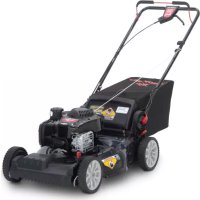
TB220B XP - Lawn mower TROY-BILT - Free user manual and instructions
Find the device manual for free TB220B XP TROY-BILT in PDF.



User questions about TB220B XP TROY-BILT
0 question about this device. Answer the ones you know or ask your own.
Ask a new question about this device
Download the instructions for your Lawn mower in PDF format for free! Find your manual TB220B XP - TROY-BILT and take your electronic device back in hand. On this page are published all the documents necessary for the use of your device. TB220B XP by TROY-BILT.
USER MANUAL TB220B XP TROY-BILT
Self Propelled Mower
English
Spanish (Espanol) Page 24
French (Francais) Page 48
Record Product Information
Before setting up and operating your new mower, please locate the model plate on the equipment and record the information in the provided area to the right. You can locate the model plate by standing at the operator's position and looking down at the rear of the deck. This information will be necessary, should you seek technical support via our web site, Customer Support Department, or with a local authorized service dealer.
Model Number
Serial Number
WARNING
Read and follow all safety rules and instructions in this manual before attempting to operate this machine.
Failure to comply with these instructions may result in personal injury - SAVE THESE INSTRUCTIONS.
WARNING
CALIFORNIA PROPOSITION 65
Engine Exhaust, some of its constituents, and certain vehicle components contain or emit chemicals known to State of California to cause cancer and birth defects or other reproductive harm.
NOTE: This Operator's Manual covers several models. Features may vary by model. Not all features in this manual are applicable to all models and the model depicted may differ from yours.

WARNING

This symbol points out important safety instructions which, if not followed, could endanger the personal safety and/or property of yourself and others. Read and follow all instructions in this manual before attempting to operate this machine. Failure to comply with these instructions may result in personal injury. When you see this symbol, HEED ITS WARNING!

DANGER
This machine was built to be operated according to the safe operation practices in this manual. As with any type of power equipment, carelessness or error on the part of the operator can result in serious injury. This machine is capable of amputating fingers, hands, toes and feet and throwing debris. Failure to observe the following safety instructions could result in serious injury or death.
GENERAL INFORMATION
- Read, understand, and follow all instructions on the mower and in the manual(s) before attempting to assemble and operate. Keep this manual in a safe place for future and regular reference and for ordering replacement parts.
- Be familiar with all controls and their proper operation.
- Never allow children under 14 years of age to operate this mower. Children 14 and over should read and understand the instructions and safe operation practices in this manual and on the mower and should be trained and supervised by an adult.
- Never allow adults to operate this mower without proper instruction.
- Store mower in a dry, clean area. Do not store next to corrosive materials, such as fertilizer.
- If situations occur which are not covered in this manual, use care and good judgment. Contact your customer service representative for assistance.
- According to the U.S. Consumer Products Safety Commission (CPSC) and the U.S. Environmental Protection Agency (EPA), this product has an estimated useful life of seven (7) years, under ordinary use conditions. At the end of its useful life, have the product inspected annually to ensure all mechanical and safety systems are operating properly, safely, and are not worn excessively. Failure to do so may result in accident, injury, or death.
- Thoroughly inspect the area where the mower is to be used. Remove all stones, sticks, wire, bones, toys, and other foreign objects which could be tripped over or picked up and thrown by the blade(s). Thrown objects can cause serious personal injury.
-
To help avoid blade contact or a thrown object injury, stay in the operator zone behind the mower handles. Keep helpers at least 75 feet (23 meters) from the mower while it is in operation. Keep bystanders, children and pets inside while the mower is in operation. Stop mower if anyone enters the area.
-
Be aware of the mower and attachment discharge direction and do not point the mower discharge at anyone.
- Always wear safety glasses or safety goggles during operation and while performing an adjustment or repair to protect your eyes. Thrown objects which ricochet can cause serious injury to the eyes.
- Wear sturdy, rough-soled work shoes and close-fitting slacks and shirts. Loose fitting clothes, jewelry and long hair can be caught in moving parts. Shirts and pants that cover the arms and legs and steel-toed shoes are recommended.
- Never operate mower in bare feet, sandals, slippery or lightweight (e.g. canvas) shoes.
- Never over fill fuel tank. Fill tank to no more than 1^ (2.5 cm) below bottom of filler neck to allow space for fuel expansion.
- Replace gasoline cap and tighten securely.
- Use only accessories and attachments approved for this mower by the mower manufacturer. Read, understand and follow all instructions provided with the approved accessory or attachment.
OPERATING
- Data indicates that operators, age 65 years and above, are involved in a large percentage of mower-related injuries. These operators should evaluate their ability to operate the mower safely enough to protect themselves and others from serious injury.
- Many injuries occur as a result of the mower being pulled over the foot during a fall caused by slipping or tripping. Do not hold on to the mower if you are losing your balance or footing; immediately release the handle.
- Never pull the mower back toward you while you are walking. If you must back the mower away from a wall or obstruction first look down and behind to avoid tripping and then follow these steps:
a. Step back from mower to fully extend your arms.
b. Be sure you are well balanced with sure footing.
c. Pull the mower back slowly, no more than half way toward you.
d. Repeat these steps as needed.
- Do not engage the drive control (if equipped) while starting engine.
- The blade control is a safety device. Never attempt to bypass its operation. Doing so makes the safety device inoperative and may result in personal injury through contact with the rotating blade. The blade control must operate freely in both directions and automatically return to the disengaged (off) position when released. The cutting blade continues to rotate for up to three seconds after the blade control is released. Never place any part of the body in the blade area until you are certain the blade has stopped rotating.
- If the mower should start to vibrate abnormally, stop the engine and check immediately for the cause. Vibration is generally a warning of trouble.
- Never operate mower without the proper trail shield, discharge cover, grass catcher, blade control or other safety protective devices in place and working. Never operate mower with damaged safety devices. Failure to do so can result in personal injury.
- When starting engine, pull cord slowly until resistance is felt, then pull rapidly. Rapid retraction of starter cord (kickback) will pull hand and arm toward engine faster than you can let go. Broken bones, fractures, bruises or sprains could result.
- Do not put hands or feet near rotating parts or under the cutting deck. Contact with the blade(s) can amputate hands and feet.
- Watch for holes, ruts, bumps, rocks, or other hidden objects. Uneven terrain or hidden objects could cause a slip and/or trip accident. Tall grass can hide obstacles.
- Your mower is designed to cut normal residential grass of a height no more than 7^ (17.5 cm). Do not attempt to mow through unusually tall, dry grass (e.g., pasture) or piles of dry leaves.
- Plan your mowing pattern to avoid discharge of material toward roads, sidewalks, helpers and the like. Avoid discharging material against a wall or obstruction which may cause discharged material to ricochet back toward the operator.
- Shut the engine off and wait until the blade comes to a complete stop before removing the grass catcher or unclogging the chute. The cutting blade continues to rotate for up to three seconds after the blade control is released. Never place any part of the body in the blade area until you are certain the engine is off and the blade has stopped rotating.
- A missing or damaged discharge door, chute or mulch plug can cause blade contact or thrown object injuries.
- Do not operate the mower without the discharge door, chute, mulch plug or the entire grass catcher in its proper place.
- Stop the mower blade when crossing gravel drives, walks, or roads and while not cutting grass.
-
Mow only in daylight or good artificial light.
-
Do not operate the mower while under the influence of alcohol or drugs.
- The muffler and engine become very hot and can cause serious burn injuries. Do not touch. Allow the mower to cool for at least five minutes before storing or attempting any service.
- Never run an engine indoors or in a poorly ventilated area. Engine exhaust contains carbon monoxide, an odorless and deadly gas.
CHILDREN
- Tragic accidents can occur if the operator is not alert to the presence of children. Children are often attracted to the mower and the mowing activity. They do not understand the dangers. Never assume that children will remain where you last saw them.
- Keep bystanders, children and pets inside while the mower is in operation under watchful care of a responsible adult other than the operator. Stop mower if anyone enters the area.
- Be alert and turn mower off if a child or bystander enters the area.
- Never allow children under 14 years of age to operate this mower. Children 14 and over should read and understand the instructions and safe operation practices in this manual and on the mower and should be trained and supervised by an adult.
- This mower is a precision piece of power equipment, not a plaything. Therefore, exercise extreme caution at all times. This mower has been designed to perform one job: to mow grass. Do not use it for any other purpose.
- Use extreme care when approaching blind corners, doorways, shrubs, trees or other objects that may block your vision of a child who may run into the path of the mower.
- Keep children away from hot or running engines. They can suffer burns from a hot engine or muffler.
- If your mower is equipped with an Electric Start Push Key, remove the key when the mower is unattended to prevent unauthorized operation. Make certain the key is inaccessible to small children.
- Slopes are a major factor related to slip and fall accidents which can result in severe injury or death. All slopes require extra caution. If you feel uneasy on the slope, do not mow it.
- For your safety, measure any slope before using the mower on the sloped area. Use a slope measuring device in addition to the slope gauge included as part of this manual to measure slopes before operating this mower on a sloped or hilly area. Smart phone applications can be also utilized to measure slopes. If the slope is greater than 15 degrees (25%) as shown on the slope gauge or a slope measuring device, do not operate this mower on that area or serious injury could result.
-
Do not mow on slopes greater than 15 degrees (25%)
-
Only mow across slopes, never mow up and down slopes.
- The mower may speed up when turning downhill, always turn uphill. Maintain control of the mower at all times.
- Do not mow on wet grass. Unstable footing could cause slipping.
- Do not operate the mower under any conditions where traction or stability is in question. Always be sure of your footing. A slip and fall can cause serious personal injury. If you feel you are losing your balance or footing, release the blade control handle immediately and the blade will stop rotating within three (3) seconds.
- Stay at least 3 feet (1 meter) from drop-offs, ditches, embankments or the edge of water. You could lose your balance or footing.
FIRE & FUEL
- To avoid personal injury or property damage use extreme care in handling gasoline. Gasoline is extremely flammable and the vapors are explosive.
Serious personal injury can occur when gasoline is spilled on yourself or your clothes which can ignite. Wash your skin and change clothes immediately. - Extinguish all cigarettes, cigars, pipes and other sources of ignition.
- Only use an approved portable fuel (gasoline) container. Use only containers certified by EPA, CARB, and/or OSHA.
- Never remove gas cap or add fuel while the engine is hot or running. Allow engine to cool at least five minutes before refueling.
- Never fuel the mower indoors.
- Never store the mower or fuel container inside where there is an open flame, spark or pilot light as on a water heater, space heater, furnace, clothes dryer or other gas appliances.
- If fuel is spilled, wipe it off the engine and mower. Clean up oil or fuel spillage and remove any fuel soaked debris. Move the mower to another area. Wait at least 5 minutes before starting the engine.
- To reduce fire hazards, keep mower free of grass, leaves, or other debris build-up. Follow the instructions in the Service and Maintenance section to keep your mower free of debris.
- Never over fill fuel tank. Fill tank to no more than 1^ (25mm) below bottom of filler neck to allow space for fuel expansion.
- Replace gas cap and tighten securely.
- Allow a mower to cool at least five minutes before fueling or storing.
-
Never fill containers inside a vehicle or on a truck or trailer bed with a plastic liner. Always place containers on the ground away from your vehicle before filling.
-
When practical, remove gas-powered equipment from the truck or trailer and refuel it on the ground. If this is not possible, then refuel such equipment on a trailer with a portable container, rather than from a gasoline dispenser nozzle.
- Keep the nozzle in contact with the rim of the fuel tank or container opening at all times until fueling is complete. Do not use a nozzle lock-open device.
SERVICE
- Keep the mower in good working order. Replace worn or damaged parts.
- To avoid serious injury or death, do not modify engine in any way. Tampering with the governor setting can lead to a runaway engine and cause it to operate at unsafe speeds. Never tamper with factory setting of engine governor. Do not change the engine governor settings or over-speed the engine. The governor controls the maximum safe operating speed of the engine.
- Mower blades are sharp. Wrap the blade or wear gloves, and use extra caution when servicing them.
- Before cleaning, repairing, or inspecting, make certain the blade and all moving parts have stopped. Disconnect the spark plug wire and ground against the engine to prevent unintended starting.
- Ensure the blade comes to a complete stop within (3) three seconds after operating the blade control. If the blade does not stop in less than three seconds, your mower must be serviced professionally by an authorized service dealer. Check for proper operation per the Service and Maintenance section.
- Regularly check the safety interlock system for proper function, as described later in this manual. If the safety interlock system does not function properly, have your mower serviced professionally by an authorized service dealer.
- Never tamper with the blade control safety interlock or other safety devices. Check for proper operation per the Service and Maintenance section.
- Check the mower blade and engine mounting bolt torque in accordance to the Service and Maintenance section in this manual. Also, visually inspect blade for damage (e.g., excessive wear, bent, cracked). Replace the blade with the original equipment manufacturer's (O.E.M.) blade only.
- Use of service parts which do not meet the original equipment specifications may lead to improper performance and compromise safety.
- Keep all nuts, bolts, and screws tight to be sure the equipment is in safe working condition. Check all hardware for tightness per the Service and Maintenance section.
SAFE OPERATION PRACTICES
- After striking a foreign object, stop the engine, disconnect the spark plug wire(s) and ground against the engine. Thoroughly inspect the mower for any damage. Repair the damage before starting and operating
- Never attempt to make wheel cutting height adjustments or repairs to the mower while the engine is running.
- Grass catcher components and the discharge cover are subject to wear and damage which could expose moving parts or allow objects to be thrown. For safety protection, frequently check components and replace immediately with original equipment manufacturer's (O.E.M.) parts only. "Use of parts which do not meet the original equipment specifications may lead to improper performance and compromise safety."
- Maintain or replace safety and instruction labels, as necessary.
- Observe proper disposal laws and regulations for gas, oil, etc. to protect the environment.
NOTICE REGARDING EMISSIONS
Engines which are certified to comply with California and federal EPA emission regulations for SORE (Small Off Road Equipment) are certified to operate on regular unleaded gasoline, and may include the following emission control systems: Engine Modification (EM) and Three Way Catalyst (TWC) if so equipped.
When required, models are equipped with low permeation fuel lines and fuel tanks for evaporative emission control. California models may also include a carbon canister. Please contact Customer Support for information regarding the evaporative emission control configuration for your model.
SPARK ARRESTOR

WARNING
This mower is equipped with an internal combustion engine and should not be used on or near any unimproved forest-covered, brush-covered or grass-covered land unless the engine's exhaust system is equipped with a spark arrester meeting applicable local or state laws (if any).
If a spark arrestor is used, it should be maintained in effective working order by the operator. In the State of California the above is required by law (Section 4442 of the California Public Resources Code). Other states may have similar laws. Federal laws apply on federal lands.
A spark arrester for the muffler is available through your nearest engine authorized service dealer or contact the service department, P.O. Box 361131 Cleveland, Ohio 44136-0019.
SLOPE GAUGE (BACK COVER)

WARNING
Slopes are a major factor related to slip and fall accidents which can result in severe injury or death. All slopes require extra caution. If you feel uneasy on the slope, do not mow it. Do not mow on slopes greater than 15 degrees (25%) . Only mow across slopes, never mow up and down slopes.
USE THE SLOPE GAUGE ON THE BACK COVER AS SHOWN TO DETERMINE IF A SLOPE IS TOO STEEP FOR SAFE OPERATION! To check the slope, proceed as follows:
- Open manual to page and fold along the dashed line.
- Locate a vertical object on or behind the slope (e.g. a pole, building, fence, tree, etc.)
- Align either side of the slope gauge with the object.
- Adjust gauge up or down until the left corner touches the slope.
- If there is a gap below the gauge, the slope is too steep for safe operation.
SAFETY SYMBOLS
This page depicts and describes safety symbols that may appear on this mower. Read, understand, and follow all instructions on the mower before attempting to assemble and operate.
| Symbol Description | |
| WARNING - READ THE OPERATOR'S MANUAL(S)Read, understand and follow all the safety rules and instructions in the manual(s) and on the mower before attempting to operate this mower. Failure to comply with this information may result in personal injury or death. Keep this manual in a safe location for future and regular reference. | |
| DANGER — AVOID AMPUTATION INJURYDo not put hands or feet near or under the cutting deck. Contact with the blade can amputate hands and feet. | |
| DANGER — AVOID CHILD RUNOVER/BLADE INJURYDo not mow when children or others are around. To help avoid blade contact or a thrown object injury, stay in the operator zone behind the mower handles. Keep helpers at least 75 feet (23 meters) from the mower while it is in operation. Keep bystanders, children and pets inside while the mower is in operation. Stop mower if anyone enters the area. | |
| DANGER — AVOID THROWN OBJECT INJURYKeep helpers at least 75' (23 meters) from mower during operation. Remove all stones, sticks, wire, bones, toys, and other foreign objects which could be picked up and thrown by the blade(s). Do not operate the mower without the discharge cover or entire grass catcher in its proper place. | |
| MAX 15° | DANGER — AVOID SLIP AND FALL ON SLOPESSlopes are a major factor related to slip and fall accidents which can result in severe injury or death. All slopes require extra caution. If you feel uneasy on the slope, do not mow it. Do not mow on slopes greater than 15 degrees (25%). Only mow across slopes, never mow up and down slopes. |
| WARNING—GASOLINE IS FLAMMABLEAllow the engine to cool at least five minutes before refueling. | |
| WARNING — AVOID BURN INJURTThe muffler and engine become very hot and can cause serious burn injuries. Do not touch. Allow the mower to cool for at least five minutes before storing or attempting any service. | |

WARNING
Your Responsibility—Restrict the use of this power machine to persons who read, understand and follow the warnings and instructions in this manual and on the machine - SAVE THESE INSTRUCTIONS!
IMPORTANT: This mower is shipped without gasoline or oil in the engine. Be certain to service engine with gasoline and oil as instructed in the Operation section of the Engine Manual before starting or operating your mower.
NOTE: Reference to right and left hand side of the Lawn Mower is observed from the operating position.
Unpacking
OPENING CARTON
- Cut each corner of the carton vertically from top to bottom.
-
Remove all loose parts:
-
Grass Catcher (if equipped)
Engine Oil -
Remove loose packing material.
REMOVING MOWER FROM CARTON
- Lift mower from the rear to detach it from underlying carton material and roll mower out of carton.
- Check carton thoroughly for any other loose parts.
- Remove any packing material which may be between upper and lower handles.
Mower Assembly
Preform the following procedures to assemble and set up the mower:
-
Handle Assembly
-
Pull-Out Handle. See page 7.
-
Folding Handle. See page 8.
Vertical Storage Handle. See page 9. -
Recoil Starter Rope Handle Assembly
- Attaching the Grass Catcher (if equipped)
- Attaching Side Discharge Chute or Side Discharge Blower (if equipped)
Electric Start Set-Up (If Equipped)
NOTE: If necessary, refer to the procedures in the Adjustments Section after assembling the mower.
Handle Assembly
PULL-OUT HANDLE
- Remove knobs or wing nuts (a) and carriage bolts (b) from the handle or if equipped with the EZ-lock handle (c), proceed to STEP 2 (Figure 1).
NOTE: The EZ-Fold handle release levers are shipped in the unlocked position.
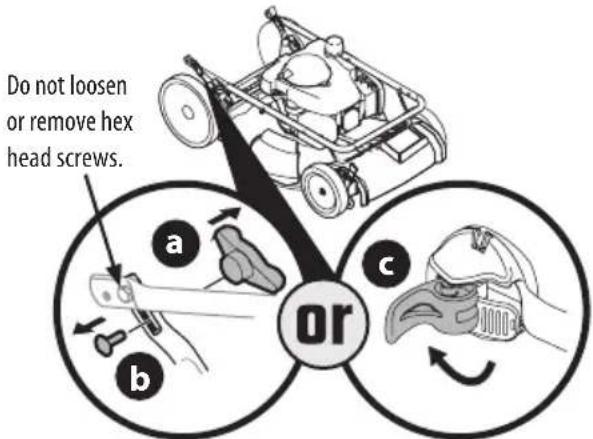
Figure 1
- Remove T-bolts (d) from the handle brackets (Figure 2).
- While stabilizing mower so it doesn't move, pivot upper handle (e) up (Figure 2). Do not crimp blade or drive control cables while lifting the handle up.
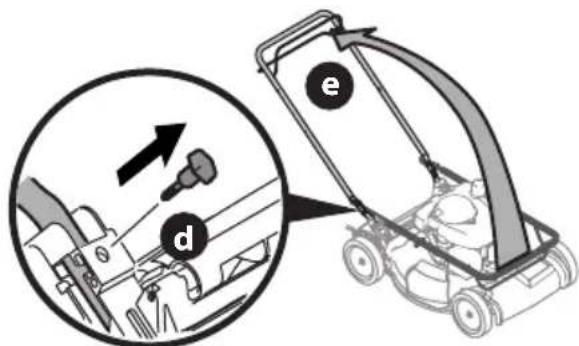
Figure 2
- Pull upward on the handle (e) (Figure 3) until holes in lower handle (f) line up with holes in handle brackets (g) (Figure 3 Inset, Deck Cutaway).
NOTE: When pulling upward on handle, do not pull handle all the way out of the handle brackets.
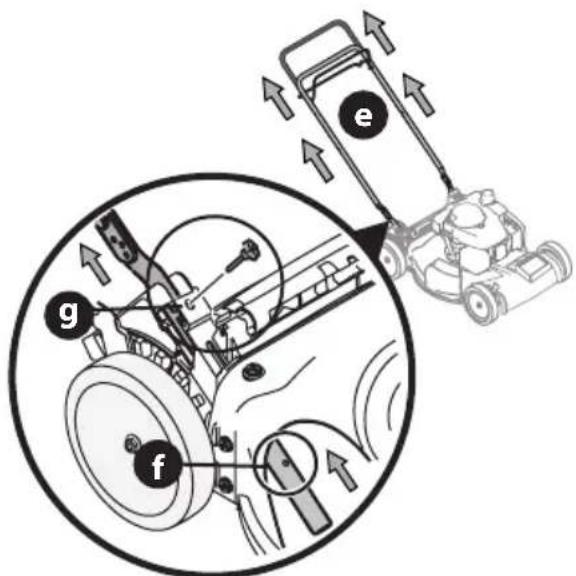
Figure 3
- Reattach knobs or wing nuts (a) and carriage bolts (b) removed in STEP 2 into lower holes of the handle or lock the EZ-fold handle release levers (c) (Figure 4).
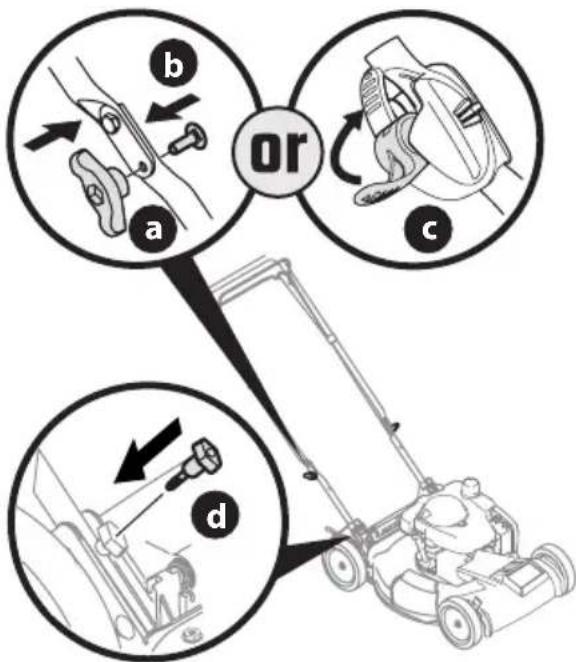
Figure 4
IMPORTANT: When locking the EZ-fold handle release lever (c) ensure the position indicator (h) aligns with one of three handle positions (i) (Figure 5).
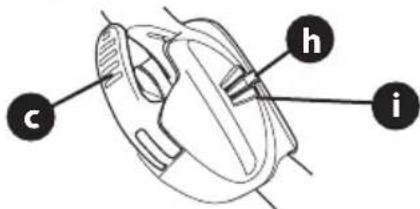
Figure 5
- Insert the T-bolts (d) removed in STEP 4 through the handle brackets and lower handle (Figure 4) and tighten securely to secure the handle in place.
FOLDING HANDLE
- Remove knobs or wing nuts (a) and carriage bolts (b) from the handle or if equipped with the EZ-lock handle (c), proceed to STEP 2 (Figure 6).
NOTE: The EZ-Fold handle release levers are shipped in the unlocked position.
Do not loosen or remove hex head screws.
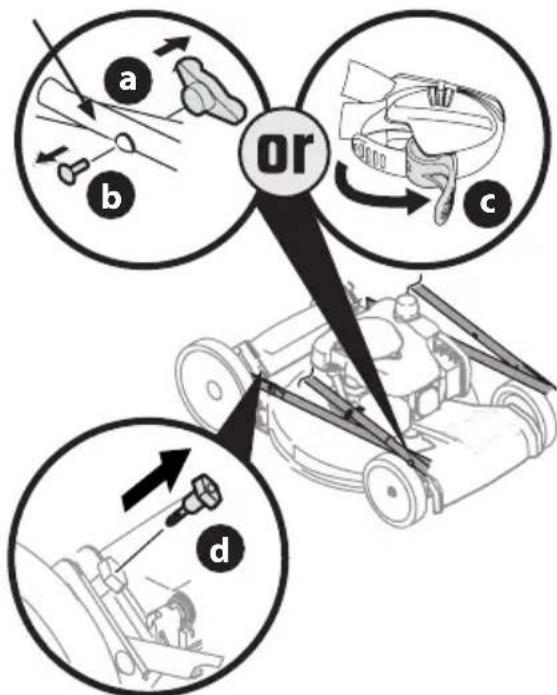
Figure 6
- Remove the T-bolts (d) from the handle brackets (Figure 6).
- While stabilizing mower so it doesn't move, gently lift and pivot the upper handle into the operating position (Figure 7). Make certain the lower handle is seated securely into the handle brackets. Do not crimp blade or drive control cables while lifting the handle up
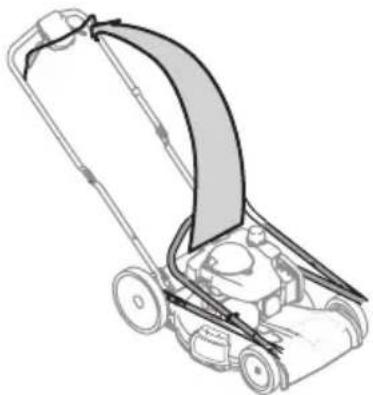
Figure 7
ASSEMBLY
- Reattach knobs or wing nuts (a) and carriage bolts (b) removed in STEP 2 into lower holes of the handle or lock the EZ-fold handle release levers (c) (Figure 8).
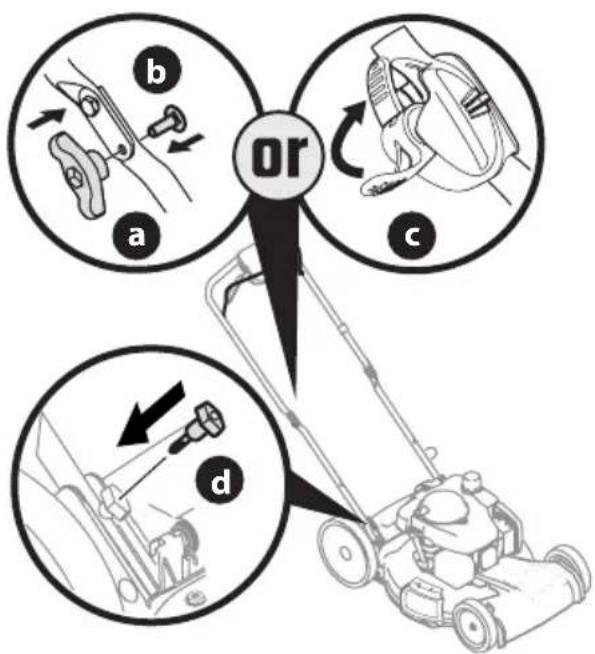
Figure 8
IMPORTANT: When locking the EZ-fold handle release lever (c) ensure the position indicator (e) aligns with one of three handle positions (f) (Figure 9).
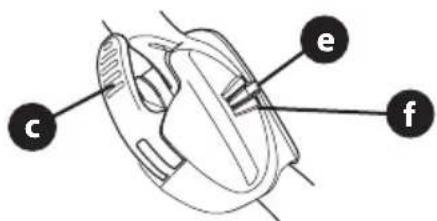
Figure 9
- Using the T-bolts (d) removed in STEP 2, secure the lower handle to the handle brackets (Figure 8) and tighten securely to secure the handle in place.
VERTICAL STORAGE HANDLE
- Remove the four carriage bolts and nuts from the lower handles (Figure 10).
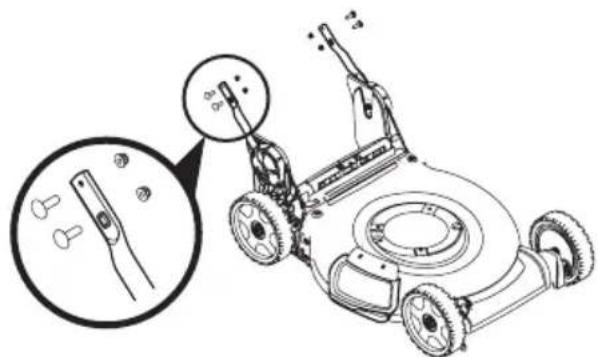
Figure 10
-
Unlock the two handle release levers. See inset, Figure 11.
-
Ensure the lower handles are folded forward towards the front of the mower.
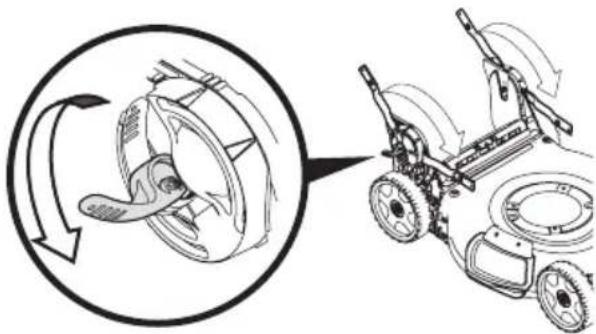
Figure 11
- Using the four carriage bolts and nuts removed in STEP 2, secure the upper handle to the lower handle. Tighten hardware securely to secure the handle in place (Figure 12).
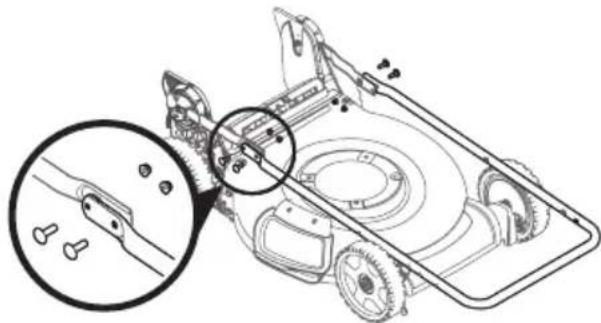
Figure 12
- While stabilizing mower so it doesn't move, lift the upper handle up (a) (Figure 13). Do not crimp blade or drive control cables while lifting the handle up.
- When lifting the upper handle ensure the position indicator (b) aligns with one of three handle positions (c). See inset, Figure 13.
- Lock the two handle release levers. See inset, Figure 13.
- Ensure all hardware is securely tightened.
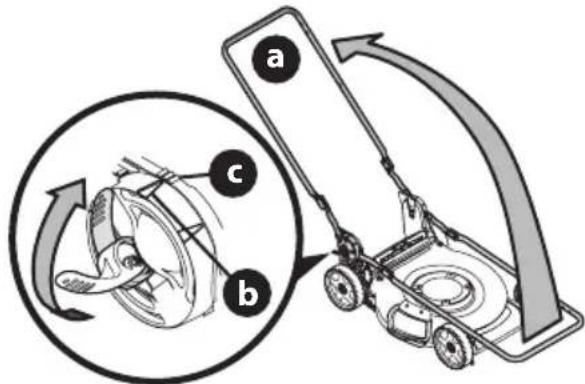
Figure 13
Recoil Starter Rope Handle Assembly
NOTE: The rope guide is attached to the right side of the upper handle. Loosen the knob securing the rope guide (Figure 14).
NOTE: Vertical Storage Mowers Only: The recoil starter rope is equipped with a rope stop clamp to prevent the starter rope being pulled into the engine. Do not remove the rope stop clamp.
- Hold blade control against upper handle.
- Slowly pull recoil starter rope handle from engine and slip starter rope into the rope guide.
- Tighten rope guide knob.
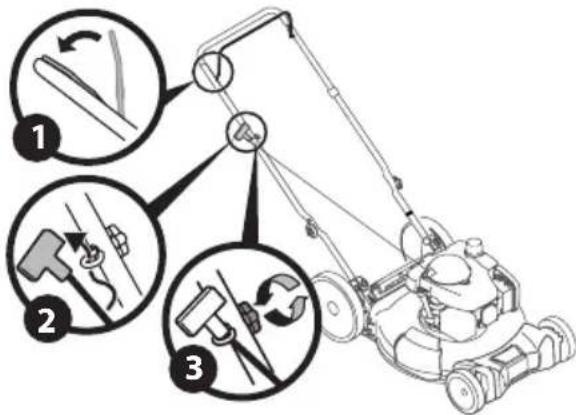
Figure 14
NOTE: On select units, use the two cable clips provided to secure blade control and drive cables to lower handle (Figure 15).
IMPORTANT: To reduce wear and allow for proper operation, make sure to leave some slack in the upper portion of the cables.
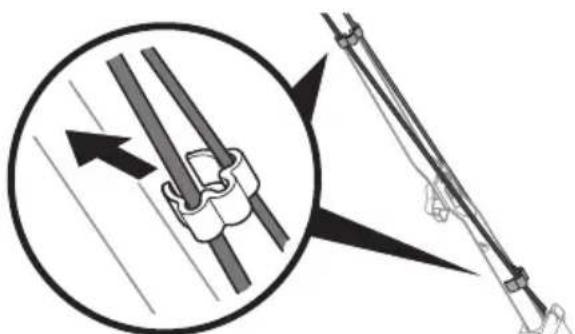
Figure 15
Attaching the Grass Catcher (If Equipped)
- Perform the following to assemble the grass catcher (Figure 16).
NOTE: Before assembling the grass catcher, ensure the grass bag is turned right side out, with the warning label showing on the outside.
a. Place bag over frame so that its black plastic side is at the bottom.
b. Slip plastic channels (a) of grass bag over the frame (b).
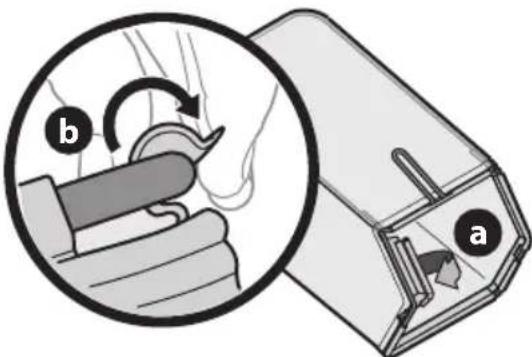
Figure 16
- Follow steps below to attach grass catcher (Figure 17):
a. Lift rear discharge door (a).
b. Remove the rear mulch plug (b) (if equipped).
c. Place grass catcher into the slots in the handle brackets (c). Lower the discharge door so that it rests on the grass catcher.
NOTE: To remove grass catcher, lift rear discharge door on the mower. Lift grass catcher up and off the slots in the handle brackets. Reinstall the rear mulch plug (if equipped). Release rear discharge door to allow it to close rear opening of mower.
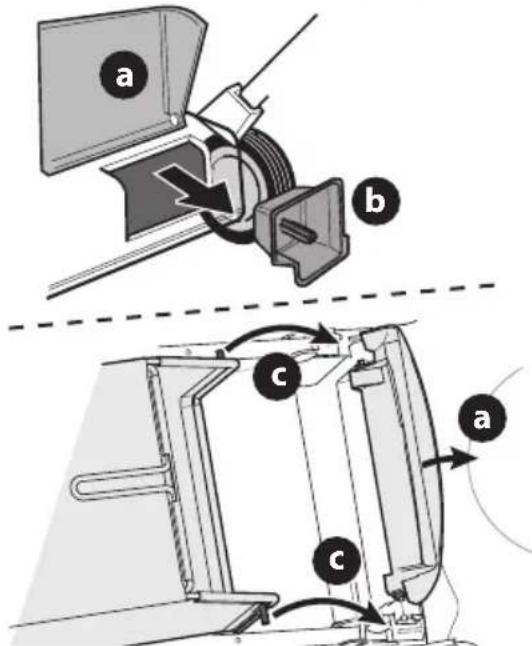
Figure 17
Attaching Side Discharge Chute or Side Discharge Blower (If Equipped)
The mower is shipped as a mulcher. To convert to side discharge or side discharge blower, ensure the grass catcher is removed, the rear mulch plug is installed (if equipped) and the rear discharge door is closed.
- Lift the mulch plug (Figure 18).
- Slide the two hooks of the side discharge chute (a) or side discharge blower (b) under the mulch plug hinge pin. Lower the mulch plug.
IMPORTANT: Do not remove side mulch plug at any time.
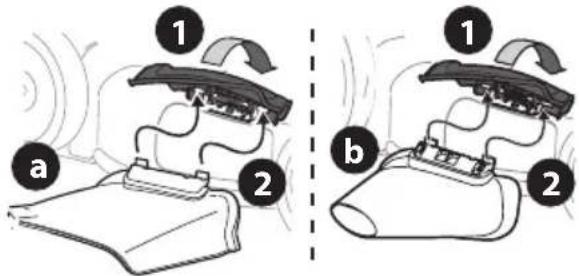
Figure 18
NOTE: Some side discharge chutes include a clip to secure the discharge chute to the handle. If equipped, the side discharge chute can be secured to the handle when not in use (Figure 19).
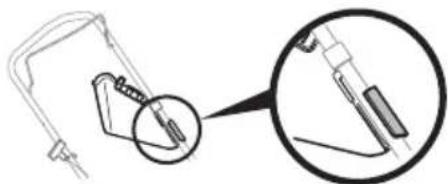
Figure 19
Electric Start Set-Up (If Equipped)
NOTE: Mowers equipped with electric start will use either a lead acid battery in an enclosed battery box (see Electric Starter Battery Box) or a removable lithium ion battery pack (See Installing/Removing Battery Pack).
ELECTRIC STARTER BATTERY BOX (IF EQUIPPED)
NOTE: Remove cable tie (a) from around battery box. Cable tie is used for shipping only (Figure 20).
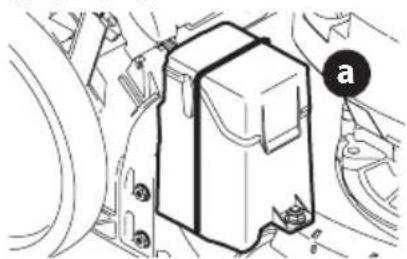
Figure 20
INSTALLING/REMOVING BATTERY PACK (IF EQUIPPED)
NOTE: To ensure maximum performance and life of lithium-ion battery packs, charge the battery fully before first use.
WARNING
Read all safety warnings, instructions, and cautionary markings for the battery pack, charger and product. Failure to follow the warnings and instructions may result in electric shock, fire and/or serious injury.
IMPORTANT: Refer to instructional manual supplied with battery charger for charging, maintenance and battery disposal instructions.
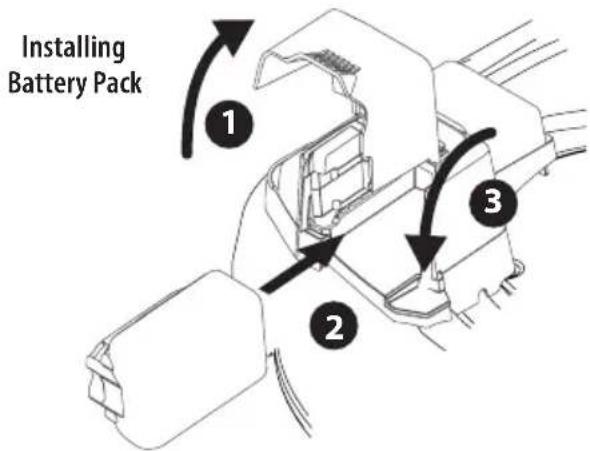
Installing The Battery Pack (Figure 21):
- Lift the battery box cover.
- Insert the battery pack into the battery box. An audible "click" will be heard when the battery is properly connected.
- Close the battery box cover.
Removing The Battery Pack (Figure 21):
- Lift the battery box cover.
- Press the battery pack release button.
- Pull the battery pack from the battery box.
- Close the battery box cover.
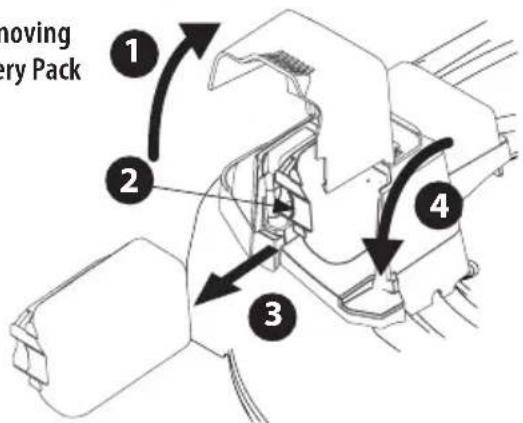
Removing Battery Pack
Figure 21
ADJUSTMENTS
Cutting Height Adjustments
This mower is equipped with one of three types of cutting height adjustment. Refer to Single Lever, Dual Lever or Rear Wheel/ Caster Wheels in this section.
SINGLE LEVER
The single lever cutting height adjustment is located above the rear left wheel (Figure 22).
- Carefully pull the height adjustment lever outward towards wheel (mower will tend to fall when lever is moved outward).
- Move lever to desired position for a change in cutting height.
- Release lever towards deck.
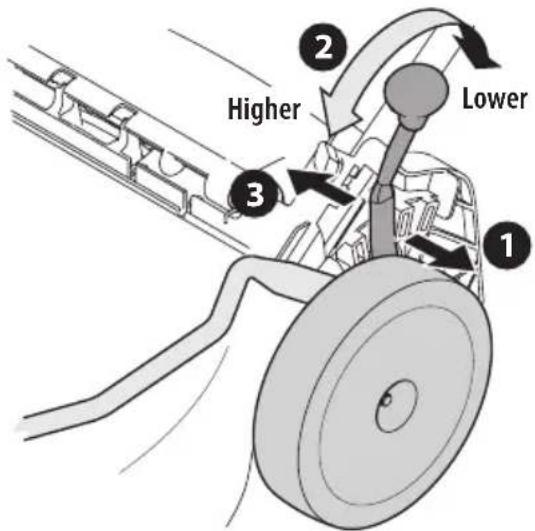
Figure 22
DUAL LEVER
Front Wheel Drive Mowers - The dual lever cutting height adjustment levers are located above the front and rear right wheels.
Rear Wheel Drive Mowers - The dual lever cutting height adjustment levers are located above the front and rear left wheels.
NOTE: Front wheel drive mower shown in Figure 23.
NOTE: On select mowers - The front and rear height adjustment levers move in the opposite direction to adjust height.
- Carefully pull the height adjustment lever outward towards wheel (mower will tend to fall when lever is moved outward).
- Move lever to desired position for a change in cutting height.
- Release lever towards deck.
IMPORTANT: All wheels must be placed in the same position. For rough or uneven lawns, move each height adjustment lever to a higher position. This will prevent you from cutting the grass too close to the ground.
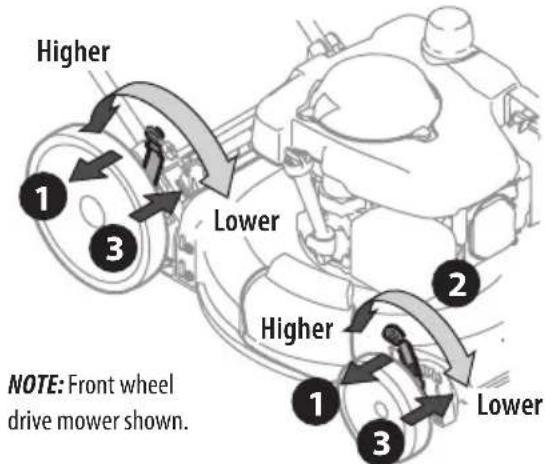
Figure 23
REAR WHEEL/CASTER WHEELS
NOTE: The rear wheel cutting height adjustment lever is located above the rear left wheel (Inset A, Figure 24).
- Pull lever out and away from mower.
- Move lever forward or back for desired cutting height.
- Release lever towards mower deck.
NOTE: The caster wheels cutting height are determined by selecting one of six positions on each caster assembly (Figure 24).
4. Remove wing nut (a) from axle bolt (b). Slide axle bolt from the assembly and select a cutting height.
5. Reinsert axle bolt in the square hole desired through wheel assembly and secure with wing nut removed in STEP 1.
IMPORTANT: All wheels must be placed in the same relative position. For rough or uneven lawns, move the height adjustment lever to a higher position. This will stop scalping of grass.
- The casters can be locked in a straight ahead position or positioned to swivel freely (Inset B, Figure 24).
a. Lift lock pins.
b. Place in larger holes to lock wheels. Place pins in smaller holes to allow casters to rotate freely for turning.
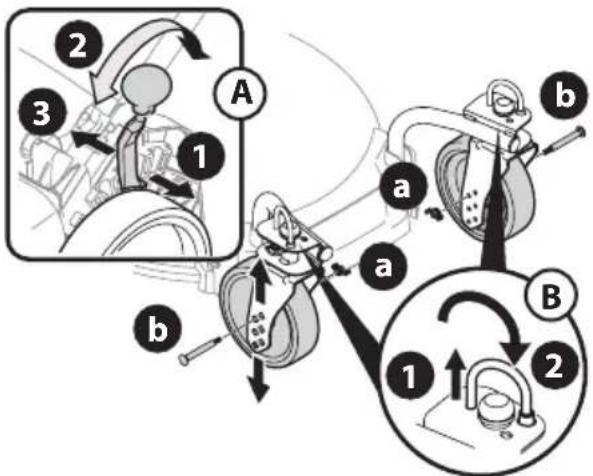
Figure 24
Handle Pitch (If Equipped)
For convenience of operation, you may adjust the pitch of the handle. Perform one of the following.
PULL-OUT AND FOLDING HANDLES
- Remove wing nuts and carriage bolts from handle (Figure 25).
- Position the handle in one of the three positions that is most comfortable. See Figure 25 inset.
- Secure into position with wing nuts and carriage bolts removed in STEP 1.
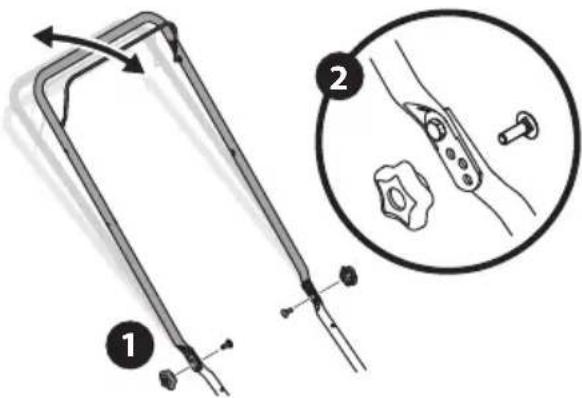
Figure 25
EZ-FOLD OR VERTICAL STORAGE HANDLES
NOTE: For EZ-Fold handles see Figure 26 or for vertical storage handles see Figure 27.
- Unlock the two handle release levers. See inset.
- Move the upper handle (a) to align the position indicator (b) with the most comfortable of the three handle positions (c).
- Lock the two handle release levers. See inset.
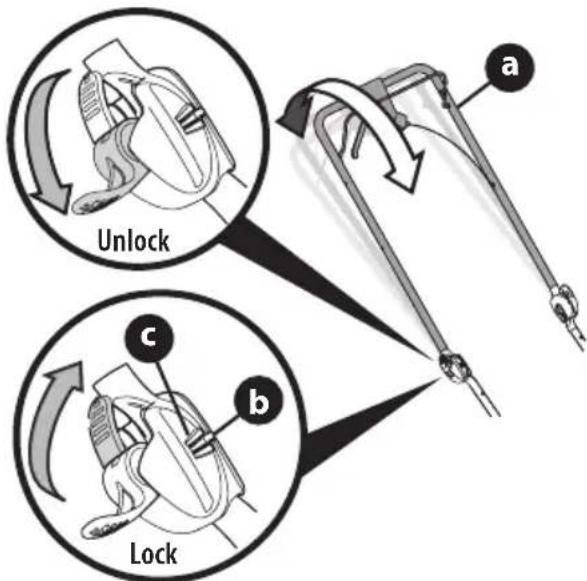
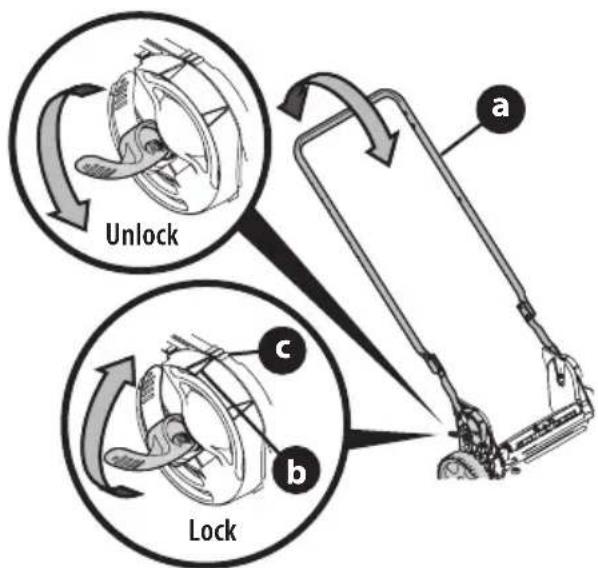
Figure 26
Figure 27
OPERATION
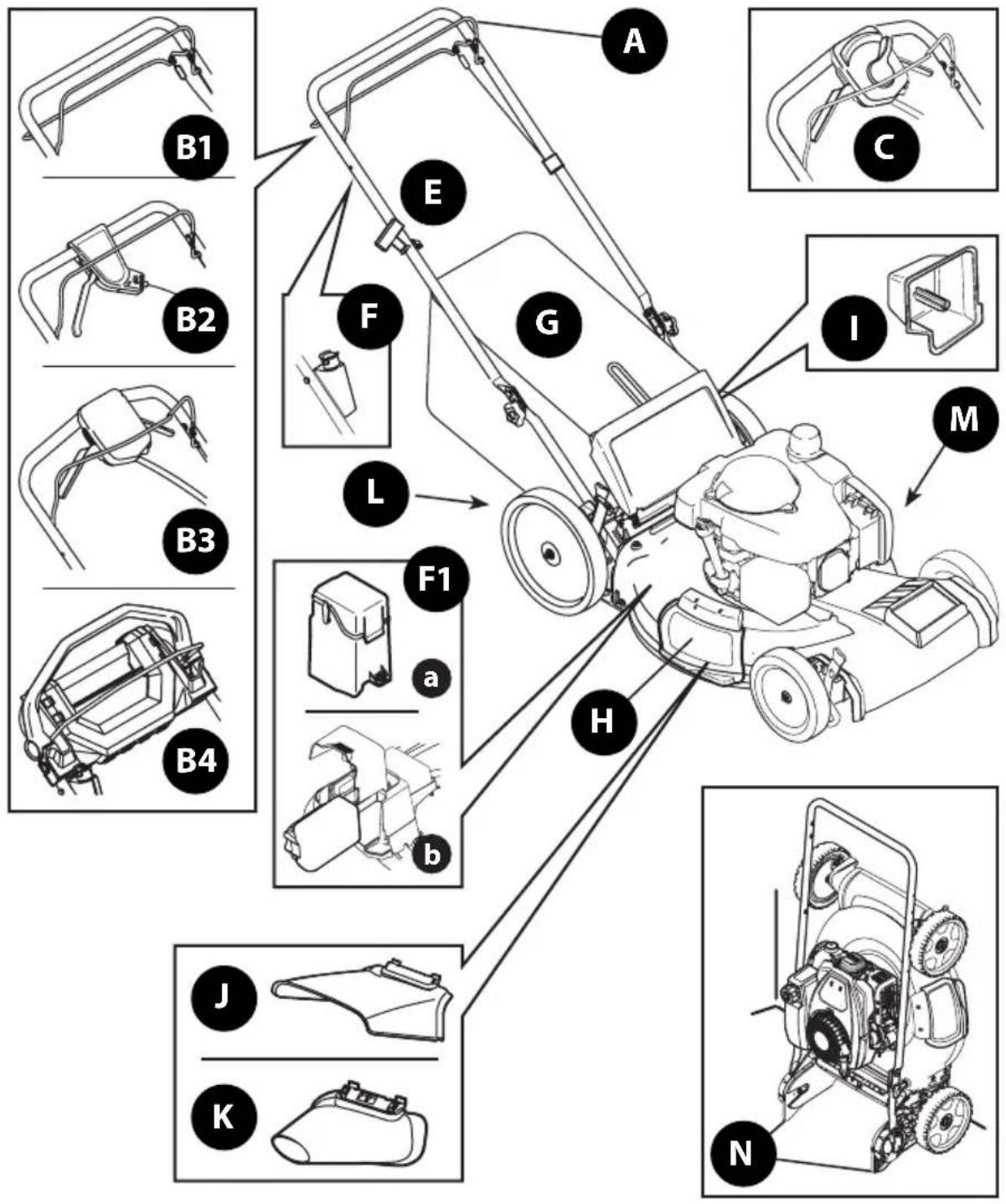
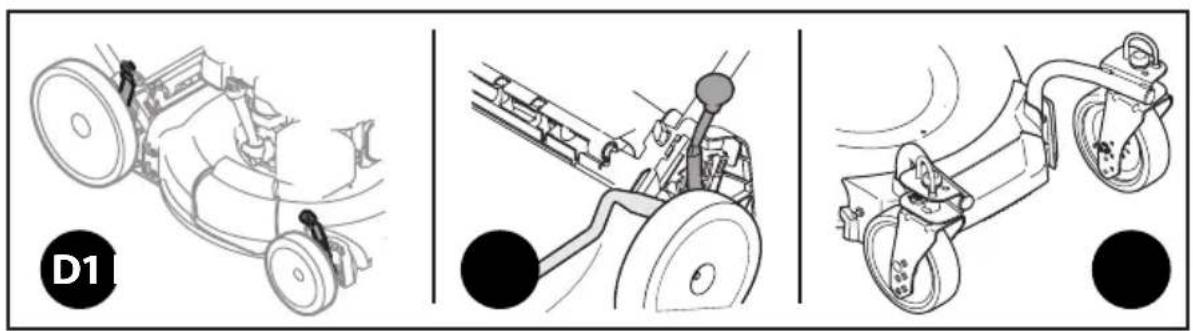
Figure 28
OPERATION
Features
A. BLADE CONTROL
The blade control is attached to the upper handle of the mower. Depress and squeeze it against the upper handle to operate the mower. Release the blade control to stop blade and engine.

WARNING
This blade control is a safety device. Never attempt to bypass its operation.
B. DRIVE CONTROL
There are four drive control configurations.
- Bail Drive Control (If Equipped) - The bail drive control is located on the underside of the upper handle and is used to engage the drive. Squeeze it against the upper handle to engage the drive; release it to stop mower.
- Single Lever Drive Control (If Equipped) - The single lever drive control is located on top of the upper handle and is used to engage the drive. Squeeze it against the upper handle to engage the drive; release it to slow down or stop mower.
- Dual Lever Drive Controls (If Equipped) - The dual lever drive controls are located on top of the upper handle and are used to engage the drive. Squeeze the right, left, or both right and left controls against the upper handle to engage the drive; release it/them to slow down or stop mower.
- Premium Drive Control (If Equipped) - The premium drive control is located on the upper handle and is used to engage the drive. Pushing the control forward will engage the drive. The farther the control is pushed forward, the faster the mower will propel. Once pressure is released from the control it will return to the neutral position and the drive will be disengaged.
C. SPEED CONTROL (IF EQUIPPED)
The speed control is located on the variable speed control housing on the upper handle. This control is used to select the forward speed of the mower.
IMPORTANT: Move the speed control only when the engine is running. Changing the speed control setting with the engine OFF can damage the mower.
D. CUTTING HEIGHT ADJUSTMENT LEVER
There are three cutting height adjustment configurations.
- Dual Lever - The dual lever cutting height adjustment levers are located above the front and rear right wheels. To adjust the cutting height, refer to Cutting Height Adjustment on page 12.
-
Single Lever - The cutting height adjustment lever is located above the rear left wheel. To adjust the cutting height, refer to Cutting Height Adjustment on page 12.
-
Rear Wheel/Caster Wheels - The rear wheel cutting height adjustment lever is located above the rear left wheel. The caster wheels adjust by moving the wheel bolts to the desired position. To adjust the cutting height, refer to Cutting Height Adjustment on page 12.
E. RECOIL STARTER
The recoil starter is attached to the right upper handle. Stand behind the mower and pull the recoil starter rope to start the mower.
F. ELECTRIC STARTER PUSH KEY (IF EQUIPPED)
The electric starter push key is located on the right side of the upper handle. It is both a removable key and push button and is only provided on electric start models.
NOTE: Remove the key when the mower is unattended or in storage to prevent unauthorized operation. Keep key in a safe place out of the reach of children.
- Mowers equipped with electric starters are also equipped with a battery in an enclosed battery box (a) or a removable battery pack (b).
G. GRASS CATCHER (IF EQUIPPED)
The grass catcher, located at the rear of the mower, is used to collect the grass clippings for disposal. Once the bag is full, remove it up through the handles and empty it before any further mowing.
H. MULCH PLUG (IF EQUIPPED)
The mulch plug is located on the right side of the mower and is used for mulching purposes (recirculating the clippings back to the lawn).
I. REAR MULCH PLUG (IF EQUIPPED)
On select mowers, the mulch plug is a separate component. If equipped, this mulch plug must be installed into the rear bagging discharge area when using the mower as a mulcher (recirculating the clippings back to the lawn) or side discharge.
J. SIDE DISCHARGE CHUTE (IF EQUIPPED)
The side discharge chute is used to discharge grass clippings to the side of the mower instead of collecting the clippings in the grass catcher or using the mower as a mulcher.

WARNING
Keep hands and feet away from the chute area on cutting deck. Refer to warning label on the unit.
K. SIDE DISCHARGE BLOWER (IF EQUIPPED)
The side discharge blower is used to blow leaves, grass clippings and debris to the side.
L. TRAIL SHIELD
The trail shield is attached to the rear of the mower and is there to protect the operator from flying debris. Do not use the mower unless the shield is fully functional and in place.
OPERATION
M. DECK WASH (IF EQUIPPED)
Your mower's deck may be equipped with a fast attach deck wash nozzle on its surface as part of its deck wash system. Use the deck wash to rinse grass clippings from the deck's underside.
N. VERTICAL STORAGE (IF EQUIPPED)
This feature allows the handle to be folded forward and the mower tipped back and stored vertically.

WARNING
Standing a mower with out the vertical storage feature in the upright position may cause damage to the engine or cause a fuel or oil leak.
Only mowers with the vertical storage feature include an engine that can be stored in the upright position.
Gasoline And Oil Fill-up
IMPORTANT: Refer to the separate Engine Operator's Manual for additional engine information.
This mower is shipped without gasoline (fuel) or oil in the engine. Be certain to service engine with gasoline and oil as instructed before starting or operating your lawn mower.
- Add provided oil before starting mower for the first time as instructed in the separate Engine Operator's Manual.
- Service the engine with gasoline as instructed in the separate Engine Operator's Manual.

WARNING
Use extreme care when handling gasoline. Gasoline is extremely flammable and the vapors are explosive. Never fuel the machine indoors or while the engine is hot or running. Extinguish cigarettes, cigars, pipes and other sources of ignition.
Checking Battery Pack Charge (if Equipped)

WARNING
Read all safety warnings, instructions, and cautionary markings for the battery pack, charger and product. Failure to follow the warnings and instructions may result in electric shock, fire and/or serious injury.
IMPORTANT: Refer to instructional manual supplied with battery charger for charging, maintenance and battery disposal instructions.
- Press the battery gauge button on front of the battery pack to check charge level (Figure 29):
- Charged Battery - One to three lights of the battery gauge will light to show charge level.
- Discharged Battery - If no lights show, charge battery pack. Refer to manual supplied with battery charger for charging instructions.
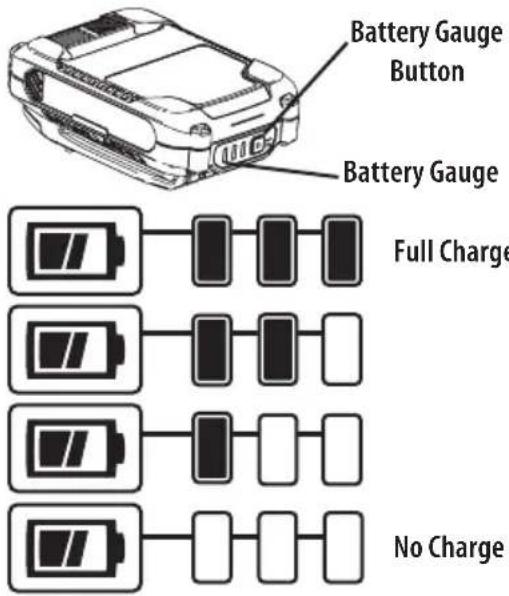
Figure 29
To Start Engine

WARNING
Be sure no one other than the operator is standing near the lawn mower while starting engine or operating mower. Never run engine indoors or in enclosed, poorly ventilated areas. Engine exhaust contains carbon monoxide, an odorless and deadly gas. Keep hands, feet, hair and loose clothing away from any moving parts on engine and lawn mower.
Refer to the Engine Operator's Manual for instructions on starting and stopping the engine.
To Stop Engine
Release blade control to stop the engine and blade.
NOTE: If equipped with an electric starter push key, remove the key when the mower is unattended to prevent unauthorized operation.

WARNING
Wait for the blade to stop completely before performing any work on the mower or to remove the grass catcher. Check blade stopping time is within 3 seconds. If blade does not stop within 3 seconds contact your Service Center.
OPERATION
Using Your Lawn Mower

WARNING
The operation of any lawn mower can result in foreign objects being thrown into the eyes, which can damage your eyes severely. Always wear safety glasses while operating the mower, or while performing any adjustments or repairs.
Be sure lawn is clear of stones, sticks, wire, or other objects which could damage lawn mower or engine. Such objects could be thrown by the blade in any direction and cause serious personal injury to the operator and helpers.
BAIL DRIVE CONTROL
- Once the engine is running, squeeze the bail drive control against the upper handle to propel mower.
- Release the bail drive control to stop mower from propelling.
- Once the engine is running, squeeze the single lever drive control against the upper handle to propel mower.
- Release the single lever drive control to slow down or stop mower from propelling.
- Once the engine is running and while continuing to hold the blade control down, squeeze either (or both) drive controls against the upper handle to propel mower (Figure 30).
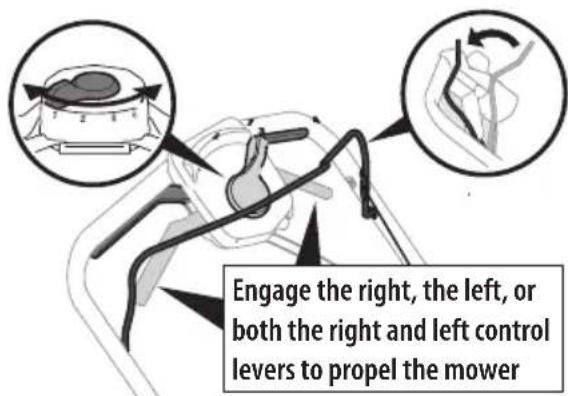
Figure 30
- Release the dual lever drive controls to slow down or stop mower.
- Speed Control (if equipped) - To change speed, move speed control to the desired speed.
NOTE: When selecting a drive speed, use the first speed until you are comfortable and familiar with the operation of the mower.
IMPORTANT: If you are shifting speeds while the mower is stationary it may be difficult to shift into first speed under certain conditions. This is easily remedied by briefly engaging the drive lever.
NOTE: Your mower is equipped with an advanced internal drive system for ease of use and smooth shifting. When turning or pulling the unit rearward, you may notice higher than normal resistance in the rear wheels under certain conditions. This is perfectly normal and can be remedied by allowing the unit to roll forward slightly without the drive lever(s) engaged before pulling backwards.
PREMIUM DRIVE CONTROL
- Once the engine is running and while continuing to hold the blade and drive controls together, push the drive control forward to propel mower. The farther the control is pushed forward, the faster the mower will propel (Figure 31).
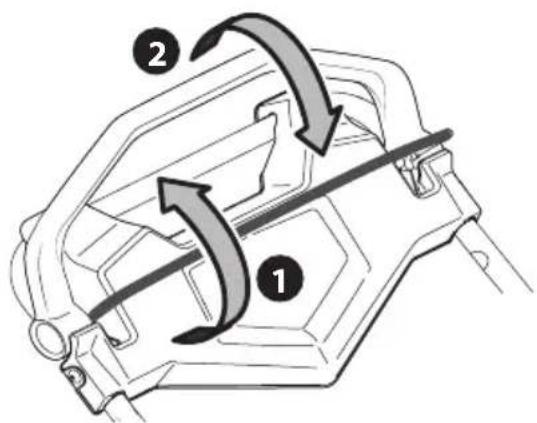
Figure 31
- Once pressure is released from the control it will return to the neutral position and the drive will be disengaged and mower will stop.
NOTE: For ease of use, while gripping the controls, simply lock your wrist and elbows and walk - the unit will automatically adjust to your speed.
Using Side Discharge Chute (If Equipped)
To use the mower without mulching or collecting grass, remove the grass catcher and ensure the rear mulch plug (if equipped) is installed. Allow the rear discharge door to close the rear opening of mower. Refer to Attaching The Side Discharge Chute or Side Discharge Blower in on page 11.
Using Mower as a Mulcher (If Equipped)
For mulching grass, remove the grass catcher or side discharge chute from the mower. When you remove the grass catcher from the mower, ensure the rear mulch plug (if equipped) is installed and allow the rear discharge door to close the rear opening of mower. When you remove the side discharge chute, the mulching plug will close. For effective mulching, do not cut wet grass. If the grass has been allowed to grow in excess of four inches, mulching is not recommended. Use the grass catcher to collect clippings instead.
OPERATION
Using Mower with Grass Catcher (If Equipped)
You can use the grass catcher to collect clippings while you are operating the mower.
- Attach grass catcher, refer to Attaching the Grass Catcher on page 10. Grass clippings will automatically collect in bag. Operate mower until grass bag is full.
- Stop engine by releasing the blade control. Make sure that the engine has come to a complete stop.
- Lift rear discharge door and pull grass bag up and away from the mower to remove the bag. Dispose of the grass clippings and reinstall the bag when complete.

WARNING
If you strike a foreign object, stop the engine. Disconnect the spark plug wire, thoroughly inspect mower for any damage, and repair damage before restarting and operating. Extensive vibration of mower during operation is an indication of damage. The mower should be promptly inspected and repaired.
Vertical Storage Mower (If Equipped)

WARNING
Standing a mower without the vertical storage feature in the upright position may cause damage to the engine or cause a fuel or oil leak.
Only mowers with the vertical storage feature include an engine that can be stored in the upright position.
Do not store the mower outside or in damp area. Store mower in a dry, clean area.
STORING THE MOWER

WARNING
Wait for engine to cool before wiping or storing.
IMPORTANT: Before storing the mower in the vertical position ensure the fuel level is at or below the recommended fill level. Refer to the Engine Operator's Manual.
- Using compressed air or dry rag clean the outside of the mower and remove any debris from around the engine.
- If equipped, remove the starting key.
- Unlock the two handle release levers. See inset Figure 32.
-
Fold the handle forward to the storage position (Figure 32). Do not crimp blade control cable or the drive control cable (if equipped) while lowering the handle.
-
Lock the two handle release levers (inset, Figure 32).
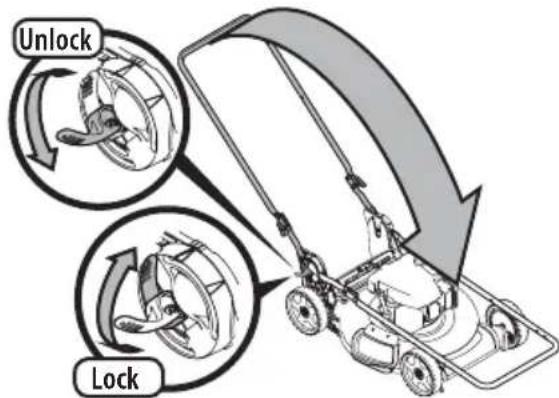
Figure 32
- Lifting from the handle (a), tilt the mower up onto the rear wheels and back of the handle bracket (b) (Figure 33).
- Position the mower so that the blade is facing a wall.
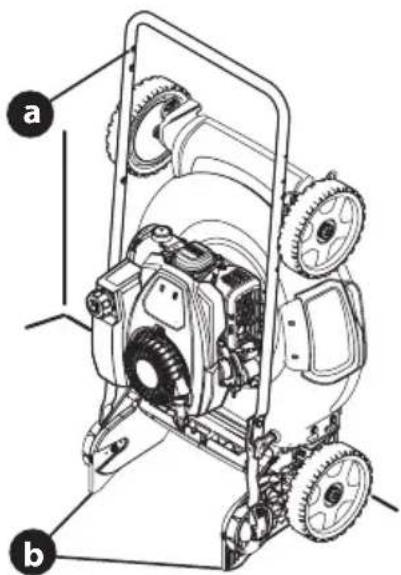
Figure 33
REMOVING THE MOWER FROM STORAGE

WARNING
When moving the mower or unfolding the handle do not put hands or feet near or under the cutting deck. Otherwise serious injury may occur.
To prevent accidentally starting the mower engine when unfolding the handle, do not hold the blade control against the upper handle. Otherwise serious injury may occur.
- Holding the mower by the upper handle, gently set the mower down on all four wheels.
- To unfold the handle, unlock the two handle release levers (inset, Figure 32) and perform STEPS 5-8 in ASSEMBLY, Vertical Storage Handle on page 9.
SERVICE AND MAINTENANCE
WARNING
Before performing any type of maintenance/service, disengage all controls and stop the engine. Wait until all moving parts have come to a complete stop. Allow the engine to cool. Disconnect spark plug wire and ground it against the engine to prevent unintended starting.
General Recommendations
- Always observe safety rules on the mower and in the manual(s) when performing any maintenance.
- The warranty on this mower does not cover items that have been subjected to operator abuse or negligence. To receive full value from warranty, operator must maintain the mower as instructed here.
- Changing of engine-governed speed will void engine warranty.
- Check that all hardware is in place & secure and tight before each use and before off season storage.
Lubrication
BLADE CONTROL
Lubricate pivot points on the blade control at least once a season and before storage with light oil. This control must operate freely in both directions (Figure 34).
WHEELS
Lubricate all wheel hubs/axles at least once a season and before storage with light oil (Figure 34).
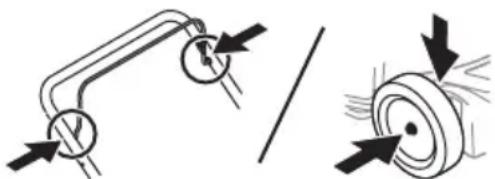
Figure 34
Engine Maintenance
Annually check the engine mounting bolts torque: Min. 29.2 ft-lbs (39.6 N-m), Max. 41.7 ft-lbs (56.3 N-m).
Refer to the Engine Operator's Manual packed with your mower for a detailed description of all engine-related service specifications and storage.
If engine fails to start, runs erratic, overheats, skips (hesitates) or idles poorly refer to the Engine Operator's Manual.
IMPORTANT: Check engine oil level before each use. Refer to Engine Operator's Manual.
CLEAN ENGINE
- Before every use, clean grass, chaff or accumulated debris from engine. Keep linkage, spring, and controls clean. Keep area around and behind muffler free of any combustible debris.
- Keeping engine clean allows air movement around engine.
- Engine parts should be kept clean to reduce the risk of overheating and ignition of accumulated debris.
CAUTION
Do not use water to clean engine parts. Water could contaminate fuel system. Use a brush or dry cloth.
Mower Maintenance
DECK WASH (IF EQUIPPED)
Your mower's deck may be equipped with a deck wash system. Use the deck wash to rinse grass clippings from the deck's underside and prevent the buildup of corrosive chemicals. Complete the following steps AFTER EACH MOWING:
- Push the mower to a level, clear location on your lawn. Ensure your garden hose can reach your mower.
CAUTION
Make certain the mower's discharge chute is directed AWAY from your house, garage, parked cars, etc.
- Remove the fast attach deck wash nozzle from the mower deck and thread it onto the end of your garden hose.
- Attach garden hose with the deck wash nozzle to the water port on your deck's surface (Figure 35).
- Turn the water ON.
- Start the engine as described in the Engine Operator's Manual.
- Run the engine for a minimum of two minutes, allowing the underside of the cutting deck to thoroughly rinse.
- Release blade control to stop the engine and blade.
- Turn the water OFF and detach the deck wash nozzle from the water port on your deck's surface.
- After cleaning your deck, restart the mower. Keep the engine and blade running for a minimum of two minutes, allowing the underside of the cutting deck to thoroughly dry.
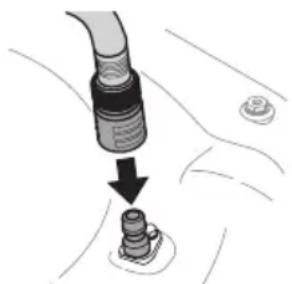
Figure 35
SERVICE AND MAINTENANCE
DECK CLEANING
At least once a season and before storage, clean the underside of the mower deck to prevent build-up of grass clippings or other debris.
- Allow the engine to run until it is out of fuel. Do not attempt to pour fuel from the engine. Disconnect spark plug wire. Refer to Engine Operator's Manual.
- Turn mower on its side keeping the muffler side down and making sure that the air filter and the carburetor are facing up. Hold mower firmly.
- Scrape and clean the underside of the deck with a suitable tool. Do not spray with water.
IMPORTANT: Do not use a pressure washer or garden hose to clean your mower. These may cause damage to bearings, or the engine. The use of water will result in shortened life and reduce serviceability.
- Put the mower back on its wheels on the ground.
Blade Care

WARNING
Wait for the blade to stop completely before performing any work on the mower or to remove the grass catcher.
Check blade stopping time is within 3 seconds. If blade does not stop within 3 seconds contact your Service Center.

WARNING
When removing the cutting blade for sharpening or replacement, protect your hands with a pair of heavy gloves or use a heavy rag to hold the blade.
Annually check the mower blade mounting bolt torque: Min. 37.5 ft-lbs (50.8 N-m), Max. 50.0 ft-lbs (67.8 N-m).
Periodically inspect the blade and blade adapter for bends or cracks, especially if you strike a foreign object or experience excessive vibration. Replace when necessary. Follow the steps below for blade service:
- Allow the engine to run until it is out of fuel. Do not attempt to pour fuel from the engine.
- Disconnect spark plug wire. Refer to Engine Operator's Manual.
- Turn mower on its side keeping the muffler side down and making sure that the air filter and the carburetor are facing up.
-
Remove bolt (a) and blade bell support (b) which hold the blade and the blade adapter to the engine crankshaft (Figure 36).
-
Remove blade (c) and blade adapter (d) from the crankshaft (Figure 36).
- Remove blade from the blade adapter for testing balance.
a. Balance the blade on a round shaft screwdriver to check.
b. Remove metal from the heavy side until it balances evenly.
NOTE: When sharpening the blade, follow the original angle of grind. Grind each cutting edge equally to keep the blade balanced.
WARNING
An unbalanced blade will cause excessive vibration when rotating at high speeds. It may cause damage to engine and blade could break causing personal injury.
- Lubricate the engine crankshaft and the inner surface of the blade adapter with light oil (Figure 36 inset).
a. Slide the blade adapter (d) onto the engine crankshaft.
b. Place the blade on the adapter such that the side of the blade marked "Grass Side" (or with part number) faces the ground when the mower is in the operating position.
c. Make sure that the blade is aligned and seated on the blade adapter flanges.
- Place blade bell support (b) on the blade (c). Align notches on the blade bell support with small holes in blade.
- Replace hex bolt (a) and tighten hex bolt to torque: Min. 37.5 ft-Ibs (50.8N - m) Max.50.0 ft-Ibs (67.8N - m)
NOTE: To ensure safe operation of your mower, periodically check the blade bolt for correct torque.
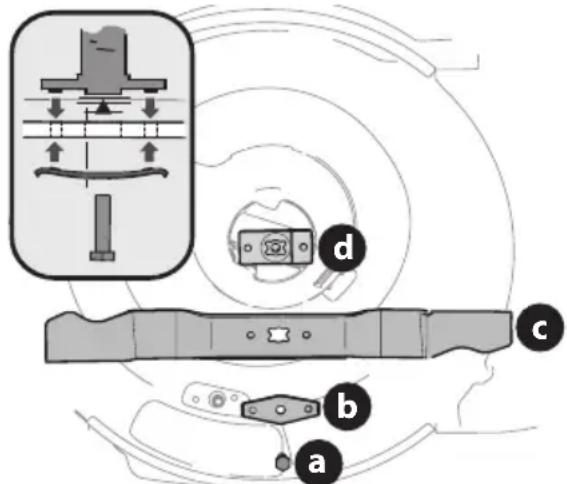
Figure 36
SERVICE AND MAINTENANCE
Belt Care
A damaged or worn belt may prevent the mower from selfpropelling. Periodically inspect the belt and pulley system for damage or wear. If necessary contact an authorized Service Center to have belt replaced.
NOTE: Several components must be removed in order to change the mower's drive belt. See an authorized Service Center to have belt replaced.
Drive Control Adjustment
If equipped, there is an adjustment wheel located in the drive control handle housing that is used to tighten or loosen the drive belt. You will need to adjust the drive control if the mower does not propel itself with the drive control engaged or if the mower's wheels hesitate with the drive control engaged. If either of these conditions occur, rotate adjustment wheel clockwise to tighten cable or counterclockwise to loosen the cable. See Figure 37 for location on Single Lever Drive Control and Figure 38 for Dual Lever Drive Control.
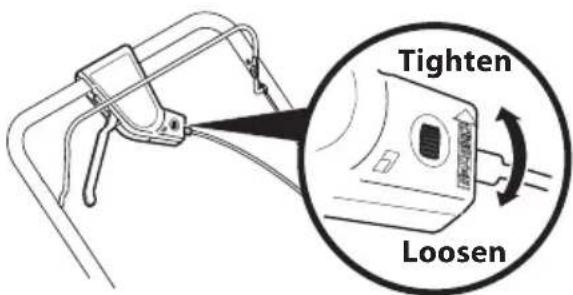
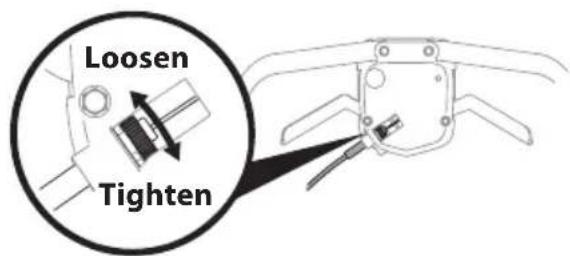
Figure 37
Figure 38
PREMIUM DRIVE (IF EQUIPPED)
The drive system consists of pulleys, a belt, and a cable linking the transmission to the drive handle. As these components wear, adjustment may be needed. To adjust the drive linkage perform the following:
- Rotate the drive cable fitting located on the left upper handle upward (Figure 39).
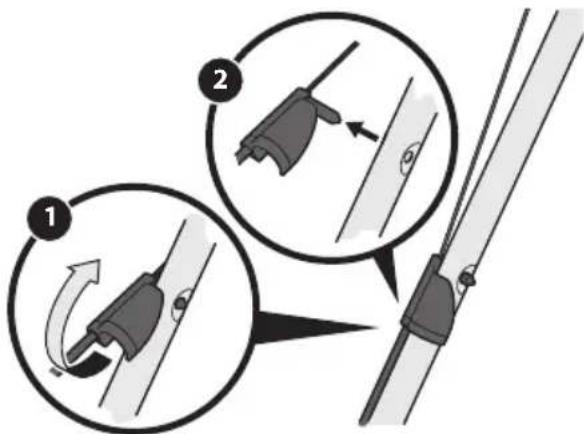
Figure 39
- Pull the fitting away from the handle.
- Unhook the cable (a) and remove the metal bushing (b) from the plastic drive handle (Figure 40).
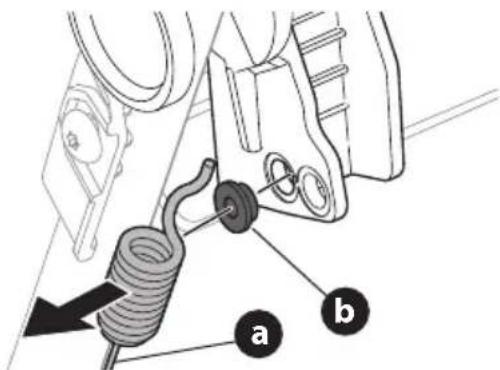
Figure 40
- Replace bushing in the lower hole and reattach the cable through the bushing and lower hole in the handle (Figure 41).
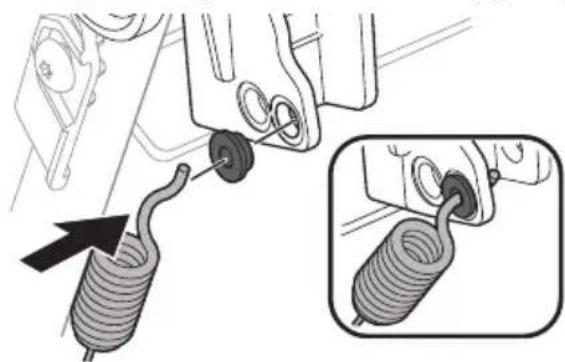
Figure 41
- Reinsert the drive cable fitting into the upper handle and rotate it downward.
- Start the mower and check the function of the drive handle.
SERVICE AND MAINTENANCE
Replacing Battery (If Equipped)

WARNING
Batteries contain sulfuric acid which may cause burns. Do not short circuit or damage batteries in any way. Do not put batteries in fire as these may burst or release toxic materials.
- Removing the battery (Figure 42):
a. Open the charging port cover (a) and remove the battery box cover (b).
b. Disconnect the positive and negative leads from the battery (c).
c. Lifting up, remove the battery from the battery box.
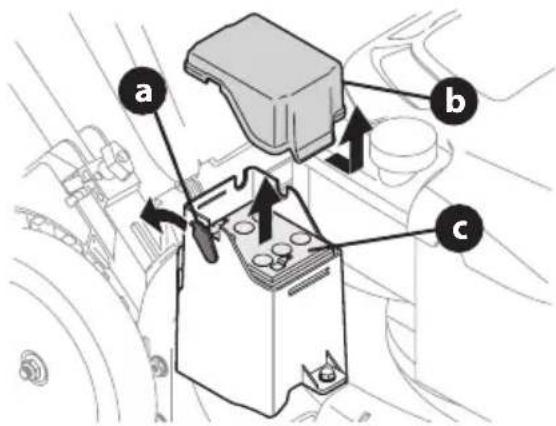
Figure 42
- Installing the battery (Figure 43):
a. Insert the battery (c) into the battery box.
b. Connect the positive lead (red) to the positive (+) terminal (d).
c. Connect the negative lead (black) to the negative (-) terminal (e).
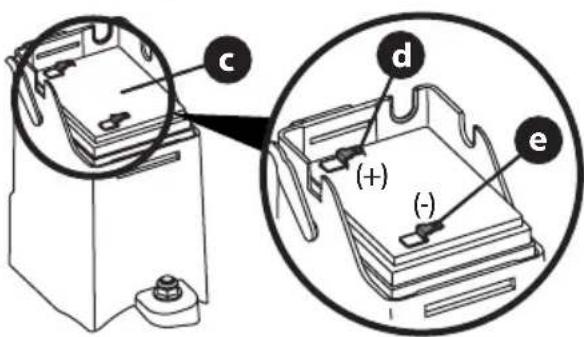
Figure 43
- Install the battery box cover and close the charging port cover.
Charging Battery (If Equipped)

WARNING
The battery contains corrosive fluid and toxic material; handle with care and keep away from children. Do not puncture, disassemble, damage or incinerate the battery. Explosive gases could be vented during charging or discharging. Use in a well ventilated area, away from sources of ignition.
Charge the battery at initial setup, at end of the season, after extended periods of non-use, and as needed.
The battery may need to be charged more often if stopping and starting the mower frequently during each cut throughout the season, such as when bagging.
NOTE: The specially designed plug on the charger lead will only fit into the charging port on the battery box.
NOTE: The battery must be stored with a full charge. Extended storage of a discharged battery will reduce life and capacity of the battery. For optimal battery life, charge the battery once per month while in storage.
IMPORTANT: Do not remove the battery from the battery box for any reason other than replacement.
- Open the charging port cover (a) and plug the charger lead (b) into the charging port (c) (Figure 44).
- Plug the battery charger (d) into a standard 120V household outlet.
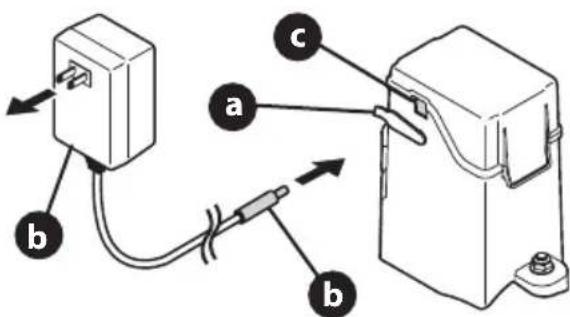
Figure 44
- Charge battery for 8 to 10 hours before initial use. Do not charge longer than 12 hours.
IMPORTANT: Always plug charger lead into charging port first, and then plug battery charger into 120V standard household outlet. Follow this order of steps every time you charge the battery. - After charging, disconnect the charger from outlet first, then disconnect the charger lead from the charging port.
- Close the charging port cover.
SERVICE AND MAINTENANCE
Charging the Battery Pack (If Equipped)
IMPORTANT: Refer to instructional manual supplied with battery charger for charging, maintenance and battery disposal instructions (Figure 45).
WARNING
The battery contains corrosive fluid and toxic material; handle with care and keep away from children. Do not puncture, disassemble, mutilate or incinerate the battery. Explosive gases could be vented during charging or discharging. Use in a well ventilated area, away from sources of ignition.
WARNING
Read all safety warnings, instructions, and cautionary markings for the battery pack, charger and product. Failure to follow the warnings and instructions may result in electric shock, fire and/or serious injury.
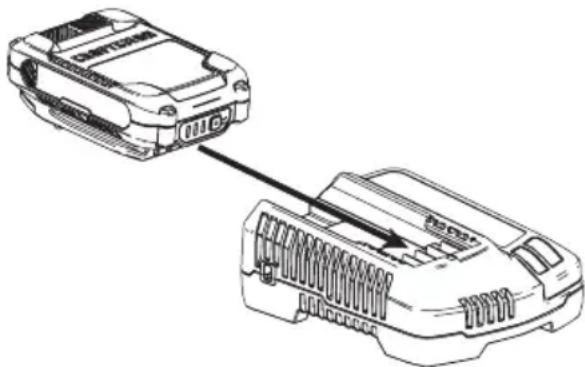
Figure 45
Battery Disposal
IMPORTANT: This procedure refers to mowers equipped with a battery in an enclosed battery box. For mowers equipped with a removable battery pack, refer to instructional manual supplied with battery charger for disposal instructions.
DISPOSING OF DAMAGED OR WORN-OUT BATTERIES
WARNING
The following toxic and corrosive material is used in this battery: SULFURIC ACID, a toxic material.
WARNING
To prevent contamination of the environment, contact your local waste disposal agency for specific instructions before disposing of damaged or worn-out lithium-ion batteries. Take batteries to a local recycling and/or disposal center, certified for lithium-ion battery disposal.
WARNING
Do not use broken or cracked batteries, even if there is no leakage. Replace damaged or worn-out batteries with new batteries. DO NOT ATTEMPT TO REPAIR BATTERIES! Repair attempts may result in severe personal injury, due to explosion or electrical shock.
To avoid personal injury and damage to the environment:
- Do not attempt to remove or destroy any of the battery components. Do not open or mutilate the battery. If a leak develops, released electrolytes are corrosive and toxic. Do not get the solution in your eyes or on your skin, and do not swallow it.
- Do not dispose of the battery in the regular household trash.
- Do not dispose of the battery in a fire. The cell may explode.
- Do not dispose of the battery where it will become part of any waste landfill or municipal solid waste stream.
- Cover the battery terminals with heavy-duty adhesive tape.
- Dispose of the battery according to local, state and federal regulations.
- Dispose of the battery promptly.
BATTERIES Labeled With The CALL2RECYCLE BATTERY SEAL
About Call2Recycle Battery
Seals - Call2Recycle's industry steward program helps battery and product manufacturers fulfill recycling requirements in the U.S. and Canada, including compliance with extensive state, provincial and federal regulations, such as the Mercury

Containing and Rechargeable Battery Act (The Battery Act). Call2Recycle Licensees/Industry Stewards, participating battery and product manufacturers and marketers, purchase the rights to imprint the Call2Recycle Battery Seals on their rechargeable batteries and products. When you see the Call2Recycle Battery Seal, you can feel confident knowing that your battery or product can be safely and responsibly recycled.
About Call2Recycle - Since 1994, Call2Recycle has diverted more than 75 million pounds of rechargeable batteries from local landfills and established a network of 30,000 recycling drop-off locations. More than 200 battery and/or product manufacturers, Call2Recycle Industry Stewards, have united to ensure that batteries are responsibly recycled when they reach their end of life and fund the program that is operated by Call2Recycle, Inc., a 501(c)4 nonprofit public service organization.
To locate the nearest recycling center, please call 1-800-822-8837.
Manual del Operador
G. COLECTOR DE CÉSPED (SI SE INCLUYE)
Francais (French) Page 48