ManualGo.com
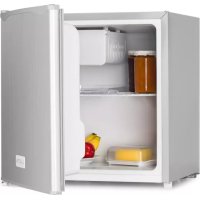
Spitzbergen Uni - Fridge Klarstein - Free user manual and instructions
Find the device manual for free Spitzbergen Uni Klarstein in PDF.



Download the instructions for your Fridge in PDF format for free! Find your manual Spitzbergen Uni - Klarstein and take your electronic device back in hand. On this page are published all the documents necessary for the use of your device. Spitzbergen Uni by Klarstein.
USER MANUAL Spitzbergen Uni Klarstein
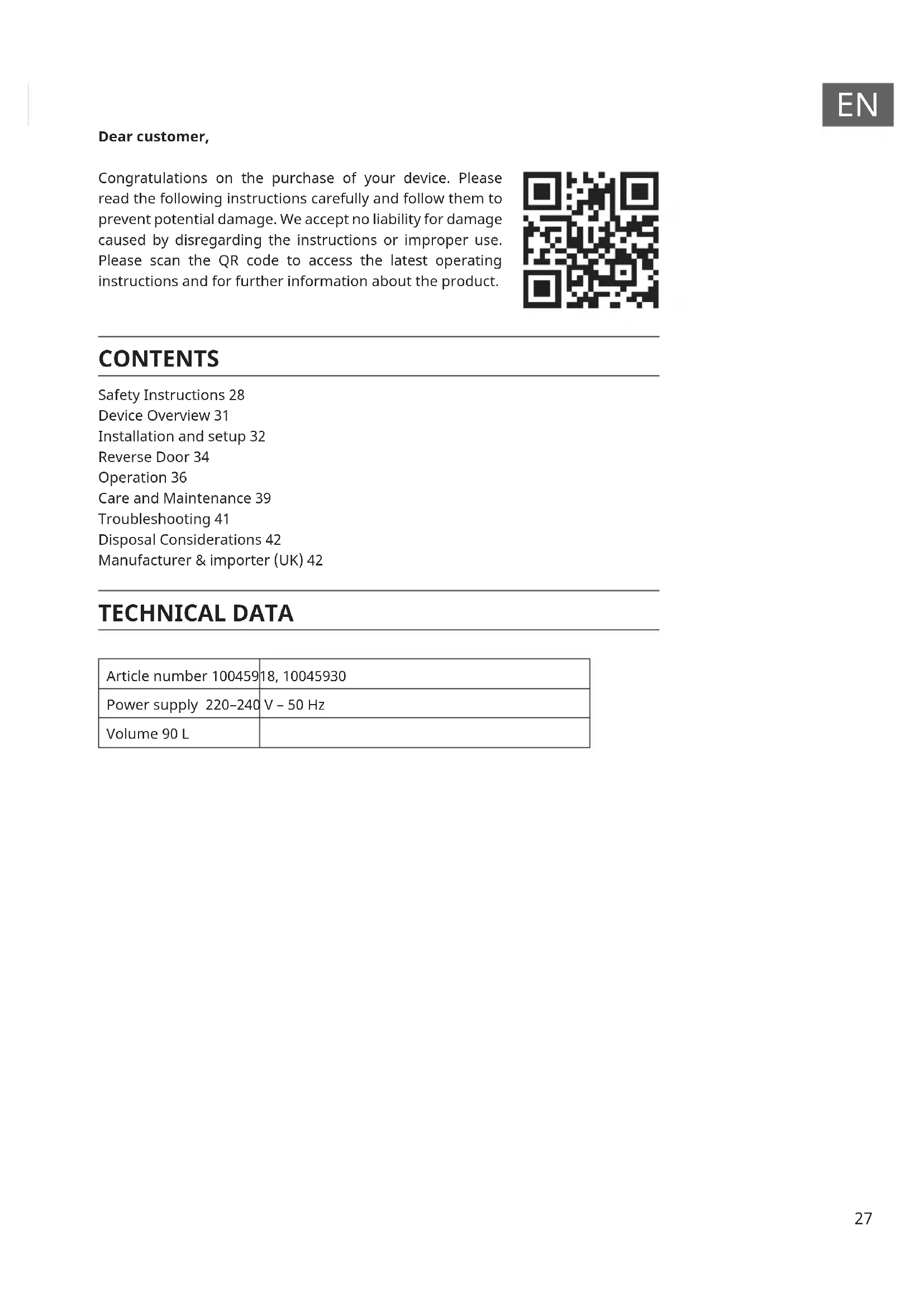
Dear customer, Congratulations on the purchase of your device. Please read the following instructions carefully and follow them to prevent potential damage. We accept no liability for damage caused by disregarding the instructions or improper use. Please scan the QR code to access the latest operating instructions and for further information about the product. CONTENTS TECHNICAL DATA Article number 10045918, 10045930 Power supply 220–240 V – 50 Hz Volume 90 L Safety Instructions 28 Device Overview 31 Installation and setup 32 Reverse Door 34 Operation 36 Care and Maintenance 39 Troubleshooting 41 Disposal Considerations 42 Manufacturer & importer (UK) 4228
SAFETY INSTRUCTIONS Advice for the safety of children and vulnerable people
- This device can be used by children aged from 8 years and above and people with limited physical, sensory or mental abilities or a lack of experience and knowledge only if they are supervised during use or have received instruction in the safe use of the device and understand the hazards involved.
- Children aged 3 to 8 may ll refrigerators with food and remove food.
- Make sure that children do not play with the device.
- Cleaning and maintenance of the device may be carried out by children only if they are at least 8 years old and are supervised.
- Keep all packaging away from children. There is a danger of suffocation.
- When disposing of the appliance, unplug it from the mains outlet, cut off the power cord and remove the door. This prevents playing children from injuring themselves on the device, being hit or locking themselves in it.
- If this appliance is replacing an older appliance with a spring lock and latch on the door or lid, render the spring lock and latch unusable before discarding the old appliance. This prevents children from locking themselves in and suffocating. General Instructions
- Keep ventilation openings in the device housing or in the built-in closet free of obstacles.
- Do not use mechanical devices or other means to speed up the defrosting process.
- Do not damage the refrigerant circuit.
- Do not use other electrical devices, such as ice machines, inside refrigerators unless approved for this purpose by the manufacturer.
- If there is a light bulb in the device, do not touch it. If left on for a long period of time, it can become very hot. The light bulb supplied with this device is a special lamp that must only be used with the supplied device. This bulb is not suitable for household lighting. Do not use the device without the light bulb.
- When setting up the device, make sure that the power cord is not pinched or damaged.
- Do not store explosive substances such as aerosol cans with a ammable propellant in this appliance.
- During the transportation and installation of the unit, be careful not to damage any refrigerant cycle components.
- Avoid open ames and sources of ignition in the vicinity of the device.
- Ventilate the room in which the device is located thoroughly and regularly.
- It is dangerous to modify this product in any way. Any damage to the cord can cause a short circuit, re, or electric shock.
- All electrical components such as the plug, power cord and compressor may only be replaced by a certied service centre or by qualied service personnel.29
- The power cord must not be extended.
- Make sure that the mains plug is not crushed or damaged. A crushed or damaged mains plug can overheat and cause a re.
- Make sure that you can access the mains plug of the device at all times.
- Do not pull on the mains cord.
- If the outlet is loose, do not insert the power cord. There is a risk of electric shock or re.
- This refrigerator appliance requires a standard 220–240 V AC, 50 Hz electrical outlet with grounding.
- This unit is heavy. Be careful when moving it.
- Do not touch the freezer compartment when your hands are damp or wet as this may cause abrasions or cold burns.
- Do not place the device in direct sunlight.
- This appliance is intended for use in households and similar environments. These include: - Staff kitchens in shops, oces and other work environments - Farms, hotels, motels and other residential establishments - Guest houses that offer breakfast (Bed & Breakfasts) - Catering and similar non-retail applications This unit contains the refrigerant Isobutane (R600a), a natural gas that has high environmental compatibility, but is ammable. Although it is ammable, it does not damage the ozone layer or increase the greenhouse effect. The use of this refrigerant results in a slightly higher noise level of the unit. In addition to the compressor noise, you can hear the ow of refrigerant. This is unavoidable and has no negative effect on the performance of the device. Be careful during transport to avoid damage to the refrigerant circuit. Refrigerant leaks can irritate the eyes. Instructions for daily use
- Do not put hot food in the appliance.
- Do not place food directly against the back wall.
- Frozen food must not be refrozen after it has been thawed.
- Store packaged frozen foods according to the frozen food manufacturer‘s instructions.
- Do not place zzy drinks in the freezer compartment as the pressure generated could cause them to explode and damage the appliance.
- Open the door as infrequently as possible.
- Do not leave the door open too long.
- Do not set the thermostat too low.
- To reduce energy consumption, leave all accessories such as drawers, shelves or trays in the appliance.30
Notes on cleaning and maintenance
- Before cleaning or servicing the appliance, switch it off and disconnect the power cord from the wall socket.
- Do not clean the device with metal objects. Do not use sharp objects to remove the frost from the device. Use a plastic scraper.
- All electrical work required to service the unit should be performed by a qualied electrician or competent person. WARNING When using, during maintenance and when disposing of the device, pay attention to the left symbol located on the back or on the compressor of the device. This symbol warns you of possible res. There are ammable substances in the refrigerant lines and in the compressor. Keep the appliance away from sources of re during use, maintenance and disposal. Climate Range The information about the climate range of the appliance is provided on the rating plate. It indicates at which ambient temperature (that is, room temperature, in which the appliance is working) the operation of the appliance is optimal (proper). SN Low This cooling unit is designed for use at ambient temperatures from 10 °C to 32 °C. N Moderate This cooling unit is designed for use at ambient temperatures from 16 °C to 32 °C. ST Subtropical This cooling unit is designed for use at ambient temperatures from 16 °C to 38 °C. T Tropical This cooling unit is designed for use at ambient temperatures from 16 °C to 43 °C. Note: Given the limit values of the ambient temperature range for the climate classes for which the refrigerating appliance is designed and the fact that the internal temperatures could be affected by such factors as location of the refrigerating appliance, ambient temperature and the frequency of door opening, the setting of any temperature control device might have to be varied to allow for these factors, if appropriate.31
DEVICE OVERVIEW Article: 10045918, 10045930 No. Description 1 Chill door 2 Thermostat 3 Drip tray 4 Shelf 5 Crisper cover 6 Crisper 7 Adjustable front feet 8 Plastic retainings32
INSTALLATION AND SETUP
- When choosing a location for your fridge/freezer, make sure that the oor is level and rm and that the room is well ventilated.
- Avoid placing the fridge near a heat source such as a cooker, boiler or radiator.
- Avoid placing the fridge in an outbuilding or solarium where it will be exposed to direct sunlight.
- If you place your fridge in an outbuilding such as a garage or annexe, make sure that the fridge is placed above the damp course, otherwise condensation will form on the fridge cabinet.
- The refrigerator gives off heat to the environment when it is in operation. Therefore, there should be at least 30 mm of free space on the top, more than 100 mm on both sides and more than 50 mm on the back of the refrigerator.
- Cleaning before use: Wipe the inside of the fridge with a weak solution of bicarbonate of soda. Then rinse with warm water using a damp sponge or cloth. Wash the baskets and shelves in warm soapy water and dry completely before replacing in the fridge. The external parts of the fridge can be cleaned with wax polish. Electric parts of the refrigerator can only be wiped by dry cloth.
- Check that you have a socket which is compatible with the plug supplied with the fridge before plugging in.
- Do not switch on until four hours after moving the fridge. The coolant uid needs time to settle. If the appliance is switched off at any time, wait 30 minutes before switching back on to allow the coolant uid to settle.
- Before storing foods in your fridge, turn the fridge on and wait for 24 hours, to make sure it is working properly and to allow the fridge to fail to the correct temperature. Dimensions in mm W D H A B °C E F 470 447 831 800 874 130±5 50 10033
Note: Figures 1 and 2 are for reference only. Levelling the fridge If the Fridge is not level, the door and magnetic seal alignment will be affected and may cause you Fridge to work incorrectly. Once the Fridge is placed in its nal location, adjust the leveling feet at the front by turning them.34
1. Make sure that your refrigerator is unplugged.
2. Remove the hinge cover and top
hinge from the top right side of the cabinet. Remove the screw hole cover from the top left of the cabinet.
3. Remove the refrigerator compartment door from the cabinet.
4. Remove the screws that secure
the lower hinge of the right side of the cabinet, then remove the hinge. Remove the adjustable foot that the left.
5. Remove the adjustable foot on the
lower hinge shaft, and remove the washer and nut.
6. Turn the lower hinge by 180°.
7. Fit the washer and nut into the
8. Install the lower hinge on the
left side of the cabinet. Install the adjustable foot at the right.
9. Remove the screw securing the
door stop to the bottom right of the refrigerator compartment door, then remove the door stop and t it to the bottom left.
10. Install the refrigerator compartment door.
11. Move the door bushing from
the top right of the fridge door to the top left of the door. And move the left hole cover to the right side.
12. Secure the top hinge to the
top left of the cabinet using the three screws you removed earlier. Before tightening the upper hinge screws, make sure that the top of the door is level with the cabinet and that the rubber seal provides a good seal.36
OPERATION Temperature Control The temperature of the appliance can be adjusted by turning the thermostat dial. The thermostat can be set between 1 and 7.
- 1 is the warmest setting.
- 7 is the coldest setting.
- Set the dial to OFF to turn off the cooling function.
- Under the normal operating condition (in spring and autumn), it is recommended to set the temperature at 4.
- In summer, when the ambient temperature is high, it is recommended to set the temperature to 3–4 to maintain the refrigerator and freezer temperatures and reduce the continuous running time of the refrigerator; in winter, when the ambient temperature is low, it is recommended to set the temperature to 5–6 to avoid frequent start/stop of the refrigerator. Notes: The temperatures may vary due to compressor cycles and outside conditions. First operation
- Plug in the device and turn the thermostat knob to the position „4“.
- Open the door 30 minutes later and if the temperature inside the fridge has dropped signicantly, it shows that the fridge system is working well. If the fridge has been running for a while, the temperature regulator will automatically adjust the temperature after the door is opened. Storage of food
- Cooked food can be placed in the fridge to keep fresh after it has cooled to room temperature. Egg and bottle trays for eggs, butter, milk and bottled drinks, etc. are included.
- Food should be stored in adequate space rather than too close together.
- Food to be stored should be wrapped in clean plastic lm or fresh food paper and then spread over several frames to avoid contamination and loss of water and odour mixture.
- Cool hot food to room temperature before storing, otherwise electricity consumption will increase and frost will form inside.
- Cooked meats should always be stored on a shelf above raw meats to avoid cross-contamination. Keep raw meats or sh on a plate large enough to37
collect juices and cover with cling lm or foil.
- Leave space around food to allow cold air to circulate around the fridge, ensuring all parts of the fridge are kept cool.To prevent transfer of avors and drying out, food should be separately packed or covered. Fruit and vegetables need not be wrapped.
- Allow pre-cooked food to cool before putting it in the fridge. This will help prevent the internal temperature of the fridge from rising.
- To prevent cold air escaping, try to limit the number of times you open the door. When you return from shopping, sort the food you want to keep in your fridge before opening the door. Only open the door to put food in or take food out. Storage locations Cool area This is the place to store foods that will keep for longer if they are kept in a cool place:
- Milk, eggs, yoghurt, fruit juices, hard cheeses such as cheddar, opened jars and bottles of salad dressings, sauces and jams, fats such as butter, margarine, low-fat spreads, cooking fats and lard. Coldest area This is where food that needs to be kept cold to be safe should be stored:
- Raw and uncooked foods should always be wrapped. Pre-cooked chilled foods, e.g. ready meals, meat pies, soft cheeses.
- Pre-cooked meat, e.g. ham
- Prepared salads (including pre-packaged mixed green salads, rice, potato salad, etc.)
- Desserts, e.g. fromage frais, home-made dishes and leftovers or cream cakes. Notes:
- Always wrap and store raw meat, poultry and sh on the bottom shelf.
- Do not leave food out for too long. This will prevent it from dripping onto or touching other food.38
- Do not store ammable gases or liquids in the fridge.
- For recommended food storage time, refer to the information given on your food packaging. Advice on how to save energy
- Place the refrigerator in the coolest part of the room, out of direct sunlight and away from heating ducts or registers. Do not place the refrigerator near heat-generating appliances such as a cooker, oven or dishwasher.
- Do not leave the door open for longer than necessary, and do not place hot food inside the refrigerator.
- Organise the fridge to reduce the number of door openings. Take out as many items as you need at one time and close the door as soon as possible.
- Close the refrigerator door properly to avoid increased energy consumption and the formation of excess ice and/or condensation inside.
- Constant circulation of cold air maintains a uniform temperature inside the refrigerator. For this reason, it is important to distribute the food properly to facilitate the ow of air.
- Cover food and wipe containers dry before placing them in the fridge. This will reduce the build-up of moisture inside the appliance.
- During long absences (e.g. holidays), it is advisable to unplug the refrigerator, remove all the food and clean it. The door should be left slightly open to prevent mould and unpleasant odours. This will not affect the refrigerator when it is reconnected.
- During short absences (e.g. holidays), the refrigerator can be left on. However, remember that there may be longer power cuts while you are away.39
Cleaning the unit inside
- Defrost the appliance.
- Clean the inside of the fridge with a weak solution of bicarbonate of soda.
- Rinse with warm water using a damp sponge or cloth and wipe dry.
- Wash the baskets in warm, soapy water and ensure they are completely dry before returning them to the fridge. Cleaning the unit outside
- Use a standard non-abrasive detergent diluted in warm water to clean the outside of the fridge.
- The condenser grille at the back of the fridge and adjacent components can be vacuumed using a soft brush attachment.
- Do not use abrasive cleaners, scouring pads or solvents to clean any part of the fridge. Location
- Do not place your fridge near a heat source such as a cooker, boiler or radiator. Also avoid direct sunlight in outbuildings or conservatories. Levelling the fridge
- Make sure the fridge is level.
- Use the swivel levelling feet on the front.
- If the fridge is not level, the alignment of the doors and magnetic seals will be affected and your fridge may not function properly.
- Do not switch on the fridge for 4 hours after moving it to a new location. This will allow time for the coolant to settle.
- Don‘t cover or block the appliance‘s vents or grilles. Vacation time
- Turn off the refrigerator rst and then unplug the unit from the wall outlet.
- Remove all the food and clean the fridge.
- Leave the lid open slightly to avoid possible formation of condensation, mold, or odors.
- Exercise extreme caution around children. The unit should not be accessible to children.
- Leave the fridge running for holidays of less than three weeks.
- If the appliance is not to be used for several months, remove all food and unplug the power cord. Thoroughly clean and dry the interior. To prevent odours and mould growth, leave the door slightly ajar: if necessary, block it or have the door removed.40
- This product should be serviced by an authorized engineer and only genuine spare parts should be used.
- Under no circumstances should you attempt to repair the appliance yourself.
- Repairs carried out by inexperienced persons may cause injury or serious malfunctioning. Contact the local store where your purchase was made.
- If the appliance is not to be used for a long period, unplug the appliance, empty all food and clean the appliance, leaving the door ajar to prevent unpleasant odours.
- If you need change the knob, please set to the position “off“. The knob can be easily disassembled. Changing the lamp
- The LED lamp is used by the refrigerator for lighting, which features low power consumption and long service life.
- In case of any abnormality, please contact after-sales personnel for service visit.
- The LED lamps should only be replaced by after-sales personnel.
- Lamp type: Inside light.41
TROUBLESHOOTING Problem Possible cause and solution The appliance is not working It is not plugged in. Re-plug. Breakers or fuses could be blown. Open the door and check whether the lamp is lit. No electricity or power failure. Check whether there is a power or mains failure. Check if the refrigerator is installed in a place like balconies, garages, storage rooms or other places, where the ambient temperature is below 10 °C. Install the refrigerator in a sheltered place where the ambient temperature is above 10°C. If the refrigerator is installed in a place where the temperature is too low, the internal cooling system may not function properly. Abnormal noise The device is not level. Adjust refrigerator‘s adjustable feet. The refrigerator touches the wall. Place it away from the wall. Poor re- frigerat- ing eciency Hot food or too much food placed in the fridge. Only put food in the fridge when it has cooled down. The door is opened too often. Do not open the door more often than necessary. A food clip is stuck in the seal of the door. Remove the clip and close the door. The fridge is placed in direct sunlight or near a furnace or stove. Remove the refrigerator from the heatsource. Check whether the fridge is well ventilated. Increase the distance to ensure sucient ventilation Check whether the temperature setting is too high. Set the appropriate temperature. Peculiar smell inside Check if soiled food is inside the refrigerator. Throw away spoiled food. Check if you need to clean the refrigerator. Clean the refrigerator. Strong-smelling food was not packaged. Pack strong-smelling foods. If the above descriptions are inapplicable to troubleshooting, do not disassemble and repair it yourself. Repairs carried out by inexperienced persons may cause injury or serious malfunctioning. This product should be serviced by an authorized engineer and only genuine spare parts should be used.42
DISPOSAL CONSIDERATIONS If there is a legal regulation in your country regarding the disposal of electrical and electronic equipment, this symbol on the product or on the packaging indicates that this product must not be disposed of with household waste. Instead, it must be taken to a collection point for the recycling of electrical and electronic equipment. By disposing of this product in accordance with the regulations, you protect the environment and the health of those around you from negative consequences. For information on recycling and disposal of this product, contact your local government or household waste disposal service. MANUFACTURER & IMPORTER (UK) Manufacturer: Chal-Tec GmbH, Wallstrasse 16, 10179 Berlin, Germany. Importer for Great Britain: Berlin Brands Group UK Limited PO Box 42 272 Kensington High Street London, W8 6ND United Kingdom43
Annual energy consumption (kWh/a) 85 Climate class: temperate, subtropi- cal Minimum ambient tempera- ture (ºC), for which the refrig- erating appliance is suitable
Maximum ambient tem- perature (ºC), for which the refrigerating appliance is suitable
Light source parameters: Type of light source LED Energy efficiency class G Minimum duration of the guarantee offered by the manufacturer: 24 months Additional information: Weblink to the supplier's website, where the information in point 4 of Annex II of Commission Regulation (EU) 2019/2019 is found: https://www.electronic-star.com/ Model placed on the Union market from 01/02/2024 EPREL registration number: 1860738 https://eprel.ec.europa.eu/qr/1860738 Supplier: Chal-Tec GmbH (Authorised representative) Website: Customer care service: Name: Customer service Website: https://www.elektronik-star.de/I nfo/Impressum/ Email: info@electronic-star.de Phone: +49303001385500 Address: Wallstraße 16 10179 berlin Germany Page 2 / 2 –45
Annual energy consumption (kWh/a) 85 Climate class: temperate, subtropi- cal Minimum ambient tempera- ture (ºC), for which the refrig- erating appliance is suitable
Maximum ambient tem- perature (ºC), for which the refrigerating appliance is suitable
Light source parameters: Type of light source LED Energy efficiency class G Minimum duration of the guarantee offered by the manufacturer: 24 months Additional information: Weblink to the supplier's website, where the information in point 4 of Annex II of Commission Regulation (EU) 2019/2019 is found: https://www.electronic-star.com/ Model placed on the Union market from 01/02/2024 EPREL registration number: 1860751 https://eprel.ec.europa.eu/qr/1860751 Supplier: Chal-Tec GmbH (Authorised representative) Website: Customer care service: Name: Customer service Website: https://www.elektronik-star.de/I nfo/Impressum/ Email: info@electronic-star.de Phone: +49303001385500 Address: Wallstraße 16 10179 berlin Germany Page 2 / 2 –47