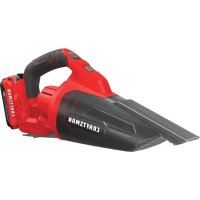
CMCVH001 - Vacuum Cleaner Craftsman - Free user manual and instructions
Find the device manual for free CMCVH001 Craftsman in PDF.


| Product Type | Cordless Hand Vacuum |
| Brand | Craftsman |
| Model | CMCVH001 |
| Rated Voltage | 20 V max (18 V nominal) |
| Battery Type | Lithium-ion |
| Runtime | 10 to 15 minutes |
| Filter Type | Filter with washable pre-filter |
| Crevice Tool | Yes, built-in with storage |
| Use | Dry vacuum only |
| Recommended Use | Household |
| Weight (approx.) | 1.2 kg |
| Dimensions (approx.) | 45 x 15 x 20 cm |
| Tool Warranty | 3 years |
| Battery Warranty | 2 years (for select models) |
| Compatible Accessories | VersaTrack Hang Hook (sold separately) |
| Filter Maintenance | Wash with warm soapy water, dry completely |
| Dust Cup Maintenance | Wash with warm soapy water |
| Motor Cleaning | Damp cloth, do not immerse |
| Storage | Cool, dry place |
| Safety | Do not use for liquids, do not charge outdoors |
| Replacement Parts | Filter, pre-filter, battery pack, charger |
| Charging | Use only Craftsman charger |
| Charge Indicator | LED light on charger |
| Charging Temperature | 4°C to 40°C |
| Protection System | Electronic protection against overload, overheating, deep discharge |
Frequently Asked Questions - CMCVH001 Craftsman
User questions about CMCVH001 Craftsman
0 question about this device. Answer the ones you know or ask your own.
Ask a new question about this device
Download the instructions for your Vacuum Cleaner in PDF format for free! Find your manual CMCVH001 - Craftsman and take your electronic device back in hand. On this page are published all the documents necessary for the use of your device. CMCVH001 by Craftsman.
USER MANUAL CMCVH001 Craftsman
IF YOU HAVE QUESTIONS OR COMMENTS, CONTACT US.
POUR TOUTE QUESTION OU TOUT COMMENTAIRE, NOUS CONTACTER.
SI TIENE DUDAS O COMENTARIOS, CONTÁCTENOS.
1-888-331-4569 WWW.CRAFTSMAN.COM
English (original instructions) 3
1 On/Off switch
2 Release button
3 Dust bowl
4 Filter (Fig. D)
5 Battery pack
6 Battery pack release button
7 Crevice tool
8 On board storage
Composants
WARNING: Read all safety warnings
and all instructions. Failure to follow the warnings and instructions may result in electric shock, fire and/or serious injury.

WARNING: To reduce the risk of injury, read the instruction manual.
Intended Use
Your 20V Max* cordless vacuum cleaner has been designed for dry vacuuming purposes. This appliance is intended for household use only.
Definitions: Safety Alert Symbols and Words
This instruction manual uses the following safety alert symbols and words to alert you to hazardous situations and your risk of personal injury or property damage.
MANGER: Indicates an imminently hazardous situation which, if not avoided, will result in death or serious injury.
WARNING: Indicates a potentially hazardous situation which, if not avoided, could result in death or serious injury.
AUTION: Indicates a potentially hazardous situation which, if not avoided, may result in minor or moderate injury.
(⚠️ without word) Indicates a safety related message.
NOTICE: Indicates a practice not related to personal injury which, if not avoided, may result in property damage.
IMPORTANT SAFETY INSTRUCTIONS
When using an electrical appliances, basic precautions should always be followed, including the following:
READ ALL INSTRUCTIONS BEFORE USING THIS APPLIANCE.
WARNING: Read all safety warnings
and all instructions. Failure to follow the warnings and instructions listed below may result in electric shock, fire and/or serious injury.
WARNING: Some household dust contains chemicals known to the State of California to cause cancer, birth defects or other reproductive harm such as asbestos and lead in lead based paint.
WARNING: Do not attempt to modify or repair the appliance.
WARNING: Do not charge the battery at ambient temperatures below 39 °F (4 °C) or above 104 °F (40 °C). Follow all charging instructions and do not charge the appliance outside of the temperature range specified in the instructions. Charging improperly or at temperatures outside of the specified range may damage the battery and increase risk of fire.
WARNING: To reduce the risk of fire, electrical shock or injury:
- Shock Hazard. To protect against risk of electrical shock, do not put charging base in water or other liquid.
- Do not allow to be used as a toy. Close attention is necessary when used by or near children.
- Use only as described in this manual. Use only manufacturer's recommended attachments.
- If appliance is not working as it should, has been dropped, damaged, left outdoors, or dropped into water, return it to a service center.
- Do not handle charger, including charger plug, and charger terminals with wet hands.
- Do not put any object into openings. Do not use with any opening blocked; keep free of dust, lint, hair, and anything that may reduce air flow.
- Keep hair, loose clothing, fingers, and all parts of body away from openings and moving parts.
- Use extra care when cleaning on stairs.
- Do not use to pick up flammable or combustible liquids, such as gasoline, or use in areas where they may be present.
- Do not pick up anything that is burning or smoking, such as cigarettes, matches, or hot ashes.
- Do not use without dust bag and/or filters in place.
- Do not charge the unit outdoors.
- Use only the charger supplied by the manufacturer to recharge.
- Do not incinerate the appliance even if it is severely damaged. The batteries can explode in a fire.
- This appliance is intended for household use only and not for commercial or industrial use. The unit should be placed or mounted away from sinks and hot surfaces.
- Plug the charger directly into an electrical outlet.
- Use the charger only in a standard electrical outlet (120V/60Hz).
- Unplug the charger from outlet before any routine cleaning or maintenance.
- Do not look into the air vents when the unit is switched on, as sometimes there is a possibility of small debris being
English
discharged from the air vents, especially after cleaning / replacement of the filters as debris inside the unit can be disturbed.
- Leaks from battery cells can occur under extreme conditions. If the liquid, which is a 20 - 35% solution of potassium hydroxide, gets on the skin (1) wash quickly with soap and water or (2) neutralize with a mild acid such as lemon juice or vinegar. If the liquid gets into the eyes, flush them immediately with clean water for a minimum of 10 minutes. Seek medical attention.
Additional Safety Warnings
a) Prevent unintentional starting. Ensure the switch is in the off-position before picking up or carrying the appliance. Carrying the appliance with your finger on the switch or energizing appliance that have the switch on invites accidents.
b) Disconnect the battery pack from the appliance before making any adjustments, changing accessories, or storing appliance. Such preventive safety measures reduce the risk of starting the appliance accidentally.
c) Recharge only with the charger specified by the manufacturer. A charger that is suitable for one type of battery pack may create a risk of fire when used with another battery pack.
d) Use appliance only with specifically designed battery packs. Use of any other battery packs may create a risk of injury and fire.
e) When battery pack is not in use, keep it away from other metal objects, like paper clips, coins, keys, nails, screws or other small metal objects, that can make a connection from one terminal to another. Shorting the battery terminals together may cause burns or a fire.
f) Under abusive conditions, liquid may be ejected from the battery; avoid contact. If contact accidentally occurs, flush with water. If liquid contacts eyes, additionally seek medical help. Liquid ejected from the battery may cause irritation or burns.
g) Do not use a battery pack or appliance that is damaged or modified. Damaged or modified batteries may exhibit unpredictable behavior resulting in fire, explosion or risk of injury.
h) Do not expose a battery pack or appliance to fire or excessive temperature. Exposure to fire or temperature above 266 °F (130 °C) may cause explosion.
i) Follow all charging instructions and do not charge the battery pack or appliance outside of the temperature range specified in the instructions. Charging improperly or at temperatures outside of the specified range may damage the battery and increase the risk of fire.
j) Have servicing performed by a qualified repair person using only identical replacement parts. This will ensure that the safety of the product is maintained.
k) Do not modify or attempt to repair the appliance or the battery pack except as indicated in the instructions for use and care.
Additional Safety Information
WARNING:
Never modify the power
tool or any part of it. Damage or personal injury could result.
WARNING:
ALWAYS use safety glasses.
Everyday eyeglasses are NOT safety glasses. Also use face or dust mask if cutting operation is dusty. ALWAYS WEAR CERTIFIED SAFETY EQUIPMENT:
• ANSI Z87.1 eye protection (CAN/CSA Z94.3),
• ANSI S12.6 (S3.19) hearing protection,
• NIOSH/OSHA/MSHA respiratory protection.
WARNING:
Some dust created by
power sanding, sawing, grinding, drilling, and other construction activities contains chemicals known to the State of California to cause cancer, birth defects or other reproductive harm. Some examples of these chemicals are:
- lead from lead-based paints,
• crystalline silica from bricks and cement and other masonry products, and
• arsenic and chromium from chemically-treated lumber.
Your risk from these exposures varies, depending on how often you do this type of work. To reduce your exposure to these chemicals: work in a well ventilated area, and work with approved safety equipment, such as those dust masks that are specially designed to filter out microscopic particles.
- Wear protective clothing and wash exposed areas with soap and water. Allowing dust to get into your mouth, eyes, or lay on the skin may promote absorption of harmful chemicals. Direct particles away from face and body.
- Use the appropriate dust extractor vacuum to remove the vast majority of static and airborne dust. Failure to remove static and airborne dust could contaminate the working environment or pose an increased health risk to the operator and those in close proximity.
- Use clamps or other practical ways to secure and support the workpiece to a stable platform. Holding the work by hand or against your body is unstable and may lead to loss of control and injury.
- Air vents often cover moving parts and should be avoided. Loose clothes, jewelry or long hair can be caught in moving parts.
CAUTION:
When not in use, place tool on
its side on a stable surface where it will not cause a tripping or falling hazard. Some tools with large battery packs will stand upright on the battery pack but may be easily knocked over.
The label on your tool may include the following symbols. The symbols and their definitions are as follows:
BPM.....beats per minute
V....volts
min......minutes
=== or DC......direct current
.../min.....per minute
RPM......revolutionsper minute
A ...... amperes
Hz......hertz
W.....watts
Wh.....watt hours
n_0 no load speed
n......rated speed
⚠️ ____ safety alert symbol
wearrespiratory protection
∞ .... wear eye protection
☐ Class II Construction (double insulated)
○ ....wearhearing protection
readall documentation
△.... avoid staring at light
\~ or AC......alternating current
Ah......amphours
BATTERIES AND CHARGERS
The battery pack is not fully charged out of the carton. Before using the battery pack and charger, read the safety instructions below and then follow charging procedures outlined. When ordering replacement battery packs, be sure to include the catalog number and voltage.
READ ALL INSTRUCTIONS
Important Safety Instructions for All Battery Packs
WARNING: Read all safety warnings, instructions, and cautionary markings for the battery pack, charger and product. Failure to follow the warnings and instructions may result in electric shock, fire and/or serious injury.
- Do not charge or use the battery pack in explosive atmospheres, such as in the presence of flammable liquids, gases or dust. Inserting or removing the battery pack from the charger may ignite the dust or fumes.
- NEVER force the battery pack into the charger. DO NOT modify the battery pack in any way to fit into a non-compatible charger as battery pack may rupture causing serious personal injury. Consult the chart at the end of this manual for compatibility of batteries and chargers.
- Charge the battery packs only in CRAFTSMAN chargers.
• DO NOT splash or immerse in water or other liquids.
• DO NOT allow water or any liquid to enter battery pack.
- Do not store or use the tool and battery pack in locations where the temperature may reach or exceed 104 °F (40 °C) (such as outside sheds or metal buildings in summer). For best life store battery packs in a cool, dry location.
NOTE: Do not store the battery packs in a tool with the trigger switch locked on. Never tape the trigger switch in the ON position.
- Do not incinerate the battery pack even if it is severely damaged or is completely worn out. The battery pack can explode in a fire. Toxic fumes and materials are created when lithium-ion battery packs are burned.
- If battery contents come into contact with the skin, immediately wash area with mild soap and water. If battery liquid gets into the eye, rinse water over the open eye for 15 minutes or until irritation ceases. If medical attention is needed, the battery electrolyte is composed of a mixture of liquid organic carbonates and lithium salts.
- Contents of opened battery cells may cause respiratory irritation. Provide fresh air. If symptoms persist, seek medical attention.
- Battery liquid may be flammable if exposed to spark or flame.
- Never attempt to open the battery pack for any reason. If the battery pack case is cracked or damaged, do not insert into the charger. Do not crush, drop or damage the battery pack. Do not use a battery pack or charger that has received a sharp blow, been dropped, run over or damaged in any way (e.g., pierced with a nail, hit with a hammer, stepped on). Damaged battery packs should be returned to the service center for recycling.
Storage Recommendations
The best storage place is one that is cool and dry, away from direct sunlight and excess heat or cold. Store the fully charged battery pack out of the charger.
Battery Pack Cleaning Instructions
Dirt and grease may be removed from the exterior of the battery pack using a cloth or soft non-metallic brush. Do not use water or any cleaning solutions.
Fuel Gauge Battery Packs (Fig. B)
Some battery packs include a fuel gauge. When the fuel gauge button is pressed and held, the LED lights will indicate the approximate level of charge remaining. This does not indicate tool functionality and is subject to variation based on product components, temperature, and end-user application.
Transportation
WARNING: Fire hazard. Do not store, carry, or transport the battery pack so that metal objects can contact exposed battery terminals.
For example, do not place the battery pack in aprons, pockets, tool boxes, product kit boxes, drawers, etc., with loose nails, screws, keys, coins, hand tools, etc. When transporting individual battery packs, make sure that the battery terminals are protected and well insulated from materials that could contact them and cause a short circuit.
NOTE: Li-ion battery packs should not be
ENGLISH
put in checked baggage on airplanes and must be properly protected from short circuits if they are in carry-on baggage.
The RBRC® Seal
Please take your spent battery packs to an authorized service center or to your local retailer for recycling. In some areas, it is illegal to place spent battery packs in the trash. You may also contact your local recycling center for information on where to drop off the spent battery pack. Do not place in curbside recycling. For more information visit www.call2recycle.org, or call the toll free number in the RBRC® Seal.

RBRC® is a registered trademark of Call 2 Recycle, Inc.
Important Safety Instructions for All Battery Chargers

WARNING: Read all safety warnings, instructions, and cautionary markings for the battery pack, charger and product. Failure to follow the warnings and instructions may result in electric shock, fire and/or serious injury.
- DO NOT attempt to charge the battery pack with any chargers other than a CRAFTSMAN charger. CRAFTSMAN chargers and battery packs are specifically designed to work together.
• These chargers are not intended for any uses other than charging CRAFTSMAN rechargeable battery packs. Charging other types of battery packs may cause them to overheat and burst, resulting in personal injury, property damage, fire, electric shock or electrocution. - Do not expose the charger to rain or snow.
- Do not allow water or any liquid to enter charger.
- Pull by the plug rather than the cord when disconnecting the charger. This will reduce the risk of damage to the electric plug and cord.
- Make sure that the cord is located so that it will not be stepped on, tripped over or otherwise subjected to damage or stress.
- Do not use an extension cord unless it is absolutely necessary. Use of improper extension cord could result in risk of fire, electric shock or electrocution.
- When operating a charger outdoors, always provide a dry location and use an extension cord suitable for outdoor use. Use of a cord suitable for outdoor use reduces the risk of electric shock.
- An extension cord must have adequate wire size (AWG or American Wire Gauge) for safety. The smaller the gauge number of the wire, the heavier the cord and thus the greater its capacity. An undersized cord will cause a drop in line voltage resulting in loss of power and overheating. The following table shows the correct size to use depending on total length of all extension cords plugged together, and nameplate ampere rating. If in doubt, use the next heavier gauge.
Minimum Gauge for Cord Sets
| Volts | Total Length of Cord in Feet (meters) | ||||
| 120V 25 (7.6) | 50 (15.2) 100 | (30.5) 150 (45.7) | |||
| Ampere Rating | American Wire Gauge | ||||
| More Than Not More Than | |||||
| 0 6 18 | 16 16 14 | ||||
| 6 10 18 | 16 14 12 | ||||
| 10 12 16 | 16 14 12 | ||||
| 12 16 14 | 12 Not Recommended | ||||
- Do not place any object on top of the charger or place the charger on a soft surface that might block the ventilation slots and result in excessive internal heat. Place the charger in a position away from any heat source. The charger is ventilated through slots in the top and the bottom of the housing.
- Do not operate the charger with a damaged cord or plug. Have them replaced immediately.
- Do not operate the charger if it has received a sharp blow, been dropped or otherwise damaged in any way. Take it to an authorized service center.
- Do not disassemble the charger; take it to an authorized service center when service or repair is required. Incorrect reassembly may result in a risk of electric shock, electrocution or fire.
- The charger is designed to operate on standard 120V household electrical power. Do not attempt to use it on any other voltage. This does not apply to the vehicular charger.
- Foreign materials of a conductive nature, such as, but not limited to, grinding dust, metal chips, steel wool, aluminum foil or any buildup of metallic particles should be kept away from the charger cavities and ventilation slots.
• Always unplug the charger from the power supply when there is no battery pack in the cavity.
Charging a Battery (Fig. C)
- Plug the charger into an appropriate outlet.
- Insert and fully seat battery pack. Green charging light will continuously blink while charging.
- Charging is complete when the green charging light remains continuously ON. Battery pack can be left in charger or removed.
- Charger will not charge a faulty battery pack, which may be indicated by the light staying OFF. Take charger and battery pack to an authorized service center if light stays OFF.
NOTE: Refer to label near charging light on charger for blink patterns.
Hot/Cold Pack Delay
When the charger detects a battery pack that is too hot or too cold, it automatically starts a Hot/Cold Pack Delay, suspending charging until the battery pack has reached an appropriate temperature. The charger then automatically switches to the pack charging mode. This feature ensures maximum battery pack life.
A cold battery pack may charge at a slower rate than a warm battery pack.
The hot/cold pack delay will be indicated by the green light continuing to blink but with the red light continuously ON. Once the battery pack has reached an appropriate temperature, the red light will turn OFF and the charger will resume the charging procedure.
Electronic Protection System
Li-Ion tools are designed with an Electronic Protection System that will protect the battery pack against overloading, overheating or deep discharge. The tool will automatically turn off and the battery pack will need to be recharged.
Important Charging Notes
- The charger and battery pack may become warm to the touch while charging. This is a normal condition, and does not indicate a problem. To facilitate the cooling of the battery pack after use, avoid placing the charger or battery pack in a warm environment such as in a metal shed or an uninsulated trailer.
- If the battery pack does not charge properly:
a. Check operation of receptacle by plugging in a lamp or other appliance;
b. Check to see if receptacle is connected to a light switch which turns power off when you turn out the lights;
c. If charging problems persist, take the tool, battery pack and charger to your local service center.
- You may charge a partially used pack whenever you desire with no adverse effect on the battery pack.
Charger Cleaning Instructions
WARNING: Shock hazard. Disconnect the charger from the AC outlet before cleaning. Dirt and grease may be removed from the exterior of the charger using a cloth or soft non-metallic brush. Do not use water or any cleaning solutions.
Wall Mounting
Some CRAFTSMAN chargers are designed to be wall mountable or to sit upright on a table or work surface. If wall mounting, locate the charger within reach of an electrical outlet, and away from a corner or other obstructions which may impede air flow. Use the back of the charger as a template for the location of the mounting screws on the wall. Mount the charger securely using drywall screws (purchased separately) at least 1" (25.4 mm) long, with a screw head diameter of 0.28–0.35" (7–9 mm), screwed into wood to an optimal depth leaving approximately 7/32" (5.5 mm) of the screw exposed. Align the slots on the back of the charger with the exposed screws and fully engage them in the slots.
VersaTrack™
CRAFTSMAN chargers can be mounted to the wall using CRAFTSMAN VersaTrack™ Trackwall. Hooks and accessories are sold separately. Please refer to the VersaTrack™ Trackwall accessory sheet for further information.
SAVE THESE INSTRUCTIONS FOR FUTURE USE
ASSEMBLY AND ADJUSTMENTS
WARNING: To reduce the risk of serious personal injury, turn unit off and remove the battery pack before making any adjustments or removing/installing attachments or accessories. An accidental start-up can cause injury.
Filter (Fig. D)
WARNING: Never use this cordless hand vacuum without its filters.
- Remove the dust bowl 3 by pressing the dust bowl release button 2 and pulling the bowl down and out.
- Remove the filter 4 by pulling it out of the dust bowl.
- Twist and pull to remove the pre-filter 9 from the filter.
- Install the filter into the dust bowl by aligning the filter with the dust bowl and placing it firmly into position.
Dust Bowl (Fig. E)
nOTE: It is very important that the filter and pre-filter are correctly positioned before use.
To install the dust bowl 3, place it onto the front of the unit and click firmly into position.
OPERATION
WARNING: To reduce the risk of serious personal injury, turn unit off and remove the battery pack before making any adjustments or removing/installing attachments or accessories. An accidental start-up can cause injury.
Installing and Removing the Battery Pack (Fig. F)
nOTE: For best results, make sure your battery pack is fully charged.
To install the battery pack 5 into the tool handle, align the battery pack with the rails inside the tool's handle and slide it into the handle until the battery pack is firmly seated in the tool and ensure that it does not disengage.
To remove the battery pack from the tool, press the release button 6 and firmly pull the battery pack out of the tool handle. Insert it into the charger as described in the charger section of this manual.
On/Off Switch (Fig. G)
nOTE: This product is for dry pick-up only.
• To switch the vac on, slide the On/Off switch
1 forward.
• To switch the vac off, slide the On/Off switch
1 back.
English
Run Time
When fully charged, the average effective usage times are between 10-15 minutes.
It may take several chargings before these times can be achieved.
MAINTENANCE
WARNING: To reduce the risk of serious personal injury, turn unit off and remove the battery pack before making any adjustments or removing/installing attachments or accessories.
An accidental start-up can cause injury.
Cleaning
WARNING: Blow dirt and dust out of all air vents with clean, dry air at least once a week. To minimize the risk of eye injury, always wear ANSI Z87.1 approved eye protection when performing this procedure.
WARNING: Never use solvents or other harsh chemicals for cleaning the non-metallic parts of the tool. These chemicals may weaken the plastic materials used in these parts. Use a cloth dampened only with water and mild soap. Never let any liquid get inside the tool; never immerse any part of the tool into a liquid.
Dust Bowl (Fig. D)
iIMPORTAnT: Maximum dust collection will only be obtained with clean filters and an empty dust bowl. If dust begins to fall back out of the product after it is switched off, this indicates that the bowl is full and requires emptying
• Refer to Filter to remove the dust bowl 3.
- The dust bowl can be washed in warm soapy water. Ensure that it is dry before re-attaching.
Motor Section (Fig. D)
iIMPORTAnT: Never immerse the product in water.
A damp cloth and soapy water should be used to clean the exterior of the motor section 10. Always ensure the product is completely dry before re-use or storing.
Filter (Fig. D)
nOTE: The product performs better with a clean filter and pre-filter.
- Remove the pre-filter 9 and shake or lightly brush loose dust off the filter.
- Empty the dust from the dust bowl 3 and wash if necessary.
- Wash the pre-filter regularly using warm, soapy water. Ensure that it is completely dry before using again.
Accessories
WARNING: Since accessories, other than those offered by CRAFTSMAN, have not been tested with this product, use of such accessories with this tool could be hazardous. To reduce the risk of injury, only CRAFTSMAN recommended accessories should be used with this product.
Recommended accessories for use with your tool are available at extra cost from your local dealer or authorized service center. If you need assistance in locating any accessory, please contact CRAFTSMAN call 1-888-331-4569.
On Board Storage (Fig. A)
The crevice 7 slides into the on board storage 8 underneath the motor housing.
VersaTrack™ (Fig. H)
WARNING: To reduce the risk of serious personal injury, turn unit off and remove the battery pack before making any adjustments or removing/installing attachments or accessories.
An accidental start-up can cause injury.
WARNING: To reduce the risk of serious personal injury, do not use a damaged VersaTrack™ hang hook or VersaTrack™ Trackwall. A damaged VersaTrack™ hang hook or VersaTrack™ Trackwall will not support the weight of the tool.
WARNING: To reduce the risk of serious personal injury, ensure the screw holding the VersaTrack™ hang hook is securely tightened.
WARNING: To reduce the risk of serious personal injury, DO NOT suspend tool overhead or suspend objects from the hang hook. ONLY suspend tool on the VersaTrack™ Trackwall using the hang hook.
WARNING: Ensure that the tool weight does not exceed the maximum rated weight of 20 lb (9 kg) for the selected VersaTrack™ hook.
WARNING: When hanging objects on a VersaTrack™ Trackwall rail, adequately space the tools in order to not exceed 75 lb (35 kg) per linear foot.
iIMPORTAnT: When attaching the VersaTrack™ hang hook, use only the screw that is provided. Be sure to securely tighten the screw. VersaTrack™ accessories mount compatible tools securely to the VersaTrack™ Trackwall system.
- Turn the tool off, remove the battery pack and accessories.
CAUTION:
Any product with exposed
cutting teeth must have them covered securely if it is to be on the VersaTrack™ Trackwall.
- Attach the hang hook 11 on the tool.
a. Place the VersaTrack™ hang hook onto the mounting location at the base of the tool.
b. Use a screwdriver to secure the hang hook with the provided screw 12. Do not use any other screw for this.
NOTE: VersaTrack™ accessories for use with your tool are available at extra cost from your local dealer or authorized service center. If you need assistance in locating any accessory, please contact CRAFTSMAN, call 1-888-331-4569.
Repairs
The charger and battery pack are not serviceable. There are no serviceable parts inside the charger or battery pack.
WARNING:
To assure product SAFETY
and RELIABILITY, repairs, maintenance and adjustment (including brush inspection and replacement, when applicable) should be performed by a CRAFTSMAN factory service center or a CRAFTSMAN authorized service center. Always use identical replacement parts.
Register Online
Thank you for your purchase. Register your product now for:
- WARRANTY SERVICE: Registering your product will help you obtain more efficient warranty service in case there is a problem with your product.
- CONFIRMATION OF OWNERSHIP: In case of an insurance loss, such as fire, flood or theft, your registration of ownership will serve as your proof of purchase.
• FOR YOUR SAFETY: Registering your product will allow us to contact you in the unlikely event a safety notification is required under the Federal Consumer Safety Act. - Register online at www.craftsman.com/registration
Three Year Limited Warranty
CRAFTSMAN will repair or replace, without charge, any defects due to faulty materials or workmanship for three years from the date of purchase (two years for batteries). This warranty does not cover part failure due to normal wear or tool abuse. For further detail of warranty coverage and warranty repair information, visit www.craftsman.com or call 1-888-331-4569. This warranty does not apply to accessories or damage caused where repairs have been made or attempted by others. THIS LIMITED WARRANTY IS GIVEN IN LIEU OF ALL OTHERS, INCLUDING THE IMPLIED WARRANTY OF MERCHANTABILITY AND FITNESS FOR A PARTICULAR PURPOSE, AND EXCLUDES ALL INCIDENTAL OR CONSEQUENTIAL DAMAGES. Some states do not allow limitations on how long an implied warranty lasts or the exclusion or limitation of incidental or consequential damages, so these limitations may not apply to you. This
warranty gives you specific legal rights and you may have other rights which vary in certain states or provinces.
2 YEARS FREE SERVICE ON CRAFTSMAN BATTERY PACKS
CMCB201, CMCB2011
3 YEARS FREE SERVICE ON CRAFTSMAN BATTERY PACKS
CMCB202, CMCB204
NOTE: Battery warranty voided if the battery pack is tampered with in any way. CRAFTSMAN is not responsible for any injury caused by tampering and may prosecute warranty fraud to the fullest extent permitted by law.
90 DAY MONEY BACK GUARANTEE
If you are not completely satisfied with the performance of your CRAFTSMAN Power Tool or Nailer for any reason, you can return it within 90 days from the date of purchase with a receipt for a full refund – no questions asked.
LATIN AMERICA: This warranty does not apply to products sold in Latin America. For products sold in Latin America, see country specific warranty information contained in the packaging, call the local company or see website for warranty information.
FREE WARNING LABEL REPLACEMENT: If your warning labels become illegible or are missing, call 1-888-331-4569 for a free replacement.
FRAnÇAis
--- o DC......corriente directa
.../min.....por minuto
Eje Central Lázaro Cárdenas No. 18 - Local (55) 5588 9377 D, Col. Obrera
MERIDA, YUC
Calle 63 #459-A - Col. Centro (999) 928 5038
MONTERREY, N.L.
Av. Francisco I. Madero 831 Poniente - Col. (818) 375 23 13 Centro
PUEBLA, PUE
17 Norte #205 - Col. Centro (222) 246 3714
QUERETARO, QRO
Av. San Roque 274 - Col. San Gregorio (442) 2 17 63 14
SAN LUIS POTOSI, SLP
www.craftsman.com/registration.
natural_image
Pure horizontal and vertical lines without any text, numbers, or symbols
natural_image
Pure geometric lines forming a symmetrical shape with no text, numbers, or symbols
natural_image
Pure geometric lines without any text, numbers, or symbols
natural_image
Pure geometric lines forming a symmetrical shape without any text, numbers, or symbols
natural_image
Pure horizontal and vertical lines without any text, numbers, or symbols
natural_image
Pure geometric lines forming a symmetrical shape with no text, numbers, or symbolsCompatible battery packs and chargers / Blocs-piles et chargeurs compatibles / Baterías y cargadores compatibles
| 20V Max* Li-Ion | Battery PacksBlocs-piles Baterías | CMCB201, CMCB2011, CMCB202, CMCB204 |
| ChargersChargeurs Cargadores | CMCB100, CMCB102, CMCB104 |
* Maximum initial battery voltage (measured without a workload) is 20 volts. Nominal voltage is 18.
* La tension initiale maximum du bloc-piles (mesurée à vide) est de 20 volts. La tension nominale est de 18.
* El máximo voltaje inicial de la batería (medido sin carga de trabajo) es 20 voltios. El voltaje nominal es de 18.
WARNING:
Use of any other battery packs may create a risk of injury and fire.
AVERTISSEMENT :

- Composants
- WARNING: Read all safety warnings
- WARNING: To reduce the risk of injury, read the instruction manual.
- Intended Use
- Definitions: Safety Alert Symbols and Words
- MANGER: Indicates an imminently hazardous situation which, if not avoided, will result in death or serious injury.
- WARNING: Indicates a potentially hazardous situation which, if not avoided, could result in death or serious injury.
- AUTION: Indicates a potentially hazardous situation which, if not avoided, may result in minor or moderate injury.
- NOTICE: Indicates a practice not related to personal injury which, if not avoided, may result in property damage.
- IMPORTANT SAFETY INSTRUCTIONS
- READ ALL INSTRUCTIONS BEFORE USING THIS APPLIANCE.
- WARNING: Do not attempt to modify or repair the appliance.
- WARNING: To reduce the risk of fire, electrical shock or injury:
- English
- Additional Safety Warnings
- Additional Safety Information
- WARNING:
- CAUTION:
- BATTERIES AND CHARGERS
- READ ALL INSTRUCTIONS
- Important Safety Instructions for All Battery Packs
- Storage Recommendations
- Battery Pack Cleaning Instructions
- Fuel Gauge Battery Packs (Fig. B)
- Transportation
- The RBRC® Seal
- Important Safety Instructions for All Battery Chargers
- Charging a Battery (Fig. C)
- Hot/Cold Pack Delay
- Electronic Protection System
- Important Charging Notes
- Charger Cleaning Instructions
- Wall Mounting
- VersaTrack™
- SAVE THESE INSTRUCTIONS FOR FUTURE USE
- ASSEMBLY AND ADJUSTMENTS
- Filter (Fig. D)
- Dust Bowl (Fig. E)
- OPERATION
- Installing and Removing the Battery Pack (Fig. F)
- On/Off Switch (Fig. G)
- Run Time
- MAINTENANCE
- Cleaning
- Dust Bowl (Fig. D)
- Motor Section (Fig. D)
- Accessories
- On Board Storage (Fig. A)
- VersaTrack™ (Fig. H)
- Repairs
- Register Online
- Three Year Limited Warranty
- YEARS FREE SERVICE ON CRAFTSMAN BATTERY PACKS
- YEARS FREE SERVICE ON CRAFTSMAN BATTERY PACKS
- DAY MONEY BACK GUARANTEE
- FRAnÇAis
- MERIDA, YUC
- MONTERREY, N.L.
- PUEBLA, PUE
- QUERETARO, QRO
- SAN LUIS POTOSI, SLP
Brand : Craftsman
Model : CMCVH001
Category : Vacuum Cleaner