ManualGo.com
GH 651 B - Mechanical chipper Güde - Free user manual and instructions
Find the device manual for free GH 651 B Güde in PDF.



Download the instructions for your Mechanical chipper in PDF format for free! Find your manual GH 651 B - Güde and take your electronic device back in hand. On this page are published all the documents necessary for the use of your device. GH 651 B by Güde.
USER MANUAL GH 651 B Güde
GB Translation of the original instructions
Please read carefully these Operating Instructions before putting the appliance into operation. A.V. 2 Any reprints, even in abbreviated version, are subject to approval. Technical changes reserved.
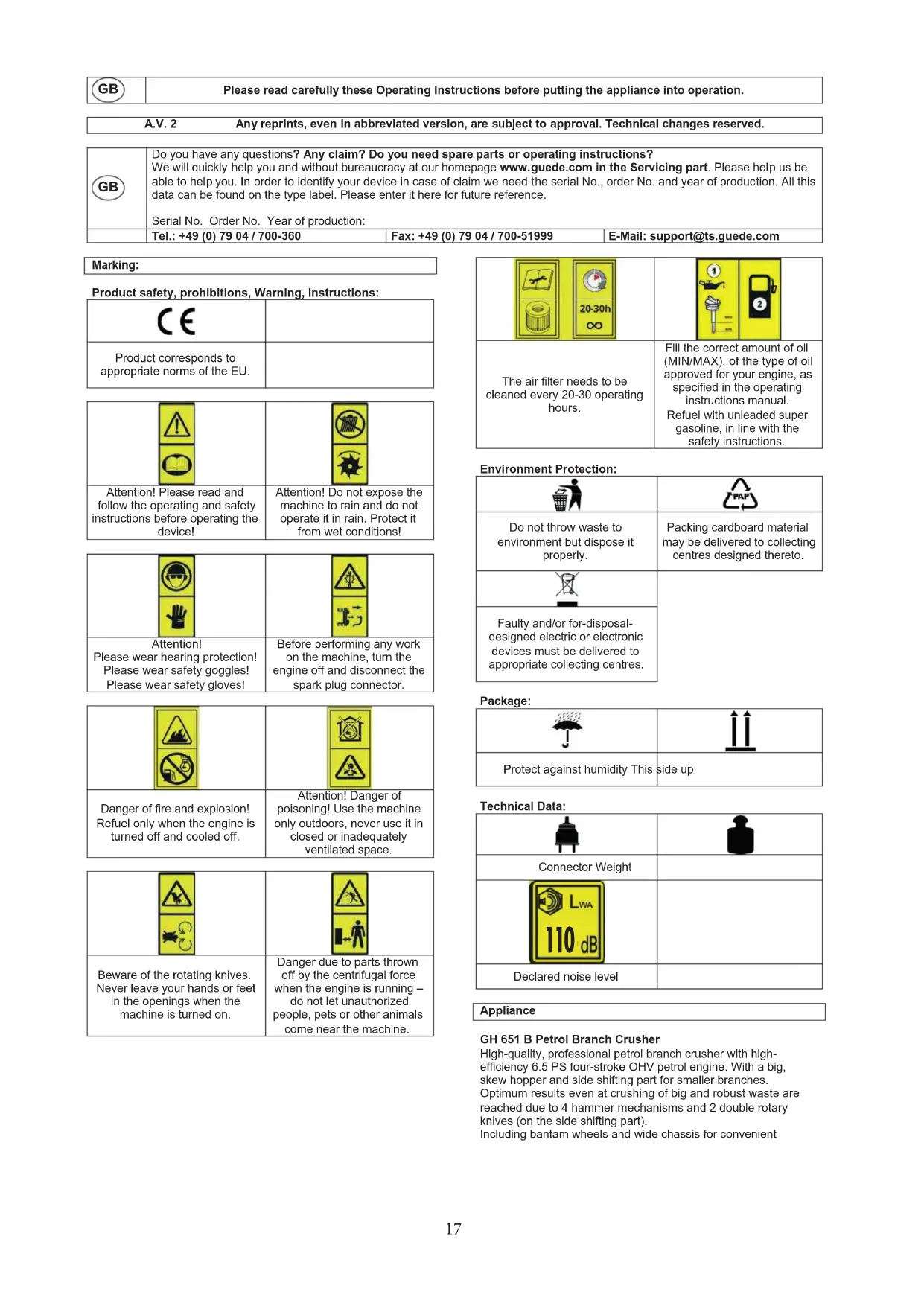
Do you have any questions? Any claim? Do you need spare parts or operating instructions? We will quickly help you and without bureaucracy at our homepage www.guede.com in the Servicing part. Please help us be able to help you. In order to identify your device in case of claim we need the serial No., order No. and year of production. All this data can be found on the type label. Please enter it here for future reference. Serial No. Order No. Year of production: Tel.: +49 (0) 79 04 / 700-360 Fax: +49 (0) 79 04 / 700-51999 E-Mail: support@ts.guede.com Marking: Product safety, prohibitions, Warning, Instructions: Product corresponds to appropriate norms of the EU. Attention! Please read and follow the operating and safety instructions before operating the device! Attention! Do not expose the machine to rain and do not operate it in rain. Protect it from wet conditions! Attention! Please wear hearing protection! Please wear safety goggles! Please wear safety gloves! Before performing any work on the machine, turn the engine off and disconnect the spark plug connector. Danger of fire and explosion! Refuel only when the engine is turned off and cooled off. Attention! Danger of poisoning! Use the machine only outdoors, never use it in closed or inadequately ventilated space. Beware of the rotating knives. Never leave your hands or feet in the openings when the machine is turned on. Danger due to parts thrown off by the centrifugal force when the engine is running – do not let unauthorized people, pets or other animals come near the machine. The air filter needs to be cleaned every 20-30 operating hours. Fill the correct amount of oil (MIN/MAX), of the type of oil approved for your engine, as specified in the operating instructions manual. Refuel with unleaded super gasoline, in line with the safety instructions. Environment Protection: Do not throw waste to environment but dispose it properly. Packing cardboard material may be delivered to collecting centres designed thereto. Faulty and/or for-disposal- designed electric or electronic devices must be delivered to appropriate collecting centres. Package: Protect against humidity This side up Technical Data: Connector Weight Declared noise level Appliance GH 651 B Petrol Branch Crusher High-quality, professional petrol branch crusher with high- efficiency 6.5 PS four-stroke OHV petrol engine. With a big, skew hopper and side shifting part for smaller branches. Optimum results even at crushing of big and robust waste are reached due to 4 hammer mechanisms and 2 double rotary knives (on the side shifting part). Including bantam wheels and wide chassis for convenient YELLOW BACKGROUND STRONG PLASTIC MATERIAL - RESISTANT AGAINST DELAMINATION
transport and safe standing. Ideal for crushing of garden waste of all types. Scope of application: Ideal for crushing of garden waste of all types. Supply including (pic. 1)
9. Hole for crushing knife maintenance
Warranty Warranty period of 12 months applies to commercial use and 24 months applies to private use and commences on the day of purchase of the device. Warranty applies exclusively to failures due to defective material or workmanship. An original sale slip with indication of date of sale must be presented in case of claiming for the warranty rights. Warranty does not cover unprofessional use such as device overload, violent use, damage caused by third party or foreign materials, failure to comply with operations and assembly manual, and normal wear and tear. The Operating Instructions need to be thoroughly read before first use of the appliance. Should there be any doubts concerning appliance connection and handling please contact the producer (servicing department).
1. Pay attention to conditions of environment you are
working in. The motor machine produces poisonous burnt gases after engine starting. These gases can be invisible and odourless. Therefore you can never work in closed or poorly ventilated spaces with the machine. Ensure good lighting at your work. Ensure corresponding stability at work in wet, snow or ice, on slopes or uneven surfaces.
2. Do not let foreign persons get to the machine. Keep
visitors and persons standing by, especially children and ill or weak people, in safe distance from your workplace. Make sure no persons can touch the machine.
3. Ensure safe storage of tools. Store machines that are not
used at a dry, preferably elevated, place or lock them so that they were not accessible to other persons.
4. Always use correct machine for each work. Do not use
e.g. small appliances or equipment for works that actually need to be executed with big appliances. Use the appliances solely for purposes to which they have been designed.
5. Be particular about reasonable clothing. Your clothes
must be purposeful and must not limit you in your work.
6. Use personal protective equipment. Wear safety boots
with steel toe boxes and a non-slip sole.
7. Wear protective glasses. Items may be thrown away.
8. Wear hearing protection aids. Wear personal equipment
for hearing protection, e.g. ear protectors.
9. Hand protection. Wear firm gloves – chromium tanned
leather gloves provide good protection.
10. Transport. Always transport the crusher with the feeding
hopper assembled. Make sure no-one can be threatened at machine shutdown. Ensure the appliance against turnover, damage and fuel escape.
11. Remove the tool wrenches, etc. All wrenches, etc. need
to be removed before machine starting.
12. Be always careful. Pay attention to what you are doing.
Use common sense at your work. Do not use the motor machines if you are tired. Do not work with the machine when impaired or intoxicated or when consumed drugs reducing concentration ability.
13. Refuelling. The engine must always be switched off before
refuelling. Always open the tank cover carefully so that overpressure could slowly escape and fuel did not squirt. High temperatures are generated on the machine body at work with the machine. Let the machine cool down before refuelling. Otherwise there could be fuel ignition and person burning. Make sure you did not overfill the tank at refuelling. If the fuel runs out, it needs to be immediately removed and the appliance cleaned. After refuelling, check whether the screw closure is fixed firmly to avoid loosening due to vibrations at work.
14. Pay attention to damaged parts. Inspect the appliance
before use. Are any parts damaged? In case of slight damage seriously consider whether the appliance will continue to work safely and faultlessly. Ensure correct adjustment and setting of movable parts. Do any elements not fit into each other correctly? Are any of them damaged? Is everything installed properly? Are all other assumptions of perfect machine working fulfilled? Any damaged protective equipment, etc. need to be repaired or replaced at authorised servicemen unless explicitly provided otherwise in the Operating Instructions. Have any faulty switches replaced in an authorised service. If your machine needs to be repaired, please contact your nearest servicing centre.
15. Ensure that the protection cover (feeding hopper) of the
crusher always works and was fitted in a manner that the knives were always totally covered. Always switch the engine off before any adjustment and maintenance. That especially applies for crushing knife replacement.
16. Use approved parts only. Use only identical spare parts at
any maintenance and repair. Contact your authorised servicing centre for this purpose.
17. Before starting the operation, always check the wind
direction and make sure you never stand in the exhaust fumes during work. Be extremely careful when handling gasoline. It is highly flammable and the fumes are explosive. The following points need to be observed: x Gasoline must be stored only in containers designed for this purpose. x When the engine is running or the machine is hot, the fuel tank lid must not be opened and the machine must not be refuelled. Before refuelling gasoline, let the engine and exhaust system cool down. x Do not smoke. x Refuel the machine only outdoors. x The machine or gasoline container must never be stored in a closed space with open fire, e.g. water boiler. x If the gasoline spills over, the engine must not be started. Instead, remove the machine from the space polluted by gasoline. x For safety reasons, the fuel tank lids and other lids must be replaced when damaged. Emergency Action Apply the first aid adequate to the injury and get qualified medical assistance as quickly as possible. Protect the injured person from more accidents and calm him/her down. For the sake of eventual accident, in accordance with DIN 13164, a workplace has to be fitted with a first-aid kit. It is essential to replace any used material in the first-aid kit immediately after it has been used. If you seek help, state the following pieces of information:
3. Number of injured persons
Disposal Disposal instructions are illustrated in the form of pictograms on the device or packaging. Description of the pictograms is given in "Identification" chapter. Disposal of transport packaging Packaging protects the device against damage during transport. Packaging materials are usually selected according to their effect on environment and disposal methods and can therefore be recycled. Returning of the packaging back to circulation saves resources and costs for packaging disposal. Parts of the packaging (e.g. foil, styropor) may be dangerous for children. Risk of suffocation! Keep these parts of the packaging out of reach of children and dispose as soon as possible. Operating staff requirements The operating staff must thoroughly read the Operating Instructions before appliance use. Qualification No special qualification is needed for appliance use apart from detailed instructions by a specialist. Minimum age Persons above 16 years of age are only allowed to work with the appliance. An exception includes youngsters working within their professional education to reach skills under the supervision of a trainer. Use as designed The motor branch crusher is designed for crushing of waste of branches, bushes, hedges and trees up to the maximum- specified diameter (waste of coniferous trees and similar species may lead to blockage). ATTENTION! The crusher is not suitable for e.g. earth processing and must never be used for crushing of metal parts, stones, soil, glass, textile, paper, cardboard or plastic materials. These materials lead to serious damage of the cutting tool. There is also a risk of stone blow hit. The producer cannot be held responsible for any damage should any provision of the generally valid regulations or Operating Instructions be breached. Always work with gloves. Always keep the knives sharp and make sure the crushing mechanism is thoroughly cleaned after work finish! Technical data Engine design: 4-stroke OHV Max. output N: at 3,600 a min
Branch diameter: max. 76 mm Crushing system: 3 hammer mechanisms 2 double rotary knives Tank capacity: Oil tank:
Dimensions L x W x H in mm: [[PP Noisiness:
Assembly and first putting into operation ATTENTION: There must be NO fuel in the appliance during assembly! Take the screws supplied (pic. 2a) and assemble the legs (pic. 2b). Take the screws supplied (pic. 2c) and assemble the chassis. If not already assembled, assemble the feeding hopper to the appliance (pic. 3). For this purpose, you must insert the gasket supplied between the hopper and body and tightly screw together with the screws and check nuts supplied (pic. 3a). Assemble the handle for travelling on the feeding hopper (pic. 4). Use the screws supplied (pic. 4a) for this. Assemble the side shifting part (pic. 5) on the appliance. Insert the shifting part on the screws and firmly screw on (pic. 5a) with the check nuts supplied. First putting into operation Place the crusher on an even, clean and dry basis Motor oil filling (10W40), for this, screw the filling screw (pic. 6a) out and fill the oil up to the final engine oil filter screw thread. Now insert the dipstick and pull out again, by this you can find out the oil level according to the marking (pic. 7a). Fuel up the tank (unleaded petrol), pic. 8 schematically shows the neck for tank fuelling, pic. 8a shows the maximum fuel level. Engine starting x Open the fuel cock (pic. 9a) – in the arrow direction x Press the choke lever down (pic. 10a) – in the arrow direction x Start the engine: main switch position in pic. 11a x Ensure safe crusher standing and slowly pull the starter cable with perceivable resistance pic. 12) (the reverse starter shaft carrier is now fitted in and prevents motor damage due to slipping through) x Now pull strongly the starter cable, the engine should start after 3-5 attempts (if no, repeat the procedure) x When the engine starts and runs slightly warm shift the choke lever back to the operating position (pic. 13a) x The engine revolutions can be set through regulation on the gas lever (pic. 14a). Engine stopping x Turn the main switch off to stop the engine: main switch position (pic. 15a) x Now close the fuel cock (pic. 16.a) – in the arrow direction Crushing ATTENTION: Ensure, if possible, DRY crushed material! Too wet crushed material necessarily leads to blockage and subsequent cleaning or maintenance! Always keep your hands out of reach of the engine oil filters! The petrol branch crusher offers the following two basic functions:
1. EITHER: crushing of leaves, branches, underbrushes
and tiny loppings through the feeding hopper: - Slowly and carefully insert the crushed material to the top feeding hopper and use a rod (pic. 22) for this - Do not add too much material to the feeding hopper and do not push the material to the feeding hopper too strongly!
2. OR: crushing of branches up to maximum diameter of
76 mm - Ensure safe poise and stand sideways to the crusher (pic. 23)20 - Remove tillers and leaves from branches you want to crush - Always first insert the branches to the side shifting part with a stronger end (young branches can be crushed easier than the old ones) - Push the branches to the side shifting part slightly, the crushing mechanism will automatically pull in the crushed material– please apply only reasonable pressure if necessary! ATTENTION: Never use both crushing functions at the same time! For protection of the environment and persons around you, always reduce the engine revolutions when the machine is not used to full output or when you go for other material. You must do the following before machine moving, transport, cleaning or maintenance: x switch off the engine x wait until all movable parts safely stop x let the engine cool down x pull out the socket plug Inspections and maintenance Any repair must in all cases be only executed by trained authorised staffs. The socket plug needs to be pulled out before any changeover, setting or maintenance of the appliance. The hammer mechanisms can only be serviced by authorised or servicing staffs! Only use original parts from the manufacturer! Safety instructions for inspections and maintenance - Make sure petrol or oil did not run out – wear protective gloves at work near the knives! Treatment, maintenance, repair, storage General instructions, follow especially the safety instructions! Regular maintenance is necessary to ensure faultless work of your crusher. The feeding hopper, ejection hole and knives must especially be carefully maintained to prevent damage or injuries whatsoever. Do the following before maintenance beginning: - pull out the socket plug, - stand up the machine safely, - wait until the engine cools down. Safety instructions for inspections and maintenance Only a regularly maintained and treated appliance can be a satisfactory aid. Insufficient maintenance and care can lead to unforeseen accidents and injuries. Work only when the appliance is cooled down and serviceable! Feeding hopper cleaning Clean the crusher and especially the feeding hopper after each use! For this, disassemble the side shifting part and feeding hopper (see pic. 3 and 5). Now you can clean the hopper and holes. Discharge outlet and crushing screen cleaning Remove the lid for discharge outlet maintenance: screw out the through-bolt and remove it along with the case (pic. 24). Loosen the top and external wing nuts and unhook the lid. Tip the crushing screen down by screwing out the wing nuts (pic.
25) and clean the discharge outlet.
Always use safety gloves! The hammer mechanism knives are very sharp! Use eventually a rod or other tool that cannot damage the knives. Maintenance of knives To turn the cutting knives, you must first remove the socket plug (engine is cooled down). Disassemble the lid for discharge outlet maintenance as described in the above article (pic. 24/25/26). Then, after screwing out the check nuts, remove the lid of outlet for crushing knives maintenance (pic. 1 note 9). Now you can see into the knife disc. Now you must place the crushing knives in front of the maintenance outlet. To do so, remove the crushing screen so that the knife disc could turn on the outer side of the hammer mechanism. Remove the cotter key on the crushing screen axis (pic. 26) – arrow. Pull out the axis with the case (pic. 27 – arrow) and remove the crushing screen. Now CAREFULLY turn the hammer mechanism (use safety gloves) Pic. 21a shows the position at which knives can be disassembled. ATTENTION: The knives are extremely sharp! Loosen the holding screws and turn the knives by 180°. Make sure the knives are fitted well again. If the knives are blunt, you can have them sharpened at a specialist or replaced with new ones. Cleaning in general Lubricate all movable parts with oil and safely re-fix all removed parts after each cleaning. Clean the engine with a rag. Avoid sprinkling with heavy water current as water can get to ignition, fuel system and lubricant system and cause failures. Air filter and fuel screen cleaning The air filter must be cleaned every 20-30 running hours. Remove the air filter cover by screwing out the wing nuts (pic. 17a - arrow) and pull out the air filter insertion. Clean the filter with benzoline. Drop a few drops of motor petrol on the filter after cleaning. Assembly in the opposite order. Clean the fuel screen by removing the tank cover and pulling out the screen (pic. 18a). The screen can carefully be blown-dry. Transport and storing The appliance can only be transported when the engine is off. Clean the appliance thoroughly before storing. Store the appliance at a clean and dry place with no fuel in the tank. Storing If the crusher is not used for a longer period of time, the following works need to be executed: Thorough cleaning and repair of the damaged varnish. Sprinkle the movable and stressed parts with anti-corrosive oil. Crusher shutdown and storing Do not store the crusher in wet rooms, in rooms with fertilisers, in stables and adjacent spaces. At tipping, the motor oil can get to the combustion space and thus cause problems at starting or oil carbonisation. Risk of strong corrosion creation.21 Failure - Causes - Removal Failure Cause Removal Jammed crushed material
1. Switch off the appliance and
clean it Engine does not start
with excessive consumpti
the carburettor contains fuel; Check tank vent pipe and perforate the hole in the tank cover with a needle
2. Clean the ignition spark and
keep the distance of electrodes at 0.6 –0.8 mm (pic. 19 a) or use a new one; Check the ignition cable; Have the ignition checked at a servicing centre
3. Screw out the sparking-plug,
clean and dry it; Pull the starter cable several times while the sparking-plug is screwed out
4. Make sure that the crushing
mechanism was not blocked.
5. Please check carefully the oil
level and add motor oil again. Place the unit in a horizontal position.22
1. %8ĆGUFHQtOLVWtYČWYtSRGURVWXDGUREQpKRNOHVWtSĜHV
plnicí násypku: - 'UFHQêPDWHULiOYVXĖWHSRPDOXDRSDWUQČdo vrchní plnicí násypky a použijte k tomu W\þREU -DRSOQLFtQiV\SN\QHGiYHMWHSĜtOLãPQRKRPDWHULiOXD PDWHULiOQHWODþWHGRQiV\SN\SĜtOLãVLOQČ40
2. $1(%2GUFHQtYČWYtGRPD[LPiOQtKRSUĤPČUXPP
VFKRSQRVĢV~VWUHGHQLD
YNOMXþLWHSRVSUDYLWHYVHPRQWDåQHNOMXþHQDYDUQRPHVWR