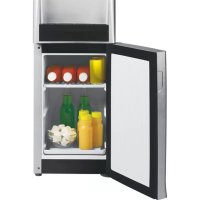
Profile PXCR33KSSDM - Water filter GE - Free user manual and instructions
Find the device manual for free Profile PXCR33KSSDM GE in PDF.


| Product Type | Three-temperature water dispenser with cooler compartment |
| Brand | GE |
| Model | Profile PXCR33KSSDM |
| Bottle Capacity | 15 or 20 liters (3 or 5 gallons) |
| Cooling Rate | Approximately 2 liters per hour |
| Heating Rate | Approximately 3 liters per hour |
| Power Consumption (Heating) | 480 W maximum |
| Power Consumption (Cooling) | 125 W maximum |
| Hot Water Temperature | Approximately 88 °C (190 °F) |
| Dispensing Functions | Hot, ambient and cold water |
| Child Safety | Lock switch for hot water tap |
| Cooler Compartment | For canned drinks and packaged non-perishable items |
| Exterior Material | Stainless steel (on some models) |
| Available Spare Parts | Bottle support collar (WS28X10048), Separator (WS28X10013), Drip tray (WS28X10031), Grill (WS28X10032), Drain cap (WS01X10008), Silicone plug (WS01X10007) |
| Exterior Maintenance | Clean with soapy water; avoid abrasive cleaners |
| Interior Maintenance | Clean with baking soda; periodic disinfection with bleach |
| Descaling | With vinegar or citric acid |
| Defrosting | Use a plastic scraper; do not use metal or electric tools |
| Warranty | Limited one-year (product replacement) |
Frequently Asked Questions - Profile PXCR33KSSDM GE
User questions about Profile PXCR33KSSDM GE
0 question about this device. Answer the ones you know or ask your own.
Ask a new question about this device
Download the instructions for your Water filter in PDF format for free! Find your manual Profile PXCR33KSSDM - GE and take your electronic device back in hand. On this page are published all the documents necessary for the use of your device. Profile PXCR33KSSDM by GE.
USER MANUAL Profile PXCR33KSSDM GE
GE Profile™ Tri-Temperature Water Dispenser
Safety Instructions....2,3
Using the Water Dispenser
Child Safeguard ....4
Cold Water and Compartment
Features and Parts List ....4
Loading the Dispenser ....4
Specifications 8
Care and Cleaning 5-8
Troubleshooting Tips ....8, 9
Consumer Support
Consumer Support ....Back Cover
Warranty ....Back Cover
Français
*ENERGY STAR® qualified product.

As an ENERGY STAR ^® partner, GE has determined that this product meets the ENERGY STAR ^® guidelines for energy efficiency.
WARNING!
Use this appliance only for its intended purpose as described in this Owner's Manual.

SAFETY PRECAUTIONS
When using electrical appliances, basic safety precautions should be followed, including the following:
This water dispenser must be properly installed and located in accordance with these instructions before it is used.
Do not allow children to climb, stand or hang on the outside of the dispenser, or on the shelves inside the storage cabinet (on some models). They could tip the dispenser over and damage it and seriously injure themselves.
Do not store or use gasoline or other flammable vapors and liquids in the vicinity of this or any other appliance.
■ Unplug the water dispenser before cleaning or making repairs.
NOTE: GE does not support any servicing of the dispenser. We strongly recommend that you do not attempt to service the dispenser yourself.
Do not use this dispenser to dispense anything other than water.
Do not plug in the power cord or turn on the power switches when the water dispenser is empty.
■ Wipe up any water spills immediately after loading or unloading water bottles.
Children should be supervised by a parent when using this product.
WARNING: Do not use with water that is microbiologically unsafe or of unknown quality.
CAUTION: The dispenser heats water to a temperature of approximately 194°F (90°C). Water temperatures above 125°F (52°C) can cause severe burns or death from scalding. Children, the disabled and the elderly are at highest risk of being scalded.
NOTICE: This product is intended solely for use in chilling canned and boxed beverages, and packaged nonperishables.
PROPER INSTALLATION AND LOCATION
Allow at least 1" (2.5 cm) of space between the back of the water dispenser and the wall to allow for proper air circulation.
Do not install the water dispenser where the temperature will go below 50^ F ( 10^ C) or above 100^ F ( 38^ C).
■ Install the water dispenser on a level floor strong enough to support it when fully loaded. Do not install where it will be subject to direct sunlight, heat or moisture.
■ Stainless steel panels (on some models) are covered with protective film. Remove the film before operating the product.
GROUNDING INSTRUCTIONS
WARNING: Improper use of the grounding plug can result in a risk of electric shock.
This appliance must be grounded. In the event of an electrical short circuit, grounding reduces the risk of electric shock.
This appliance is equipped with a power cord having a grounding wire with a grounding plug. The plug must be plugged into an outlet that is properly installed and grounded.
Consult a qualified electrician if the grounding instructions are not completely understood, or if doubt exists as to whether the appliance is properly grounded.
If the outlet is a standard 2-prong wall outlet, it is your personal responsibility and obligation to have it replaced with a properly grounded 3-prong wall outlet.
Do not under any circumstances cut or remove the third (ground) prong from the power cord.
Do not use an adapter plug with this appliance.
Do not use an extension cord with this appliance. If the power cord is too short, have a qualified electrician install an outlet near the appliance.
For best operation, plug the appliance into its own electrical outlet on a dedicated circuit to prevent flickering of lights, blowing of fuse or tripping of circuit breaker.
PROPER DISPOSAL OF THE WATER DISPENSER
Refrigerant Disposal
Your old water dispenser may have used a regulated refrigerant in its cooling system. These refrigerants are believed to harm stratospheric ozone. If you are throwing away your old dispenser, make sure the refrigerant is removed and recovered for proper disposal by an EPA-certified technician. If you intentionally release this refrigerant, you can be subject to fines and imprisonment under provisions of environmental legislation.

READ AND FOLLOW THIS SAFETY INFORMATION CAREFULLY.
SAVE THESE INSTRUCTIONS
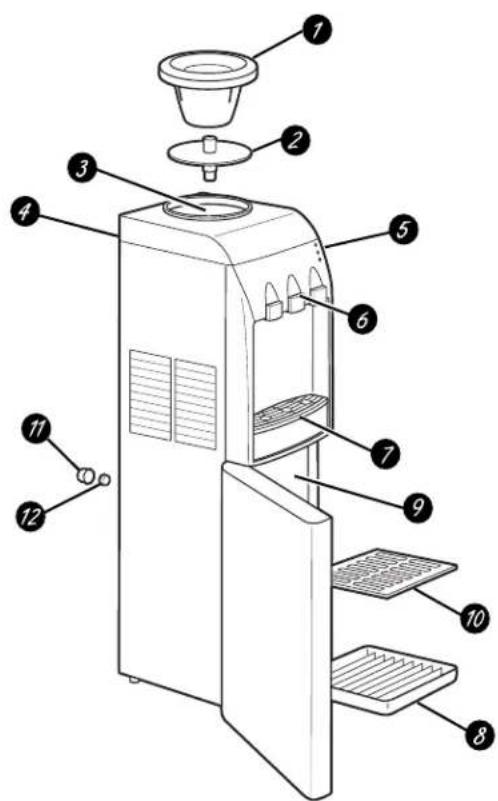
Features and Parts List
⑦ Bottle Support Collar—Black (WS28X10048)
2 Separator (WS28X10013)
3 Cold Water Tank
4 Hot (Red) and Cold (Blue) Power Switch (back of dispenser on equipped models). The Cold (Blue) power switch also turns on the chiller compartment, on equipped models.
5 Indicator Lights. The power indicator light will be lit when the dispenser is plugged in. The hot and cold indicator lights will cycle on and off while the dispenser heats and cools the water. Compressor start may be delayed up to 3 minutes on certain models.
6 Hot Room Temperature, Cold Water Dispenser Buttons
7 Dispenser Drip Tray (WS28X10031) and Grille (WS28X10032)
8 Compartment Drip Tray (WS29X10029) on models GXCF25FBS, GXCF25HBS and PXCR33KSS only
9 Chiller Compartment on models GXCF25FBS, GXCF25HBS and PXCR33KSS only. The compartment is intended solely for use in chilling canned and boxed beverages and packaged nonperishables.
Storage Compartment on model PXCF22RBS. Do not use to store foods requiring refrigeration. The compartment is not refrigerated.
10 Compartment Shelf (WS28X10028)
11 Drainage Cap (WS01X10008)
12 Silicon Stopper (WS01X10007)
natural_image
Line drawing of a hand pressing down on a water dispenser (no text or symbols)Loading the Dispenser and Start Up
Sanitize the dispenser water tanks prior to installing a full bottle of water for the first time (see "Cleaning and Sanitizing the Water Tanks").
IMPORTANT: Make sure the dispenser is unplugged with both the hot and cold power switches (on the back of the dispenser on models so equipped) set to the O (off) position. Before placing the water bottle on the dispenser, wash hands and wipe the top of the bottle with a clean cloth. Avoid touching the part of the bottle that will be in contact with the water dispenser.
Make sure the water level in the top of the dispenser is low enough to allow for proper bottle installation. Failure to do so may cause the dispenser to overflow.
-
Peel the label from the top cover of the bottle (if present). Do not remove the entire bottle cap.
-
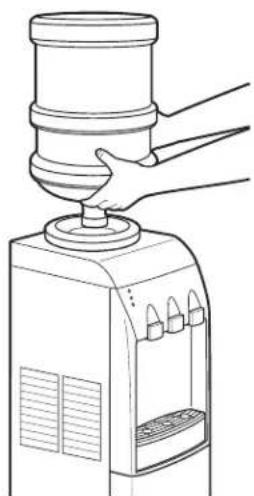
Place the bottle on top of the dispenser as shown, aligning the dispensing valve probe to the center of the water bottle cap. Press down until the probe penetrates the bottle cap, allowing the bottle to rest on the support collar.
- IMPORTANT: Press both dispense buttons until water runs from both taps.
- Plug in the dispenser.
- Set the COLD and HOT power switches (located on the top left rear of the dispenser on models so equipped) to the I(on) position.
- Allow 30 minutes for water to reach hot and cold temperatures.
Contact a local water bottle distributor to purchase water bottles.
Child Safeguard
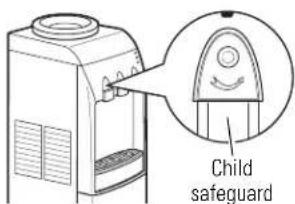
The HOT dispenser button is equipped with a child safeguard that reduces the risk of hot water being dispensed accidentally or by small children. To dispense water, rotate the knob counterclockwise and push the button in. The knob will reset automatically when the button is released.
The dispenser heats water to a temperature of approximately 190°F (88°C). Water temperatures above 125°F (52°C) can cause severe burns or death from scalding. Children, the disabled and the elderly are at highest risk of being scalded.
CAUTION: Children should be supervised by a parent when using this product.
Care and cleaning of the dispenser.
Cleaning the Outside Cabinet and Storage/Chiller Compartment
IMPORTANT: Set both power switches (on the back of the dispenser, if equipped) in the O (off) position and unplug the water dispenser before cleaning.
The cabinet and compartment of the dispenser can be washed with mild soap and water. Rinse thoroughly with clear water. Never use commercial cleaners or abrasive scouring powders.
Sweep away or vacuum any dust from the condenser coils on the back of the unit. For best results, use a brush specially designed for this purpose. It is available at most appliance stores.
Stainless Steel Surfaces (on some models)
Do not use a steel wool pad; it will scratch the surface.
To clean the stainless steel surface, use warm sudsy water or a stainless steel cleaner or polish. Always wipe the surface in the direction of the grain. Follow the cleaner instructions for cleaning the stainless steel surface.
To inquire about purchasing stainless steel appliance cleaner or polish, or to find the location of a dealer nearest you, please call our toll-free number:
National Parts Center 800.626.2002
In Canada, call 800.663.6060
ge.com
Cleaning the Inside of the Chiller Compartment (GXCF25FBS, GXCF25HBS and PXCR33KSS)
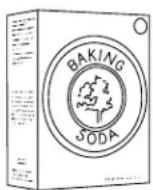
To help prevent odors, leave an open box of baking soda in the chiller compartment.
Unplug the dispenser before cleaning.
Use warm water and baking soda solution—about a tablespoon (15 ml) of baking soda to a quart (1 liter) of water. This both cleans and neutralizes odors. Rinse and wipe dry.
Clean other parts of the chiller compartment—including door gaskets and all plastic parts—the same way.
Cleaning the Drip Tray and Grille
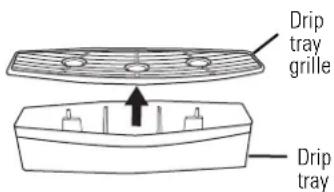
The dispenser drip tray is not self-draining. To reduce water spotting or deposits, the tray and its grille should be emptied, cleaned and wiped dry regularly.
Clean with mild soap or on the top rack in the dishwasher.
Draining the Dispenser
The dispenser should be drained before cleaning the tanks and before leaving for long vacations or absences.
(rear of dispenser)
- Set both power switches (on the back of the dispenser, if equipped) in the O (off) position and unplug the dispenser.
- Remove the water bottle from the dispenser.
- Put a container that will withstand hot water under the hot water tap. Press the hot dispenser button until the water is cool (about 1 quart). Add water to the cold water reservoir (on top where the bottle supplies water) as needed.
- Dispense water from both buttons into container(s) until no more water can be dispensed (about 1 quart of water still remains in the dispenser).
-
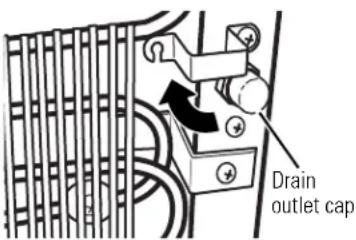
Place a large bucket beneath the drain outlet on the rear of the dispenser.
-
Using a Phillips screwdriver, loosen the screws on the bracket covering the drain outlet cap. Rotate the bracket out of the way to allow access to the cap.
- Remove the cap and silicon stopper from the drain outlet and allow water to drain. After draining, replace the stopper and cap.
- Rotate the bracket back into place and tighten screws. Make sure to install a full bottle and dispense water from the hot water tap before plugging in and turning on the dispenser (see Loading the Dispenser).
Cleaning the Separator
IMPORTANT: Set both power switches (on the back of the dispenser, if equipped) in the O (off) position and unplug the water dispenser before cleaning.
- Remove the water bottle and drain the dispenser (see Draining the Dispenser).
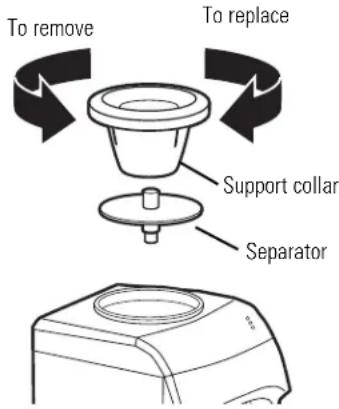
- Remove the support collar by turning counterclockwise and pulling straight off.
- Remove the plastic separator by pulling straight out (you may need to twist slightly to loosen).
-
Clean the separator with dish soap and water or in the top rack of the dishwasher.
-
Dry the separator thoroughly on both sides.
- Using a clean cloth or paper towel, thoroughly dry the cold water reservoir.
- Place the separator back in the dispenser. Make sure the long, tapered end of the separator is positioned firmly on the metal plug on the bottom of the reservoir.
- Replace the support collar and turn clockwise until it is firmly in place.
- Install a full water bottle on the dispenser (see Loading the Dispenser).
Sanitizing and Cleaning the Water Tanks
IMPORTANT: Periodically the water dispenser tanks must be sanitized to prevent unpleasant tastes in the water and cleaned to remove mineral deposits that can impair flow.
To Sanitize:
- Before cleaning, set both power switches (on the back of the dispenser, if equipped) in the O (off) position and unplug the water dispenser.
NOTE: For first time installation, skip steps 2–4.
- Empty the water bottle, then remove it from the dispenser.
- Drain the water tanks (see Draining the Dispenser).
- Reinstall the silicon stopper and drain cap (see Draining the Dispenser).
- DO NOT ADD BLEACH FIRST OR DIRECTLY TO THE DISPENSER. Concentrated bleach may damage plastic.
Add 1/2 teaspoon (2.5 ml) of ordinary 6.0% maximum household bleach to a 2 quart (2 liter) pitcher filled with tap water.
- Pour the solution in the opening at the top of the dispenser.
- Repeat steps 5 and 6 until the dispenser is full.
- Press the hot and cold dispenser buttons until the water just begins to flow from the taps.
-
Allow to sit for 15–20 minutes.
-
Rinse out the bleach solution:
— Drain the water tanks into a large bucket (see Draining the Dispenser).
— Make sure that the silicon stopper is NOT installed.

OFF
position
— IMPORTANT: Remove the separator and wipe out the cold water reservoir (see Cleaning the Separator).
— Clean, then reinstall the separator and collar (see Cleaning the Separator).
— Pour approximately 1 gallon (4 quarts or 4 liters) of fresh tap water into the top and allow to drain into the bucket.
— Flush with an additional 1 gallon (4 quarts or 4 liters) of fresh tap water and allow to drain into the bucket.
- Reinstall the silicon stopper and drain cap (see Draining the Dispenser).
- Install a fresh water bottle (see Loading the Dispenser).
- Dispense 1 quart (1 liter) of water from each tap and taste to make sure the bleach solution is completely removed.
If you continue to taste the chlorine from the bleach solution, repeat steps 10–13 until the taste is gone.
- Plug in the dispenser. Then turn on the hot and cold power switches (on the back of the dispenser, if equipped).

ON
position
To Remove Mineral Deposits:
Mix 2 quarts (2 liters) of water with two quarts of vinegar OR mix 1 gallon of water (4 liters) with 16 ounces (454 g) of citric acid crystals. Bleach does not remove mineral deposits. Do this in place of step 5 when removing mineral deposits.
Care and cleaning of the dispenser.
Defrosting (for models GXCF25FBS, GXCF25HBS and PXCR33KSS)
| Defrost whenever frost on the wall of the chiller compartment becomes excessive. Never use a sharp or metallic instrument to remove frost as it may damage the liner. We recommend using a plastic scraper. Do not use any electrical device in defrosting your chiller compartment. |
To defrost:
| Remove items from the compartment. |
| Turn the Cold (Blue) Power switch (if equipped) to off and unplug the dispenser. |
| Put several towels in the bottom of the compartment to collect water. |
Defrosting usually takes a few hours. To defrost faster, keep the door open.
After defrosting:
| Remove the wet towels and wipe up any remaining water. |
| Wipe the compartment with a dry cloth. |
| Plug in the unit and turn on the Cold (Blue) power switch (if equipped). Return items to the unit. |
Preparing for Vacation
| For long vacations or absences, set both power switches (on the back of the dispenser, if equipped) to the 0 (off) position. |
| 1. Unplug the water dispenser. |
| 2. Remove the water bottle. |
| 3. Drain the water tanks (see Draining the Dispenser). |
| 4. Dry the separator thoroughly on both the top and bottom (see Cleaning the Separator). |
| 5. Leave the door of the chiller compartment open. After returning from vacation, make sure to sanitize the water tanks before using the dispenser (see Cleaning and Sanitizing the Water Tank). |
Specifications
| Chilling Rate: approx. 0.5 gallons (2 liters) per hour |
| Heating Rate: approx. 0.8 gallons (3 liters) per hour |
Capacity: 3 or 5 gallon bottle
Power Consumption: Heating: 480 watts max. Cooling: 125 watts max.
Troubleshooting Tips.
| Problem Possible Causes What To Do | ||
| Water has poor taste or odor | Separator needs cleaning. •See | Cleaning the Separator. |
| Unit needs to be sanitized. •See | Cleaning and Sanitizing the Water Tanks. | |
| Water not hot enough or cold enough | Dispenser is unplugged. | •Push the plug completely into the outlet. |
| The fuse is blown/circuit breaker is tripped. | •Replace house fuse or reset the house circuit breaker.•If too many items are plugged into a single circuit, move some items to a different circuit. | |
| All the water in the water tank has been used. | •Wait 30 minutes for water to heat or cool. | |
| Temperature limiter tripped. | •Set the hot and cold power switches (on the back of the dispenser, if equipped) to the O (off) position. Wait 5 minutes; then set the switches to the I (on) position. Unplug unit for 5 minutes if model does not have separate power switches. Wait 30 minutes for water to heat or cool. | |
| Water dispenser does not work—No water flow | Empty water bottle. | •Replace with a new bottle of water. |
| Mineral deposits clogging tanks. | •See Care and Cleaning. | |
| Cold water button does not dispense | Chiller door has been left open. | •Close chiller door. |
| Ice buildup blocking water flow. | •Turn off cold power switch (if equipped) or unplug unit overnight. Once water can be dispensed from faucet, plug unit back in or turn cold power switch back to the ON position. | |
| Water dispenser leaks from the outside | Crack or pin hole in bottle. | •Replace with a new bottle of water. |
| Compressor does not start when unit is plugged in and cold power switch (if equipped) is on 8 | Normal Operation—Compressor start may be delayed by up to 3 minutes (on certain models) to prolong the compressor life. | •Wait for up to 3 minutes for the compressor to start. |
| Bottle feels warm | Water system overfilled. Water is boiling in the hot tank and bubbling up into the bottle. | Dispense cold water until air is released into the bottle. |
| Water dispenser is noisy | Water dispenser is uneven. | Make sure the water is installed on a level floor strong enough to support it when fully loaded. |
| Bottle making a gurgling noise This is normal.as water fills the tanks. | ||
| Hot water boiling sound. This is normal. | ||
| Dispenser or water bottle shakes This is normal.when the cooling system cycles off. | ||
| Particles floating in water | Water has high mineral content. | Find a water source with lower hardness. |
| Foul odor in air around dispenser | Hot water tank is empty or not completely full. air from the hot tank. | Press the hot dispenser button until water flows to remove |
| Chiller does not operate (Chiller models only) | Chiller is not on. | Turn the Cold (Blue) power switch on, if equipped. |
| Water dispenser is unplugged. | Push the plug completely into the outlet. | |
| The fuse is blown/circuit breaker is tripped. | Replace fuse or reset the breaker. | |
| Vibration or rattling (slight vibration is normal) | Water dispenser is on Use shims to level the unit.an uneven surface. | |
| Compressor/motor operates (light on) for long periods or cycles (Chiller models only) | Often occurs when large amounts of food are placed in cooler. | This is normal. |
| Door left open. | Check to see if package is holding door open. | |
| Hot weather or frequent door openings. | This is normal. | |
| Compressor/motor operates (cooling light on) for long periods or cycles | Normal when unit is first plugged in. | Wait 24 hours for the unit to completely cool down. |
| Not enough clearance from the wall. | Make sure there is enough air circulation around the unit. | |
| Water system overfilled. | Dispense water from the cold faucet until air is released into the bottle. | |
| Chiller compartment too warm (Chiller models only) | Door left open. | Check to see if package is holding door open. |
| Compartment/cold water too cold/frozen | Low ambient temperature. | Place units in room temperature environment. |
| Chiller compartment has odor (Chiller models only) | Foods transmitting odor to chiller. | Foods with strong odors should be tightly wrapped.Keep an open box of baking soda in the unit; replace every three months.See Care and cleaning. |
| Interior needs cleaning. | ||
| Moisture forms on outside of chiller compartment (Chiller models only) | Not unusual during periods of high humidity and/or temperature. | Wipe surface dry.Operate unit in temperature- and humidity-controlled location.Place unit in tray to contain moisture accumulation. |
| Moisture collects inside chiller compartment (in humid weather, air carries moisture into chiller compartment when door is opened) (Chiller models only) | Too frequent or too long door openings. | Minimize time door is open.Wipe surface dry.Empty internal drip tray.Operate unit in temperature- and humidity-controlled location.Place unit in tray to contain moisture accumulation. |
▲ AVERTISSEMENT!
natural_image
Line drawing of a hand pressing a water dispenser into a container (no text or symbols)natural_image
Line drawing of a hand pressing down on a water dispenser (no text or symbols)General Manager, Customer Relations
GE Appliances, Appliance Park
Louisville, KY 40225
GARANTÍA LIMITADA POR UN AÑO
Garante: General Electric Company, Louisville, KY 40225.
GE Appliances Website ge.com
Have a question or need assistance with your appliance? Try the GE Appliances Website 24 hours a day, any day of the year! For greater convenience and faster service, you can now download Owner's Manuals, or even order parts, on-line.

Real Life Design Studio ge.com
GE supports the Universal Design concept—products, services and environments that can be used by people of all ages, sizes and capabilities. We recognize the need to design for a wide range of physical and mental abilities and impairments. For details of GE's Universal Design applications, including kitchen design ideas for people with disabilities, check out our Website today. For the hearing impaired, please call 800.TDD.GEAC (800.833.4322).
Parts and Accessories ge.com
Individuals can have parts sent directly to their homes (VISA, MasterCard and Discover cards are accepted). Order on-line today, 24 hours every day or by phone, in the U.S., at 800.626.2002 during normal business hours. In Canada, call 800.663.6060.
Instructions contained in this manual cover procedures to be performed by any user. GE does not support any servicing of the dispenser. We strongly recommend that you do not attempt to service the dispenser yourself.

Contact Us ge.com
If you are not satisfied with the service you receive from GE, contact us on our Website with all the details including your phone number, or write to: General Manager, Customer Relations
GE Appliances, Appliance Park
Louisville, KY 40225
LIMITED 1-YEAR WARRANTY
• What does this warranty cover?
— Any defect in materials or workmanship in the manufactured product.
• What does this warranty not cover?
— Water bottles.
— Service trips to your home to teach you how to use the product.
— Improper installation, delivery or maintenance.
— Failure of the product if it is abused, misused, altered, used commercially or used for other than the intended purpose.
— Products that are used outside a residential or office environment.
— Replacement of house fuses or resetting of circuit breakers.
— Use of this product where water is microbiologically unsafe or of unknown quality.
— Damage to the product if used to dispense anything other than water.
— Damage to the product caused by accident, fire, floods or acts of God.
— Any service to the product.
— Incidental or consequential damage caused by possible defects with this appliance, its installation or repair.
- For how long after the original purchase? — One (1) year.
• How do I make a warranty claim?
— Return to the retailer from which it was purchased, along with a copy of the “Proof of Purchase.” A new or reconditioned unit will be provided. This warranty excludes the cost of shipping the product to your home.
EXCLUSION OF IMPLIED WARRANTIES—Your sole and exclusive remedy is product exchange as provided in this Limited Warranty. Any implied warranties, including the implied warranties of merchantability or fitness for a particular purpose, are limited to one year or the shortest period allowed by law.
This warranty is extended to the original purchaser and any succeeding owner for products purchased for home or office use within the USA. In Alaska, the warranty excludes the cost of shipping or service to your home or office.
Some states do not allow the exclusion or limitation of incidental or consequential damages. This warranty gives you specific legal rights, and you may also have other rights, which vary from state to state. To know what your legal rights are, consult your local or state consumer affairs office or your state's Attorney General.
Contact us at ge.com, or call toll-free at 800.952.5039 in the U.S., or 866.777.7627 in Canada.

- GE Profile™ Tri-Temperature Water Dispenser
- Français
- WARNING!
- SAFETY PRECAUTIONS
- PROPER INSTALLATION AND LOCATION
- GROUNDING INSTRUCTIONS
- WARNING: Improper use of the grounding plug can result in a risk of electric shock.
- PROPER DISPOSAL OF THE WATER DISPENSER
- Refrigerant Disposal
- READ AND FOLLOW THIS SAFETY INFORMATION CAREFULLY.
- SAVE THESE INSTRUCTIONS
- Features and Parts List
- Loading the Dispenser and Start Up
- Child Safeguard
- Care and cleaning of the dispenser.
- Cleaning the Outside Cabinet and Storage/Chiller Compartment
- Stainless Steel Surfaces (on some models)
- Do not use a steel wool pad; it will scratch the surface.
- Cleaning the Inside of the Chiller Compartment (GXCF25FBS, GXCF25HBS and PXCR33KSS)
- Unplug the dispenser before cleaning.
- Cleaning the Drip Tray and Grille
- Draining the Dispenser
- Cleaning the Separator
- Sanitizing and Cleaning the Water Tanks
- To Sanitize:
- To Remove Mineral Deposits:
- ▲ AVERTISSEMENT!
- GARANTÍA LIMITADA POR UN AÑO
- GE Appliances Website ge.com
- Real Life Design Studio ge.com
- Parts and Accessories ge.com
- Contact Us ge.com
- LIMITED 1-YEAR WARRANTY
Brand : GE
Model : Profile PXCR33KSSDM
Category : Water filter