
NIS 41 V (EU) - Tumble dryer INDESIT - Free user manual and instructions
Find the device manual for free NIS 41 V (EU) INDESIT in PDF.
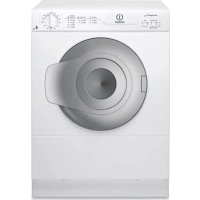



| Product type | Vented tumble dryer |
| Brand | Indesit |
| Model | NIS 41 V (EU) |
| Maximum load capacity | 4 kg (cotton), 2 kg (synthetics) |
| Dimensions (H x W x D) | 85 x 60 x 50 cm |
| Weight | Approximately 30 kg |
| Power supply | 220-240 V, 50 Hz |
| Maximum power | See rating plate on the appliance |
| Energy consumption (Cotton Standard 4 kg program) | 2.9 kWh |
| Drying programs | Cotton Standard, Synthetics, Acrylics |
| Temperature settings | High temperature, Low temperature |
| Timer | Drying time adjustment via rotary knob |
| Automatic shut-off | Yes, with cooling phase |
| Ventilation type | Exhaust via flexible hose |
| Lint filter | Yes, clean after each cycle |
| Child safety | Yes, access prevention |
| Door opening | Automatic cycle stop when opened |
| Maintenance | Cleaning the filter and drum |
| Repairability | Use of original parts |
| Repairability index | Not provided |
| General information | User manual available in PDF |
Frequently Asked Questions - NIS 41 V (EU) INDESIT
User questions about NIS 41 V (EU) INDESIT
0 question about this device. Answer the ones you know or ask your own.
Ask a new question about this device
Download the instructions for your Tumble dryer in PDF format for free! Find your manual NIS 41 V (EU) - INDESIT and take your electronic device back in hand. On this page are published all the documents necessary for the use of your device. NIS 41 V (EU) by INDESIT.
USER MANUAL NIS 41 V (EU) INDESIT
Maintenance and Care, 6
Dryer description, 7
Start and programmes, 7
TUMBLE DRYER
Laundry, 8
Troubleshooting-Service, 9
www.indesit.com

booklet.
! Keep this instruction booklet on hand in order to refer to it when necessary. Take it with you when you move, and should you sell this appliance or pass it on to another party, make sure that this booklet is supplied along with the dryer so that the new owner may be informed about warnings and suggestions on how the appliance works.
! Read these instructions carefully; the following pages contain important information on installation and suggestions on how the appliance works.
Where to put your dryer
- Place your dryer at a distance from gas ranges, stoves, heaters, or cook tops because flames can damage the appliance.
Minimum gap 50mm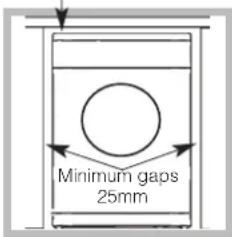
If you are going to install the appliance under a work counter, be sure to leave a 50mm space between the top and any other objects on or above the machine and a 25mm space between the sides and lateral furnishings or walls.
This is to ensure proper air circulation. Make sure that the back vents are not obstructed.
- Make sure you put your dryer in an environment that is not damp and has proper air circulation throughout. The dryer will not operate efficiently in an enclosed space or cupboard. We do not recommend that the dryer is installed in a cupboard, but the dryer must never be installed behind a lockable door, a sliding door, or a door with a hinge on the opposite side to that of the dryer door. The appliance must be installed with the rear surface placed against a wall.
Ventilation
The dryer dries your laundry by drawing in cool, clean, and relatively dry air, heating it, and then distributing it through the clothes as they are gently tumbled. For optimum performance, the moist air is then blown out through a vent tube.
When the dryer is in use, there has to be adequate ventilation to avoid the back flow of gases into the room from appliances burning other fuels, including open fires.
! Ensure that the dryer is adequately ventilated and that the end of the vent tube is not directed towards the air intake duct.
! The vent tube must always be fitted for optimum performance.
! Make sure that the vent tube and air intake vents are not obstructed or blocked.
! The dryer must not recycle exhaust air. ! Misusing a tumble dryer may create a fire hazard. ! Do not discharge exhaust air into a flue which is used for exhaust fumes from other appliances that burn gas or other fuels. ! Do not discharge exhaust air into an extraction system or any duct with an extractor fan. This will affect the way the thermal controls operate and can result in a fire hazard. ! Do not allow clothes, towels, etc., to hang down the front of the dryer into the airstream. This obstructs the airflow and may damage the dryer.
Mobile venting
A vent tube must always be fitted when the dryer is used in conjunction with Mobile Venting.
The tube must be fitted securely into the front of the dryer. If possible, it is always best to connect the tube to a permanent outlet close to the dryer. If permanent installation is not possible, the dryer will work just as well with the tube passing through a partly-opened window.
! Ensure that the end of the tube is not directed toward the air intake vent at the rear of the dryer. The vent tube should not exceed 2.4 metres in length and should be kept free of any possible accumulation of fluff, lint, and water by shaking it out frequently. Always ensure that the tube is not squashed.
Permanent venting
In conjunction with the vent tube, we recommend using a Wall/Window Vent Kit, available at a retail location or the nearest Spare Parts Dealer.
Window mounting
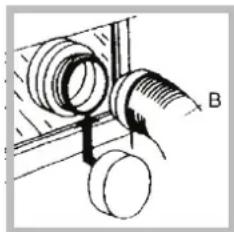
- The hole in the window should ideally be made below the vent.
- The tube should be kept as short as possible.
Depending on how often you use your dryer, it is essential that areas A and B are checked periodically to remove lint or debris.
The vent tube adaptor must be fitted securely thus preventing any humid air from being emitted back into the room.
The tube should be kept clear of the air intake vent and kinks or 'U' bends must be avoided as these will obstruct the tube or trap condensation.
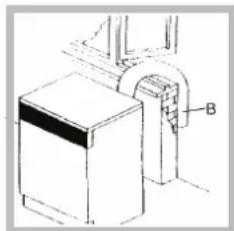
Open window venting
The end of the tube should be directed downwards, to prevent warm moist air from condensing in the room or in the dryer.
Wall hanging kit
This allows the dryer to be mounted on a wall of suitable strength to take the weight. Alternatively it should be used when the dryer is mounted on top of a work surface to secure the dryer to the wall.
Electrical connections
Make sure of the following before you insert the plug into the the electrical socket:
Make sure your hands are dry. - The socket must have an earth connection. - The socket must be able to sustain the machines maximum power, which is indicated on the rating label (see Dryer Description). - Power voltage must be within the values indicated on the rating label (see Dryer Description). - The socket must be compatible with the dryers plug. Should this not be the case, replace the plug or the socket.
The dryer must not be installed outdoors, even if the space is sheltered. It can be very dangerous if it is exposed to rain or storms. Once installed, the dryers electrical wire and plug must be within easy reach. Do not use extension cords. The power cord must not be bent or squashed. The power cord should be regularly checked. If the supply cord is damaged, it must be replaced by the manufacturer, its service agent or similarly qualified persons in order to avoid a hazard. New or longer power cords are supplied at an extra charge by authorised dealers. The manufacturer denies any responsibility should any of these rules not be followed.
If in doubt about any of the above consult a qualified electrician.
Maximum load: 4 kg
| Power Consumption | ||
| Off-mode (Po) - Watts 0.00 | ||
| Left-on mode (PI) - Watts 0.00 | ||
| Programmes Kg kWh Minutes | ||
| Standard Cotton* | 4 2.95 | 101 |
| Standard Cotton | 2 1.40 | 51 |
| Synthetics | 2 0.84 | 35 |
| *This is the reference programme for the energy label and suitable to dry normal wet cotton laundry. This is the most efficient programme in terms of energy consumption for drying wet cotton laundry. | ||
Before you start using your dryer
Once you have installed your dryer and before you use it, clean the inside of the drum to remove any dust that could have accumulated during transport.
Save energy and respect the environment
- Wring out items to eliminate excess water before tumble drying (if you use a washing machine first, select a high spin cycle). Doing this will save time and energy during drying. Always dry full loads - you save energy: single items or small loads take longer to dry. Clean the filter after each use to contain energy consumption costs (see Maintenance).
! The appliance has been designed and built according to international safety standards.
These warnings are given for safety reasons and must be followed carefully.
General safety
- This appliance can be used by children aged from 8 years and above and persons with reduced physical, sensory or mental capabilities, or lack of knowledge if they are given supervision or instruction concerning use of the appliance in a safe way and understand the hazards involved.
- This tumble dryer has been designed for home, and not professional use.
- Do not touch the appliance while bare foot or with wet hands or feet.
- Unplug the machine by pulling on the plug, not the cord. After using the dryer, turn it off and unplug it. Keep the door closed to make sure that children do not use it as a toy. Children should be supervised to ensure that they do not play with the dryer.
- Cleaning and user maintenance should not be made by children without supervision. Children of less than 3 years should be kept away from the appliance unless continuously supervised.
- The appliance must be installed correctly and have proper ventilation. The air intake vents behind the machine, the outlet vents and the vent tube should never be obstructed (see Installation).
- Never direct the vent tube outlet towards the air intake at the back of the machine.
- Never allow the tumble dryer to recycle exhaust air.
- Never use the dryer on carpeting where the pile height would prevent air from entering the dryer from the base.
- Check to see if the dryer is empty before loading it. The back of the dryer could become very hot. Never touch it while in use.
- Do not use the dryer unless the filter is securely in place (see Maintenance).
- Do not overload the dryer (see Laundry for maximum loads).
- Do not load items that are dripping wet.
- Carefully check all instructions on clothing labels (see Laundry).
- Do not tumble dry large, very bulky items.
- Do not tumble dry acrylic fibres at high temperatures.
- Do not turn off the dryer when there are still warm items inside.
- Clean the filter after each use (see Maintenance).
- Do not allow lint to collect around the dryer.
- Never climb on top of the dryer. It could result in damage. Always follow electrical standards and requirements (see Installation). Always buy original spare parts and accessories (see Service).
To minimise the risk of fire in your tumble dryer, the following should be observed:
- Tumble dry items only if they have been washed with detergent and water, rinsed and been through the spin cycle. It is a fire hazard to dry items that HAVE NOT been washed with water.
- Do not dry garments that have been treated with chemical products.
- Do not tumble dry items that have been spotted or soaked with vegetable or cooking oils, this constitutes a fire hazard. Oil-affected items can ignite spontaneously, especially when exposed to heat sources such as a tumble dryer. The items become warm, causing an oxidisation reaction with the oil, Oxidisation creates heat. If the heat cannot escape, items can become hot enough to catch fire. Piling, stacking or storing oil-effected items can prevent heat from escaping and so create a fire hazard. If it is unavoidable that fabrics containing vegetable or cooking oil or those that have been contaminated with hair care products be placed in a tumble dryer they should first be washed with extra detergent - this will reduce, but not eliminate the hazard. They should not be removed from the dryer and piled or stacked while hot.
- Do not tumble dry items that have previously been cleaned in or washed in, soaked in or soiled with petrol/gasoline, dry cleaning solvents or other flammable
or explosive substances. Highly flammable substances commonly used in domestic environments including cooking oil, acetone, denatured alcohol, kerosene, spot removers, turpentine, waxes and wax removers. Ensure these items have been washed in hot water with an extra amount of detergent before being dried in the tumble dryer.
- Do not tumble dry items containing foam rubber (also known as latex foam), or similarly textured rubber like materials. Foam rubber materials can, when heated, produce fire by spontaneous combustion.
- Fabric softener or similar products should not be used in a tumble dryer to eliminate the effects of static electricity unless the practice is specifically recommended by the manufacturer of the fabric softener product.
- Do not tumble dry undergarments that contain metal reinforcements eg. bras with metal reinforcing wires. Damage to the tumble dryer can result if the metal reinforcements come loose during drying.
- Do not tumble dry rubber, plastic articles such as shower caps or babies water proof covers, polythene or paper.
- Do not tumble dry rubber backed articles, clothes fitted with foam rubber pads, pillows, galoshes and rubber coated tennis shoes.
- Remove all objects from pockets, such as lighters and matches.
!WARNING: Never stop the dryer before the end of the drying cycle unless all items are quickly removed and spread out so that the heat is dissipated.
Switching off the electricity
Unplug your dryer when not using it, when cleaning it and during all maintenance operations.
Clean the filter after each cycle.
The filter is an important part of your dryer: it accumulates lint and fluff that is formed while drying.
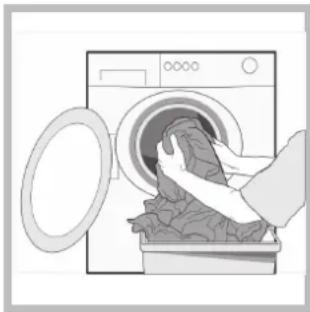
When finished drying, clean the filter by rinsing it under running water or with your vacuum cleaner. Should the filter become clogged up, the airflow inside the dryer will be seriously compromised: drying times lengthen and you will consume more energy.
It may also damage your dryer.
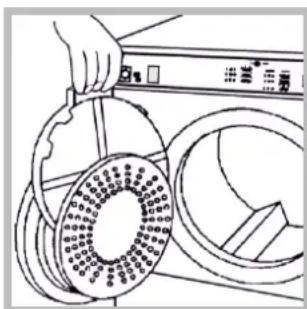
The filter is found in the door trim (see diagram).
Removing the filter: 1. Pull the plastic grip of the filter upwards (see diagram).
Removing the filter: 1. Pull the plastic tab of the filter upwards (see diagram).
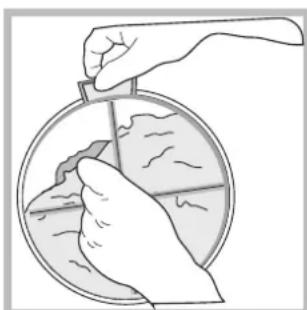
- Clean the lint from the inside surface of the filter.
- Replace the filter correctly. Ensure the filter is fully located flush into the door trim.
- Remove any lint that has built up on the inside of the door and around the door seal.
! Do not use the dryer without replacing the filter.
Check the drum after each cycle
Turn the drum manually in order to remove small items (handkerchiefs) that could have been left behind.
Cleaning the drum
! Do not use abrasives, steel wool or stainless steel cleaning agents to clean the drum.
A coloured film may start to appear on the stainless steel drum, this may be caused by a combination of water and, or cleaning agents such as fabric conditioner from the wash. This coloured film will not affect the dryer performance.
Cleaning
- External parts in metal or plastic and rubber parts can be cleaned with a damp cloth. Periodically check the vent tube and any permanent venting fixture to make sure that there has been no accumulation of fluff or lint, and remove it.
- Remove lint that collects around the filter and the outlet vents.
! Do not use solvents or abrasives.
! Have your dryer checked regularly by authorised technicians to ensure electrical and mechanical safety (see Service).
The features
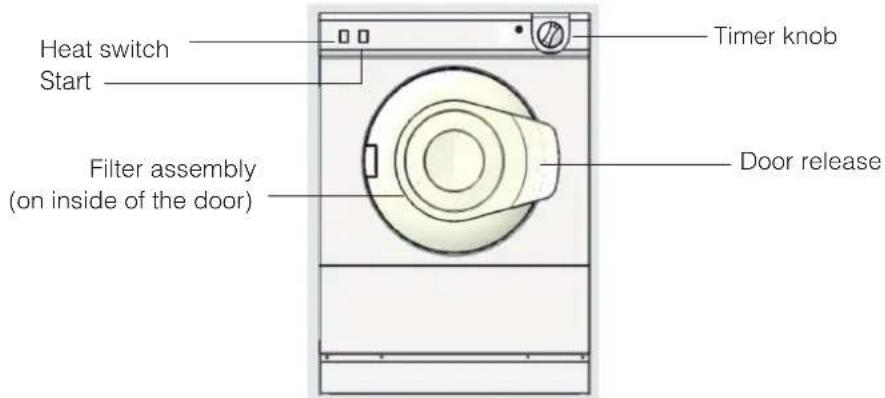
GB
Heat selection
Select the relevant heat setting :
To select high heat the Heat Selection button must be IN
To select Low heat the Heat Selection button must be OUT
The choice of HIGH HEAT or LOW HEAT depends upon the fabric you wish to dry (see Laundry).
Door release
To open door, grip handle and pull towards you. If the door is opened while the dryer is in use, the drying programme cuts out automatically and the
machine stops. When the door is closed, press the start button and the dryer will restart but you will not need to reset the timer control. You can however reset the Timer Control at any stage should you wish.
The TIMER knob sets the drying time: rotate it clockwise, never counter-clockwise, until the indicator is pointing to the drying time you want to select (see Start and Programmes).
To turn Off the dryer: turn this knob until the '0' is in line with the indicator.
Start and Programmes
Choosing a programme
- Plug the dryer into the electrical socket.
- Sort your laundry according to fabric type (see Laundry).
- Open the door and make sure the filter is clean and in place (see Maintenance).
- Load the machine and make sure items are not in the way of the door seal. Close the door.
- Choose a drying time by checking the Drying Times guide (see Laundry).
- Select the required temperature with the heat button.
- Select a drying time by rotating the TIMER knob clockwise.
- Press the start switch.
- About 10 minutes before the programme is completed, the heating elements will be switched off, and the programme enters the final 'Cool Tumble' phase. During this phase, the fabric is cooled. You should always allow the dryer to complete this phase. If you open the door you must press the start switch to resume drying.
- Open the door, take the laundry out, clean the filter and replace it (see Maintenance).
- Unplug the dryer
Sorting your laundry
- Check symbols on clothing labels to make sure that the articles can be tumble dried.
- Sort laundry by fabric type.
- Empty pockets and check buttons.
- Close zippers and hooks and tie loose belts and strings.
- Wring out each item in order to eliminate as much excess water as possible.
! Do not load dripping wet clothes into the dryer.
Maximum load size
Do not load more than maximum capacity. These numbers refer to dry weight: Natural fibres: 4kg max (9lb) Synthetic fibres: 2kg max (4.4lb)
! DO NOT overload the dryer as this could result in reduced drying performance.
Wash Care Labels
Look at the labels on your garments, especially when tumble drying for the first time. The following symbols are the most common:

May be tumble dried

Do not tumble dry

Tumble dry at high heat setting

Tumble dry at low heat setting
Drying times
The table (see below) presents APPROXIMATE drying times in Minutes. Weights refer to dry garments.
Times are approximate and can vary depending upon:
- Amount of water retained in clothes after spin cycle: towels and delicates retain a lot of water.
- Fabrics: items that are the same type of fabric but different textures and thicknesses may not have the same drying time.
- Quantity of laundry: single items or small loads may take longer to dry.
- Dryness: If you are going to iron some of your clothes, they can be taken out while still a bit damp. Others can be left longer if you need them to be completely dry.
- Heat setting.
- Room temperature: if the room where the dryer is located is cold, it will take longer for the dryer to dry your clothes.
- Bulk: some bulky items can be tumble dried with care. We suggest that you remove these items several times, shake them out, and return them to the dryer until finished.
! Do not over-dry your clothes. All fabrics contain a little natural moisture, which keeps them soft and fluffy.
| Cottons (Standard Cotton) | Drying times 800 -1000 rpm in washing machine. High Heat | |||
| 1 kg | 2 kg | 3 kg | 4 kg | |
| 30 - 40 | 40 - 55 | 60 - 70 | 85 - 120 | |
| Synthetics (Synthetics) | Drying times on reduced spin in washing machine. High Heat | |||
| 1 kg | 2 kg | |||
| 20 - 30 | 30 - 45 | |||
| Acrylics (Acrylics) | Drying times on reduced spin in washing machine. Low Heat | |||
| 1 kg | 2 kg | |||
| 30 - 50 | 50 - 70 | |||
Note: At the end of a drying cycle, cottons could still be damp if you grouped cottons and synthetics together. If this is the case, simply give the damp cotton items an additional short period of drying.
One day your dryer seems not to be working. Before you call your Service Centre (see Service), go through the following troubleshooting suggestions:
Problem:
The tumble dryer won't start.
Possible causes / Solution:
The plug is not plugged into the socket, or not making contact. There has been a power failure. The fuse has blown. Try to plug another appliance into the socket. - You are using an extension cord? Try to plug the dryer's power cord directly into the socket. The TIMER knob has not been set properly (see Start and Programmes). The Start button has not been pressed (see Start and Programmes).
It's taking a long time to dry.
The filter has not been cleaned (see Maintenance). - The temperature setting is not ideal for the type of fabric you are drying (see Start and Programmes, and see Laundry). The correct drying time has not been selected for the load (see Laundry). The flexible vent tube is obstructed (see Installation). The air intake at the rear of the dryer is obstructed (see Installation). The permanent ventilation flap on the storm cover is obstructed (see Installation). The items were too wet (see Laundry). The dryer was overloaded (see Laundry).
Service
Before calling the Service Centre:
Use the troubleshooting guide to see if you can solve the problem yourself (see Troubleshooting). If not, turn off the dryer and call the Service Centre closest to you.
What to tell the Service Centre:
- Name, address and post code.
- Telephone number. The type of problem. The date of purchase. The appliance model (Mod.). The serial number (S/N).
This information can be found on the data label inside the door of the machine.
Spare Parts
This dryer is a complex machine. Repairing it yourself or having a non-authorised person try to repair it could cause harm to one or more persons, could damage the machine and could invalidate the spare parts warranty. Call an authorised technician if you experience problems while using the machine.
Recycling and Disposal Information

As part of our continued commitment to helping the environment, we reserve the right to use quality recycled components to keep down customer costs and minimise material wastage.
- Disposing of the packaging material: follow local regulations, so the packaging can be recycled.
- To minimise risk of injury to children, remove the door and plug - then cut off mains cable, flush with the appliance. Dispose of these parts separately to ensure that the appliance can no longer be plugged into a mains socket.
Disposal of old electrical appliances
The European Directive 2012/19/EC on Waste Electrical and Electronic Equipment (WEEE), requires that old household electrical appliances must not be disposed of in the normal unsorted municipal waste stream. Old appliances must be collected separately in order to optimise the recovery and recycling of the materials they contain and reduce the impact on human health and the environment.

The crossed out "wheeled bin" symbol on the product reminds you of your obligation that when you dispose of the appliance it must be separately collected.
Consumers should contact their local authority or retailer for information concerning the correct disposal of their old appliance.

This appliance has been designed, constructed and distributed in compliance with the requirements of European Directives:
- LVD 2014/35/EU, EMC 2014/30/EU and RoHS 2011/65/EU.
Italian
Index
Installation, 11
- TUMBLE DRYER
- WHERE TO PUT YOUR DRYER
- VENTILATION
- MOBILE VENTING
- PERMANENT VENTING
- WINDOW MOUNTING
- OPEN WINDOW VENTING
- WALL HANGING KIT
- ELECTRICAL CONNECTIONS
- BEFORE YOU START USING YOUR DRYER
- SAVE ENERGY AND RESPECT THE ENVIRONMENT
- GENERAL SAFETY
- TO MINIMISE THE RISK OF FIRE IN YOUR TUMBLE DRYER, THE FOLLOWING SHOULD BE OBSERVED
- SWITCHING OFF THE ELECTRICITY
- CLEAN THE FILTER AFTER EACH CYCLE
- CHECK THE DRUM AFTER EACH CYCLE
- CLEANING THE DRUM
- CLEANING
- THE FEATURES
- HEAT SELECTION
- DOOR RELEASE
- START AND PROGRAMMES
- CHOOSING A PROGRAMME
- SORTING YOUR LAUNDRY
- MAXIMUM LOAD SIZE
- WASH CARE LABELS
- DRYING TIMES
- PROBLEM
- POSSIBLE CAUSES / SOLUTION
- SERVICE
- BEFORE CALLING THE SERVICE CENTRE
- WHAT TO TELL THE SERVICE CENTRE
- SPARE PARTS
- RECYCLING AND DISPOSAL INFORMATION
- DISPOSAL OF OLD ELECTRICAL APPLIANCES
- INDEX
Brand : INDESIT
Model : NIS 41 V (EU)
Category : Tumble dryer