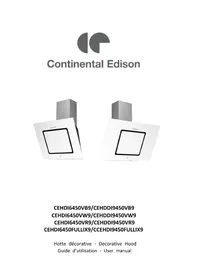
CEHDI9450WB9 - Range hood CONTINENTAL EDISON - Free user manual and instructions
Find the device manual for free CEHDI9450WB9 CONTINENTAL EDISON in PDF.


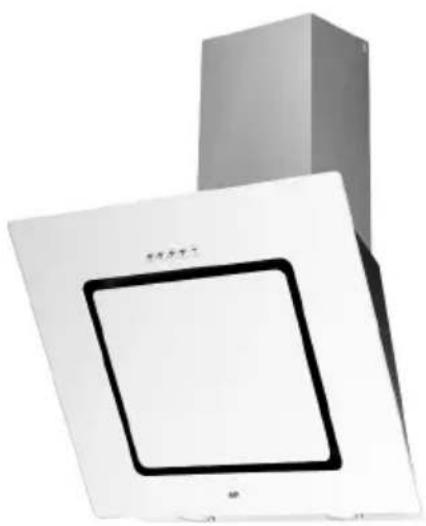
| Brand | Continental Edison |
| Model | CEHDI9450WB9 |
| Product type | Decorative hood |
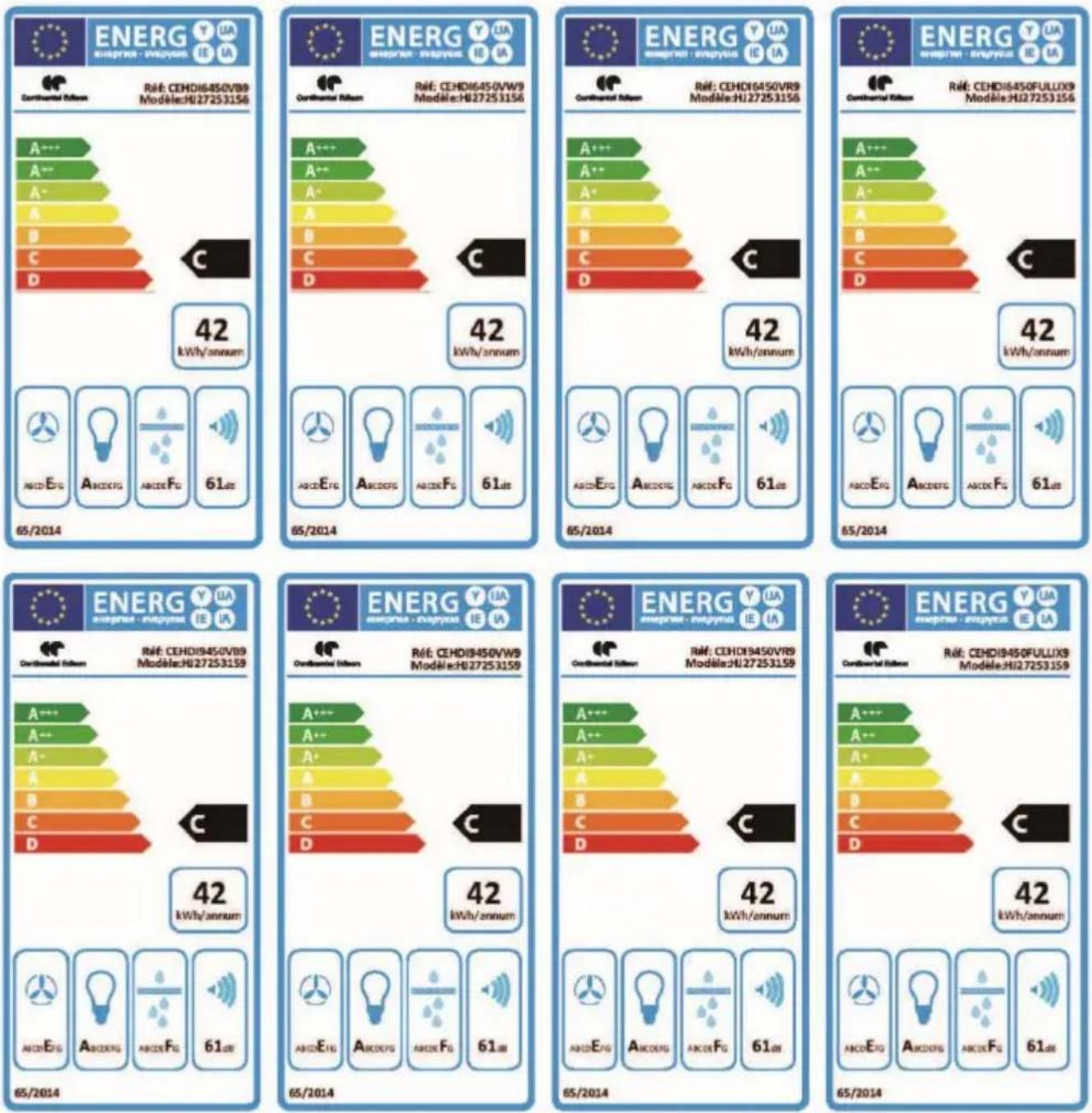
| Energy efficiency class | C |
| Annual energy consumption | 41.4 kWh/year |
| Fluid dynamic efficiency class | E |
| Light efficiency class | A |
| Grease filtration efficiency class | F |
| Maximum air flow | 283.3 m³/h |
| Pressure at maximum efficiency point | 121 Pa |
| Electrical power at maximum efficiency point | 62.0 W |
| Lighting system power | 4.0 W |
| Average illuminance on cooking surface | 145 lux |
| Acoustic power level | 61 dB |
| Power supply | 220-240 V ~ 50 Hz |
| Operating modes | Extraction and recirculation |
| Number of speeds | 3 (low, medium, high) |
| Grease filter type | Metal (cleanable) |
| Charcoal filter type | Active (replaceable) |
| Number of charcoal filters supplied | 2 |
| Minimum height above hob | Gas: 800 mm, Electric: 700 mm |
| Extraction duct diameter | 150-153 mm |
| Maximum duct length | 2.5 m |
| Lighting | Non-replaceable LED, 2 W per lamp |
Frequently Asked Questions - CEHDI9450WB9 CONTINENTAL EDISON
User questions about CEHDI9450WB9 CONTINENTAL EDISON
0 question about this device. Answer the ones you know or ask your own.
Ask a new question about this device
Download the instructions for your Range hood in PDF format for free! Find your manual CEHDI9450WB9 - CONTINENTAL EDISON and take your electronic device back in hand. On this page are published all the documents necessary for the use of your device. CEHDI9450WB9 by CONTINENTAL EDISON.
USER MANUAL CEHDI9450WB9 CONTINENTAL EDISON
natural_image
Abstract geometric shapes resembling partial arcs or circles, no text or symbols presentContinental Edison
natural_image
Exterior view of a modern office building (no signage)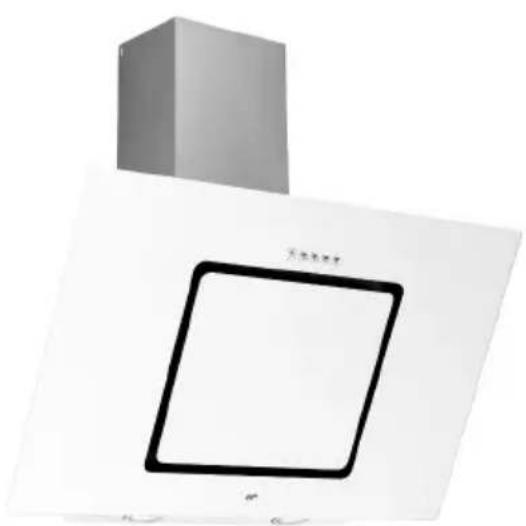
natural_image
3D rendering of a square frame with a gray block above it, no text or symbols visibleCEHDI6450VB9/CEHDDI9450VB9
CEHDI6450VW9/CEHDDI9450VW9
CEHDI6450VR9/CEHDDI9450VR9
CEHDI6450FULLIX9/CCEHDI9450FULLIX9
Installation (Mode extraction).... 12
Installation (Mode recyclage)....14
Installation (Mode extraction)
natural_image
Diagram of airflow around a mechanical component with directional arrows indicating movement (no text or symbols)natural_image
Simple line drawing of a cabinet or enclosure with an arrow indicating downward motion (no text or symbols)Installation (Mode recyclage)
natural_image
Diagram of a mechanical or fluid system with directional arrows and a central block, no text or symbols present.natural_image
Illustration of a hand holding an electrical outlet with a cable, showing a lightning bolt (no text or symbols)natural_image
Diagram showing a cylindrical object being dropped into a 3D mechanical part with internal components (no text or symbols)natural_image
Two technical line drawings showing a tool inside a box and a drill bit emerging from a base, both without any text or symbols.natural_image
Simple line drawing of a rectangular box with a smaller 3D cube below showing internal structure (no text or symbols)natural_image
Line drawing of a box with a handle and internal compartments, no text or symbols present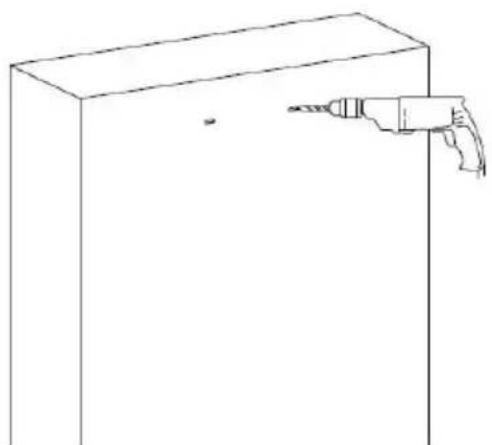
natural_image
Line drawing of a hand holding a tool near a rectangular box (no text or symbols)natural_image
Pure technical line drawing of a 3D rectangular block with internal structure and arrows indicating direction (no text or symbols)natural_image
Line drawing of a brick wall structure with hanging sensors and a door, no text or symbols presentnatural_image
Technical line drawing of an electric motor with visible blades and mounting flanges (no text or symbols)natural_image
Symbol of a trash bin with crossed lines indicating no waste, and a solid black rectangle below (no text or labels)Read this guide carefully before installing and using this product and keep it for future reference.
Read this guide and keep it
Thank you for choosing Continental Edison. This Use and Maintenance Guide is designed to provide you with all the necessary information regarding the installation, use and maintenance of the appliance.
In order to operate the unit properly and securely, read this user guide carefully before installing and using the product.
Contents
Find some informations.... 29
Important safety instructions....30
Lamp.... 36
Product description.... 37
Description of the pieces....38
Installing the hood....39
Preparation before installation.... 39
Installation (Mode extraction)....39
Installation (Mode recyclage)......41
Fixing the hood to the wall....41
Cleaning....50
Control panel....51
Help....52
Technical informations....53
Further information....54
IMPORTANT: Keep this guide for the electrical control agency.
When using electrical appliances, basic safety precaution should always be followed, including the following:
● These instructions are for your safety. Please read through them thoroughly prior to installation.
- This appliance has been designed for use as an exhausting (air evacuation to the outside) or filtering (indoor air re-cycling) hood.
- All installation work must be carried out by a competent person or qualified electrician.
- This appliance must be installed correctly by a suitably qualified person, strictly following the manufacturer's instructions.
- Accessible parts may become hot during use.
● Young children should be kept away. Care should be taken to avoid touching the appliance.
- The Manufacturer highly recommends that this appliance be kept out of the reach of babies and small children.
- This appliance can be used by children aged from 8 years and above and persons with reduced physical, sensory or mental capabilities or lack of experience and knowledge if they have been given supervision or instruction concerning use of the appliance in a safe way and understand the hazards involved.
Children shall not play with the appliance. Cleaning and user maintenance shall not be made by children without supervision.
- Regularly check the power plug and power cord for damage. If the supply cord is damaged, it must be replaced by the manufacturer, its service agent or similarly qualified persons in order to avoid a hazard.
- Do not allow the electric cables to touch the hot parts of the appliance.
● Make sure that the power cord is not caught under or in the appliance and avoid damage to the power cable. - Do not use flammable sprays in close vicinity to the appliance.
- Please dispose of the packing material carefully.
- We also recommend that you pay special attention during use and during cleaning. Refer to the instructions in the "CLEANING" section.
● A steam cleaner is not to be used. -
The appliance is not intended to be operated by means of external timeror separated remote-control system.
-
Warning: When used for extraction, refer to the national regulations for building ventilation system. Do not connect the exhaust pipe to a VMC type ventilation system, to a flue (chimney, boiler, ...). Also check the absence of disruption with the ventilation of the room when there are gas appliances (water heater, gas cooker, ...). If in doubt, use the hood in recycling mode.
● Proper ventilation of the room must be provided when the hood is used simultaneously with appliances using gas or other fuel. - The air must not be vented through a duct that used to vent flue gases from appliances burning or other fuels. The rules regarding the evacuation of the air must be respected.
● Warning: The hood may stop working during an electrostatic discharge (e.g. lightning). This involves no risk of damage. Switch off the electricity supply to the hood and reconnect after one minute.
- To avoid the risk of fire, clean the metal filter regularly and closely watch and regulate pans containing hot oil.
- Do not use the hood if it shows signs of damage or imperfection. Contact customer services.
- Do not flame under the range hood.
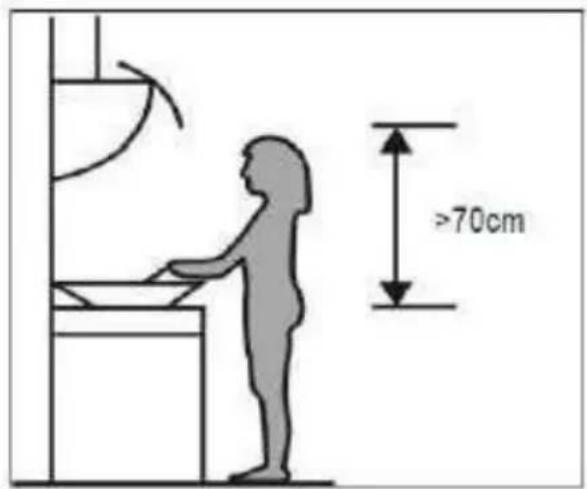
- When installing the appliance, make sure that the following distances between the top of cooker or hob and the lowest part of the cooker hood must be observed:
Gas hobs: 800mm.
Electric hobs: 700mm.
Warning: Before connecting the hood: switch off the electricity supply and check that the supplied voltage and frequency coincide with that indicated on the appliance nameplate.
Warning: There is a risk of electric shock and fire cleaning is not carried out in accordance with the instructions.
Warning: For safety reason, please use only the same size of fixing or mounting screw which are recommended in this instruction manual.
Warning: Failure to install the screws or fixing device in accordance with these instructions may result in electrical hazards.
Electrical Shock Hazard
Only plug this unit into a properly earthed outlet.If in doubt seek advice from a suitably qualified engineer.
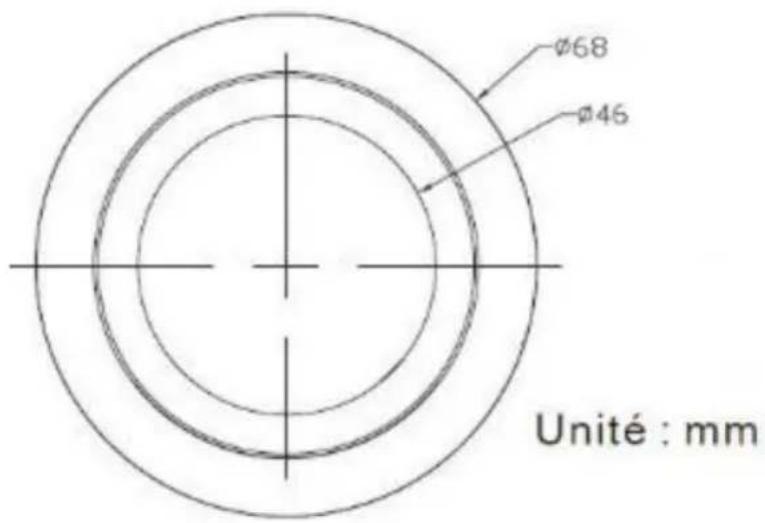
The available lamps and the correspondence ILCOS D codes and lamp pictures:
Use type lamp (or use in alternative type lamp) DBR-2-H-68 (ILCOS D code in according to standard IEC 61231).
- Non-replaceable LED lamp
- Max wattage: 2 W
- Voltage range: 220-240V\~50Hz
- Dimensions:
Preparation before installation

ATTENTION
Carefully remove the carton. Wear gloves to protect your hands from sharp edges.

ATTENTION
Remove the protective film from the product before putting it into service.
Installation (Mode extraction)
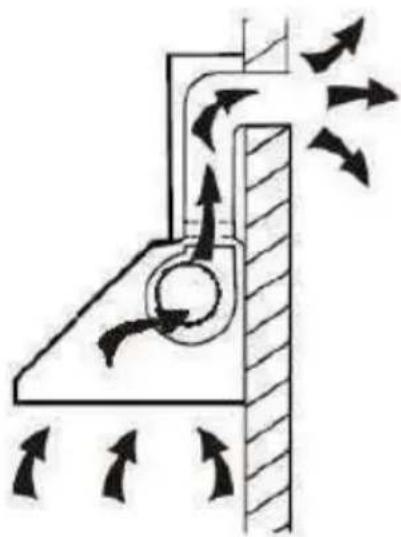
If the wall has an opening to the outside, your hood may beconnected as shown in the diagram below using
the extraction ductprovided or a suitable extraction conduit, for example a flexible aluminum sheath or constitutedanother nor flammable material with an insic diameter of less than 150mm.
natural_image
Diagram of airflow around a mechanical component with directional arrows indicating movement (no text or symbols)● Determine the exact installation position of the hood.
- Plan the path of the air exhaust duct outward.
- Make sure that the duct path is as short and straight as possible. To allo optimal use, the duct must not exceed 2.50m long in total.
natural_image
Diagram showing a cylindrical object being dropped into a device with a mechanical component (no text or symbols)- The duct must lead directly to the outside, and must not lead to aattic, a house, a garage or in an enclosed space.
- Duct accessories (elbows, fittings and adapters) would reduce the flow of air.
- Bent elbows and S-shaped profiles do not provide efficient air extraction, they are not recommended for using.
Installation (Mode recyclage)
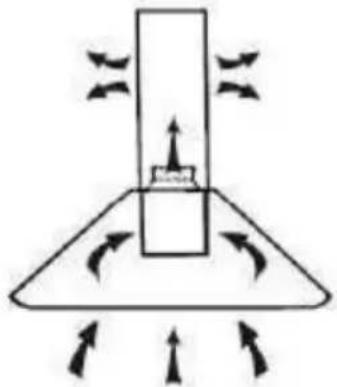
If you do not have an exit to the outside, the exhaust pipe is not required, and the installation procedures are the same as those described in the "Installation (Extraction Mode)" section.
natural_image
Diagram of a mechanical or fluid system with directional arrows and a central block, no text or symbols present.Fixing the hood to the wall
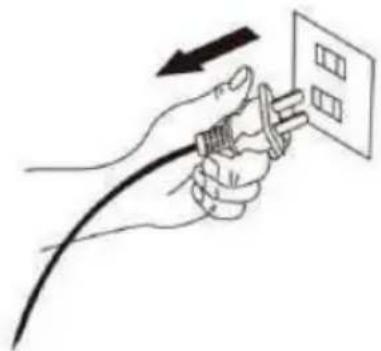
Before installing, make sure the unit is not plugged into anelectrical outlet.
natural_image
Illustration of hands holding a cable with an arrow indicating direction (no text or symbols)The hood should be placedleast 70cm above the cookto
Recommendations for wall mounting
Do not make any changes to the unit or its mounting bracket on the wall!
Before installing the device, check the condition of the wall on which it will be fixed: the wall must be in good condition, it must not show any damage (cracks, sagging humidity, ...).
Do not drill a hole near old holes, even plugged It is imperative that you consult a building professional to use the anchoring system (screws, dowels, etc.)
appropriate to the material that constitutes your wall, as well as to the weight of the appliance. Observe the diameter of the fixing screws indicated in this manual.
Do not modify the holes for securing the unit or its mounting bracket to the wall.
Drill the wall with a drill of the appropriate size for the anchoring system. Remove debris and dust.
Regularly check the mounting points of the device on the wall. Tighten them if necessary.
Position the hood at the desired height respecting the minimum height above the hob.
Mark the location of the wall bracket.
Remove the hood and position the wall bracket to make the locations of the holes on the wall.
Drill the 3 holes in the wall to insert the appropriate fastening system (screw ST4x30mm).
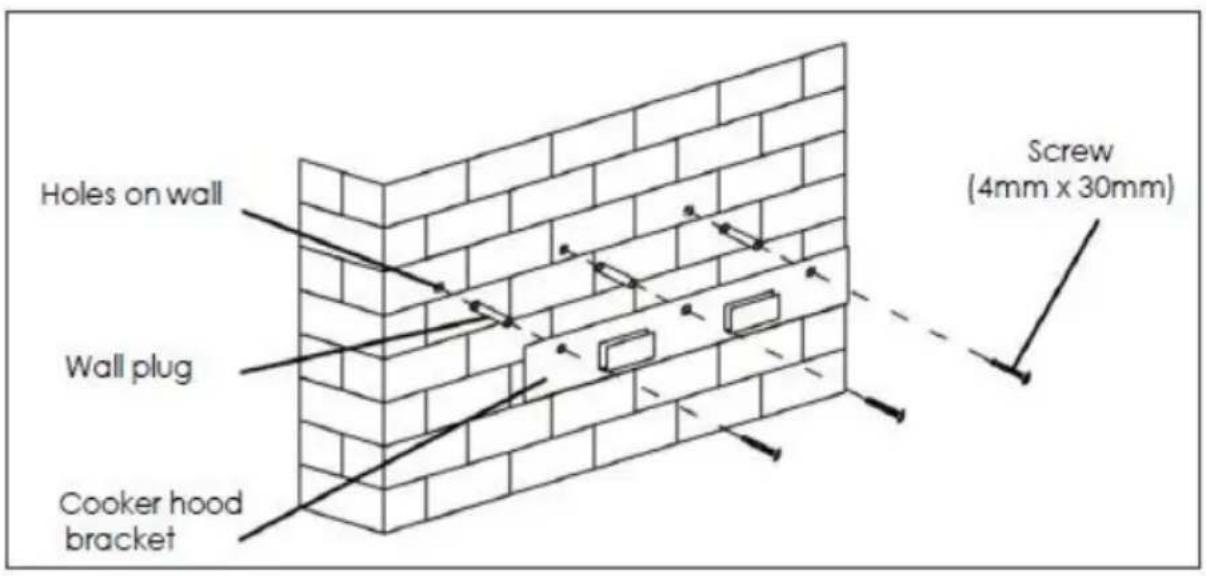
Hang the hood in the notches of wall bracket.
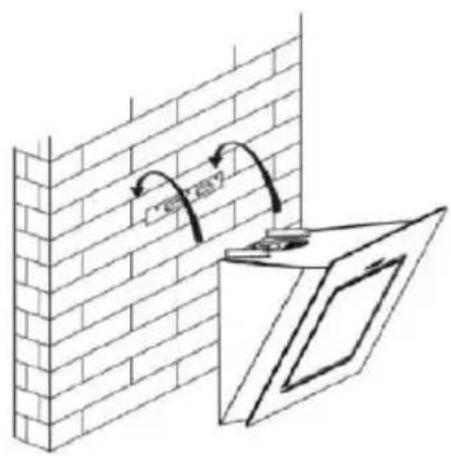
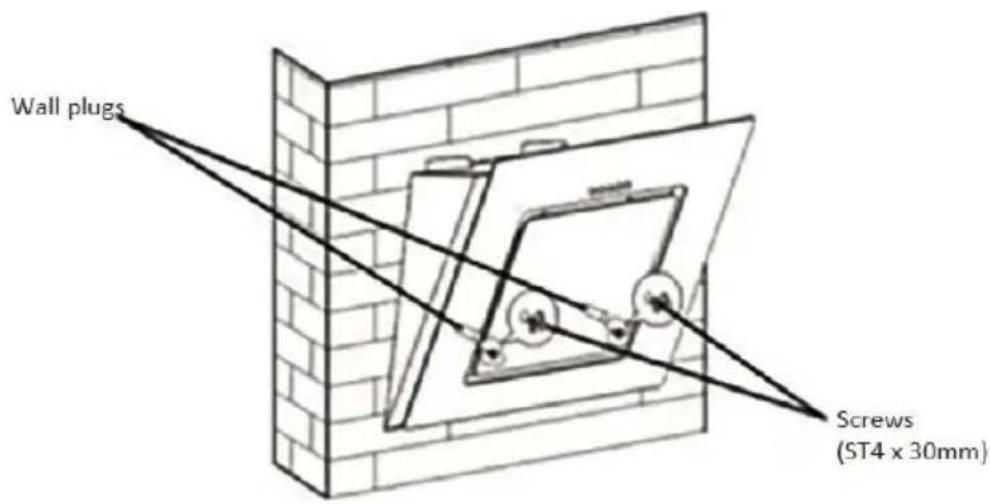
Once the hood is in place, locate the location of the additional wall mount screws as shown in the following diagram.
Remove the hood to puncture the wall and install wall plugs.
Secure the body of the hood with 2 screws of 4 mm diameter using dowels adapted to your wall.
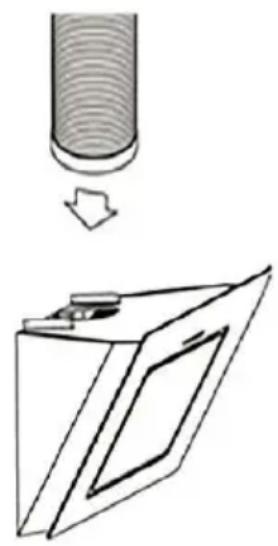
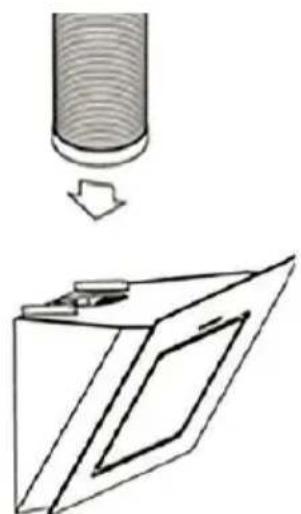
If the extraction mode is selected, place the exhaust air duct on the a outlet as shown.
natural_image
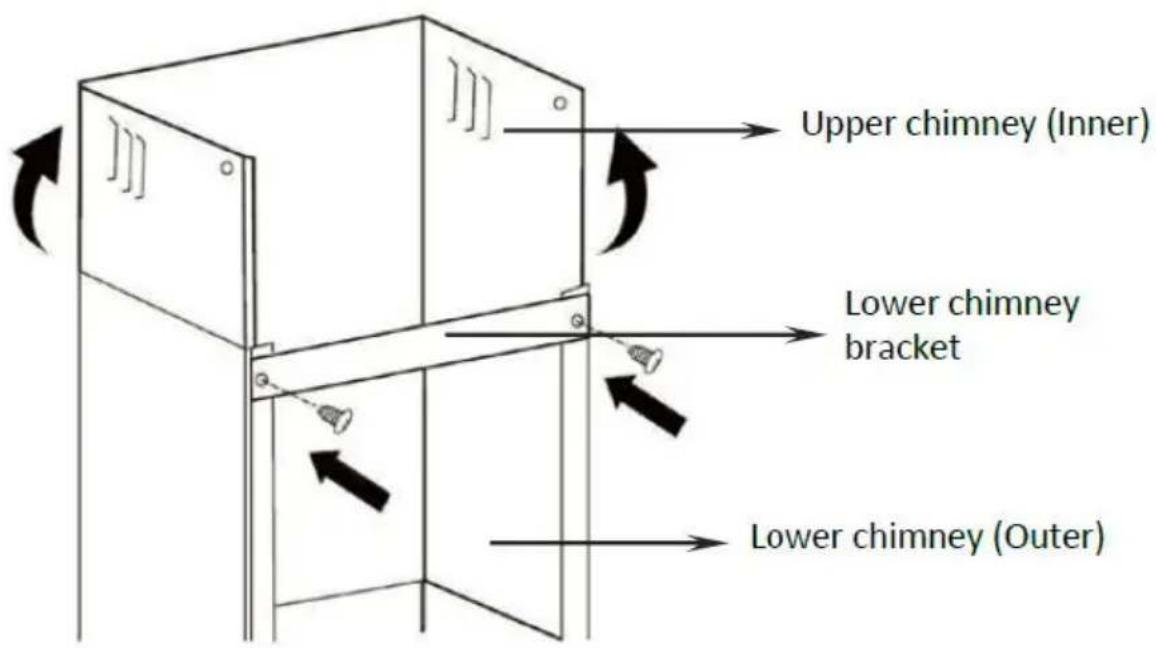
Diagram showing a cylindrical component being dropped into a 3D mechanical part with internal components (no text or symbols)Attach the lower chimney support to the lower chimney as shown.
Use 2 screws ST4x8mm.
(Do not over tighten the screws, make sure the upper chimney can slide easily into the lower chimney)
Insert the upper chimney into the lower chimney.
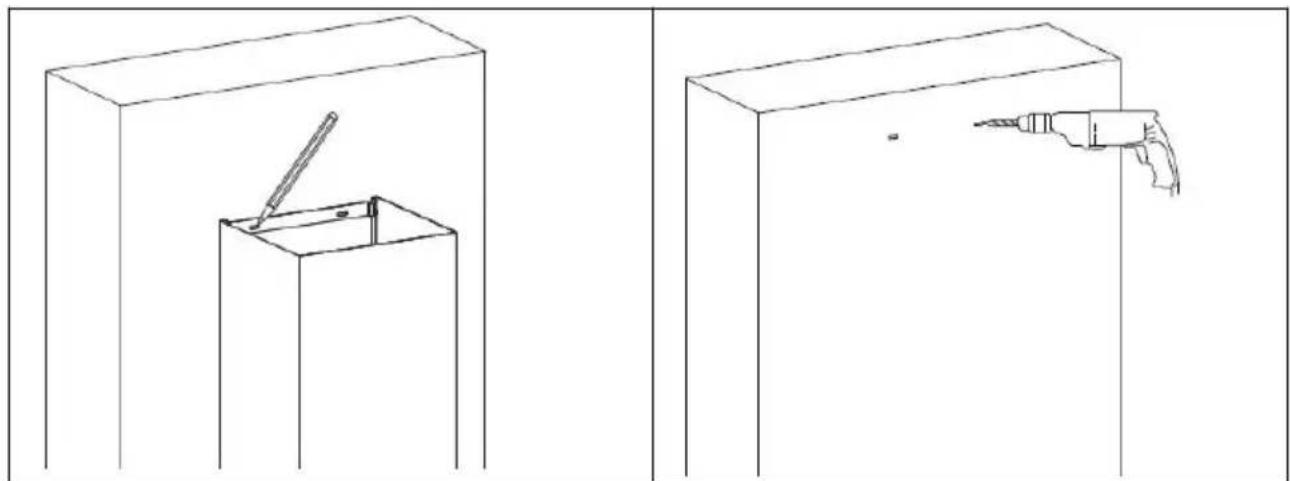
Position the bottom chimney in the appliance, then mark the holes on the wall.
natural_image
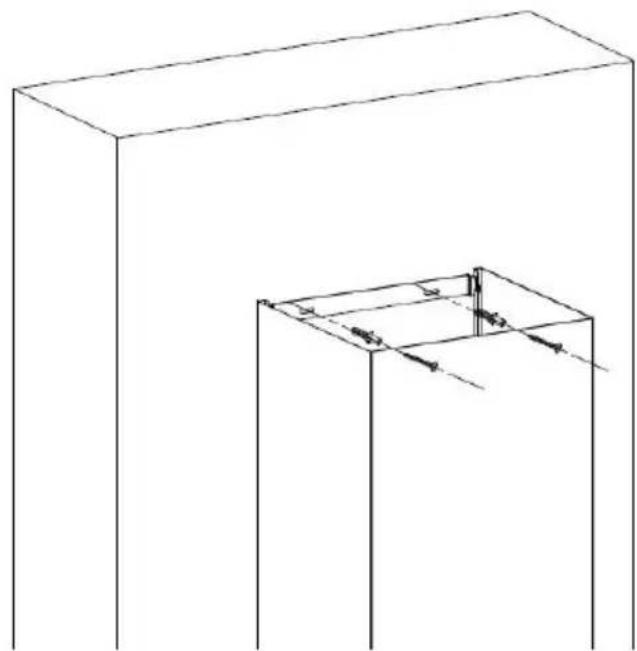
Two technical line drawings showing a tool inside a box and a drill bit emerging from a base, both without any text or symbols.Remove the lower chimney, then drill holes in the wall hole for screw diameter 8 mm Use the dowels adapted to your wall
Install the lower chimney then screw it to the wall with 2 screws of diameter 8 mm
natural_image
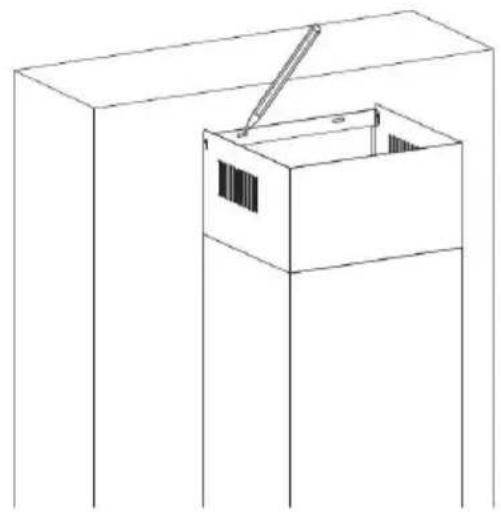
Simple line drawing of a rectangular box with a smaller 3D cutout showing internal structure (no text or symbols)Then pull the upper chimney upwards to the desired height. Mark the locations of the mounting holes of the upper chimney support.
natural_image
Line drawing of a box with a pen inserted into one corner, no text or symbols present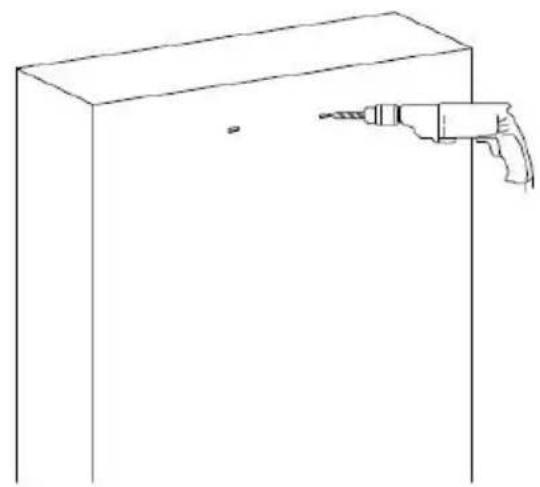
natural_image
Line drawing of a hand holding a tool near a rectangular box (no text or symbols)Lower the upper chimney and then drill holes in the wall. Insert the dowels adapted to your wall
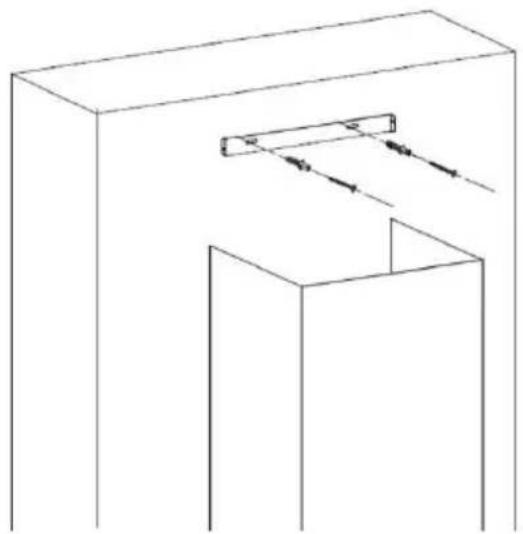
Secure the wall bracket of th upper chimney to the wall using the selected dowels (8 mm screws recommended).
natural_image
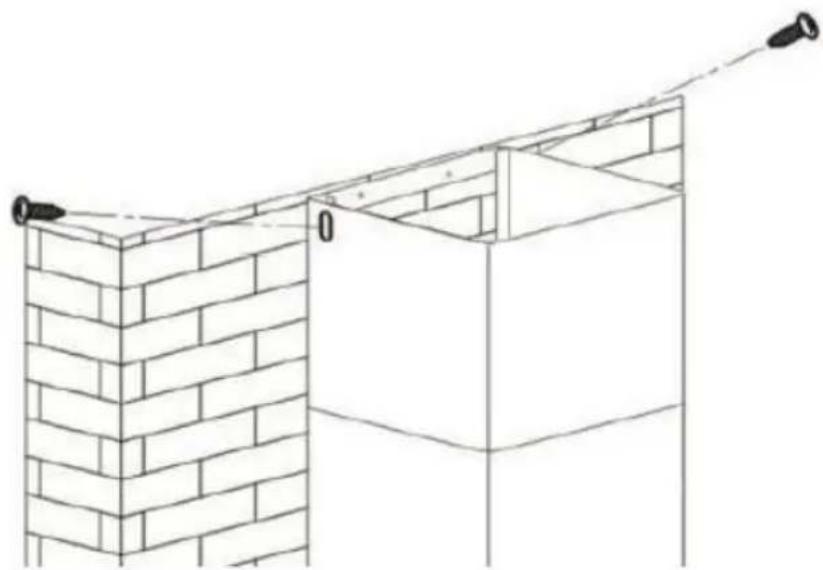
Pure technical line drawing of a 3D rectangular block with internal structure and dimension arrows, no text or symbols presentReassemble the upper chimney and fix it to the wall bracket with 2 screws ST4x8mm
natural_image
Line drawing of a brick wall structure with a vertical support and diagonal line, no text or symbols presentFasten the lower chimney to the lugs of the kitchen hood using 2 screws ST4x8mm.
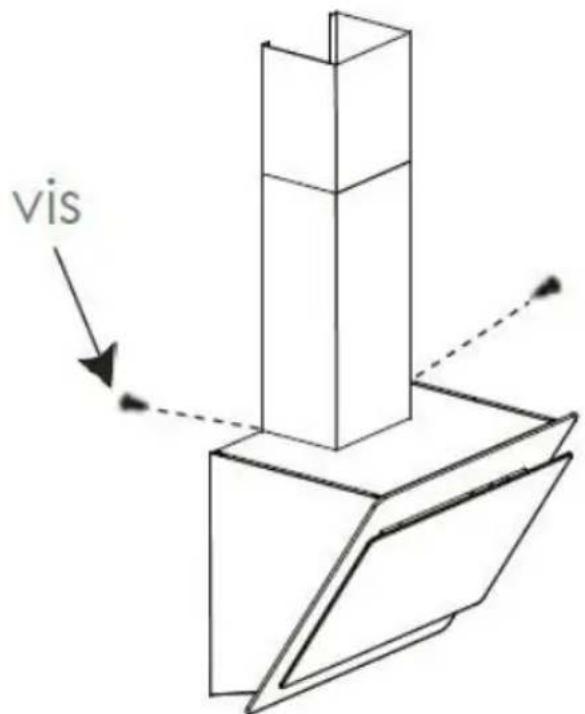
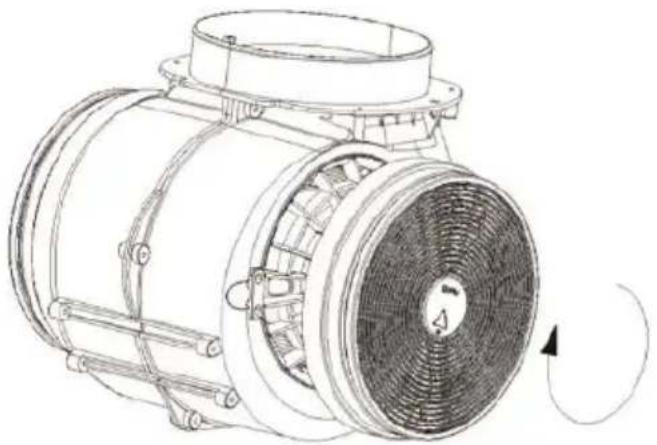
Position the activated charcoal filter in the block and turn it clockwise. Do t same on the other side.
natural_image
Technical line drawing of a mechanical fan or motor assembly with no visible text or symbolsNOTE: Make sure the filter properly engaged. Otherwise, it could fall, which is dangerous. When the activated charcoal filter is switched on, the suction force drops.
Make sure the filters are properly engaged to prevent it from falling and may cause damage.
The carbon filters must be replaced at least once a year, or more often if used intensively.
Attention! Before cleaning switch the unit off and pull out the plug.
- Regular Cleaning
Use a soft cloth moistened with hand-warm mildly soapy water or household cleaning detergent. Never use metal pads, chemical, abrasive material or stiff brush to clean the unit.
• Monthly Cleaning for Grease Filter
ESSENTIAL: Clean the filter every month can prevent any risk of fire.
The filter collects grease, smoke and dust. It is directly affecting the efficiency of the cooker hood. If not cleaned, the grease residue (potential flammable) will saturate on the filter. Clean it with household cleaning detergent.
| 0 | Engine On / Off switch.Press this button to stop engine operation. |
| 1 | Low speed button.Press this button to operate the system at low speed |
| 2 | Average speed button.Press this button to operate the system at med speed |
| 3 | High speed button.Press this button to operate the system at high speed |
 | Lighting button.Press this button once to turn on the lights. Pr again to turn them off. |
0 1 2 3


| Fault | Cause | Solution |
| Light on, but fandoes not work | The fan bladeis jammed. | Switch of the unit and repairby qualified service personnelonly. |
| The motor isdamaged. | ||
| Fan do not work | light burn | Replace the lamp with correct rating. |
| Power cordlooses. | Plug in to the power supplyagain | |
| Serious Vibrationof the unit | The fan bladeis jammed. | Switch of the unit and repair by qualified service personnel only. |
| The fan motoris not fixedtightly. | Switch of the unit and repair by qualified service personnel only. | |
| The unit is nothing properlyon the bracket. | Take down the unit and check whether the bracket is in proper location. | |
| Weak power | The filter is dirty | Clean the filter |
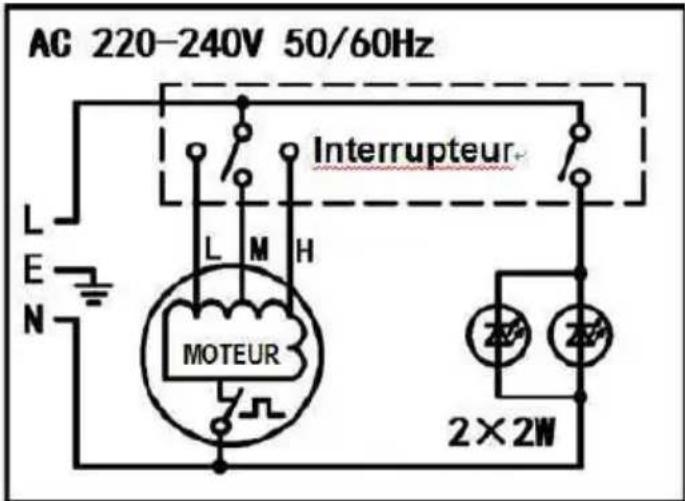
ELECTRICAL CONNECTION DIAGRAM
| Symbol | Value | Unit | ||
| Model identification | CEHDI6450VB9CEHDI6450VW9CEHDI6450VR9CEHDI6450FULLIX9(HJ27253156) | CEHDI9450VB9CEHDI9450VW9CEHDI9450VR9CEHDI9450FULLIX9(HJ27253159) | ||
| Annual Energy Consumption | AEChotte | 41,4 | kWh/a | |
| Energy Efficiency class | C | |||
| Time increase factor | f | 1,7 | ||
| Fluid Dynamic Efficiency | FDEhotte | 9 | ||
| Fluid Dynamic Efficiency class | E | |||
| Energy Efficiency Index | EEhotte | 80,2 | ||
| Measured air flow rate at best efficiency point | QBEP | 165,8 | m3/h | |
| Measured air pressure at best efficient point | PBEP | 121 | Pa | |
| Maximum airflow | Qmax | 283,3 | m3/h | |
| Measured electric power input at best efficiency point | WBEP | 62 | W | |
| Nominal power of thelighting system | WL | 4 | W | |
| Average illumination of the lighting system on thecooking surface | Emoyen | 145 | lux | |
| Lighting Efficiency | LEhotte | 36,3 | lux/W | |
| Lighting efficiency class | A | |||
| Grease Filtering Efficiency | GFEhotte | 47,3 | ||
| Grease Filtering Efficiency class | F | |||
| Measured power consumption off mode | PO | 0,0 | W | |
| Sound power level | LWA | 61 | dB | |
The method of measurement and calculation of the above table is in accordance with Commission Regulation (EU) No 65/2014 and 66/2014
CONTINENTAL EDISON
120-126 quai de Bacalan
CS11584
33000 Bordeaux
Importé par A.M.C.
The following recommendations specify how to reduce the overall environmental impact of the cooking process.
(1) Install the range hood in a suitable location with good ventilation.
(2) Clean the cooker hood regularly so that nothing blocks the air.
(3) Do not forget to turn off the hood lamp once cooking is complete.
(4) Do not forget to turn off the range hood once cooking is complete.
Disassembly Information
Do not disassemble the unit in a manner that is not indicated in the operating instructions. This device must not be disassembled by the user. At the end of its life cycle, the appliance must not be disposed of with household waste. For recycling tips, please contact your local administration or dealer.
ENVIRONMENTAL PROTECTION
Electrical and electronic equipment is subject to selective collection.
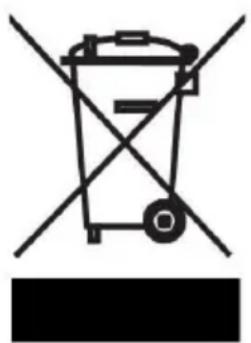
Do not dispose of used electrical and electronic equipment with unsorted household waste; instead, take part in their selective collection.
It is for this reason that your appliance, as indicated by the symbol on its nameplate or on the packaging, must never be thrown in a public or private bin intended for household waste.
The user has the right to deposit the device in public collection places that selectively dispose of the waste to be recycled or reused for other applications.
The packaging is recyclable.
natural_image
Symbol of a trash bin crossed with no text or numbers, representing waste sorting or disposal (no text present)
natural_image
Two overlapping gray semicircles on white background (no text or symbols)Continental Edison

- Continental Edison
- Installation (Mode extraction)
- Installation (Mode recyclage)
- Contents
- IMPORTANT: Keep this guide for the electrical control agency.
- When using electrical appliances, basic safety precaution should always be followed, including the following:
- Electrical Shock Hazard
- Preparation before installation
- ATTENTION
- Fixing the hood to the wall
- Recommendations for wall mounting
- - Regular Cleaning
- • Monthly Cleaning for Grease Filter
- Importé par A.M.C.
- Disassembly Information
- ENVIRONMENTAL PROTECTION
Brand : CONTINENTAL EDISON
Model : CEHDI9450WB9
Category : Range hood