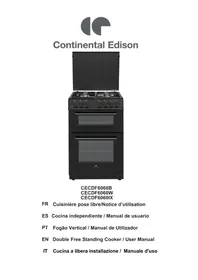
CECDF6060W - Electric oven CONTINENTAL EDISON - Free user manual and instructions
Find the device manual for free CECDF6060W CONTINENTAL EDISON in PDF.


| Brand | Continental Edison |
| Model | CECDF6060W |
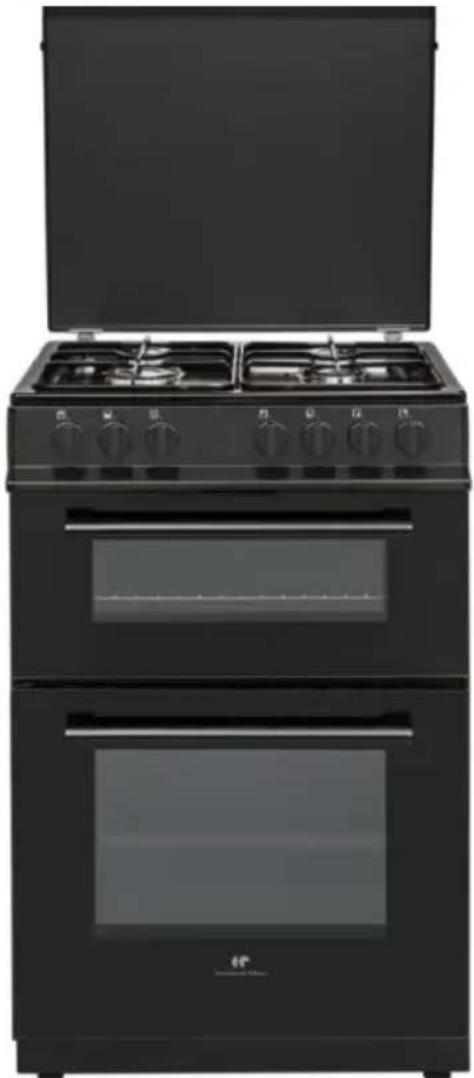
| Product type | Electric double cavity oven + gas hob |
| Dimensions (W x D x H) | 60 cm x 60 cm x 90 cm |
| Weight | 49 kg |
| Power supply | 220-240 V, 50/60 Hz |
| Energy class | A (double cavity) |
| Main oven volume (lower) | 58 L |
| Upper oven volume | 36 L |
| Main oven functions | Defrost, Natural convection, Fan forced, Grill, Fan grill |
| Upper oven functions | Natural convection, Top heat, Grill, Express grill |
| Number of gas burners (hob) | 4 (1 rapid/wok, 2 semi-rapid, 1 auxiliary) |
| Burner ignition | One-hand (electric) and manual ignition |
| Gas safety | Thermocouple on all burners |
| Anti-tilt kit | Included |
| Oven lighting | Replaceable bulb 230 V, 15-25 W, type E14, heat resistant 300 °C |
| Cleaning | Catalytic walls (lower cavity) or manual |
| Included accessories | Rack, drip tray, heat shield for grill, deflector |
| Oven door | Removable for cleaning, double glazing |
| Gas connection | Butane/Propane G30/G31 28-30 mbar or Natural gas G20/G25 20/25 mbar |
| Repairability | Spare parts available via approved after-sales service |
Frequently Asked Questions - CECDF6060W CONTINENTAL EDISON
User questions about CECDF6060W CONTINENTAL EDISON
0 question about this device. Answer the ones you know or ask your own.
Ask a new question about this device
Download the instructions for your Electric oven in PDF format for free! Find your manual CECDF6060W - CONTINENTAL EDISON and take your electronic device back in hand. On this page are published all the documents necessary for the use of your device. CECDF6060W by CONTINENTAL EDISON.
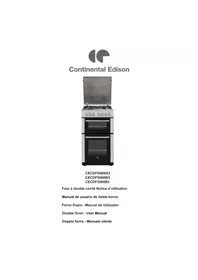
USER MANUAL CECDF6060W CONTINENTAL EDISON
natural_image
Abstract geometric shapes resembling partial arcs or circles, no text or symbols presentContinental Edison
natural_image
Exterior view of a black double boiler with open top and front doors (no visible text or symbols)CECDF6060B
CECDF6060W
CECDF6060IX
natural_image
Warning sign depicting a person pulling a large block inside a triangle (no text or symbols)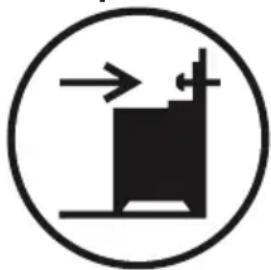
natural_image
Simple black-and-white icon of a machine with directional arrows, enclosed in a circle (no text or symbols)natural_image
Prohibition sign depicting a diagonal slash over a saw, enclosed in a circle (no text or symbols)natural_image
Diagram of a mechanical assembly with a spring and rotating component (no text or symbols)3. CARACTÉRISTIQUES DU PRODUIT

natural_image
Pure mechanical component diagram without any text, numbers, or symbolsPosition OFF
natural_image
Pure mechanical component diagram without any text, numbers, or symbolsPosition MAX
natural_image
Simple diagram of a rotating disk with a central hole and curved arrow, no text or symbols present.natural_image
Simple circular diagram with a diagonal stripe and curved arrow, no text or symbols present.natural_image
Abstract circular diagram with concentric arrows and a central grid pattern, no text or symbols present.Fonction
Décongélation :
natural_image
Gray gradient rectangular button with white ventilation slots (no text or symbols)natural_image
Abstract grayscale graphic with circular arrows and a central grid pattern (no text or symbols)natural_image
Simple black rectangular object with five white zigzag lines on a dark surface, no text or symbols present.Fonction Gril :
natural_image
Abstract diagram with circular arrows and wave patterns, no text or symbols presentnatural_image
Gray gradient rectangular button with ventilation slots (no text or symbols)natural_image
Simple grayscale icon of a rectangular device with ventilation grilles (no text or symbols)natural_image
Pure electrical circuit lines without any symbolsnatural_image
Pure electrical circuit lines without any symbolsnatural_image
Technical line drawing of a square frame with circular cutouts and mounting holes (no text or symbols)natural_image
Line drawing of a hand holding a tool inside a tray, no text or symbols present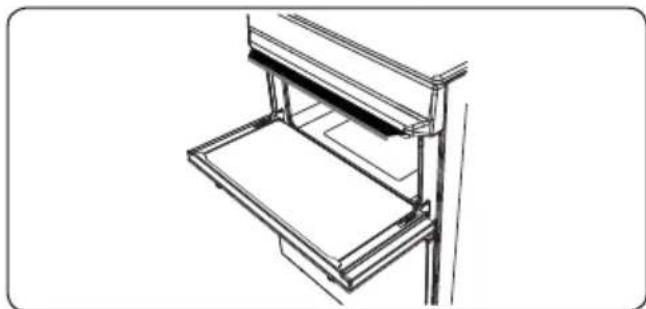
natural_image
Technical line drawing of a mechanical assembly with two stacked compartments (no text or symbols)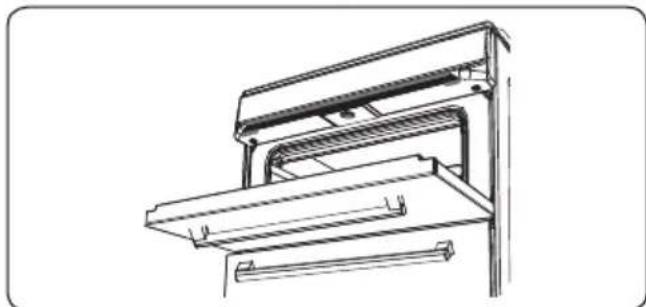
natural_image
Technical line drawing of a mechanical assembly or mounting bracket (no text or symbols)Grille
natural_image
Line drawing of a corrugated metal tray with ribbed sides (no text or symbols)
AVERTISSEMENT
natural_image
Technical line drawing of an open refrigerator with a rack and ventilation system (no text or symbols)5. NETTOYAGE ET ENTRETIEN
5.1. Nettoyage

natural_image
Line drawing of a hand cleaning a car window with a tire (no text or symbols)natural_image
Technical line drawing of a two-part interior view of an oven or enclosure, showing internal structure and mounting points (no text or symbols)natural_image
Technical line drawing of a 3D printer or printer assembly with no visible text or symbolsnatural_image
Diagram of a door with a spring mechanism, showing an upward arrow (no text or symbols)5.2. Entretien

natural_image
Warning sign depicting a person pulling a large object inside a triangle (no text or symbols)
natural_image
Simple black-and-white icon of a building with arrows indicating direction, enclosed in a circle (no text or symbols)natural_image
Symbol of a diagonal line crossing a slope, indicating horizontal compression or force (no text or numbers present)natural_image
Diagram of a mechanical assembly with a spring and nut, showing rotational motion (no text or symbols)3. CARACTERÍSTICAS DEL PRODUCTO

natural_image
Simple diagram of a cylindrical device with a curved arrow indicating rotation or direction (no text or symbols)Posición apagado
natural_image
Pure diagram of a mechanical component with no text, numbers, or symbolsPosición máx.

natural_image
Simple diagram of a circular object with internal diagonal lines and arrows, no text or symbols present.natural_image
Simple diagram of a circular device with a diagonal stripe and curved arrow, no text or symbols present.natural_image
Abstract diagram with circular arrow and concentric rings, no text or symbols presentnatural_image
Gray gradient rectangular button with white ventilation slots (no text or symbols)natural_image
Abstract grayscale graphic with curved arrows and a central diamond shape, no text or symbols present.natural_image
Pure electrical circuit lines without any symbolsnatural_image
Abstract diagram with circular arrows and a central grid pattern, no text or symbols presentnatural_image
Gray gradient rectangular button with white ventilation slots (no text or symbols)natural_image
Gray rectangular button or icon with a black center and side slats, no text or symbols present.natural_image
Black rectangular object with five white zigzag lines and side protrusions, resembling a stylized monitor or tray (no text or symbols)natural_image
Gray rectangular button with white arrows pointing downward on top and bottom (no text or symbols)natural_image
Technical line drawing of a square frame with bolt holes and a central circular hole (no text or symbols)natural_image
Line drawing of hands using a tool to lift or install a tray (no text or symbols)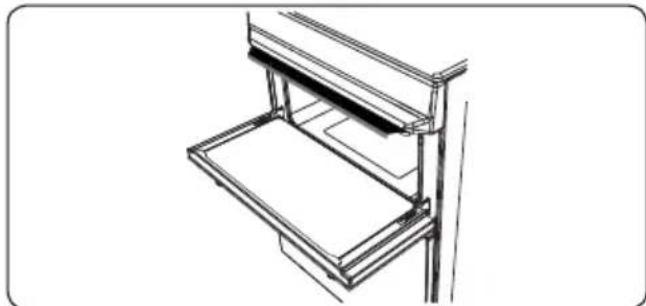
natural_image
Line drawing of a mechanical device with a rectangular frame and vertical supports (no text or symbols)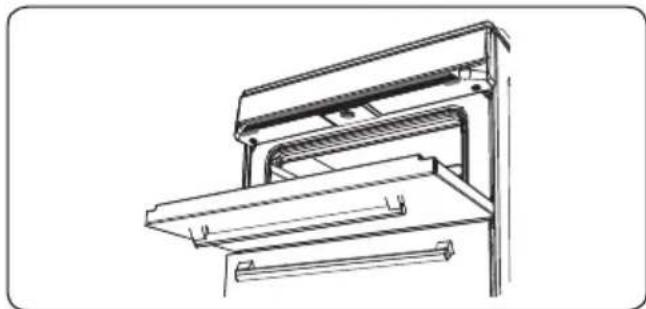
natural_image
Technical line drawing of a mechanical assembly or mounting bracket (no text or symbols)Parrilla
natural_image
Line drawing of a corrugated metal tray with ribbed sides and central seam (no text or symbols)
ADVERTENCIA
natural_image
Technical line drawing of an open refrigerator with a rack and ventilation system (no text or symbols)5. LIMPIEZA Y MANTENIMIENTO
5.1. Limpieza

natural_image
Line drawing of a hand cleaning a car window with a cloth (no text or symbols)Limpieza catalítica
natural_image
Diagram showing two views of an oven with internal compartments and mounting hardware (no text or symbols)natural_image
Technical line drawing of a mechanical assembly with an arrow indicating rotation (no text or symbols)natural_image
Diagram of a refrigerator interior with a directional arrow indicating movement (no text or symbols)5.2. Mantenimiento
natural_image
Warning symbol depicting a person pulling a large block inside a triangle (no text or numbers)
natural_image
Simple black-and-white icon of a building with arrows indicating direction, enclosed in a circle (no text or symbols)natural_image
Symbol of a diagonal slash over a broken surface, commonly used in pictograms to indicate no change or obstruction (no text present)natural_image
Diagram of a mechanical assembly with a bolt and curved arrow indicating rotation (no text or symbols)3. CARACTERÍSTICAS DO PRODUTO

Base de Tacho Circular
natural_image
Simple line drawing of a cooking pot with crossed panes and a cross symbol below (no text or labels)natural_image
Abstract diagram with circular arrow and concentric rings, no text or symbols presentnatural_image
Abstract grayscale gradient rectangle with no text or symbolsFunção de Cozinhar
natural_image
Abstract grayscale graphic with circular arrows and a central geometric pattern (no text or symbols)natural_image
Black rectangular object with white zigzag arrows on a dark surface, surrounded by decorative side stripes (no text or symbols)natural_image
Abstract diagram with circular arrows and a central hexagonal pattern, no text or symbols presentnatural_image
Simple grayscale icon of a rectangular panel with vertical stripes (no text or symbols)natural_image
Black rectangular object with five white zigzag arrows on a dark surface, no text or symbols present.Função de Grelhar:
natural_image
Simple icon of a rectangular device with ventilation grilles and three downward arrows indicating flow or discharge (no text or symbols)Função de Grelhar
natural_image
Technical line drawing of a square frame with bolt holes and a central circular hole (no text or symbols)natural_image
Line drawing of a hand holding a tool over a tray with a ruler, no text or symbols present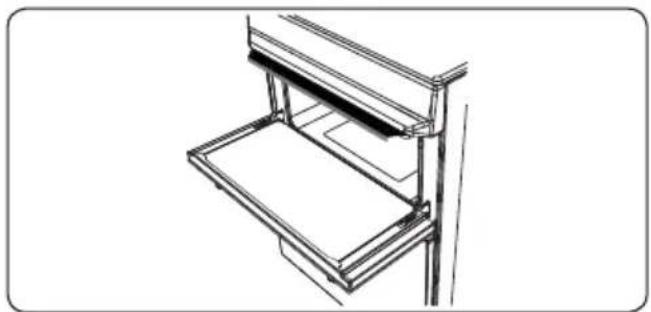
natural_image
Line drawing of a staircase with an open shelf and vertical panel (no text or symbols)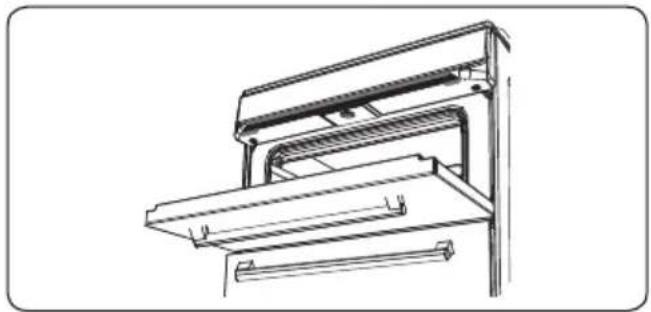
natural_image
Technical line drawing of a mechanical assembly or mounting bracket (no text or symbols)Tabuleiro Raso
natural_image
Technical line drawing of a square frame with bolt holes and internal ribs (no text or symbols)Rede de Arame
natural_image
Line drawing of a corrugated metal tray with ribbed sides (no text or symbols)
AVISO
natural_image
Technical line drawing of an oven with internal structure and a downward arrow indicating a component (no text or symbols present)natural_image
Line drawing of a hand cleaning a car window with a cloth (no text or symbols)Limpeza catalítica
natural_image
Technical line drawing of a door frame with internal compartments and mounting base (no text or symbols)Limpeza da Placa de Gás
Limpar as Partes de Vidro
Limpar as Partes Esmaltadas
natural_image
Technical line drawing of a mechanical assembly with a curved arrow indicating motion (no text or symbols)natural_image
Diagram of a door with a spring mechanism, showing an upward arrow (no text or symbols)5.2. Manutenção

Thank you for choosing this product.
This User Manual contains important safety information and instructions on the operation and maintenance of your appliance.
Please take the time to read this User Manual before using your appliance and keep this book for future reference.
| Icon Type Meaning | |
| WARNING Serious injury or death risk | |
| RISK OF ELECTRIC SHOCK Dangerous voltage risk | |
| FIRE Warning; Risk of fire / flammable materials | |
| CAUTION Injury or property damage risk | |
| IMPORTANT / NOTE Operating the system correctly |
CONTENTS
1.SAFETY INSTRUCTIONS....3
1.1 General Safety Warnings ....3
1.2 Installation Warnings ....6
1.3 During Use ....7
1.4 During Cleaning and Maintenance....9
2.INSTALLATION AND PREPARATION FOR USE.... 11
2.1 Instructions for the Installer 11
2.2 Installation of the Cooker....12
2.3 Gas Connection....12
2.4 Gas Conversion (if available) 13
2.5 Electrical Connection and Safety (if available)(OBO674X-OBO674W) 14
2.6 Adjusting the feet 15
3.PRODUCT FEATURES....17
4. USE OF PRODUCT ...... 18
4.1 Use of gas burners 18
4.2 Use of Gas Burners 18
5.CLEANING AND MAINTENANCE....22
5.1 Cleaning 22
5.2 Maintenance....24
5.3 Maintenance 24
6.TROUBLESHOOTING&TRANSPORT 25
6.1 Troubleshooting....25
6.2 Transport 26
7.TECHNICAL SPECIFICATIONS....27
7.1 Injector Table 27
1. SAFETY INSTRUCTIONS
- Carefully read all instructions before using your appliance and keep them in a convenient place for reference when necessary.
- This manual has been prepared for more than one model therefore your appliance may not have some of the features described within. For this reason, it is important to pay particular attention to any figures whilst reading the operating manual.
1.1 General Safety Warnings
- This appliance can be used by children aged from 8 years and above and by persons with reduced physical, sensory or mental capabilities or lack of experience and knowledge if they have been given supervision or instruction concerning use of the appliance in a safe way and understand the hazards involved. Children should not play with the appliance. Cleaning and user maintenance should not be made by children without supervision.
WARNING: The appliance and its accessible parts become hot during use. Care should be taken to avoid touching heating elements. Keep children less than 8 years of age away unless they are continually supervised.
WARNING: Unattended cooking on a hob with fat or oil can be dangerous and may result in fire. NEVER try to extinguish such a fire with water, but switch off the appliance and cover the flame with a lid or a fire blanket.
⚠️ CAUTION: The cooking process has to be supervised. A short term cooking process has to be supervised continuously
WARNING: Danger of fire: Do not store items on the cooking surfaces.
⚠️ WARNING: If the surface is cracked, switch off the appliance to avoid the possibility of electric shock.
- For models which incorporate a hob lid, clean any spillages off the lid before use and allow the cooker to cool before closing the lid.
- Do not operate the appliance with an external timer or separate remote-control system.
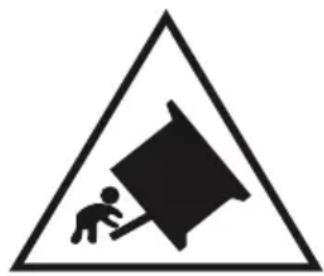
WARNING: To prevent the appliance tipping, the stabilising brackets must be installed. (For detailed information refer to the anti-tilting kit set guide.)
natural_image
Warning sign depicting a person pulling a large object into a triangle (no text or symbols)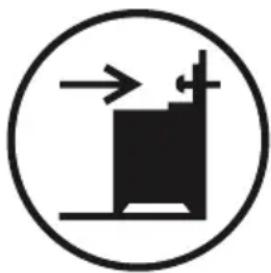
natural_image
Simple black-and-white diagram of a building inside a circle with arrows indicating direction (no text or symbols)- During use the appliance will get hot. Care should be taken to avoid touching heating elements inside the oven.
- Handles may become hot after a short period during use.
- Do not use harsh abrasive cleaners or scourers to clean oven surfaces. They can scratch the surfaces which may result in shattering of the door glass or damage to surfaces.
- Do not use steam cleaners to clean the appliance.
⚠️ WARNING: To avoid the possibility of electric shock, make sure that the appliance is switched off before replacing the lamp.
⚠️ CAUTION: Accessible parts may be hot when cooking or grilling. Keep young children away from the appliance when it is in use.
- Your appliance is produced in accordance with all
applicable local and international standards and regulations.
- Maintenance and repair work should only be carried out by authorised service technicians. Installation and repair work that is carried out by unauthorised technicians may be dangerous. Do not alter or modify the specifications of the appliance in any way. Inappropriate hob guards can cause accidents.
- Before connecting your appliance, make sure that the local distribution conditions (nature of the gas and gas pressure or electricity voltage and frequency) and the specifications of the appliance are compatible. The specifications for this appliance are stated on the label.
⚠️ CAUTION: This appliance is designed only for cooking food and is intended for indoor domestic household use only. It should not be used for any other purpose or in any other application, such as for non-domestic use, in a commercial environment or for heating a room.
- Do not use the oven door handles to lift or move the appliance.
- This appliance is not connected to a ventilation device. It should be installed and connected in accordance with current installation regulations. Particular attention shall be given to the relevant requirements regarding ventilation.
- If the burner has not lit after 15 seconds, stop operating the device and open the compartment door. Wait at least 1 minute before attempting to ignite the burner again.
• These instructions are only valid if the correct country symbol appears on the appliance. If the symbol does not appear on the appliance, refer to
the technical instructions which describe how to modify the appliance to match the conditions of use of the country.
- All possible measures have been taken to ensure your safety. Since the glass may break, care should be taken while cleaning to avoid scratching. Avoid hitting or knocking the glass with accessories.
- Make sure that the supply cord is not trapped or damaged during installation. If the supply cord is damaged, it must be replaced by the manufacturer, its service agent or similarly qualified persons in order to prevent a hazard.
- Do not let children climb on the oven door or sit on it while it is open.
- If your appliance is provided with a cooking hotplate made of glass or glass ceramic:
CAUTION: "In case of hotplate glass breakage":
- immediately shut off all burners and any electrical heating element and isolate the appliance from the power supply
- do not touch the appliance surface
- do not use the appliance.
- Please keep children and animals away from this appliance.
1.2 Installation Warnings
- Do not operate the appliance before it is fully installed.
- The appliance must be installed by an authorised technician. The manufacturer is not responsible for any damage that might be caused by incorrect placement and installation by unauthorised people.
- When the appliance is unpacked, make sure that it is has not been damaged during transportation.
In the case of a defect do not use the appliance and contact a qualified service agent immediately. The materials used for packaging (nylon, staplers, styrofoam, etc.) may be harmful to children and they should be collected and removed immediately.
- Protect your appliance from the atmosphere. Do not expose it to sun, rain, snow, dust or excessive humidity.
- Materials around the appliance (i.e. cabinets) must be able to withstand a minimum temperature of 100^ .
- The appliance must not be installed behind a decorative door, in order to avoid overheating.
1.3 During Use
- When you first use your oven you may notice a slight smell. This is perfectly normal and is caused by the insulation materials on the heater elements. We suggest that, before using your oven for the first time, you leave it empty and set it at maximum temperature for 45 minutes. Make sure that the environment in which the product is installed is well ventilated.
• Take care when opening the oven door during or after cooking. The hot steam from the oven may cause burns. - Do not put flammable or combustible materials in or near the appliance when it is operating.
• Always use oven gloves to remove and replace food in the oven.


Do not leave the cooker unattended when ing with solid or liquid oils. They may catch fire extreme heating conditions. Never pour water flames that are caused by oil, instead switch the
cooker off and cover the pan with its lid or a fire blanket.
• Always position pans over the centre of the cooking zone, and turn the handles to a safe position so they cannot be knocked.
- If the product will not be used for a long period of time, turn the main control switch off. Turn the gas valve off when gas appliances are not in use.
- Make sure the appliance control knobs are always in the “0” (stop) position when the appliance is not in use.
- The trays incline when pulled out. Take care not to spill or drop hot food when removing it from the oven.
⚠️ CAUTION: The use of a gas cooking appliance results in the production of heat, moisture and products of combustion in the room in which it is installed. Ensure that the kitchen is well ventilated especially when the appliance is in use, keep natural ventilation holes open or install a mechanical ventilation device (mechanical extractor hood).
- Prolonged intensive use of the appliance may call for additional ventilation, such as opening a window, or for more effective ventilation, for example by increasing the level of mechanical ventilation where present.
- While using the grill burner, keep the oven door open and always use the grill deflector shield supplied with the product. Never use the grill burner with the oven door closed.
⚠️ CAUTION: Glass lids may shatter when heated. Turn off all the burners and allow the hob surface to cool before closing the lid.
natural_image
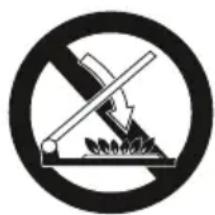
Symbol of a diagonal slash over a slope, indicating no change or obstruction (no text present)- Do not place anything on the oven door when it is open. This could unbalance the oven or damage the door.
- Do not place heavy or flammable items (e.g. nylon, plastic bags, paper, cloth, etc.) into the drawer. This includes cookware with plastic accessories (e.g. handles).
⚠️ CAUTION: The inside surface of the storage compartment may get hot when the appliance is in use. Avoid touching the inside surface.
- Do not hang towels, dishcloths or clothes from the appliance or its handles.
1.4 During Cleaning and Maintenance
- Make sure that your appliance is turned off at the mains before carrying out any cleaning or maintenance operations.
- Do not remove the control knobs to clean the control panel.
- To maintain the efficiency and safety of your appliance, we recommend you always use original spare parts and to call our authorised service agents when needed. CE Declaration of conformity
CE We declare that our products meet the applicable European Directives, Decisions and Regulations and the requirements listed in the standards referenced.
This appliance has been designed to be used only for home cooking. Any other use (such as heating a room) is improper and dangerous.
The operating instructions apply to several models. You may notice differences between these instructions and your model.
Disposal of your old machine
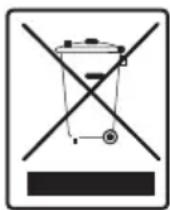
This symbol on the product or on its packaging indicates that this product should not be treated as household waste. Instead it should be handed over to the applicable collection point for the recycling of electrical and electronic equipment. By ensuring this product is disposed of correctly, you will help prevent potential negative consequences for the environment and human health, which could otherwise be caused by inappropriate waste handling of this product. For more detailed information about recycling of this product, please contact your local city office, your household waste disposal service or the retailer who you purchased this product from.
2. INSTALLATION AND PREPARATION FOR USE

WARNING : This appliance must be installed by an authorised service person or qualified technician, according to the instructions in this guide and in compliance with the current local regulations.
- Incorrect installation may cause harm and damage, for which the manufacturer accepts no responsibility and the warranty will not be valid.
- Prior to installation, ensure that the local distribution conditions (electricity voltage and frequency and/or nature of the gas and gas pressure) and the adjustments of the appliance are compatible. The adjustment conditions for this appliance are stated on the label.
- The laws, ordinances, directives and standards in force in the country of use are to be followed (safety regulations, proper recycling in accordance with the regulations, etc.).
2.1 Instructions for the Installer Ventilation requirements
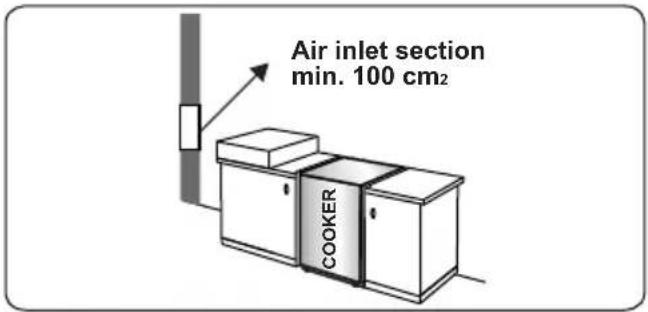
- For rooms with a volume of less than 5m_3 , permanent ventilation of 100cm_2 free area is required.
- For rooms with a volume of between 5 m 3 and 10 m 3 , permanent ventilation of 50 cm _2 free area will be required, unless the room has a door which opens directly to outside air in which case no permanent ventilation is required.
- For rooms with a volume greater than 10m^3 , no permanent ventilation is required.

Important: Regardless of room size, all ms containing the appliance must have ct access to outside air via an openable dow or equivalent.
Emptying of burned gases from the environment
Gas appliances expel burned gas waste to the outside air, either directly or via a cooker hood with a chimney. If it is not possible to install a cooker hood, install a fan on the window or wall that has access to fresh air. The fan must have the capacity to change the volume of air in the kitchen a minimum of 4-5 times per hour.
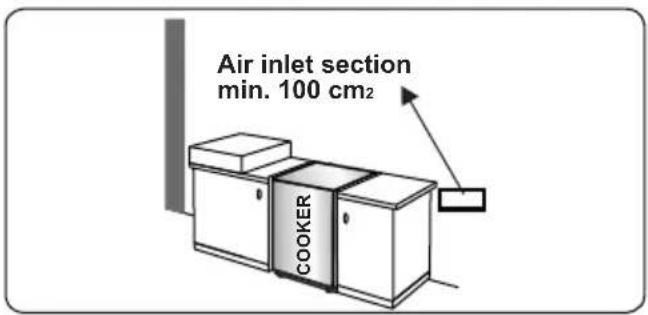
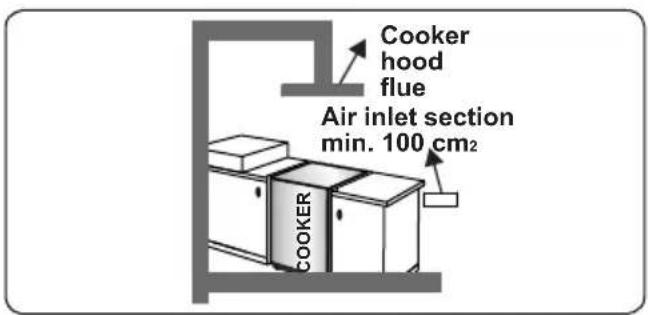
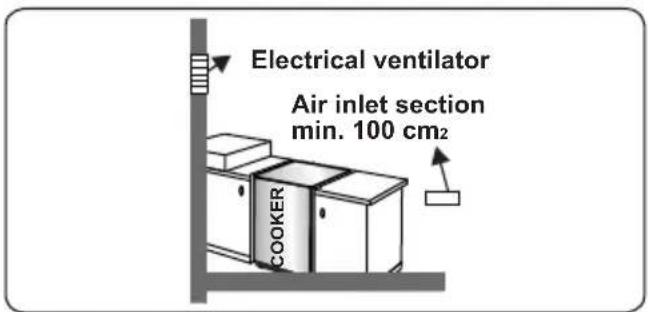
General instructions
• After removing the packaging material from the appliance and its accessories, ensure that the appliance is not damaged. If you suspect any damage, do not use it and contact an authorised service person or qualified technician immediately.
- Make sure that there are no flammable or combustible materials in the close vicinity, such as curtains, oil, cloth etc. which may catch fire.
- The worktop and furniture surrounding the appliance must be made of materials resistant to temperatures above 100°C.
- The appliance should not be installed directly above a dishwasher, fridge, freezer, washing machine or clothes dryer.
- The appliance can be placed close to other furniture on condition that, in the area where the appliance is set up, the furniture's height does not exceed the height of the cooktop.
2.2 Installation of the Cooker
- If the kitchen furniture is higher than the cooktop, the kitchen furniture must be at least 10 cm away from the sides of appliance for air circulation.
- There should be a minimum 2cm blank space around the appliance for air circulation.
- If a cooker hood or cupboard is to be installed above the appliance, the safety distance between cooktop and any cupboard/cooker hood should be as shown below.
| A (mm) Cupboard 420 | |
| B (mm) Cooker Hood 650/700 | |
| C (mm) 20 | |
| D (mm) Product Width | |
| E (mm) 100 |
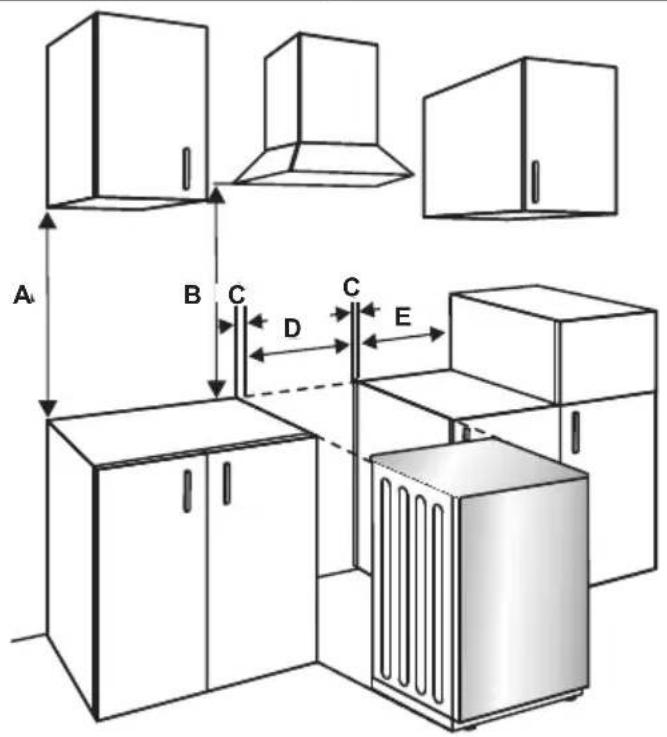
2.3 Gas Connection
Assembly of gas supply and leakage check
Connect the appliance in accordance with applicable local and international standards and regulations. First, check what type of gas is installed on the cooker. This information is available on a sticker on the back of the cooker. You can find the information related to appropriate gas types and appropriate gas injectors in the technical data table. Check that the feeding gas pressure matches the values on the technical data table, to be able to get the most efficient use and to ensure the minimum gas consumption. If the pressure of used gas is different than the values stated or is not stable in your area, it may
be necessary to assemble an available pressure regulator on the gas inlet. You should contact an authorised service centre to make these adjustments.
Points that must be checked during flexible hose assembly:
- If the gas connection is made by a flexible hose fixed onto the gas inlet of the hob, it must be fixed on by a pipe collar.
- Connect your appliance with a short and durable hose that is as close as possible to the gas source.
-
The permitted maximum length of the hose is 1.5 m.
-
The device should be connected in line with the relevant local gas standards.
- The hose must be kept clear of areas that may heat up to temperatures of more than 90^ .
- The hose must not be cracked, torn, bent or folded.
- Keep the hose clear of sharp corners and objects that could move.
- Before you assemble the connection, you must make sure the hose is not damaged. Use bubbly water or leakage fluids to perform the check. Do not use a naked flame to check for gas leakage.
- All metal items that are used during gas connection must be free from rust. Check the expiry date of any components used for connection.
Points that must be checked during fixed gas connection assembly
The method used to assemble a fixed gas connection (gas connection made by threads, e.g. a nut) varies according to the country you are in. The most common parts for your country will be supplied with your appliance. Any other parts required can be supplied as spare parts.
During connection, always keep the nut on the gas manifold fixed while rotating the counter-part. Use appropriately-sized spanners for a safe connection. For surfaces between different components always use the seals provided in the gas conversion kit.
The seals used during connection should also be approved to be used in gas connections. Do not use plumbing seals for gas connections.
Remember that this appliance is ready to be connected to the gas supply in the country for which it has been produced. The main country of destination is marked on the rear cover of the appliance. If you need to use it in another country, any of the connections in the figure below may be required. In such a case, contact local authorities to learn the correct gas connection.
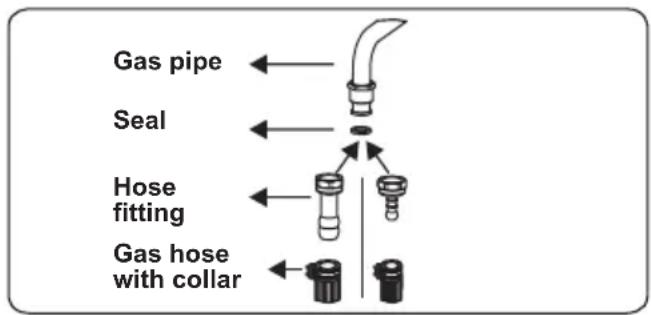
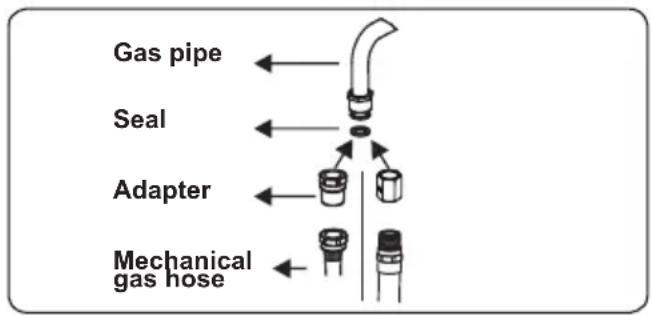
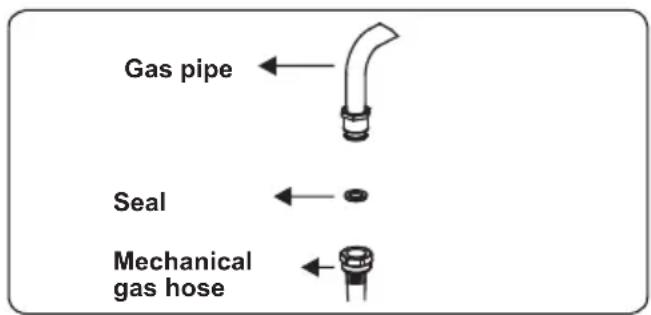
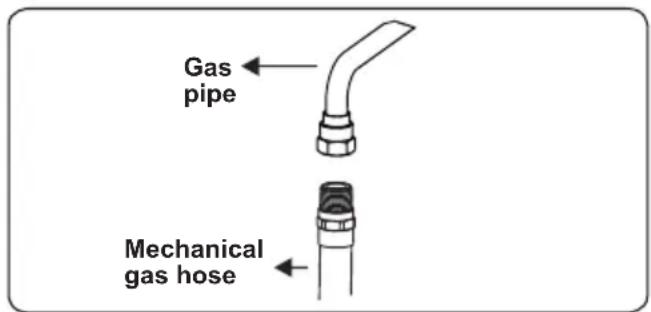
The Cooker must be installed and maintained by a suitably qualified gas registered technician in accordance with current safety legislation.

WARNING: Do not use a naked flame to check for gas leaks.
2.4 Gas Conversion (if available)
Your appliance is designed to be operated with LPG/NG gas. The gas burners can be adapted to different types of gas, by replacing the corresponding injectors and adjusting the minimum flame length suitable to the gas in use. For this purpose, the following steps should be performed.
Changing injectors Hob burners
- Cut off the main gas supply and unplug the appliance from the mains electrical supply.
- Remove the burner caps and the adapters.
- Use a 7 mm spanner to unscrew the injectors.
- Replace the injector with the ones from the gas conversion kit, with the correct diameters for the type of gas that is going to be used, according to the gas injector table.
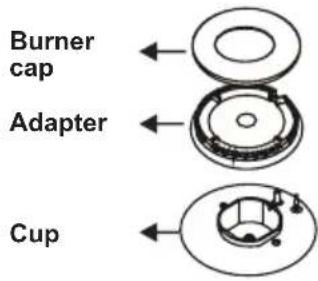
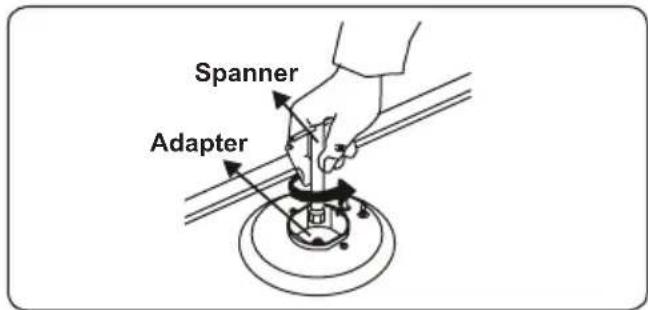
Adjusting the minimum flame position:
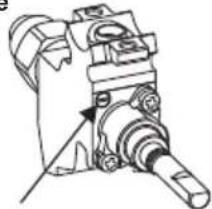
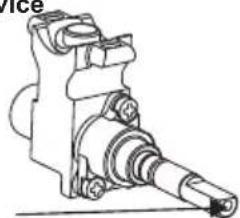
First of all, make sure that the appliance is unplugged from the mains electrical supply and that the gas feed is open. The minimum flame position is adjusted with a flat screw located on the valve. For valves with a flame failure safety device, the screw is located on the side of the valve spindle as shown in the figures. For valves without a flame failure safety device, the screw is located inside the valve spindle as shown in the figure. To make adjusting the flame position easier, we recommend that you remove the control panel (and the micro switch if your model has one) during the alteration. The bypass screw must be loosened for conversion from LPG to NG. For conversion from NG to LPG, the bypass screw must be tightened.
Valve with flame failure device
natural_image
Mechanical assembly diagram showing a shaft and housing component (no text or labels)Bypass screw
Valve with flame failure device
natural_image
Technical line drawing of a mechanical assembly (no text or symbols)Screw(inside the hole)
Determining the minimum flame position
To determine the minimum position, ignite the burners and leave them on in the minimum position. Remove the knobs because the screws are accessible only when the knobs are removed. With the help of a small screwdriver, fasten or loosen the bypass screw by around 90 degrees. When the flame has a length of at least 4mm, the gas is well distributed. Make sure that the flame does not die out when passing from the maximum position to the minimum position. Create an artificial wind with your hand towards the flame to see if the flames are stable.
Changing the gas inlet
For some countries, the gas inlet type can be different for NG/LPG gases. In this case, remove the current connection components and nuts (if any) and connect the new gas supply accordingly. In all conditions, all components used in gas connections should be approved by local and/or international authorities. In all gas connections, refer to the “Assembly of gas supply and leakage check” clause explained above.
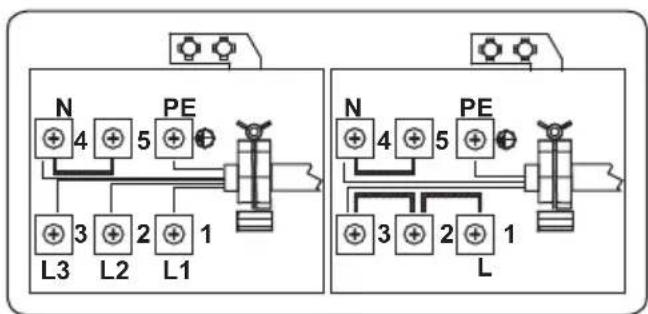
2.5 Electrical Connection and Safety (if available)
WARNING: The electrical connection of this appliance should be carried out by an authorised service person or qualified electrician, according to the instructions in this guide and in compliance with the current local regulations.
WARNING: THE APPLIANCE MUST BE EARTHED.
- Before connecting the appliance to the power supply, the voltage rating of the appliance (stamped on the appliance identification plate) must be checked for correspondence to the available mains supply voltage, and the mains electric wiring should be capable of handling the appliance's power rating (also indicated on the identification plate).
Anti-tilting kit
- During installation, please ensure that isolated cables are used. An incorrect connection could damage your appliance. If the mains cable is damaged and needs to be replaced this should be done by a qualified personnel.
- Do not use adaptors, multiple sockets and/or extension leads.
- The supply cord should be kept away from hot parts of the appliance and must not be bent or compressed. Otherwise the cord may be damaged, causing a short circuit.
- If the appliance is not connected to the mains with a plug, a all-pole disconnector (with at least 3 mm contact spacing) must be used in order to meet the safety regulations.
- The appliance is designed for a power supply of 220-240 V\~. If your supply is different, contact the authorized service personnel or qualified electrician.
- The power cable (H05VV-F) must be of sufficient length to be connected to the appliance.
- The fused switch must be easily accessible once the appliance has been installed.
- Ensure all connections are adequately tightened.
- Fix the supply cable in the cable clamp and then close the cover.
- The terminal box connection is placed on the terminal box.
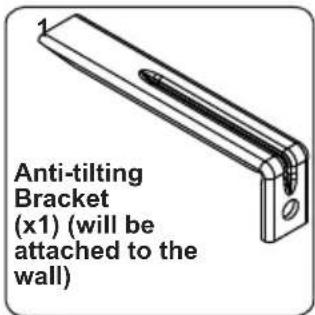
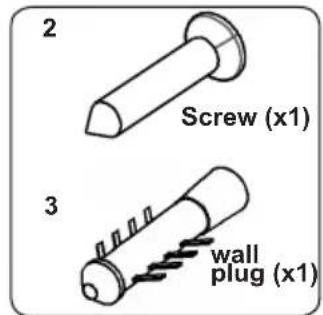
The document bag contains an anti-tilting kit. Loosely attach the anti-tilting bracket (1) to the wall using the screw (2) and wall plug (3), following the measurements shown in the figure and table below. Adjust the height of the anti-tilting bracket so that it lines up with the slot on the cooker and tighten the screw. Push the appliance towards the wall making sure that the anti-tilting bracket is inserted into the slot on the rear of the appliance.
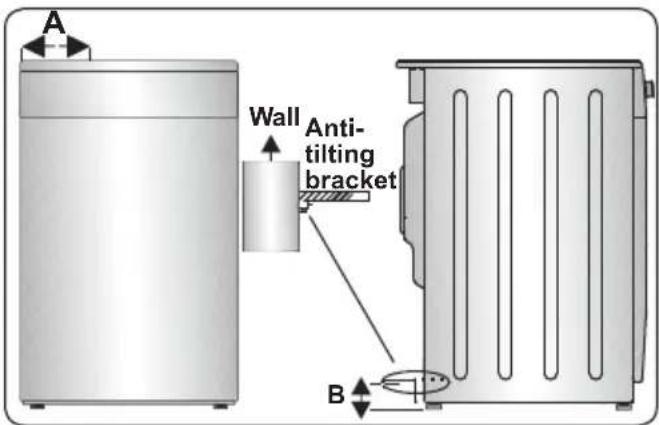
| Product Dimensions (Width X Depth X Height) (Cm) | A (mm) | B (mm) |
| 60x60x90 (Double Oven) 297 | 5 52 | |
| 50x60x90 (Double Oven) 247 | 5 52 | |
| 90x60x85 430 107 | ||
| 60x60x90 309.5 112 | ||
| 60x60x85 309.5 64 | ||
| 50x60x90 247.5 112 | ||
| 50x60x85 247.5 64 | ||
| 50x50x90 247.5 112 | ||
| 50x50x85 247.5 64 |
2.6 Adjusting the feet
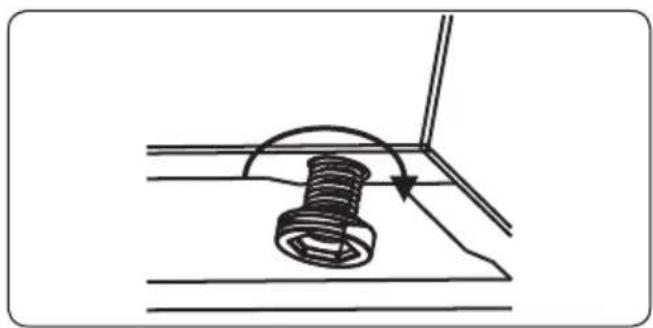
Your product stands on four adjustable feet. For safe operation, it is important that your appliance is correctly balanced. Make sure the appliance is level prior to cooking. To increase the height of the appliance, turn the feet anti-clockwise. To decrease
the height of the appliance, turn the feet clockwise.
It is possible to raise the height of the appliance up to 30 mm by adjusting the feet. The appliance is heavy and we recommend that a minimum of 2 people lift it. Never drag the appliance.
natural_image
Diagram of a mechanical assembly with a bolt and curved arrow indicating rotation (no text or symbols)3. PRODUCT FEATURES

Important: Specifications for the product vary and the appearance of your appliance may differ from that shown in the figures below.
List of Components
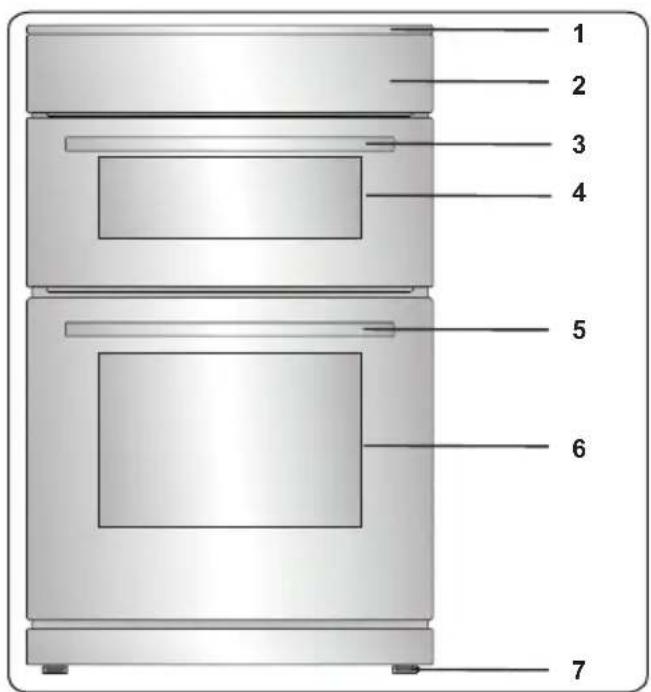
- Cooktop
- Control Panel
- Top Oven Door Handle
- Top Oven Door
- Main Oven Door Handle
- Main Oven Door
- Adjustable Feet
Control Panel
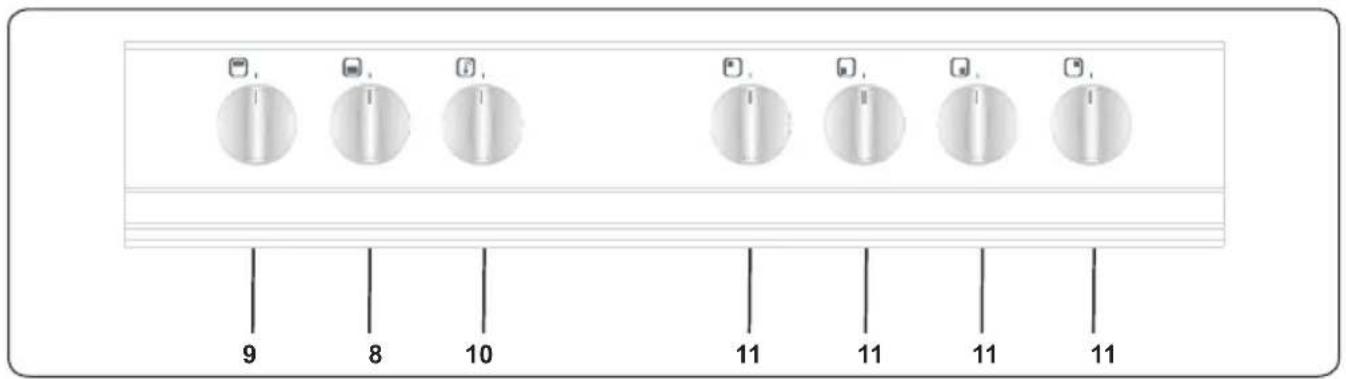
- Main Oven Control Knob
- Top Oven Control Knob
- Main Oven Thermostat Knob
- Hob Control Knob
4. USE OF PRODUCT
4.1 Use of gas burners Ignition of the burners
The position symbol above each control knob indicates the burner that the knob controls.
Manual Ignition of the Gas Burners
If your appliance is not equipped with an ignition aid, or in case there is a failure in the electric network, follow the procedures listed below.
For Hob Burners: Push in the knob of the burner you wish to ignite and keep it pressed while turning it anti-clockwise until the knob is in the 'maximum' position. Continue pressing the knob and hold a lit match, taper or other manual aid to the upper circumference of the burner. Move the ignition source away from the burner as soon as you see a stable flame.
Electrical ignition by control knob
Push in the knob of the burner you wish to ignite and keep it pressed while turning it anticlockwise until the knob is in the 90 degrees position. The microswitch under the knob will create sparks through the spark plug for as long as the control knob is pressed. Press the knob until you see a stable flame on the burner.
4.2 Use of Gas Burners Ignition of the Burners
The position symbol above each control knob indicates the burner that the knob controls.
Manual ignition of the gas burners
If your appliance is not equipped with an ignition aid, or in case there is a failure in the electric network, follow the procedures listed below.
For hob burners: Push in the knob of the burner you wish to ignite and keep it pressed while turning it anti-clockwise until the knob is in the ‘maximum’ position. Continue pressing the knob and hold a lit match, taper or other manual aid to the upper circumference of the burner. Move the ignition source away from the burner as soon as you see a stable flame.
For oven burner: Push in and turn the oven control knob anti-clockwise until the knob is in the 'maximum' position. Hold a lit match, taper or other manual aid to the ignition hole that is located on the front left corner of the burner. Move the ignition source away as soon as you see a stable flame.
For grill burner: Push in and turn the grill control knob clockwise until the marker on the knob points at the grill sign. Continue pressing the knob and hold a lit match, taper or other manual aid to the holes on the burner. Move the ignition source away from the burner as soon as you see a stable flame.
Electrical ignition by control knob
Push in the knob of the burner you wish to ignite and keep it pressed while turning it anti-clockwise until the knob is in the 90 degrees position. The microswitch under the knob will create sparks through the spark plug for as long as the control knob is pressed. Press the knob until you see a stable flame on the burner.
Flame safety device
Hob burners
Hobs equipped with a flame failure device provide security in case of an accidentally extinguished flame. If such a case occurs, the device will block the burners gas lines and will avoid any accumulation of unburned gas. Wait 90 seconds before re-igniting an extinguished gas burner.Hob Controls
Hob burner
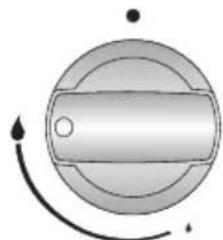
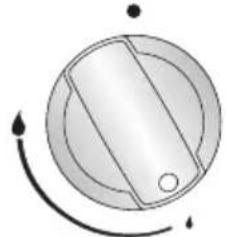
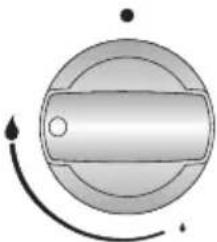
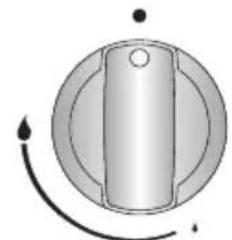
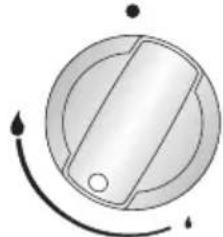
The knob has 3 positions: off (0), maximum (big flame symbol) and minimum (small flame symbol). Ignite the burner with the knob in the 'maximum' position; you can then adjust the flame length between the 'maximum' and 'minimum' positions. Do not operate the burners when the knob is between the 'maximum' and 'off' positions.
natural_image
Simple diagram of a knob or dial with arrows indicating rotation (no text or symbols)OFF position
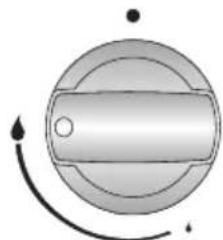
natural_image
Pure mechanical component diagram without any text, numbers, or symbolsMAX position

natural_image
Simple diagram of a circular object with internal divisions and directional arrows, no text or symbols present.MIN. position MODULATE
natural_image
Simple diagram of a circular device with a handle and arrow, no text or symbols present.After ignition, visually check the flames. If you see a yellow tip, lifted or unstable flame, switch the gas flow off, then check the assembly of burner caps and crowns once they have cooled. Make sure there is no liquid in the burner caps. If the burner flames go out accidentally, switch the burners off, ventilate the kitchen with fresh air and wait at least 90 seconds before attempting re-ignition.
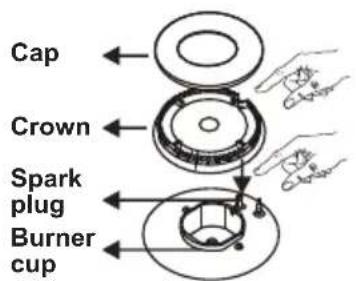
To switch the hob burners off, turn the hob burner knob clockwise to the '0' position or so that the marker on the hob burner knob points upwards.
Your hob has burners of different diameters. You will find that the most economical way of using gas is to choose the correct size gas burner for your cooking pan size and to bring the flame to the 'minimum' position once boiling point is reached. We recommend that you always cover your cooking pan to avoid heat loss.
To obtain maximum performance from the main burners, we suggest you use pots with the following flat bottom diameters. Using pots smaller than the minimum dimensions shown below will cause energy loss.
| Rapid / Wok Burner 22-26 cm | |
| Semi-rapid Burner 14-22 cm | |
| Auxiliary Burner 12-18 cm |
Make sure that the tips of the flames do not spread out from the outer circumference of the pan, as this may harm plastic accessories, such as handles.
Switch the main gas control valve off when the burners are not in use for prolonged periods of time.

WARNING:
- Only use flat-bottomed pans with thick bases.
• Make sure the bottom of the pan is dry before placing it on the burner. - The temperature of accessible parts may become high while the appliance is operating. It is imperative that children and animals are kept well away from the burners during and after cooking.
• After use, the hob remains very hot for a prolonged period of time. Do not touch it and do not place any object on top of it. - Never place knives, forks, spoons and lids on the hob as they will get hot and could cause serious burns.
- Do not allow pan handles or any other cooking utensils to project over the edge of the cooker top.
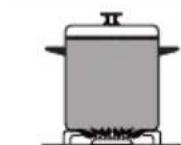

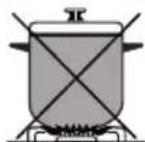

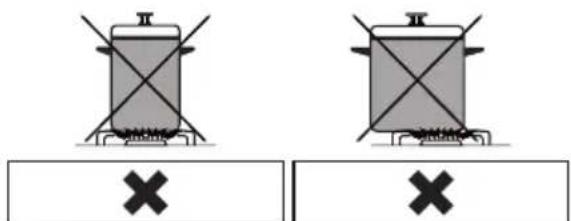
Circular Saucepan Base
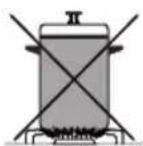

Small Saucepan Diameter
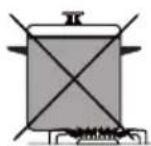

Saucepan base that has not settled
Main Oven Functions
* The functions available on your oven may differ from those listed below depending on the model purchased.
natural_image
Abstract circular graphic with concentric arrows and a central pattern, no text or symbols present.Defrost Function:
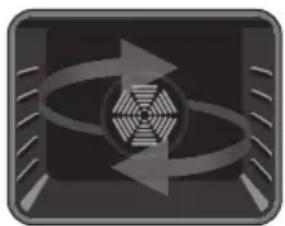
Switch on the DEFROST function using the main oven function control knob. The oven's warning lights will switch on, and the fan will start operating. To use the defrost function, place your frozen food on a shelf in the middle of the oven. It is recommended that you put an oven tray under the defrosting food to catch accumulated water due to melting ice. This function will not cook or bake your food, it will only help to defrost it.
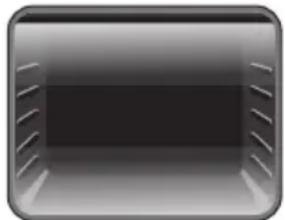
natural_image
Gray gradient rectangular button with ventilation grilles (no text or symbols)Static Cooking
Function: Switch on the STATIC function using the main oven function control knob. The oven's thermostat and warning lights will switch on, and the
lower and upper heating elements will start operating. The temperature can be adjusted using the main oven function control knob. The static cooking function emits heat, ensuring even cooking of food. This is ideal for making pastries, cakes, baked pasta, lasagne and pizza. Preheating the oven for 10 minutes is recommended and it is best to cook on only one shelf at a time in this function.
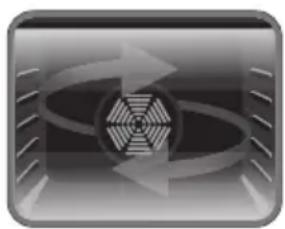
natural_image
Abstract grayscale graphic with circular arrows and a central grid pattern (no text or symbols)Fan Function: Switch on the FAN function using the main oven control knob. The oven's thermostat and warning lights will switch on, and the upper and lower
heating elements and fan will start operating. The temperature can be adjusted using the main oven thermostat knob. Cooking is carried out by the lower and upper heating elements within the oven while the fan provides air circulation, dispersing the heat and giving the food a slightly grilled effect. It is recommended you preheat the oven for 10 minutes.
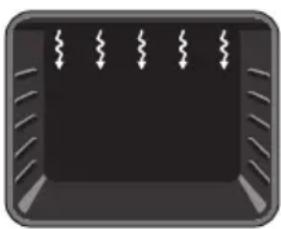
natural_image
Simple diagram of a black rectangular object with five white zigzag arrows on its top surface, surrounded by side slats (no text or symbols)Grilling Function:
Switch on the GRILLING function using the main oven control knob. The oven's thermostat and warning lights will switch on, and the grill heating element will start operating. The temperature can be adjusted using the main oven thermostat knob. This function is used for grilling and toasting food. Use the upper shelves of the oven. Lightly brush the wire grid with oil to stop food sticking and place food in the centre of the grid. Always place a tray beneath the food to catch any drips of oil or fat. It is recommended that you leave the grill to preheat for 10 minutes.

Warning: When grilling, the oven door must be closed and the oven
temperature should be adjusted to 190^ C.
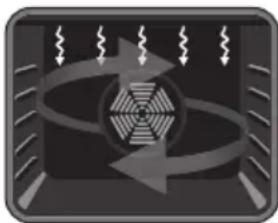
natural_image
Abstract diagram with circular arrows and waveforms, no readable text or symbolsGrill and Fan
Function: Switch on the GRILL AND FAN function using the main oven control knob. The oven's thermostat and warning lights will switch on, and the grill
heating element and fan will start operating. The temperature can be adjusted using the main oven thermostat knob. This function is ideal for thicker foods. When grilling, use the upper shelves of the oven. Lightly brush the wire grid with oil to stop food sticking and place food in the centre of the grid. Always place a tray beneath the food to catch any drips of oil or fat.

Warning: When grilling, the oven door must be closed and the oven temperature should be adjusted to C.
Top Oven Functions
* The functions available on your oven may differ from those listed below depending on the model purchased.
natural_image
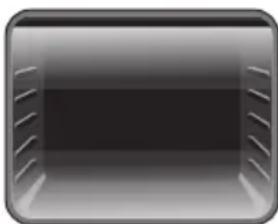
Gray gradient rectangular button with ventilation grilles (no text or symbols)Static Cooking
Function: Switch on the STATIC function using the top oven function control knob. The oven thermostat and warning lights will illuminate, and the
upper and lower heating elements will switch on. The temperature can be adjusted using the top oven function control knob. The heat generated by the upper and lower
heating elements ensures that food is cooked evenly. You will find this setting ideal for cooking cakes, baked pasta, lasagne, and pizza. We recommend that the oven is preheated for 10 minutes before use and that you cook on one rack at a time.
natural_image
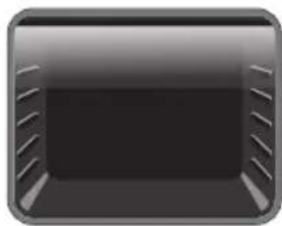
Abstract dark rectangular shape with a gradient fill and side slats, no text or symbols present.Upper Heating
Function: Switch on the UPPER function using the top oven function control knob. The oven thermostat and warning lights will illuminate, and the
upper heating element will switch on. The temperature setting will set to the highest level for this function. The UPPER heating function is ideal for heating food or for frying the top of food that has already been cooked, as the heat radiates from the upper heating element closest to the top of the food.
natural_image
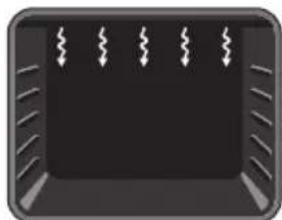
Simple diagram of a device with five vertical lines and downward arrows, no text or symbols present.Grilling Function:
Switch on the GRILL function using the top oven function control knob. The oven thermostat and warning lights will
illuminate, and the grill heating element will switch on. Use this function for grilling. When you have finished grilling, switch the top oven off. Keep children away from the oven during grilling and until it has fully cooled after use.

Warning: The top oven door must be fully open when this function is selected.
natural_image
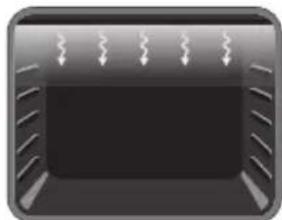
Simple diagram of a tray with arrows indicating downward flow or movement (no text or symbols)Faster Grilling
Function: Switch on the FASTER GRILL function using the function selector knob. The oven thermostat and warning lights will
illuminate, and the grill and upper heating elements will switch on. Use this function for wide area grilling. When you have finished grilling, switch the top oven off. Keep children away from the oven during grilling and until the oven has fully cooled after use.

Warning: The top oven door must be fully open when this function is
selected.
Accessories
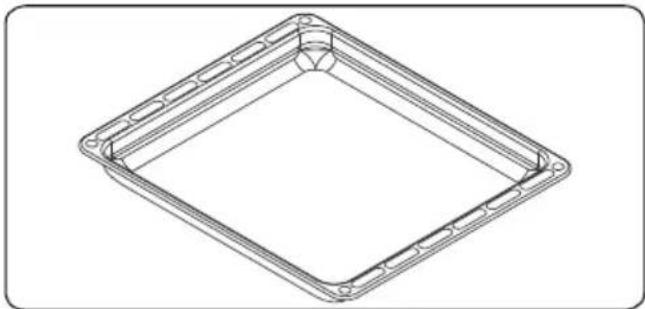
The Deep Tray
The deep tray is best used for cooking stews.
Put the tray into any rack and push it to the end to make sure it is placed correctly.
natural_image
Technical line drawing of a square frame with bolt holes and a central circular hole (no text or symbols)The Grill Heat Shield
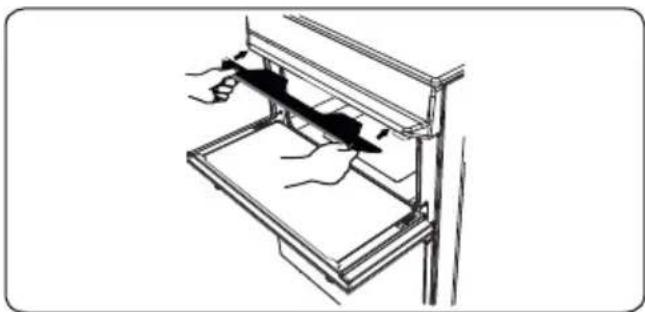
WARNING
When the grill is in use for longer than 15 minutes, always fit the heat shield provided to prevent the control knobs from overheating. Take care to avoid touching the heat shield when closing the oven door. Allow the heat shield to cool before removing.
natural_image
Line drawing of a hand holding a tool above a tray with a ruler, no text or symbols present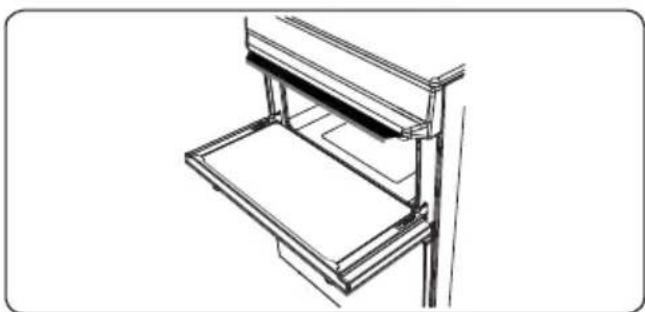
natural_image
Line drawing of a mechanical device with a rectangular frame and a horizontal panel (no text or symbols)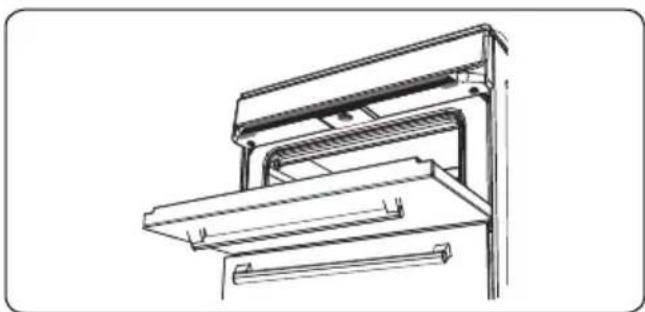
natural_image
Technical line drawing of a mechanical assembly or lifting device (no text or symbols)The Shallow Tray
The shallow tray is best used for baking pastries.
Put the tray into any rack and push it to the end to make sure it is correctly placed.
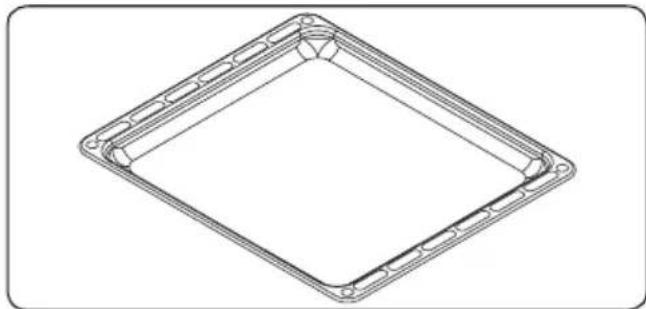
natural_image
Technical line drawing of a square frame with circular cutouts and mounting holes (no text or symbols)The Wire Grid
The wire grid is best used for grilling or for processing food in oven-friendly containers.
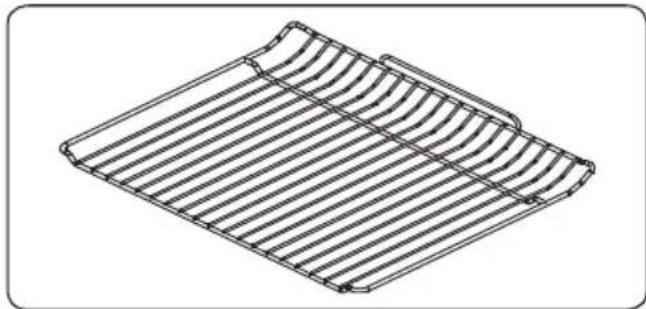
natural_image
Line drawing of a corrugated metal tray with ribbed sides (no text or symbols)
WARNING
Place the grid to any corresponding rack in the oven cavity correctly and push it to the end.
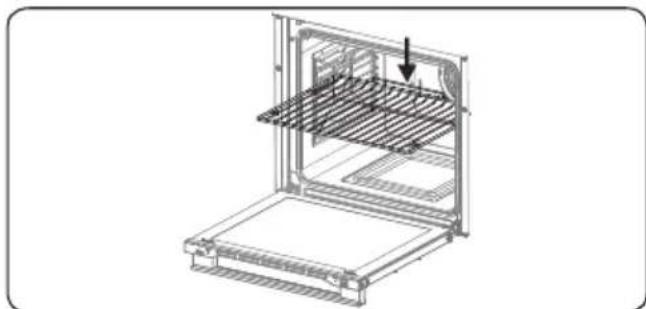
natural_image
Technical line drawing of an oven with a rack and vent, showing internal structure without any text or symbols5. CLEANING AND MAINTENANCE
5.1 Cleaning

WARNING: Switch off the appliance and allow it to cool before cleaning is to be carried out.
General Instructions
- Check whether the cleaning materials
are appropriate and recommended by the manufacturer before use on your appliance.
- Use cream cleaners or liquid cleaners which do not contain particles. Do not use caustic (corrosive) creams, abrasive cleaning powders, rough wire wool or hard tools as they may damage the cooker surfaces.

Do not use cleaners that contain articles, as they may scratch the glass, smelled and/or painted parts of your reliance.
- Should any liquids overflow, clean them immediately to avoid parts becoming damaged.

Do not use steam cleaners for cleaning part of the appliance.
Cleaning the Inside of the Oven
- The inside of enamelled ovens are best cleaned while the oven is warm.
- Wipe the oven with a soft cloth soaked in soapy water after each use. Then, wipe the oven over again with a wet cloth and dry it.
- You may need to use a liquid cleaning material occasionally to completely clean the oven.
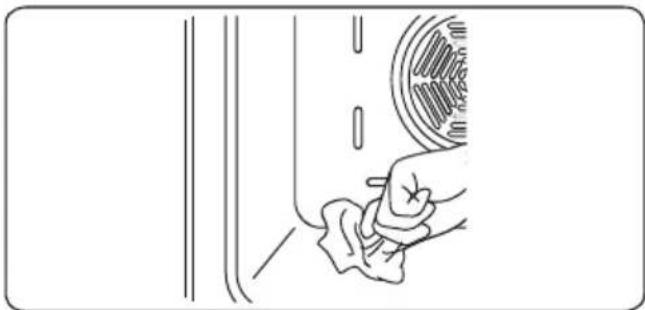
natural_image
Line drawing of a hand cleaning a car window with a circular vent (no text or symbols)Catalytic Cleaning
Catalytic liners are installed within the oven cavity. These are the matte-finished, light-coloured panels on the sides and/or the matte-finished panel at the rear of the oven. They work by collecting any grease and oil residue during cooking. Catalytic liners are designed to have a working life of about 300 hours.
The liner self-cleans by absorbing fats and oils and burning them to ash, which can then be easily removed from the floor of the oven with a damp cloth. The lining must be porous to be effective. The liner may discolour with age.
If a large amount of fat is spilled onto the liner it may reduce its efficiency. To overcome this problem, set the oven to maximum temperature for about 20 - 30 minutes. After the oven has cooled, wipe out the floor of the oven.
Manual cleaning of the catalytic liners is not recommended. Damage will occur if a soap-impregnated steel wool pad or any other abrasives are used. In addition, we do not recommend the use of aerosol cleaners on the liners. The walls of a catalytic liner may become ineffective due to excess grease. The excess grease can be removed with a soft cloth or sponge soaked in hot water and the cleaning cycle can be carried out as described above.
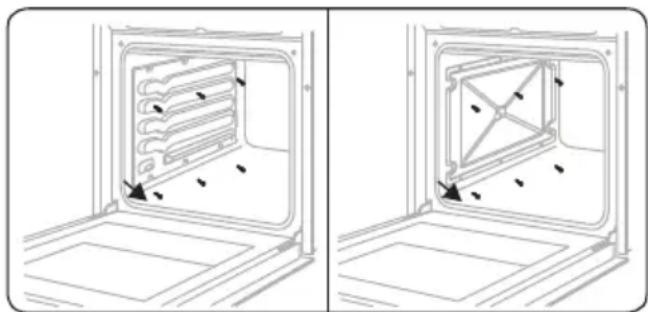
Removal of Catalytic Liner
To remove the catalytic liner, remove the screws holding each catalytic panel to the oven.
natural_image
Technical line drawing of an oven with internal compartments and mounting base (no text or symbols)Cleaning the Gas Hob
- Clean the gas hob on a regular basis.
• Take off the pan supports, caps and crowns of the hob burners. - Wipe the hob surface with a soft cloth soaked in soapy water. Then, wipe the hob surface over again with a wet cloth and dry it.
- Wash and rinse the hob-burner caps. Do not leave them wet. Dry them immediately with a dry cloth.
• Make sure you re-assemble all parts correctly after cleaning. - The surfaces of the pan supports may become scratched over time due to use. This is not a production fault.
Do not use a metal sponge for cleaning any part of the hob.
Make sure no water gets into the burners as this may block the injectors.
Cleaning the Hotplate Heater (if available)
- Clean the hotplate heater on a regular basis.
- Wipe the hotplate with a soft cloth soaked in only water. Then, run the hotplate for a short time to dry it completely.
Cleaning the Glass Parts
- Clean the glass parts of your appliance on a regular basis.
- Use a glass cleaner to clean the inside and outside of the glass parts. Then, rinse and dry them thoroughly with a dry cloth.
Cleaning the Enamelled Parts
- Clean the enamelled parts of your appliance on a regular basis.
- Wipe the enamelled parts with a soft cloth soaked in soapy water. Then, wipe them over again with a wet cloth and dry them.
Do not clean the enamelled parts while they are still hot from cooking.
Do not leave vinegar, coffee, milk, salt, water, lemon or tomato juice on the enamel for a long time.
Cleaning the Stainless Steel Parts (if available)
- Clean the stainless steel parts of your appliance on a regular basis.
- Wipe the stainless steel parts with a soft cloth soaked in only water. Then, dry them thoroughly with a dry cloth.
Do not clean the stainless steel parts while they are still hot from cooking.
Do not leave vinegar, coffee, milk, salt, water, lemon or tomato juice on the stainless steel for a long time.
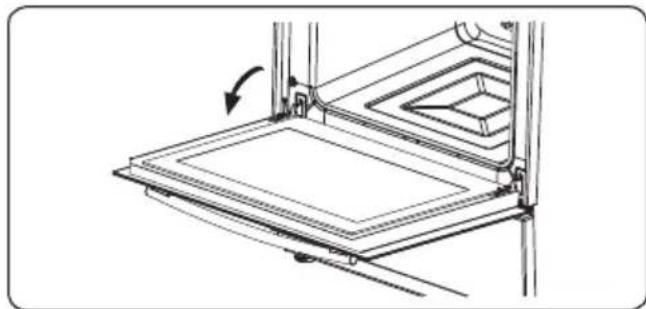
Removal of the Oven Door
Before cleaning the oven door glass, you must remove the oven door, as shown below.
- Open the oven door.
natural_image
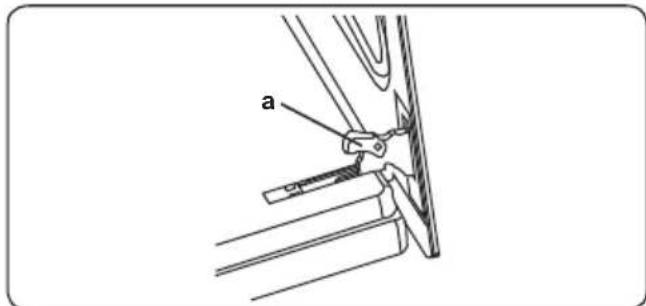
Technical line drawing of a mechanical assembly with a rotating component (no text or symbols)- Open the locking catch (a) (with the aid of a screwdriver) up to the end position.
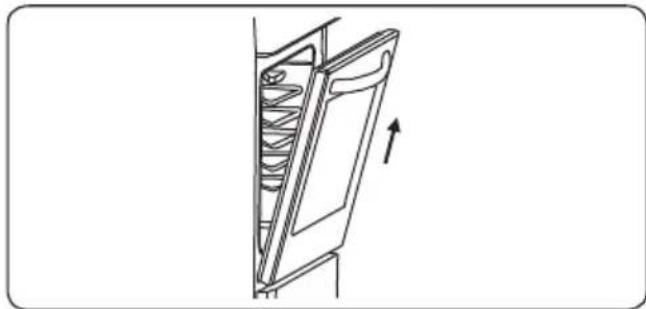
- Close the door until it almost reaches the fully closed position and remove the door by pulling it towards you.
natural_image
Line drawing of a refrigerator with a door and rack, showing an upward arrow (no text or symbols)5.2 Maintenance
WARNING: The maintenance of this appliance should be carried out by an authorised service person or qualified technician only.
Changing the Oven Lamp
WARNING: Switch off the appliance and allow it to cool before cleaning your appliance.
- Remove the glass lens, then remove the bulb.
- Insert the new bulb (resistant to 300 °C) to replace the bulb that you removed (230 V, 15-25 Watt, Type E14).
- Replace the glass lens, and your oven is ready for use.
The lamp is designed specifically for use in household cooking appliances. It is not suitable for household room illumination.
5.3 Maintenance
WARNING: The maintenance of this appliance should be carried out by an authorised service person or qualified technician only.
Other Controls
• Periodically check expiration date of the gas connection pipe.
• Periodically check the gas connection pipe. If a defect is found, contact an authorised service provider to have it changed.
- If a defect is found while operating the control knobs of the appliance, contact an authorised service provider.
6. TROUBLESHOOTING&TRANSPORT
6.1 Troubleshooting

If you still have a problem with your appliance after checking these basic troubleshooting steps, please contact an authorised service person or qualified technician.
| Problem Possible Cause Solution | ||
| Hob burners do not work. | The burners may be in the 'off position. Supply gas pressure may not be correct. Power (if the appliance has an electric connection) is switched off. | Check the position of the control knob. Check the gas supply and gas pressure. Check whether there is power supplied. Also check that other kitchen appliances are working. |
| Hob burners do not light. | Burner cap and crown are not assembled correctly. Supply gas pressure may not be correct. LPG cylinder (if applicable) may be depleted. Power (if the appliance has an electric connection) is switched off. | Ensure the burner parts have been placed correctly. Check the gas supply and gas pressure. LPG cylinder may need replacing. Check whether power is being supplied. Also, check that other kitchen appliances are working. |
| Flame colour is orange/yellow. | Burner cap and crown are not assembled correctly. Different gas compositions. | Ensure the burner parts have been placed correctly. Due to the design of the burner, the flame can appear to be orange/yellow in certain areas of the burner. If you operate the appliance with natural gas, city natural gas may have different compositions. Do not operate the appliance for a couple of hours. |
| Burner is not igniting or only partially lighting. | Burner parts may not be clean or dry. | Ensure that parts of the appliance are dry and clean. |
| Burner sounds noisy. | - | This is normal. The noise may reduce as they heat up. |
| Noise - | It is normal for some metal parts on the cooker to produce noise when in use. | |
| The hob or cooking zones cannot be switched on. | There is no power supply. | Check the household fuse for the appliance. Check whether there is a power cut by trying other electronic appliances. |
| The hob produces an odour during the first cooking sessions. | New appliance. | Heat a saucepan full of water on each cooking zone for 30 minutes. |
| Oven does not switch on. | Power is switched off. | Check whether there is power supplied. Also, check that other kitchen appliances are working. |
| No heat or oven does not warm up. | Oven temperature control is incorrectly set. Oven door has been left open. | Check the oven temperature control knob is set correctly. |
| Cooking is uneven within the oven. | Oven shelves are incorrectly positioned. | Check that the recommended temperatures and shelf positions are being used.Do not frequently open the door unless you are cooking things that need to be turned. If you open the door often, the interior temperature will be lower and this may affect the results of your cooking. |
| Oven light (if available) does not operate. | Lamp has failed.Electrical supply is disconnected or switched off. | Replace lamp according to the instructions.Make sure the electrical supply is switched on at the wall socket outlet. |
| The oven fan (if available) is noisy. | Oven shelves are vibrating. | Check that the oven is level.Check that the shelves and any bake ware are not vibrating or in contact with the oven back panel. |
6.2 Transport
If you need to transport the product, use the original product packaging and carry it using its original case. Follow the transport signs on the packaging. Tape all independent parts to the product to prevent damaging the product during transport.
If you do not have the original packaging, prepare a carriage box so that the appliance, especially the external surfaces of the product, is protected against external threats.
7. TECHNICAL SPECIFICATIONS
7.1 Injector Table
| G30 28-30mbar 7,5 kW 545 g/hI2E+3+ FR Classe: 1 | NGG20/G2520/25 mbar | LPGG30/G3128-30/37 mbar |
| LARGE BURNER | ||
| DIA. of INJECTOR (1/100mm) 115 85 | ||
| NOMINAL RATING (kW) 2,9 3 | ||
| CONSUMPTION 276 l/h 218,1 g/h | ||
| MEDIUM BURNER | ||
| DIA. of INJECTOR (1/100mm) 97 65 | ||
| NOMINAL RATING (kW) 1,75 1,75 | ||
| CONSUMPTION 166.7 l/h 127,2 g/h | ||
| MEDIUM BURNER | ||
| DIA. of INJECTOR (1/100mm) 97 65 | ||
| NOMINAL RATING (kW) 1,75 1,75 | ||
| CONSUMPTION 166.7 l/h 127,2 g/h | ||
| SMALL BURNER | ||
| DIA. of INJECTOR (1/100mm) 72 50 | ||
| NOMINAL RATING (kW) | 1 | 1 |
| CONSUMPTION | 95.2 l/h | 72,7 g/h |
natural_image
Warning symbol depicting a person pulling a large object inside a triangle (no text or numbers)
natural_image
Simple black-and-white diagram of a mechanical or electrical component with directional arrows, enclosed in a circle (no text or symbols)natural_image
No sign depicting a crossed-out saw cutting through a circular border (no text or symbols)natural_image
Diagram of a mechanical assembly with a spring and nut, showing rotational motion (no text or symbols)3. CARATTERISTICHE DEL PRODOTTO

natural_image
Abstract diagram with circular arrows and concentric rings, no text or symbols presentnatural_image
Grayscale gradient rectangular object with vertical lines, no text or symbols visiblenatural_image
Abstract grayscale graphic with circular arrows and a central geometric pattern (no text or symbols)natural_image
Simple icon of a black rectangular object with five white zigzag lines on top, surrounded by decorative side elements (no text or symbols)Funzione grill:
natural_image
Abstract diagram with circular arrows and waveforms, no readable text or symbolsnatural_image
Simple black rectangular icon with a rounded corner and diagonal stripes, no text or symbols present.natural_image
Simple diagram of a black rectangular object with five white zigzag lines on its surface, surrounded by a gray border (no text or symbols)natural_image
Black rectangular object with white downward arrows on a dark surface, no text or symbols visiblenatural_image
Technical line drawing of a square frame with bolt holes and a central circular hole (no text or symbols)natural_image
Line drawing of hands using a tool to lift or install a tray (no text or symbols)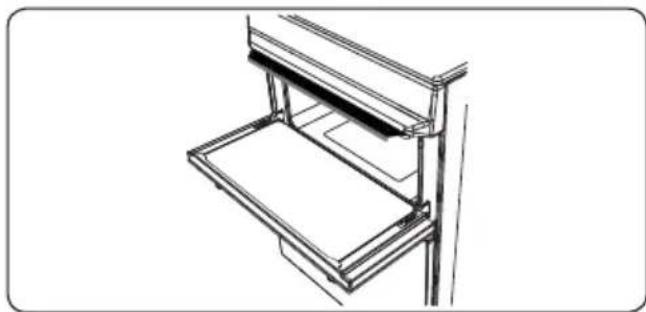
natural_image
Line drawing of a mechanical device with a rectangular frame and a horizontal panel (no text or symbols)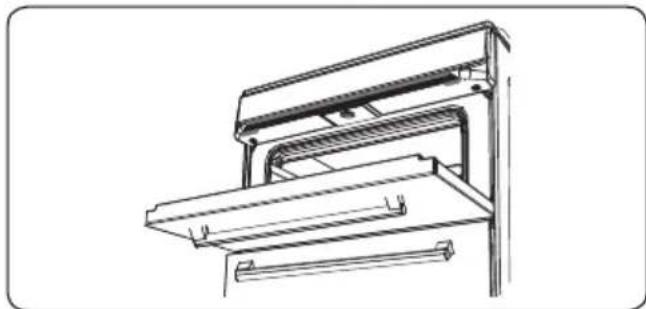
natural_image
Technical line drawing of a mechanical assembly or mounting bracket (no text or symbols)Teglia piatta
natural_image
Technical line drawing of a square frame with bolt holes and internal ribs (no text or symbols)Griglia metallica
natural_image
Line drawing of a corrugated metal tray with ribbed sides (no text or symbols)
AVVERTENZA
natural_image
Technical line drawing of an open oven with internal rack and ventilation slots (no text or symbols)natural_image
Line drawing of a hand cleaning a car tire with a circular tire, no text or symbols presentPulizia catalitica
natural_image
Technical line drawing of a two-part interior view of an oven or enclosure, showing internal structure and mounting points (no text or symbols)natural_image
Technical line drawing of a mechanical component with an arrow indicating direction (no text or symbols)natural_image
Diagram of a refrigerator interior with a door and fan, showing a scroll inside (no text or symbols)5.2. Manutenzione
natural_image
Abstract geometric shapes with two curved segments, no text or symbols presentContinental Edison
www.continentaledison.fr

52296361
- CARACTÉRISTIQUES DU PRODUIT
- Fonction
- Décongélation :
- Fonction Gril :
- Grille
- AVERTISSEMENT
- NETTOYAGE ET ENTRETIEN
- Nettoyage
- Entretien
- CARACTERÍSTICAS DEL PRODUCTO
- Parrilla
- ADVERTENCIA
- LIMPIEZA Y MANTENIMIENTO
- Limpieza
- Limpieza catalítica
- Mantenimiento
- CARACTERÍSTICAS DO PRODUTO
- Função de Cozinhar
- Função de Grelhar:
- Função de Grelhar
- Tabuleiro Raso
- Rede de Arame
- AVISO
- Limpeza catalítica
- Limpeza da Placa de Gás
- Limpar as Partes de Vidro
- Limpar as Partes Esmaltadas
- Manutenção
- Thank you for choosing this product.
- CONTENTS
- SAFETY INSTRUCTIONS
- General Safety Warnings
- Installation Warnings
- During Use
- During Cleaning and Maintenance
- Disposal of your old machine
- INSTALLATION AND PREPARATION FOR USE
- Instructions for the Installer Ventilation requirements
- Emptying of burned gases from the environment
- General instructions
- Installation of the Cooker
- Gas Connection
- Assembly of gas supply and leakage check
- Points that must be checked during flexible hose assembly:
- Points that must be checked during fixed gas connection assembly
- Gas Conversion (if available)
- Changing injectors Hob burners
- Adjusting the minimum flame position:
- Determining the minimum flame position
- Changing the gas inlet
- Electrical Connection and Safety (if available)
- WARNING: THE APPLIANCE MUST BE EARTHED.
- Anti-tilting kit
- Adjusting the feet
- PRODUCT FEATURES
- USE OF PRODUCT
- Use of gas burners Ignition of the burners
- Manual Ignition of the Gas Burners
- Electrical ignition by control knob
- Use of Gas Burners Ignition of the Burners
- Flame safety device
- Hob burners
- Hob burner
- WARNING:
- Main Oven Functions
- Top Oven Functions
- Upper Heating
- Grilling Function:
- Faster Grilling
- Accessories
- The Deep Tray
- The Grill Heat Shield
- WARNING
- The Shallow Tray
- The Wire Grid
- CLEANING AND MAINTENANCE
- Cleaning
- Cleaning the Inside of the Oven
- Catalytic Cleaning
- Removal of Catalytic Liner
- Cleaning the Gas Hob
- Cleaning the Glass Parts
- Cleaning the Enamelled Parts
- Cleaning the Stainless Steel Parts (if available)
- Removal of the Oven Door
- Maintenance
- Changing the Oven Lamp
- Maintenance
- Other Controls
- TROUBLESHOOTING&TRANSPORT
- Troubleshooting
- Transport
- TECHNICAL SPECIFICATIONS
- Injector Table
- CARATTERISTICHE DEL PRODOTTO
- Teglia piatta
- Griglia metallica
- AVVERTENZA
- Pulizia catalitica
- Manutenzione
- Continental Edison
Brand : CONTINENTAL EDISON
Model : CECDF6060W
Category : Electric oven