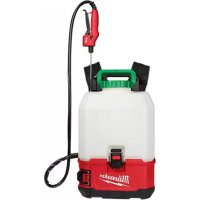
282020PS - Irrigation timer MILWAUKEE - Free user manual and instructions
Find the device manual for free 282020PS MILWAUKEE in PDF.

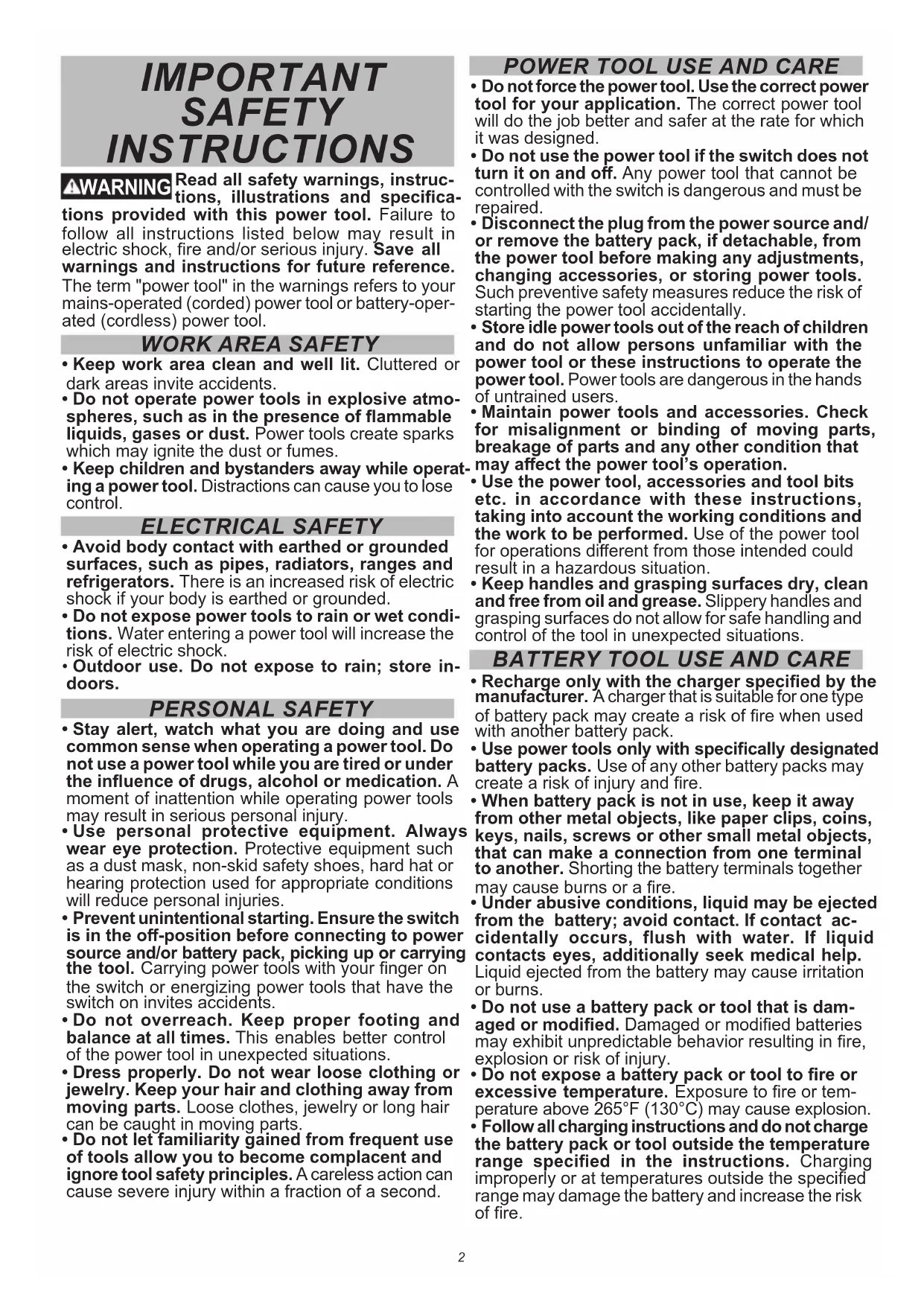


| Product Type | Cordless Backpack Sprayer |
| Brand | Milwaukee |
| Model | 282020PS (2820-20) |
| Power Source | M18™ 18V Lithium-Ion Battery |
| Tank Capacity | 15 L (4 gal US) |
| Adjustable Flow Rate | 0.38 to 4.28 L/min (depending on nozzle model) |
| Total Weight (with full tank) | 25 kg (55 lbs) |
| Operating Ambient Temperature | -18°C to 50°C (0°F to 125°F) |
| Tank Material | Chemical-Compatible Plastic |
| Compatible Battery Type | M18™ |
| Compatible Charger Type | M18™ |
| Main Functions | Spraying pesticides, fertilizers, concrete (non-flammable sealants), watering with water nozzle |
| Adjustments | 5 flow positions, trigger lock, adjustable nozzle (cone/fan) |
| Included Accessories | Spray wand, trigger handle, hose, shoulder straps, belt, interchangeable nozzles, strainer, measuring cup |
| Maintenance and Cleaning | Clean with soapy water after use, drain tank, do not immerse |
| Safety | Wear PPE (gloves, goggles, mask) according to chemical; avoid flames; do not spray towards electrical outlets |
| Spare Parts and Repairability | Interchangeable tank (pesticide/concrete/water), repairs by authorized Milwaukee service center |
| Warranty | 3 years (parts and labor); accessories 1 year |
| Certifications | FCC Part 15, ISED RSS, ONE-KEY™ wireless communication |
Frequently Asked Questions - 282020PS MILWAUKEE
User questions about 282020PS MILWAUKEE
0 question about this device. Answer the ones you know or ask your own.
Ask a new question about this device
Download the instructions for your Irrigation timer in PDF format for free! Find your manual 282020PS - MILWAUKEE and take your electronic device back in hand. On this page are published all the documents necessary for the use of your device. 282020PS by MILWAUKEE.
USER MANUAL 282020PS MILWAUKEE
IMPORTANT SAFETY INSTRUCTIONS
WARNING
Read all safety warnings, instructions, illustrations and specifica
tions provided with this power tool. Failure to follow all instructions listed below may result in electric shock, fire and/or serious injury. Save all warnings and instructions for future reference.
The term "power tool" in the warnings refers to your mains-operated (corded) power tool or battery-operated (cordless) power tool.
WORK AREA SAFETY
- Keep work area clean and well lit. Cluttered or dark areas invite accidents.
- Do not operate power tools in explosive atmospheres, such as in the presence of flammable liquids, gases or dust. Power tools create sparks which may ignite the dust or fumes.
- Keep children and bystanders away while operating a power tool. Distractions can cause you to lose control.
ELECTRICAL SAFETY
- Avoid body contact with earthed or grounded surfaces, such as pipes, radiators, ranges and refrigerators. There is an increased risk of electric shock if your body is earthed or grounded.
- Do not expose power tools to rain or wet conditions. Water entering a power tool will increase the risk of electric shock.
- Outdoor use. Do not expose to rain; store indoors.
PERSONAL SAFETY
- Stay alert, watch what you are doing and use common sense when operating a power tool. Do not use a power tool while you are tired or under the influence of drugs, alcohol or medication. A moment of inattention while operating power tools may result in serious personal injury.
- Use personal protective equipment. Always wear eye protection. Protective equipment such as a dust mask, non-skid safety shoes, hard hat or hearing protection used for appropriate conditions will reduce personal injuries.
- Prevent unintentional starting. Ensure the switch is in the off-position before connecting to power source and/or battery pack, picking up or carrying the tool. Carrying power tools with your finger on the switch or energizing power tools that have the switch on invites accidents.
- Do not overreach. Keep proper footing and balance at all times. This enables better control of the power tool in unexpected situations.
- Dress properly. Do not wear loose clothing or jewelry. Keep your hair and clothing away from moving parts. Loose clothes, jewelry or long hair can be caught in moving parts.
- Do not let familiarity gained from frequent use of tools allow you to become complacent and ignore tool safety principles. A careless action can cause severe injury within a fraction of a second.
POWER TOOL USE AND CARE
- Do not force the power tool. Use the correct power tool for your application. The correct power tool will do the job better and safer at the rate for which it was designed.
- Do not use the power tool if the switch does not turn it on and off. Any power tool that cannot be controlled with the switch is dangerous and must be repaired.
- Disconnect the plug from the power source and/ or remove the battery pack, if detachable, from the power tool before making any adjustments, changing accessories, or storing power tools. Such preventive safety measures reduce the risk of starting the power tool accidentally.
- Store idle power tools out of the reach of children and do not allow persons unfamiliar with the power tool or these instructions to operate the power tool. Power tools are dangerous in the hands of untrained users.
- Maintain power tools and accessories. Check for misalignment or binding of moving parts, breakage of parts and any other condition that may affect the power tool's operation.
- Use the power tool, accessories and tool bits etc. in accordance with these instructions, taking into account the working conditions and the work to be performed. Use of the power tool for operations different from those intended could result in a hazardous situation.
- Keep handles and grasping surfaces dry, clean and free from oil and grease. Slippery handles and grasping surfaces do not allow for safe handling and control of the tool in unexpected situations.
BATTERY TOOL USE AND CARE
- Recharge only with the charger specified by the manufacturer. A charger that is suitable for one type of battery pack may create a risk of fire when used with another battery pack.
- Use power tools only with specifically designated battery packs. Use of any other battery packs may create a risk of injury and fire.
- When battery pack is not in use, keep it away from other metal objects, like paper clips, coins, keys, nails, screws or other small metal objects, that can make a connection from one terminal to another. Shorting the battery terminals together may cause burns or a fire.
- Under abusive conditions, liquid may be ejected from the battery; avoid contact. If contact accidentally occurs, flush with water. If liquid contacts eyes, additionally seek medical help. Liquid ejected from the battery may cause irritation or burns.
- Do not use a battery pack or tool that is damaged or modified. Damaged or modified batteries may exhibit unpredictable behavior resulting in fire, explosion or risk of injury.
- Do not expose a battery pack or tool to fire or excessive temperature. Exposure to fire or temperature above 265^ (130^) may cause explosion.
- Follow all charging instructions and do not charge the battery pack or tool outside the temperature range specified in the instructions. Charging improperly or at temperatures outside the specified range may damage the battery and increase the risk of fire.
SERVICE
- Have your power tool serviced by a qualified repair person using only identical replacement parts. This will ensure that the safety of the power tool is maintained.
- Never service damaged battery packs. Service of battery packs should only be performed by the manufacturer or authorized service providers.
SPECIFIC SAFETY RULES FOR BACKPACK SPRAYER
AWARNING Risk of fire or explosion. Do not spray flammable liquids such as gasoline, solvents, or gas producing chemicals. Do not use tool around spark, flame, or smoke. Chemical may ignite.
- Use the correct tank for your application. These products are suitable for pesticide applications (such as insecticides, fungicides, or herbicides), fertilizers, concrete applications (such as non-flammable sealants, curing compounds and form oil), and water supply applications, when used in accordance with these instructions and those supplied with the chemicals.
- Do not use bleach, caustic (alkali) self-heating or corrosive (acid) liquids in this sprayer. Do not pour hot or boiling liquids into the tank. These can corrode metal parts or weaken the tank and hose.
- To reduce the risk of fire, personal injury, and product damage due to a short circuit, never immerse your tool, battery pack or charger in fluid or allow a fluid to flow inside them. Do not place or store tool where it can fall or be pulled into a tub or sink. Corrosive or conductive fluids, such as seawater, certain industrial chemicals, and bleach or bleach containing products, etc., can cause a short circuit.
Electric shock hazard. Never spray toward electrical outlets.
- Spray area must be well ventilated to avoid hazardous fumes build-up.
- Avoid spraying on windy days. Spray can be blown onto people, plants, or objects that should not be sprayed.
- Do not store chemicals in the tank. Chemicals can degrade seals and hoses. Drain and clean after each use.
- Remove gloves before handling battery packs. Chemicals are harmful to plastics.
- Maintain your power tool. Thoroughly inspect inside and outside and examine all components before each use. Check for cracked and deteriorated hoses, leaks, clogged nozzles, and missing or damaged parts. If damaged, have the power tool repaired before use. Many accidents are caused by poorly maintained power tools.
- Always unplug the charger and remove the battery pack from the charger or tool before performing any maintenance, storing, or draining the tool. Never disassemble the tool, battery pack or charger. Contact a MILWAUKEE service facility for ALL repairs.
- Do not eat or smoke while handling or operating the tool. After use, wash with hot, soapy water to help reduce the risk of health hazards due to exposure to chemicals.
- Always use common sense and be cautious when using tools. It is not possible to anticipate every situation that could result in a dangerous outcome. Do not use this tool if you do not understand these operating instructions or you feel the work is beyond your capability; contact Milwaukee Tool or a trained professional for additional information or training.
- Do not use the battery compartment for storage.
- Maintain labels and nameplates. These carry important information. If unreadable or missing, contact a MILWAUKEE service facility for a free replacement.
AWARNING Some dust created by power sanding, sawing, grinding, drilling, and other construction activities contains chemicals known to cause cancer, birth defects or other reproductive harm. Some examples of these chemicals are:
- lead from lead-based paint
crystalline silica from bricks and cement and other masonry products, and - arsenic and chromium from chemically-treated lumber.
Your risk from these exposures varies, depending on how often you do this type of work. To reduce your exposure to these chemicals: work in a well-ventilated area, and work with approved safety equipment, such as those dust masks that are specially designed to filter out microscopic particles.
SAVE THESE INSTRUCTIONS
SYMBOL

Direct Current

Read operator's manual

Wear personal protective equipment (PPE) according to the chemical manufacturer's instructions.

Wear eye protection

Wear gloves

Do not spray flammable liquids

UL Listing for Canada and U.S.
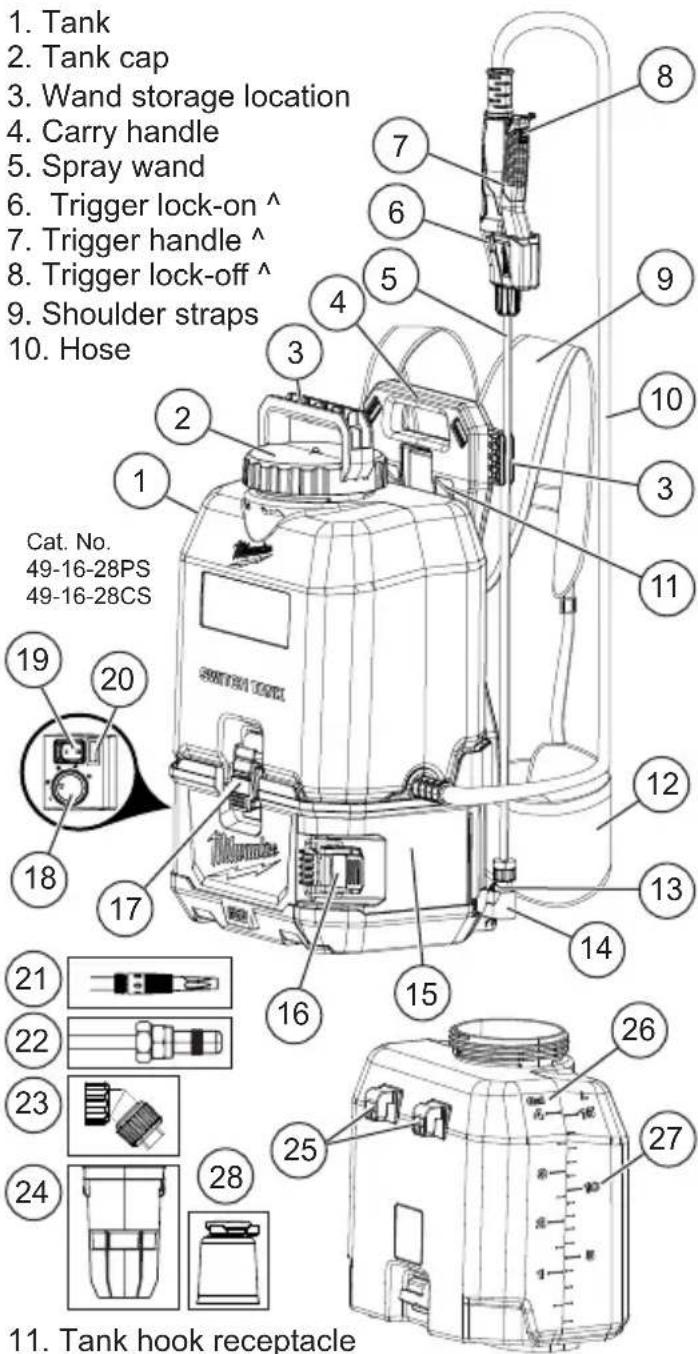
FUNCTIONAL DESCRIPTION
-
Adjustable nozzle
-
Nozzle holder
-
Battery compartment
-
Battery compartment latch
-
Tank latch
-
Flow rate dial
-
On/Off switch
-
On/Off light
-
Water nozzle *
-
Adjustable nozzle
-
Fan nozzle
-
Strainer
-
Tank hooks
-
Gallon markings
-
Liter markings
-
Measuring cup
-
49-16-28WS only
^49-16-28PS and 49-16-28CS only
Cat. No. 49-16-28WS
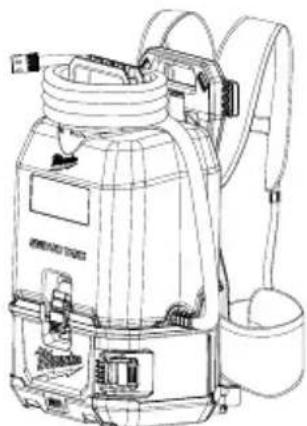
SPECIFICATIONS
Cat. No. 2820-20
Volts. 18 DC
Battery Type M18TM
Charger Type. M18TM
Tank Capacity 4 Gal. (15 L)
Flow Rate 0.10 to 1.13 GPM
Full Weight. 55 lbs
Recommended Ambient
Operating Temperature 32°F to 125°F
Tank Only (Pesticide) 49-16-28PS
Tank Only (Concrete) 49-16-28CS
Tank Only (Water) 49-16-28WS
ASSEMBLY
WARNING Recharge only with the charger specified for the battery. For specific charging instructions, read the operator's manual supplied with your charger and battery.
Removing/Inserting the Battery
To remove the battery, push in the release buttons and pull the battery pack away from the tool.
WARNING Always remove battery pack before changing or removing accessories.
To insert the battery, slide the pack into the body of the tool. Make sure it latches securely into place.
WARNING Only use accessories specifically recommended for this tool. Others may be hazardous.
Connecting the Spray Wand to the Trigger Handle
(Cat. No. 49-16-28PS, 49-16-28CS)
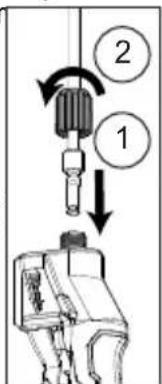
- Insert the spray wand into the trigger handle (1) until firmly seated.
- Slide the nut onto the threaded coupling and hand tighten securely (2).
- Pull on the spray wand to be certain it is properly secured.
- Place the assembled trigger handle and wand into one of the wand storage locations.
Connecting the Nozzles
(Cat. No. 49-16-28PS, 49-16-28CS)
Select and screw on nozzle by job type. When using the adjustable nozzle, adjust spray pattern as desired by tightening/loosening the nozzle.
Connecting Water Supply or Nozzle (Cat. No. 49-16-28WS)
To attach water supply hose to the tool or nozzle, push the quick connect fitting and tool/nozzle together (1). Pull on the connection to be certain it is properly secured. To remove, pull the collar back to release (2). When using the nozzle, adjust spray pattern as desired by tightening/loosening the nozzle.

Filling the Tank
WARNING Before filling the tank, remove the tank from the base.
Ensure battery door is closed and latched whenever chemicals are present.
Mix chemicals per manufacturer's instructions. Failure to follow instructions may cause harsh chemicals to injure user or damage tool.
A removable strainer prevents debris that can clog or damage the pump from entering thetank. Label tank contents accordingly during each use. Only put recommended liquids in tank. Only use water in water supply tank.
- Ensure the battery door is closed securely.
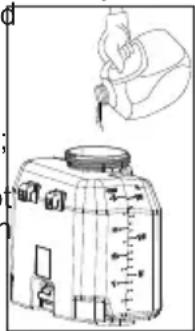
- Remove the tank from the base and set on a level surface away from the base to prevent exposing the base to harsh chemicals.
- Unscrew and remove the tank cap; ensure strainer is in place.
- Fill the tank (up to 4 gallons; do not overfill). Use the gallon markings on the side of the tank as a guide.
- Reinstall the tank cap.
- Reinstall the tank.
Installing the Tank
- Ensure the battery door is closed securely.
- Slide tank hooks into base and seat tank into tank reservoir in the base.
- Secure tank to base with front and rear tank latches; ensuring the tank is level, firmly seated, and all seals are aligned.
WARNING When filled, the sprayer will be heavy, take care when putting on the backpack to avoid strain.
Putting on the Backpack
- Ensure tank is securely attached to base with front and rear tank latches, tank cap is installed, and battery door is latched.
- Pick up the backpack by one of the shoulder straps, slide your arms through each shoulder U strap.
- With the sprayer on your back, tighten the shoulder and waist straps until they fit snugly and securely, high on your back. Connect chest strap.
- Be sure the shoulder, chest, and waist straps are tight but comfortable; if they are too loose, the sprayer may slide around on your back, making it uncomfortable to wear.
- Be aware tank contents may shift during use and movement, such as twisting or bending over.
OPERATION
Adjusting the Flow Rate
Select the desired flow rate from Low (1) to High (5), depending on the job and the chemical manufacturer's instructions.
| Flow Rate | 2820-20PS (Stream Nozzle) | 2820-20CS (Stream Nozzle) | 2820-20WS (Open Flow) |
| 1 0.1 | 10 GPM 0.14 GPM 0.1 | 16 GPM | |
| 2 0.1 | 7 GPM 0.21 GPM 0.2 | 22 GPM | |
| 3 0.2 | 4 GPM 0.33 GPM 0.3 | 35 GPM | |
| 4 0.3 | 5 GPM 0.44 GPM 0.4 | 53 GPM | |
| 5 0.5 | 1 GPM 0.82 GPM 1.1 | 13 GPM |
WARNING To reduce the risk of injury, always wear personal protective equipment (PPE) according to the chemical manufacturer's instructions. Always wear eye protection. Always ensure battery compartment latch is securely closed before use.
Ensure trigger handle lock-on is not engaged before turning ON tool.
Turning the Sprayer ON/OFF
- Install the battery pack. Close and latch the battery compartment.
- To turn the sprayer ON, press the ON/OFF switch to "I". The Power LED will light green.
- To start the flow of liquid at the spray wand, pull the trigger.
- To stop the flow of liquid at the spray wand, release the trigger.
- To turn the sprayer OFF, press the ON/OFF switch to "O".
NOTE: Be aware some spray material may remain inside the spray wand and drip out. To drain, turn off the tool, then pull the trigger and point the tool down until dripping stops.
Trigger Lock-On
(Cat. No. 49-16-28PS, 49-16-28CS)
Use trigger lock-on when spraying for an extended period of time or when covering a large area.
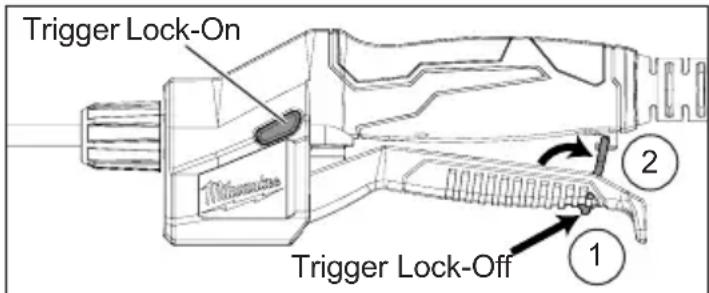
- To lock-on, pull the trigger and push in the lock-on button.
- To release the lock-on, pull and release the trigger.
NOTE: Ensure the trigger is not locked on before turning the sprayer off to avoid accidental spraying when the sprayer is restarted.
Trigger Lock-Off
(Cat. No. 49-16-28PS, 49-16-28CS)
To avoid accidental spraying, lock-off the trigger.
- Press the lock-off toggle at the end of the trigger (1).
- Hook the lock-off tab onto the hook under the trigger (2).
- To release, push the tab back into the trigger.
APPLICATIONS
WARNING Before using any chemicals and/or solutions, read and follow all original manufacturer instructions. Read all Safety Data Sheets (SDS) and container labels provided with the chemical. Chemicals can cause serious bodily injury, property damage, and/or damage the tool. Wear personal protective equipment (PPE) according to the chemical manufacturer's instructions. Always wear eye protection.
Spraying
(Cat. No. 49-16-28PS, 49-16-28CS)
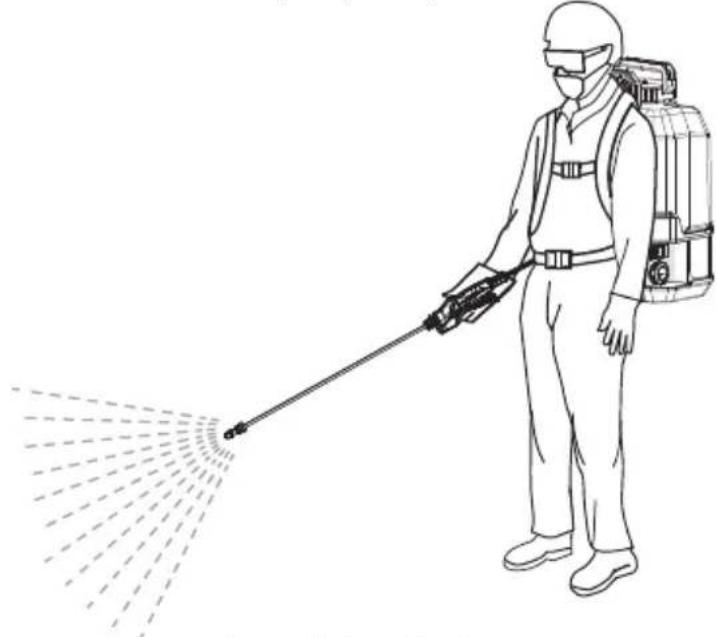
- Fill the tank and then install onto the base.
- Put on the backpack and properly adjust the straps
- Turn on the tool.
- Pull the trigger and begin sweeping the nozzle from side to side, coating the desired surface evenly in accordance with chemical manufacturer's instructions.
- If desired, lock-on the trigger for extended use.
- When done, release the trigger, turn off the tool, remove the backpack, drain, and clean the tank.
Supplying Water
(Cat. No. 49-16-28WS)
- Fill the tank with clean water and then install onto the base.
- Place tool near the job within range of water supply hose.
- Attach water supply hose with the quick connect fitting. Pull on the connection to be certain it is properly secured.
- To start water flow, turn on the tool.
- Monitor water level in tank. When empty, turn off tool, disconnect the hose, and refill tank. Don't run tool when tank is empty.
- When done, turn off the tool, disconnect hose, drain, and clean the tank.
MAINTENANCE
Maintaining Tool
Keep your tool, battery pack and charger in good repair by adopting a regular maintenance program. Inspect your tool for issues such as undue noise, misalignment or binding of moving parts, breakage of parts, or any other condition that may affect the tool operation. Return the tool, battery pack, and charger to a MILWAUKEE service facility for repair. After six months to one year, depending on use, return the tool, battery pack and charger to a MILWAUKEE service facility for inspection. If the tool does not start or operate at full power with a fully charged battery pack, clean the contacts on the battery pack. If the tool still does not work properly, return the tool, charger and battery pack, to a MILWAUKEE service facility for repairs.
AWARNING To reduce the risk of personal injury and damage, never immerse your tool, battery pack or charger in liquid or allow a liquid to flow inside them. Do not use bleach as a cleaning agent.
Cleaning
Clean dust and debris from vents. Keep handles clean, dry and free of oil or grease. Use only mild soap and a damp cloth to clean, since certain cleaning agents and solvents are harmful to plastics and other insulated parts. Some of these include gasoline, turpentine, lacquer thinner, paint thinner, chlorinated cleaning solvents, ammonia and household detergents containing ammonia. Never use flammable or combustible solvents around tools.
Cleaning Electrical Contacts
Keep electrical contact posts between bottom of tank and base clean. WARNING! Remove battery pack from tool before cleaning electrical contacts. Clean contacts with a dry, clean cloth only.
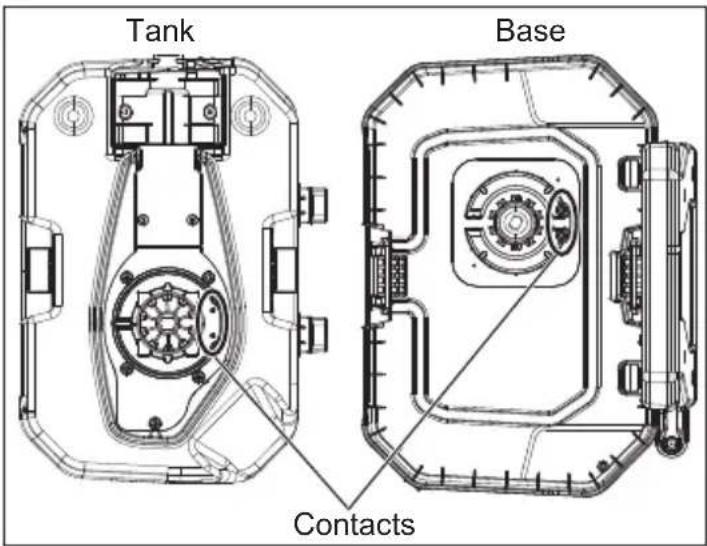
AWARNING To reduce the risk of injury, always wear personal protective equipment (PPE) according to the chemical manufacturer's instructions. Always wear eye protection.
Draining and Cleaning the Tank, Hose, and Spray Wand
If there is any liquid left in the tank after spraying, the tank should be drained before cleaning. Do not store chemicals in the tank. Tank must be cleaned before using another liquid. Do not mix liquids. Follow the chemical manufacturer's instructions for proper cleaning, storage and/or disposal of excess liquid.
To Drain:
- Ensure the battery door is closed securely.
- Remove the tank from the base.
- Empty the tank into a suitable container through the fill area. WARNING! Always wear personal protective equipment (PPE) according to the chemical manufacturer's instructions. Always wear eye protection.
To Clean:
- Ensure the battery door is closed securely.
- Remove the tank from the base and set on a level surface away from the base to prevent exposing the base to harsh chemicals.
- Remove the tank and fill it about one-third full with clean water. A small amount of mild household detergent may be added. Replace the cap and gently slosh the water around the tank.
- Install the tank and spray the water until the tank has been emptied. Make sure to direct the spray toward an area that will not be damaged by residue chemicals in the tank.
- Repeat the procedure with clean water until the tank is thoroughly clean. Wash outside of nozzles and dry with cloth.
- Wipe the outside of the tank with a clean, dry cloth
- Allow all pieces to completely dry before reinstalling parts and storing the unit. Always reinsert strainer before replacing tank cap.
Storage
Store indoors. Store spray wand securely in wand storage area. Store the sprayer in a secure, well-ventilated indoor space with the tank empty.
Repairs
For repairs, return the tool, battery pack and charger to the nearest authorized service center.
ACCESSIONS
WARNING
Use only recommended accessories. Others may be hazardous.
For a complete listing of accessories, go online to www.milwaukeeetool.com or contact a distributor.
WIRELESS COMMUNICATION
For products provided with wireless communication features, including ONE-KEYTM:
Pursuant to part 15.21 of the FCC Rules, do not modify this product. Modification could void your authority to operate the product. This device complies with part 15 of the FCC Rules and ISED-Canada's license exempt RSS standards. Operation is subject to the following two conditions: 1) This device may not cause harmful interference, and 2) This device must accept any interference received, including interference that may cause undesired operation.
SERVICE - UNITED STATES
1-800-SAWDUST (1.800.729.3878)
Monday-Friday, 7:00 AM - 6:30 PM CST
or visit www.milwaukeetool.com
Contact Corporate After Sales Service Technical Support with technical, service/repair, or warranty questions.
Email: metproductsupport@milwaukeetool.com
Become a Heavy Duty Club Member at www.milwaukeetool.com to receive important notifications regarding your tool purchases.
SERVICE - CANADA
Milwaukee Tool (Canada) Ltd
1.800.268.4015
Monday-Friday, 7:00 AM - 4:30 PM CST
or visit www.milwaukeetool.ca
LIMITED WARRANTY USA & CANADA
Every MILWAUKEE Outdoor Power Equipment Product (see exceptions below) is warranted to the original purchaser only to be free from defects in material and workmanship. Subject to certain exceptions, MILWAUKEE will repair or replace any part on an outdoor power equipment product which, after examination, is determined by MILWAUKEE to be defective in material or workmanship for a period of three (3) years* after the date of purchase unless otherwise noted. Return of the outdoor power equipment to a MILWAUKEE factory Service Center location or participating MILWAUKEE Authorized Service Station, freight prepaid and insured, is required. A copy of the proof of purchase should be included with the return product. This warranty does not apply to damage that MILWAUKEE determines to be from repairs made or attempted by anyone other than MILWAUKEE authorized personnel, misuse, alterations, abuse, normal wear and tear, lack of maintenance, or accidents.
Normal Wear: Many outdoor power equipment products need periodic parts replacement and service to achieve best performance. This warranty does not cover repair when normal use has exhausted the life of a part including, but not limited to trimmer head, trimmer head spool, cutting lines, blades, chains, blower tubes, brushes, o-rings, and seals.
*This warranty does not cover Cordless Battery Packs or Reconditioned Product. There are separate and distinct warranties available for these products.
**The warranty period for SWITCH TANK™ tank assemblies, hoses, handles, and wands are one (1) year from the date of purchase.
MILWAUKEE does not cover freight or labor charges associated with the inspection and testing of outdoor power equipment products which are found by MILWAUKEE not to be a valid warranty claim. A valid warranty claim must be substantiated by the discovery of defective material or workmanship by MILWAUKEE.
ACCEPTANCE OF THE EXCLUSIVE REPAIR AND REPLACEMENT REMEDIES DESCRIBED HEREIN IS A CONDITION OF THE CONTRACT FOR THE PURCHASE OF EVERY MILWAUKEE PRODUCT. IF YOU DO NOT AGREE TO THIS CONDITION, YOU SHOULD NOT PURCHASE THE PRODUCT. IN NO EVENT SHALL MILWAUKEE BE LIABLE FOR ANY INCIDENTAL, SPECIAL, CONSEQUENTIAL OR PUNITIVE DAMAGES, OR FOR ANY COSTS, ATTORNEY FEES, EXPENSES, LOSSES OR DELAYS ALGARED TO BE AS A CONSEQUENCE OF ANY DAMAGE TO, FAILURE OF, OR DEFECT IN ANY PRODUCT INCLUDING, BUT NOT LIMITED TO, ANY CLAIMS FOR LOSS OF PROFITS. SOME STATES DO NOT ALLOW THE EXCLUSION OR LIMITATION OF INCIDENTAL OR CONSEQUENTIAL DAMAGES, SO THE ABOVE LIMITATION OR EXCLUSION MAY NOT APPLY TO YOU. THIS WARRANTY IS EXCLUSIVE AND IN LIEU OF ALL OTHER EXPRESS WARRANTYES, WRITTEN OR ORAL. TO THE EXTENT PERMITTED BY LAW, MILWAUKEE DISCLAIMS ANY IMPLIED WARRANTYES, INCLUDING WITHOUT LIMITATION ANY IMPLIED WARRANTY OF MERCHANTABILITY OR FITNESS FOR A PARTICULAR USE OR PURPOSE; TO THE EXTENT SUCH WARRANTYER IS NOT PERMITTED BY LAW, SUCH IMPLIED WARRANTYES ARE LIMITED TO THE DURATION OF THE APPLICABLE EXPRESS WARRANTY AS DESCRIBED ABOVE. SOME STATES DO NOT ALLOW LIMITATIONS ON HOW LONG AN IMPLIED WARRANTY LASTS, SO THE ABOVE LIMITATION MAY NOT APPLY TO YOU, THIS WARRANTYY GIVES YOU SPECIFIC LEGAL RIGHTS, AND YOU MAY ALSO HAVE OTHER RIGHTS WHICH VARY FROM STATE TO STATE.
This warranty applies to product sold in the U.S.A. and Canada only. Please consult the 'Service Center Search' in the Parts & Service section of MILWAUKEE's website www.milwaukeetool.com or call 1.800.SAWDUST (1.800.729.3878) to locate your nearest service facility for warranty and non-warranty service on a Milwaukee electric power tool.
INSTRUCTIONS IMPORTANTSE CONCERNANT LA SECURITE
Connecting the Nozzles
No de Cat. 49-16-28PS, 49-16-28CS
Milwaukee Tool (Canada) Ltd 1.800.268.4015
Monday-Friday, 7:00 AM - 4:30 PM CST
www.milwaukeetool.ca
GARANTIE LIMITEE - AUX ETATS-UNIS ET AU CANADA
(Cat. No. 49-16-28PS, 49-16-28CS)
(Cat. No. 49-16-28PS, 49-16-28CS)
(Cat. No. 49-16-28WS)
(Cat. No. 49-16-28PS, 49-16-28CS)
(Cat. No. 49-16-28PS, 49-16-28CS)
Paraatarociadosaccidentales,bloqueeelgatillo.
(Cat. No. 49-16-28PS, 49-16-28CS)
(Cat. No. 49-16-28WS)
Lunes a Viernes (9am a 6pm)
O contactanos en www.milwaukeetool.com.mx
GARANTÍA LIMITADA - E.U.A. Y CANADA
13135 West Lisbon Road
Brookfield, WI 53005 USA
58140137d5 01610300601Q-01(A)
10/20 Printed in China
- IMPORTANT SAFETY INSTRUCTIONS
- WARNING
- WORK AREA SAFETY
- ELECTRICAL SAFETY
- PERSONAL SAFETY
- POWER TOOL USE AND CARE
- BATTERY TOOL USE AND CARE
- SERVICE
- SPECIFIC SAFETY RULES FOR BACKPACK SPRAYER
- SAVE THESE INSTRUCTIONS
- Direct Current
- FUNCTIONAL DESCRIPTION
- SPECIFICATIONS
- ASSEMBLY
- Connecting the Spray Wand to the Trigger Handle
- Connecting the Nozzles
- Connecting Water Supply or Nozzle (Cat. No. 49-16-28WS)
- Filling the Tank
- Installing the Tank
- WARNING When filled, the sprayer will be heavy, take care when putting on the backpack to avoid strain.
- Putting on the Backpack
- OPERATION
- Adjusting the Flow Rate
- WARNING To reduce the risk of injury, always wear personal protective equipment (PPE) according to the chemical manufacturer's instructions. Always wear eye protection. Always ensure battery compartment latch is securely closed before use.
- Turning the Sprayer ON/OFF
- Trigger Lock-On
- Trigger Lock-Off
- APPLICATIONS
- Spraying
- Supplying Water
- MAINTENANCE
- Maintaining Tool
- Cleaning
- Cleaning Electrical Contacts
- AWARNING To reduce the risk of injury, always wear personal protective equipment (PPE) according to the chemical manufacturer's instructions. Always wear eye protection.
- Draining and Cleaning the Tank, Hose, and Spray Wand
- To Drain:
- To Clean:
- Storage
- Repairs
- ACCESSIONS
- WIRELESS COMMUNICATION
- SERVICE - UNITED STATES
- 1-800-SAWDUST (1.800.729.3878)
- SERVICE - CANADA
- Milwaukee Tool (Canada) Ltd
- 1.800.268.4015
- LIMITED WARRANTY USA & CANADA
- INSTRUCTIONS IMPORTANTSE CONCERNANT LA SECURITE
- Milwaukee Tool (Canada) Ltd 1.800.268.4015
- GARANTIE LIMITEE - AUX ETATS-UNIS ET AU CANADA
- GARANTÍA LIMITADA - E.U.A. Y CANADA
Brand : MILWAUKEE
Model : 282020PS
Category : Irrigation timer