
BP38 - Battery charger BLAUPUNKT - Free user manual and instructions
Find the device manual for free BP38 BLAUPUNKT in PDF.



| Product type | Wireless battery charger |
| Brand | Blaupunkt |
| Model | BP38 |
| Intended use | Charging lithium-ion and other compatible battery types |
| Power supply | 220-240 V ~ 60 Hz |
| Output current | 0.38 A |
| Rated power | 220-240 V, 60 Hz |
| Charging time (2 Ah battery) | 3 to 5 hours |
| Charging time (4 Ah battery) | 8 to 10 hours |
| LED indicators | Red LED (charging in progress) and green LED (battery full) |
| Battery compatibility | Blaupunkt batteries only |
| Safety | Short-circuit protection, double insulation, residual current device (RCD) recommended |
| Operating temperature | Dry and temperate environment |
| Maintenance | Clean with a dry cloth; do not use chemical products |
| Warranty | 3 years against manufacturing defects |
| Approximate weight | 0.2 kg |
| Dimensions (L × W × H) | 10 × 5 × 5 cm (estimate) |
| Certifications | Compliant with CE and RoHS standards |
| Package contents | Charger and transformer |
Frequently Asked Questions - BP38 BLAUPUNKT
User questions about BP38 BLAUPUNKT
0 question about this device. Answer the ones you know or ask your own.
Ask a new question about this device
Download the instructions for your Battery charger in PDF format for free! Find your manual BP38 - BLAUPUNKT and take your electronic device back in hand. On this page are published all the documents necessary for the use of your device. BP38 by BLAUPUNKT.
USER MANUAL BP38 BLAUPUNKT
Enjoy it.
DNA battery charger
DNA battery charger
Electrical Tools – General Safety Guidelines
These are still relevant if you have purchased a battery tool and it is supplied with a battery charger.
- Use an RCD: For safe operation it is always necessary to use an RCD device which will protect you in the case of an electrical emergency.
- Operating voltage: Before putting the tool into operation, make sure that the voltage stated on the rating plate is the same as that of your electricity supply.
- Extension cables: Always ensure a cable does not become a trip hazard by routing it safely to your work location. Do not walk, ride or place objects on the cable as it will result in damage. It is important that you are aware of the location of an extension cable whenever you are working to prevent accidents. Always protect power cables from sharp edges, heat and oil. Do not allow the cable to become knotted or kinked.
- If the extension cord becomes damaged: Pull the plug immediately from the socket outlet, do not touch the cable until you have done so.
Battery Tools – General Safety Guidelines
These guidelines are relevant for all tools supplied with a battery.
- Battery Acid Hazard: If accidental damage occurs to the battery or it is used under abusive conditions, liquid may be ejected from the battery; avoid contact. Liquid ejected from the battery may cause irritation or burns.
- If Contact Occurs, quickly flush with water. If liquid contacts eyes flush with water for a minimum of 10 minutes and seek medical help. Inform the medical staff that the liquid is a 25-35% solution of potassium hydroxide.
- Connecting A Battery: Before connecting a battery to a power tool always ensure that the on/off switch is locked in the off position. Unintentional activation of the tool may result in serious personal injury.
- Transporting The Tool: Always remove the battery before transporting the tool to avoid unintentional activation.
- Charging: Recharge only with the charger specified by BLAUPUNKT. A charger that is suitable for one type of battery pack may create a risk of fire when used with another battery pack.
- Correct Battery: Use BLAUPUNKT power tools only with BLAUPUNKT battery packs. Use of any other battery packs may create a risk of injury and fire.
- Short Circuit Hazard: When battery pack is not in use, keep it away from other metal objects, like paper clips, coins, keys, nails, screws or other small metal objects that can make a connection from one terminal to another. Shorting the battery terminals together may cause burns or a fire.
- Do Not Open: Never attempt to open the battery pack for any reason. If the plastic housing of the battery pack breaks open or cracks, immediately discontinue its use and do not recharge it.
- Disposal: When the battery reaches the end of its life or is disposed of for any other reason, it must not be disposed of in household waste. In order to protect the environment please take to your local waste recycling centre or other authorised collection and disposal facility.
• Overcharging: Once the battery is charged and the green light is illuminated remove the battery immediately.
Operating Instructions
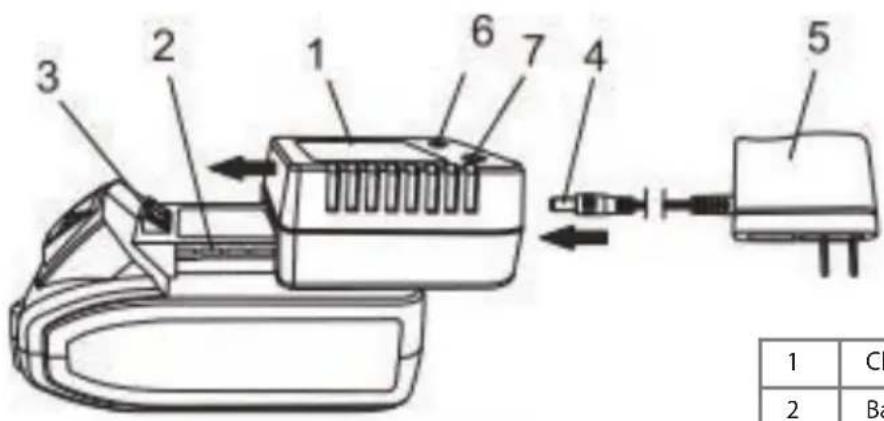
Fig. 1
| 1 | Charger |
| 2 | Battery |
| 3 | Lock/Release Latch |
| 4 | Transformer Power Output |
| 5 | Transformer |
| 6 | Red LED |
| 7 | Green LED |
• To charge the battery, place the charger (1) in a dry location near a 240V AC electrical socket. • Plug the transformer (5) into the socket. - Slide the battery onto the charger ensuring that the grooves on the charger fit into the battery (2) until the battery clicks into position over the latch (3). • Plug the output of the transformer (4) into the charger. • Charging status will be indicated by the lights as shown in the following table.
Battery Tools – Charging Indicator Lights
The following table shows the charging status indicated by the LED lights on the charger.
| Green Light (7) Red Light (6) Battery Inserted Charging Status | |||
| ON OFF NO Charger connected to power supply | |||
| OFF ON YES Battery charging | |||
| ON OFF YES Battery fully charged | |||
| Product Specifications | |
| Power Rating 220 ~ 240v, 60Hz | |
| Power Output 0.38A | |
| Approximate Charge Time (2Ah Battery) 3-5hrs | |
| Approximate Charge Time (4Ah Battery) 8-10hrs | |
Symbols
The manual or rating plate on your tool may show symbols. These represent important information about the product or instructions on its use.
 | You must read the instruction manua Wear |  | Footwear |
 | Product is compliant with CE safety standards |  | Wear ear protection |
 | Product is compliant with RoHS safety standards |  | Wear safety gloves |
 | General warning |  | Wear protective clothing |
 | Dispose of in compliance with WEEE standards |  | Wear safety mask |
 | Contains Lithium-Ion battery |  | Wear eye protection |
 | Product is double insulated |  | Wear head protection |
 | Fire hazard |  | Wear respiratory protection |
| Electrocution hazard |
DISPOSAL

Do not dispose of in general waste.
As stated in European Directive 2012/19/EU for Waste Electrical and Electronic Equipment, this product must be disposed of in an environmentally safe manner. We recommend taking it to a recycling facility.
Warranty
This product has a 3-year warranty for manufacturing defects. The warranty period is counted from the date of purchase of the product, according to the purchase invoice. The product warranty only covers manufacturing defects; defects resulting from improper use, such as dropping, improper transportation, connection to the mains power supply not in compliance with the voltage specified in this manual, insertion of foreign objects, and natural wear of parts such as plastic parts (caps, buttons, handles, latch locks, power cables, etc.) and metal parts (wires, motors, etc.) are not covered.
Also not covered are damages due to agents of nature, lightning, food, sea, oxidation, humidity, etc. The product will lose its warranty if it presents defects which, after analysis by our technicians, are characterized as being improperly used, used for professional use, or used for a purpose for which it is not intended (according to the Owner's Manual). This warranty will be void if it is found that the device has been tampered with or has been repaired by a person or service not authorized by Blaupunkt. The guarantee is only valid with the receipt/invoice provided at purchase.
We undertake to provide the above-mentioned services within the warranty period only in places where it maintains an authorized service. Consumers not located near an authorized service center are responsible for the costs and risks of transport to an authorized service.
Territorial Limitations: Any repair, replacement, or support of the Products provided under the Warranty (or any other support service offered in our sole discretion) shall be restricted to, and provided solely within, the Distribution Territory as then in effect on the date the Product is delivered to you. If you purchase a Product within a defined Distribution Territory and later transport the Product outside of the Distribution Territory, we cannot provide returns, warranty, out-of-warranty, or aftermarket support of any kind outside the Distribution Territory.
Natural 'wear and tear' is not covered under warranty.
This product is for domestic use only.
SAVE THESE INSTRUCTIONS
Imported and distributed by:
UNOLD AG
Mannheimer Straße 4
68766 Hockenheim
Tel.: 06205 9418 0
E-Mail: info@unold.de


Brand : BLAUPUNKT
Model : BP38
Category : Battery charger