ManualGo.com
NAV5805AWW - Washing machine WHIRLPOOL - Free user manual and instructions
Find the device manual for free NAV5805AWW WHIRLPOOL in PDF.



Download the instructions for your Washing machine in PDF format for free! Find your manual NAV5805AWW - WHIRLPOOL and take your electronic device back in hand. On this page are published all the documents necessary for the use of your device. NAV5805AWW by WHIRLPOOL.
USER MANUAL NAV5805AWW WHIRLPOOL
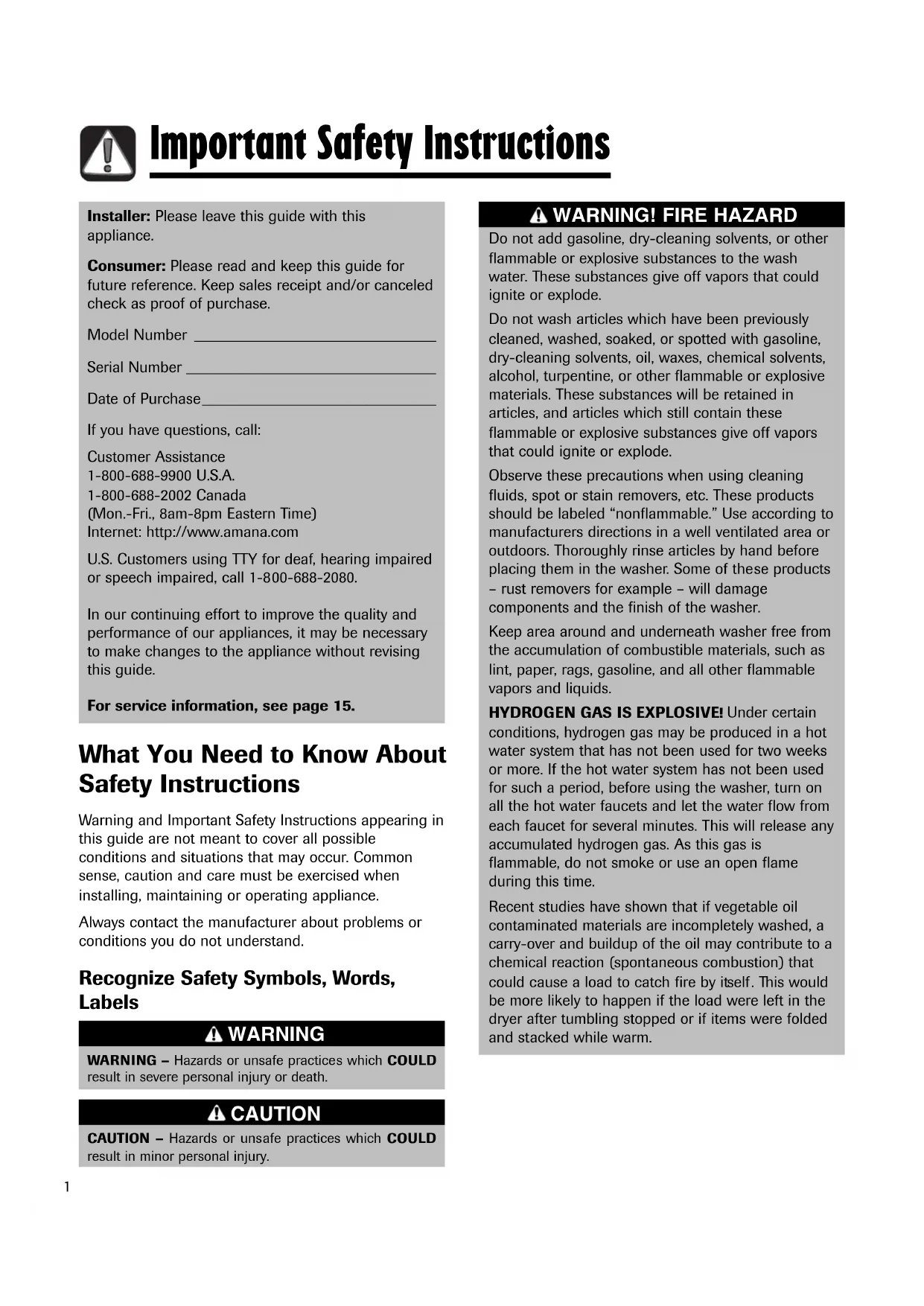
ycles, options, lights hat can & cannot be washedo perating tips dishwasher useloading Controls at a glance Dryer Exhaust tips Safety Care & Cleaning Service & Warranty urface Cooking troubleshooting Oven Cooking Storing the washer InstallationS pecial Features Notes Important Safety Instructions WARNING – Hazards or unsafe practices which COULD result in severe personal injury or death. WARNING CAUTION – Hazards or unsafe practices which COULD result in minor personal injury. CAUTION Installer: Please leave this guide with this appliance. Consumer: Please read and keep this guide for future reference. Keep sales receipt and/or canceled check as proof of purchase. Model Number _______________________________ Serial Number ________________________________ Date of Purchase______________________________ If you have questions, call: Customer Assistance 1-800-688-9900 U.S.A. 1-800-688-2002 Canada (Mon.-Fri., 8am-8pm Eastern Time) Internet: http://www.amana.com U.S. Customers using TTY for deaf, hearing impaired or speech impaired, call 1-8 00-688-2080. In our continuing effort to improve the quality and performance of our appliances, it may be necessary to make changes to the appliance without revising this guide. For service information, see page 15. What You Need to Know About Safety Instructions Warning and Important Safety Instructions appearing in this guide are not meant to cover all possible conditions and situations that may occur. Common sense, caution and care must be exercised when inst alling, maint aining or operating appliance. Always contact the manufacturer about problems or conditions you do not underst and. Recognize Safety Symbols, Words, Labels
ycles, options, lights What can & cannot be washed operating tips dishwasher useloading Controls at a glance Dryer Exhaust tips Safety are & Cleaning Service & Warranty urface Cooking troubleshooting Oven Cooking Storing the washer InstallationS pecial Features Notes
WARNING! FIRE HAZARD
Do not add gasoline, dry-cleaning solvents, or other flammable or explosive substances to the wash water. These substances give off vapors that could ignite or explode. Do not wash articles which have been previously cleaned, washed, soaked, or spotted with gasoline, dry-cleaning solvents, oil, waxes, chemical solvents, alcohol, turpentine, or other flammable or explosive materials. These substances will be retained in articles, and articles which still contain these flammable or explosive substances give off vapors that could ignite or explode. Observe these precautions when using cleaning fluids, spot or stain removers, etc. These products should be labeled “nonflammable.” Use according to manufacturers directions in a well ventilated area or outdoors. Thoroughly rinse articles by hand before placing them in the washer . Some of the se products – rust removers for example – will damage components and the finish of the washer. Keep area around and underneath washer free from the accumulation of combustible materials, such as lint, paper, rags, gasoline, and all other flammable vapors and liquids. HYD ROGEN GAS IS EXPLOSIVE! Under cer tain conditions, hydrogen gas may be produced in a hot water system that has not been used for two weeks or more. If the hot water system has not been used for such a period, before using the washer, turn on all the hot water faucets and let the water flow from each faucet for several minute s. T his will release any accumulated hydrogen gas. As this gas is flammable, do not smoke or use an open flame during this time. Recent studies have shown that if vegetable oil contaminated materials are incompletely washed, a
arry-over and buildup of the oil may contribute to a chemical reaction (spontaneous combustion) that could c ause a load to c atch fire by it self . T his would be more likely to happen if the load were left in the dryer after tumbling stopped or if items were folded and st acked while warm.2
1. Read all instructions before using the appliance.
2. As with any equipment using electricity and having
moving parts, there are potential hazards. To use this appliance safely, the operator should become familiar with the instructions for operation of the appliance and always exercise care when using it.
Do not install or store this appliance where it will be exposed to the weather.
4. Install and level washer on a floor that can support
5. This appliance must be properly grounded. Never
plug the appliance cord into a receptacle which is not grounded adequately and in accordance with local and national codes. See installation instructions for grounding this appliance.
6. To avoid the possibility of fire or explosion:
Do not wash items that have been previously cleaned in, washed in, soaked in, or spotted with gasoline, dry-cleaning solvents, other flammable or explosive substances as they give off vapors that could ignite or explode. Hand wash and line dry any items containing these substances. Any material on which you have used a cleaning solvent, or which is saturated with flammable liquids or solids, should not be placed in the washer until all traces of these liquids or solids and their fumes have been removed. These items include acetone, denatured alcohol, gasoline, kerosene, some liquid household cleaners, some spot removers, turpentine, waxes and wax removers.
Do not add gasoline, dry-cleaning solvents, or other flammable or explosive substances to the wash water. These substances give off vapors that could ignite or explode.
ain conditions, hydrogen gas may be produced in a hot water system that has not been used for two weeks or more. HYD
XPLOSIVE. If the hot water system has not been used for such a period, before using a washing machine or combination washer-dryer , turn on all hot water faucets and let the water flow from each for several minute s. T his will release any To reduce the risk of fire, explosion, electric shock, or personal injury when using your washer, follow basic safety precautions, including the following: WARNING accumulated hydrogen gas. As the gas is flammable, do not smoke or use an open flame during this time. d. Do not wash or dry items that are soiled with vegetable or cooking oil. These items may contain some oil after laundering. Due to the remaining oil, the fabric may smoke or catch fire by itself.
7. Do not reach into the appliance if the tub or agitator
Do not allow children or pets to play on, in, or in front of the appliance. Close supervision is necessary when the appliance is used near children and pets.
Do not tamper with controls.
Do not repair or replace any part of the appliance or attempt any servicing unless specifically recommended in published user-repair instructions that you understand and have the skills to carry out.
11. Unplug power supply cord before attempting to
service your washer. Service is to be done only by qualified service personnel.
ator should not be removed. If the agitator is removed, it must be replaced by pushing down completely and the locking screw tightened before the washer is operated.
13. Keep all laundry aids such as detergents, bleach, etc.,
out of the reach of children, preferably in a locked cabinet. Use laundry aids only as directed by the manufacturer. Observe all warnings on container labels.
14. Keep the area around and underneath washer free
from the accumulation of combustible materials, such as lint, paper, rags, gasoline, and all other flammable vapors and liquids.
Do not use chlorine bleach and ammonia or acids (such as vinegar or rust remover) in the s ame wash. Hazardous fumes can form.
16. Do not machine wash fiberglass materials. Small
particles can stick to fabrics washed in following loads and c ause skin irrit ation.
17. For flame resistant finishes - follow garment
manufacturer's instructions carefully. Improper laundering could remove the finish.
18. Before the appliance is removed from service or
disc arded, remove the door to the washing compar tment.
19. Inlet hoses are subject to damage and deterioration
over time. Check the hoses periodically for bulges, kinks, cuts, wear or leaks and replace them every five years.
ycles, options, lights hat can & cannot be washedo perating tips dishwasher useloading Controls at a glance Dryer Exhaust tips afety Care & Cleaning Service & Warranty urface Cooking troubleshooting Oven Cooking Storing the washer InstallationS pecial Features Notes Important Safety Instructions
ycles, options, lights What can & cannot be washed operating tips dishwasher useloading Controls at a glance Dryer Exhaust tips Safety are & Cleaning Service & Warranty urface Cooking troubleshooting Oven Cooking Storing the washer InstallationS pecial Features Notes
SAVE THESE INSTRUCTIONS3
toring the washer Installation
- Use either liquid or granular laundry detergent. For best results, be sure detergent is added to the washer BEFORE the load and be sure the wash water is above 60
- Use the correct amount of detergent for the load size, soil level and water conditions. Use more detergent if you have hard water and very soiled loads. If you have soft water or a lightly soiled load, use less detergent. (See manufacturer’s instructions.)
- Wipe up any detergent spills on the washer. Loading
For best results add the detergent to the washtub before adding the load.
- Put dry, unfolded clothes loosely in the tub, up to the top row of holes for a maximum load.
Do not wrap large items like sheets around the agit ator.
- Mix large and small items for best circulation. W ash bulky items like blankets separately.
- When laundering wrinkle free items or items of delic ate construction, washable woolens or loosely knit items, never use le ss than the MEDIUM water level setting. This will minimize shrinkage, wrinkling and pulling of seams.
Close lid c arefully to avoid slamming.Additional Tips
- During the spin, it is possible for the load to become unevenly distributed in the tub. If this happens, push in the control dial, open the lid, redistribute the load, close the lid and restart the washer. The spin will resume at the point it was interrupted.
- The washer will pause briefly throughout each cycle. These pauses are normal.
- This washer is designed so that it will not agitate or spin when the lid is open. It will, however, fill with the lid open so water is available for pretreating stains or diluting fabric softener.
- If you open the lid during a spin cycle, the washer will stop. When the lid is closed and the washer is restarted, the washer will continue the cycle at the point it was interrupted.
toring the washer Installation
otes Operating Tips 4Hot/ColdWhite and heavily soiled, color-fastitems.Warm/Warm Moderately soiled, colored items. arm/ColdModerately soiled, colored items; most permanent press items.Cold/ColdBrightly colored, lightly soiled items; washable woolens. ycles, options, lights What can & cannot be washed operating tips dishwasher useloadingC ontrols at a glance Dryer Exhaust tips Safety Care & Cleaning Service & Warranty Surface Cooking roubleshooting ven Cooking Storing the washer Installation Special Features Notes Using the Controls – 2 Speed Combo Models Select Water Level Determine the selected setting based on clothes loadsize. Selection should provide sufficient water to permitclothes to circulate freely during agitation.It may become necessary, due to bulky fabrics, toadjust the water level after agitation begins. To adjustthe water level, turn the control to reset and then backto the desired setting. Select Wash/Rinse Temperature Your washer gives you a choice of hot, warm or coldwater for washing and cold or warm water (selectmodels) for rinsing. Use the chart below as a guide. STEP 1 STEP 2
R LEV L SETTING LOAD SIZESmall 1/4 - 1/3Medium 1/3 – 1/2 Large 1/2 – 2/3 Super 2/3 – Full Note: Items must circulate freely for be st re sult
detergents do not dissolve well or clean well. Carelabels define cold water as up to 85
TEMPS 5Pull Control Dial Out to Start You may stop the washer at any time by simply pushing the control dial in. T herefore it is possible to obtain a non-agitated soak or to shorten, skip or repeat any part of a cycle. The control dial must be pushed in (off position) when you change the setting. Select Cycle To select a cycle, push the control dial in (off position) and turn it to the right (clockwise) until the pointer is at the soil level needed for the wash load in the Regular, Handwash or No Iron Fabrics cycles. Regular Cycle Provides normal agitation and normal spin speeds to wash cottons and heavily soiled items. F or maximum cleaning, set the dial at Extra Heavy. No Iron Fabrics Cycle
rovide s normal agit ation and normal spin speeds with a spray rinse to reduce wrinkling. Handwash Cycle Provides intermittent agitation and soak for delicates and knits.
ontrol features vary by model. Note: Do not attempt to turn the control dial counterclockwise. Damage to the timer will result. STEP 3 STEP 47
ycles, options, lights What can & cannot be washed operating tips dishwasher useloading Controls at a glance Dryer Exhaust tips Safety are & Cleaning ervice & Warranty urface Cooking troubleshootingO ven Cooking toring the washer InstallationS pecial Features Notes Using the Controls – 3 Speed Combo Models Select Water Level Determine the selected setting based on clothes loadsize. Selection should provide sufficient water to permitclothes to circulate freely during agitation. It may become necessary, due to bulky fabrics, toadjust the water level after agitation begins. To adjustthe water level, turn the control to reset and then backto the desired setting. STEP 1 Note: Items must circulate freely for best result
WATER LEVEL SETTING LOAD SIZE
Mini 1/4 FullSmall 1/4 - 1/3Medium 1/3 – 1/2 Large 1/2 – 2/3 Super 2/3 – Full Select Wash/Rinse Temperature Your washer gives you a choice of hot, warm or coldwater for washing and cold or warm water (selectmodels) for rinsing. STEP 2 Note: In wash water temperature s below 6
detergents do not dissolve well or clean well. Carelabels define cold water as up to 85
Select Cycle To select a cycle, push the control dial in (off position) and turn it to the right (clockwise) until the pointer is atthe soil level needed for the wash load in the Regular,Handwash, No Iron Fabrics or Quick Wash cycles. Regular Cycle Provides normal agitation and normal spin speeds towash cottons and heavily soiled items. For maximumcleaning, set the dial at Heavy. No Iron Fabrics Cycle Provides normal agitation and normal spin speeds witha spray rinse to reduce wrinkling. Handwash Cycle Provides intermittent agitation and soak for delicatesand knits. Quick Wash Cycle Provides normal agitation and normal spin speeds. Useto quickly clean small, lightly soiled loads or to refre items. STEP 3 Hot/ColdWhite and heavily soiled, color-fastitems. Warm/Warm Moderately soiled, colored items.
arm/ColdModerately soiled, colored items; most permanent press items.Cold/ColdBrightly colored, lightly soiled items; washable woolens.
WASH/RINSE LOAD TYPE
TEMPS8 STEP 4 Pull Control Dial Out to Start You may stop the washer at any time by simply pushing the control dial in. Therefore it is possible to obtain a non-agitated soak or to shor ten, skip or repeat any part of a cycle. The control dial must be pushed in (off position) when you change the setting. Note: Do not attempt to turn the control dial counterclockwise. Damage to the timer will result. STEP 5 Select Options (if desired) Extra Rinse When the switch or knob is in the On position, an additional rinse at the end of the Regular, No Iron Fabrics and Handwash cycle s is provided to more completely remove laundry additives, suds, perfumes, etc.9 Select Wash/Rinse Temperature Your washer gives you a choice of hot, warm or coldwater for washing and cold water or warm water(select models) for rinsing. Use the chart below as aguide.Automatic Temperature Control (A.T.C.) providesthe optimal wash water temperature for cleaning. Tosave energy, this washer will regulate wash watertemperatures by mixing hot and cold water to reachthe proper water temperature. STEP 2
ycles, options, lights What can & cannot be washed operating tips dishwasher useloading Controls at a glance Dryer Exhaust tips Safety are & Cleaning ervice & Warranty urface Cooking troubleshooting ven Cooking toring the washer InstallationS pecial Features Notes Using the Controls – Electronic Control Models Select Water Level Determine the selected setting based on clothes loadsize. Selection should provide sufficient water to permitclothes to circulate freely during agitation.It may become necessary, due to bulky fabrics, toadjust the water level after agitation begins. To adjustthe water level, turn the Infinite Water Level control toreset and then back to the desired setting. STEP 1 WATER LEVEL SETTING LOAD SIZESmall 1/4 - 1/3Medium 1/3 – 1/2 Large 1/2 – 2/3 Super 2/3 – F ull Note: The lid must be completely closed in order to operate the washer controls. Getting Started 1. Add detergent and additives to the washer.2. Load the washer.3. Close the lid.4. Select the appropriate cycle and options for the load.5. Press the Cycle Selector dial.6. The Fill indicator light will illuminate and the washerwill start to fill.Cold/ColdBrightly colored, lightly soiled items; washable woolens.These settings feature Automatic Temperature Control:ATC Hot/Cold, Save s energy by adding cold waterATC Warm/Coldto the hot water from your waterheater . P rovides optimum cleaningat lower temperatures.May add hot water to the incomingATC Cold/Coldcold water as the washer fills. Thisassures that the water will be warmenough to properly activate detergent.WASH/RINSE LOAD TYPE
ontrol features vary by model. Soil Level/Time Selection Your washer has selectable soil level/time settings. STEP 4
SELECTION Light Use for cleaning lightly soiled loads. Normal Use for cleaning moderately soiled loads. T his setting will be appropriate for most loads. Heavy Use for cleaning heavily soiled loads. Select Options Extra Rinse When the knob is in the On position, an additional rinse at the end of all cycles is provided to more completely remove laundry additives, suds, perfumes, etc. End of Cycle Signal The End of Cycle Signal will sound once the cycle is completed. On select models, the End of Cycle Signal
an be c anceled by setting the switch to Off. STEP 311
ycles, options, lights hat can & cannot be washedo perating tips dishwasher useloadingC ontrols at a glance Dryer Exhaust tipsSafety Care & Cleaning Service & Warranty urface Cooking troubleshootingO ven Cooking Storing the washer Installation Special Features Notes Using the Controls – Electronic Control Models STEP 6 Start the Washer To start the washer, press the cycle selector dial. Changing a Cycle If an incorrect cycle has been accidentallyselected:
1. Press the cycle selector dial.
2. Turn the cycle selector dial to the desired cycle.3. Set the desired options for the cycle.4. Press the
cycle selector dial. The Wash indicator lights stop flashing and the new cycle starts. Canceling a Cycle
2. Turn the cycle selector dial to Power Off and push the dial in.
o dr ain the washer: Select the Rinse & Spin or Spin Only
ycle.2. Press the cycle selector dial. The Spin light illuminates and the washer starts the rinse or spin. Soak Only Provides approximately 33 minutes of alternatingperiods of soaking with brief agitation at slow speed.At the end of the cycle, the Cycle Selector dial must bemanually set to a wash cycle or spin cycle to drain thewasher. Avoid extended soaking. Spin Only Provides a spin to remove more water from the load. Rinse and Spin Use for loads that need rinsing only or to add rinse-added fabric softener to a load. Power Off To cancel the cycle and turn off the washer, turn the Cycle Selector dial to Power Off and push the dial in. Fabric Selection Select the appropriate fabric cycle for the type of loadby turning the cycle selector dial until the indicatorlight by the desired fabric selection is illuminated. STEP 5 Quick Wash For lightly soiled or wrinkledGentle/Fast garments needed quickly. Ultra Handwash Provides intermittent agitation and Ex. Gentle/Slow soak. For wool, silk, and other hand-wash-only fabrics.Handwash For sheer fabrics, bras and lingerieGentle/Slow needing slower spin speed becauseof clothing construction.No Iron For “wash and wear” and syntheticMedium/Slow fabrics and lightly to normally soiledgarments needing a slower spin speed to reduce wrinkling.Regular For most sturdy fabrics includingMedium/Fast cottons, linens and normally soiledgarments needing maximum water extraction. Whites & Towels For sturdy fabrics and heavily soiled Normal/Fast whites needing maximum water extraction.
WASH/SPIN FABRIC SELECTION
SPEED12 Liquid Bleach Dispenser The dispenser automatically dilutes liquid chlorine bleach before it reaches your wash load. To use, follow these steps:
1. Measure liquid chlorine bleach carefully, following
the instructions on the bottle.
Pour liquid chlorine bleach into the bleach dispenser before adding the load. Avoid splashing or over-filling the dispenser. Pour liquid chlorine bleach into bleach dispenser. Fabric Softener Dispenser The dispenser automatically releases liquid fabric softener at the proper time during the cycle. To use, follow these steps:
1. Pour a measured amount of fabric softener into
the dispenser to fill line only.
2. If fabric softener comes below line, add warm water.
If it is necessary to clean the dispenser:
1. Pull the dispenser off of the top of the agitator.
2. Soak for one hour in sink or container in hot water
and dishwashing liquid.
3. Hold hands over top and bottom of dispenser and
shake to loosen buildup.
Rinse with clean, hot water.
Replace dispenser on agitator. Do not use dishwashing liquid inside the washer. Oversudsing can occur. Automatic Lint Filtering System The Lint Filtering System does not require cleaning. Wash and rinse water is filtered and re-filtered continuously to trap lint shed by most fabrics during the agitation cycle before it can be redeposited on the wash load. The engineered hole design on the wash basket in conjunction with water flow produced by the agit ator, traps lint away from the clothes between the inner wash basket and the outer tub. Lint is automatically flushed from the washer during the spin cycle. Safety Spin If for any reason you open the washer lid when the washer is in a spin or extract period, the operation will immediately stop. This is for your personal safety. If your washer does not stop, call your service technician immediately. When the lid is closed, the operation will automatically resume. Notes:
- Never pour undiluted liquid chlorine bleach directly onto the load or into the wash tub. It is a powerful chemical and can cause fabric damage, such as tearing or color loss, if not used properly.
- If you prefer to use color-safe, non-chlorine bleach, pour it into the wash tub with your detergent. Do not pour non-chlorine bleache s into the bleach dispenser. Cycles, options, lights What can & cannot be
ashed operating tips
ishwasher use loading Controls at a glance Dryer Exhaust tips
ervice & Warranty Surface Cooking troubleshooting Oven Cooking Storing the washer Installation
rovide s a flow of water when holding the switch in the On position.13 Unbalanced Spin Load Compensator Your new washer is designed to handle out-of-balance loads without shutting down or interrupting the washing cycle. For this reason, the cycle will always be completed. If heavier fabrics in such out-of-balance loads should ever contain excessive moisture at the completion of the cycle, redistribute the clothes in the washer and reset the control dial for the final spin period. Overload Protector A built-in protector automatically shuts off the washer motor in case of an overload. This can occur if:
- The load being washed is too heavy.
- Too many appliances are plugged into the line operating your washer.
- A low voltage condition exists on the line.
- Lid is opened and closed repeatedly. The overload protector permits the washer to start again when the motor has cooled to a safe operating temperature. If the motor stops repeatedly, call your service technician. Cycles, options, lights
ishwasher use loading Controls at a glance Dryer Exhaust tips
ervice & Warranty Surface Cooking troubleshooting Oven Cooking Storing the washer Installation
pecial Features Notes Special Features
ashed operating tips dishwasher use loading Controls at a glance Dryer Exhaust tips
afety Care & Cleaning Service & Warranty Surface Cooking troubleshooting Oven Cooking Storing the washer Installation Special Features Notes Care & Cleaning
1. After washing, leave the lid open until the interior
Check hoses to be sure there are no kinks or knots.
3. Your washer should not be installed where
temperatures will go below freezing, as damage to the washer could re sult.
4. To clean, occasionally wipe exterior with a clean
damp sponge or cloth. Do not use polish on plastic par ts.
5. Lifetime lubrication is done at the factory, so your
washer never needs to be oiled or greased.
Do not lay heavy or sharp objects on top of your washer.
7. The top of the washer should not be used for
removing stains from garments. Some stain removers, such as rust remover, will mar the finish.
Remove pins, buckles or other sharp objects from clothes to prevent scratching interior parts.
Clothe s should not be stored in washer
10. Bleach, detergent, solvents, etc. spilled on the top
of your washer that are allowed to remain will remove the glossy finish. Remove all spills with a damp, soft cloth.
11. If you close your home for the winter, have a service
technician drain the washer . Unplug cord from electric al outlet and disconnect hose s from faucet
Cleaning the Interior Clean the interior of the washer periodically to remove any dirt, soil, odor, mold, mildew or bacteria residue that may remain in the washer as a re sult of washing clothes. We recommend taking the following steps every 60 to 120 days to clean and freshen your washer interior. The frequency with which the washer should be cleaned and freshened depends on factors such as usage, the amount of dir t, soil or bacteria being run through your washer, or the use of cold water. Failure to follow these instructions may result in unsatisfactory conditions, including unpleasant odor and/or permanent st ains on the washer or washload.
1. Add a measured amount of chlorine bleach to the
bleach dispenser, following package directions.
2. Add 1/4 cup of detergent to the tub.
3. Run the washer without a load through a complete
ycle using hot water
Plug cord into live electrical outlet.
- Check fuse or reset circuit breaker.
- Turn the control dial to proper cycle and restart the washer.
- Turn both faucets on fully.
- Disconnect hoses and clean screens. Hose filter screens may be plugged.
- Check fuse or reset circuit breaker.
- Make sure the lid is completely closed.
- Turn the control dial to proper cycle and restart the washer.
- Pauses are normal. Wait and see if the washer will start again.
- Check fuse or reset circuit breaker.
- Straighten drain hoses. Eliminate kinked hoses. If there is a home drain restriction, call for drain service.
- Close lid and restart the washer. For your safety, washer will not spin unless the lid is closed.
- Suds lock – caused by too much suds. Rewash without detergent. Use correct amount of a low- sudsing detergent.
- Unevenly distributed load. Redistribute the load, close the lid and restart the washer. Check for leveling. Be sure water level is acceptable for load size.
- A normal spin speed is recommended for heavy loads like jeans or towels.
- Plug cord into live electrical outlet.
- Check fuse or reset circuit breaker.
- Close lid and restart the washer. For your safety, washer will not agitate or spin unless lid is closed.
- This may be a pause in the cycle. Wait briefly and it may start.
- Make sure hose connections are tight.
- Make sure end of drain hose is correctly inserted and secured to drain facility.
- Avoid extended soaking – soak for 30 minutes or less.
- Be sure washer is leveled properly as outlined in installation manual.
- Weak floors can cause vibration and walking.
- Operating sounds will vary depending on agitation speed.
If equipped with a temperature selector knob, be sure it is set directly on a temperature setting and not between settings.
- Make sure temperature selection is correct.
- While the washer is filling, you may notice just hot and/or just cold water entering the tub when cold or warm wash temperatures are selected. This is a normal function of the Automatic
emperature Control (select models) feature as the washer determine s the temperature of the water.
- If Auto Temperature Control (select models) is selected, cold water may feel warmer than cold water from the tap.
- Make sure hoses are connected to correct faucets and inlet connections. Be sure water supply is regulated correctly. Flush water line before filling washer.
Check the water heater . It should be set to deliver a minimum 120° F (49° C) hot water at the tap. Also check water heater capacity and recovery rate.
- Disconnect hoses and clean screens. Hose filter screens may be plugged.
- Extra Rinse (select models) is selected.
ycles, options, lights What can & cannot be
Fills with the Wrong Temperature Water Cycle Selector Advances Through Off
Warranty Limited One Year Warranty - Parts and Labor For one (1) year from the original retail purchase date, any part which fails in normal home use will be repaired or replaced free of charge. Canadian Residents The above warranties only cover an appliance installed in Canada that has been certified or listed by appropriate test agencies for a compliance to a National Standard of Canada unless the appliance was brought into Canada due to transfer of residence from the United States to Canada. The specific warranties expressed above are the ONLY warranties provided by the manufacturer. These warranties give you specific legal rights, and you may also have other rights which vary from state to state. Warranty & Service What is Not Covered By These Warranties
1. Conditions and damages resulting from any of the following:
a. Improper installation, delivery, or maintenance.
. Any repair, modification, alteration, or adjustment not authorized by the manufacturer or an authorized servicer. c. Misuse, abuse, accidents, unreasonable use, or acts of God. d. Incorrect electric current, voltage, electrical and/or gas supply. e. Improper setting of any control.
2. Warranties are void if the original serial numbers have been removed, altered,
or cannot be readily determined.
3. Light bulbs, water filters and air filters.
4. Products purchased for commercial or industrial use.
5. The cost of service or service call to:
a. Correct installation errors. For products requiring ventilation, rigid metal ducting must be used. b. Instruct the user on the proper use of the product. c. Transport the appliance to and from the servicer.
6. Any food loss due to refrigerator or freezer product failures.
7. Expenses for travel and transportation for product service in remote locations.
8. Outside of the United States and Canada this warranty does not apply.
Contact your dealer to determine if another warranty applies.
9. Consequential or incidental damages sustained by any person as a result of
any breach of these warranties. Some states do not allow the exclusion or limitation of consequential or incidental damages, so the above exclusion may not apply. If You Need Service First see the Troubleshooting section in your Use and Care Guide or call the dealer from whom your appliance was purchased or call Maytag Services, LLC, Customer Assistance at 1-800-688-9900 USA and 1-800-688-2002 Canada to locate an authorized servicer.
Be sure to ret ain proof of purchase to verify warranty status. Refer to WARRANTY for further information on owner’s responsibilities for warranty service.
- If the dealer or service company cannot resolve the problem, write to Maytag Service s, LLC, Attn: CAIR
- User’s guides, service manuals and parts information are available from Maytag Services, LLC, Customer Assistance. Notes: W hen writing or c alling about a service problem, please include: a. Your name, address and telephone number; b. Model number and serial number; c. Name and address of your dealer or servicer; d. A clear description of the problem you are having;
roof of purchase (s ale s receipt).
WARRANTY SHALL BE PRODUCT REPAIR
AS PROVIDED HEREIN. IMPLIED
WARRANTIES, INCLUDING WARRANTIES
ES, OR LIMITATIONS ON THE
MAY NOT APPLY TO YOU. THIS
WARRANTY GIVES YOU SPECIFIC LEGAL
RIGHTS AND YOU MAY ALSO HAVE
OTHER RIGHTS, WHICH VARY STATE TO
ycles, options, lights What can & cannot be washed operating tips dishwasher useloading Controls at a glance Dryer Exhaust tips Safety are & Cleaning Service & Warranty urface Cooking troubleshooting Oven Cooking Storing the washer InstallationS pecial Features Notes
toring the washer Installation
toring the washer Installation
ashed operating tips
ishwasher use loading Controls at a glance Dryer Exhaust tips
ervice & Warranty Surface Cooking troubleshooting Oven Cooking Storing the washer Installation
ashed operating tips
oading Controls at a glance Dryer Exhaust tips
urface Cooking troubleshooting
nstallation Special Features Notes
ashed operating tips
oading Controls at a glance Dryer Exhaust tips
urface Cooking troubleshooting
nstallation Special Features Notes
ycles, options, lights What can & cannot be washed operating tips dishwasher useloading Controls at a glance Dryer Exhaust tips Safety are & Cleaning Service & Warranty urface Cooking troubleshooting Oven Cooking Storing the washer InstallationS pecial Features Notes
toring the washer Installation
toring the washer Installation
ashed operating tips
oading Controls at a glance Dryer Exhaust tips
urface Cooking troubleshooting
ashed operating tips
oading Controls at a glance Dryer Exhaust tips
urface Cooking troubleshooting
oading Controls at a glance Dryer Exhaust tips
urface Cooking troubleshooting
toring the washer Installation