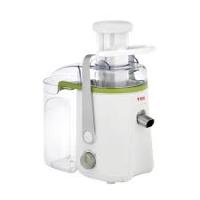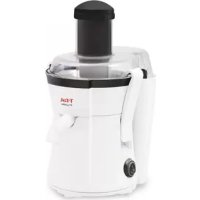
Frutelia - Juicer T-FAL - Free user manual and instructions
Find the device manual for free Frutelia T-FAL in PDF.



| Product type | Juice extractor (centrifugal) |
| Brand | T-Fal |
| Model | Frutelia |
| Power supply | 220-240 V ~ 50/60 Hz |
| Power | Not specified (estimated 200-400 W) |
| Pulp collector capacity | Approximately 0.5 L (estimated) |
| Juice collector capacity | Approximately 0.5 L (estimated) |
| Glass capacity | 20 cl (200 ml) |
| Main functions | Centrifugal juice extraction, drip-stop system, safety opening, continuous operation 1 min max |
| Safety | Lockable lid with audible click, automatic shut-off in case of incorrect lid position, safety filter |
| Filter material | Stainless steel (estimated) |
| Body material | Plastic (estimated) |
| Cleaning | Removable parts (A, B, C, D, E, F, G, H) dishwasher safe; motor unit cleaned with a damp cloth |
| Maintenance | Clean immediately after use; do not use abrasive sponges; replace the filter at the first signs of wear |
| Spare parts | Filter (D), pusher (A), juice collector (E), pulp collector (H), etc.; original parts recommended |
| Repairability | Interventions not described in the manual must be carried out by an authorized center |
| General information | Household use only; do not use for sugar cane or overly fibrous fruits; consume juice immediately |
| Weight | Not specified (estimated 2-3 kg) |
| Dimensions | Not specified (estimated 30x20x40 cm) |
Frequently Asked Questions - Frutelia T-FAL
User questions about Frutelia T-FAL
0 question about this device. Answer the ones you know or ask your own.
Ask a new question about this device
Download the instructions for your Juicer in PDF format for free! Find your manual Frutelia - T-FAL and take your electronic device back in hand. On this page are published all the documents necessary for the use of your device. Frutelia by T-FAL.
USER MANUAL Frutelia T-FAL
- Always check the sieve (D) before use.
- Never use the juicer if the sieve is broken, if it is defective, if you see cracks or breaks or if the sieve is torn. If there is any evident damage to the sieve, contact an approved Service centre. The sieve has sharp edges: handle it with care.
-
For your safety, this appliance is compliant with applicable standards and regulations:
-
Low Voltage Directive
- Electromagnetic compatibility directive
-
Regulations governing materials in contact with food.
-
Check that the supply voltage shown on the rating plate of the
appliance matchesthat of your electricalsystem. Any errorin connection will invalidate the warranty.
- Do not place or use this appliance on a hotplate or close to an open flame (gas cooker).
- Do not immerse themotor unit or put itunder running water.
- If the power cord is damaged, it must be replaced by the manufacturer, its after-sales service or any person with similar qualifications, in order to avoid any danger.
-
Use this appliance on a solid, stable worktop, away from watersplashes. Do not turn it over.
-
Any maintenance other than routine cleaning and upkeep by customers must be carried out by an approved service centre.
-
The appliance must be unplugged:
-
if there is a problem or fault during operation.
-
before assembly, disassembly or cleaning.
-
Never pull on the supply cord to unplug the appliance.
- Only use an electrical extension lead after checking that it is in perfect condition.
- A domestic appliance must not be used:
- if it has fallen on the floor.
- if it is damaged or incomplete.
-
In such cases, or for any other repair, you MUST contact an approved Service centre.
-
This product has been designed for domestic use only. Any commercial use, inappropriate use or failure to comply with the instructions, the manufacturer accepts no responsibility and the guarantee will not apply.
- This appliance is not intended for use by persons (including children) with reduced physical, sensory or mental capabilities, or lack of experience and knowledge, unless they have been given supervision or instruction concerning use of the appliance by a person responsible for their safety.
- Children should not be allowed to play with the appliance.
- Only use original accessories and components. We cannot accept any
responsibility if this is not the case.
- Never put your fingers or any other object in the feed tube (B) while the appliance is in operation. Always use the pusher (A) provided for this purpose.
- Do not remove the cover (C) until the sieve (D) has stopped completely.
- Do not remove the pulp collector (H) while the appliance is working.
Always unplug the appliance from the mains after use. - When you use the appliance for preparations with hard ingredients (for example, sugarcane), you must not run it for more than 20 seconds consecutively.
- Do not leave the appliance unattended whilst plugged in and
switched on.
-
Your appliance has been designed for household use only. It has not been designed to be used in the following cases, which are not covered by the warranty:
-
in kitchen areas intended for staff in stores, offices and other professional environments,
-
on farms,
-
by the patrons of hotels, motels and other residential environments,
-
in bed and breakfas settings.
-
Turn the appliance off and disconnect it from the power outlet prior to changing the accessories or approaching parts that move while the appliance is in operation.
DESCRIPTION
A Pusher
B Feed tube
C Cover
D Sieve
E Juice collector
F Pouring spout
G Non-drip spout
H Pulp collector
Safety clamps
J Control button
K Drive shaft
L Motor unit
SAFETY SYSTEM
To start the juicer, the cover (C) must be fitted correctly (Fig. 2).
At the end of a cycle, turn the
control button to "0" and wait until the sieve (D) stops completely before removing the cover (C).
BEFORE FIRST USE
We recommend that you wash the removable parts (A, B, C, D, E, F, G, H) before the first use (see section "Cleaning and care").
- Unpack the appliance and then place it on a solid, stable worktop, remove the cover (C) and take out the protective card on the sieve (D).
USING THE APPLIANCE
- Place the juice collector (E) on the body of the appliance (see Fig. 1).
- Place the sieve (D) in the juice collector (E). Ensure that the sieve is properly clipped onto the drive shaft (K) (see Fig. 1).
- Fit the cover (C) on the appliance, pulp ejection spout (see Fig. 2).
- Fit the cover (C) on the appliance in order to have the pulp evacuation exit to the rear (see fig.2).
- Lock the two clamps (I) on
the cover (C). You will hear an audible "click" (see Fig. 4).
- Slide the pusher (A) into the feed tube (B) aligning the groove on the pusher with the small ridge in the feed tube.
- Your appliance is equipped with a non-drip spout (G). Fit it (spout downwards) on the pouring spout (Fig. 5).
- Place a glass under the non-drip spout in front of the appliance (see Fig. 5).
-
Plug in the appliance.
-
To start the appliance, use the control button (J).
- Cut the fruits or vegetables into pieces if necessary after removing the stones.
- Insert the fruits or vegetables through the feed tube (B).
- The fruits and vegetables must be inserted only while the motor is running.
-
Do not press too hard on the pusher (A). Do not use any other utensil. NEVER push food with your fingers.
-
When you have finished, stop the appliance by turning the control button (J) to 0 and wait until the sieve (D) stops completely.
- When the pulp collector (H) is full, or the juice flow slows down, empty the pulp collector (H) and clean the sieve (D) and the cover (C).
After making your juice, turn the non-drip spout (G) by 180^ before removing the glass to stop the juice flow (see Fig. 6).
| Ingredients | Approximate weight (kg) | Quantity of juice obtained in ml (*) - 1 glass = 20 ml (approximately) |
| Apples 1 650 | ||
| Pears | 1 600 | |
| Carrots | 1 600 | |
| Cucumbers | 1 (about 2 cucumbers) | 600 |
| Pineapple | 1 300 | |
| Grapes | 1 450 | |
| Tomatoes | 1 600 | |
| Celery | 1 600 |
Do not use the appliance for more than 1 minute continuously
(*) The quality and quantity of juice varies widely depending on the freshness of the fruit or vegetables and variety of each vegetable or fruit.
The quantities of juice indicated above are therefore approximate.
PRACTICAL TIPS
- Wash the fruit carefully before stoning.
- You do not need to remove the skin or peel. You only need to peel fruit with thick (and bitter) skin: citrus fruit, pineapple (remove the centre core).
- It is difficult to extract juice from melon, bananas, avocados, blackberries, figs, aubergines and strawberries, etc.
- The juicer should not be used for sugarcane and excessively hard or fibrous fruit.
- Choose fresh, ripe fruit and vegetables, they will yield more juice. This appliance is suitable for fruits such as apples, pears,
oranges, grapes, pomegranates, pineapple, etc. and vegetables such as carrots, cucumbers, tomatoes, beetroot and celery, etc.
- If you use over-ripe fruit, the sieve (D) will tend to get clogged up more quickly.
IMPORTANT:
All juice should be consumed immediately. On contact with air, it is very quickly oxidised, which can change its taste, colour and, above all, nutritional value. Apple and pear juices quickly turn brown. Add a few drops of lemon juice to slow this discolouration.
CLEANING AND CARE
- All removable parts may be cleaned in the dishwasher (A, B, C, D, E, F, G, H). Alternatively wash the parts in warm water and washing up liquid. Don't use an abrasive sponge to do this. The appliance is easier to clean if rinsed with water immediately after use and then cleaned fully later.
Do not use scouring pads, acetone, alcohol, etc. to clean your appliance.
- The sieve (D) must be handled with care. Avoid any mishandling that may damage it. Change your sieve at the first sign of wear or damage.
- Clean the motor unit with a damp cloth.
WHAT TO DO IF YOUR APPLIANCE DOES NOT WORK
| PROBLEMS CAUSES | SOLUTIONS | |
| The appliance does not work. | The plug is not connected, the switch is not at “1”. | Connect the appliance to a socket with the correct voltage. Operate the appliance. |
| The cover (C) is not properly clamped. | Check that the cover (C) is properly fitted and clamped. | |
| The appliance is giving off a smell or is very hot to the touch or is smoking or making an abnormal noise. | The sieve (D) is not properly fitted. | Check that the sieve (D) is fitted properly. |
| The quantity of food being processed is too great. | Leave the appliance to cool and reduce the quantity to be processed. | |
| The juice does not flow correctly. | The juice collector (E) is not fitted properly. | Check that the juice collector (E) is fitted correctly. |
| The sieve (D) is blocked. | Clean the sieve (D). | |
| If you have any other problem or query please contact the Helpline at the end of this leaflet. | ||
END-OF-LIFE ELECTRIC OR ELECTRONIC PRODUCTS
Think of the environment!
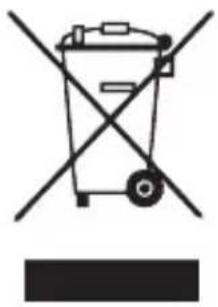
① Your appliance contains valuable materials which can be recovered or recycled.
Leave it at a local civic waste collection point.