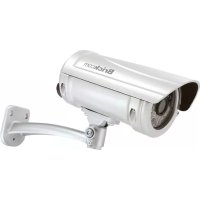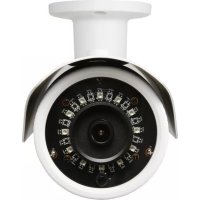
OB500Af - Surveillance Camera Brickcom - Free user manual and instructions
Find the device manual for free OB500Af Brickcom in PDF.


User questions about OB500Af Brickcom
0 question about this device. Answer the ones you know or ask your own.
Ask a new question about this device
Download the instructions for your Surveillance Camera in PDF format for free! Find your manual OB500Af - Brickcom and take your electronic device back in hand. On this page are published all the documents necessary for the use of your device. OB500Af by Brickcom.
USER MANUAL OB500Af Brickcom
Hardware User's Manual
Megapixel Day & Night
Bullet Network Camera
Quality Service Group
OB-500Af Series
Review History:
- Separate User Manual into HW and SW.
- Merge OB-500Af/OB-400Af/OB-300Af/OB-200Af/OB-130Af into this User Manual
- Change pictures to OB-500Af v2 series.
- Modify Device Appearance Description (Pear Panel of DI/DO)
| Product name: | Network Camera (OB-500Af v2) |
| Release Date: | 2013/3/21 |
| Manual Revision: | V3.2 |
| Web site: | www.brickcom.com |
| Email: | support@brickcom.com info@brickcom.com |
| © 2011 Brickcom Corporation. All Rights Reserved |
Table of Contents
Before You Use This Product 1
Regulatory Information 1
Chapter 1 - Package Contents 5
Chapter 2 - Bullet Network Camera Overview 6
Chapter 3 - Device Appearance Description 7
Chapter 4 - Installation 11
4.1 Hardware Installation 11
4.2 Camera Connection 13
4.3 System Requirements 15
4.4 Software Installation 16
4.3.1 EasyConfig 24
Before You Use This Product
In many countries, there are laws prohibiting or restricting the use of surveillance devices. This Network Camera is a high-performance, web-ready camera which can be part of a flexible surveillance system. It is the user's responsibility to ensure that the operation of this camera is legal before installing this unit for its intended use.
Upon opening the product's package, verify that all the accessories listed on the "Package Contents" are included. Before installing the Network Camera, read the warnings in the "Quick Installation Guide" to avoid misuse. When installing the Network Camera, carefully read and follow the instructions in the "Installation" chapters to avoid damages due to faulty assembly or installation.
Regulatory Information
Federal Communication Commission Interference Statement
This equipment has been tested and found to comply with the limits for a Class B digital device, pursuant to Part 15 of the FCC Rules. These limits are designed to provide reasonable protection against harmful interference in a residential installation. This equipment generates uses and can radiate radio frequency energy and, if not installed and used in accordance with the instructions, may cause harmful interference to radio communications. However, there is no guarantee that interference will not occur in a particular installation. If this equipment does cause harmful interference to radio or television reception, which can be determined by turning the equipment off and on, the user is encouraged to try to correct the interference by one of the following measures:
- Reorient or relocate the receiving antenna.
- Increase the separation between the equipment and receiver.
- Connect the equipment into an outlet on a circuit different from that to which the receiver is connected.
- Consult the dealer or an experienced radio/TV technician for help.
FCC Caution: Any changes or modifications not expressly approved by the party responsible for compliance could void the user's authority to operate this equipment.
This device complies with Part 15 of the FCC Rules. Operation is subject to the following two conditions: (1) This device may not cause harmful interference, and (2) this device
must accept any interference received, including interference that may cause undesired operation.

IMPORTANT NOTE:
FCC Radiation Exposure Statement:
This equipment complies with FCC radiation exposure limits set forth for an uncontrolled environment. This equipment should be installed and operated with minimum distance 20cm between the radiator & your body.
This transmitter must not be co-located or operating in conjunction with any other antenna or transmitter.
The availability of some specific channels and/or operational frequency bands are country dependent and are firmware programmed at the factory to match the intended destination. The firmware setting is not accessible by the end user.
Industry Canada statement:
Chapter 1 - Package Contents
Please check to make sure the product package contains all the accessories listed below.
A. Camera Package Contents
| a. Network Camera | b. Screw bag |
| c. Warranty Card | d. Terminal Block |
| e. Dry Bag | f. Power Adapter(Optional) |
| g. POE (Optional) | h. Product CD |
| i. Bracket |
Chapter 2 - Bullet Network Camera
Overview
The Brickcom Bullet SERIES is a Bullet network camera. It adopts a megapixel sensor which allows the camera to deliver extremely clear and detailed images that CCTV cameras cannot offer. To optimize use of the megapixel resolution, the Bullet SERIES uses efficient H.264/ MJPEG/ MPEG-4 codec compression to deliver dual configurable video streams simultaneously at up to 30 fps. These features make this series the perfect outdoor camera for neighborhood, school campus, and parking lot surveillance.
The Bullet SERIES has many user friendly features, such as support for DC12V power supply, Power over Ethernet enables the camera to use the same cable for power and data transmission, eliminating the need to install an external power supply.
Users do not have to worry about the data connection failing because each camera is equipped with a SD/SDHC memory card slot for local storage.
With an IP66 certified outdoor enclosure, the Bullet SERIES is not only weather proof, but also dust and rust resistant.
Chapter 3 - Device Appearance Description
< Front Panel >
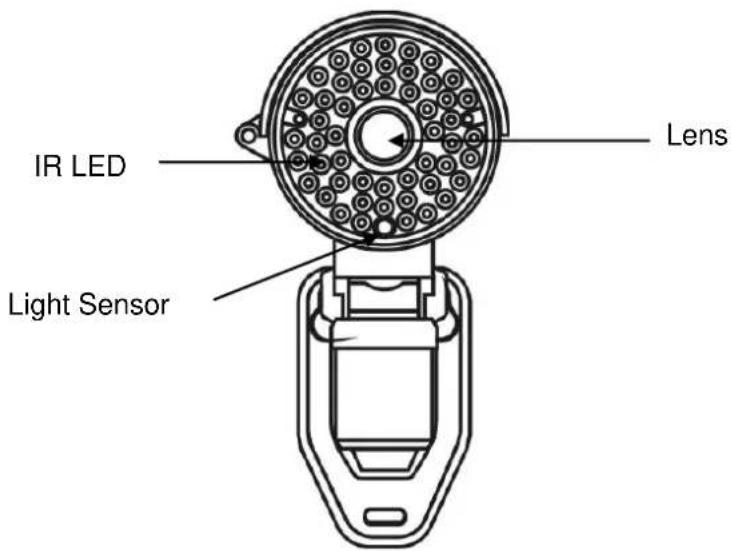
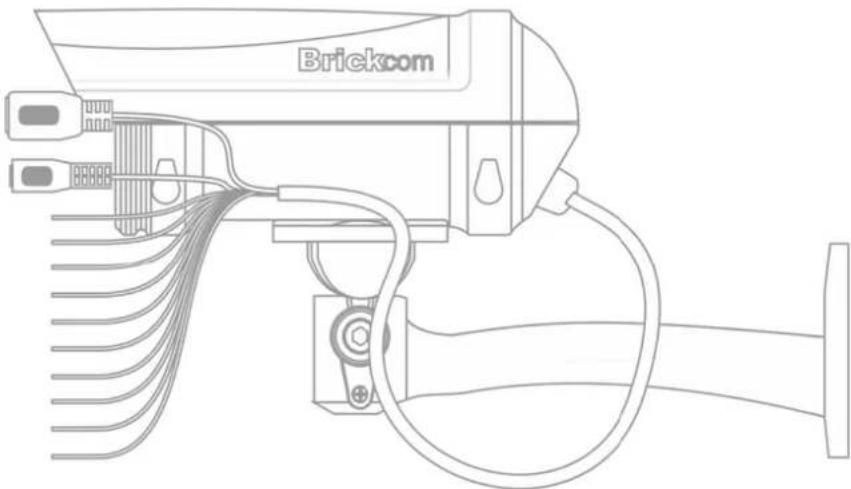
1.RJ 45 Connector
2. Power Connector (DC12V)
3. Ground (Orange White)
4. Power + 5V (Brown White)
5. Digital Input (Blue White)
6. Digital Output (Green White)
7. RS485+ (Purple White)
8. RS485-(Gray Black)
9. Line In (Pink)
10. Line In Ground (Pink Black/Gray)
11. Line Out (Green)
12. Line Out Ground (Red Black/ White)
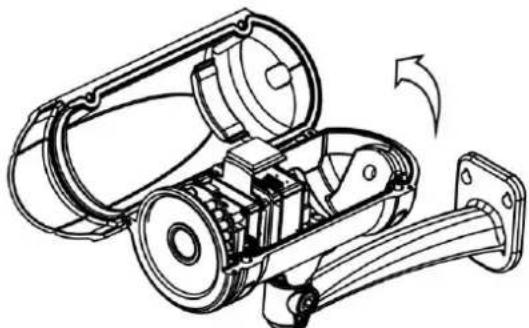
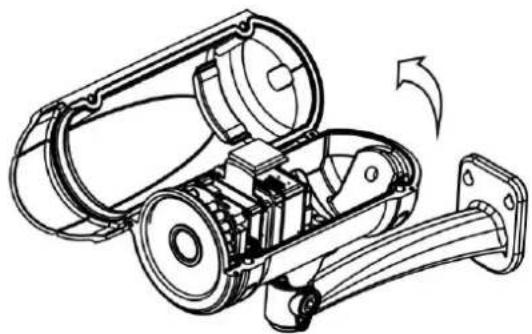
Please open the top case with the screwdriver.
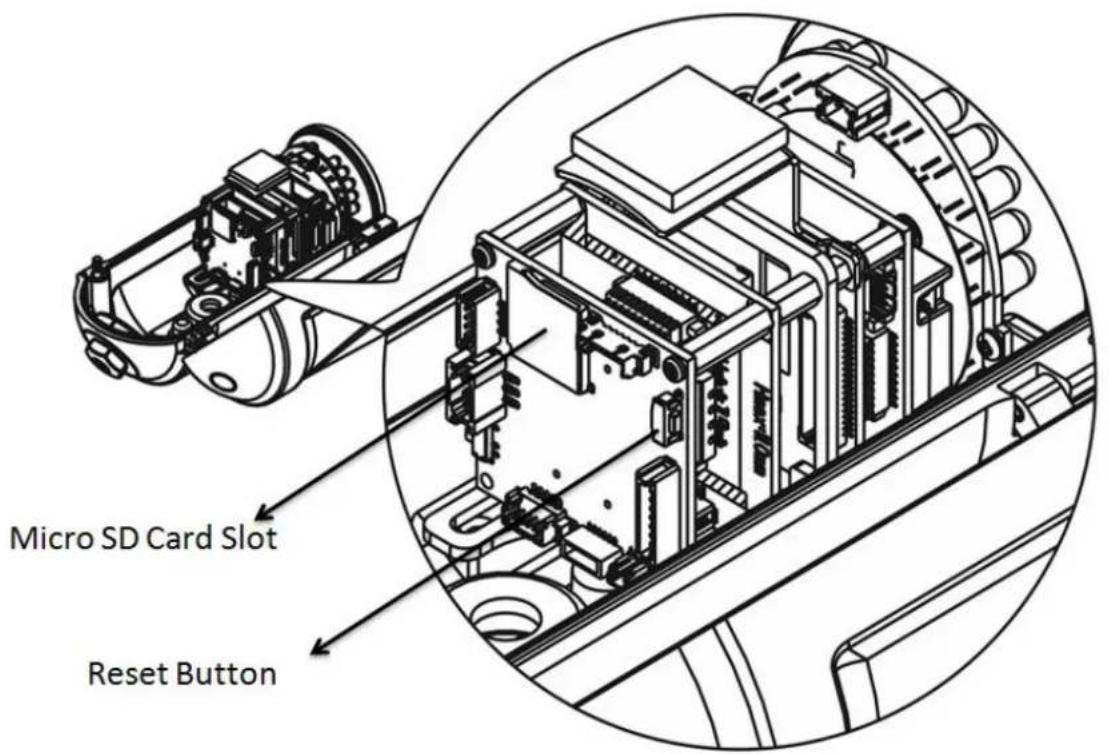
Micro SD card slot and HW Reset Button
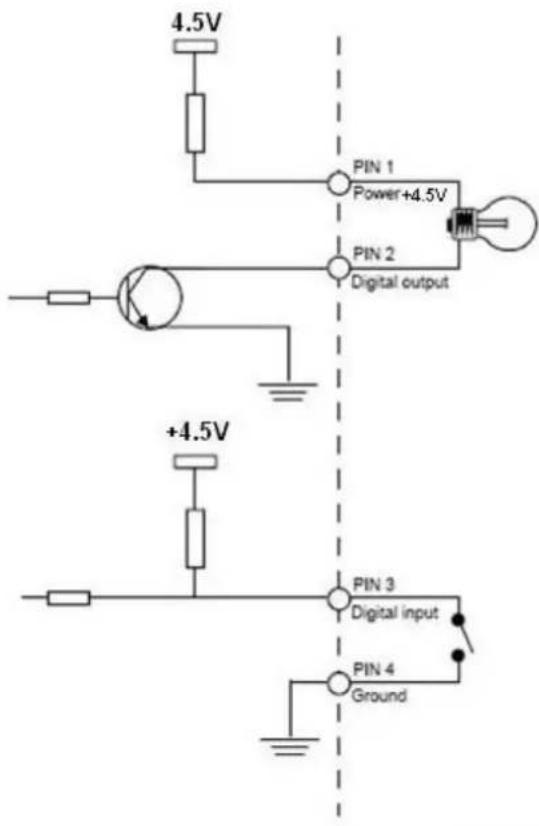
< Extension I/O Terminal Block >
The Network Camera provides an extension I/O terminal block which is used to connect the camera with external input/output devices. The pin definitions are listed as below.
| Pin Line | Function |
| Brown White | Power + 5V |
| Green White | Digital Input |
| Blue White | Digital Output |
| Orange White | Ground |
| Purple White | RS485+ |
| Gray Black | RS485- |
| Pink | Audio In |
| Pink Black | Audio In Ground |
| Light Green | Audio Out |
| Red Black | Audio Out Ground |
< Hardware Reset >
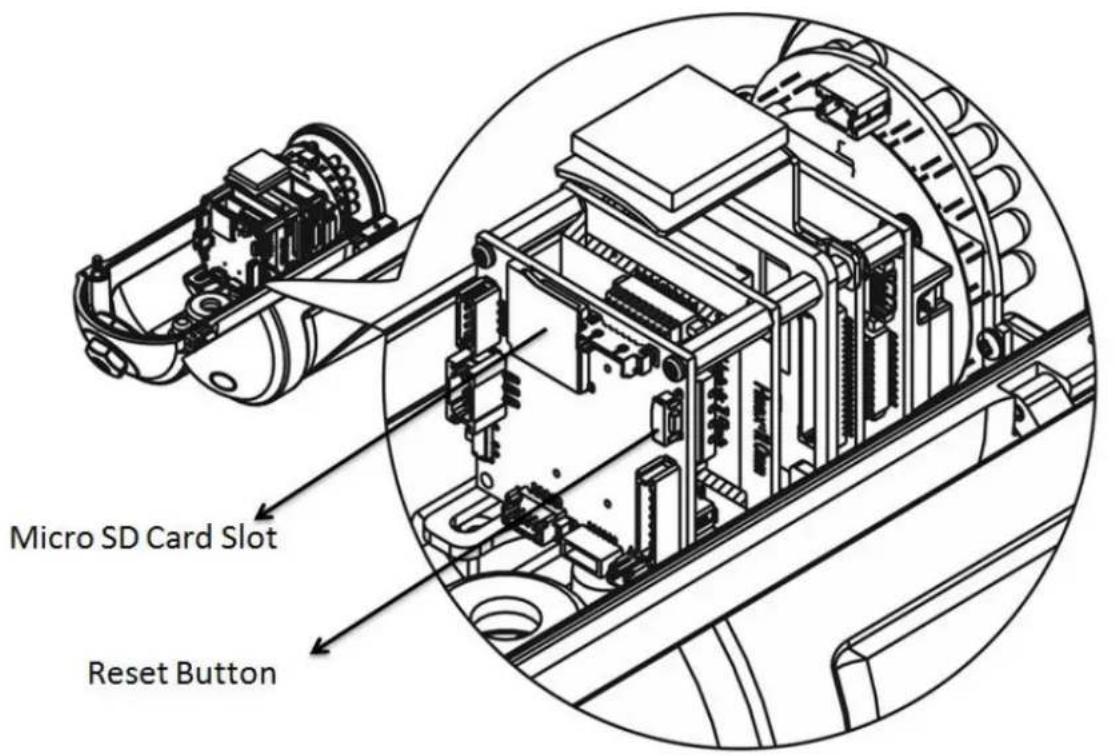
The Reset Button can be used to reboot the camera or restore it to factory default settings. If the camera experiences a problem, rebooting the camera may correct the problem. If the problem remains, please restore the camera to factory default settings and reinstall the software.
To Reboot
Press and hold the Reset Button for one second using a paper clip or thin object. Wait for the camera to reboot.
To Restore
Press and hold the Reset Button for ten seconds until the LED light turns off. When successful restored, the LED will be blue during normal operation.

NOTE - By restoring the camera, all settings will be restored to the factory default settings.
Micro-SD/SDHC Card Capacity
The network camera is compatible with Micro-SD/SDHC (Maximum 32GB) cards.
(*) These are optional features. Please refer to the Product List for the full list of optional features that are available for this product.
Chapter 4 - Installation
4.1 Hardware Installation

WARNING - Do not mount the camera on a soft material. The camera may fall and be damaged.
A. Micro-SD/SDHC Card
a. Remove the top case from the Bullet Camera.
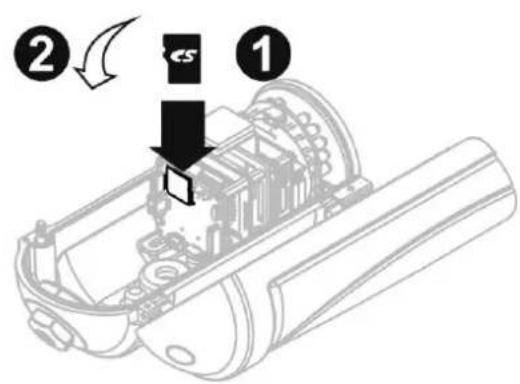
b. (1)Insert the Micro SD/SDHC card into their respective slots.
(2) Reattach the Lens cover and secure the cover to the top of the camera device using two screws.
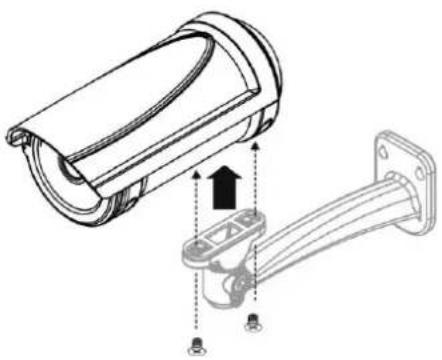
B. Bracket Installation
Use the screws to lock the bracket along with the Bullet housing.
C. Wall Installation
a. Drill three holes into the wall and (1) hammer the supplied plastic anchors into the three holes. (2) Use a screwdriver and the supplied screws to secure the plate to the wall.
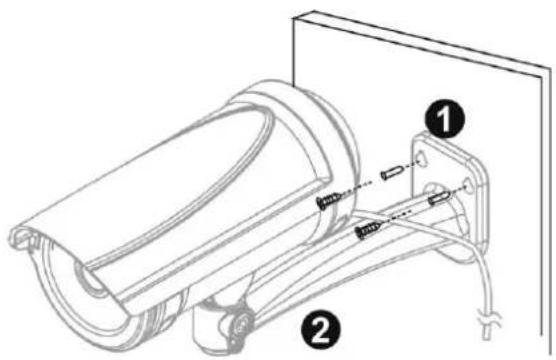
b. Connect (1) the POE cable; (2) DC12 Power Connector, (3) Line In/Out, DIDO, RS485 cable; with the camera. Refer to "Chapter 3" for more details installation information.

a. PoE Connection
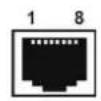
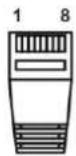
For the Power over Ethernet connection, construct the PoE cable using the pin definitions of the RJ45 connector below and refer to step 5 for instructions on how to install the Water Proof Connector. Once the PoE cable has been constructed using the waterproof connector, pass the RJ-45 cable from the camera through the bracket and connect it to the PoE cable.

| RJ45 Connector | |
| Pin No. | Function |
| Pin 1 | Transmit Out+ (Tx+) |
| Pin 2 | Transmit Out- (Tx-) |
| Pin 3 | Receive In+ (Rx+) |
| Pin 4 | DC 48V |
| Pin 5 | DC 48V |
| Pin 6 | Receive In- (Rx-) |
| Pin 7 | 48V_GND |
| Pin 8 | 48V_GND |
4.2 Camera Connection
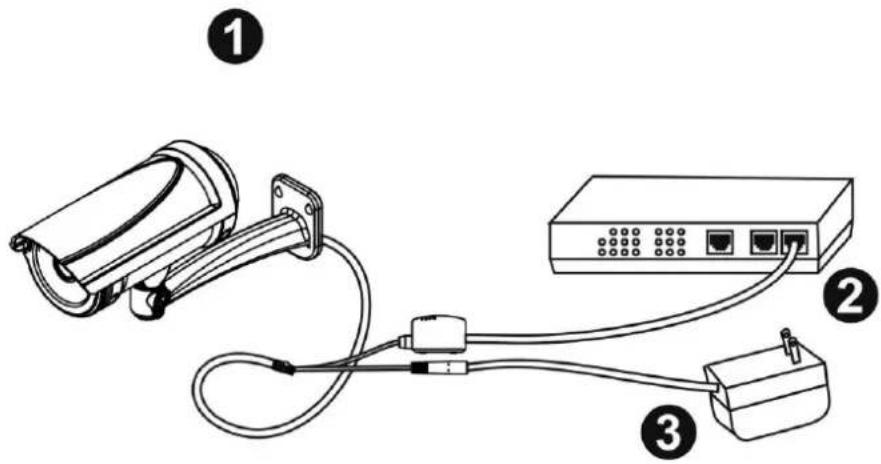
The Bullet Series is DC12V and PoE compliant, so there are two options for connecting the camera to a power and Ethernet source. The camera can either be connected to a PoE-enabled switch or a non-PoE switch.
a. If using a PoE-enabled switch:
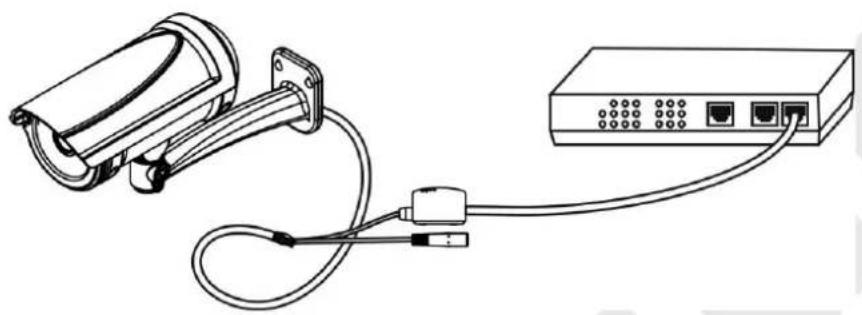
i. Use a single Ethernet cable to connect the camera to the PoE-enabled switch.
b. If using a non-PoE switch:
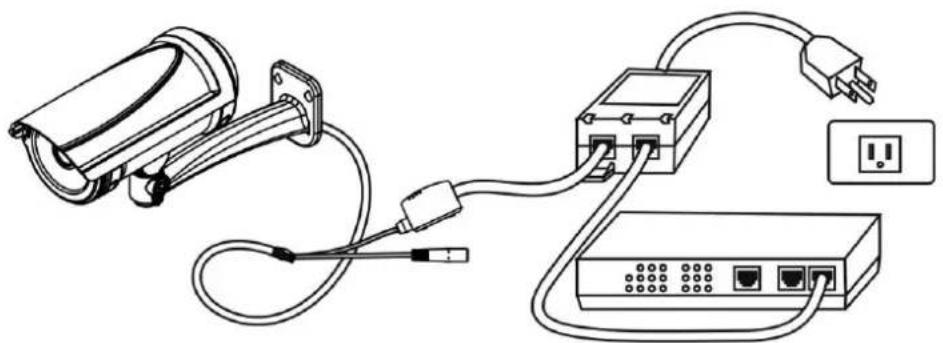
i. Use a standard RJ-45 cable to connect the camera to a PoE Injector.
ii. Use a standard RJ-45 cable to connect the PoE Injector to the non-PoE switch.
iii. Use a standard power cable to connect the PoE Injector to a power outlet.
If using the DC12V for the power Supply. The RJ45 cable will be data transmission.
4.3 System Requirements
Operating System:
Microsoft Windows XP Home Edition SP2
Microsoft Windows XP Professional SP2
Computer:
IBM PC/AT Compatible
CPU:
Pentium 3GHz or faster
Memory:
1024 MB or more
Monitor:
1024 x 768 pixels or more, 24-bit True color or better
Network Interface:
10/100Mbps Network interface card must be installed
Web Browser:
Microsoft Internet Explorer 6.0 SP2 or higher
Adobe Reader:
Adobe Reader 8.0 or higher
Audio:
The audio function will not work if a sound card is not installed in the PC. Audio may be interrupted depending on network traffic.
4.4 Software Installation
In this manual, "User" refers to whoever has access to the Network Camera, and "Administrator" refers to the person who can configure the camera and grant user access to the camera.
After checking the hardware connection, run the Installation Wizard program included on the product's CDROM to automatically search the intranet for the camera. There may be many cameras on the local network. Differentiate the cameras using the serial number which is printed on the labels on the carton and the bottom of the camera.
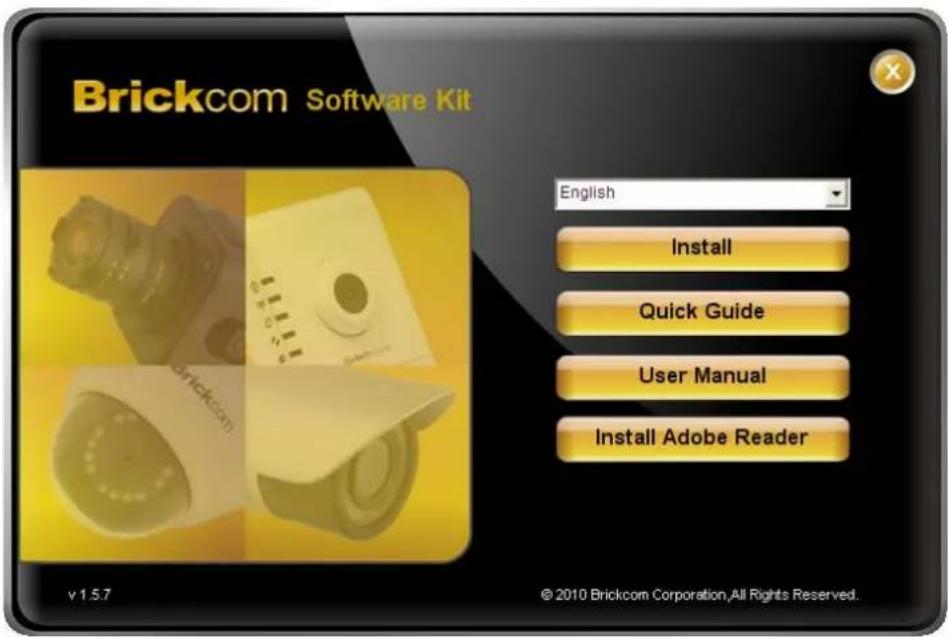
A. Insert the Installation CD into the CD-ROM driver. Run Auto-Run Tool directly from the CD-ROM to start the installation. When installing the Brickcom software kit for the first time, select a desired language for the interface. The available languages are listed in the scroll box. Click
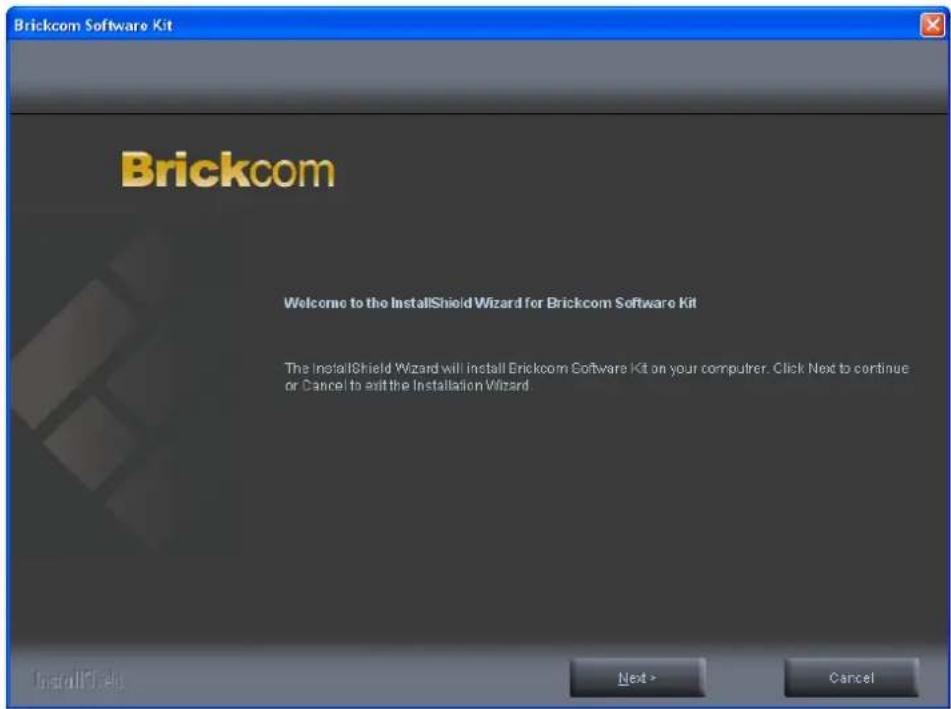
B. In the Install Shield Wizard dialog box, click
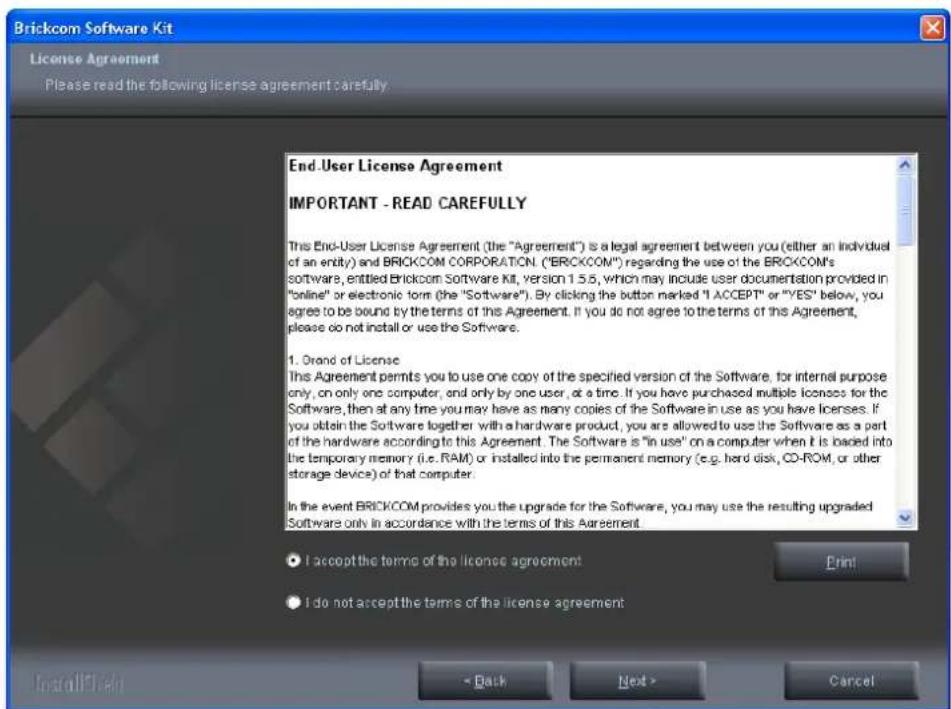
C. Read the End-User License Agreement and check the option "I accept the terms of the license agreement". Click
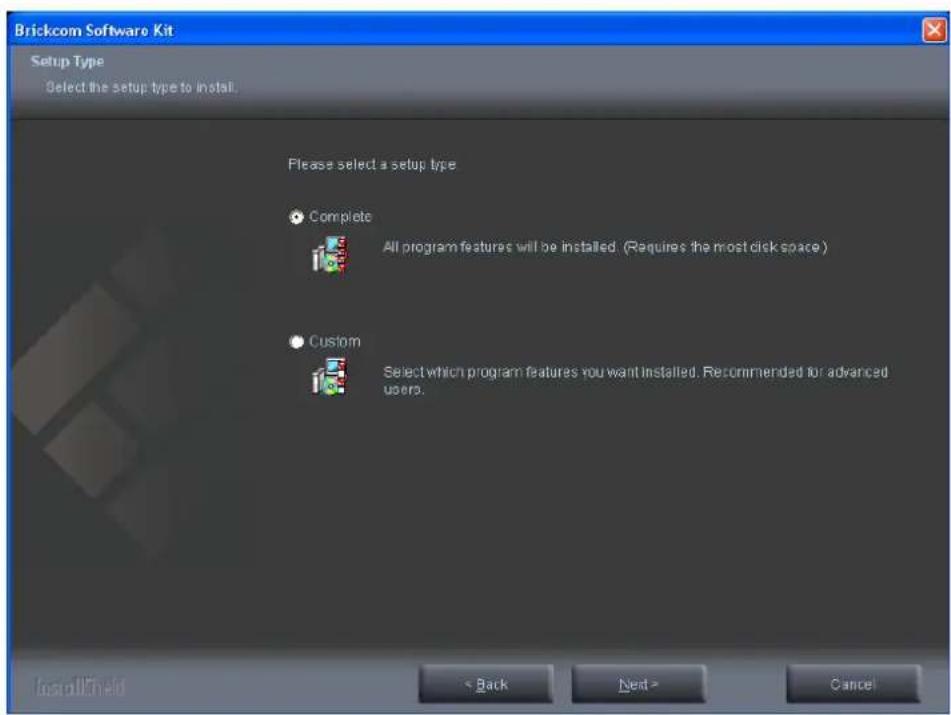
D. Select either "Complete" setup or "Custom" setup to install the system.
a. If COMPLETE SETUP is selected:
i. All program features will be installed into the default directory. Check the option "Complete" and then click
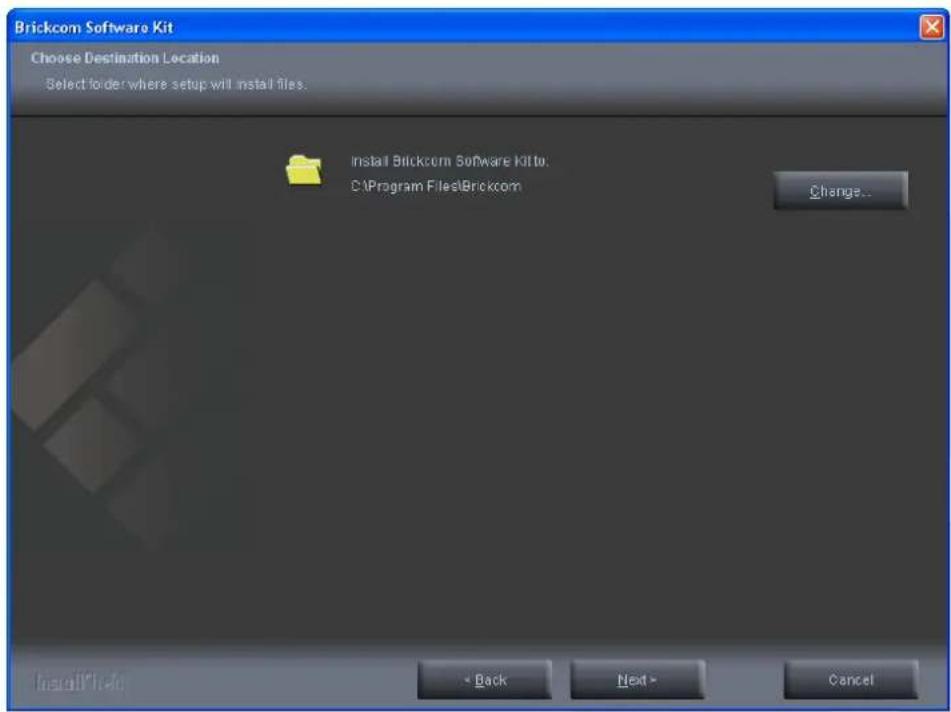
ii. Click
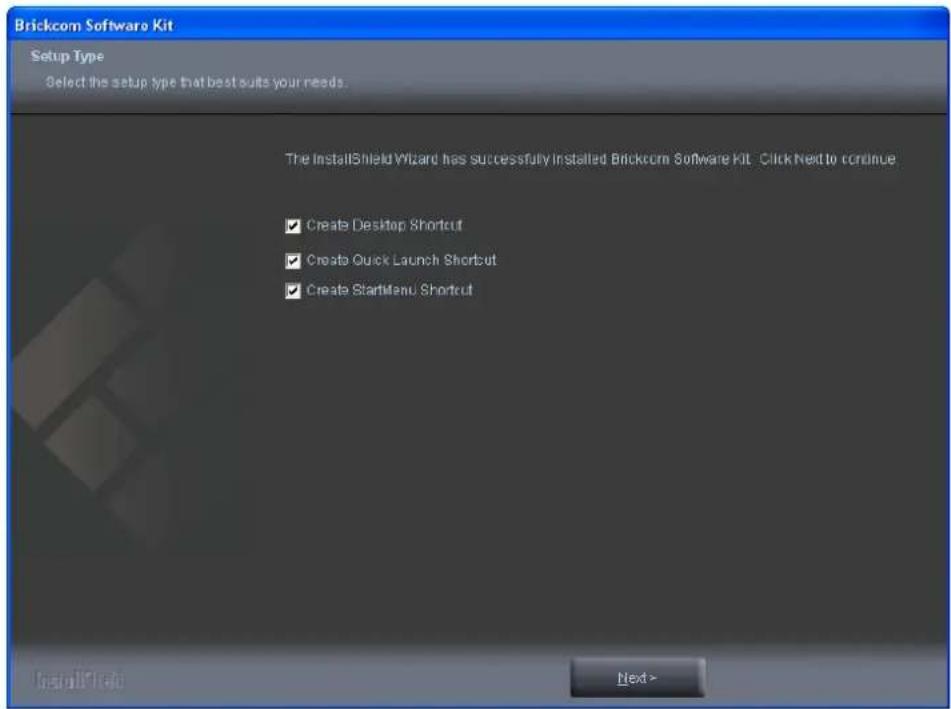
iii. Select to create shortcuts. Click
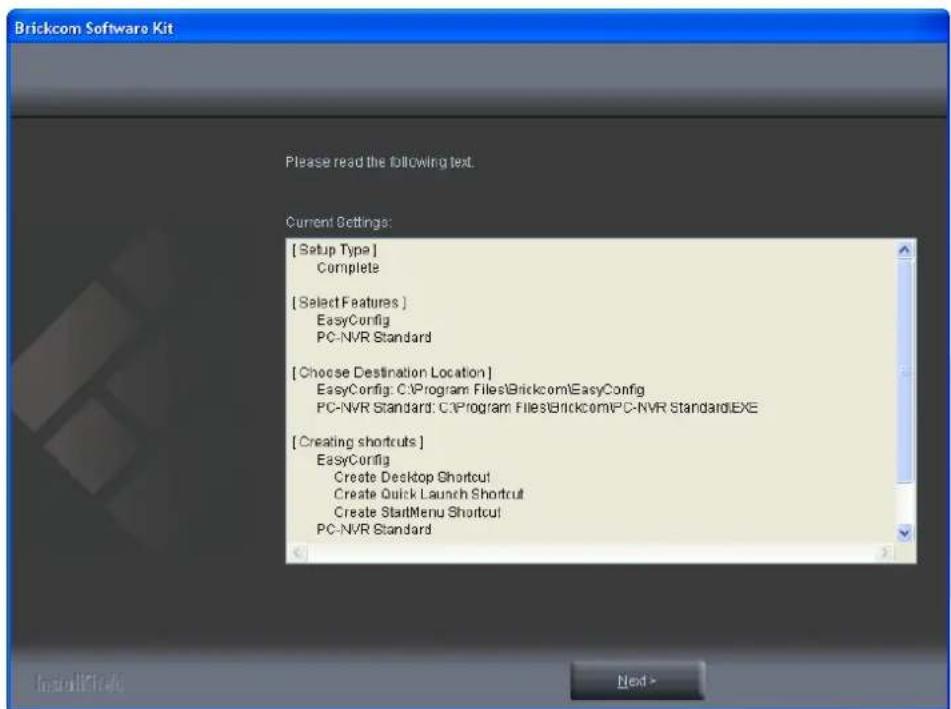
iv. The installation information will be displayed. Click
v. To launch EasyConfig or PC-NVR Standard, select the application and click
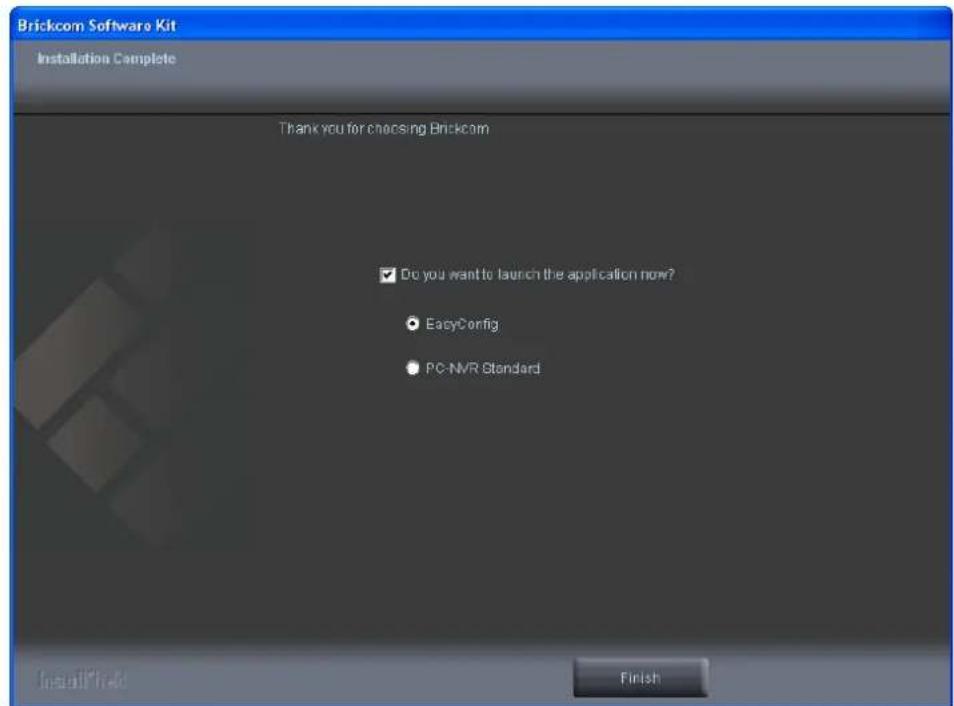
b. If CUSTOM SETUP is selected:
i. This option is recommended for advanced users. It can be used to install the system to a preferred directory or to select specific program feature(s).
ii. Check the option "Custom", and then click
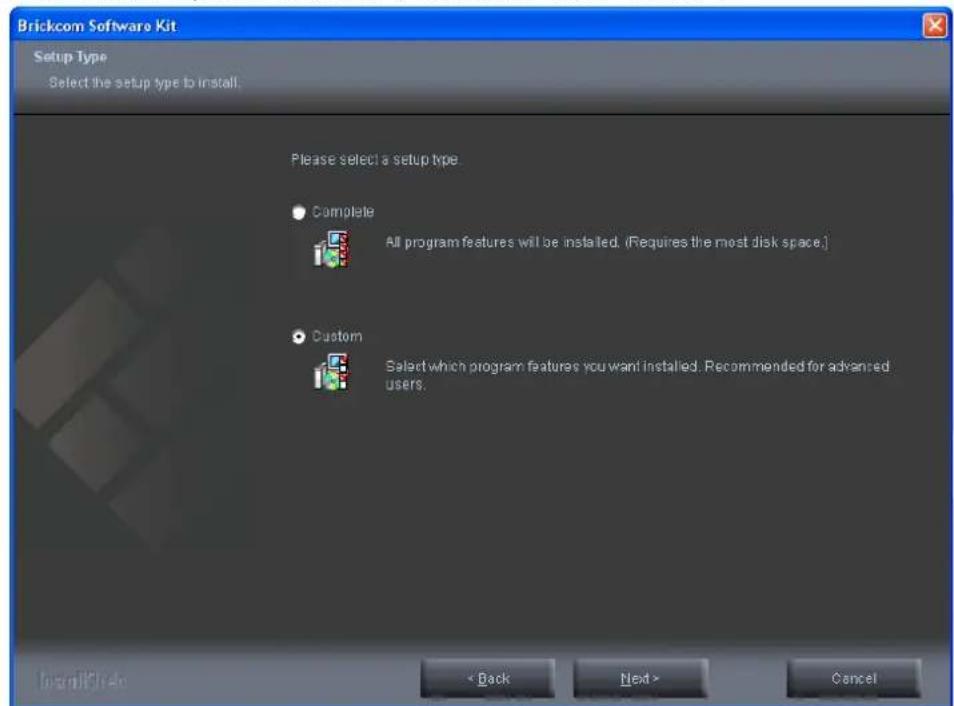
iii. Select the features to install. Click
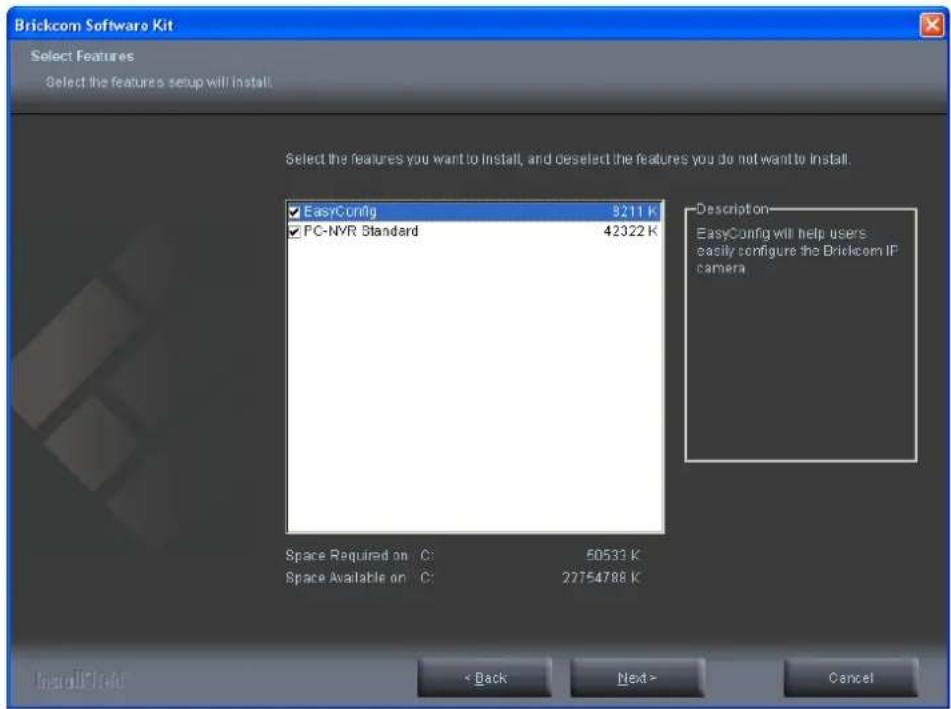
iv. Click
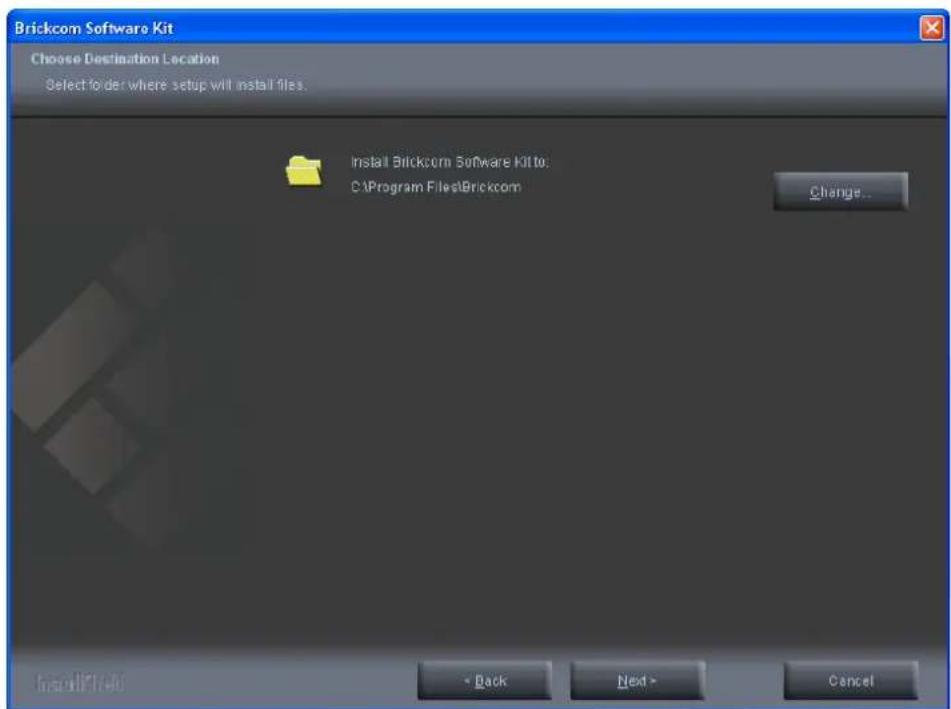
v. Select programs to create shortcuts. Click
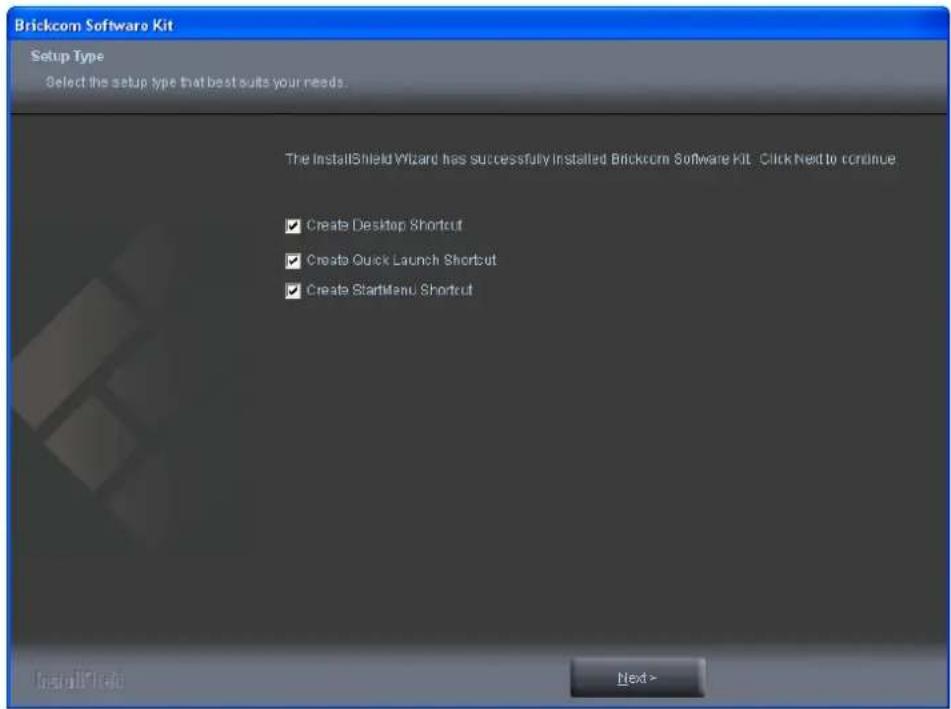
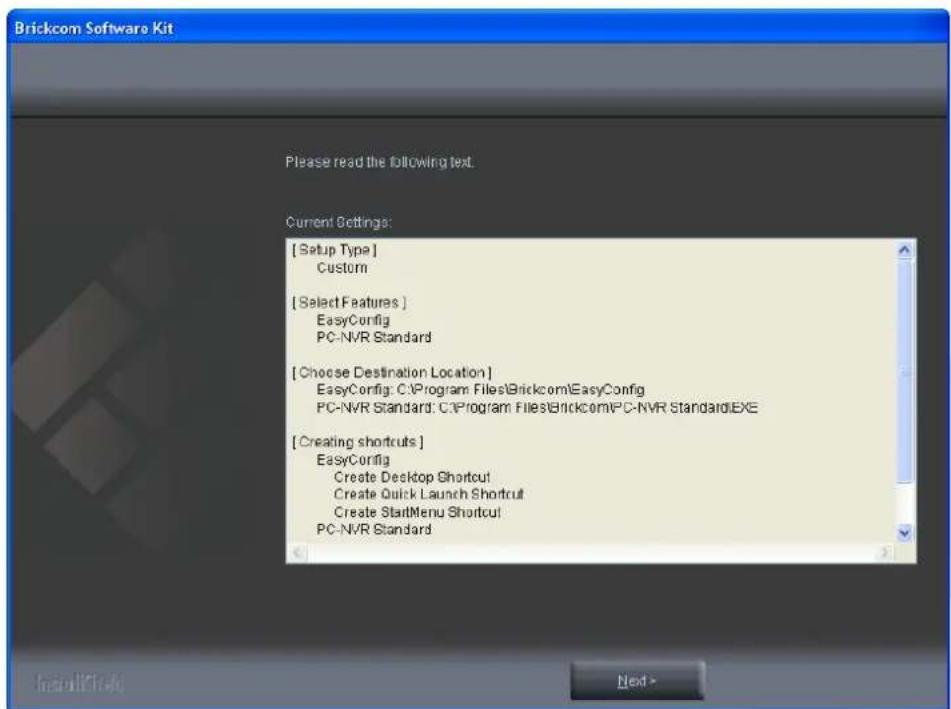
vi. The installation information will be displayed. Click
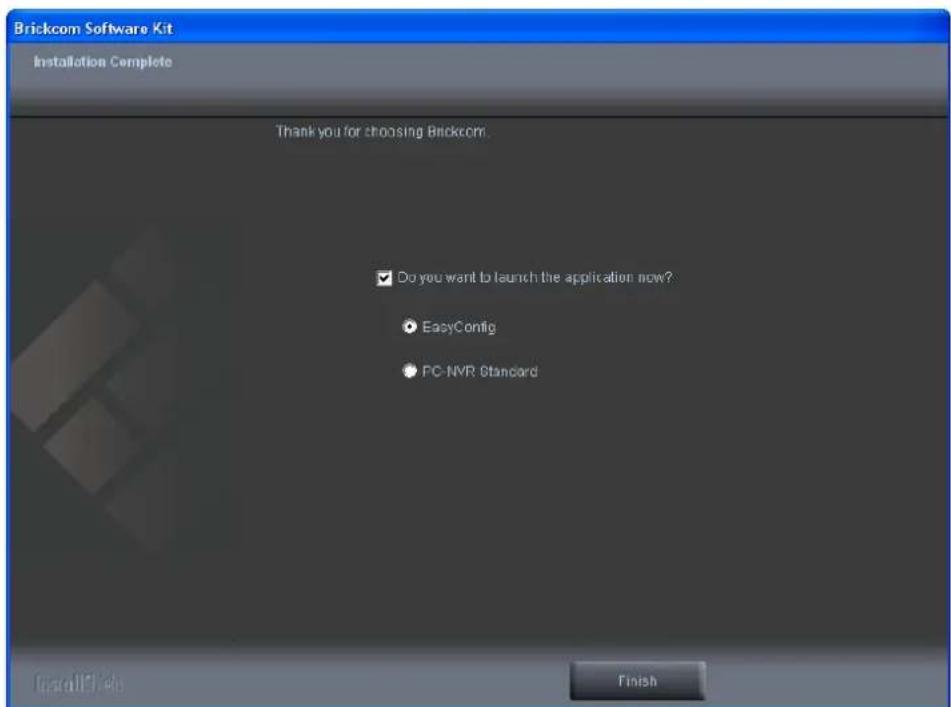
E. To launch EasyConfig or PC-NVR Standard, select the application and click
4.4.1 EasyConfig
To launch EasyConfig, select EasyConfig from the start menu. If Complete Setup type was used in the software installation, an EasyConfig icon was installed on the desktop. Double click to open the icon.
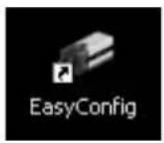
If Custom Setup type was used in the software installation and an EasyConfig icon was not installed on the desktop, the program will be installed under C:\Program Files\Brickcom\EasyConfig unless the program was saved to a preferred directory.
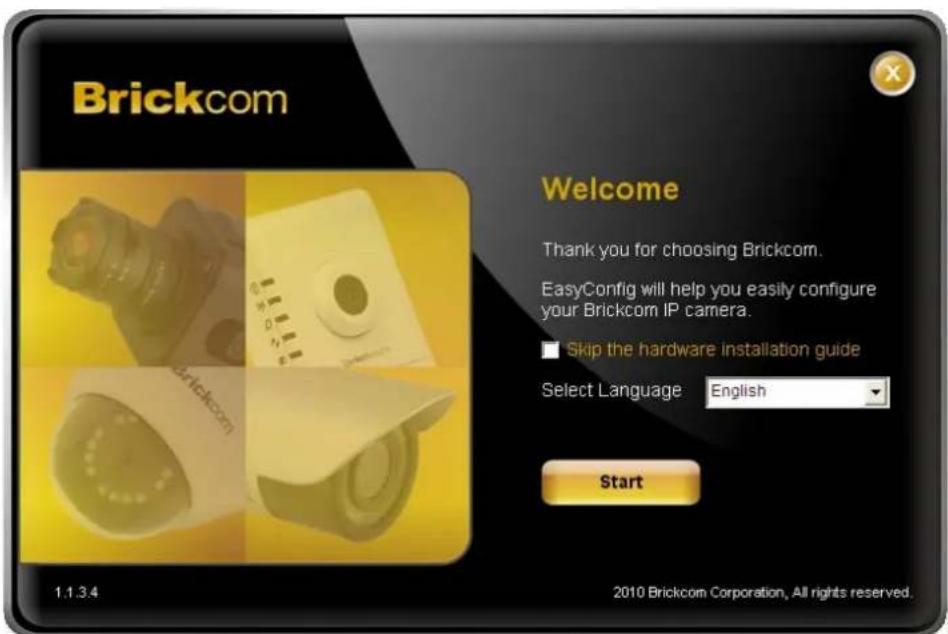
A. Click

NOTE - Check "Skip the hardware installation guide" to skip checking the hardware connection. To check the hardware installation settings, do not check the option box.
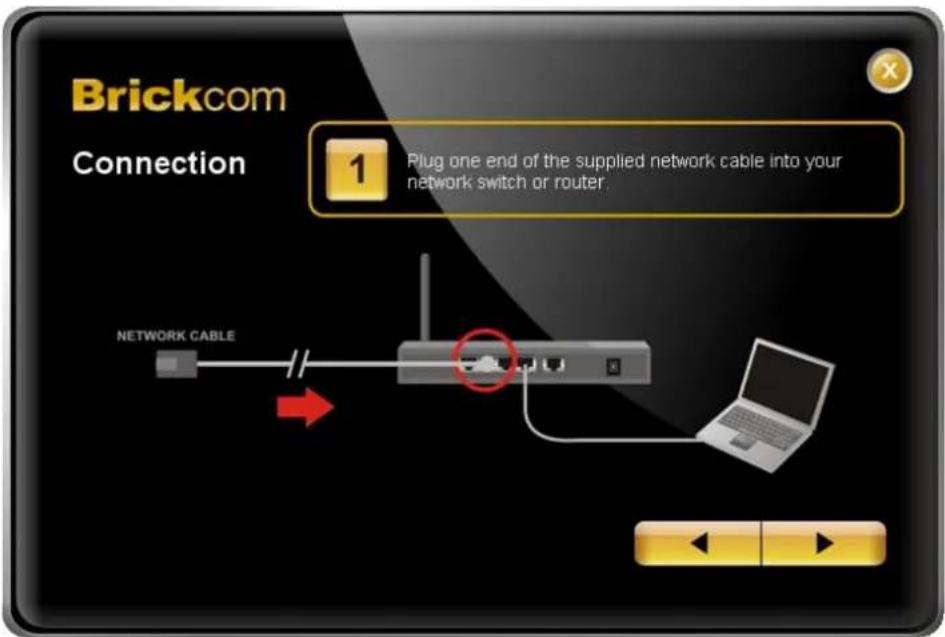
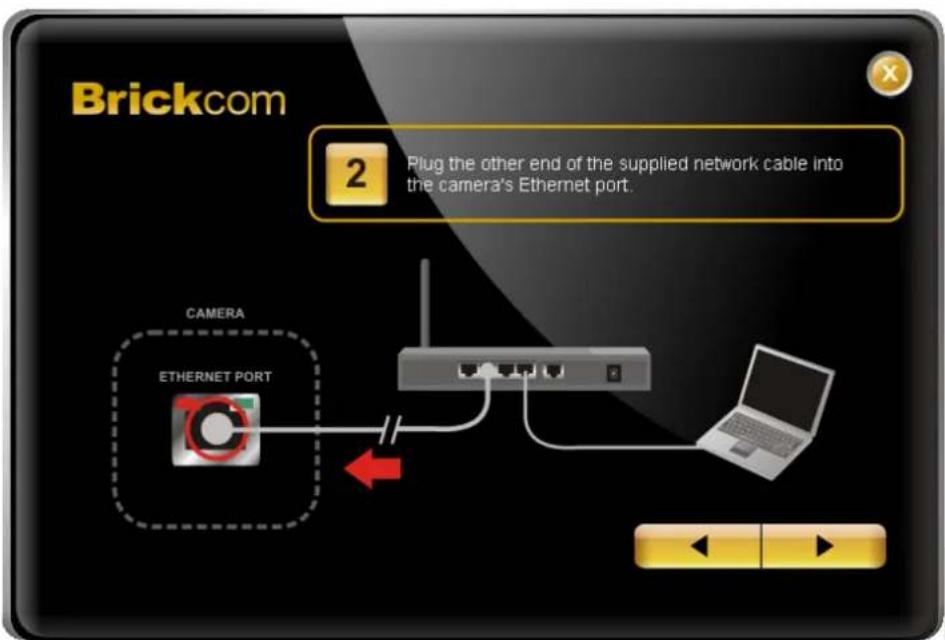
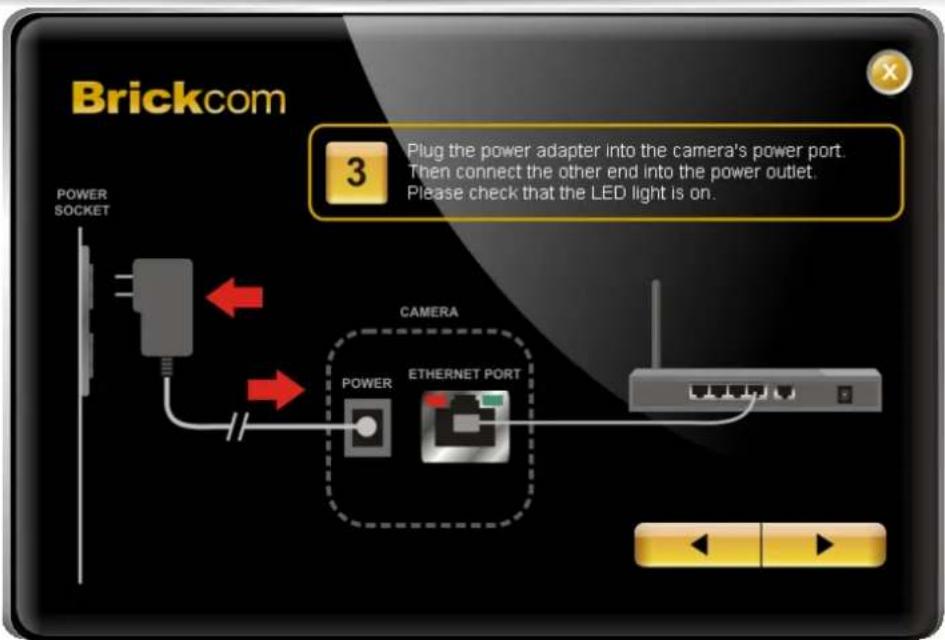
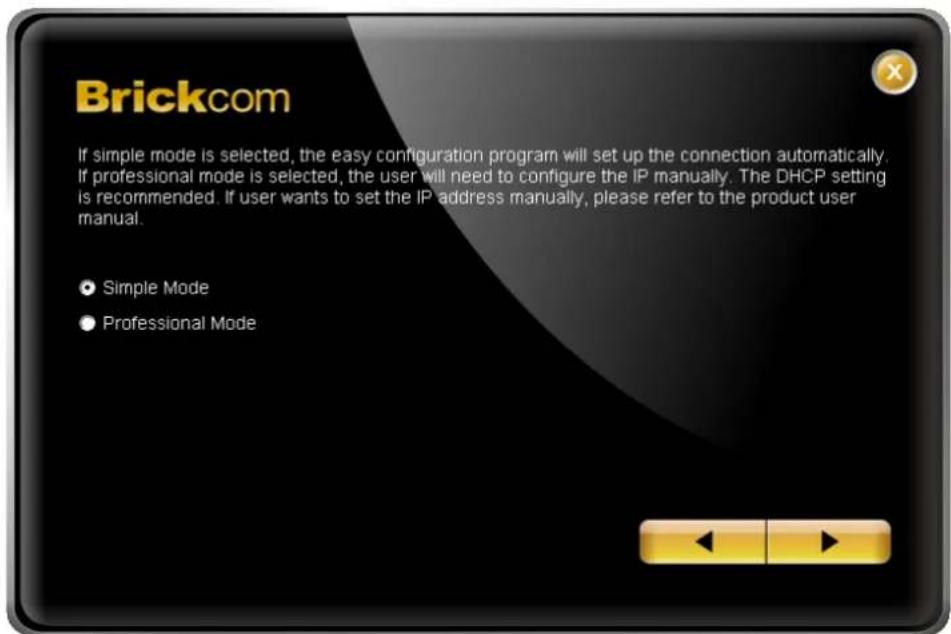
B. Select either "Simple Mode" or "Professional Mode" to obtain the camera's IP settings. If "Simple Mode" is selected, EasyConfig will set up the connection automatically. If "Professional Mode" is selected, the user will need to configure the IP settings manually.
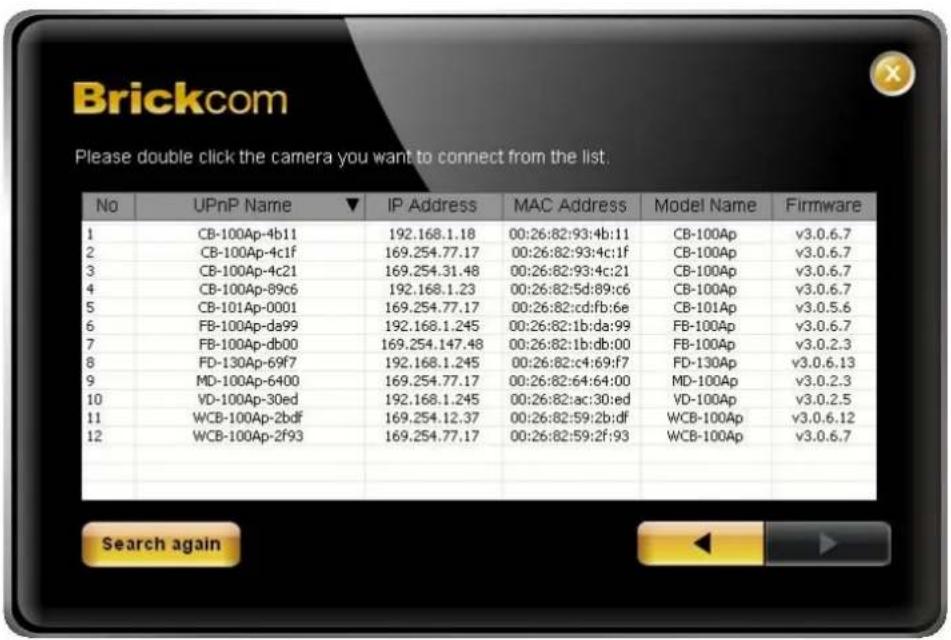
C. There may be many cameras in the local network. Differentiate the cameras using their UPnP name. Double click on the camera from the survey list to connect.
D. For configuring the IP address settings, select either
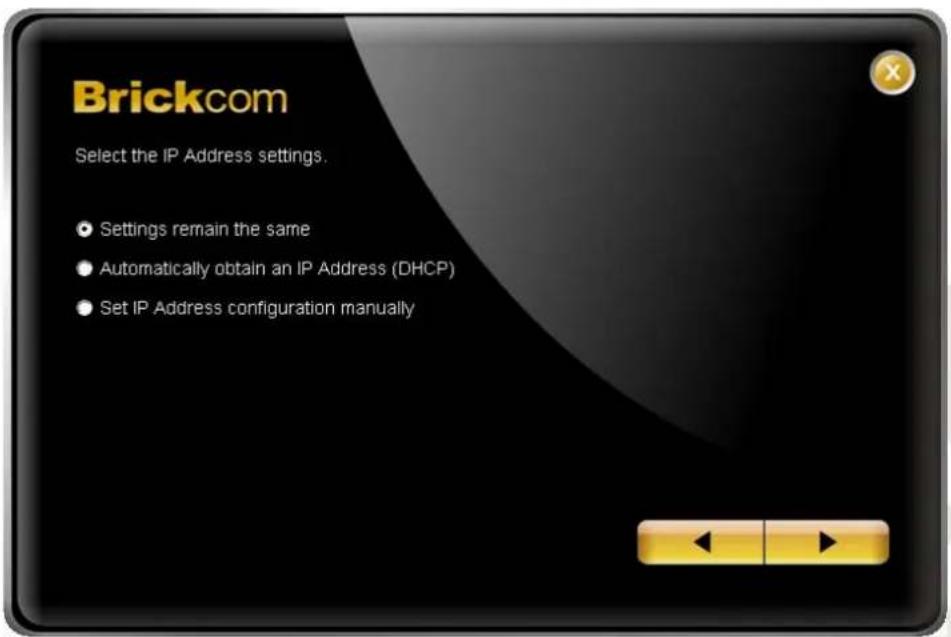
If
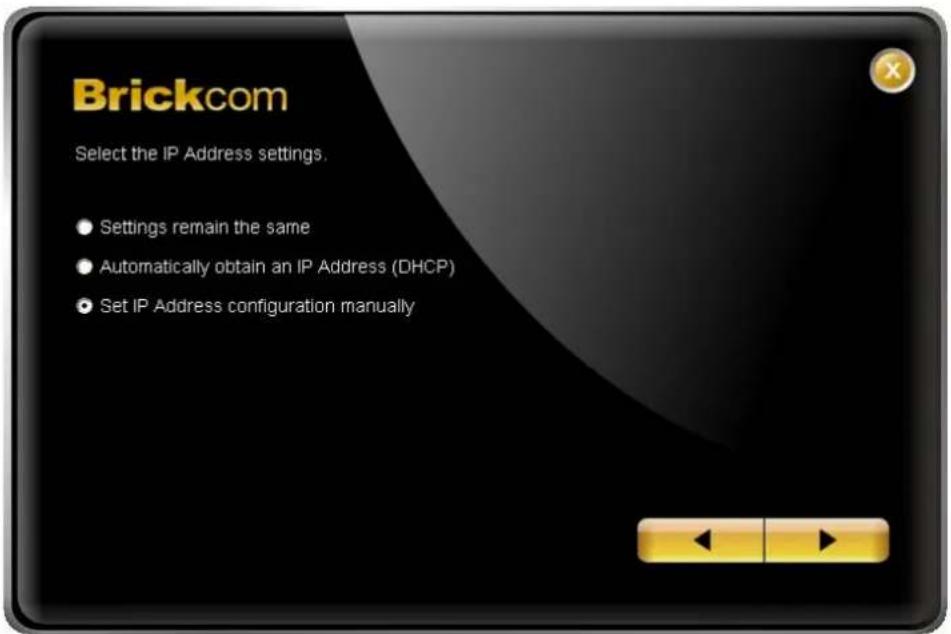
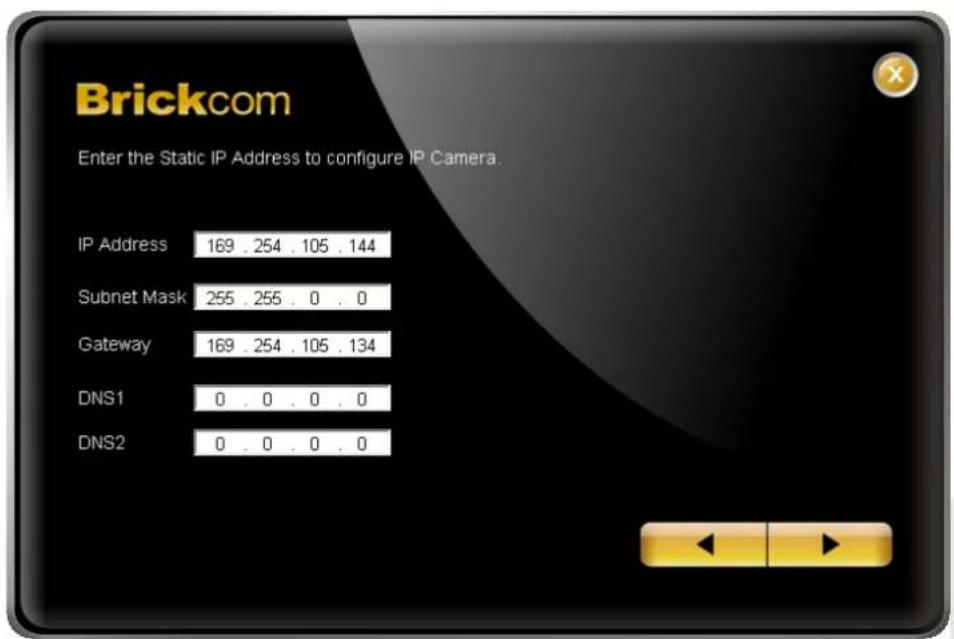
E. If the camera supports the EasyLinkTM function, the following page will be displayed. Otherwise, this page will not be shown. *If desired, click
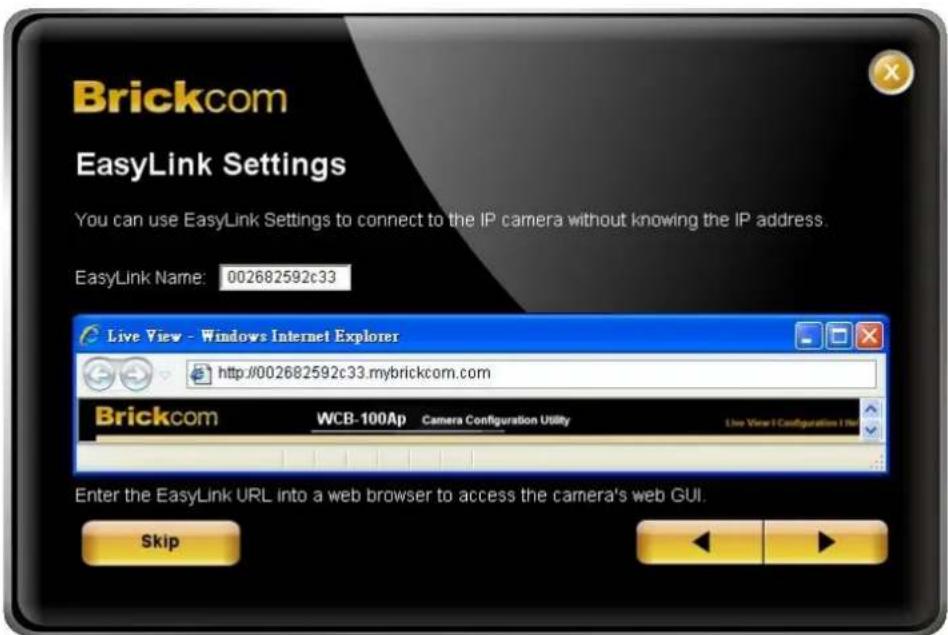
EasyLinkTM is a unique Brickcom function which allows users to assign a unique EasyLink name to their network camera's IP address. There is no need to configure the router to open up ports or remember hard-to-memorize IP addresses. Users can log onto [uniqueEasyLinkname].mybrickcom.com to view the camera's web GUI and live view.
a. Enter a unique EasyLink name whose length must be between 5-32 characters.
b. When finished, click the arrow button to continue.
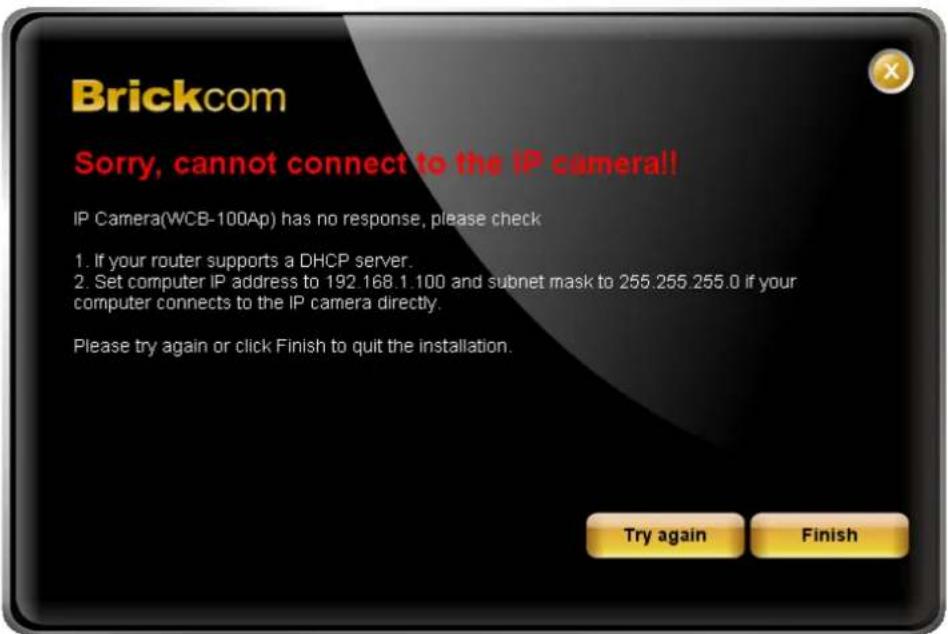
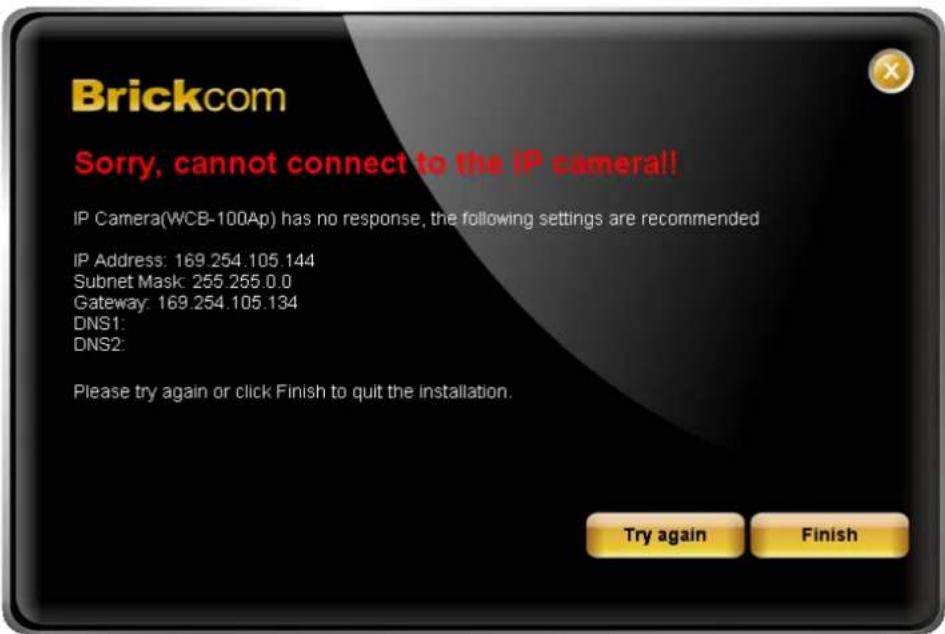
F. When the IP address settings have been configured, the screen will either display a successful or failed connection message. If the connection failed, either try again or quit the installation.
a. If "DHCP IP address settings" was selected, the failure page will be displayed as below:
b. If "Static IP address settings" was selected, the failure page will be displayed as below:
c. If the connection was successful, the user will see the message: "Congratulations. The installation of the camera is complete."
When this window is displayed, click
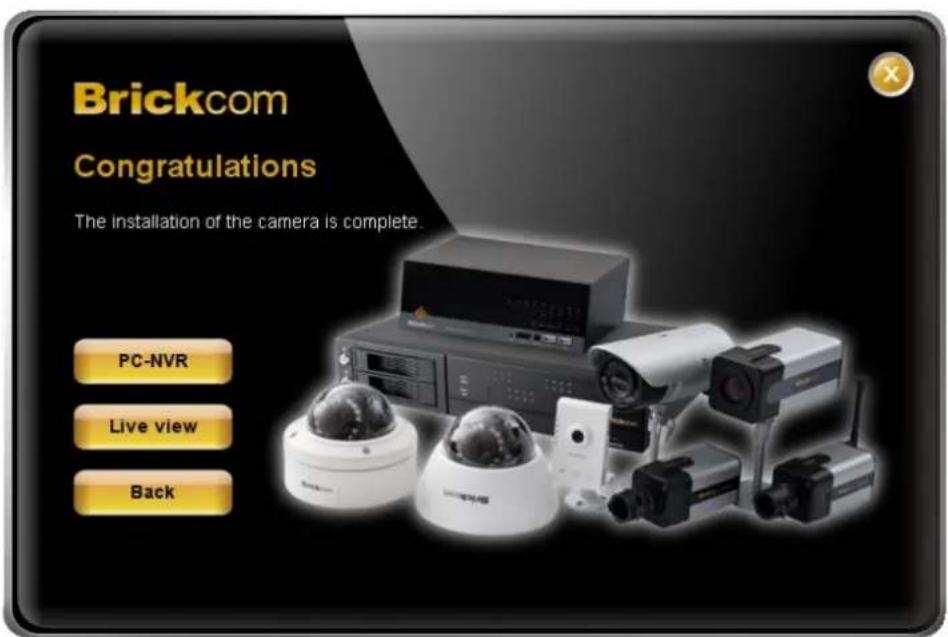
Once installation is complete, the Administrator should proceed to the next section "Accessing the Network Camera" for necessary changes and configurations.